
Spanish I Unidad 1 Leccin 1 Gramtica Subjects
Spanish I Unidad 1, Lección 1 Gramática

Subjects and verbs Subject • person or thing doing the action or is being described Verb • the action word, like jump or sing, or a linking word like are or is, that links the subject to a description
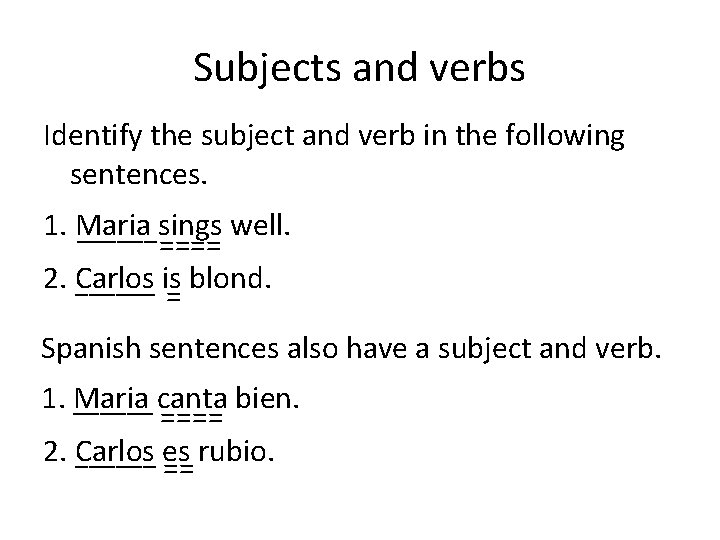
Subjects and verbs Identify the subject and verb in the following sentences. 1. Maria ______ sings well. ==== 2. Carlos ______ is blond. = Spanish sentences also have a subject and verb. 1. Maria ______ canta bien. ==== 2. Carlos ______ es rubio. ==
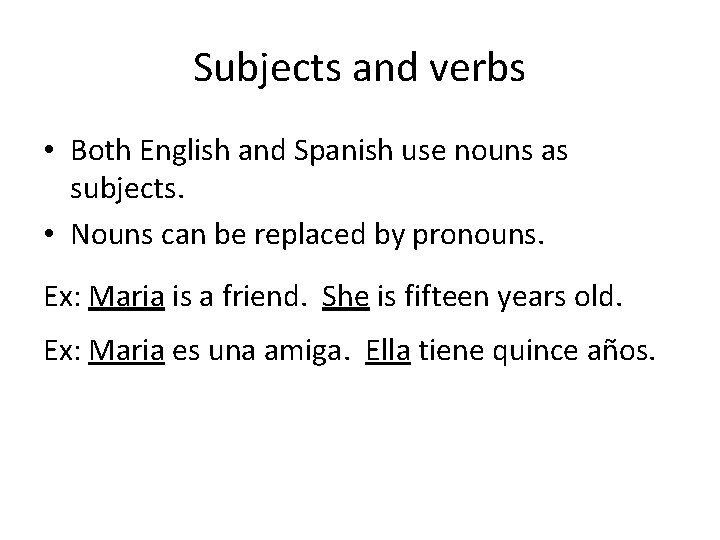
Subjects and verbs • Both English and Spanish use nouns as subjects. • Nouns can be replaced by pronouns. Ex: Maria is a friend. She is fifteen years old. Ex: Maria es una amiga. Ella tiene quince años.
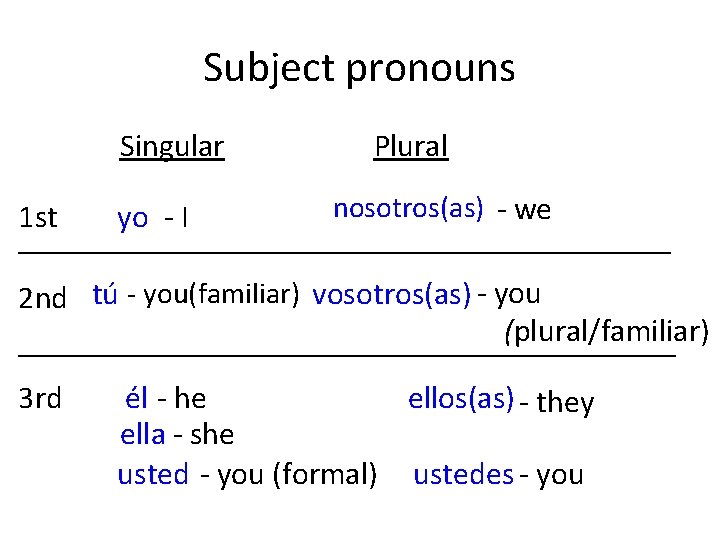
Subject pronouns Singular Plural nosotros(as) - we 1 st yo - I _____________________ 2 nd tú - you(familiar) vosotros(as) - you (plural/familiar) ______________________ 3 rd él - he ellos(as) - they ella - she usted - you (formal) ustedes - you
Singular subject pronouns Use tú with • a friend • a family member • someone your age or younger Use usted with • addressing an adult, like your teacher • talking to someone you do not know • someone to whom you want to show respect
Plural subject pronouns Use vosotros(as) with • friends, family, and younger people only in Spain. Use ustedes with • people you do not know, older people, and people for whom you want to show respect in Spain. • any group of people in Latin America. Use nosotras, vosotras, and ellas with • groups of females
Verbs • In order to use a verb in a sentence, it must change forms to agree with the subject. We call this conjugating a verb. • In its simplest form, a verb is in the infinitive form. In English, an infinitive is a verb with the word “to” in front of it. Ex: to eat, to run, to walk, to talk, to write, to speak, to listen, to watch, etc.
Verbs • In Spanish, infinitives will either end in –ar, –er, or –ir. • Verbs can either be regular (meaning they follow a pattern) or irregular (meaning they do not follow a pattern).
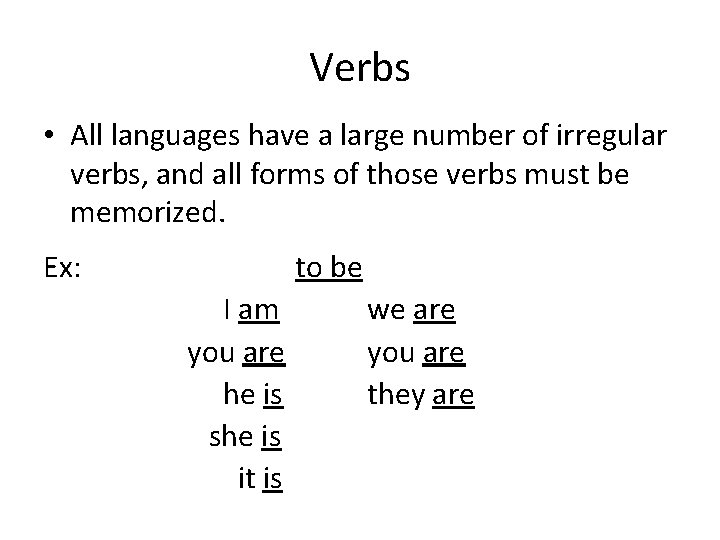
Verbs • All languages have a large number of irregular verbs, and all forms of those verbs must be memorized. Ex: to be I am you are he is she is it is we are you are they are
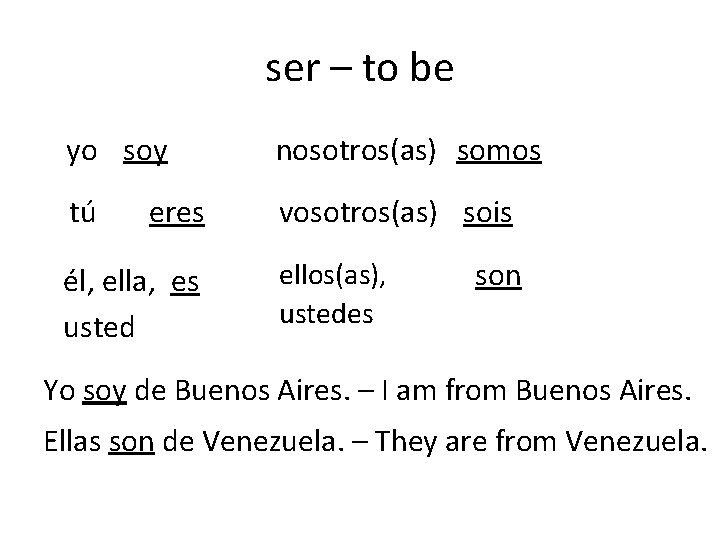
ser – to be yo soy nosotros(as) somos tú vosotros(as) sois eres él, ella, es usted ellos(as), ustedes son Yo soy de Buenos Aires. – I am from Buenos Aires. Ellas son de Venezuela. – They are from Venezuela.
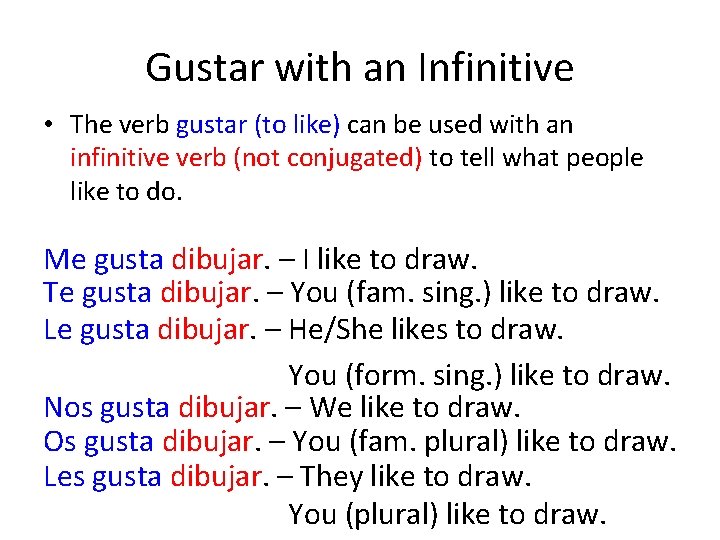
Gustar with an Infinitive • The verb gustar (to like) can be used with an infinitive verb (not conjugated) to tell what people like to do. Me gusta dibujar. – I like to draw. Te gusta dibujar. – You (fam. sing. ) like to draw. Le gusta dibujar. – He/She likes to draw. You (form. sing. ) like to draw. Nos gusta dibujar. – We like to draw. Os gusta dibujar. – You (fam. plural) like to draw. Les gusta dibujar. – They like to draw. You (plural) like to draw.
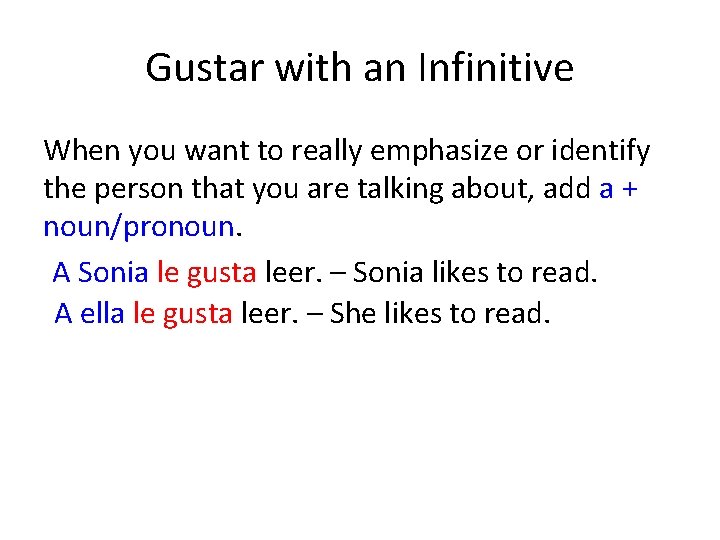
Gustar with an Infinitive When you want to really emphasize or identify the person that you are talking about, add a + noun/pronoun. A Sonia le gusta leer. – Sonia likes to read. A ella le gusta leer. – She likes to read.
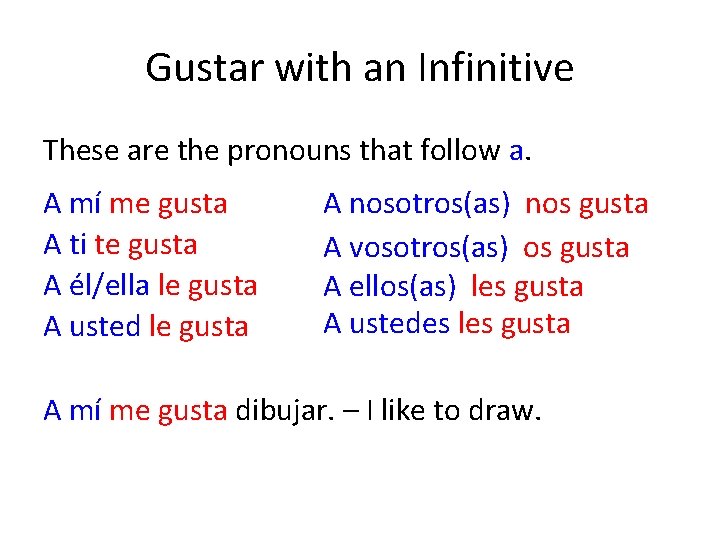
Gustar with an Infinitive These are the pronouns that follow a. A mí me gusta A ti te gusta A él/ella le gusta A usted le gusta A nosotros(as) nos gusta A vosotros(as) os gusta A ellos(as) les gusta A ustedes les gusta A mí me gusta dibujar. – I like to draw.
- Slides: 14