
SPANISH AMERICAN WAR AND IMPERIALISM MONROE DOCTRINE President




- Slides: 57
SPANISH AMERICAN WAR AND IMPERIALISM
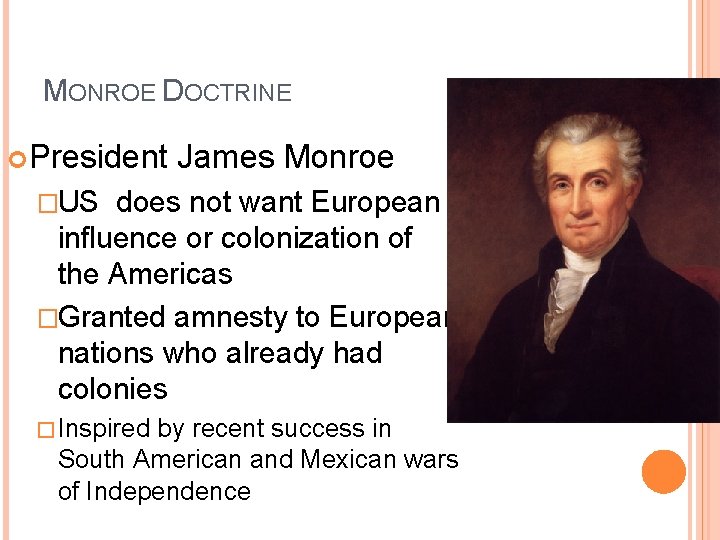
MONROE DOCTRINE President James Monroe �US does not want European influence or colonization of the Americas �Granted amnesty to European nations who already had colonies �Inspired by recent success in South American and Mexican wars of Independence
DISCUSS Why did the US feel a need to pass this doctrine?
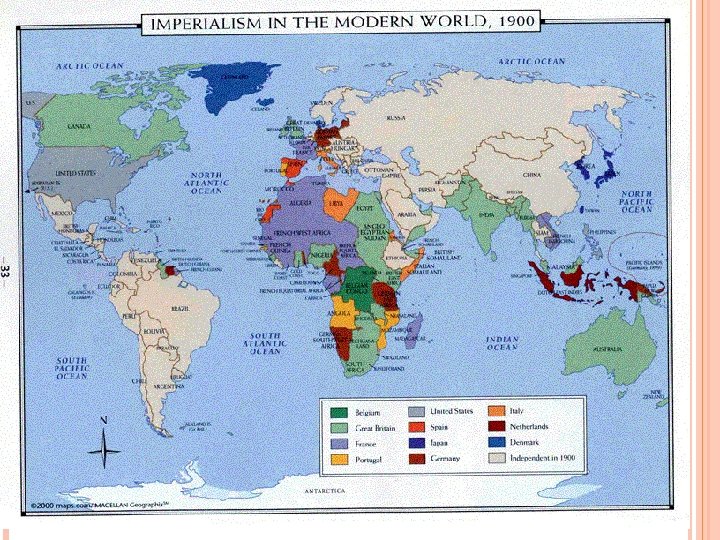
http: //www. iranreview. org/file/cms/files/imp erialism 1900. gif
WHITE BOARD What nation seems to have the most territory?
WHY IMPERIALISM 3 REASONS Economic: Desire for new markets and raw materials 1) 2) Military: Desire for naval bases and coaling stations 3) Ideology: Desire to bring Christianity, western culture, and democracy to other people. �Idea that European were superior and had to “civilize” the world
U. S. SCRAMBLE FOR TERRITORY • • The United States entered the imperialist competition later than the European powers U. S. begins imperialist policies with Hawaii
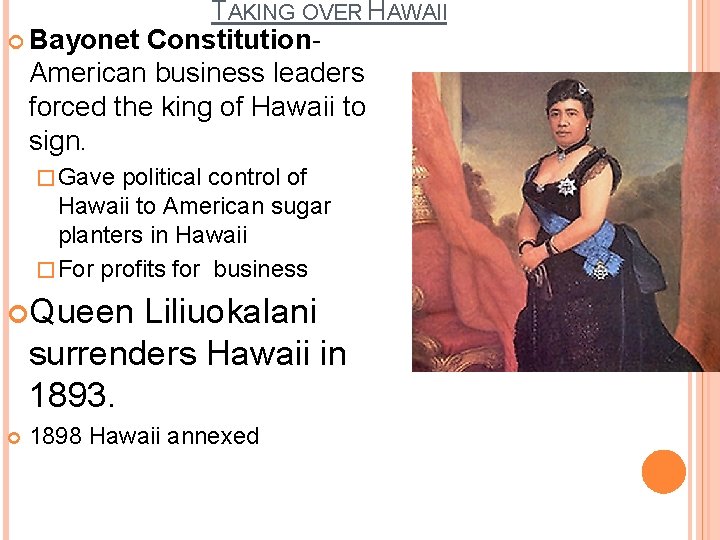
TAKING OVER HAWAII Bayonet Constitution- American business leaders forced the king of Hawaii to sign. � Gave political control of Hawaii to American sugar planters in Hawaii � For profits for business Queen Liliuokalani surrenders Hawaii in 1893. 1898 Hawaii annexed
WHITE BOARD Which of the reasons for Imperialism pushed the US to want Hawaii? Discuss your answer
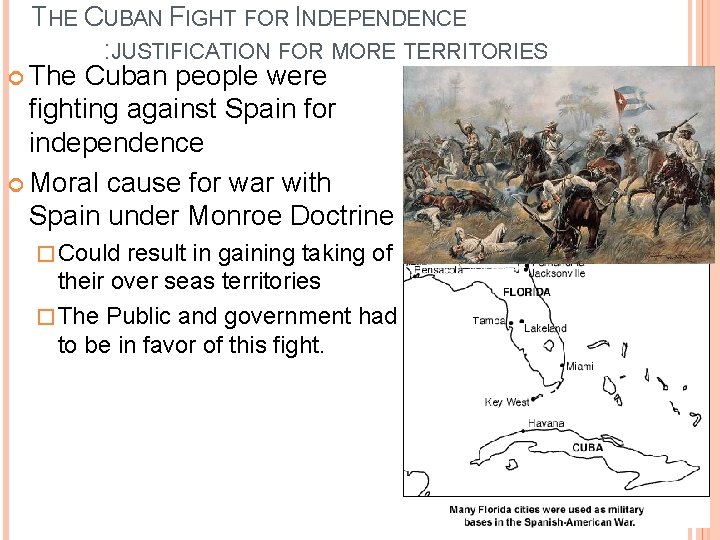
THE CUBAN FIGHT FOR INDEPENDENCE : JUSTIFICATION FOR MORE TERRITORIES The Cuban people were fighting against Spain for independence Moral cause for war with Spain under Monroe Doctrine � Could result in gaining taking of their over seas territories � The Public and government had to be in favor of this fight.
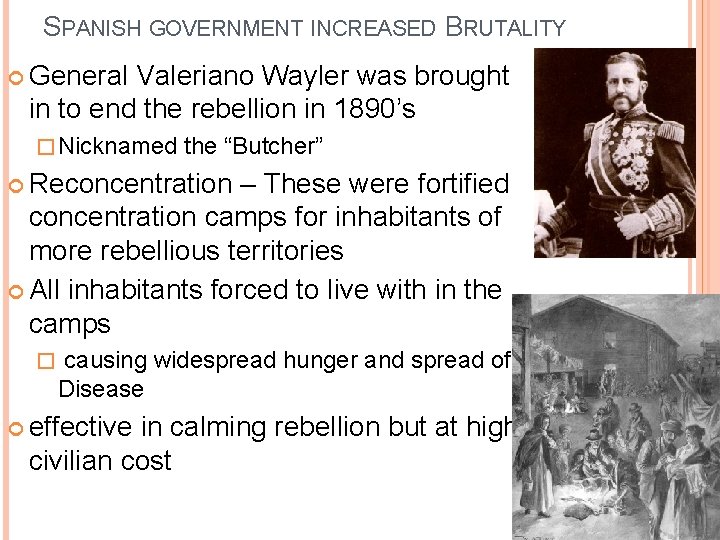
SPANISH GOVERNMENT INCREASED BRUTALITY General Valeriano Wayler was brought in to end the rebellion in 1890’s � Nicknamed the “Butcher” Reconcentration – These were fortified concentration camps for inhabitants of more rebellious territories All inhabitants forced to live with in the camps � causing widespread hunger and spread of Disease effective in calming rebellion but at high civilian cost
WHITE BOARD How do we get info from other nations?
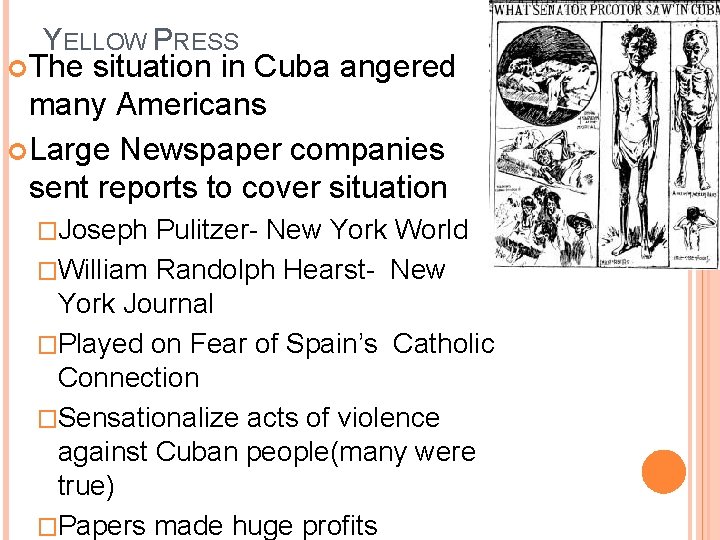
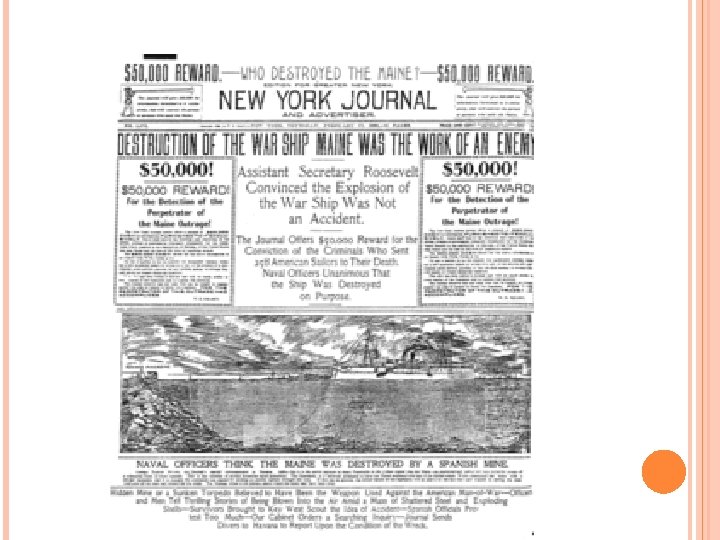
YELLOW PRESS The situation in Cuba angered many Americans Large Newspaper companies sent reports to cover situation �Joseph Pulitzer- New York World �William Randolph Hearst- New York Journal �Played on Fear of Spain’s Catholic Connection �Sensationalize acts of violence against Cuban people(many were true) �Papers made huge profits
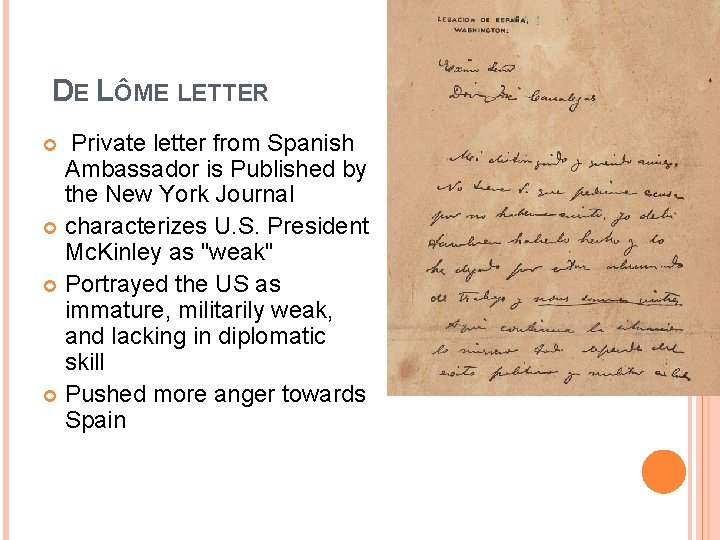
DE LÔME LETTER Private letter from Spanish Ambassador is Published by the New York Journal characterizes U. S. President Mc. Kinley as "weak" Portrayed the US as immature, militarily weak, and lacking in diplomatic skill Pushed more anger towards Spain
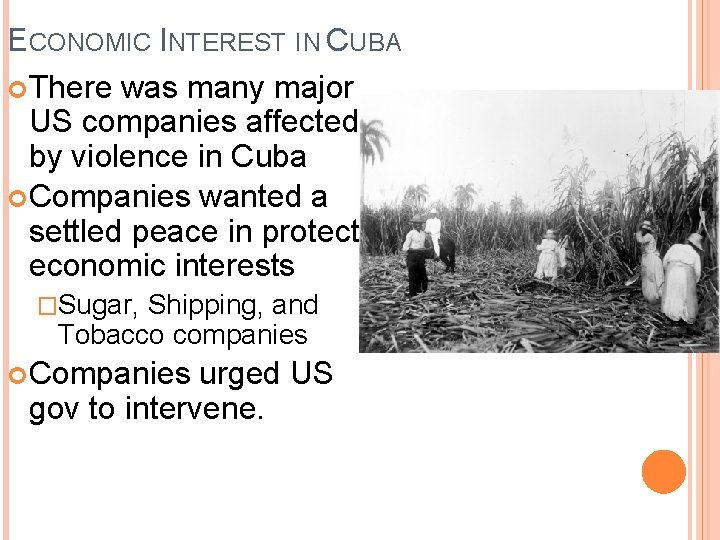
ECONOMIC INTEREST IN CUBA There was many major US companies affected by violence in Cuba Companies wanted a settled peace in protect economic interests �Sugar, Shipping, and Tobacco companies Companies urged US gov to intervene.
WHITE BOARD What type of event would push the US to go to war with Spain?
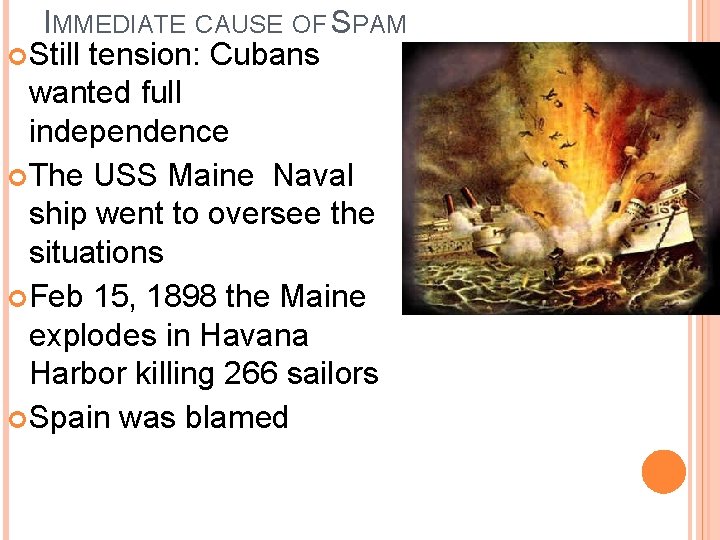
IMMEDIATE CAUSE OF SPAM Still tension: Cubans wanted full independence The USS Maine Naval ship went to oversee the situations Feb 15, 1898 the Maine explodes in Havana Harbor killing 266 sailors Spain was blamed
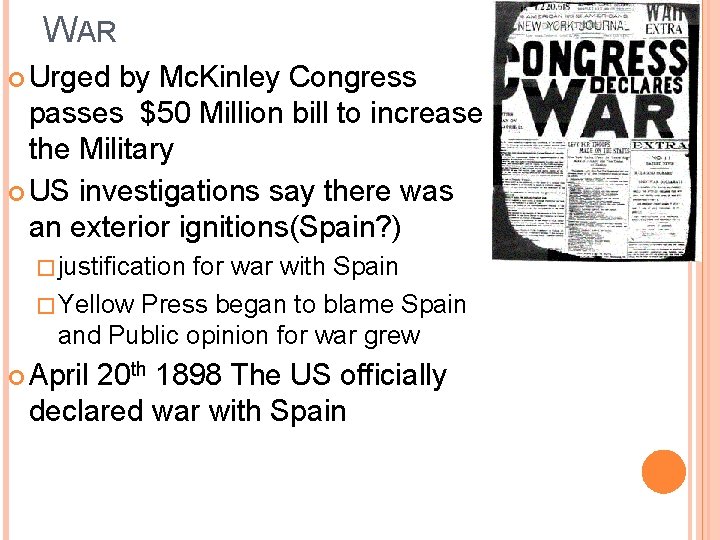
WAR Urged by Mc. Kinley Congress passes $50 Million bill to increase the Military US investigations say there was an exterior ignitions(Spain? ) �justification for war with Spain �Yellow Press began to blame Spain and Public opinion for war grew April 20 th 1898 The US officially declared war with Spain
IMPORTANT DATES: OF THE WAR May 1, 1898: U. S. defeat the Spanish fleet at Manila Bay in the Philippines. July 1, 1898: U. S. forces defeat the Spanish at the Battle of San Juan Heights. July 17, 1898: The Spanish surrender at Santiago. August 12, 1898: Cease fire between US and Spain December 10, 1898: The Treaty of Paris is signed by U. S. and Spain. February 6, 1899. Treaty is ratified U. S. acquires control over Cuba, Puerto Rico, Guam and the Philippines
II IMPACT OF THE WAR AND BIG STICK DIPLOMACY
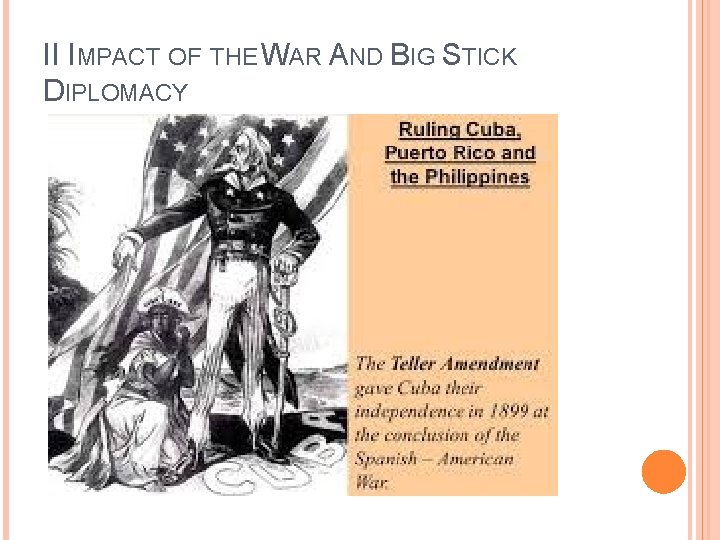
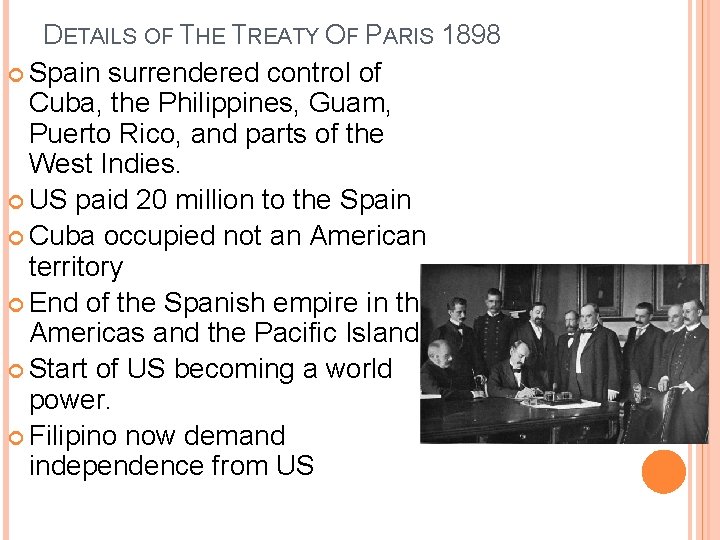
DETAILS OF THE TREATY OF PARIS 1898 Spain surrendered control of Cuba, the Philippines, Guam, Puerto Rico, and parts of the West Indies. US paid 20 million to the Spain Cuba occupied not an American territory End of the Spanish empire in the Americas and the Pacific Islands Start of US becoming a world power. Filipino now demand independence from US
DISCUSS Positives for the US in the treaty and drawbacks
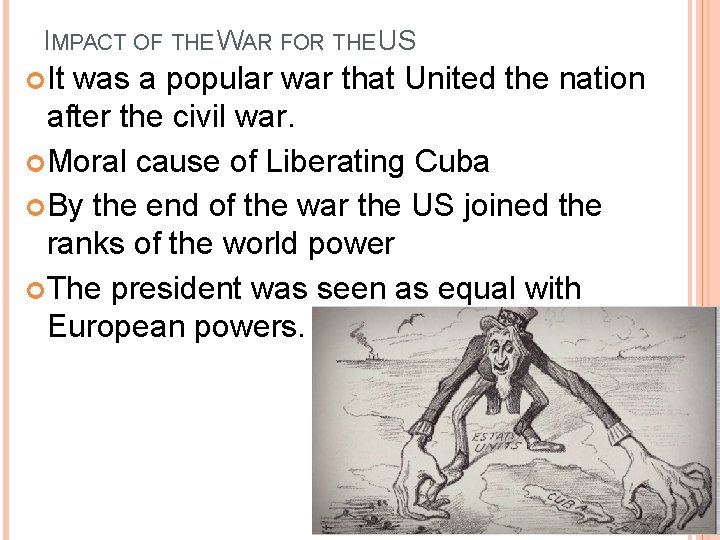
IMPACT OF THE WAR FOR THE US It was a popular war that United the nation after the civil war. Moral cause of Liberating Cuba By the end of the war the US joined the ranks of the world power The president was seen as equal with European powers.
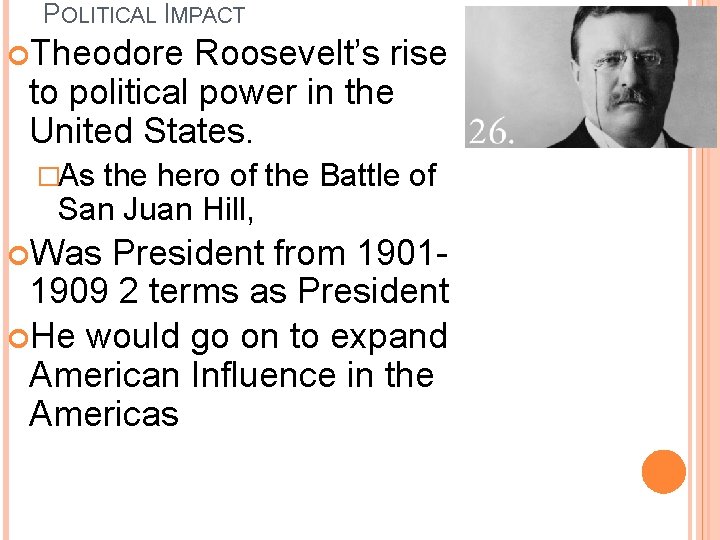
POLITICAL IMPACT Theodore Roosevelt’s rise to political power in the United States. �As the hero of the Battle of San Juan Hill, Was President from 1901 - 1909 2 terms as President He would go on to expand American Influence in the Americas
WHITE BOARD List other Presidents that had a military history that helped them gain power.
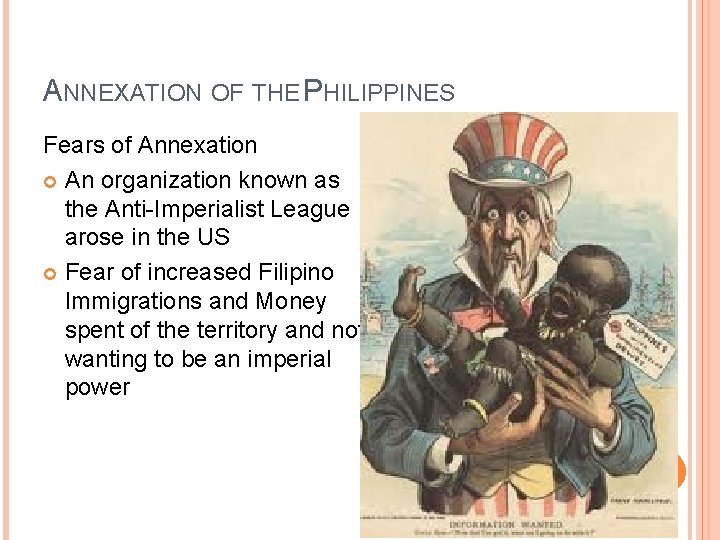
ANNEXATION OF THE PHILIPPINES Fears of Annexation An organization known as the Anti-Imperialist League arose in the US Fear of increased Filipino Immigrations and Money spent of the territory and not wanting to be an imperial power
WHITE BOARD List territories that were gained and which was the only independent one.
THE TREATY OF PARIS WAS PASSED BY TWOTHIRDS OF THE SENATE IN 1899 Reasons for Passage and Territories Benefits of trade, natural resources, and Military outpost near Asia. suggested that the sooner the US annexed the Philippines, Guam, and Puerto Rico, the sooner the US could prepare them for independence.
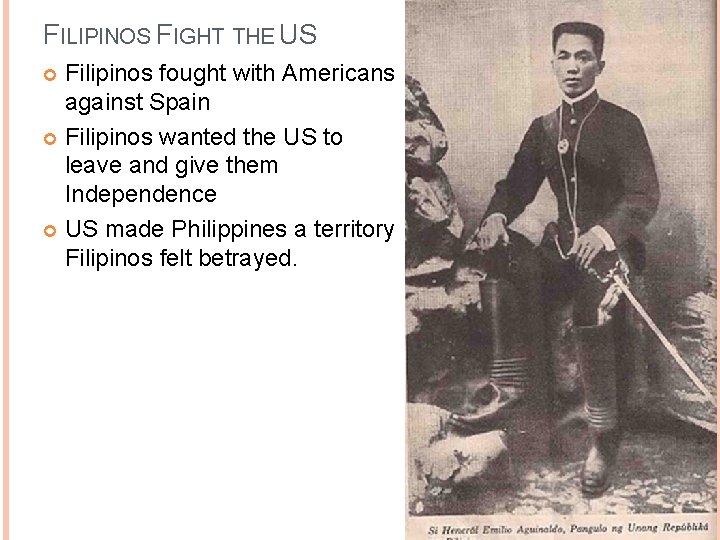
FILIPINOS FIGHT THE US Filipinos fought with Americans against Spain Filipinos wanted the US to leave and give them Independence US made Philippines a territory Filipinos felt betrayed.
FILIPINOS CLAIM INDEPEDENCE On Jan 23, 1899, the Filipinos proclaimed an independent republic and elected long-time nationalist Emilio Aguinaldo president. US fought Aguinaldo to control the Islands
WHAT IS THIS CARTOON SAYING?
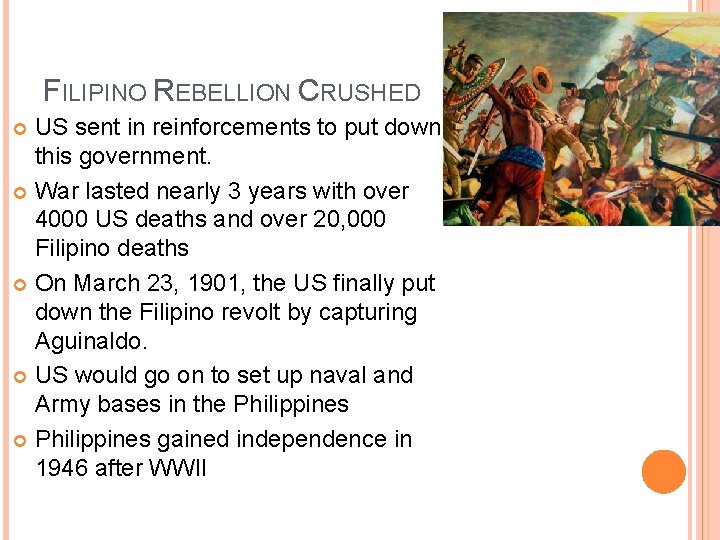
FILIPINO REBELLION CRUSHED US sent in reinforcements to put down this government. War lasted nearly 3 years with over 4000 US deaths and over 20, 000 Filipino deaths On March 23, 1901, the US finally put down the Filipino revolt by capturing Aguinaldo. US would go on to set up naval and Army bases in the Philippines gained independence in 1946 after WWII
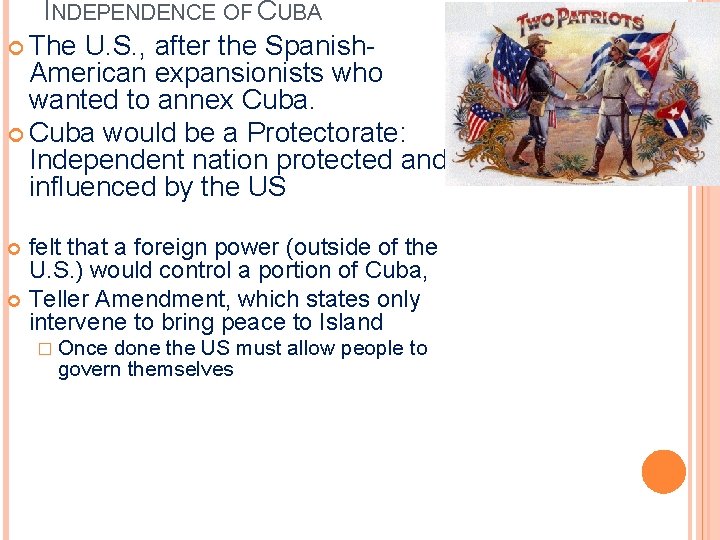
INDEPENDENCE OF CUBA The U. S. , after the Spanish. American expansionists who wanted to annex Cuba would be a Protectorate: Independent nation protected and influenced by the US felt that a foreign power (outside of the U. S. ) would control a portion of Cuba, Teller Amendment, which states only intervene to bring peace to Island � Once done the US must allow people to govern themselves
DISCUSS Why do you feel the US made the Cuba a protectorate and not the Philippines?
PLATT AMENDMENT 1901 Cuba pledged herself not to incur an indebtedness beyond her means The United States was at liberty to intervene for the purpose of preserving order and maintaining Cuban independence. Cuba would agree to an Americansponsored sanitation Cuba would agree to sell or lease to the United States sites for naval or coaling stations [Guantánamo became the principal base]. By 1903 US Troops would leave mainland Cuba
DISCUSS “Speak softly and carry a big stick” what does this quote mean?
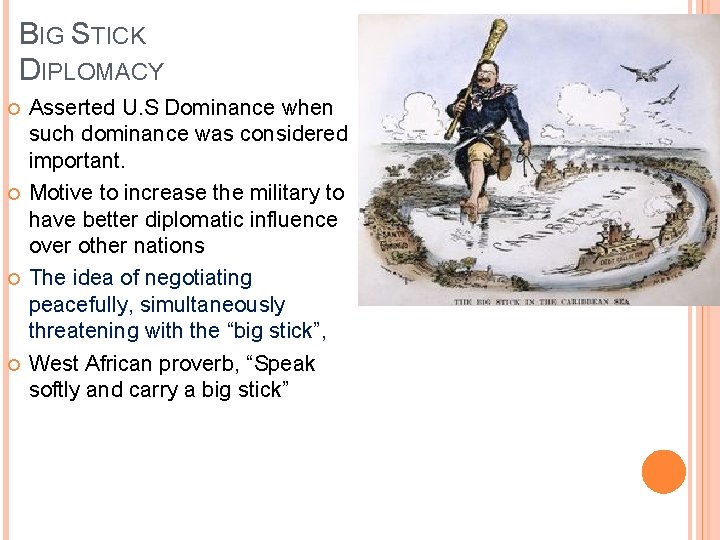
BIG STICK DIPLOMACY Asserted U. S Dominance when such dominance was considered important. Motive to increase the military to have better diplomatic influence over other nations The idea of negotiating peacefully, simultaneously threatening with the “big stick”, West African proverb, “Speak softly and carry a big stick”
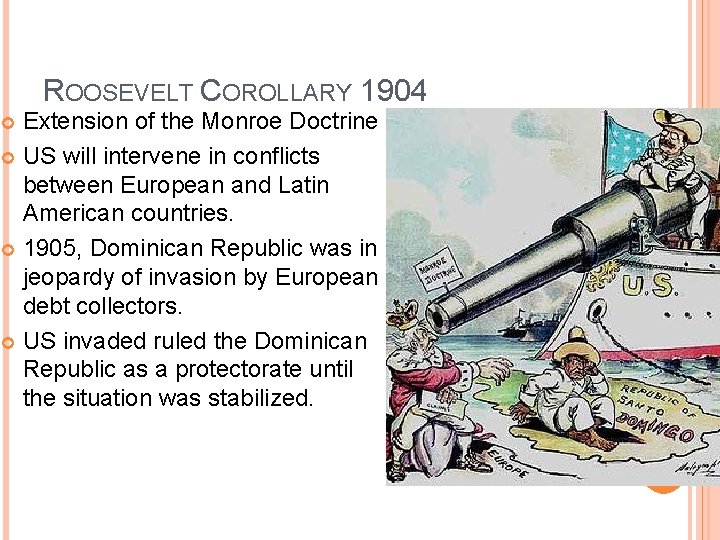
ROOSEVELT COROLLARY 1904 Extension of the Monroe Doctrine US will intervene in conflicts between European and Latin American countries. 1905, Dominican Republic was in jeopardy of invasion by European debt collectors. US invaded ruled the Dominican Republic as a protectorate until the situation was stabilized.
DISCUSS How was the Dominican Republic Issues an example of Big Stick Diplomacy
PART III Continuation of US intervention in Latin America
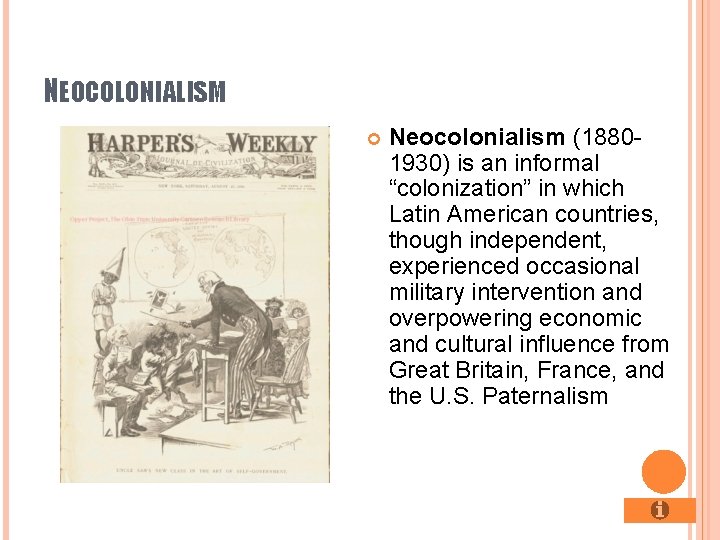
NEOCOLONIALISM Neocolonialism (18801930) is an informal “colonization” in which Latin American countries, though independent, experienced occasional military intervention and overpowering economic and cultural influence from Great Britain, France, and the U. S. Paternalism
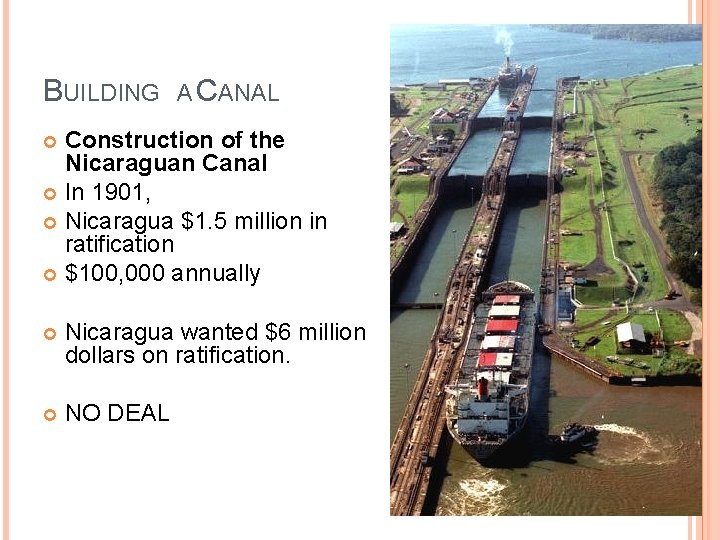
BUILDING A CANAL Construction of the Nicaraguan Canal In 1901, Nicaragua $1. 5 million in ratification $100, 000 annually Nicaragua wanted $6 million dollars on ratification. NO DEAL
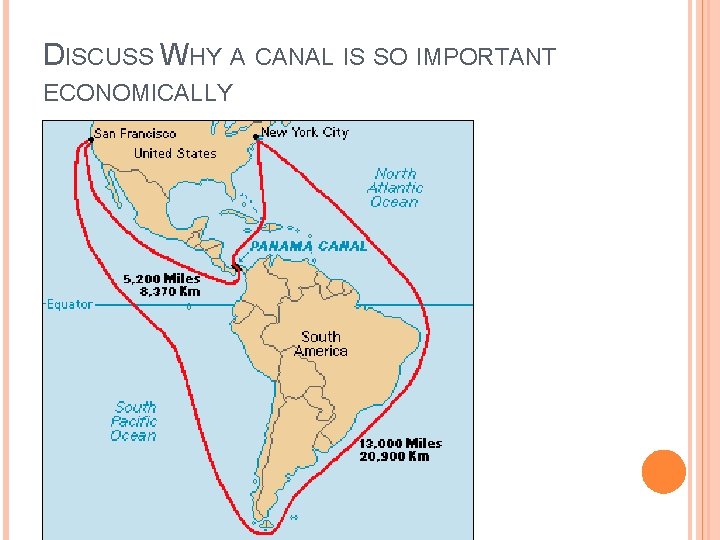
DISCUSS WHY A CANAL IS SO IMPORTANT ECONOMICALLY
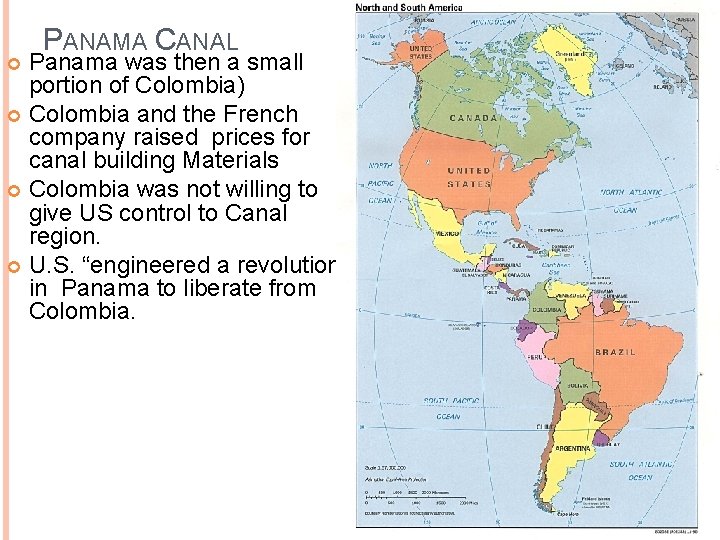
PANAMA CANAL Panama was then a small portion of Colombia) Colombia and the French company raised prices for canal building Materials Colombia was not willing to give US control to Canal region. U. S. “engineered a revolution” in Panama to liberate from Colombia.
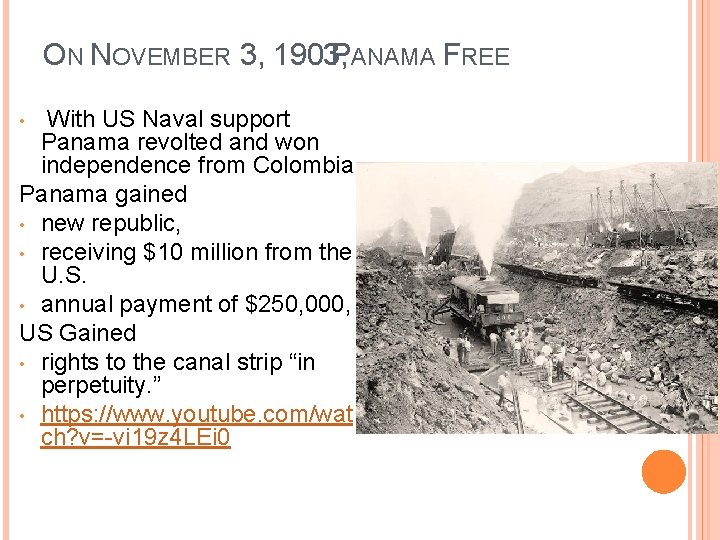
ON NOVEMBER 3, 1903, PANAMA FREE With US Naval support Panama revolted and won independence from Colombia. Panama gained • new republic, • receiving $10 million from the U. S. • annual payment of $250, 000, US Gained • rights to the canal strip “in perpetuity. ” • https: //www. youtube. com/wat ch? v=-vi 19 z 4 LEi 0 •
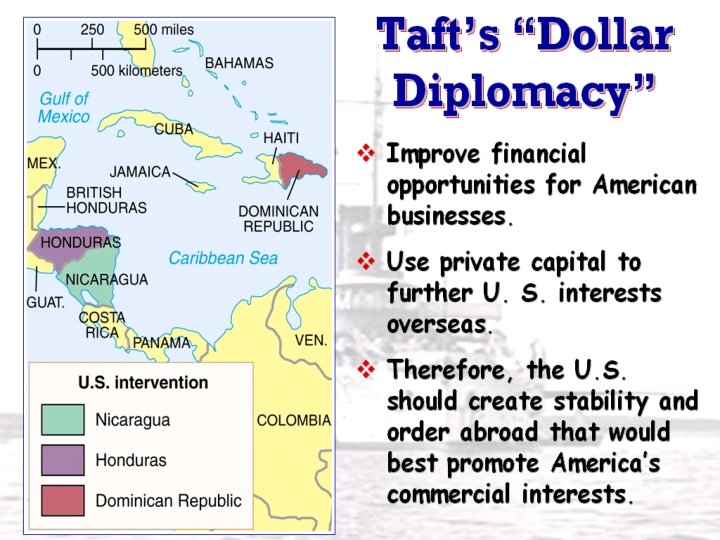
TAFT AND DOLLAR DIPLOMACY ■ President Taft took over after TR & continued an aggressive foreign policy, called “Dollar Diplomacy” Dollar Diplomacy Use U. S. wealth rather than military strength in foreign policy – In Latin America, U. S. banks assumed debts to Europe – Taft’s attempts to build railroads in China alienated Japan & ended the Open Door Policy – White Board: – What would the US want in return? –
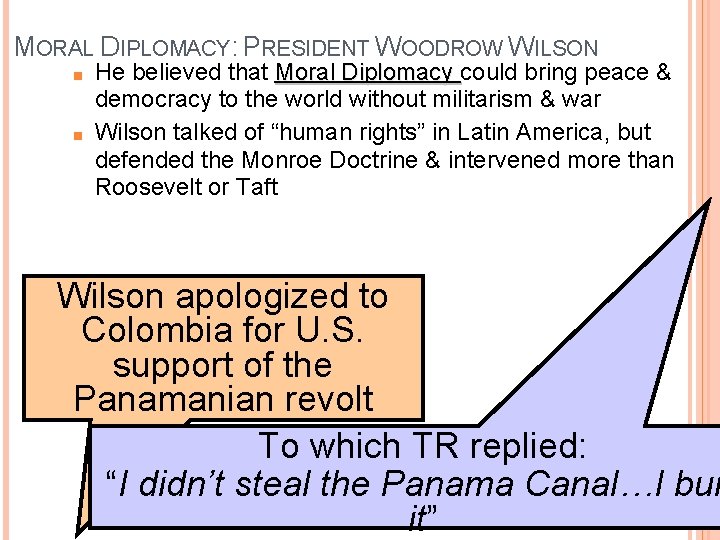
MORAL DIPLOMACY: PRESIDENT WOODROW WILSON ■ ■ He believed that Moral Diplomacy could bring peace & Moral Diplomacy democracy to the world without militarism & war Wilson talked of “human rights” in Latin America, but defended the Monroe Doctrine & intervened more than Roosevelt or Taft Wilson apologized to Colombia for U. S. support of the Panamanian revolt To which TR replied: “I didn’t steal the Panama Canal…I bui it”
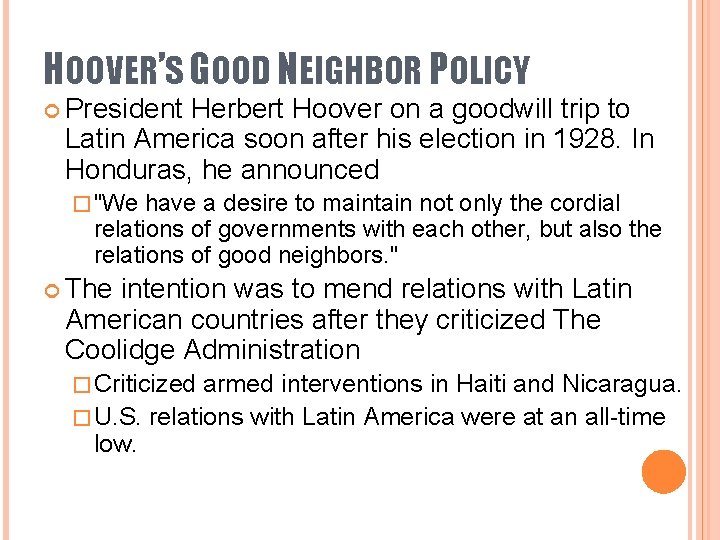
HOOVER’S GOOD NEIGHBOR POLICY President Herbert Hoover on a goodwill trip to Latin America soon after his election in 1928. In Honduras, he announced � "We have a desire to maintain not only the cordial relations of governments with each other, but also the relations of good neighbors. " The intention was to mend relations with Latin American countries after they criticized The Coolidge Administration � Criticized armed interventions in Haiti and Nicaragua. � U. S. relations with Latin America were at an all-time low.
WHITE BOARD List laws or agreements that allowed the US to intervene in Latin America
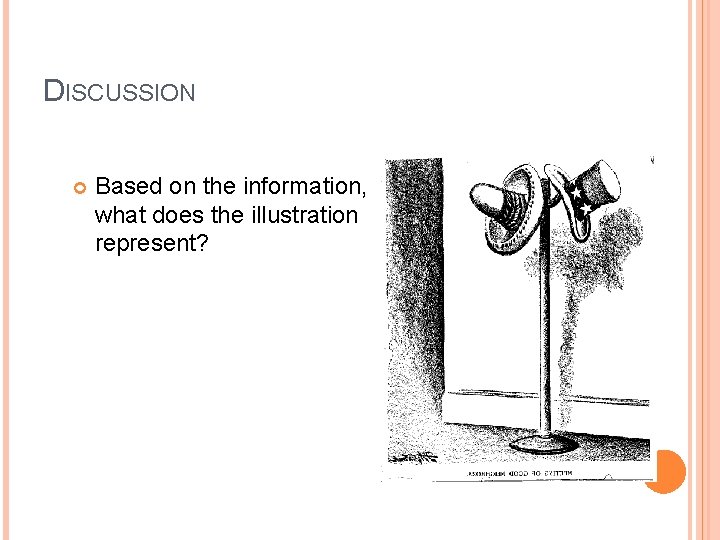
THE CLARK MEMORANDUM Rejects the notion that the Roosevelt Corollary is part of the Monroe Doctrine � U. S. has an interest in Latin America for the purpose of self-preservation � primary purpose of the Doctrine was to protect Latin American nations from intervention by European powers, � Not to victimize or oppress and benefit ourselves from Latin American nations The Clark Memo was the foundation of Hoover’s Good Neighbor Policy
DISCUSSION Based on the information, what does the illustration represent?
FDR’S GOOD NEIGHBOR POLICY In President Franklin Roosevelt's inaugural address, he also promised to improve relations with Latin America by stating: � "In the field of world policy, I dedicate this nation to the policy of the good neighbor — the neighbor who resolutely respects himself and, because he does so, respects the rights of others. " FDR’s Sec. of State, Cordell Hull � Sought to ensure non-hostile neighbors south of the border and � secure Latin American cooperation in the war effort by maintaining the flow of petroleum & raw materials.
FDR’S GOOD NEIGHBOR POLICY � Low tariffs improved the economies of the Latin American � policy of non-intervention into the affairs of Latin American countries. � U. S. Marines were removed from Haiti in 1934 and Congress signed a treaty with Cuba nullifying the Platt Amendment
CONCLUSION After the Spanish-American War, the USA assumed an aggressive foreign policy: � In order to maintain order, forestall foreign intervention, & protect U. S. economic interests � By the outbreak of WWI, the USA had seen its foreign policy evolve from strict neutrality, to imperialist