
Spanish 1 Qu clases tomas Tienes otras actividades
- Slides: 22
Spanish 1 ¿Qué clases tomas?
¿Tienes otras actividades en la universidad?
Learning Outcomes: ¿Tienes otras actividades en la universidad? 2. 4. 1: Recognize and understand the use of the irregular verbs tener and venir 2. 4. 2: Recognize the subject of a sentence (personal pronoun) based on the conjugation of tener and venir 2. 4. 3: Use tener + que + infinitive to descrive things one has to do
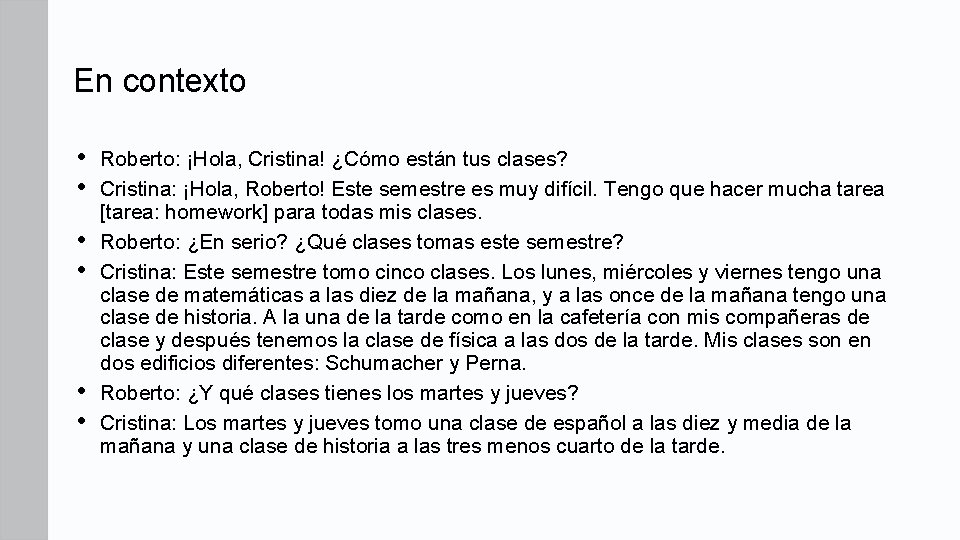
En contexto • • • Roberto: ¡Hola, Cristina! ¿Cómo están tus clases? Cristina: ¡Hola, Roberto! Este semestre es muy difícil. Tengo que hacer mucha tarea [tarea: homework] para todas mis clases. Roberto: ¿En serio? ¿Qué clases tomas este semestre? Cristina: Este semestre tomo cinco clases. Los lunes, miércoles y viernes tengo una clase de matemáticas a las diez de la mañana, y a las once de la mañana tengo una clase de historia. A la una de la tarde como en la cafetería con mis compañeras de clase y después tenemos la clase de física a las dos de la tarde. Mis clases son en dos edificios diferentes: Schumacher y Perna. Roberto: ¿Y qué clases tienes los martes y jueves? Cristina: Los martes y jueves tomo una clase de español a las diez y media de la mañana y una clase de historia a las tres menos cuarto de la tarde.
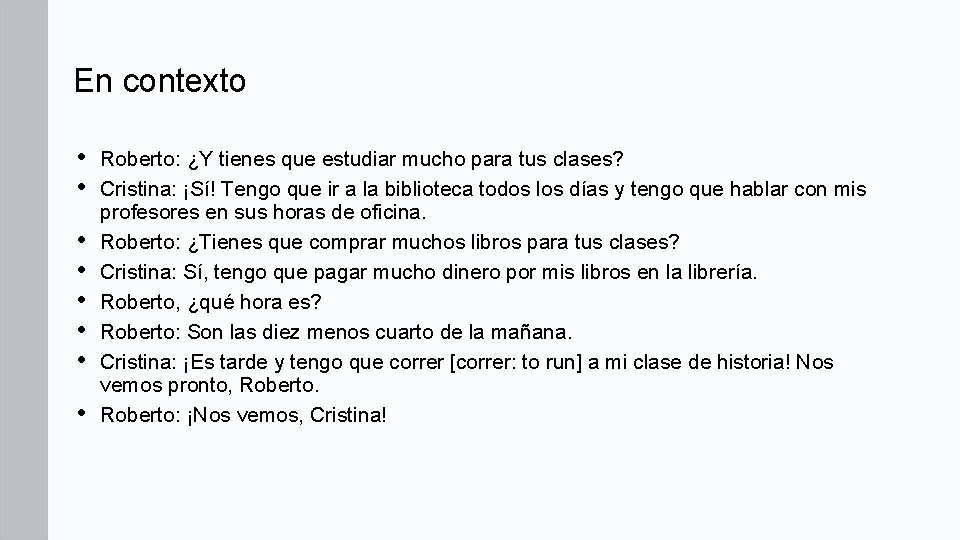
En contexto • • Roberto: ¿Y tienes que estudiar mucho para tus clases? Cristina: ¡Sí! Tengo que ir a la biblioteca todos los días y tengo que hablar con mis profesores en sus horas de oficina. Roberto: ¿Tienes que comprar muchos libros para tus clases? Cristina: Sí, tengo que pagar mucho dinero por mis libros en la librería. Roberto, ¿qué hora es? Roberto: Son las diez menos cuarto de la mañana. Cristina: ¡Es tarde y tengo que correr [correr: to run] a mi clase de historia! Nos vemos pronto, Roberto: ¡Nos vemos, Cristina!
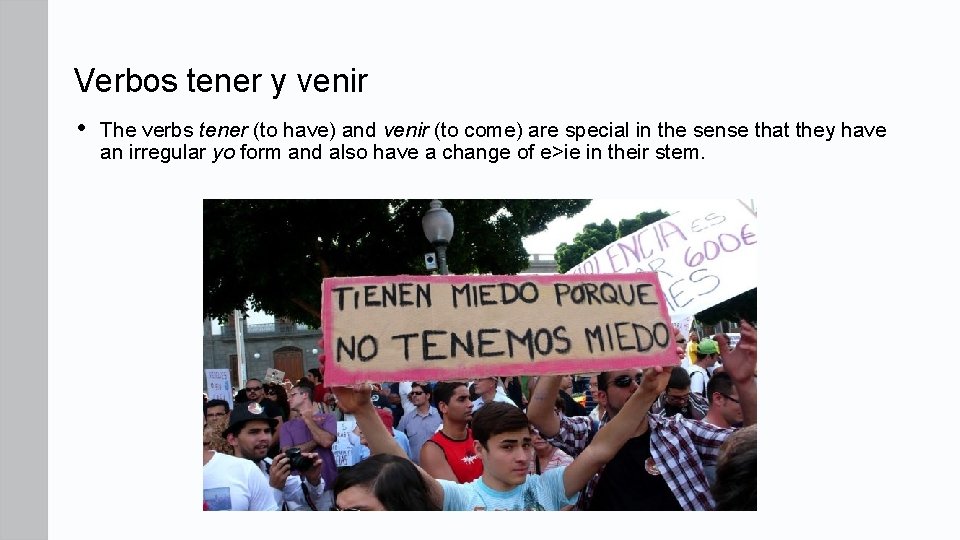
Verbos tener y venir • The verbs tener (to have) and venir (to come) are special in the sense that they have an irregular yo form and also have a change of e>ie in their stem.
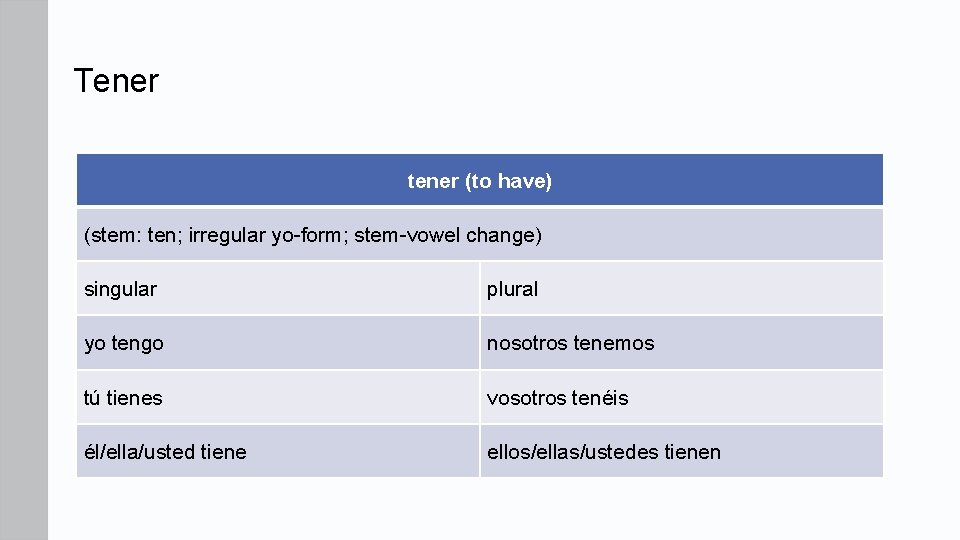
Tener tener (to have) (stem: ten; irregular yo-form; stem-vowel change) singular plural yo tengo nosotros tenemos tú tienes vosotros tenéis él/ella/usted tiene ellos/ellas/ustedes tienen
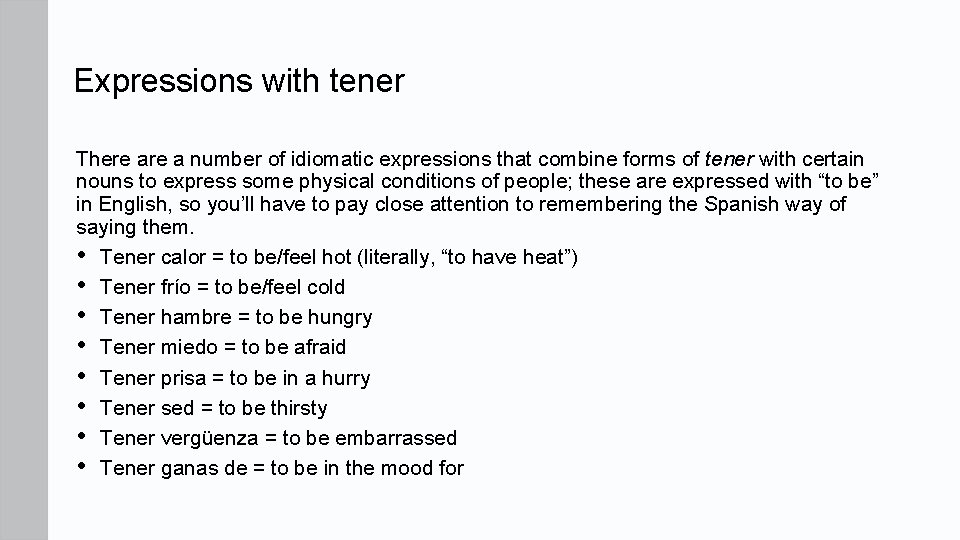
Expressions with tener There a number of idiomatic expressions that combine forms of tener with certain nouns to express some physical conditions of people; these are expressed with “to be” in English, so you’ll have to pay close attention to remembering the Spanish way of saying them. • Tener calor = to be/feel hot (literally, “to have heat”) • Tener frío = to be/feel cold • Tener hambre = to be hungry • Tener miedo = to be afraid • Tener prisa = to be in a hurry • Tener sed = to be thirsty • Tener vergüenza = to be embarrassed • Tener ganas de = to be in the mood for
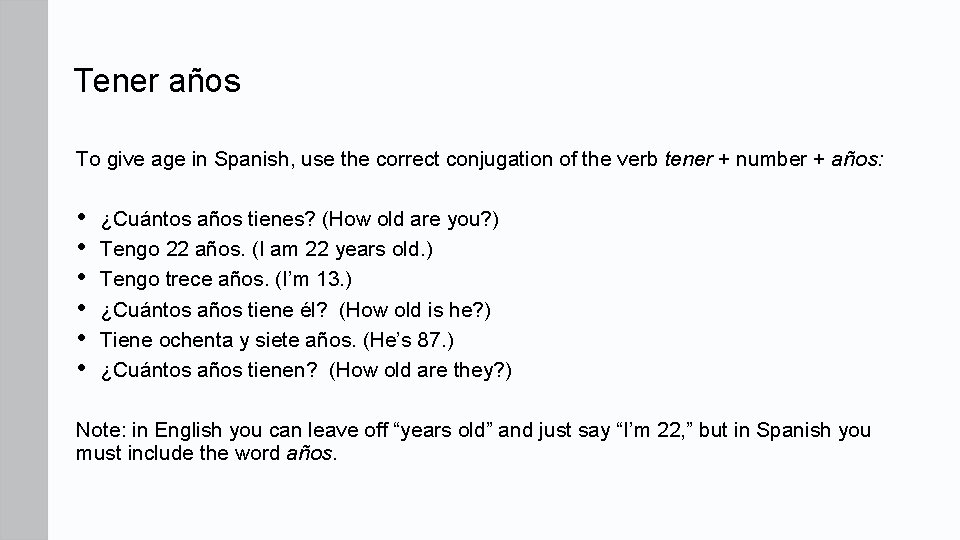
Tener años To give age in Spanish, use the correct conjugation of the verb tener + number + años: • • • ¿Cuántos años tienes? (How old are you? ) Tengo 22 años. (I am 22 years old. ) Tengo trece años. (I’m 13. ) ¿Cuántos años tiene él? (How old is he? ) Tiene ochenta y siete años. (He’s 87. ) ¿Cuántos años tienen? (How old are they? ) Note: in English you can leave off “years old” and just say “I’m 22, ” but in Spanish you must include the word años.
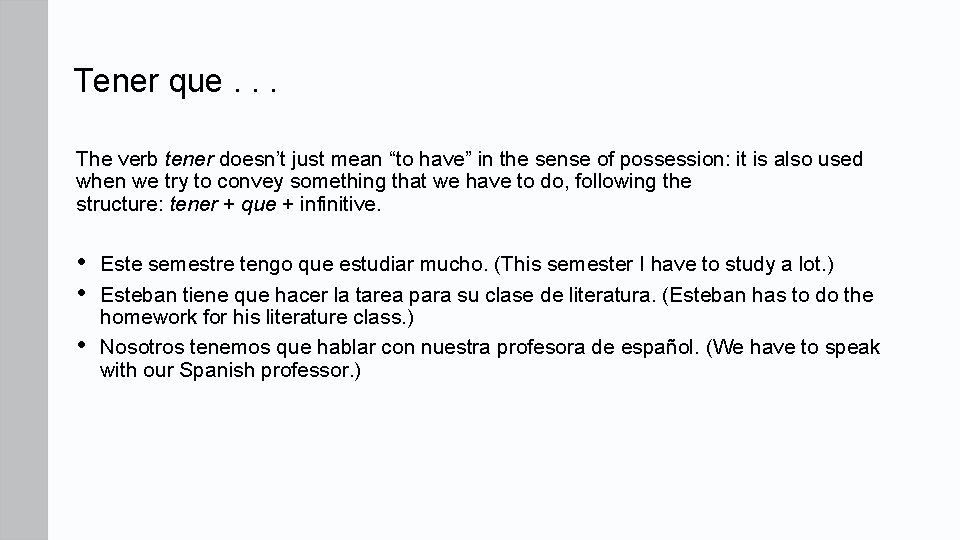
Tener que. . . The verb tener doesn’t just mean “to have” in the sense of possession: it is also used when we try to convey something that we have to do, following the structure: tener + que + infinitive. • • • Este semestre tengo que estudiar mucho. (This semester I have to study a lot. ) Esteban tiene que hacer la tarea para su clase de literatura. (Esteban has to do the homework for his literature class. ) Nosotros tenemos que hablar con nuestra profesora de español. (We have to speak with our Spanish professor. )
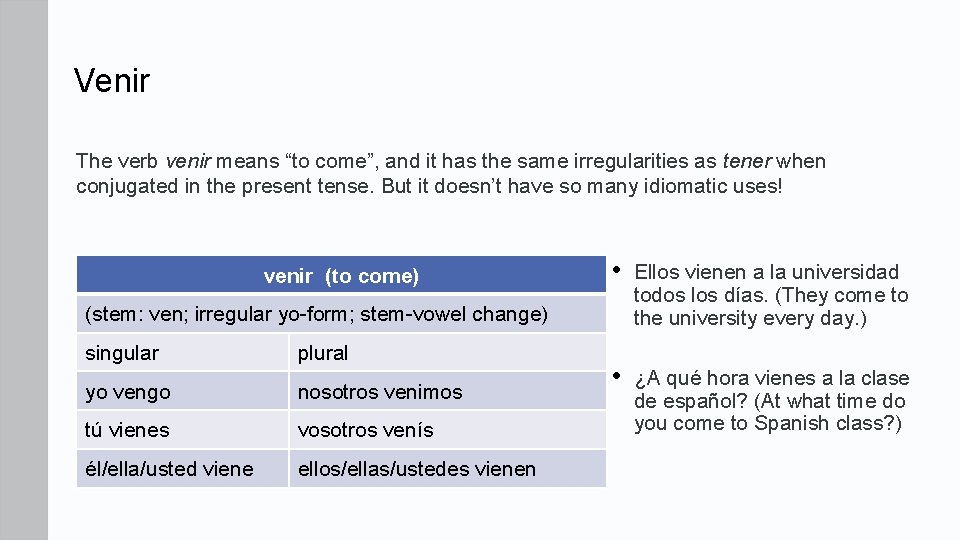
Venir The verb venir means “to come”, and it has the same irregularities as tener when conjugated in the present tense. But it doesn’t have so many idiomatic uses! venir (to come) • Ellos vienen a la universidad todos los días. (They come to the university every day. ) • ¿A qué hora vienes a la clase de español? (At what time do you come to Spanish class? ) (stem: ven; irregular yo-form; stem-vowel change) singular plural yo vengo nosotros venimos tú vienes vosotros venís él/ella/usted viene ellos/ellas/ustedes vienen
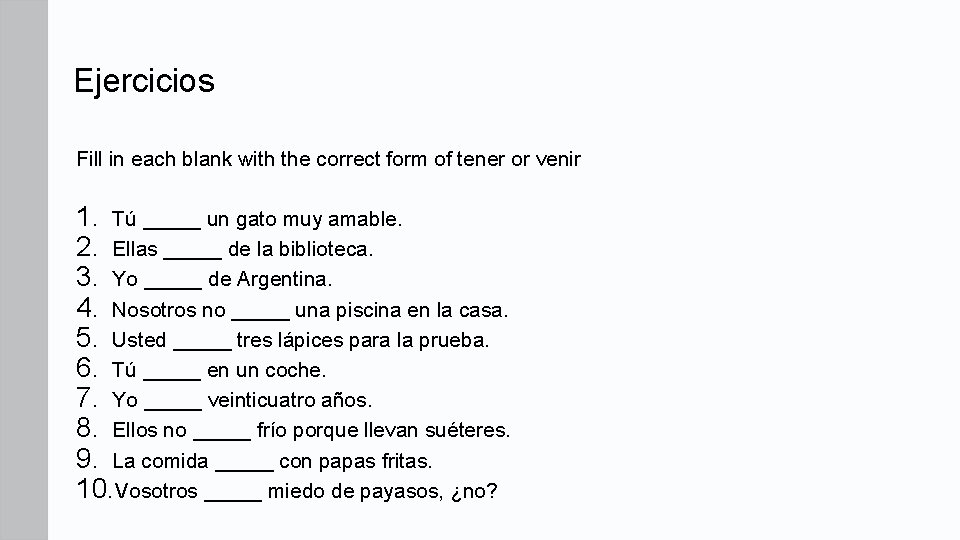
Ejercicios Fill in each blank with the correct form of tener or venir 1. Tú _____ un gato muy amable. 2. Ellas _____ de la biblioteca. 3. Yo _____ de Argentina. 4. Nosotros no _____ una piscina en la casa. 5. Usted _____ tres lápices para la prueba. 6. Tú _____ en un coche. 7. Yo _____ veinticuatro años. 8. Ellos no _____ frío porque llevan suéteres. 9. La comida _____ con papas fritas. 10. Vosotros _____ miedo de payasos, ¿no?
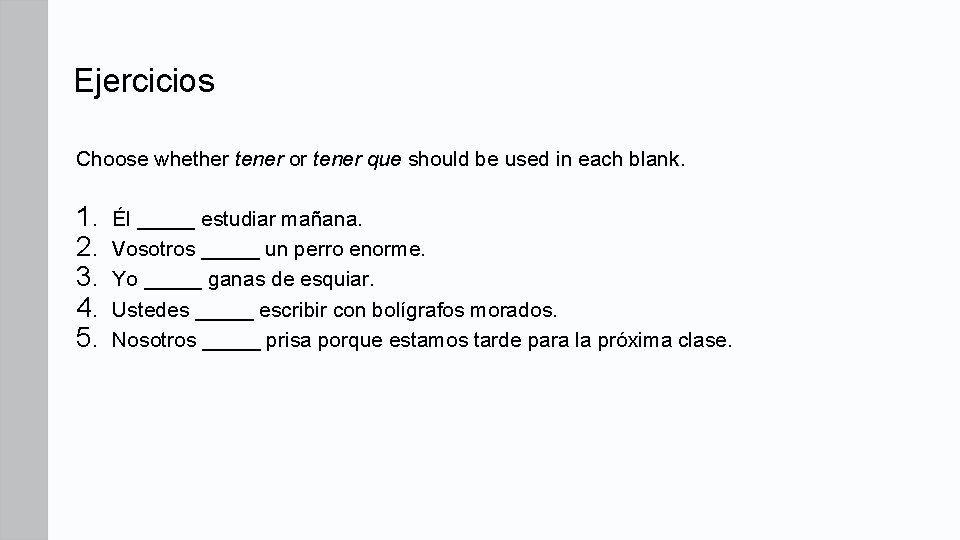
Ejercicios Choose whether tener or tener que should be used in each blank. 1. 2. 3. 4. 5. Él _____ estudiar mañana. Vosotros _____ un perro enorme. Yo _____ ganas de esquiar. Ustedes _____ escribir con bolígrafos morados. Nosotros _____ prisa porque estamos tarde para la próxima clase.
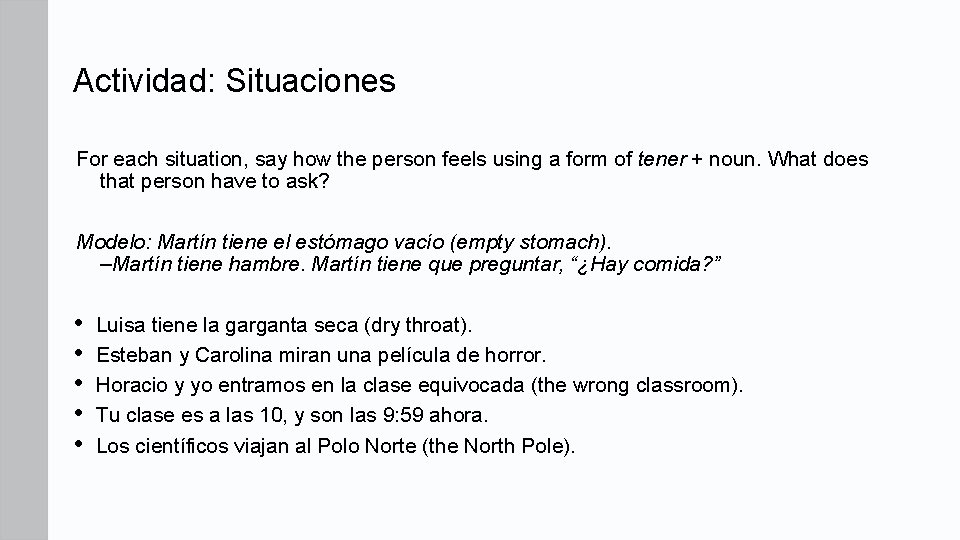
Actividad: Situaciones For each situation, say how the person feels using a form of tener + noun. What does that person have to ask? Modelo: Martín tiene el estómago vacío (empty stomach). –Martín tiene hambre. Martín tiene que preguntar, “¿Hay comida? ” • • • Luisa tiene la garganta seca (dry throat). Esteban y Carolina miran una película de horror. Horacio y yo entramos en la clase equivocada (the wrong classroom). Tu clase es a las 10, y son las 9: 59 ahora. Los científicos viajan al Polo Norte (the North Pole).
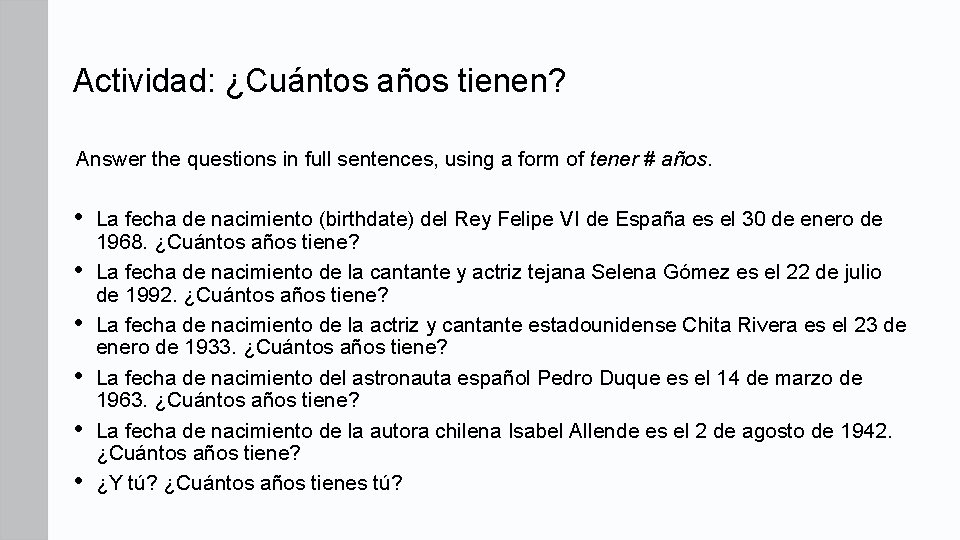
Actividad: ¿Cuántos años tienen? Answer the questions in full sentences, using a form of tener # años. • • • La fecha de nacimiento (birthdate) del Rey Felipe VI de España es el 30 de enero de 1968. ¿Cuántos años tiene? La fecha de nacimiento de la cantante y actriz tejana Selena Gómez es el 22 de julio de 1992. ¿Cuántos años tiene? La fecha de nacimiento de la actriz y cantante estadounidense Chita Rivera es el 23 de enero de 1933. ¿Cuántos años tiene? La fecha de nacimiento del astronauta español Pedro Duque es el 14 de marzo de 1963. ¿Cuántos años tiene? La fecha de nacimiento de la autora chilena Isabel Allende es el 2 de agosto de 1942. ¿Cuántos años tiene? ¿Y tú? ¿Cuántos años tienes tú?
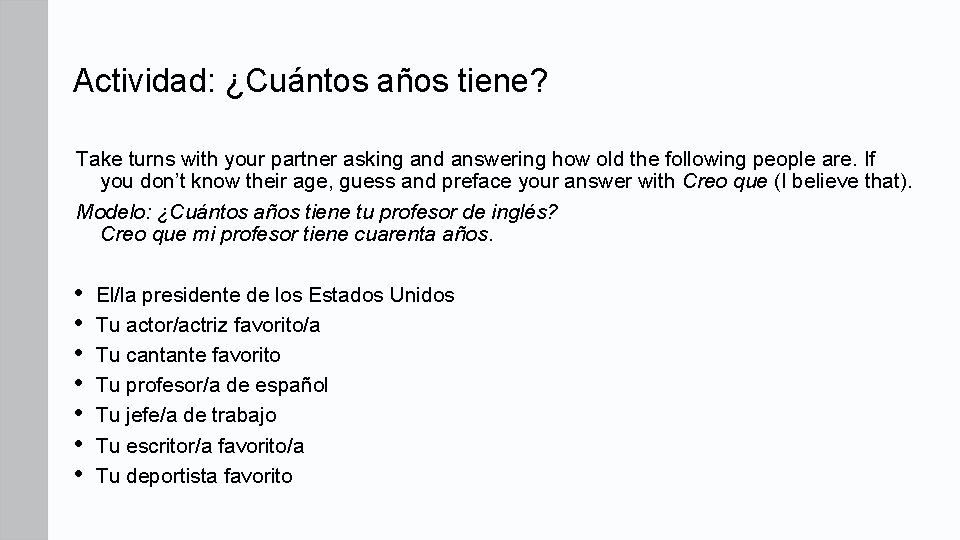
Actividad: ¿Cuántos años tiene? Take turns with your partner asking and answering how old the following people are. If you don’t know their age, guess and preface your answer with Creo que (I believe that). Modelo: ¿Cuántos años tiene tu profesor de inglés? Creo que mi profesor tiene cuarenta años. • • El/la presidente de los Estados Unidos Tu actor/actriz favorito/a Tu cantante favorito Tu profesor/a de español Tu jefe/a de trabajo Tu escritor/a favorito/a Tu deportista favorito
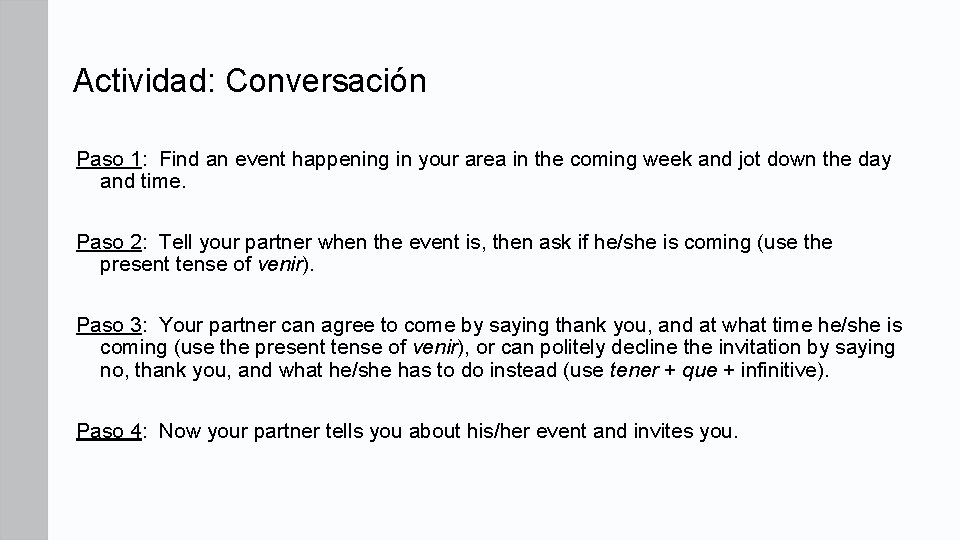
Actividad: Conversación Paso 1: Find an event happening in your area in the coming week and jot down the day and time. Paso 2: Tell your partner when the event is, then ask if he/she is coming (use the present tense of venir). Paso 3: Your partner can agree to come by saying thank you, and at what time he/she is coming (use the present tense of venir), or can politely decline the invitation by saying no, thank you, and what he/she has to do instead (use tener + que + infinitive). Paso 4: Now your partner tells you about his/her event and invites you.
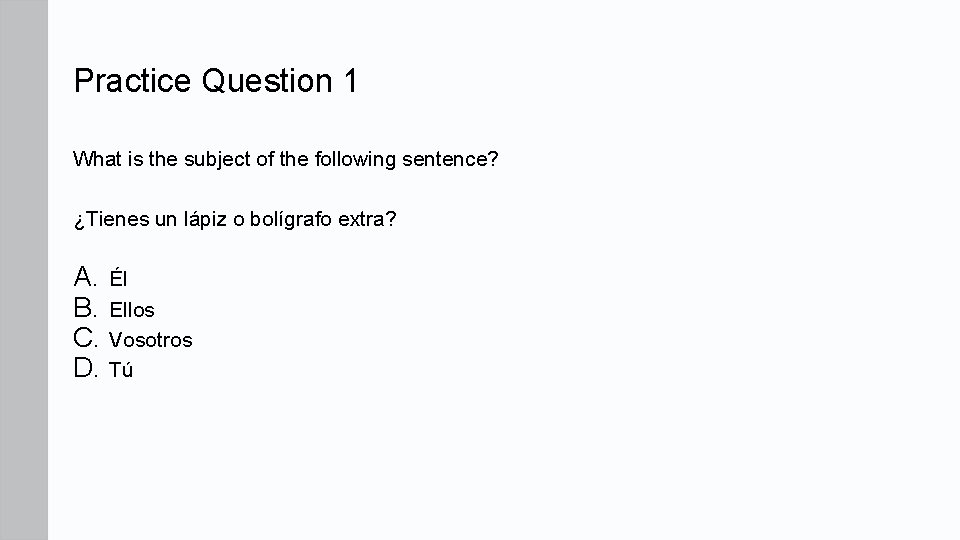
Practice Question 1 What is the subject of the following sentence? ¿Tienes un lápiz o bolígrafo extra? A. Él B. Ellos C. Vosotros D. Tú
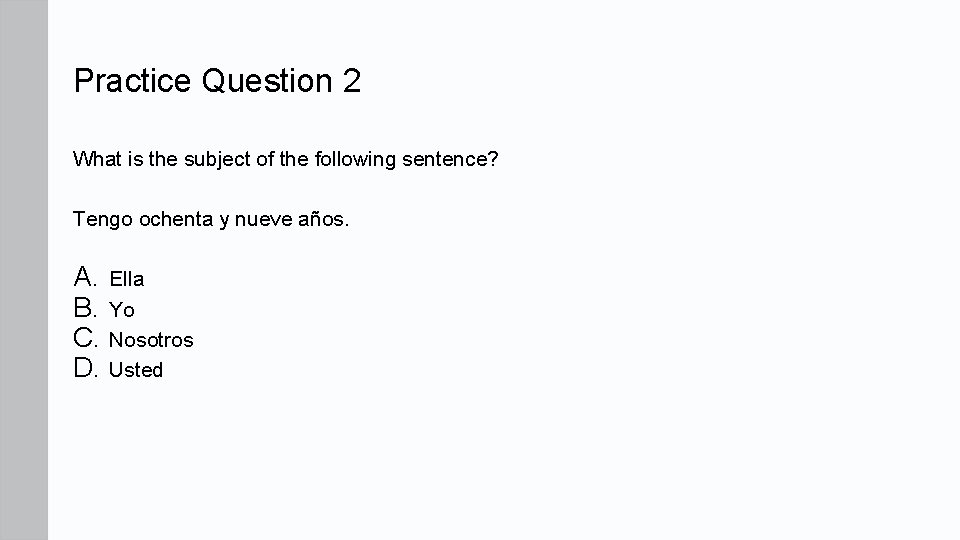
Practice Question 2 What is the subject of the following sentence? Tengo ochenta y nueve años. A. Ella B. Yo C. Nosotros D. Usted
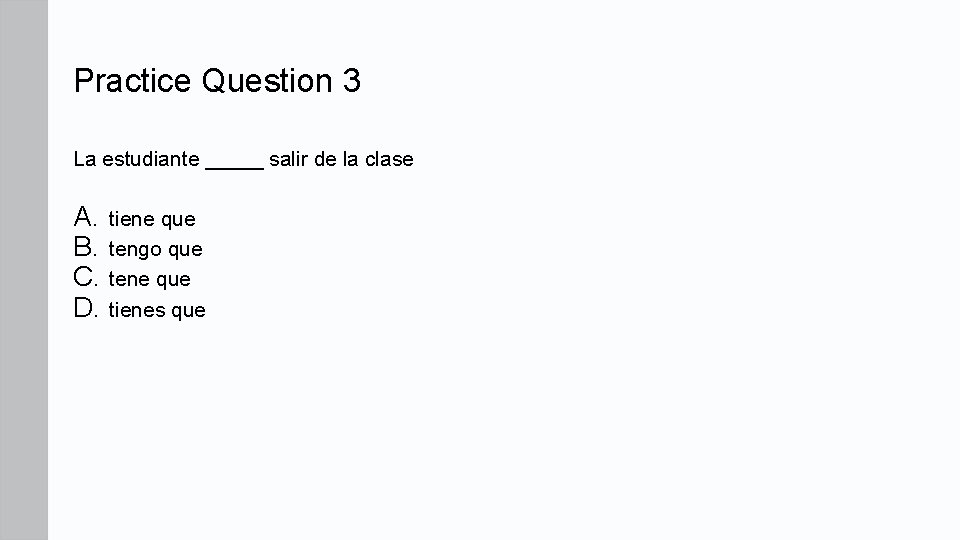
Practice Question 3 La estudiante _____ salir de la clase A. tiene que B. tengo que C. tene que D. tienes que
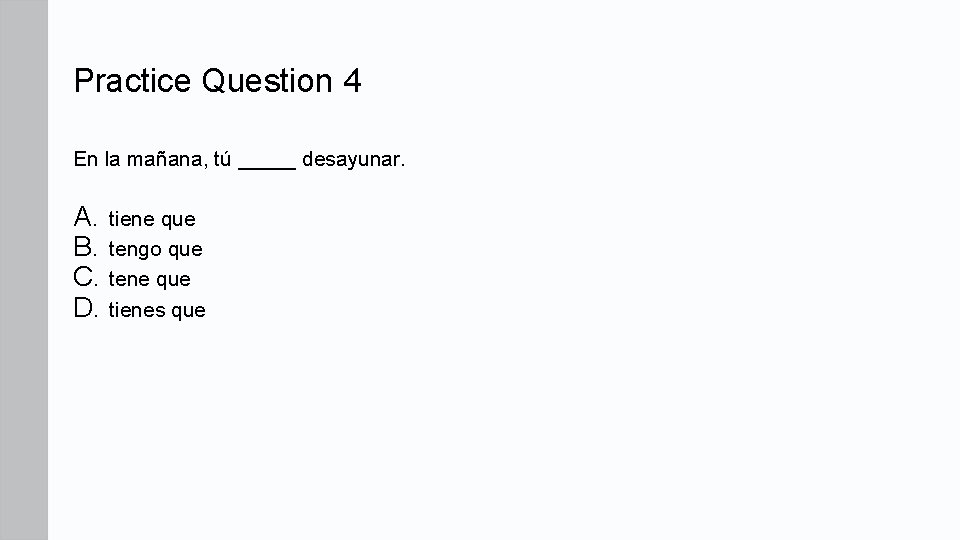
Practice Question 4 En la mañana, tú _____ desayunar. A. tiene que B. tengo que C. tene que D. tienes que
Quick Review • What is irregular about the verbs tener and venir? • What expressions with tener are there? • How do you talk about age?