
Spanish 1 Cmo eres Cmo ests Ests estudiando
- Slides: 23
Spanish 1 ¿Cómo eres? ¿Cómo estás?
¿Estás estudiando ahora?
Learning Outcomes: ¿Estás estudiando ahora? 6. 2. 1: Review and practice use of all question-words 6. 2. 2: Use the present progressive to talk about actions ongoing in the present moment 6. 2. 3: Distinguish the different ways to say “to be” in Spanish
Introduction to ¿Estás estudiando ahora? When we talk about the present, people often refer to their present life using the present progressive tense, which is used to create a greater sense of continuity or ongoing action. In English, the present progressive tense is formed by combining the verb “to be” with the present participle. So: Present tense: I work Present progressive/continuous tense: I am working In Spanish, the present progressive tense functions similarly: Present tense: Trabajo Present tense: Estoy trabajando Note that Spanish always uses estoy with the present progressive. We’ll discuss that more in the section that follows.
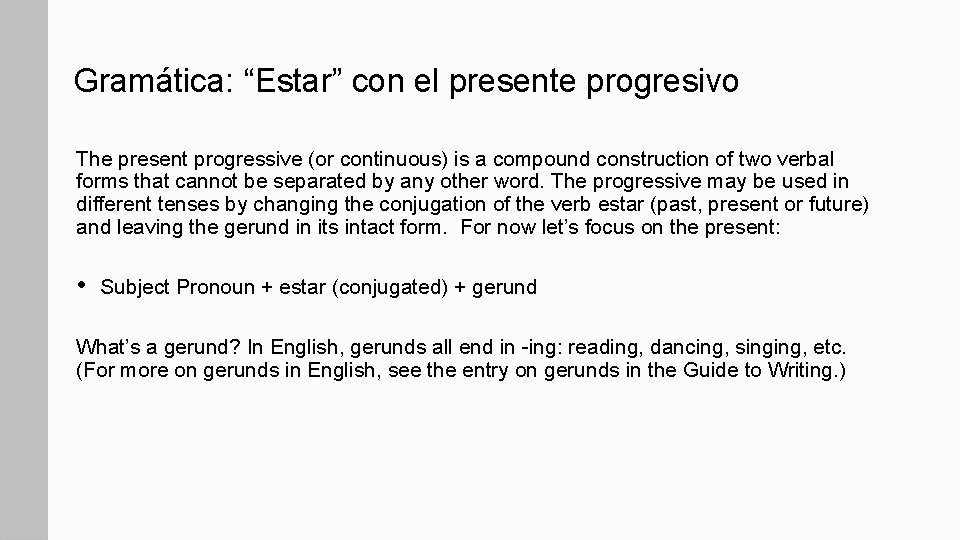
Gramática: “Estar” con el presente progresivo The present progressive (or continuous) is a compound construction of two verbal forms that cannot be separated by any other word. The progressive may be used in different tenses by changing the conjugation of the verb estar (past, present or future) and leaving the gerund in its intact form. For now let’s focus on the present: • Subject Pronoun + estar (conjugated) + gerund What’s a gerund? In English, gerunds all end in -ing: reading, dancing, singing, etc. (For more on gerunds in English, see the entry on gerunds in the Guide to Writing. )
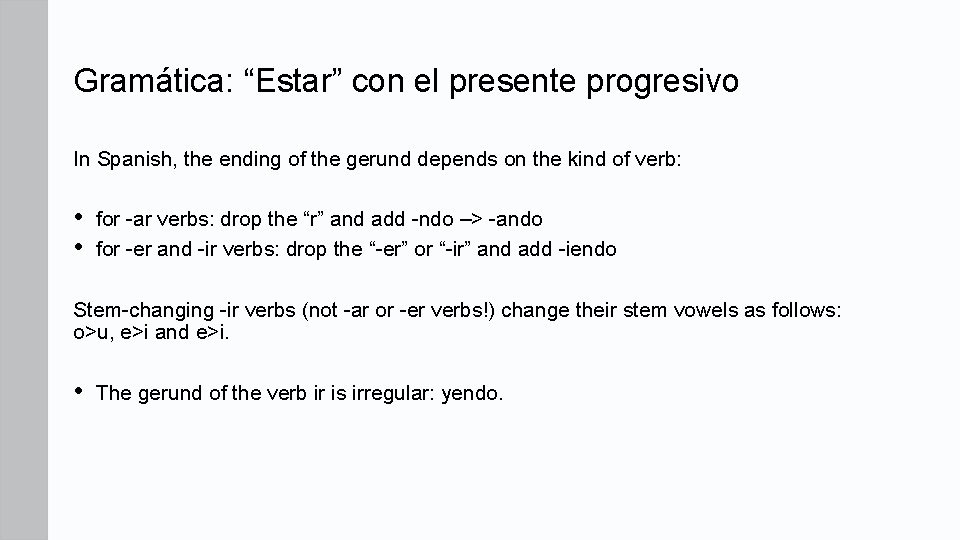
Gramática: “Estar” con el presente progresivo In Spanish, the ending of the gerund depends on the kind of verb: • • for -ar verbs: drop the “r” and add -ndo –> -ando for -er and -ir verbs: drop the “-er” or “-ir” and add -iendo Stem-changing -ir verbs (not -ar or -er verbs!) change their stem vowels as follows: o>u, e>i and e>i. • The gerund of the verb ir is irregular: yendo.
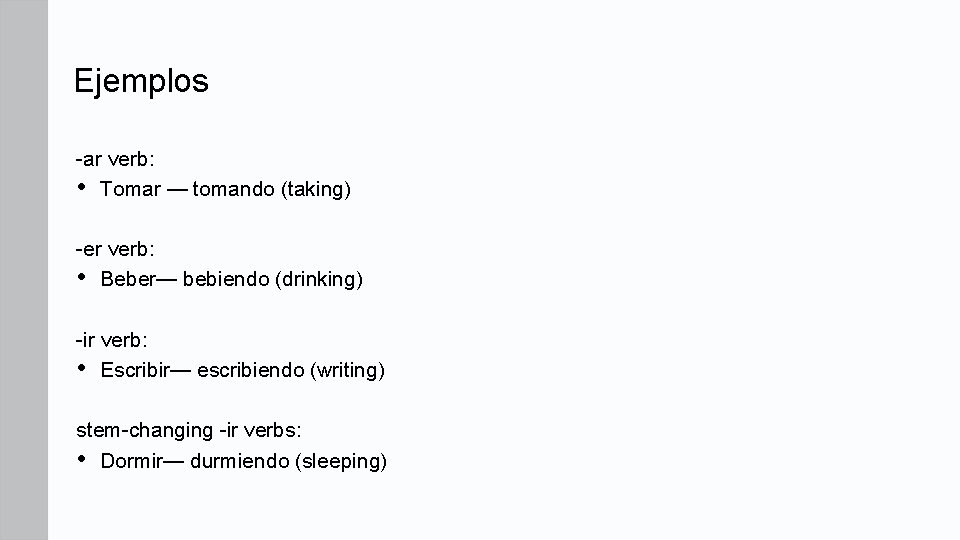
Ejemplos -ar verb: • Tomar — tomando (taking) -er verb: • Beber— bebiendo (drinking) -ir verb: • Escribir— escribiendo (writing) stem-changing -ir verbs: • Dormir— durmiendo (sleeping)
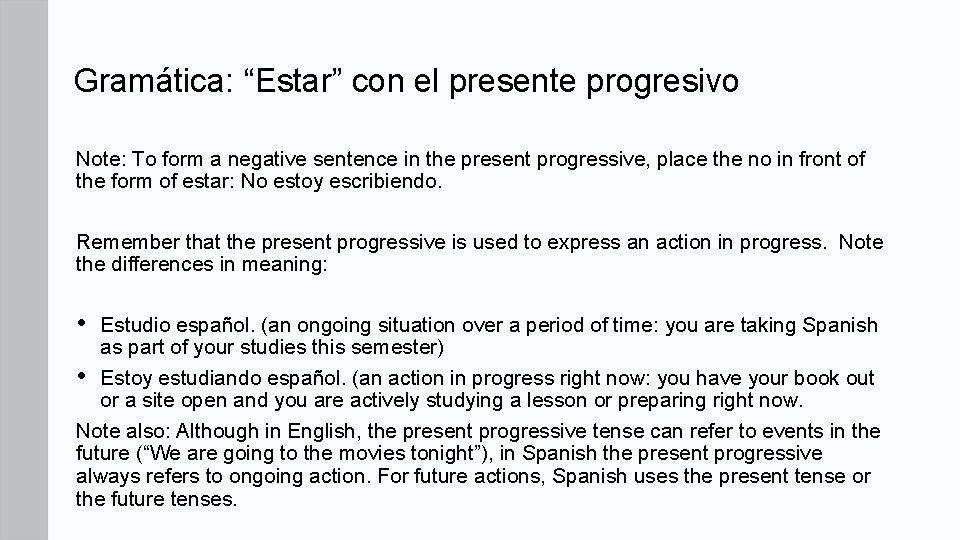
Gramática: “Estar” con el presente progresivo Note: To form a negative sentence in the present progressive, place the no in front of the form of estar: No estoy escribiendo. Remember that the present progressive is used to express an action in progress. Note the differences in meaning: • Estudio español. (an ongoing situation over a period of time: you are taking Spanish as part of your studies this semester) • Estoy estudiando español. (an action in progress right now: you have your book out or a site open and you are actively studying a lesson or preparing right now. Note also: Although in English, the present progressive tense can refer to events in the future (“We are going to the movies tonight”), in Spanish the present progressive always refers to ongoing action. For future actions, Spanish uses the present tense or the future tenses.
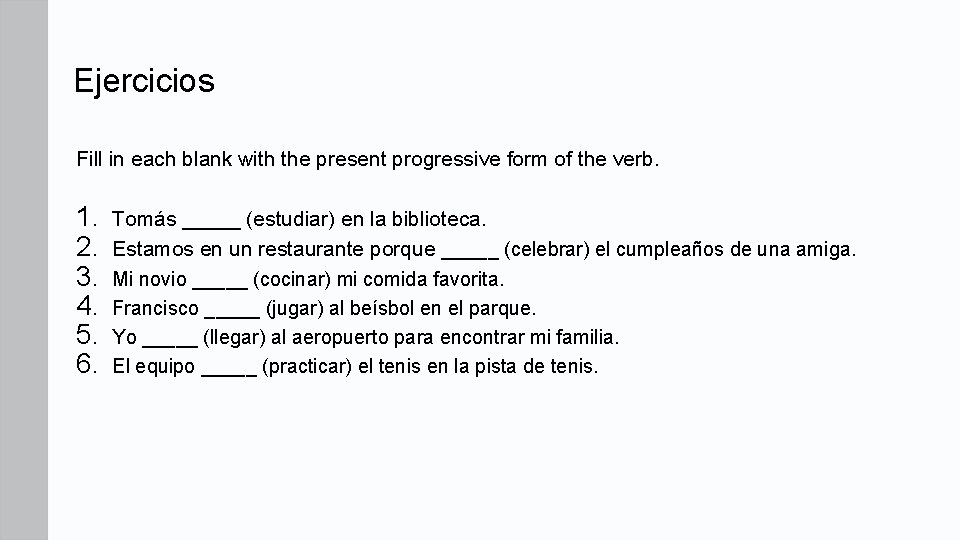
Ejercicios Fill in each blank with the present progressive form of the verb. 1. 2. 3. 4. 5. 6. Tomás _____ (estudiar) en la biblioteca. Estamos en un restaurante porque _____ (celebrar) el cumpleaños de una amiga. Mi novio _____ (cocinar) mi comida favorita. Francisco _____ (jugar) al beísbol en el parque. Yo _____ (llegar) al aeropuerto para encontrar mi familia. El equipo _____ (practicar) el tenis en la pista de tenis.
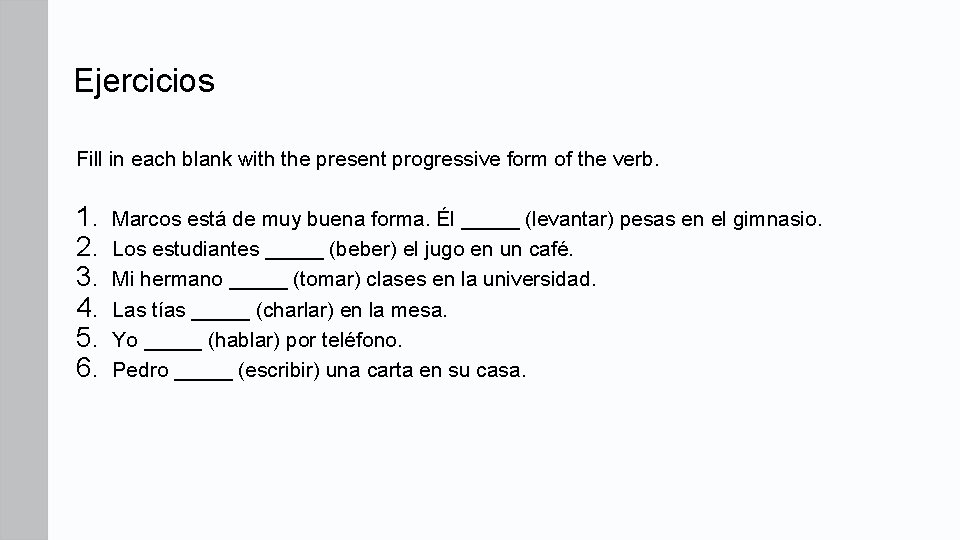
Ejercicios Fill in each blank with the present progressive form of the verb. 1. 2. 3. 4. 5. 6. Marcos está de muy buena forma. Él _____ (levantar) pesas en el gimnasio. Los estudiantes _____ (beber) el jugo en un café. Mi hermano _____ (tomar) clases en la universidad. Las tías _____ (charlar) en la mesa. Yo _____ (hablar) por teléfono. Pedro _____ (escribir) una carta en su casa.
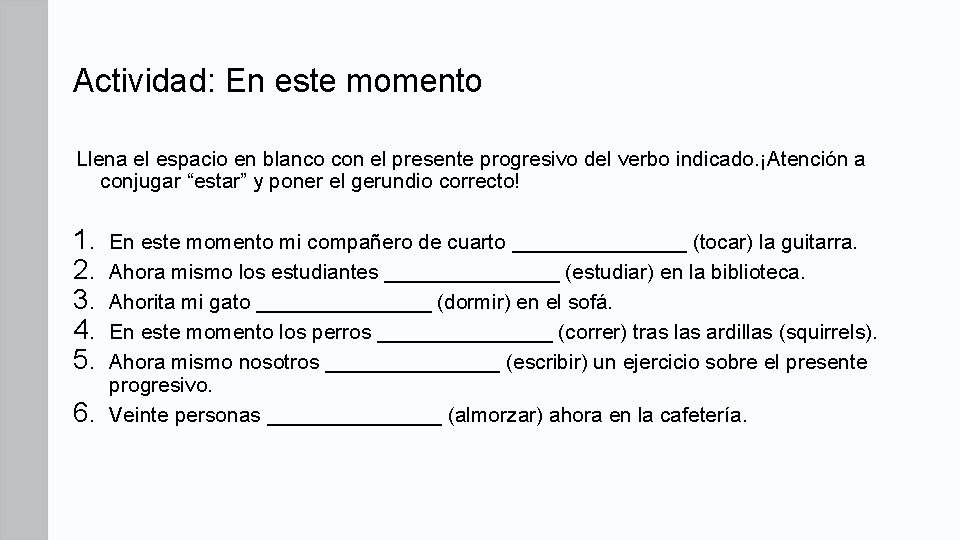
Actividad: En este momento Llena el espacio en blanco con el presente progresivo del verbo indicado. ¡Atención a conjugar “estar” y poner el gerundio correcto! 1. 2. 3. 4. 5. 6. En este momento mi compañero de cuarto ________ (tocar) la guitarra. Ahora mismo los estudiantes ________ (estudiar) en la biblioteca. Ahorita mi gato ________ (dormir) en el sofá. En este momento los perros ________ (correr) tras las ardillas (squirrels). Ahora mismo nosotros ________ (escribir) un ejercicio sobre el presente progresivo. Veinte personas ________ (almorzar) ahora en la cafetería.
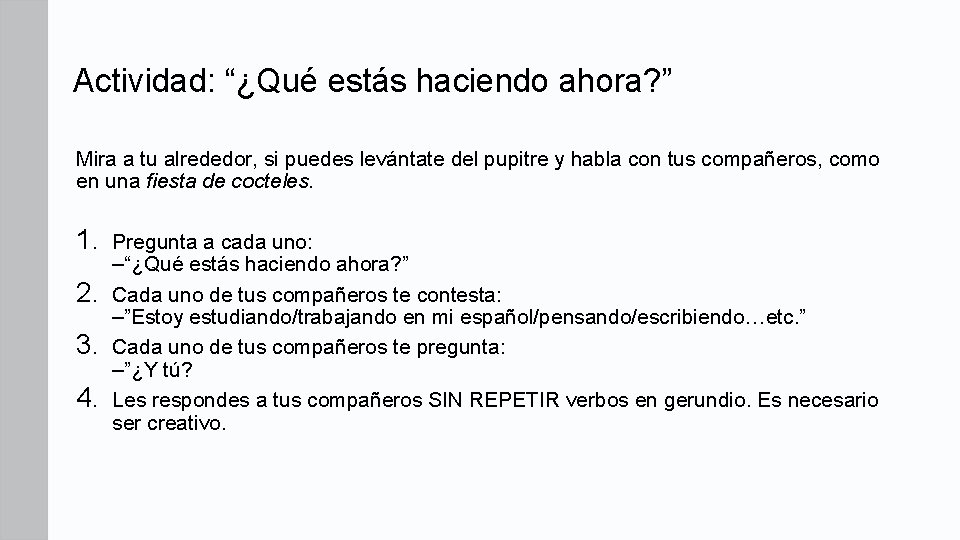
Actividad: “¿Qué estás haciendo ahora? ” Mira a tu alrededor, si puedes levántate del pupitre y habla con tus compañeros, como en una fiesta de cocteles. 1. 2. 3. 4. Pregunta a cada uno: –“¿Qué estás haciendo ahora? ” Cada uno de tus compañeros te contesta: –”Estoy estudiando/trabajando en mi español/pensando/escribiendo…etc. ” Cada uno de tus compañeros te pregunta: –”¿Y tú? Les respondes a tus compañeros SIN REPETIR verbos en gerundio. Es necesario ser creativo.
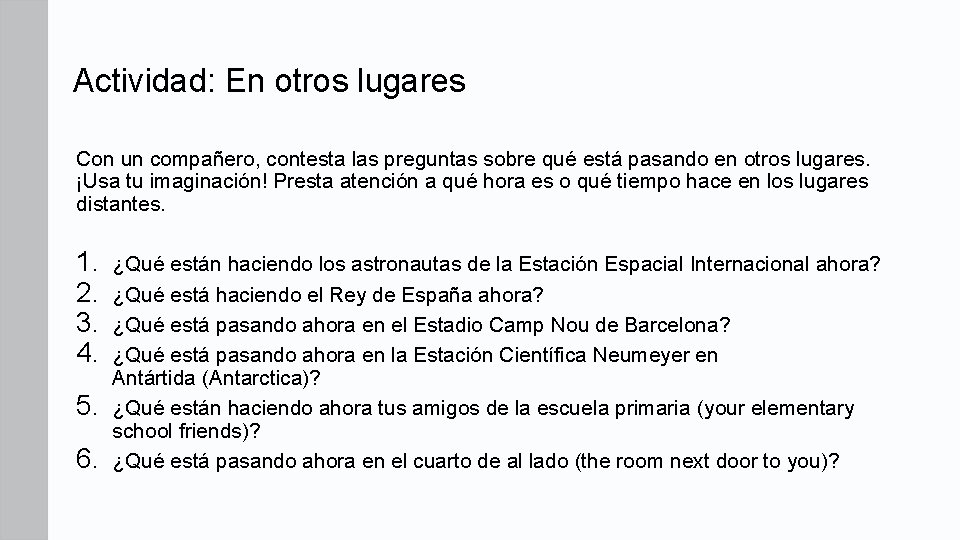
Actividad: En otros lugares Con un compañero, contesta las preguntas sobre qué está pasando en otros lugares. ¡Usa tu imaginación! Presta atención a qué hora es o qué tiempo hace en los lugares distantes. 1. 2. 3. 4. 5. 6. ¿Qué están haciendo los astronautas de la Estación Espacial Internacional ahora? ¿Qué está haciendo el Rey de España ahora? ¿Qué está pasando ahora en el Estadio Camp Nou de Barcelona? ¿Qué está pasando ahora en la Estación Científica Neumeyer en Antártida (Antarctica)? ¿Qué están haciendo ahora tus amigos de la escuela primaria (your elementary school friends)? ¿Qué está pasando ahora en el cuarto de al lado (the room next door to you)?
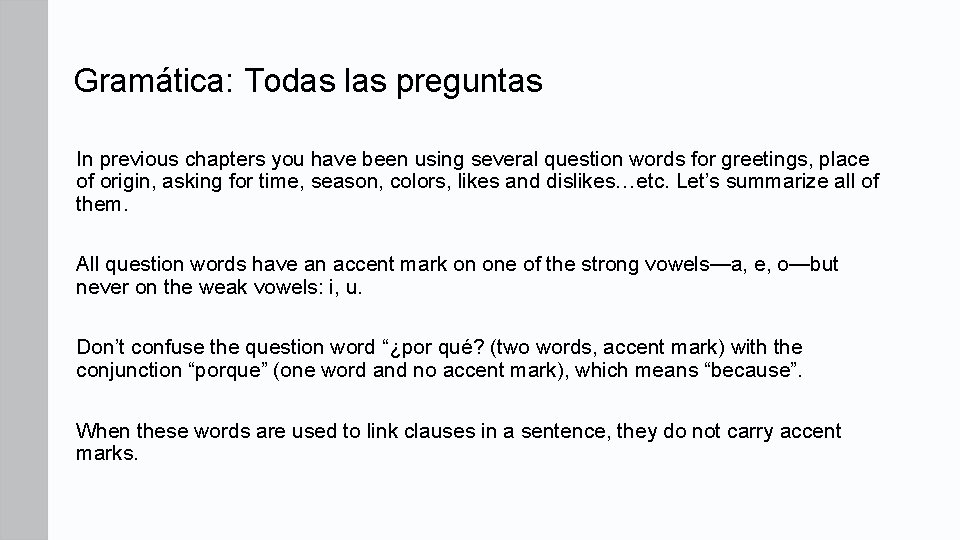
Gramática: Todas las preguntas In previous chapters you have been using several question words for greetings, place of origin, asking for time, season, colors, likes and dislikes…etc. Let’s summarize all of them. All question words have an accent mark on one of the strong vowels—a, e, o—but never on the weak vowels: i, u. Don’t confuse the question word “¿por qué? (two words, accent mark) with the conjunction “porque” (one word and no accent mark), which means “because”. When these words are used to link clauses in a sentence, they do not carry accent marks.
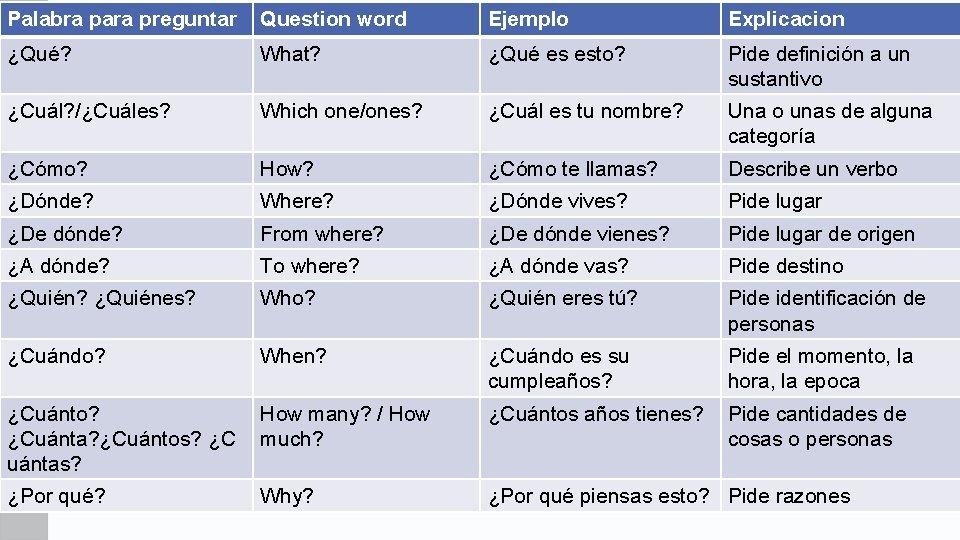
Palabra para preguntar Question word Ejemplo Explicacion ¿Qué? What? ¿Qué es esto? Pide definición a un sustantivo ¿Cuál? /¿Cuáles? Which one/ones? ¿Cuál es tu nombre? Una o unas de alguna categoría ¿Cómo? How? ¿Cómo te llamas? Describe un verbo ¿Dónde? Where? ¿Dónde vives? Pide lugar ¿De dónde? From where? ¿De dónde vienes? Pide lugar de origen ¿A dónde? To where? ¿A dónde vas? Pide destino ¿Quién? ¿Quiénes? Who? ¿Quién eres tú? Pide identificación de personas ¿Cuándo? When? ¿Cuándo es su cumpleaños? Pide el momento, la hora, la epoca ¿Cuánto? ¿Cuánta? ¿Cuántos? ¿C uántas? How many? / How much? ¿Cuántos años tienes? Pide cantidades de cosas o personas ¿Por qué? Why? ¿Por qué piensas esto? Pide razones
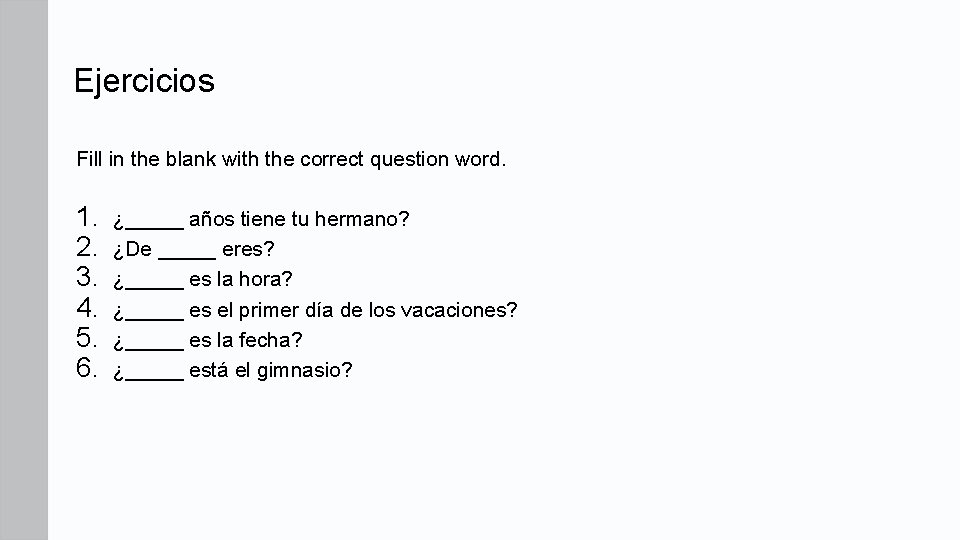
Ejercicios Fill in the blank with the correct question word. 1. 2. 3. 4. 5. 6. ¿_____ años tiene tu hermano? ¿De _____ eres? ¿_____ es la hora? ¿_____ es el primer día de los vacaciones? ¿_____ es la fecha? ¿_____ está el gimnasio?
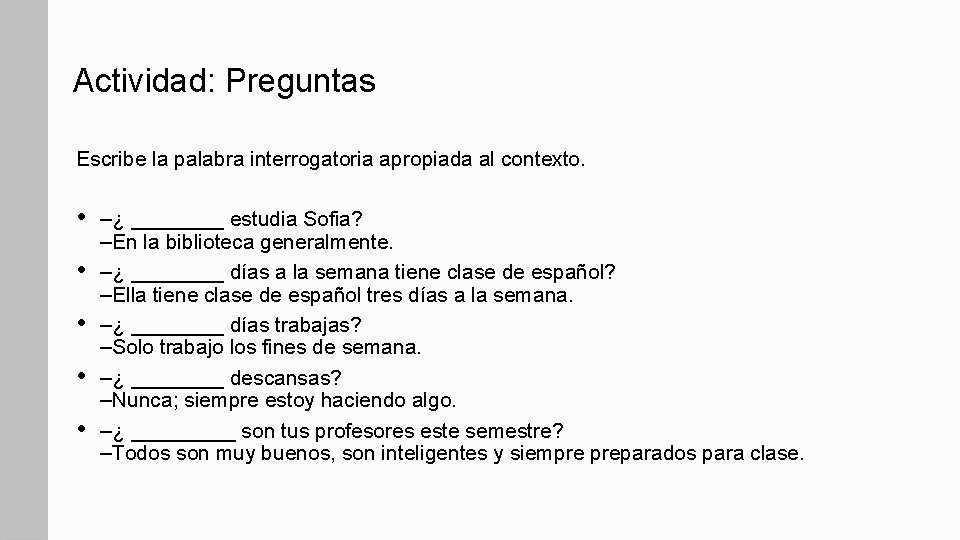
Actividad: Preguntas Escribe la palabra interrogatoria apropiada al contexto. • • • –¿ ____ estudia Sofia? –En la biblioteca generalmente. –¿ ____ días a la semana tiene clase de español? –Ella tiene clase de español tres días a la semana. –¿ ____ días trabajas? –Solo trabajo los fines de semana. –¿ ____ descansas? –Nunca; siempre estoy haciendo algo. –¿ _____ son tus profesores este semestre? –Todos son muy buenos, son inteligentes y siempre preparados para clase.
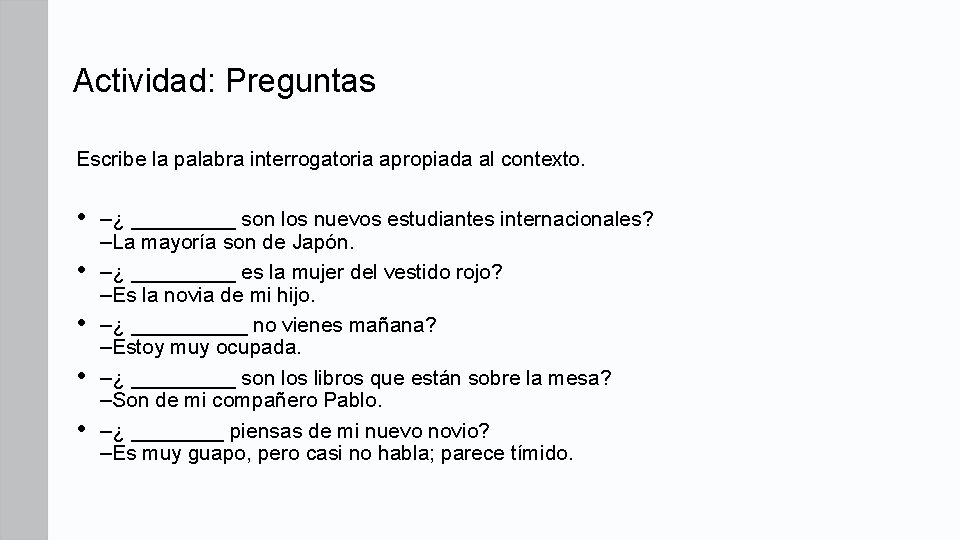
Actividad: Preguntas Escribe la palabra interrogatoria apropiada al contexto. • • • –¿ _____ son los nuevos estudiantes internacionales? –La mayoría son de Japón. –¿ _____ es la mujer del vestido rojo? –Es la novia de mi hijo. –¿ _____ no vienes mañana? –Estoy muy ocupada. –¿ _____ son los libros que están sobre la mesa? –Son de mi compañero Pablo. –¿ ____ piensas de mi nuevo novio? –Es muy guapo, pero casi no habla; parece tímido.
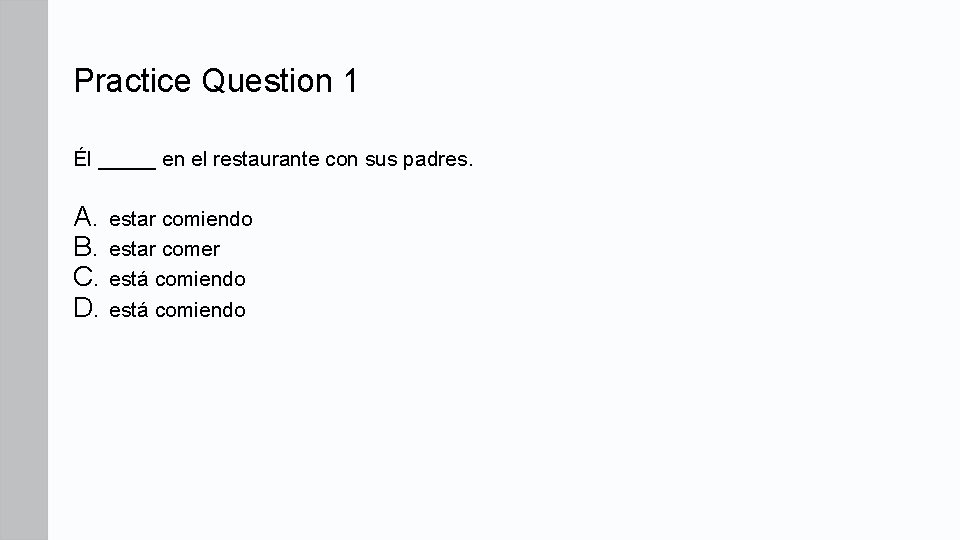
Practice Question 1 Él _____ en el restaurante con sus padres. A. estar comiendo B. estar comer C. está comiendo D. está comiendo
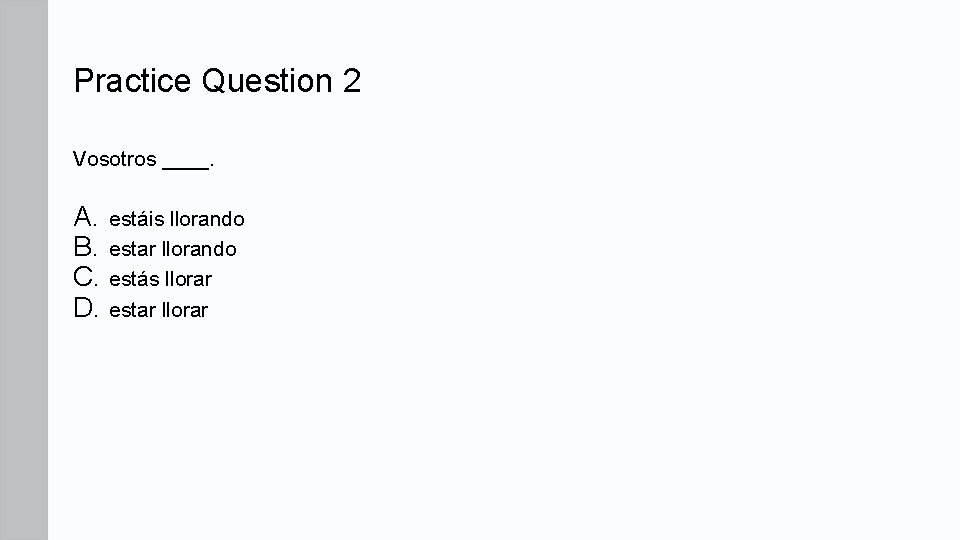
Practice Question 2 Vosotros ____. A. estáis llorando B. estar llorando C. estás llorar D. estar llorar
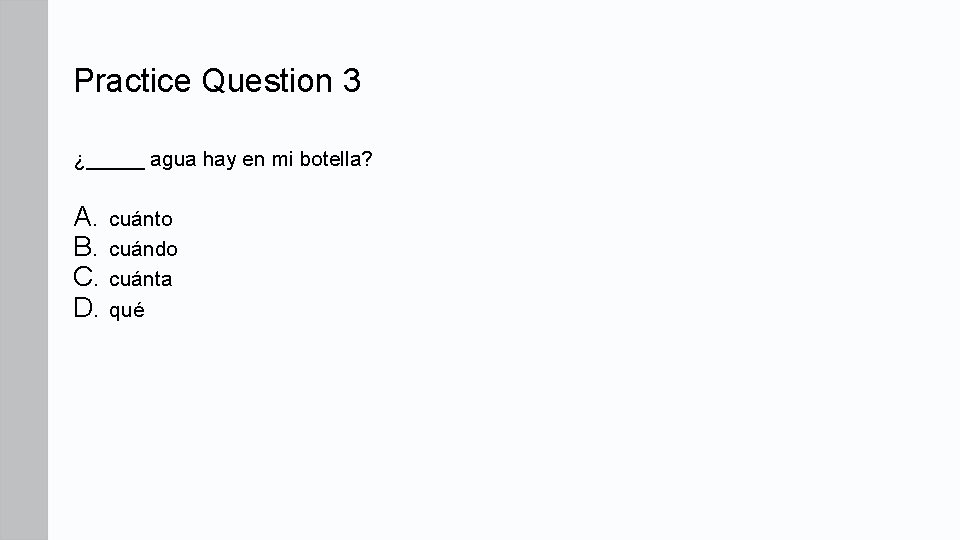
Practice Question 3 ¿_____ agua hay en mi botella? A. cuánto B. cuándo C. cuánta D. qué
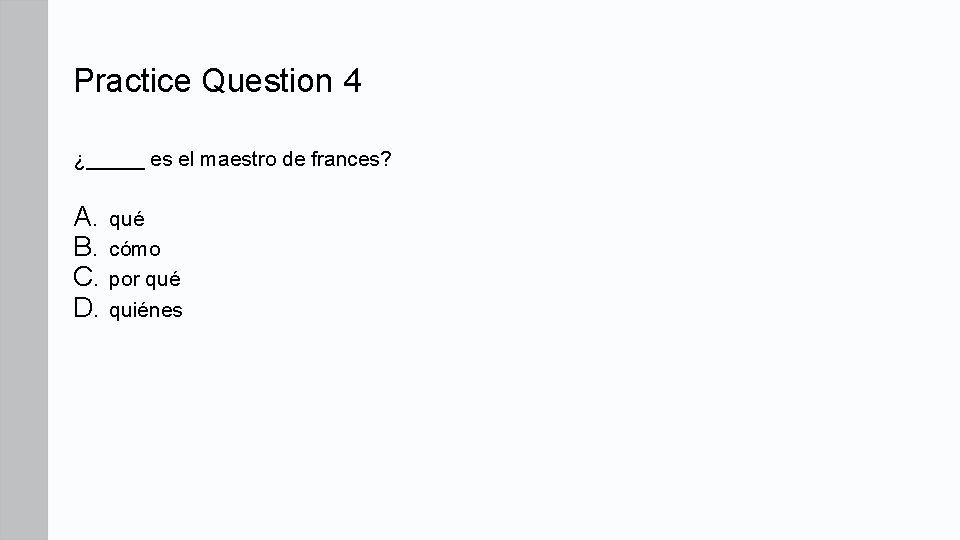
Practice Question 4 ¿_____ es el maestro de frances? A. qué B. cómo C. por qué D. quiénes
Quick Review • What is the present progressive and how is it used? • What are the question words of Spanish and when is each one used?