
Spallation Neutron Source Proton Power Upgrade High Power
- Slides: 1
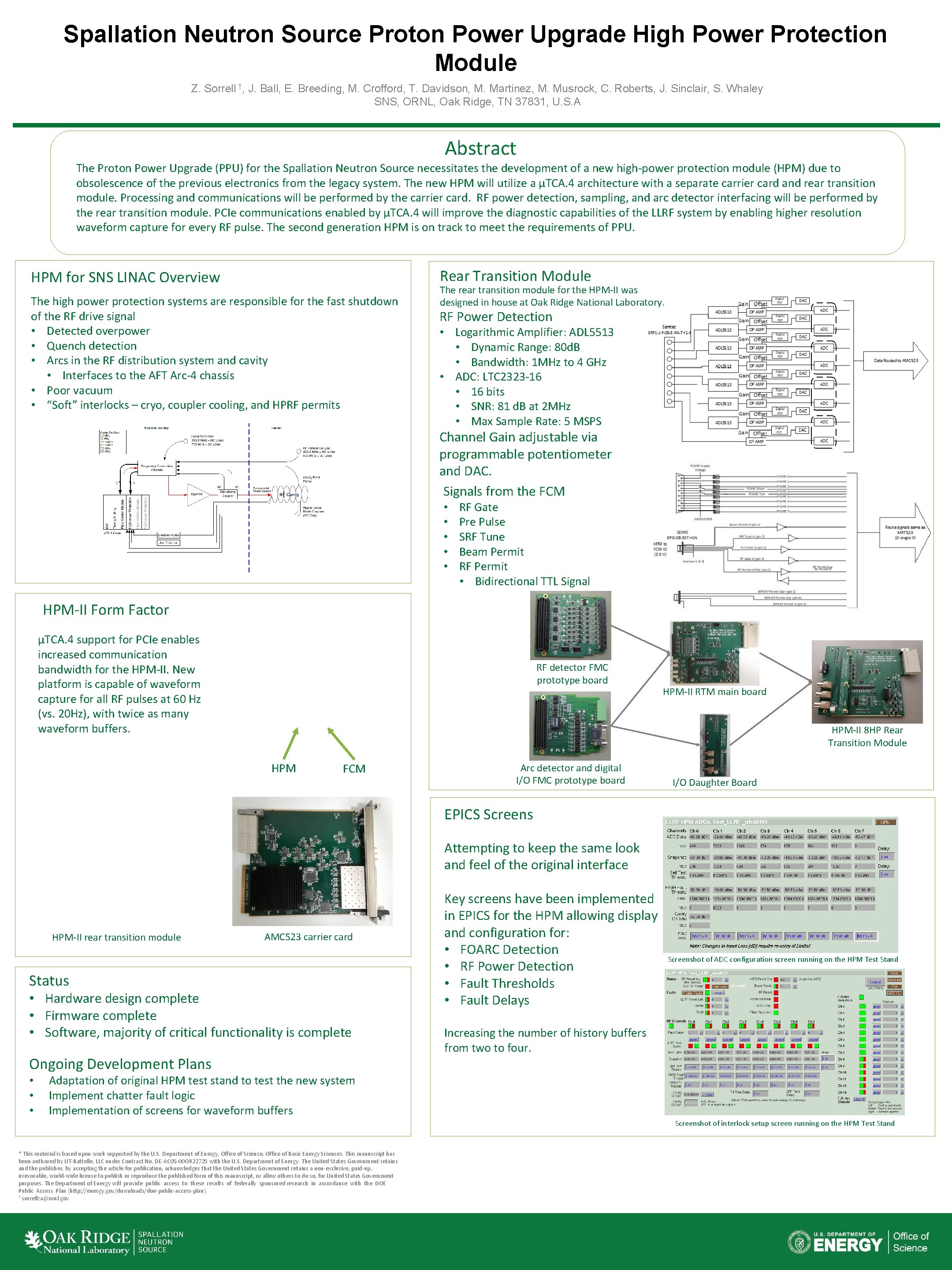
Spallation Neutron Source Proton Power Upgrade High Power Protection Module Z. Sorrell †, J. Ball, E. Breeding, M. Crofford, T. Davidson, M. Martinez, M. Musrock, C. Roberts, J. Sinclair, S. Whaley SNS, ORNL, Oak Ridge, TN 37831, U. S. A Abstract The Proton Power Upgrade (PPU) for the Spallation Neutron Source necessitates the development of a new high-power protection module (HPM) due to obsolescence of the previous electronics from the legacy system. The new HPM will utilize a µTCA. 4 architecture with a separate carrier card and rear transition module. Processing and communications will be performed by the carrier card. RF power detection, sampling, and arc detector interfacing will be performed by the rear transition module. PCIe communications enabled by µTCA. 4 will improve the diagnostic capabilities of the LLRF system by enabling higher resolution waveform capture for every RF pulse. The second generation HPM is on track to meet the requirements of PPU. Rear Transition Module HPM for SNS LINAC Overview The high power protection systems are responsible for the fast shutdown of the RF drive signal • Detected overpower • Quench detection • Arcs in the RF distribution system and cavity • Interfaces to the AFT Arc-4 chassis • Poor vacuum • “Soft” interlocks – cryo, coupler cooling, and HPRF permits The rear transition module for the HPM-II was designed in house at Oak Ridge National Laboratory. RF Power Detection • Logarithmic Amplifier: ADL 5513 • Dynamic Range: 80 d. B • Bandwidth: 1 MHz to 4 GHz • ADC: LTC 2323 -16 • 16 bits • SNR: 81 d. B at 2 MHz • Max Sample Rate: 5 MSPS Channel Gain adjustable via programmable potentiometer and DAC. Signals from the FCM • • • RF Gate Pre Pulse SRF Tune Beam Permit RF Permit • Bidirectional TTL Signal HPM-II Form Factor µTCA. 4 support for PCIe enables increased communication bandwidth for the HPM-II. New platform is capable of waveform capture for all RF pulses at 60 Hz (vs. 20 Hz), with twice as many waveform buffers. RF detector FMC prototype board HPM-II RTM main board HPM-II 8 HP Rear Transition Module HPM FCM Arc detector and digital I/O FMC prototype board I/O Daughter Board EPICS Screens Attempting to keep the same look and feel of the original interface HPM-II rear transition module AMC 523 carrier card Status • Hardware design complete • Firmware complete • Software, majority of critical functionality is complete Ongoing Development Plans • • • Key screens have been implemented in EPICS for the HPM allowing display and configuration for: • FOARC Detection • RF Power Detection • Fault Thresholds • Fault Delays Screenshot of ADC configuration screen running on the HPM Test Stand Increasing the number of history buffers from two to four. Adaptation of original HPM test stand to test the new system Implement chatter fault logic Implementation of screens for waveform buffers Screenshot of interlock setup screen running on the HPM Test Stand * This material is based upon work supported by the U. S. Department of Energy, Office of Science, Office of Basic Energy Sciences. This manuscript has been authored by UT-Battelle, LLC under Contract No. DE-AC 05 -00 OR 22725 with the U. S. Department of Energy. The United States Government retains and the publisher, by accepting the article for publication, acknowledges that the United States Government retains a non-exclusive, paid-up, irrevocable, world-wide license to publish or reproduce the published form of this manuscript, or allow others to do so, for United States Government purposes. The Department of Energy will provide public access to these results of federally sponsored research in accordance with the DOE Public Access Plan (http: //energy. gov/downloads/doe-public-access-plan). † sorrellza@ornl. gov