
Spallation Neutron Source Proton Power Upgrade Field Control
- Slides: 1
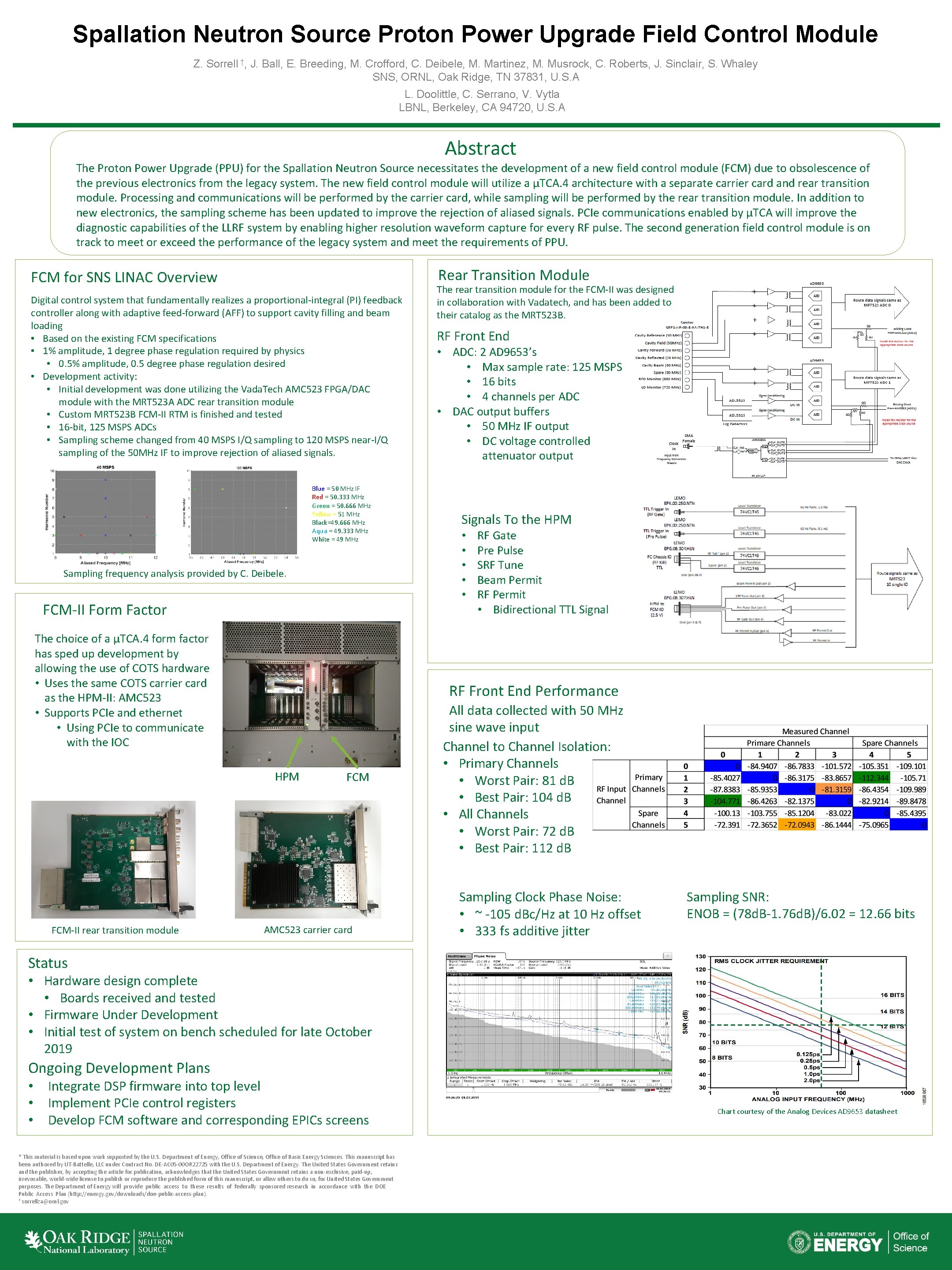
Spallation Neutron Source Proton Power Upgrade Field Control Module Z. Sorrell †, J. Ball, E. Breeding, M. Crofford, C. Deibele, M. Martinez, M. Musrock, C. Roberts, J. Sinclair, S. Whaley SNS, ORNL, Oak Ridge, TN 37831, U. S. A L. Doolittle, C. Serrano, V. Vytla LBNL, Berkeley, CA 94720, U. S. A Abstract The Proton Power Upgrade (PPU) for the Spallation Neutron Source necessitates the development of a new field control module (FCM) due to obsolescence of the previous electronics from the legacy system. The new field control module will utilize a µTCA. 4 architecture with a separate carrier card and rear transition module. Processing and communications will be performed by the carrier card, while sampling will be performed by the rear transition module. In addition to new electronics, the sampling scheme has been updated to improve the rejection of aliased signals. PCIe communications enabled by µTCA will improve the diagnostic capabilities of the LLRF system by enabling higher resolution waveform capture for every RF pulse. The second generation field control module is on track to meet or exceed the performance of the legacy system and meet the requirements of PPU. Rear Transition Module FCM for SNS LINAC Overview Digital control system that fundamentally realizes a proportional-integral (PI) feedback controller along with adaptive feed-forward (AFF) to support cavity filling and beam loading • Based on the existing FCM specifications • 1% amplitude, 1 degree phase regulation required by physics • 0. 5% amplitude, 0. 5 degree phase regulation desired • Development activity: • Initial development was done utilizing the Vada. Tech AMC 523 FPGA/DAC module with the MRT 523 A ADC rear transition module • Custom MRT 523 B FCM-II RTM is finished and tested • 16 -bit, 125 MSPS ADCs • Sampling scheme changed from 40 MSPS I/Q sampling to 120 MSPS near-I/Q sampling of the 50 MHz IF to improve rejection of aliased signals. Blue = 50 MHz IF Red = 50. 333 MHz Green = 50. 666 MHz Yellow = 51 MHz Black=49. 666 MHz Aqua = 49. 333 MHz White = 49 MHz Sampling frequency analysis provided by C. Deibele. FCM-II Form Factor The choice of a µTCA. 4 form factor has sped up development by allowing the use of COTS hardware • Uses the same COTS carrier card as the HPM-II: AMC 523 • Supports PCIe and ethernet • Using PCIe to communicate with the IOC RF Front End • ADC: 2 AD 9653’s • Max sample rate: 125 MSPS • 16 bits • 4 channels per ADC • DAC output buffers • 50 MHz IF output • DC voltage controlled attenuator output Signals To the HPM • • • RF Gate Pre Pulse SRF Tune Beam Permit RF Permit • Bidirectional TTL Signal RF Front End Performance HPM FCM-II rear transition module The rear transition module for the FCM-II was designed in collaboration with Vadatech, and has been added to their catalog as the MRT 523 B. FCM AMC 523 carrier card All data collected with 50 MHz sine wave input Channel to Channel Isolation: • Primary Channels • Worst Pair: 81 d. B • Best Pair: 104 d. B • All Channels • Worst Pair: 72 d. B • Best Pair: 112 d. B Sampling Clock Phase Noise: • ~ -105 d. Bc/Hz at 10 Hz offset • 333 fs additive jitter Sampling SNR: ENOB = (78 d. B-1. 76 d. B)/6. 02 = 12. 66 bits Status • Hardware design complete • Boards received and tested • Firmware Under Development • Initial test of system on bench scheduled for late October 2019 Ongoing Development Plans • • • Integrate DSP firmware into top level Implement PCIe control registers Develop FCM software and corresponding EPICs screens * This material is based upon work supported by the U. S. Department of Energy, Office of Science, Office of Basic Energy Sciences. This manuscript has been authored by UT-Battelle, LLC under Contract No. DE-AC 05 -00 OR 22725 with the U. S. Department of Energy. The United States Government retains and the publisher, by accepting the article for publication, acknowledges that the United States Government retains a non-exclusive, paid-up, irrevocable, world-wide license to publish or reproduce the published form of this manuscript, or allow others to do so, for United States Government purposes. The Department of Energy will provide public access to these results of federally sponsored research in accordance with the DOE Public Access Plan (http: //energy. gov/downloads/doe-public-access-plan). † sorrellza@ornl. gov Chart courtesy of the Analog Devices AD 9653 datasheet