
SPAIN By Briana Carvalho Julianna Vivino Samantha Fabrizio
SPAIN By: Briana Carvalho Julianna Vivino Samantha Fabrizio Megan Frain
SYMBOLS OF SPAIN v Animal: Bull v Bird: Short-Toed Eagle v Flower: Red Carnation v Coat of Arms: The country's coat of arms is composed of six (6) other coats of arms, including those of Aragon, House of Bourbon, Castile, Granada, Leon and Navarre. On either side of the Coat of Arms are the Pillars of Hercules, an ancient name given to the Straits of Gibraltar. It is topped by the royal crown of Spain. v National Anthem: La March Real (The Royal March), is an instrumental piece with no official lyrics. v Motto: “Plus Ultra” (means “Further Beyond”)
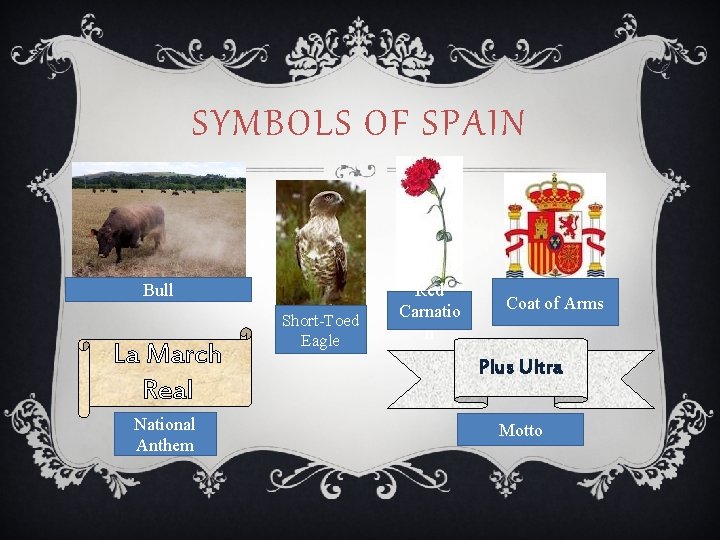
SYMBOLS OF SPAIN Bull La March Real National Anthem Short-Toed Eagle Red Carnatio n Coat of Arms Plus Ultra Motto
FLAG OF SPAIN The Spanish flag is a red and yellow horizontal tri-band (the yellow stripe is in the middle, and is twice as tall as each red band). A simplified version of Spain's coat of arms is pictured on the yellow band, towards the hoist side. The height of this flag is two-thirds the width. Spain's flag was officially adopted on December 19, 1981. An urban legend holds that the colors of the flag of Spain derive from the bullfight arena - with the red representing the bullfighter´s blood and the yellow the sand of the arena - but this has no basis in fact. The colors of the flag of Spain were chosen as they were the colors of King Ferdinand´s own coat of arms. The Spanish coat of arms depicts two crown-topped pillars of Hercules (with red banners displaying the motto in Latin, “PLUS ULTRA” alluding to Columbus' discovery of the New World). The two columns flank a shield that displays a castle, a lion wearing a crown, red and yellow vertical stripes, chain mail, and three fleurs-de-lis in an oval in the center. An ornate red and golden crown sits atop the shield. v Pledge to the Flag: The Spanish pledge to the flag is called the Jura de Bandera (meaning "oath of the flag").
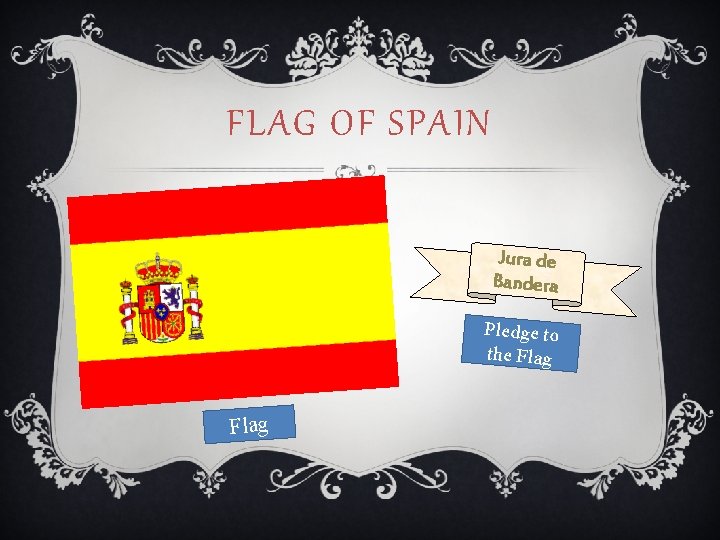
FLAG OF SPAIN Jura de Bandera Pledge to the Flag
MUSIC OF SPAIN v Flamenco: music and dance genre. Its origin and development was in Andalucia starting from XVII century. It attributed to Andalucia's persecuted gypsy culture, flamenco is a passionate form of music and dance combining Jewish, Moorish and Andalucían influences. v Jota: The fast tempo jota originally hails from Aragón but is popular - with minor modifications - throughout the rest of Spain. With probable Moorish influences, the jota is typically danced in two's as couples raise their hands above their heads playing castanets. v Fandango: Until flamenco came along, the fandango was Spain's most famous dance. Lively, energetic and happy, it's a traditional Spanish dance performed in couples. v Paso Doble: The paso doble is a quick and lively one-step traditional Spanish dance.
MUSIC OF SPAIN v Sardana: Danced in a closed circle by several couples joined at the hands, the sardana is a popular form of traditional Spanish music and dance from Cataluñia. v Muñeira. : Whether alone or in two's, the muñeira - or "Miller's Dance" - is a typical dance in Galicia and Asturias accompanied by soulful bagpipe music. v Bolero: A fast and spirited dance, the bolero - featuring unexpected pauses and sharp turns - is one of the oldest and most traditional Spanish dances. v Sevillanas: Sevillanas are, in many ways, reminiscent of flamenco. Joyful and undeniably happy, a sevillana is a four -part music with an accompanying four-part dance. v Zambra: The zambra actually got its start as a Moorish dance. While Moorish and Jewish music and dance were banned following the Reconquest, the Moors managed to conserve this particular dance by adapting it to traditional Spanish music and dance trends.
SPAIN’S GOVERNMENT v Spain’s president is Rodriguez Zapatero, sometimes referred to as “Zapatero”. He is married with 2 daughters. He and his family are very private about their personal lives. For the most part, the media has respected that. v Political Parties: - Unificatiōn Comunista de España - Partido Popular - Los Verdes - Cultura Natural - Communist Party of Asturia v As of 2012, the population of Spain was 47, 265, 321. Like the rest of the world, that number is transient.
SPAIN’S “NATIONAL DAY” Spain doesn’t have an Independence Day. However, it does have a “National Day”, which is October 12. It began in 1942.
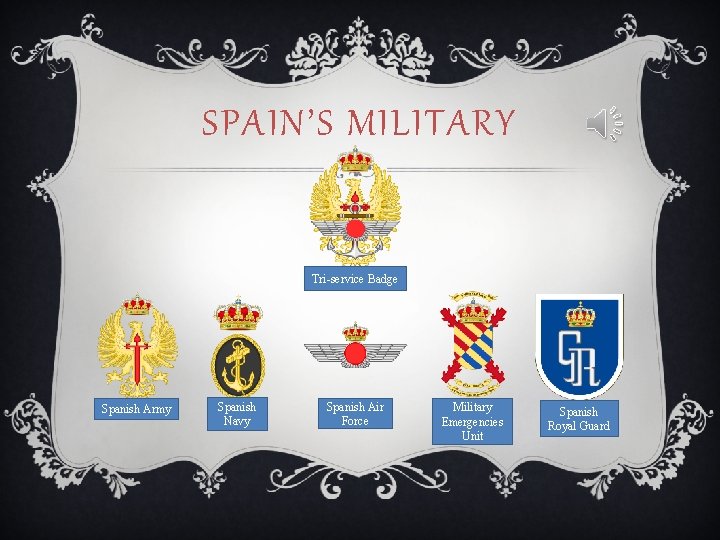
SPAIN’S MILITARY Tri-service Badge Spanish Army Spanish Navy Spanish Air Force Military Emergencies Unit Spanish Royal Guard
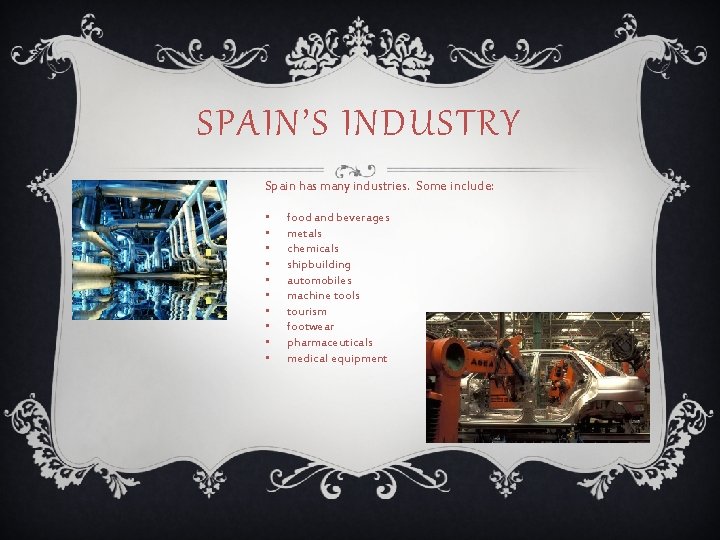
SPAIN’S INDUSTRY Spain has many industries. Some include: • • • food and beverages metals chemicals shipbuilding automobiles machine tools tourism footwear pharmaceuticals medical equipment
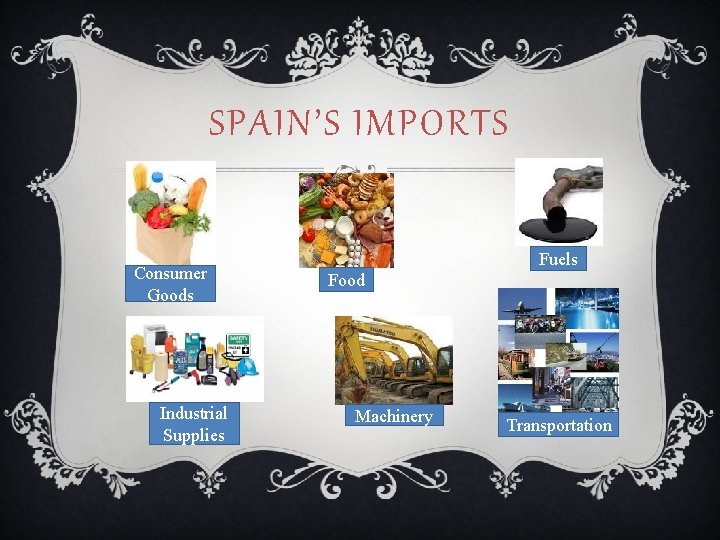
SPAIN’S IMPORTS Consumer Goods Industrial Supplies Fuels Food Machinery Transportation
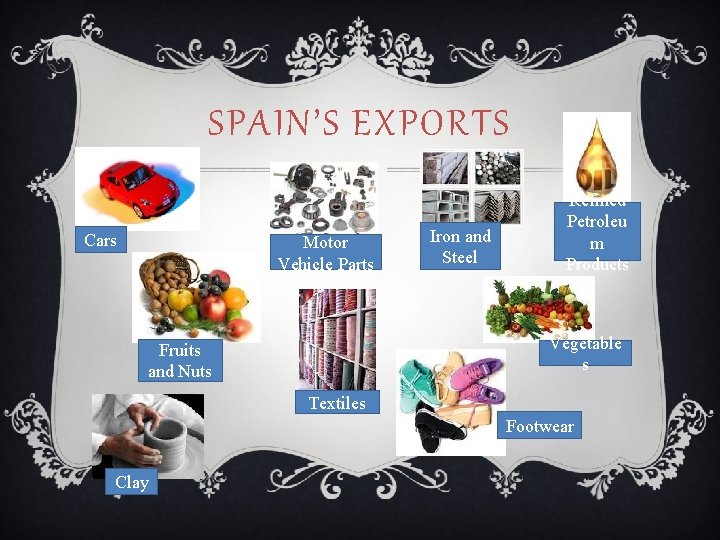
SPAIN’S EXPORTS Cars Motor Vehicle Parts Iron and Steel Refined Petroleu m Products Vegetable s Fruits and Nuts Textiles Footwear Clay
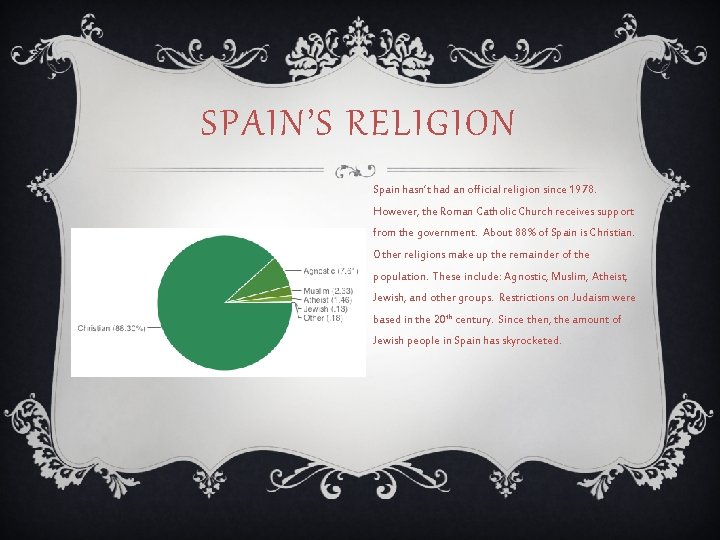
SPAIN’S RELIGION Spain hasn’t had an official religion since 1978. However, the Roman Catholic Church receives support from the government. About 88% of Spain is Christian. Other religions make up the remainder of the population. These include: Agnostic, Muslim, Atheist, Jewish, and other groups. Restrictions on Judaism were based in the 20 th century. Since then, the amount of Jewish people in Spain has skyrocketed.
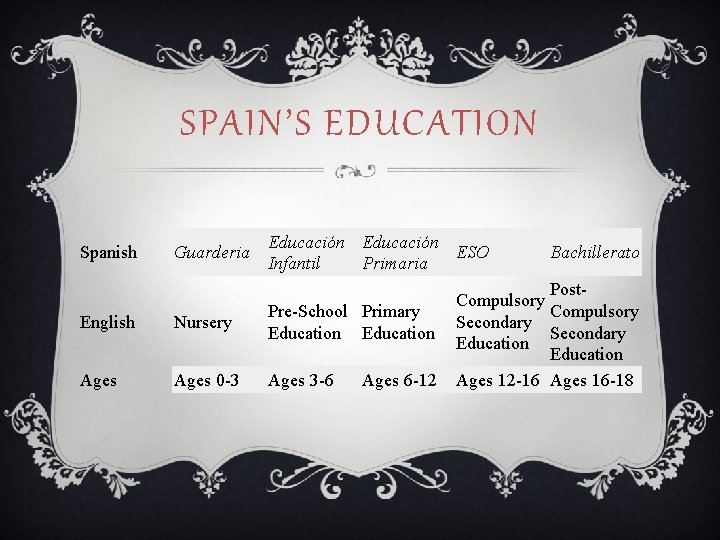
SPAIN’S EDUCATION Spanish Guarderia Educación ESO Infantil Primaria English Nursery Pre-School Primary Education Ages 0 -3 Ages 3 -6 Ages 6 -12 Bachillerato Post. Compulsory Secondary Education Ages 12 -16 Ages 16 -18
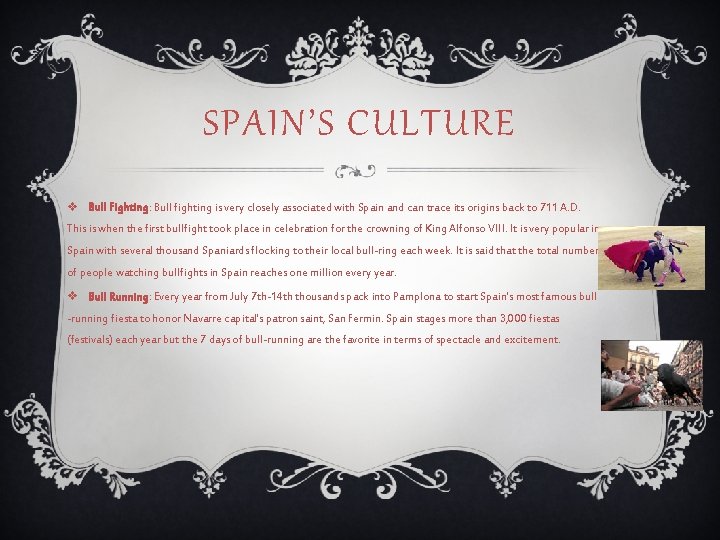
SPAIN’S CULTURE v Bull Fighting: Bull fighting is very closely associated with Spain and can trace its origins back to 711 A. D. This is when the first bullfight took place in celebration for the crowning of King Alfonso VIII. It is very popular in Spain with several thousand Spaniards flocking to their local bull-ring each week. It is said that the total number of people watching bullfights in Spain reaches one million every year. v Bull Running: Every year from July 7 th-14 th thousands pack into Pamplona to start Spain's most famous bull -running fiesta to honor Navarre capital's patron saint, San Fermin. Spain stages more than 3, 000 fiestas (festivals) each year but the 7 days of bull-running are the favorite in terms of spectacle and excitement.
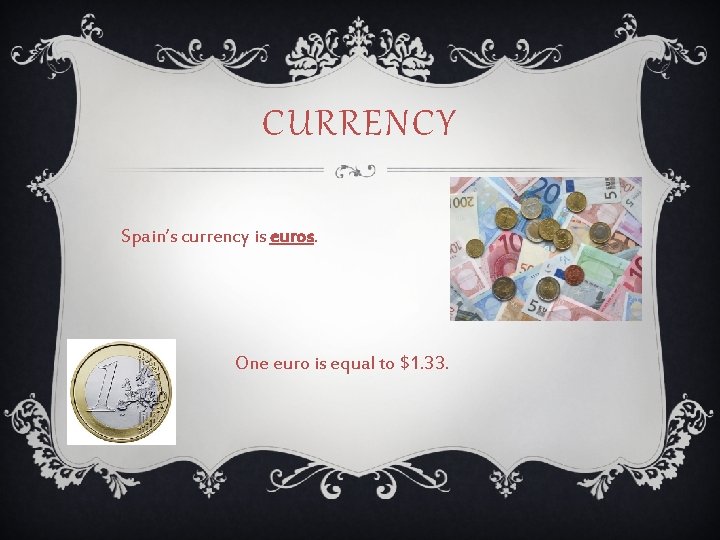
CURRENCY Spain’s currency is euros. One euro is equal to $1. 33.
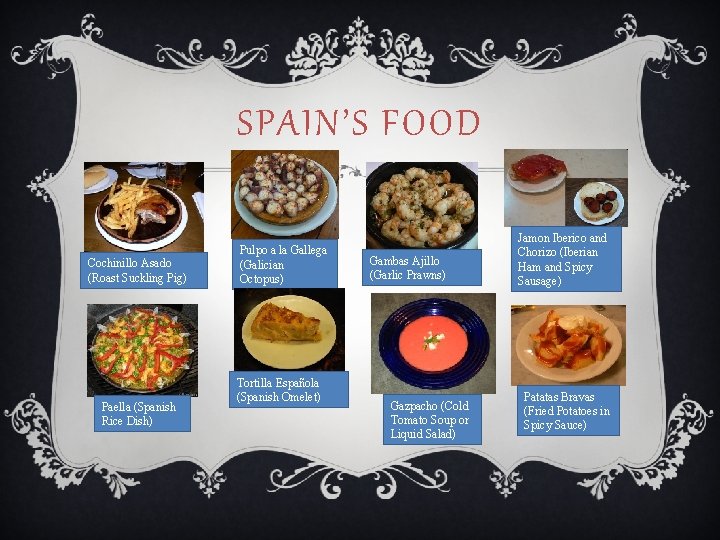
SPAIN’S FOOD Cochinillo Asado (Roast Suckling Pig) Paella (Spanish Rice Dish) Pulpo a la Gallega (Galician Octopus) Tortilla Española (Spanish Omelet) Gambas Ajillo (Garlic Prawns) Gazpacho (Cold Tomato Soup or Liquid Salad) Jamon Iberico and Chorizo (Iberian Ham and Spicy Sausage) Patatas Bravas (Fried Potatoes in Spicy Sauce)
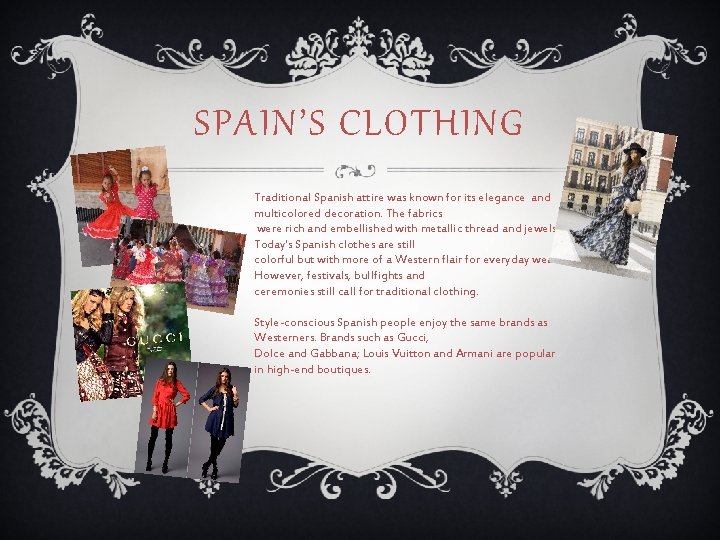
SPAIN’S CLOTHING Traditional Spanish attire was known for its elegance and multicolored decoration. The fabrics were rich and embellished with metallic thread and jewels. Today's Spanish clothes are still colorful but with more of a Western flair for everyday wear. However, festivals, bullfights and ceremonies still call for traditional clothing. Style-conscious Spanish people enjoy the same brands as Westerners. Brands such as Gucci, Dolce and Gabbana; Louis Vuitton and Armani are popular in high-end boutiques.
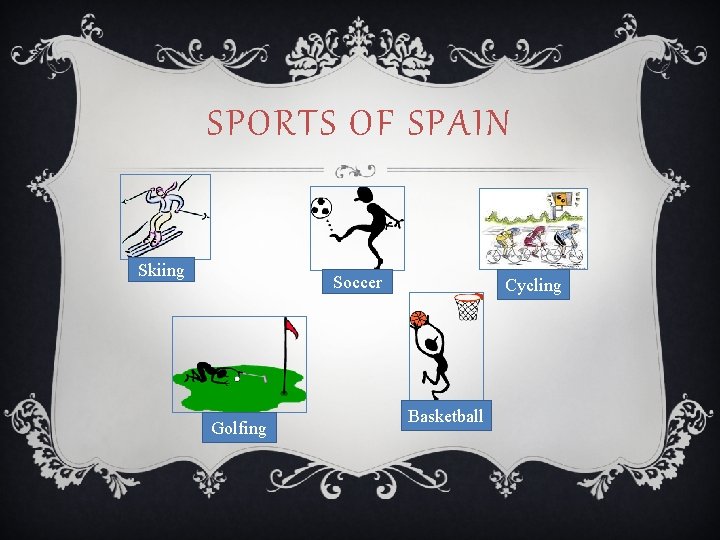
SPORTS OF SPAIN Skiing Soccer Golfing Cycling Basketball
FUN FACTS! v Most households buy fresh bread every day. Traditionally, they are long baguettes called barras or pistolas. Bread is present (and required) at almost every meal. v Spain is the world's 51 st-largest country and the third largest country in Europe. v Spain has over 8, 000 km of beaches. v During the 16 th century, Spain was one of the most powerful empires in the world v There are no tooth fairies in Spain. Instead, there is a tooth mouse named Ratoncito Pérez. v Spain is the only country in Europe that produces bananas.
SOURCES v www. euroresidentes. com v www. spanish-fiestas. com v www. thearda. com v www. badrash. com v www. spain. angloinfo. com v www. nationsencyclopedia. com v www. worldatlas. com/webimage/countrys/europe/spain/essymbols. htm v www. enchantedlearning. com/europe/spain/flag v www. whatspain. com/traditional-spanish. html v http: //en. wikipedia. org/wiki/Spanish_Armed_Forces v http: /gospain. about. com/od/fooddrink/ss/topspanishfood. htm v *pie chart link: www. thearda. com/internationaldata/countries/country_208_1. asp*
- Slides: 22