
SpaceTimeFrequency Methods for InterferenceLimited Communication Systems Karl F
![Summary of Relevant Work by Presenter [Nie 10 a] – K. F. Nieman, K.](https://slidetodoc.com/presentation_image_h/28fc761750ddcb01040d8236d88610a8/image-41.jpg "Summary of Relevant Work by Presenter [Nie 10 a] – K. F. Nieman, K.")
![References [Cai 08] – G. Caire; T. Y. Al-Naffouri; A. K. Narayanan, "Impulse noise](https://slidetodoc.com/presentation_image_h/28fc761750ddcb01040d8236d88610a8/image-42.jpg "References [Cai 08] – G. Caire; T. Y. Al-Naffouri; A. K. Narayanan, \"Impulse noise")
- Slides: 43
Space-Time-Frequency Methods for Interference-Limited Communication Systems Karl F. Nieman Department of Electrical and Computer Engineering The University of Texas at Austin PHD DEFENSE October 22, 2014 COMMITTEE MEMBERS Brian L. Evans Ross Baldick Robert W. Heath, Jr. Russell Pinkston Preston S. Wilson
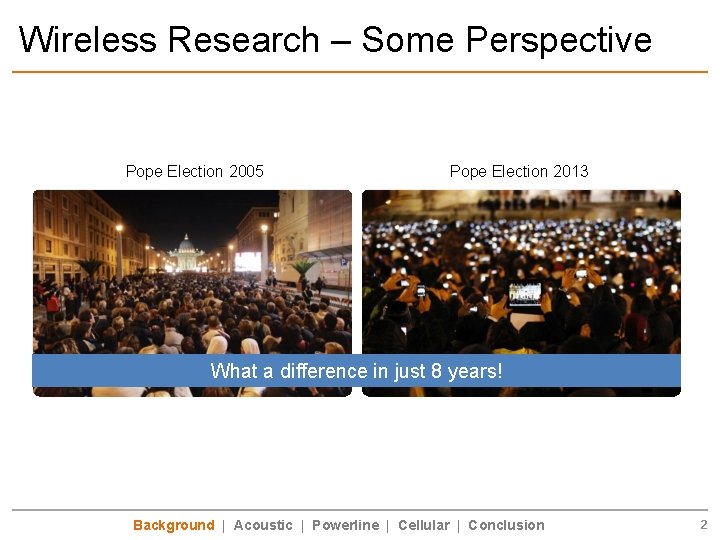
Wireless Research – Some Perspective Pope Election 2005 Pope Election 2013 What a difference in just 8 years! Background | Acoustic | Powerline | Cellular | Conclusion 2
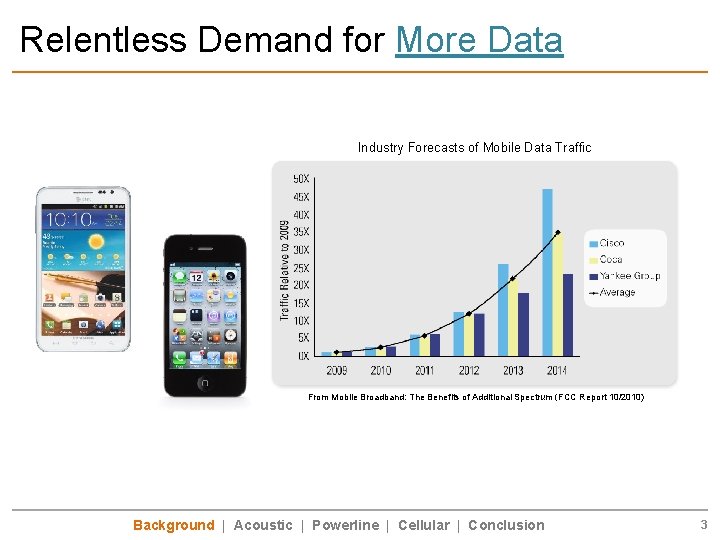
Relentless Demand for More Data Industry Forecasts of Mobile Data Traffic From Mobile Broadband: The Benefits of Additional Spectrum (FCC Report 10/2010) Background | Acoustic | Powerline | Cellular | Conclusion 3
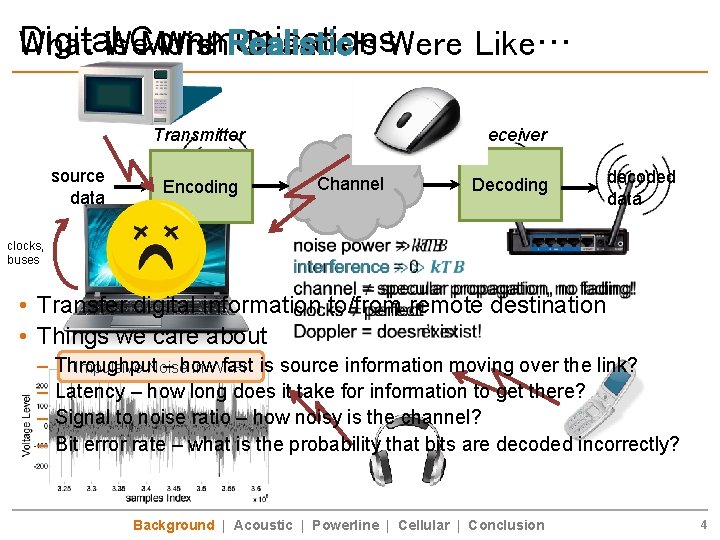
Digital Communications What We. More is Wish. Realistic… Channels Were Like… Transmitter source data clocks, buses Receiver Channel Encoding Decoding decoded data • Transfer digital information to/from remote destination • Things we care about – – Throughput – how fast is source information moving over the link? Impulsive Noise in Wi-Fi Latency – how long does it take for information to get there? Signal to noise ratio – how noisy is the channel? Bit error rate – what is the probability that bits are decoded incorrectly? Background | Acoustic | Powerline | Cellular | Conclusion 4
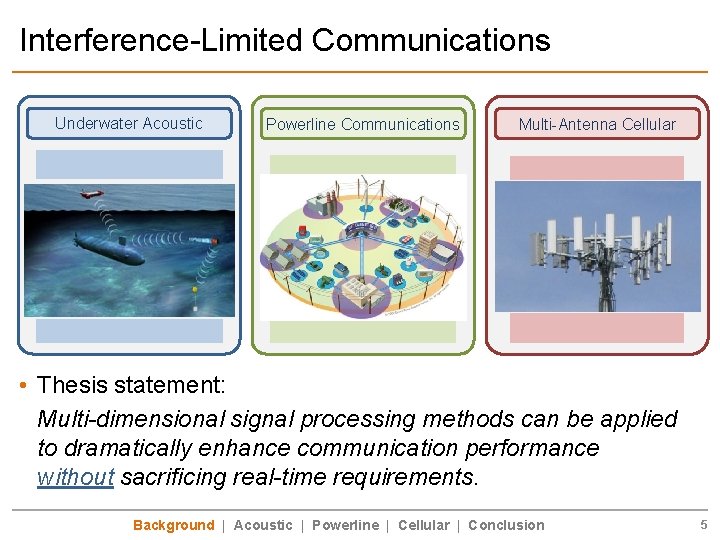
Interference-Limited Communications Underwater Acoustic Powerline Communications Multi-Antenna Cellular • Thesis statement: Multi-dimensional signal processing methods can be applied to dramatically enhance communication performance without sacrificing real-time requirements. Background | Acoustic | Powerline | Cellular | Conclusion 5
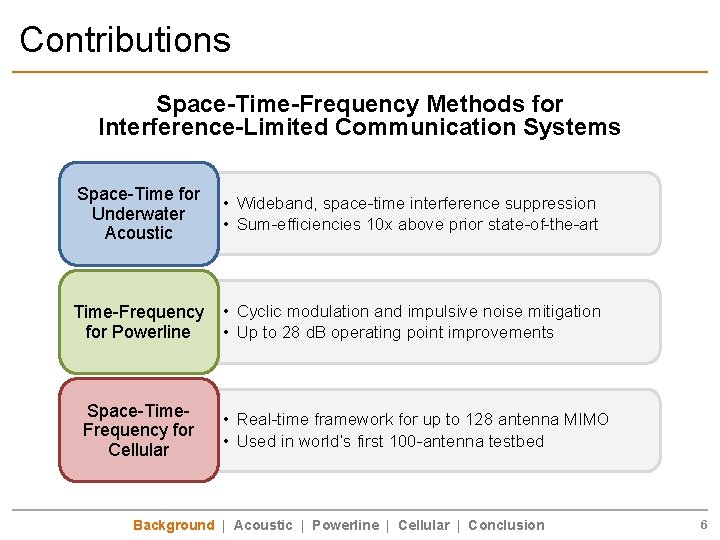
Contributions Space-Time-Frequency Methods for Interference-Limited Communication Systems Space-Time for • Wideband, space-time interference suppression Underwater • Sum-efficiencies 10 x above prior state-of-the-art Acoustic Time-Frequency • Cyclic modulation and impulsive noise mitigation for Powerline • Up to 28 d. B operating point improvements Space-Time. Frequency for Cellular • Real-time framework for up to 128 antenna MIMO • Used in world’s first 100 -antenna testbed Background | Acoustic | Powerline | Cellular | Conclusion 6
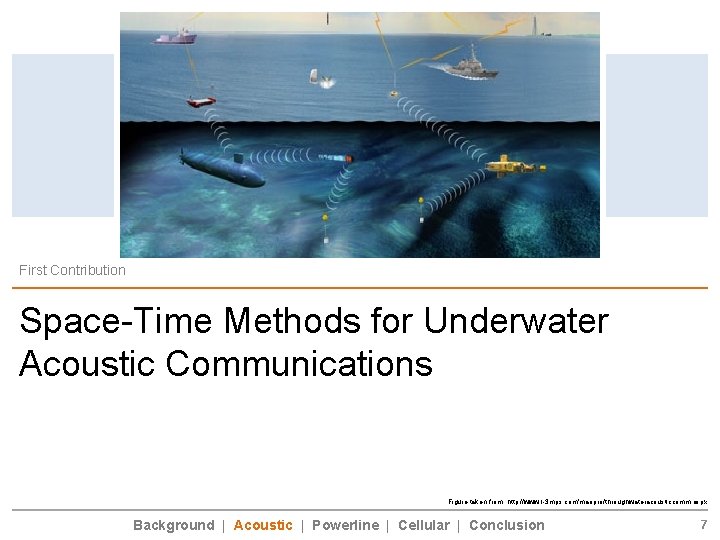
First Contribution Space-Time Methods for Underwater Acoustic Communications Figure taken from: http: //www. l-3 mps. com/maripro/throughwateracousticcomm. aspx Background | Acoustic | Powerline | Cellular | Conclusion 7
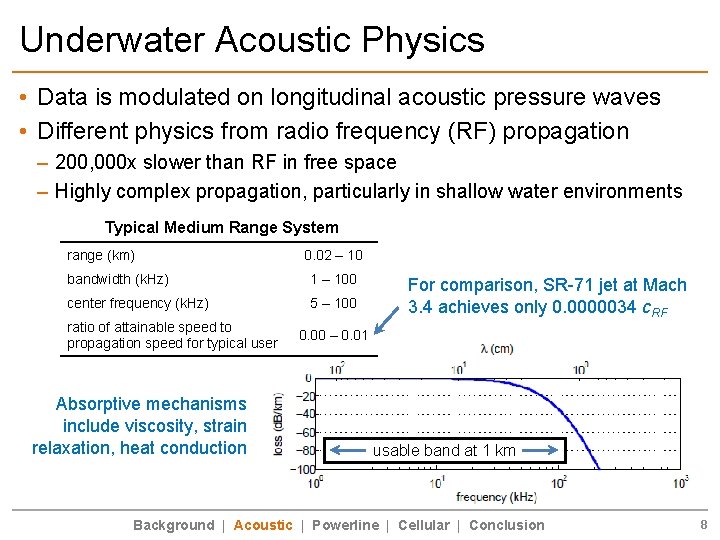
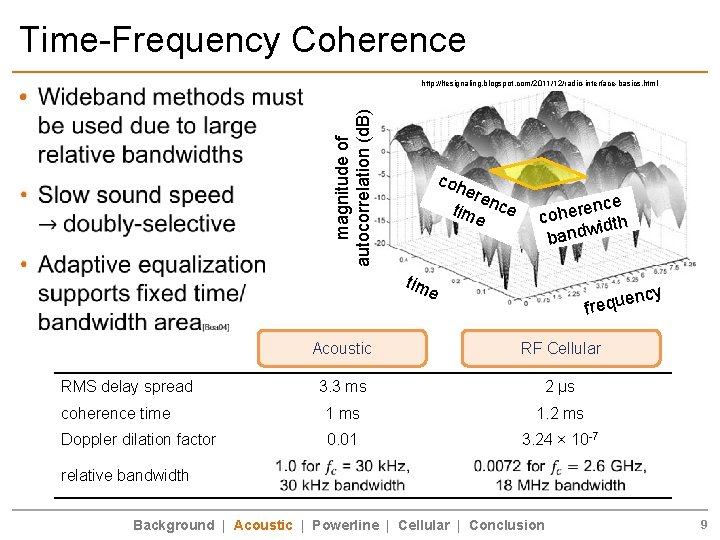
Underwater Acoustic Physics • Data is modulated on longitudinal acoustic pressure waves • Different physics from radio frequency (RF) propagation – 200, 000 x slower than RF in free space – Highly complex propagation, particularly in shallow water environments Typical Medium Range System range (km) 0. 02 – 10 bandwidth (k. Hz) 1 – 100 center frequency (k. Hz) 5 – 100 ratio of attainable speed to propagation speed for typical user Absorptive mechanisms include viscosity, strain relaxation, heat conduction For comparison, SR-71 jet at Mach 3. 4 achieves only 0. 0000034 c. RF 0. 00 – 0. 01 usable band at 1 km Background | Acoustic | Powerline | Cellular | Conclusion 8
Time-Frequency Coherence http: //ltesignaling. blogspot. com/2011/12/radio-interface-basics. html magnitude of autocorrelation (d. B) • coh ere tim nce e ce n e r e coh idth w d n a b tim e en frequ Acoustic RF Cellular 3. 3 ms 2 μs coherence time 1 ms 1. 2 ms Doppler dilation factor 0. 01 3. 24 × 10 -7 RMS delay spread cy relative bandwidth Background | Acoustic | Powerline | Cellular | Conclusion 9
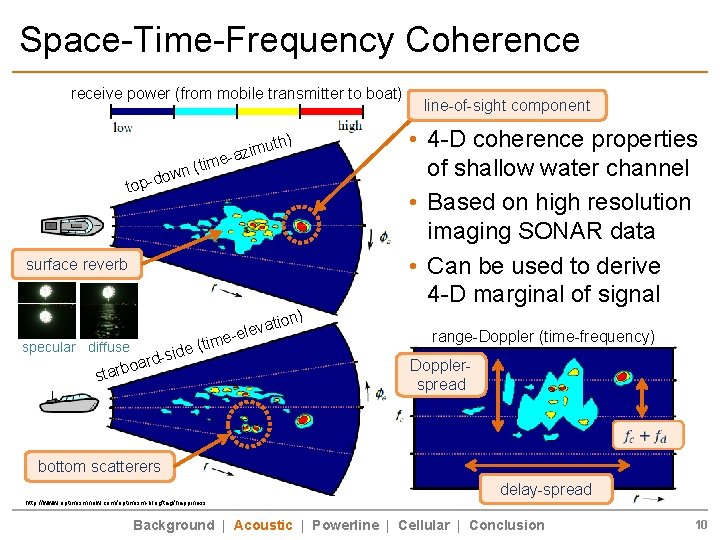
Space-Time-Frequency Coherence receive power (from mobile transmitter to boat) h) imut z a e (tim wn p-do to surface reverb specular diffuse de rd-si oa starb ion) t a v -ele (time line-of-sight component • 4 -D coherence properties of shallow water channel • Based on high resolution imaging SONAR data • Can be used to derive 4 -D marginal of signal range-Doppler (time-frequency) Dopplerspread bottom scatterers delay-spread http: //www. optimismnow. com/optimism-blog/tag/happiness Background | Acoustic | Powerline | Cellular | Conclusion 10
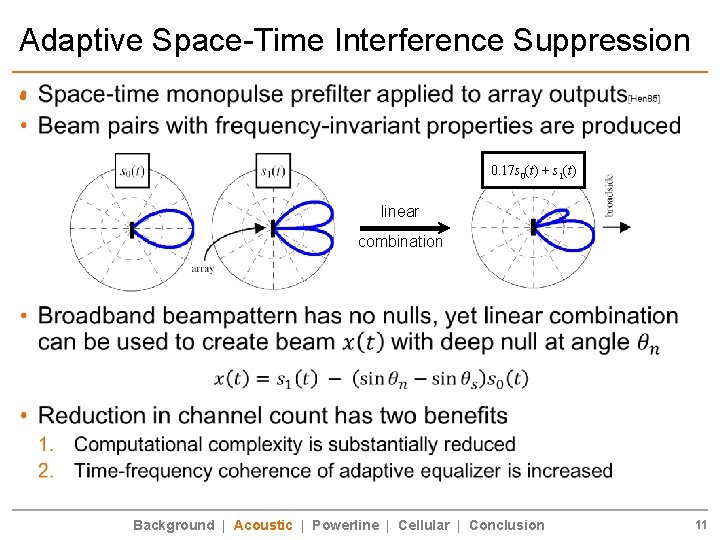
Adaptive Space-Time Interference Suppression • 0. 17 s 0(t) + s 1(t) linear combination Background | Acoustic | Powerline | Cellular | Conclusion 11
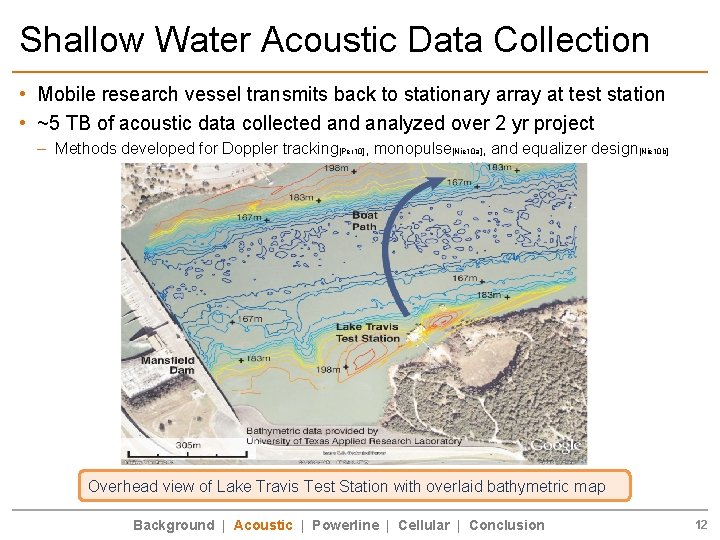
Shallow Water Acoustic Data Collection • Mobile research vessel transmits back to stationary array at test station • ~5 TB of acoustic data collected analyzed over 2 yr project – Methods developed for Doppler tracking[Per 10], monopulse[Nie 10 a], and equalizer design[Nie 10 b] Overhead view of Lake Travis Test Station with overlaid bathymetric map Background | Acoustic | Powerline | Cellular | Conclusion 12
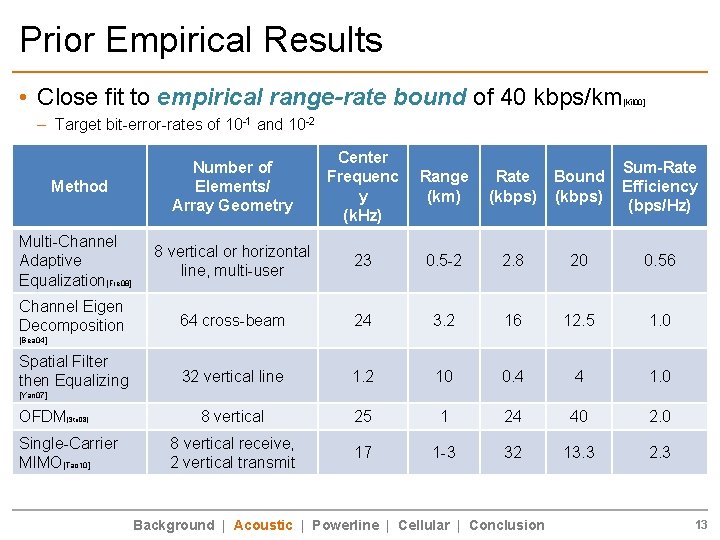
Prior Empirical Results • Close fit to empirical range-rate bound of 40 kbps/km [Kil 00] – Target bit-error-rates of 10 -1 and 10 -2 Method Number of Elements/ Array Geometry Center Frequenc y (k. Hz) Range (km) Rate (kbps) Bound (kbps) Sum-Rate Efficiency (bps/Hz) Multi-Channel Adaptive Equalization[Fre 08] 8 vertical or horizontal line, multi-user 23 0. 5 -2 2. 8 20 0. 56 Channel Eigen Decomposition 64 cross-beam 24 3. 2 16 12. 5 1. 0 32 vertical line 1. 2 10 0. 4 4 1. 0 8 vertical 25 1 24 40 2. 0 8 vertical receive, 2 vertical transmit 17 1 -3 32 13. 3 2. 3 [Bea 04] Spatial Filter then Equalizing [Yan 07] OFDM[Sto 08] Single-Carrier MIMO[Tao 10] Background | Acoustic | Powerline | Cellular | Conclusion 13
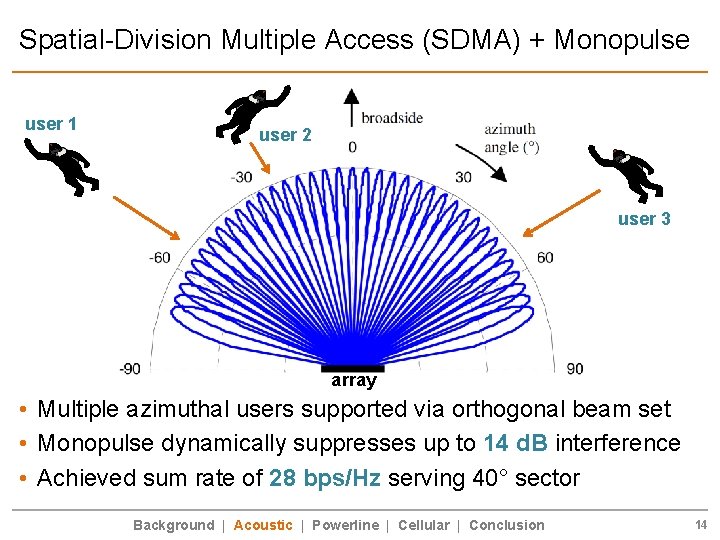
Spatial-Division Multiple Access (SDMA) + Monopulse user 1 user 2 user 3 array • Multiple azimuthal users supported via orthogonal beam set • Monopulse dynamically suppresses up to 14 d. B interference • Achieved sum rate of 28 bps/Hz serving 40° sector Background | Acoustic | Powerline | Cellular | Conclusion 14
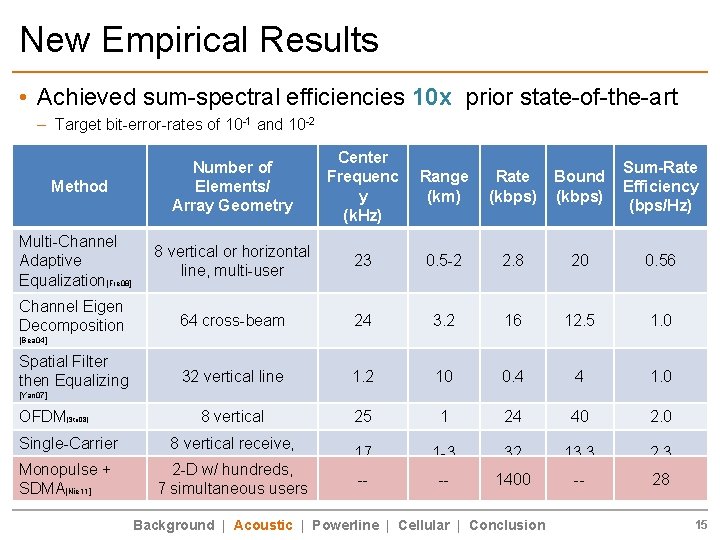
New Empirical Results • Achieved sum-spectral efficiencies 10 x prior state-of-the-art – Target bit-error-rates of 10 -1 and 10 -2 Method Number of Elements/ Array Geometry Center Frequenc y (k. Hz) Range (km) Rate (kbps) Bound (kbps) Sum-Rate Efficiency (bps/Hz) Multi-Channel Adaptive Equalization[Fre 08] 8 vertical or horizontal line, multi-user 23 0. 5 -2 2. 8 20 0. 56 Channel Eigen Decomposition 64 cross-beam 24 3. 2 16 12. 5 1. 0 32 vertical line 1. 2 10 0. 4 4 1. 0 8 vertical 25 1 24 40 2. 0 8 vertical receive, 2 vertical transmit 2 -D w/ hundreds, 17 1 -3 32 13. 3 2. 3 -- -- 1400 -- 28 [Bea 04] Spatial Filter then Equalizing [Yan 07] OFDM[Sto 08] Single-Carrier MIMO [Tao 10] Monopulse + SDMA[Nie 11] 7 simultaneous users Background | Acoustic | Powerline | Cellular | Conclusion 15
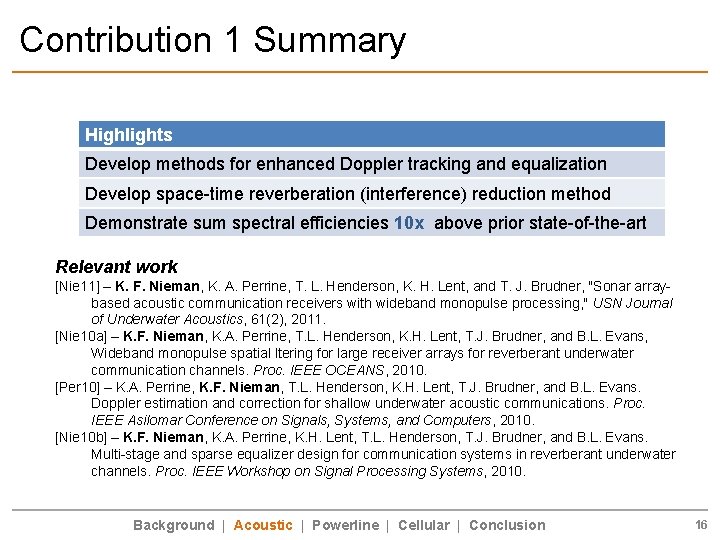
Contribution 1 Summary Highlights Develop methods for enhanced Doppler tracking and equalization Develop space-time reverberation (interference) reduction method Demonstrate sum spectral efficiencies 10 x above prior state-of-the-art Relevant work [Nie 11] – K. F. Nieman, K. A. Perrine, T. L. Henderson, K. H. Lent, and T. J. Brudner, "Sonar arraybased acoustic communication receivers with wideband monopulse processing, " USN Journal of Underwater Acoustics, 61(2), 2011. [Nie 10 a] – K. F. Nieman, K. A. Perrine, T. L. Henderson, K. H. Lent, T. J. Brudner, and B. L. Evans, Wideband monopulse spatial ltering for large receiver arrays for reverberant underwater communication channels. Proc. IEEE OCEANS, 2010. [Per 10] – K. A. Perrine, K. F. Nieman, T. L. Henderson, K. H. Lent, T. J. Brudner, and B. L. Evans. Doppler estimation and correction for shallow underwater acoustic communications. Proc. IEEE Asilomar Conference on Signals, Systems, and Computers, 2010. [Nie 10 b] – K. F. Nieman, K. A. Perrine, K. H. Lent, T. L. Henderson, T. J. Brudner, and B. L. Evans. Multi-stage and sparse equalizer design for communication systems in reverberant underwater channels. Proc. IEEE Workshop on Signal Processing Systems, 2010. Background | Acoustic | Powerline | Cellular | Conclusion 16
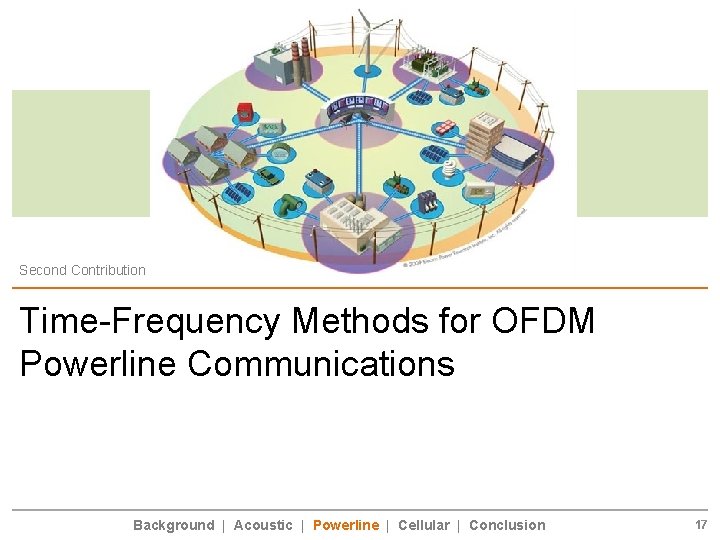
Second Contribution Time-Frequency Methods for OFDM Powerline Communications Background | Acoustic | Powerline | Cellular | Conclusion 17
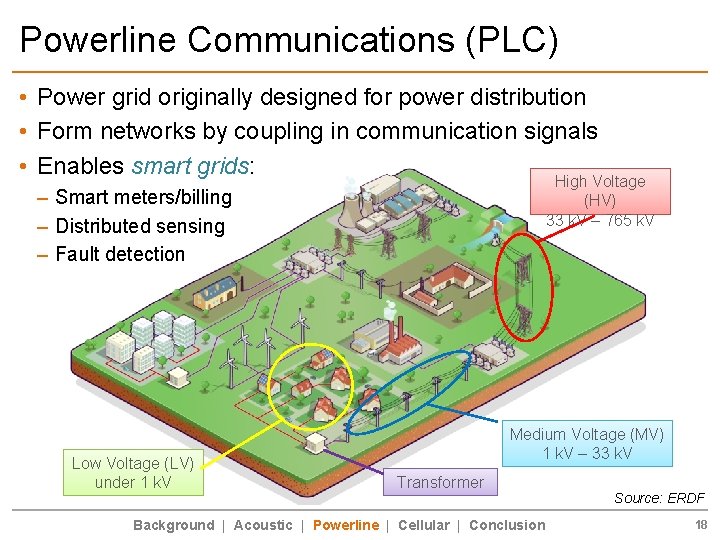
Powerline Communications (PLC) • Power grid originally designed for power distribution • Form networks by coupling in communication signals • Enables smart grids: High Voltage (HV) 33 k. V – 765 k. V – Smart meters/billing – Distributed sensing – Fault detection Low Voltage (LV) under 1 k. V Medium Voltage (MV) 1 k. V – 33 k. V Transformer Background | Acoustic | Powerline | Cellular | Conclusion Source: ERDF 18
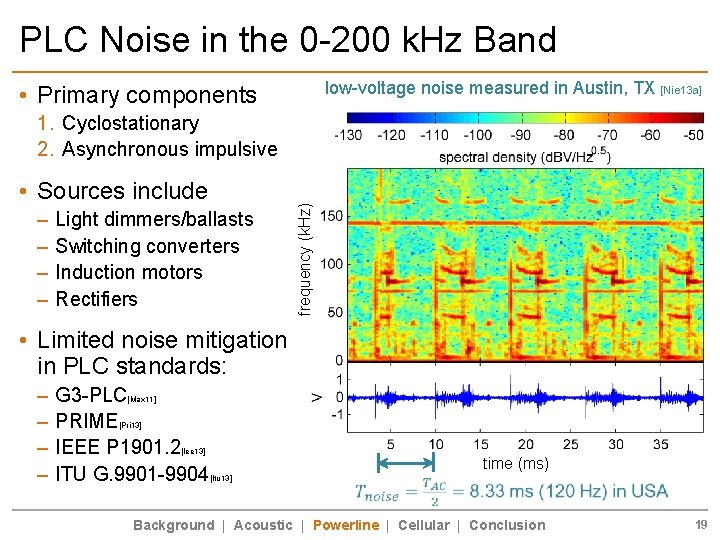
PLC Noise in the 0 -200 k. Hz Band low-voltage noise measured in Austin, TX [Nie 13 a] • Primary components • Sources include – – Light dimmers/ballasts Switching converters Induction motors Rectifiers frequency (k. Hz) 1. Cyclostationary 2. Asynchronous impulsive • Limited noise mitigation in PLC standards: – – G 3 -PLC PRIME IEEE P 1901. 2 ITU G. 9901 -9904 [Max 11] [Pri 13] [Iee 13] time (ms) [Itu 13] Background | Acoustic | Powerline | Cellular | Conclusion 19
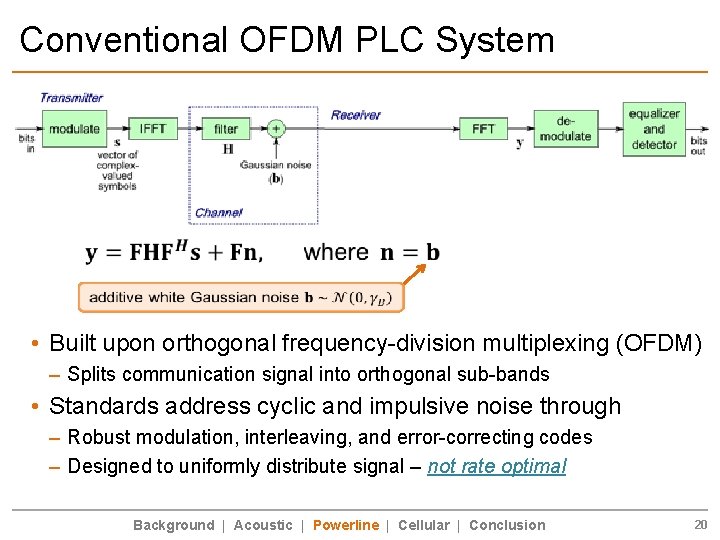
Conventional OFDM PLC System • Built upon orthogonal frequency-division multiplexing (OFDM) – Splits communication signal into orthogonal sub-bands • Standards address cyclic and impulsive noise through – Robust modulation, interleaving, and error-correcting codes – Designed to uniformly distribute signal – not rate optimal Background | Acoustic | Powerline | Cellular | Conclusion 20
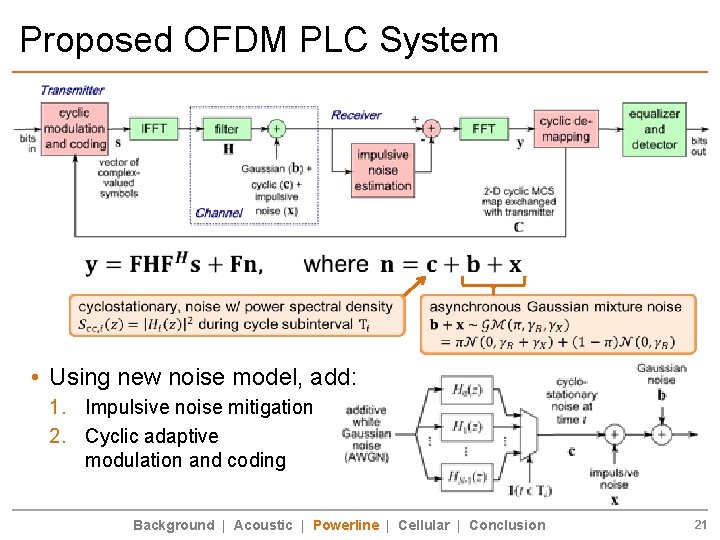
Proposed OFDM PLC System • Using new noise model, add: 1. Impulsive noise mitigation 2. Cyclic adaptive modulation and coding Background | Acoustic | Powerline | Cellular | Conclusion 21
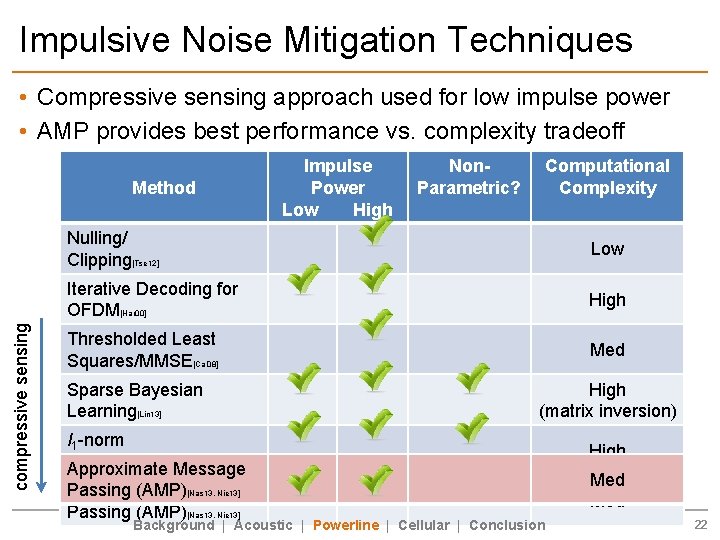
Impulsive Noise Mitigation Techniques • Compressive sensing approach used for low impulse power • AMP provides best performance vs. complexity tradeoff compressive sensing Method Impulse Power Low High Non. Parametric? Computational Complexity Nulling/ Clipping[Tse 12] Low Iterative Decoding for OFDM[Har 00] High Thresholded Least Squares/MMSE[Cai 08] Med Sparse Bayesian Learning[Lin 13] High (matrix inversion) l 1 -norm minimization [Cai 08] Approximate Message Passing (AMP) [Nas 13, Nie 13] Passing (AMP)[Nas 13, Nie 13] Background | Acoustic | Powerline | Cellular | Conclusion High Med 22
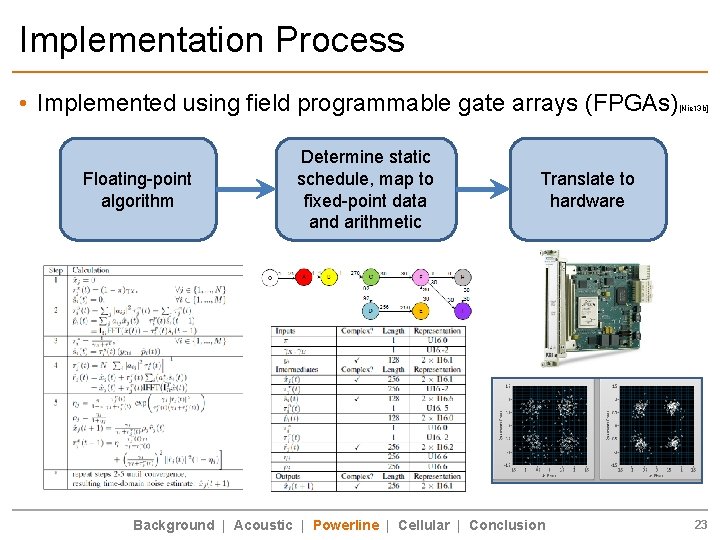
Implementation Process • Implemented using field programmable gate arrays (FPGAs) Floating-point algorithm Determine static schedule, map to fixed-point data and arithmetic [Nie 13 b] Translate to hardware Background | Acoustic | Powerline | Cellular | Conclusion 23
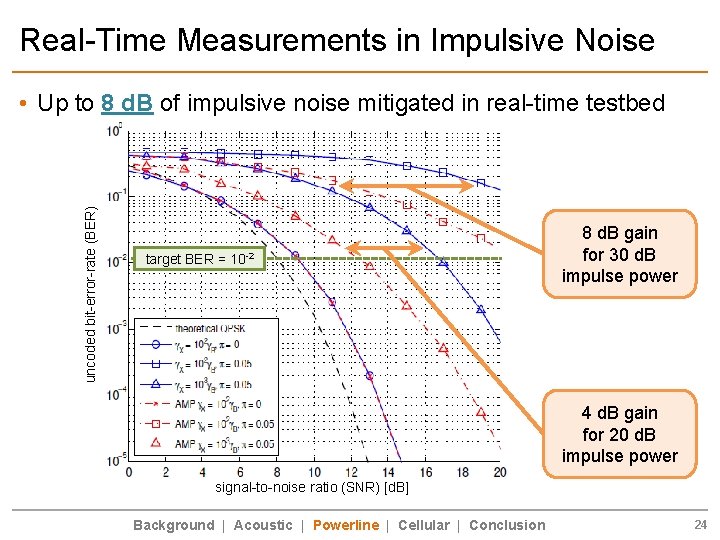
Real-Time Measurements in Impulsive Noise uncoded bit-error-rate (BER) • Up to 8 d. B of impulsive noise mitigated in real-time testbed target BER = 10 -2 8 d. B gain for 30 d. B impulse power 4 d. B gain for 20 d. B impulse power signal-to-noise ratio (SNR) [d. B] Background | Acoustic | Powerline | Cellular | Conclusion 24
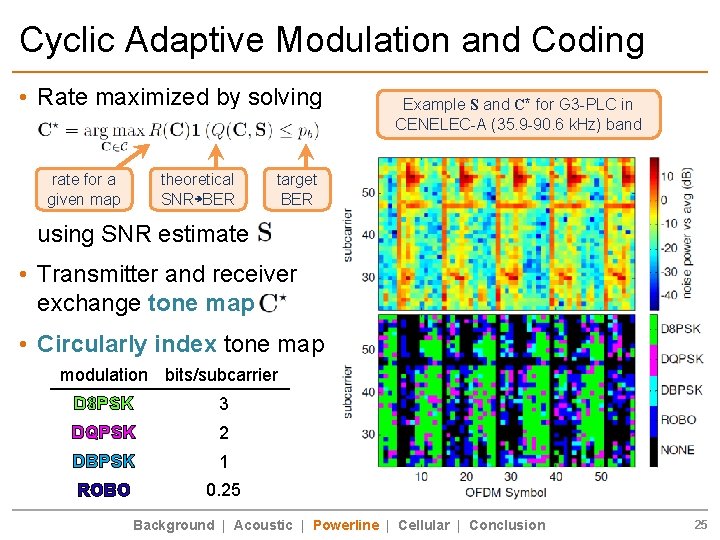
Cyclic Adaptive Modulation and Coding • Rate maximized by solving rate for a given map theoretical SNR→BER Example S and C* for G 3 -PLC in CENELEC-A (35. 9 -90. 6 k. Hz) band target BER using SNR estimate • Transmitter and receiver exchange tone map • Circularly index tone map modulation bits/subcarrier D 8 PSK 3 DQPSK 2 DBPSK 1 ROBO 0. 25 Background | Acoustic | Powerline | Cellular | Conclusion 25
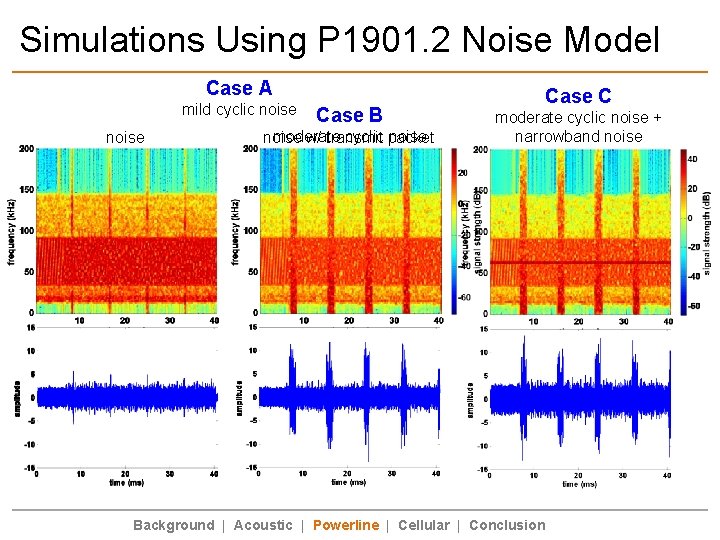
Simulations Using P 1901. 2 Noise Model Case A mild cyclic noise Case B moderate cyclic noise w/ transmit packet Case C moderate cyclic noise + narrowband noise Background | Acoustic | Powerline | Cellular | Conclusion
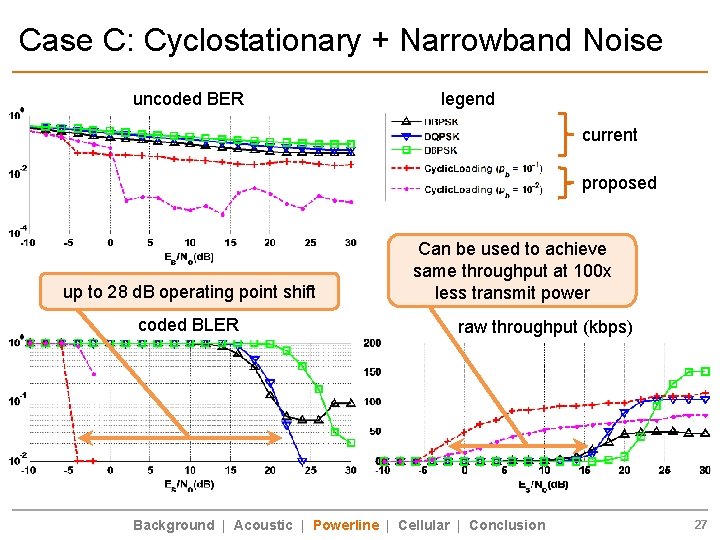
Case C: Cyclostationary + Narrowband Noise uncoded BER legend current proposed up to 28 d. B operating point shift coded BLER Can be used to achieve same throughput at 100 x less transmit power raw throughput (kbps) Background | Acoustic | Powerline | Cellular | Conclusion 27
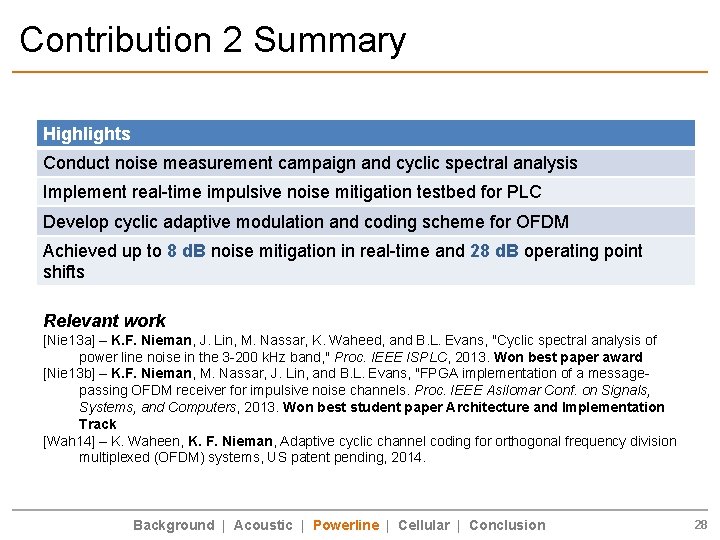
Contribution 2 Summary Highlights Conduct noise measurement campaign and cyclic spectral analysis Implement real-time impulsive noise mitigation testbed for PLC Develop cyclic adaptive modulation and coding scheme for OFDM Achieved up to 8 d. B noise mitigation in real-time and 28 d. B operating point shifts Relevant work [Nie 13 a] – K. F. Nieman, J. Lin, M. Nassar, K. Waheed, and B. L. Evans, "Cyclic spectral analysis of power line noise in the 3 -200 k. Hz band, " Proc. IEEE ISPLC, 2013. Won best paper award [Nie 13 b] – K. F. Nieman, M. Nassar, J. Lin, and B. L. Evans, "FPGA implementation of a messagepassing OFDM receiver for impulsive noise channels. Proc. IEEE Asilomar Conf. on Signals, Systems, and Computers, 2013. Won best student paper Architecture and Implementation Track [Wah 14] – K. Waheen, K. F. Nieman, Adaptive cyclic channel coding for orthogonal frequency division multiplexed (OFDM) systems, US patent pending, 2014. Background | Acoustic | Powerline | Cellular | Conclusion 28
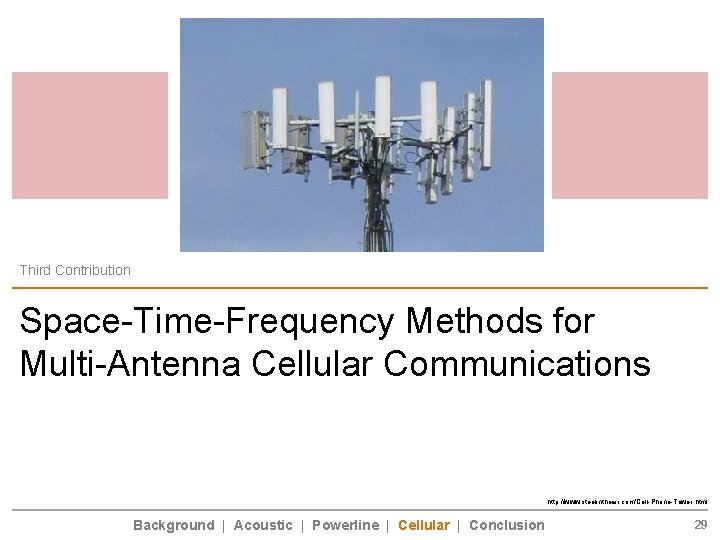
Third Contribution Space-Time-Frequency Methods for Multi-Antenna Cellular Communications http: //www. steelintheair. com/Cell-Phone-Tower. html Background | Acoustic | Powerline | Cellular | Conclusion 29
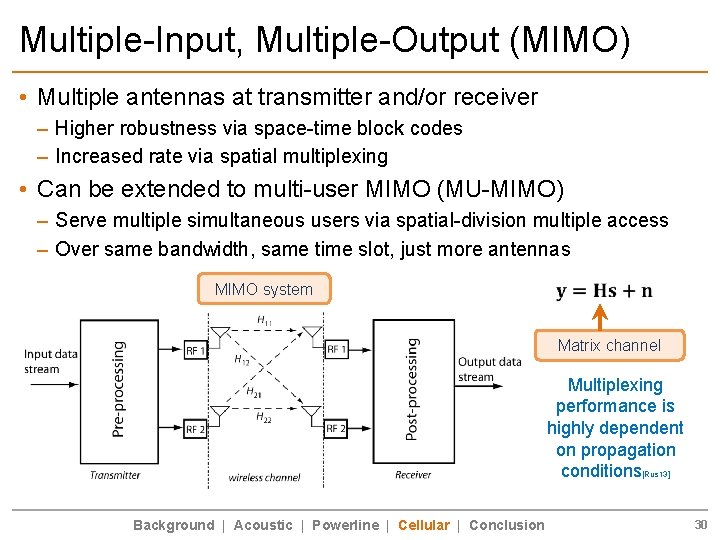
Multiple-Input, Multiple-Output (MIMO) • Multiple antennas at transmitter and/or receiver – Higher robustness via space-time block codes – Increased rate via spatial multiplexing • Can be extended to multi-user MIMO (MU-MIMO) – Serve multiple simultaneous users via spatial-division multiple access – Over same bandwidth, same time slot, just more antennas MIMO system Matrix channel Multiplexing performance is highly dependent on propagation conditions[Rus 13] Background | Acoustic | Powerline | Cellular | Conclusion 30
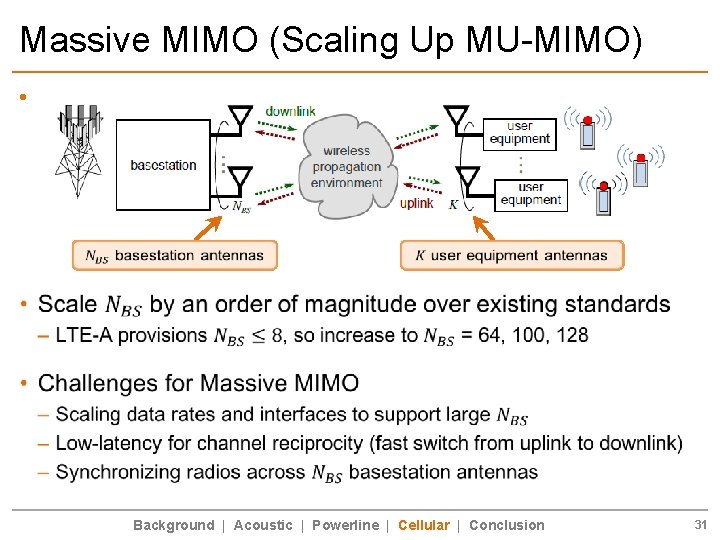
Massive MIMO (Scaling Up MU-MIMO) • Background | Acoustic | Powerline | Cellular | Conclusion 31
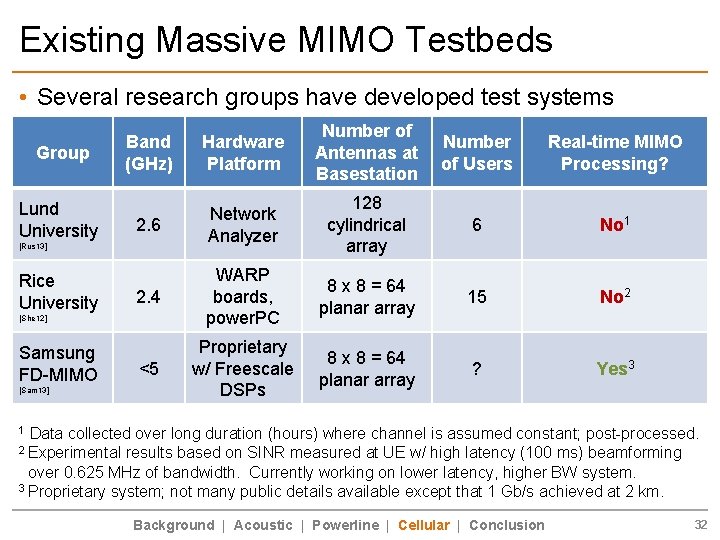
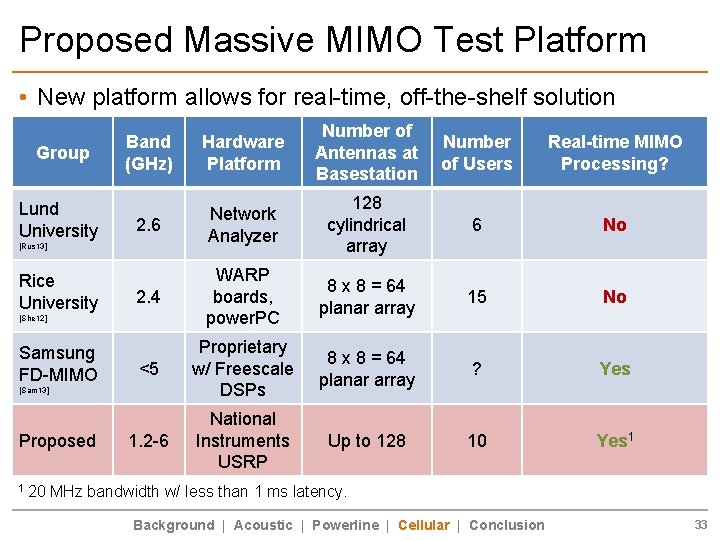
Existing Massive MIMO Testbeds • Several research groups have developed test systems Group Lund University Band (GHz) Hardware Platform Number of Antennas at Basestation Number of Users Real-time MIMO Processing? 2. 6 Network Analyzer 128 cylindrical array 6 No 1 2. 4 WARP boards, power. PC 8 x 8 = 64 planar array 15 No 2 <5 Proprietary w/ Freescale DSPs 8 x 8 = 64 planar array ? Yes 3 [Rus 13] Rice University [She 12] Samsung FD-MIMO [Sam 13] 1 Data collected over long duration (hours) where channel is assumed constant; post-processed. 2 Experimental results based on SINR measured at UE w/ high latency (100 ms) beamforming over 0. 625 MHz of bandwidth. Currently working on lower latency, higher BW system. 3 Proprietary system; not many public details available except that 1 Gb/s achieved at 2 km. Background | Acoustic | Powerline | Cellular | Conclusion 32
Proposed Massive MIMO Test Platform • New platform allows for real-time, off-the-shelf solution Group Lund University Band (GHz) Hardware Platform Number of Antennas at Basestation Number of Users Real-time MIMO Processing? 2. 6 Network Analyzer 128 cylindrical array 6 No 2. 4 WARP boards, power. PC 8 x 8 = 64 planar array 15 No <5 Proprietary w/ Freescale DSPs 8 x 8 = 64 planar array ? Yes 1. 2 -6 National Instruments USRP Up to 128 10 Yes 1 [Rus 13] Rice University [She 12] Samsung FD-MIMO [Sam 13] Proposed 1 20 MHz bandwidth w/ less than 1 ms latency. Background | Acoustic | Powerline | Cellular | Conclusion 33
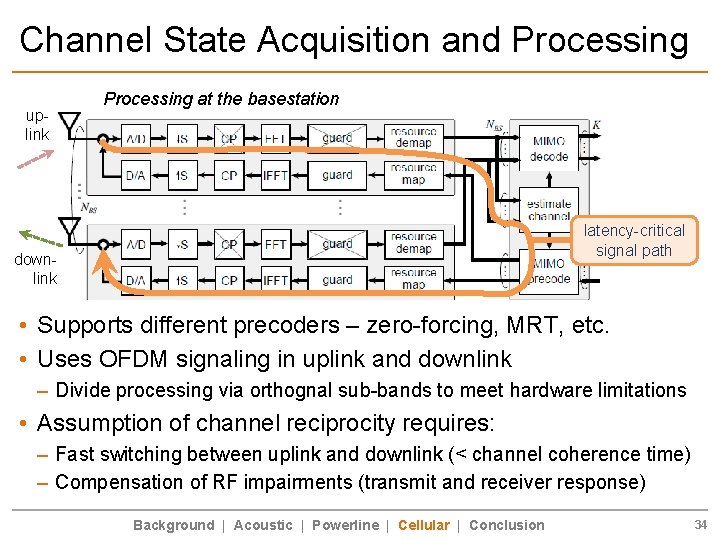
Channel State Acquisition and Processing uplink Processing at the basestation latency-critical signal path downlink • Supports different precoders – zero-forcing, MRT, etc. • Uses OFDM signaling in uplink and downlink – Divide processing via orthognal sub-bands to meet hardware limitations • Assumption of channel reciprocity requires: – Fast switching between uplink and downlink (< channel coherence time) – Compensation of RF impairments (transmit and receiver response) Background | Acoustic | Powerline | Cellular | Conclusion 34
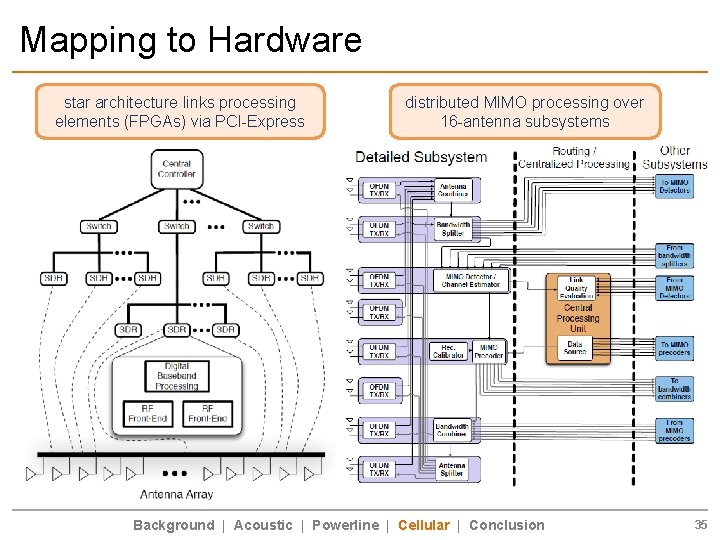
Mapping to Hardware star architecture links processing elements (FPGAs) via PCI-Express distributed MIMO processing over 16 -antenna subsystems Background | Acoustic | Powerline | Cellular | Conclusion 35
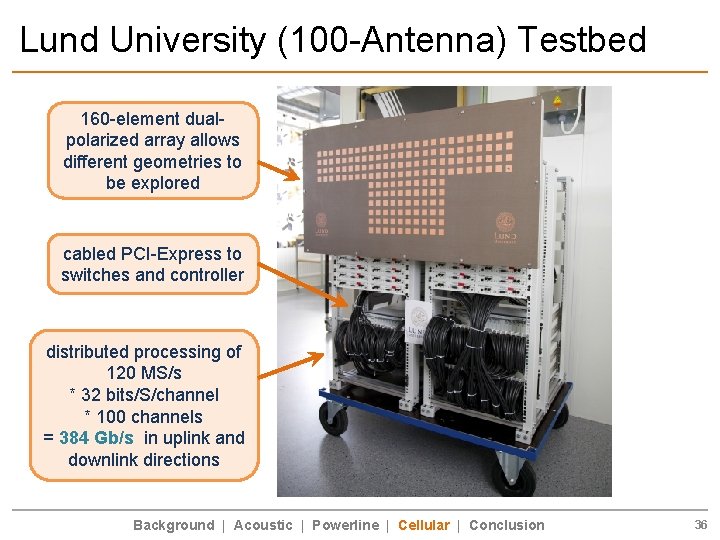
Lund University (100 -Antenna) Testbed 160 -element dualpolarized array allows different geometries to be explored cabled PCI-Express to switches and controller distributed processing of 120 MS/s * 32 bits/S/channel * 100 channels = 384 Gb/s in uplink and downlink directions Background | Acoustic | Powerline | Cellular | Conclusion 36
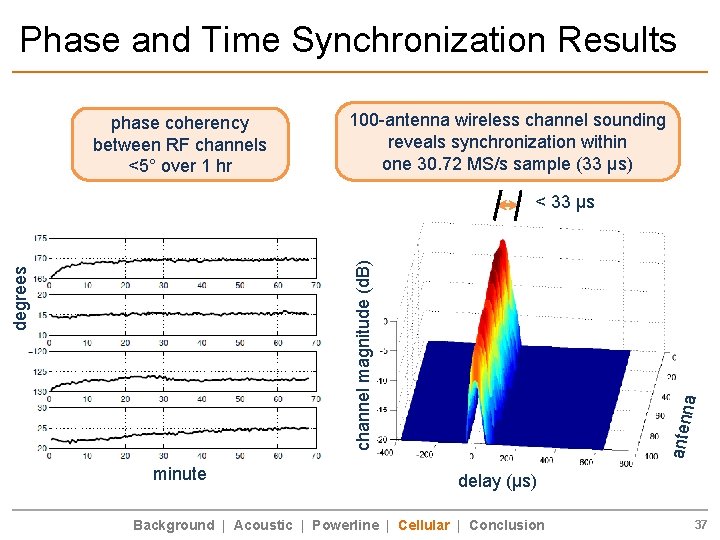
Phase and Time Synchronization Results phase coherency between RF channels <5° over 1 hr 100 -antenna wireless channel sounding reveals synchronization within one 30. 72 MS/s sample (33 μs) minute a anten n degrees channel magnitude (d. B) < 33 μs delay (μs) Background | Acoustic | Powerline | Cellular | Conclusion 37
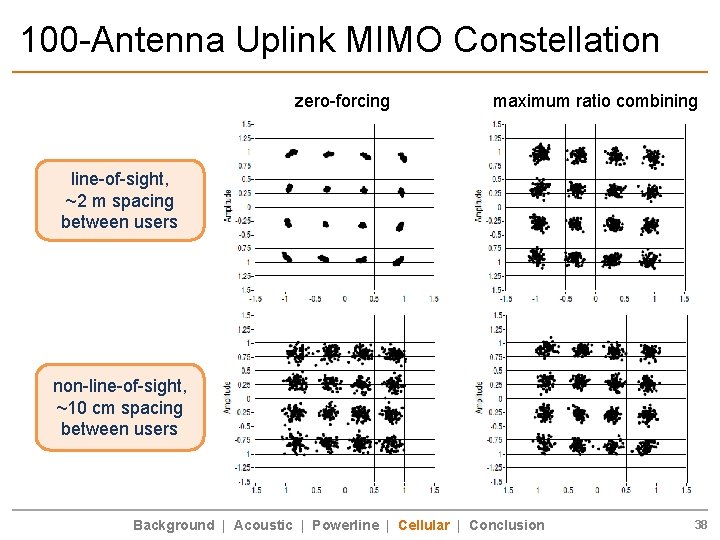
100 -Antenna Uplink MIMO Constellation zero-forcing maximum ratio combining line-of-sight, ~2 m spacing between users non-line-of-sight, ~10 cm spacing between users Background | Acoustic | Powerline | Cellular | Conclusion 38
Contribution 3 Summary Highlights Develop a commercial, off-the-shelf solution for up to 128 -antenna MIMO Scale data rates/interfaces, minimize latency, and distribute synchronization Presented first results of 100 -antenna MIMO Relevant work [Nie 13] – K. F. Nieman and B. L. Evans, "Time-Domain Compression of Complex-Baseband LTE Signals for Cloud Radio Access Networks", Proc. IEEE Global Conference on Signal and Information Processing, 2013. [Hua 12] – H. Huang, K. Nieman, P. Chen, M. Ferrari, Y. Hu, and D. Akinwande, "Properties and applications of electrically small folded ellipsoidal helix antenna", IEEE Antennas and Wireless Propagation Letters, 2012. [Hua 11] – H. Huang, K. Nieman, Y. Hu, and D. Akinwande, "Electrically small folded ellipsoidal helix antenna for medical implant applications", Proc. IEEE International Symposium on Antennas and Propagation, 2011. [Vei 14] – J. Vieira, S. Malkowsky, K. F. Nieman, Z. Miers, N. Kundargi, L. Liu, I. Wong, V. Owall, O. Edfors, and F. Tufvesson, "A flexible 100 -antenna testbed for Massive MIMO", Proc. IEEE Global Communication Conference (GLOBECOM), 2014, accepted for publication. [Nie 14] -- K. F. Nieman, N. U. Kundargi, I. C. Wong, and B. C. Prumo, Synchronization of large antenna count systems”, 2014, US patent pending. [Won 14] – I. C. Wong, K. F. Nieman, and N. U. Kundargi, “Signaling and frame structure for Massive MIMO cellular telecommunication systems”, 2014, US patent pending. [Kun 14] – N. U. Kundargi, I. C. Wong, and K. F. Nieman, Distributed low latency Massive MIMO telecommunication transceiver processing framework and use, " 2014, US patent pending [Nie 14] – K. F. Nieman, N. Kundargi, I. Wong, and B. L. Evans, "High speed processing framework for high channel count MIMO", Proc. IEEE ISCAS, 2014, to be submitted. Background | Acoustic | Powerline | Cellular | Conclusion 39
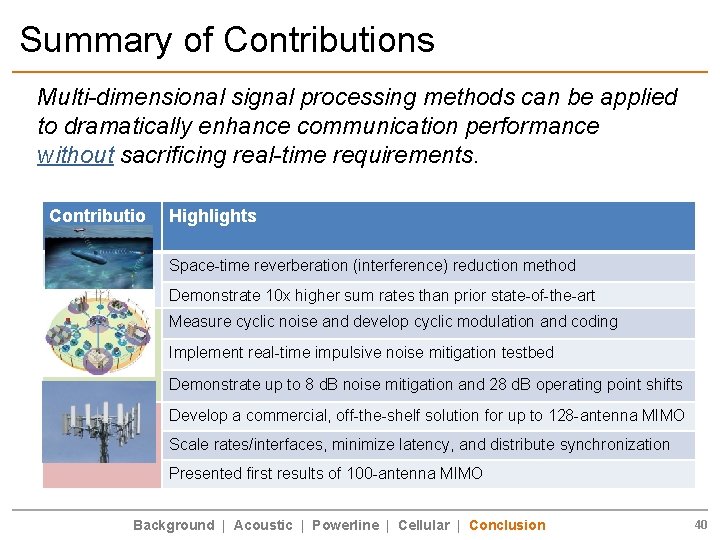
Summary of Contributions Multi-dimensional signal processing methods can be applied to dramatically enhance communication performance without sacrificing real-time requirements. Contributio n Highlights Space-time reverberation (interference) reduction method Demonstrate 10 x higher sum rates than prior state-of-the-art Measure cyclic noise and develop cyclic modulation and coding Implement real-time impulsive noise mitigation testbed Demonstrate up to 8 d. B noise mitigation and 28 d. B operating point shifts Develop a commercial, off-the-shelf solution for up to 128 -antenna MIMO Scale rates/interfaces, minimize latency, and distribute synchronization Presented first results of 100 -antenna MIMO Background | Acoustic | Powerline | Cellular | Conclusion 40
Summary of Relevant Work by Presenter [Nie 10 a] – K. F. Nieman, K. A. Perrine, T. L. Henderson, K. H. Lent, T. J. Brudner, and B. L. Evans, Wideband monopulse spatial ltering for large receiver arrays for reverberant underwater communication channels. Proc. IEEE OCEANS, 2010. [Per 10] – K. A. Perrine, K. F. Nieman, T. L. Henderson, K. H. Lent, T. J. Brudner, and B. L. Evans. Doppler estimation and correction for shallow underwater acoustic communications. Proc. IEEE Asilomar Conference on Signals, Systems, and Computers, 2010. [Nie 10 b] – K. F. Nieman, K. A. Perrine, K. H. Lent, T. L. Henderson, T. J. Brudner, and B. L. Evans. Multi-stage and sparse equalizer design for communication systems in reverberant underwater channels. Proc. IEEE Workshop on Signal Processing Systems, 2010. [Nie 11] – K. F. Nieman, K. A. Perrine, T. L. Henderson, K. H. Lent, and T. J. Brudner, "Sonar array-based acoustic communication receivers with wideband monopulse processing, " USN Journal of Underwater Acoustics, 61(2), 2011. [Hua 11] – H. Huang, K. Nieman, Y. Hu, and D. Akinwande, "Electrically small folded ellipsoidal helix antenna for medical implant applications", Proc. IEEE International Symposium on Antennas and Propagation, 2011. [Hua 12] – H. Huang, K. Nieman, P. Chen, M. Ferrari, Y. Hu, and D. Akinwande, "Properties and applications of electrically small folded ellipsoidal helix antenna", IEEE Antennas and Wireless Propagation Letters, 2012. [Nie 13 a] – K. F. Nieman, Jing Lin, M. Nassar, K. Waheed, and B. L. Evans, "Cyclic spectral analysis of power line noise in the 3 -200 k. Hz band, " Proc. IEEE Conf. on Power Line Communications and Its Applications, 2013. Won best paper award [Nie 13 b] – K. F. Nieman, M. Nassar, Jing Lin, and B. L. Evans, "FPGA implementation of a message-passing OFDM receiver for impulsive noise channels. Proc. IEEE Asilomar Conf. on Signals, Systems, and Computers, 2013. Won best student paper Architecture and Implementation Track, took 2 nd place overall [Nie 13 c] – K. F. Nieman and B. L. Evans, "Time-Domain Compression of Complex-Baseband LTE Signals for Cloud Radio Access Networks", Proc. IEEE Global Conference on Signal and Information Processing, 2013. [Vei 14] – J. Vieira, S. Malkowsky, K. F. Nieman, Z. Miers, N. Kundargi, L. Liu, I. Wong, V. Owall, O. Edfors, and F. Tufvesson, "A flexible 100 antenna testbed for Massive MIMO", Proc. IEEE Global Communication Conference (GLOBECOM), 2014, accepted for publication. [Nie 14] –K. F. Nieman, N. Kundargi, I. Wong, and B. L. Evans, "High speed processing framework for high channel count MIMO", Proc. IEEE International Symposium on Circuits and Systems (ISCAS), 2014, to be submitted. [Nie 14] -- K. F. Nieman, N. U. Kundargi, I. C. Wong, and B. C. Prumo, Synchronization of large antenna count systems”, 2014, US patent pending. [Won 14] – I. C. Wong, K. F. Nieman, and N. U. Kundargi, “Signaling and frame structure for Massive MIMO cellular telecommunication systems”, 2014, US patent pending. [Kun 14] – N. U. Kundargi, I. C. Wong, and K. F. Nieman, Distributed low latency Massive MIMO telecommunication transceiver processing framework and use, " 2014, US patent pending 41
References [Cai 08] – G. Caire; T. Y. Al-Naffouri; A. K. Narayanan, "Impulse noise cancellation in OFDM: an application of compressed sensing, " Information Theory, 2008. ISIT 2008. IEEE International Symposium on , 2008. [Tse 12] – D-F. Tseng; Y. S. Han; W. H. Mow; L-C. Chang; A. J. H. Vinck, "Robust Clipping for OFDM Transmissions over Memoryless Impulsive Noise Channels, " Communications Letters, IEEE , vol. 16, no. 7, 2012. [Lin 13] – J. Lin; M. Nassar; B. L. Evans, "Impulsive Noise Mitigation in Powerline Communications Using Sparse Bayesian Learning, " Selected Areas in Communications, IEEE Journal on , vol. 31, no. 7, 2013. [Nas 13] – M. Nassar; P. Schniter; B. L. Evans, "A factor graph approach to joint OFDM channel estimation and decoding in impulsive noise environments, " IEEE Trans. on Signal Processing, accepted for publication, 2013. [Har 00] – J. Häring and A. J. Han Vinck, “OFDM transmission corrupted by impulsive noise, ” in Proc. Int. Symp. Powerline Communications (ISPLC), 2000. [Max 11] – Maxim and ERDF, "Open Standard for Smart Grid Implementation, " 2011. [Pri 13] – PRIME Alliance, "Interoperable Standard for Advanced Meter Management and Smart Grid, " 2013. [Iee 13] – P 1901. 2, "IEEE Draft Standard for Low Frequency (less than 500 k. Hz) Narrow Band Power Line Communications for Smart Grid Applications, " 2013. [Itu 13] – ITU, "Narrowband orthogonal frequency division multiplexing power line communication transceivers, " 2013. [Kil 00] – D. B. Kilfoyle; A. B. Baggeroer, "The state of the art in underwater acoustic telemetry, " IEEE Journal of Oceanic Engineering, vol. 25, no. 1, 2000. [Fre 08] – L. Freitag; M. Grund; J. Catipovic; D. Nagle; B. Pazol; J. Glynn, "Acoustic communication with small UUVs using a hull-mounted conformal array, " OCEANS, 2001. MTS/IEEE Conference and Exhibition , vol. 4, 2001. [Bea 04] – P. -P. J. Beaujean; L. R. Le. Blanc, "Adaptive array processing for high-speed acoustic communication in shallow water, " IEEE Journal of Oceanic Engineering, vol. 29, no. 3, 2004. [Yan 07] – T. C. Yang, "A study of spatial processing gain in underwater acoustic communications, " IEEE Journal of Oceanic Engineering, 32(3), 2007. [Hen 85] – T. L. Henderson, “Matched beam theory for unambiguous broadband direction finding, ” J. Acoust. Soc. Am. , 78(2), 1985. [Sto 08] – M. Stojanovic, "OFDM for underwater acoustic communications: Adaptive synchronization and sparse channel estimation, " Proc. IEEE Conf. on Acoustics, Speech and Signal Processing, 2008. [Tao 10] – J. Tao; Y. Zheng; C. Xiao; T. C. Yang; W-B. Yang, "Channel equalization for single carrier MIMO underwater acoustic communications, " EURASIP Journal on Advances in Signal Processing, 2010. [Pau 04] – A. J. Paulraj; D. A. Gore; R. U. Nabar; and H. Bolcskei, "An overview of MIMO communications - a key to gigabit wireless, " Proceedings of the IEEE, 92(2), 2004. [3 gp 13] – 3 rd Generation Partnership Project. 3 GPP Technical Specification Group Radio Access Network; Evolved Universal Terrestrial Access Network (E-UTRA); Base Station Radio Transmission and Reception (Release 12), 2013. [Rus 13] – F. Rusek; D. Persson; B. K. Lau; E. G. Larsson; T. L. Marzetta; O. Edfors; F. Tufvesson, “Scaling Up MIMO: Opportunities and Challenges with Large Arrays, ” IEEE Signal Processing Magazine, 30(1), 2013. [She 12] – C. Shepard; H. Yu, N. Anand, E. Li, T. L. Marzetta, R. Yang, L. Zhong. "Argos: Practical Many-Antenna Base Stations, " in Proc. ACM Int. Conf. Mobile Computing and Networking (Mobi. Com), 2012. [Sam 13] – Samsung, “Samsung takes first 5 G steps with advanced antenna, ” Press Release, May 2013, Online: http: //www. pcworld. idg. com. au/article/461656/samsung_takes_first_5 g_steps_advanced_antenna/ 42
Questions? 43