
Spacetime variation of Fundamental Constants and Thorium clock
- Slides: 35
Space-time variation of Fundamental Constants and Thorium clock V. V. Flambaum School of Physics, UNSW, Sydney, Australia Co-authors: Atomic calculations V. Dzuba, M. Kozlov, E. Angstmann, J. Berengut, Cheng Chin, S. Karshenboim, A. Nevsky, S. Porsev, A. Ong, A. Derevianko Nuclear and QCD calculations E. Shuryak, V. Dmitriev, D. Leinweber, A. Thomas, R. Young, A. Hoell, P. Jaikumar, C. Roberts, S. Wright, A. Tedesco, W. Wiringa, E. Litvinova, H. Feldmeier, J. Dobaczewski Cosmology J. Barrow Quasar data J. Webb, M. Murphy, J. King, S. Curran, M. Drinkwater, P. Tsanavaris, C. Churchill, J. Prochazka, A. Wolfe, S. Muller, C, Henkel, F. Combes, T. Wiklind, R. Carswell, M. Bainbridge Laboratory measurements S. J. Ferrel, , A, Cingoz, ALappiere, A. -T. Nguyen, N. Leefer, D. Budker, S. K. Lamoreuax, J. R. Torgerson, S. Blatt, A. D. Ludlow, G. K. Cambell, J. W. Thomsen, T. Zelevinsky, M. M. Boid, J. Ye, X. Baillard, M. Fouche, R. Le. Targat, A. Brush, P. Lemond e, M. Takamoto, F. -L. Hong, H. Katori, E. Peik, Ch. Tamm, …
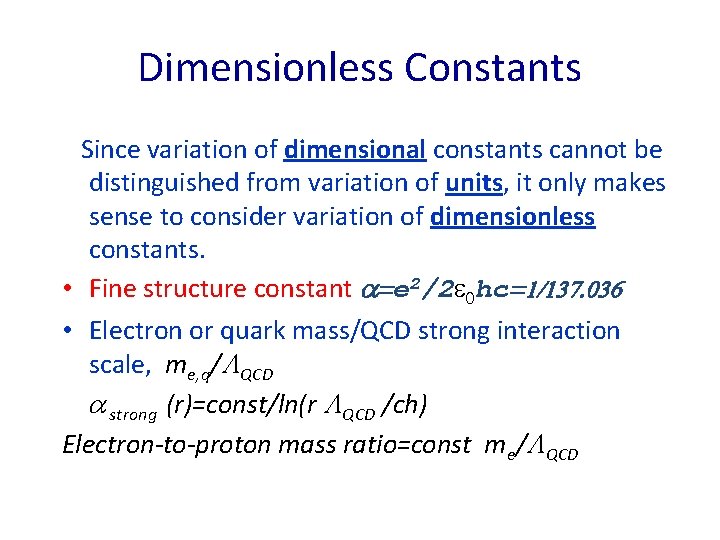
Dimensionless Constants Since variation of dimensional constants cannot be distinguished from variation of units, it only makes sense to consider variation of dimensionless constants. • Fine structure constant a=e 2/2 e 0 hc=1/137. 036 • Electron or quark mass/QCD strong interaction scale, me, q/LQCD a strong (r)=const/ln(r LQCD /ch) Electron-to-proton mass ratio=const me/LQCD
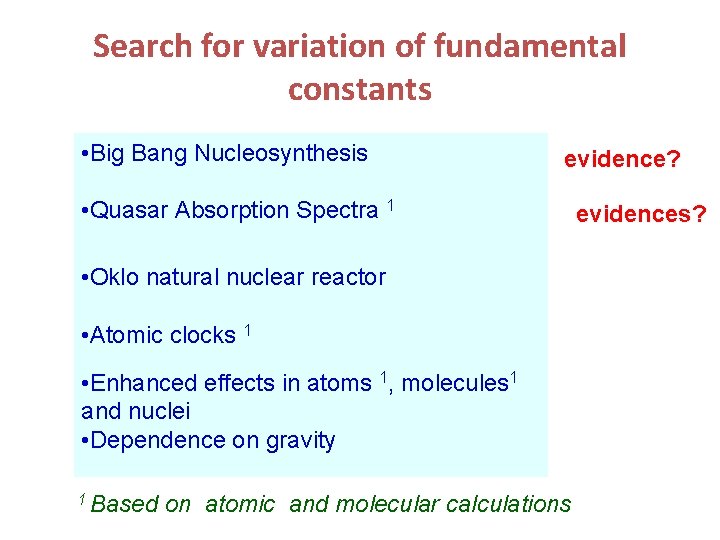
Search for variation of fundamental constants • Big Bang Nucleosynthesis evidence? • Quasar Absorption Spectra 1 • Oklo natural nuclear reactor • Atomic clocks 1 • Enhanced effects in atoms 1, molecules 1 and nuclei • Dependence on gravity 1 Based on atomic and molecular calculations evidences?
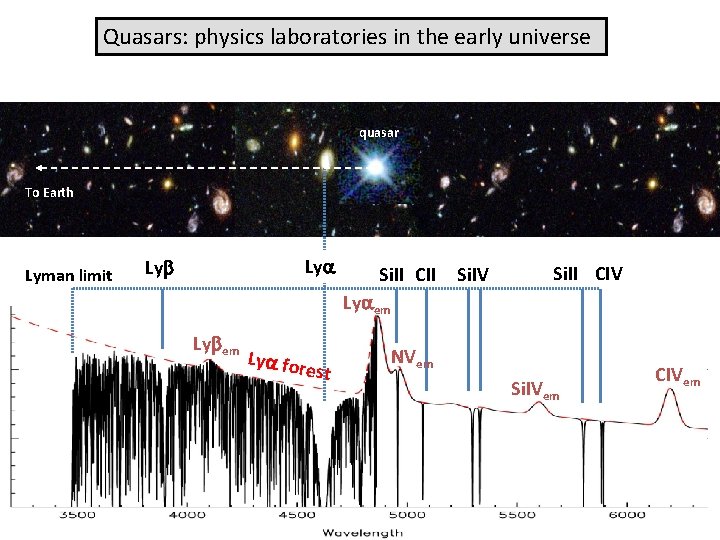
Quasars: physics laboratories in the early universe quasar To Earth Lyman limit Lya Lyb Si. II CII Si. IV Si. II CIV Lyaem Lybem Lya for e st NVem Si. IVem CIVem
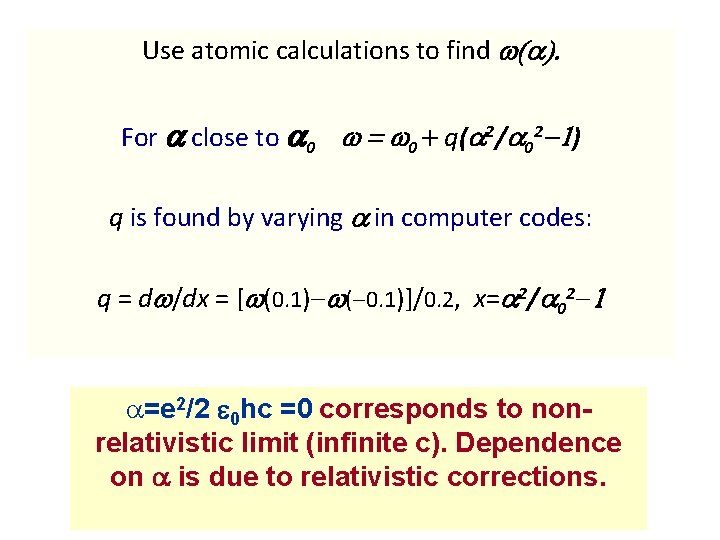
Use atomic calculations to find w(a). For a close to a 0 w = w 0 + q(a 2/a 02 -1) q is found by varying a in computer codes: q = dw/dx = [w(0. 1)-w(-0. 1)]/0. 2, x=a 2/a 02 -1 a=e 2/2 e 0 hc =0 corresponds to nonrelativistic limit (infinite c). Dependence on a is due to relativistic corrections.
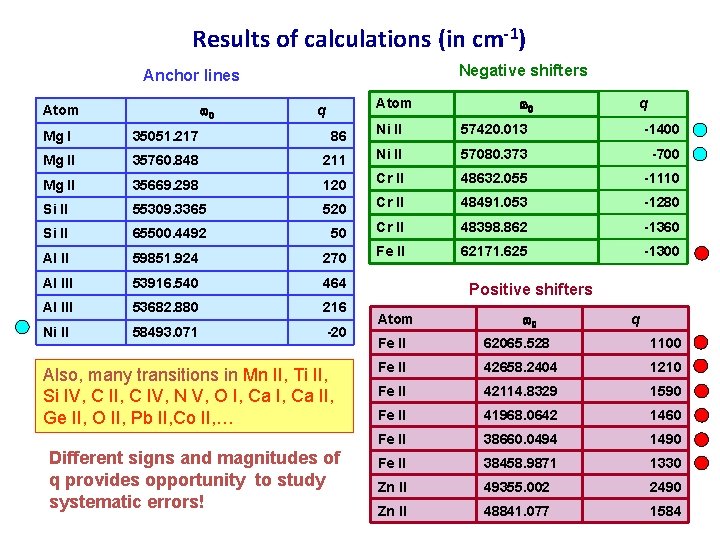
Results of calculations (in cm-1) Negative shifters Anchor lines w 0 Atom q w 0 q Mg I 35051. 217 86 Ni II 57420. 013 -1400 Mg II 35760. 848 211 Ni II 57080. 373 -700 Mg II 35669. 298 120 Cr II 48632. 055 -1110 Si II 55309. 3365 520 Cr II 48491. 053 -1280 Si II 65500. 4492 50 Cr II 48398. 862 -1360 Al II 59851. 924 270 Fe II 62171. 625 -1300 Al III 53916. 540 464 Al III 53682. 880 216 Ni II 58493. 071 -20 Also, many transitions in Mn II, Ti II, Si IV, C II, C IV, N V, O I, Ca II, Ge II, O II, Pb II, Co II, … Different signs and magnitudes of q provides opportunity to study systematic errors! Positive shifters Atom w 0 q Fe II 62065. 528 1100 Fe II 42658. 2404 1210 Fe II 42114. 8329 1590 Fe II 41968. 0642 1460 Fe II 38660. 0494 1490 Fe II 38458. 9871 1330 Zn II 49355. 002 2490 Zn II 48841. 077 1584
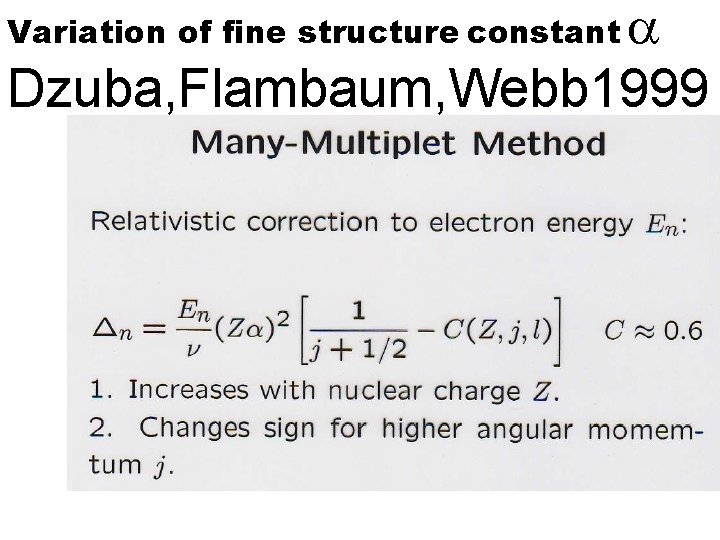
a Dzuba, Flambaum, Webb 1999 Variation of fine structure constant
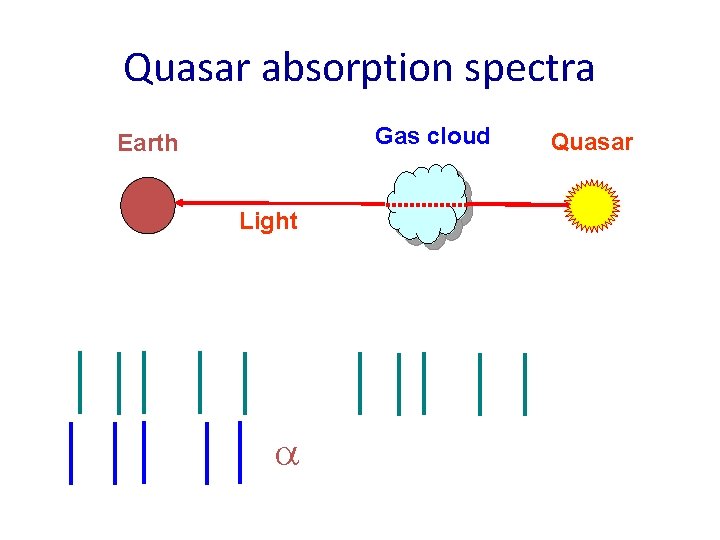
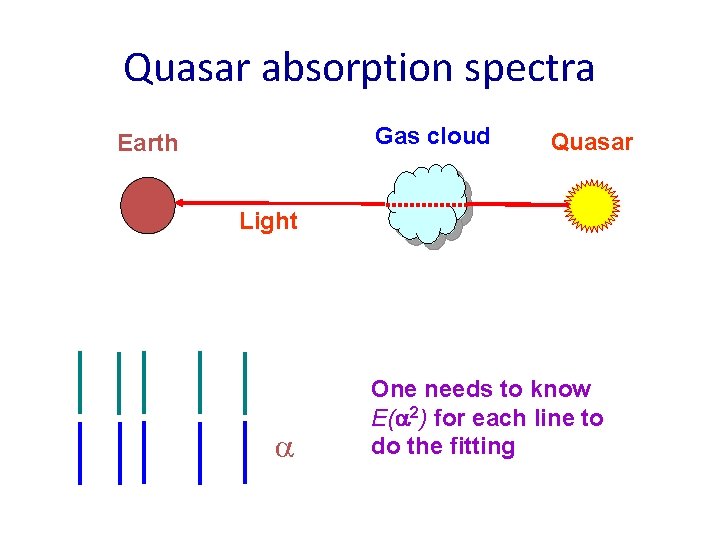
Quasar absorption spectra Gas cloud Earth Light a Quasar
Quasar absorption spectra Gas cloud Earth Quasar Light a One needs to know E(a 2) for each line to do the fitting
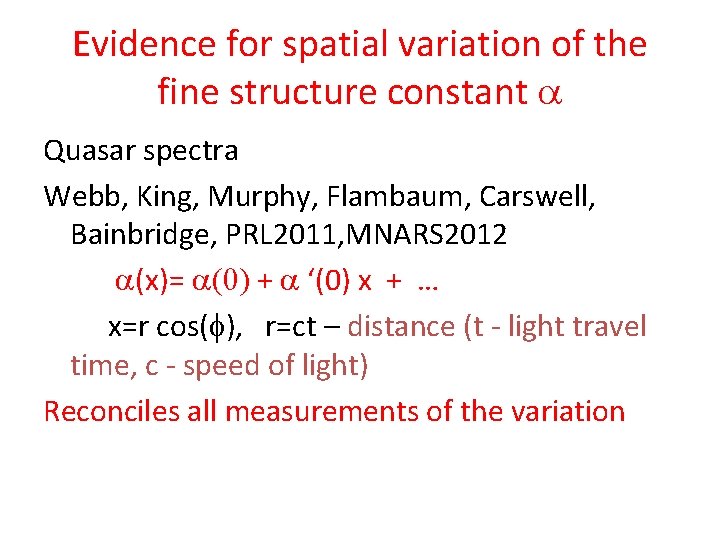
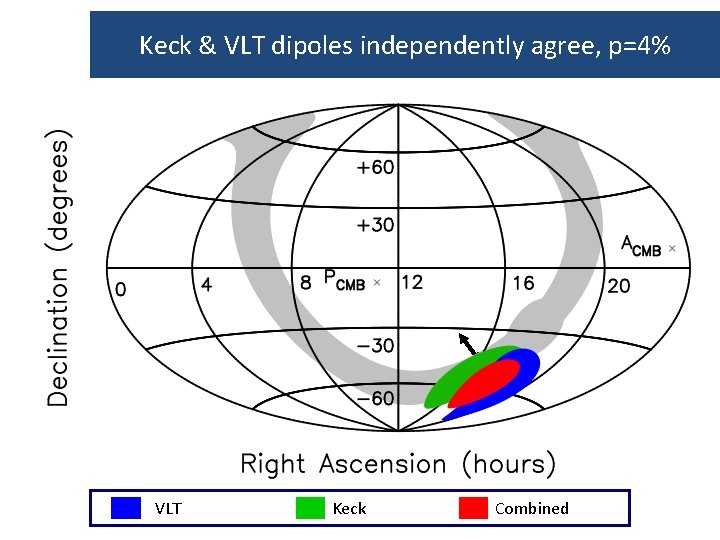
Evidence for spatial variation of the fine structure constant a Quasar spectra Webb, King, Murphy, Flambaum, Carswell, Bainbridge, PRL 2011, MNARS 2012 a(x)= a(0) + a ‘(0) x + … x=r cos(f), r=ct – distance (t - light travel time, c - speed of light) Reconciles all measurements of the variation
“ Fine tuning” of fundamental constants is needed for life to exist. If fundamental constants would be even slightly different, life could not appear! Variation of coupling constants in space provide natural explanation of the “fine tuning”: we appeared in area of the Universe where values of fundamental constants are suitable for our existence. There are theories which suggest variation of the fundamental constants in expanding Universe.
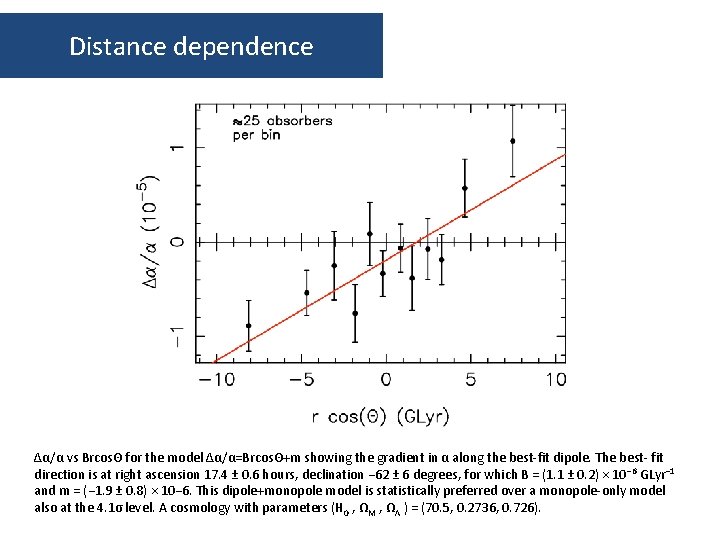
Distance dependence ∆α/α vs BrcosΘ for the model ∆α/α=BrcosΘ+m showing the gradient in α along the best-fit dipole. The best- fit direction is at right ascension 17. 4 ± 0. 6 hours, declination − 62 ± 6 degrees, for which B = (1. 1 ± 0. 2) × 10 − 6 GLyr− 1 and m = (− 1. 9 ± 0. 8) × 10− 6. This dipole+monopole model is statistically preferred over a monopole-only model also at the 4. 1σ level. A cosmology with parameters (H 0 , ΩM , ΩΛ ) = (70. 5, 0. 2736, 0. 726).
Keck & VLT dipoles independently agree, p=4% VLT Keck Combined
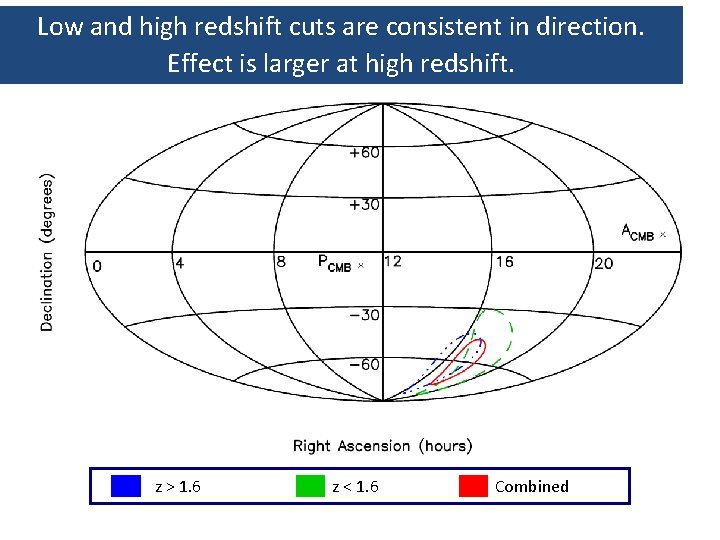
Low and high redshift cuts are consistent in direction. Effect is larger at high redshift. z > 1. 6 z < 1. 6 Combined
Hints that this result might be real Two internal consistencies: 1 Keck and VLT dipoles agree. Independent samples, different data reduction procedures, different instruments and telescopes. 2 High and low redshift dipoles also agree - different species used at low and high redshift – and different transitions respond differently to the same change in a. 300 absorption systems, 30 atomic lines
Evidence for spatial variation of a • Webb, King, Murphy, Flambaum, Carswell, Bainbridge, PRL, MNRAS a(x)= a(0) + a ‘(0) x + … x=r cos(f), r=ct – distance (instead of time) Reconciles all measurements of the variation • Berengut, Flambaum Manifestations on atomic clocks, Oklo, meteorites and cosmological phenomena • Berengut, Flambaum, King, Curran, Webb, Further astronomical evidence
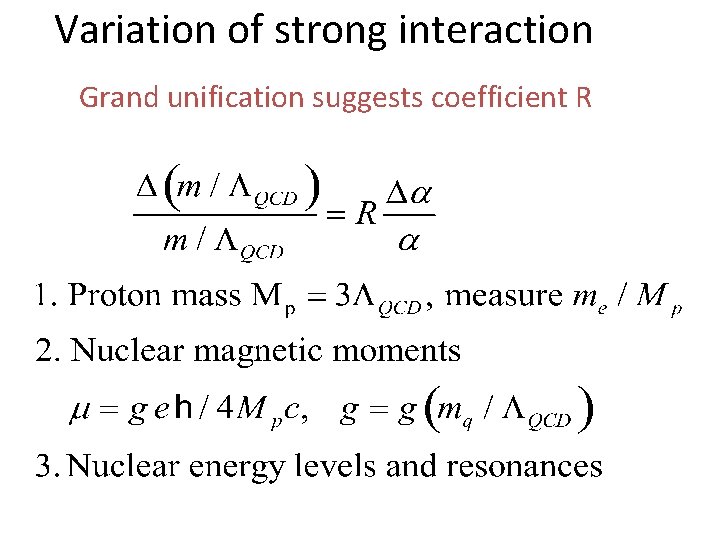
Variation of strong interaction Grand unification suggests coefficient R
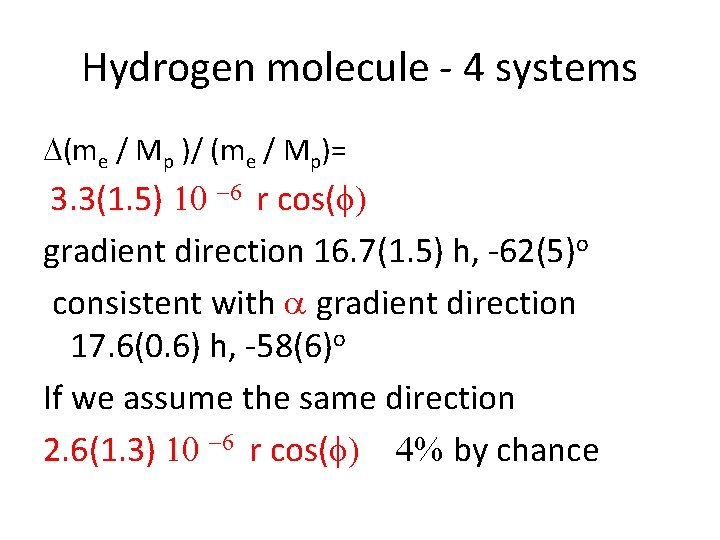
Hydrogen molecule - 4 systems D(me / Mp )/ (me / Mp)= 3. 3(1. 5) 10 -6 r cos(f) gradient direction 16. 7(1. 5) h, -62(5)o consistent with a gradient direction 17. 6(0. 6) h, -58(6)o If we assume the same direction 2. 6(1. 3) 10 -6 r cos(f) 4% by chance
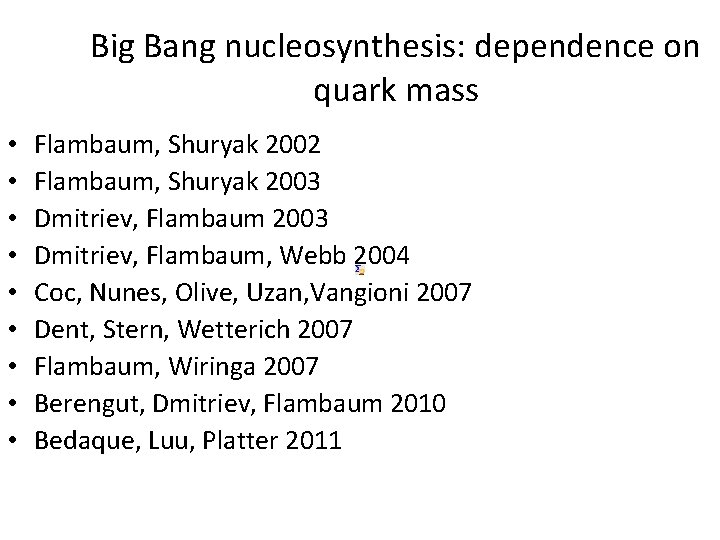
Big Bang nucleosynthesis: dependence on quark mass • • • Flambaum, Shuryak 2002 Flambaum, Shuryak 2003 Dmitriev, Flambaum, Webb 2004 Coc, Nunes, Olive, Uzan, Vangioni 2007 Dent, Stern, Wetterich 2007 Flambaum, Wiringa 2007 Berengut, Dmitriev, Flambaum 2010 Bedaque, Luu, Platter 2011
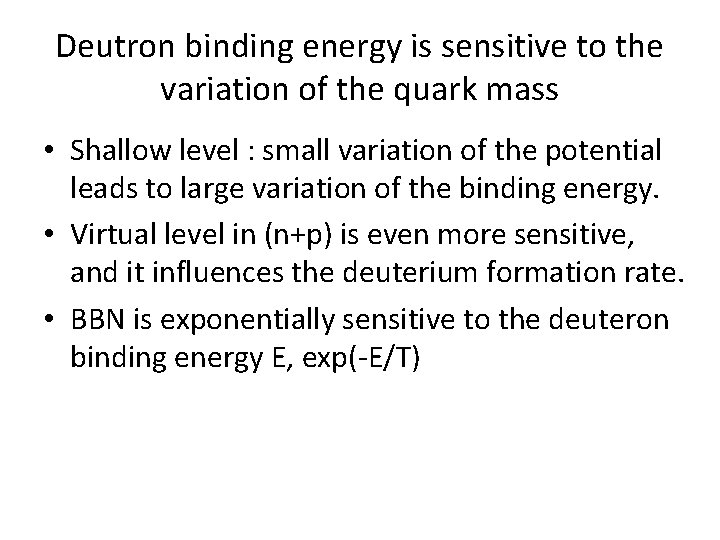
Deutron binding energy is sensitive to the variation of the quark mass • Shallow level : small variation of the potential leads to large variation of the binding energy. • Virtual level in (n+p) is even more sensitive, and it influences the deuterium formation rate. • BBN is exponentially sensitive to the deuteron binding energy E, exp(-E/T)
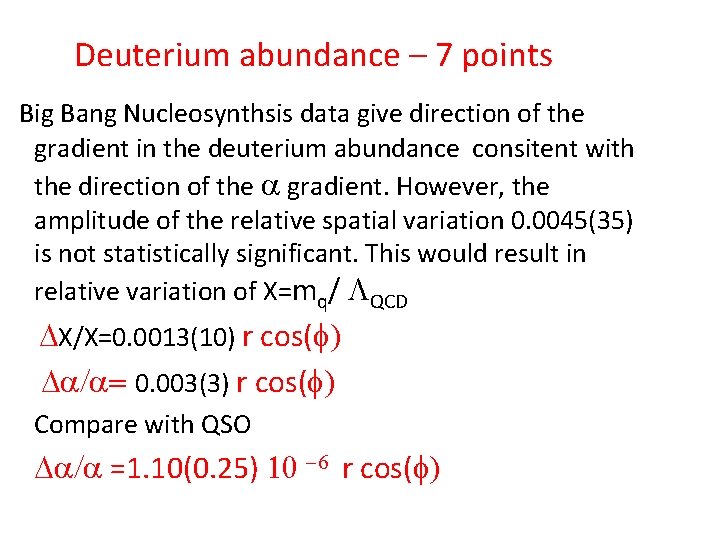
Deuterium abundance – 7 points Big Bang Nucleosynthsis data give direction of the gradient in the deuterium abundance consitent with the direction of the a gradient. However, the amplitude of the relative spatial variation 0. 0045(35) is not statistically significant. This would result in relative variation of X=mq/ LQCD DX/X=0. 0013(10) r cos(f) Da/a= 0. 003(3) r cos(f) Compare with QSO Da/a =1. 10(0. 25) 10 -6 r cos(f)
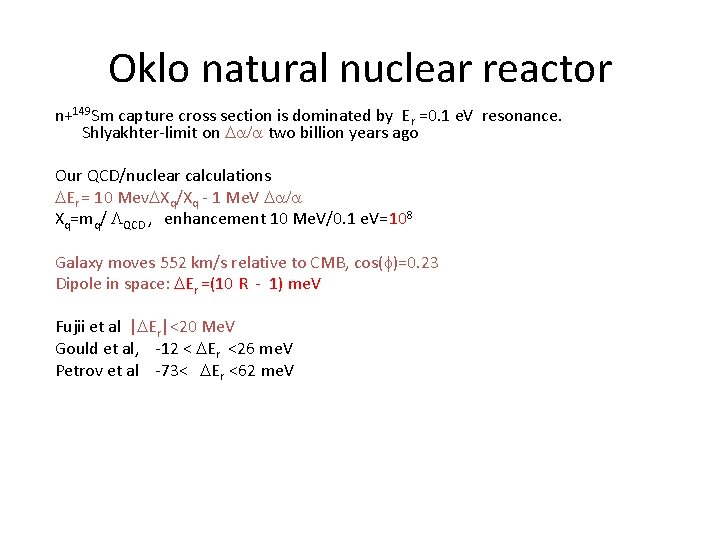
Oklo natural nuclear reactor n+149 Sm capture cross section is dominated by Er =0. 1 e. V resonance. Shlyakhter-limit on Da/a two billion years ago Our QCD/nuclear calculations DEr = 10 Mev. DXq/Xq - 1 Me. V Da/a Xq=mq/ LQCD , enhancement 10 Me. V/0. 1 e. V=108 Galaxy moves 552 km/s relative to CMB, cos(f)=0. 23 Dipole in space: DEr =(10 R - 1) me. V Fujii et al |DEr|<20 Me. V Gould et al, -12 < DEr <26 me. V Petrov et al -73< DEr <62 me. V
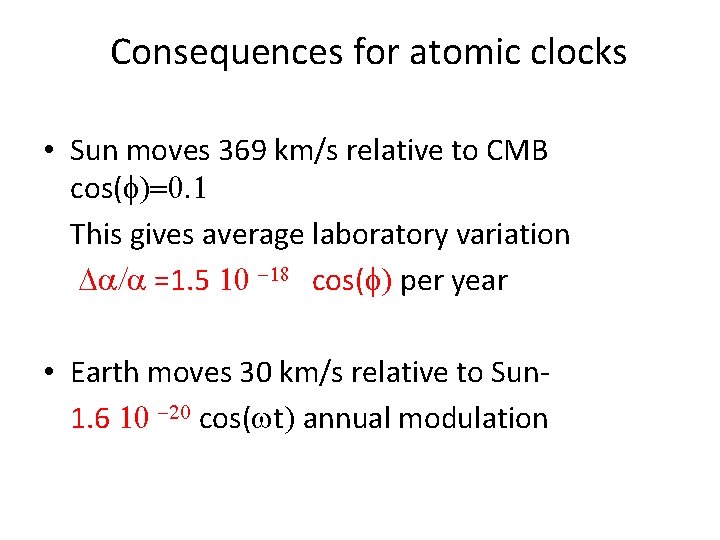
Consequences for atomic clocks • Sun moves 369 km/s relative to CMB cos(f)=0. 1 This gives average laboratory variation Da/a =1. 5 10 -18 cos(f) per year • Earth moves 30 km/s relative to Sun 1. 6 10 -20 cos(wt) annual modulation
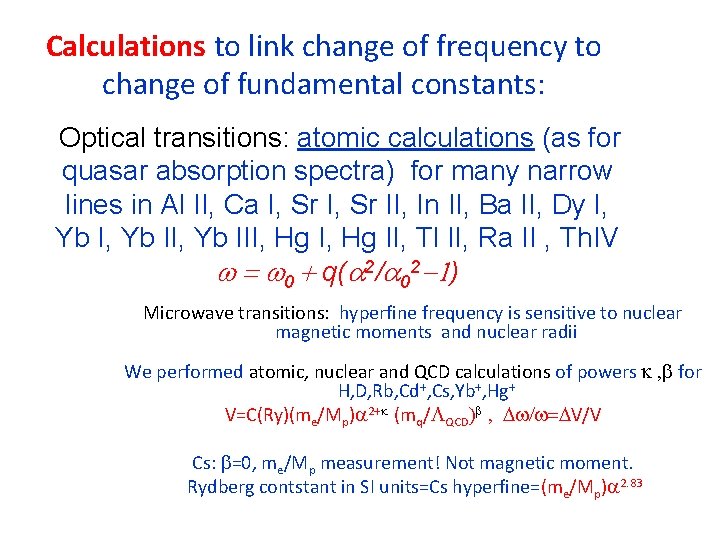
Calculations to link change of frequency to change of fundamental constants: Optical transitions: atomic calculations (as for quasar absorption spectra) for many narrow lines in Al II, Ca I, Sr II, In II, Ba II, Dy I, Yb II, Yb III, Hg II, Tl II, Ra II , Th. IV w = w 0 + q(a 2/a 02 -1) Microwave transitions: hyperfine frequency is sensitive to nuclear magnetic moments and nuclear radii We performed atomic, nuclear and QCD calculations of powers k , b for H, D, Rb, Cd+, Cs, Yb+, Hg+ V=C(Ry)(me/Mp)a 2+k (mq/LQCD)b , Dw/w=DV/V Cs: b=0, me/Mp measurement! Not magnetic moment. Rydberg contstant in SI units=Cs hyperfine=(me/Mp)a 2. 83
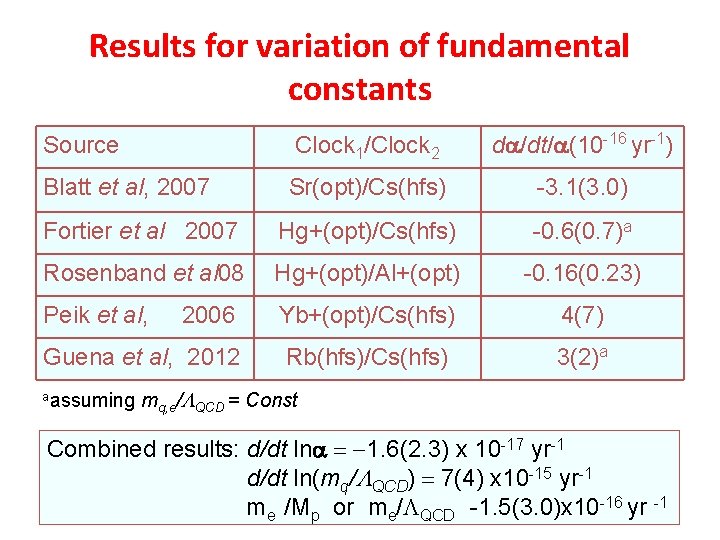
Results for variation of fundamental constants Source Clock 1/Clock 2 da/dt/a(10 -16 yr-1) Blatt et al, 2007 Sr(opt)/Cs(hfs) -3. 1(3. 0) Fortier et al 2007 Hg+(opt)/Cs(hfs) -0. 6(0. 7)a Rosenband et al 08 Hg+(opt)/Al+(opt) -0. 16(0. 23) Peik et al, 2006 Yb+(opt)/Cs(hfs) 4(7) Guena et al, 2012 Rb(hfs)/Cs(hfs) 3(2)a aassuming mq, e/LQCD = Const Combined results: d/dt lna = -1. 6(2. 3) x 10 -17 yr-1 d/dt ln(mq/LQCD) = 7(4) x 10 -15 yr-1 me /Mp or me/LQCD -1. 5(3. 0)x 10 -16 yr -1
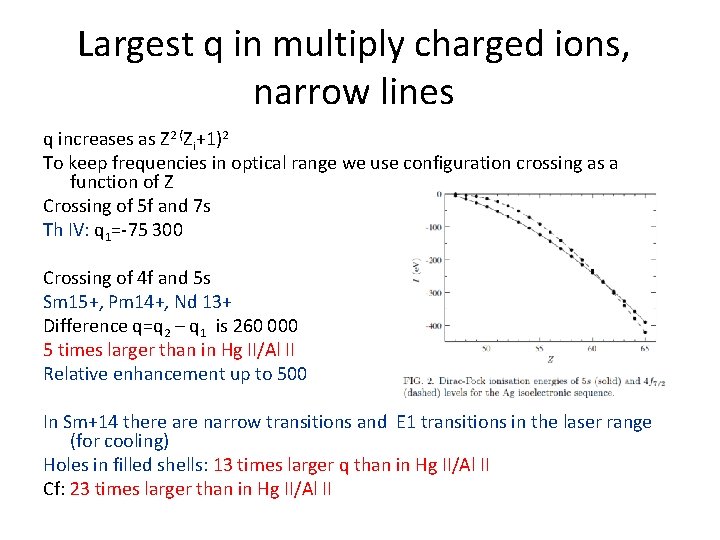
Largest q in multiply charged ions, narrow lines q increases as Z 2 (Zi+1)2 To keep frequencies in optical range we use configuration crossing as a function of Z Crossing of 5 f and 7 s Th IV: q 1=-75 300 Crossing of 4 f and 5 s Sm 15+, Pm 14+, Nd 13+ Difference q=q 2 – q 1 is 260 000 5 times larger than in Hg II/Al II Relative enhancement up to 500 In Sm+14 there are narrow transitions and E 1 transitions in the laser range (for cooling) Holes in filled shells: 13 times larger q than in Hg II/Al II Cf: 23 times larger than in Hg II/Al II
Atomic clocks with highly charged ions Highly charged ions have small size, r = const /Zion Narrow E 2 transitions, r 2 Greatly reduced coupling to external perturbations: Polarizability r 3 Small balck body radiation shift Suppressed quadrupole shift, etc Precision at the level 10 -19 Derevianko, Dzuba, Flambaum 2012; Berengut, Dzuba, Flambaum, Ong 2012 Plus enhanced sensitivity to a variation : potential for 2 -3 order of magnitude improvement in laboratory measurements of a variation
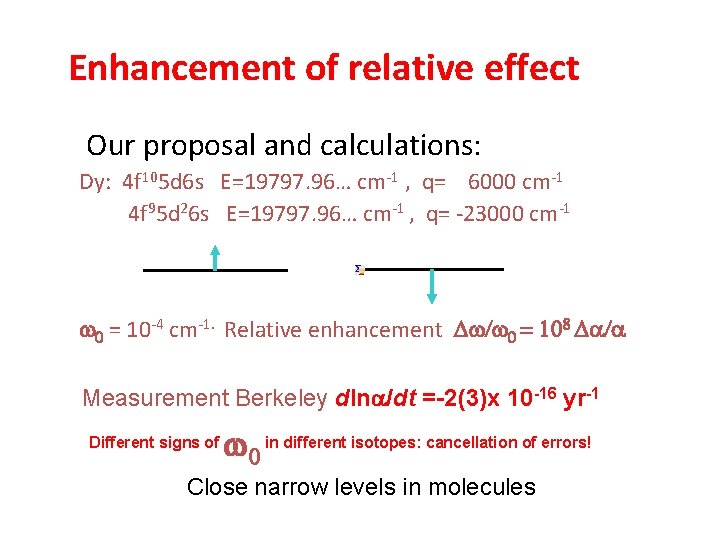
Enhancement of relative effect Our proposal and calculations: Dy: 4 f 105 d 6 s E=19797. 96… cm-1 , q= 6000 cm-1 4 f 95 d 26 s E=19797. 96… cm-1 , q= -23000 cm-1 w 0 = 10 -4 cm-1. Relative enhancement Dw/w 0 = 108 Da/a Measurement Berkeley dlna/dt =-2(3)x 10 -16 yr-1 Different signs of w 0 in different isotopes: cancellation of errors! Close narrow levels in molecules
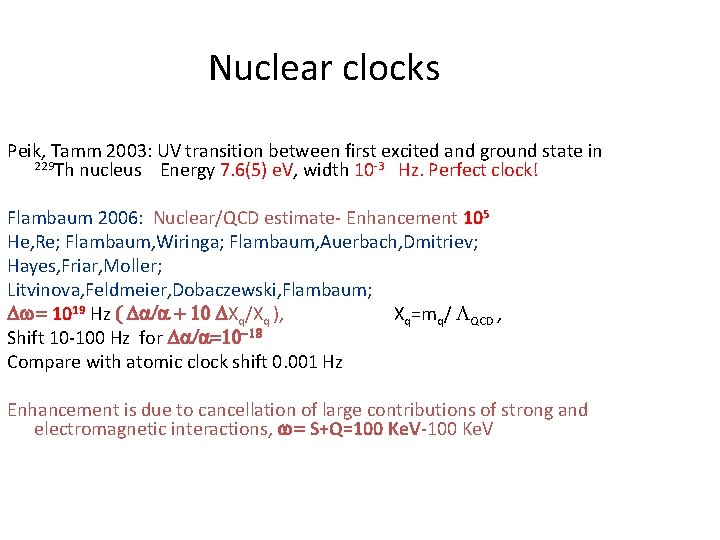
Nuclear clocks Peik, Tamm 2003: UV transition between first excited and ground state in 229 Th nucleus Energy 7. 6(5) e. V, width 10 -3 Hz. Perfect clock! Flambaum 2006: Nuclear/QCD estimate- Enhancement 105 He, Re; Flambaum, Wiringa; Flambaum, Auerbach, Dmitriev; Hayes, Friar, Moller; Litvinova, Feldmeier, Dobaczewski, Flambaum; Dw = 1019 Hz ( Da/a + 10 DXq/Xq ), Xq=mq/ LQCD , Shift 10 -100 Hz for Da/a=10 -18 Compare with atomic clock shift 0. 001 Hz Enhancement is due to cancellation of large contributions of strong and electromagnetic interactions, w = S+Q=100 Ke. V-100 Ke. V
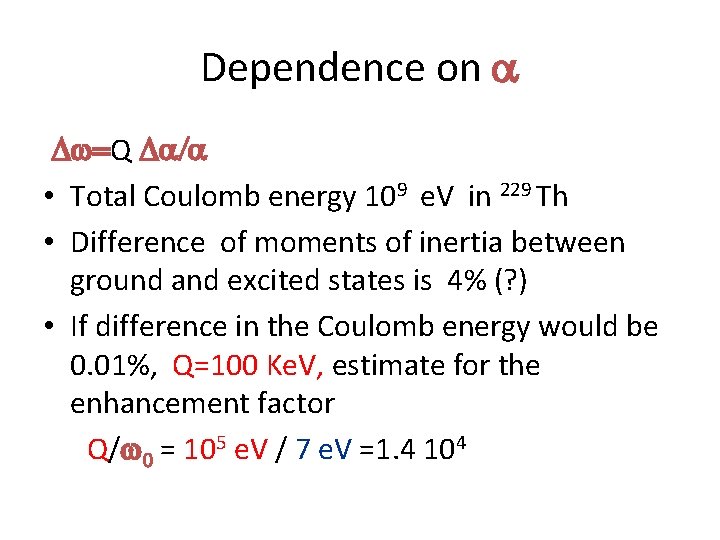
Dependence on a Dw=Q Da/a • Total Coulomb energy 109 e. V in 229 Th • Difference of moments of inertia between ground and excited states is 4% (? ) • If difference in the Coulomb energy would be 0. 01%, Q=100 Ke. V, estimate for the enhancement factor Q/w 0 = 105 e. V / 7 e. V =1. 4 104
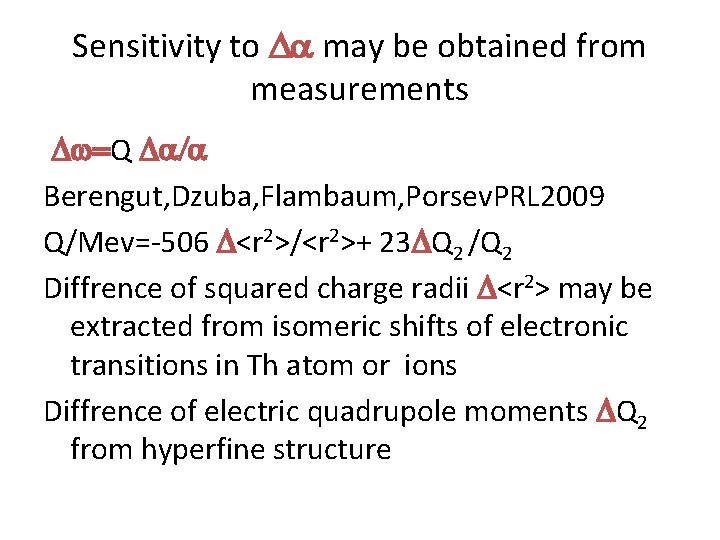
Sensitivity to Da may be obtained from measurements Dw=Q Da/a Berengut, Dzuba, Flambaum, Porsev. PRL 2009 Q/Mev=-506 D<r 2>/<r 2>+ 23 DQ 2 /Q 2 Diffrence of squared charge radii D<r 2> may be extracted from isomeric shifts of electronic transitions in Th atom or ions Diffrence of electric quadrupole moments DQ 2 from hyperfine structure
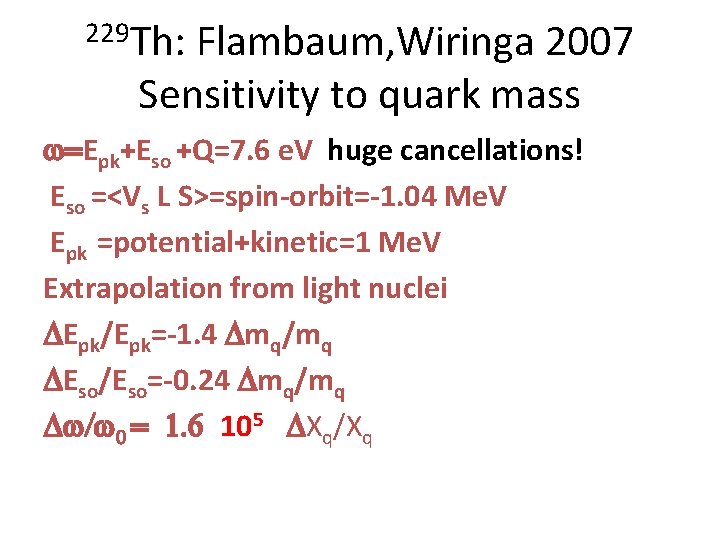
229 Th: Flambaum, Wiringa 2007 Sensitivity to quark mass w=Epk+Eso +Q=7. 6 e. V huge cancellations! Eso =<Vs L S>=spin-orbit=-1. 04 Me. V Epk =potential+kinetic=1 Me. V Extrapolation from light nuclei DEpk/Epk=-1. 4 Dmq/mq DEso/Eso=-0. 24 Dmq/mq Dw/w 0 = 1. 6 105 DXq/Xq
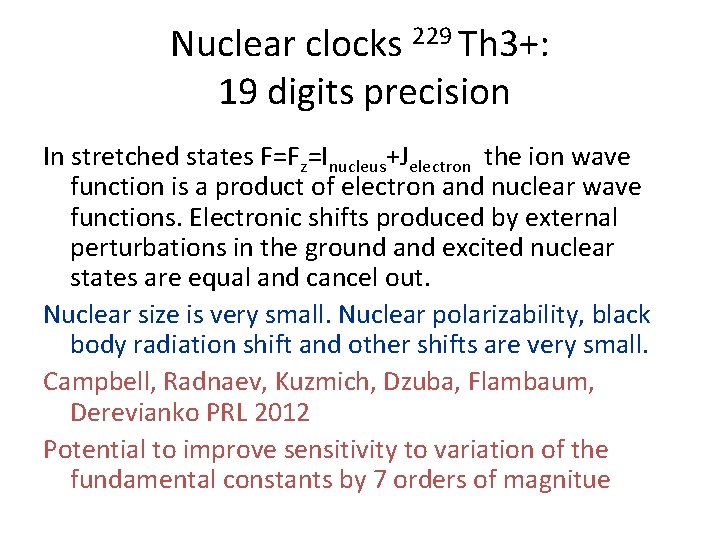
Nuclear clocks 229 Th 3+: 19 digits precision In stretched states F=Fz=Inucleus+Jelectron the ion wave function is a product of electron and nuclear wave functions. Electronic shifts produced by external perturbations in the ground and excited nuclear states are equal and cancel out. Nuclear size is very small. Nuclear polarizability, black body radiation shift and other shifts are very small. Campbell, Radnaev, Kuzmich, Dzuba, Flambaum, Derevianko PRL 2012 Potential to improve sensitivity to variation of the fundamental constants by 7 orders of magnitue
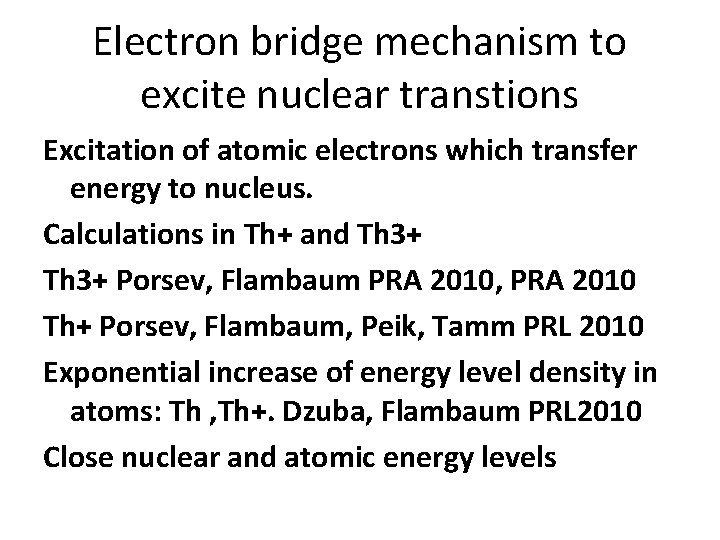
Electron bridge mechanism to excite nuclear transtions Excitation of atomic electrons which transfer energy to nucleus. Calculations in Th+ and Th 3+ Porsev, Flambaum PRA 2010, PRA 2010 Th+ Porsev, Flambaum, Peik, Tamm PRL 2010 Exponential increase of energy level density in atoms: Th , Th+. Dzuba, Flambaum PRL 2010 Close nuclear and atomic energy levels
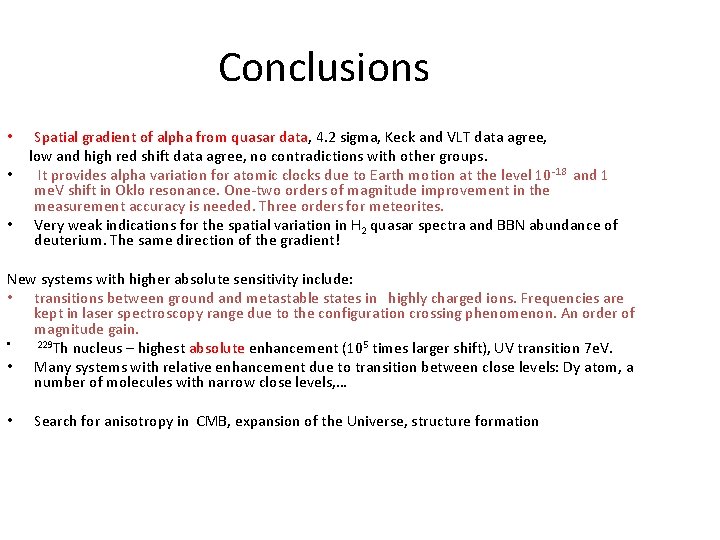
Conclusions Spatial gradient of alpha from quasar data, 4. 2 sigma, Keck and VLT data agree, low and high red shift data agree, no contradictions with other groups. • It provides alpha variation for atomic clocks due to Earth motion at the level 10 -18 and 1 me. V shift in Oklo resonance. One-two orders of magnitude improvement in the measurement accuracy is needed. Three orders for meteorites. • Very weak indications for the spatial variation in H 2 quasar spectra and BBN abundance of deuterium. The same direction of the gradient! • New systems with higher absolute sensitivity include: • transitions between ground and metastable states in highly charged ions. Frequencies are kept in laser spectroscopy range due to the configuration crossing phenomenon. An order of magnitude gain. • 229 Th nucleus – highest absolute enhancement (105 times larger shift), UV transition 7 e. V. • Many systems with relative enhancement due to transition between close levels: Dy atom, a number of molecules with narrow close levels, … • Search for anisotropy in CMB, expansion of the Universe, structure formation