
Spaceefficient and exact de Bruijn graph representation based
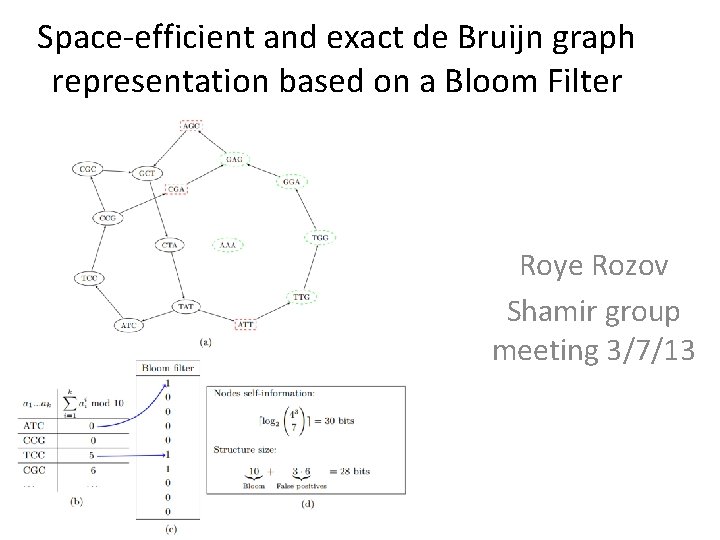
Space-efficient and exact de Bruijn graph representation based on a Bloom Filter Roye Rozov Shamir group meeting 3/7/13
Introduction • De novo assembly of large genomes is a memory intensive process – often requires >= 100 GB using standard tools (e. g. , Velvet, SOAPdenovo) • Newer methods have been able to reduce this to about half (e. g. SGA requires ~50 GB per human genome assembly), but this is still out of reach if a powerful server is not available • Minia, a new Bloom filter based assembler introduced here, reduces memory use by one more order of magnitude
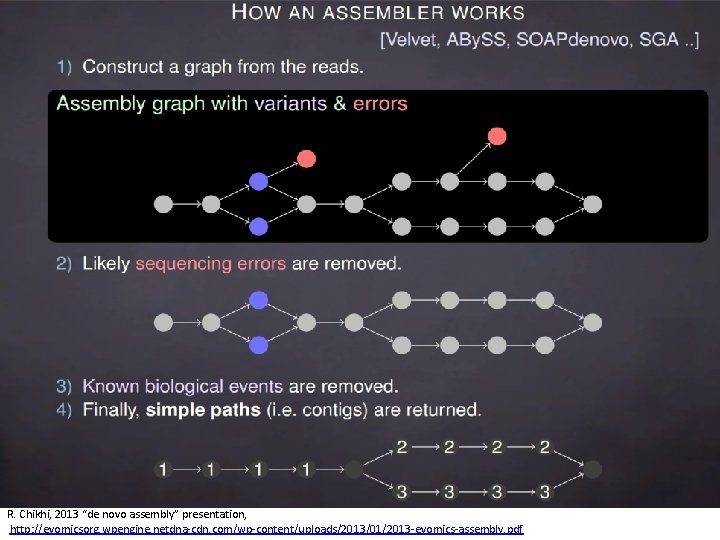
R. Chikhi, 2013 “de novo assembly” presentation, http: //evomicsorg. wpengine. netdna-cdn. com/wp-content/uploads/2013/01/2013 -evomics-assembly. pdf
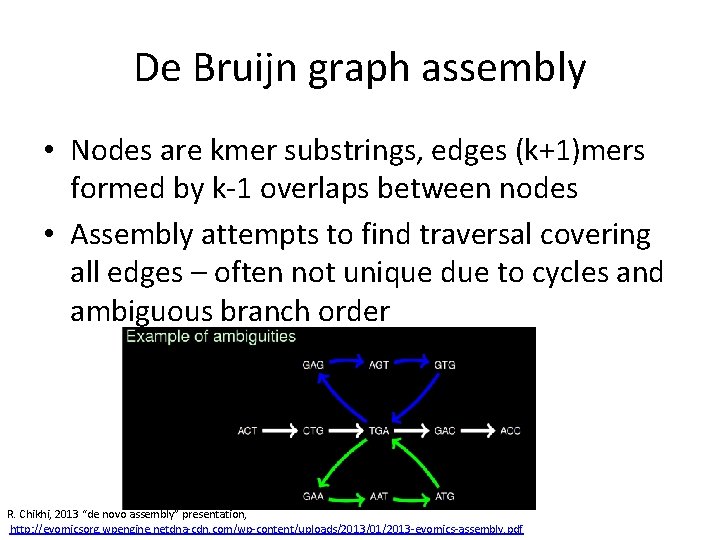
De Bruijn graph assembly • Nodes are kmer substrings, edges (k+1)mers formed by k-1 overlaps between nodes • Assembly attempts to find traversal covering all edges – often not unique due to cycles and ambiguous branch order R. Chikhi, 2013 “de novo assembly” presentation, http: //evomicsorg. wpengine. netdna-cdn. com/wp-content/uploads/2013/01/2013 -evomics-assembly. pdf
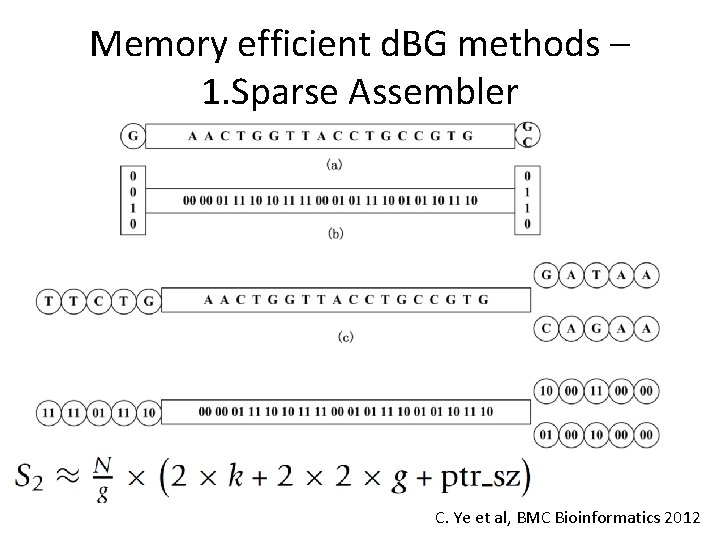
Memory efficient d. BG methods – 1. Sparse Assembler C. Ye et al, BMC Bioinformatics 2012

2. Conway and Bromage 2011 R. Chikhi, WABI 2012 presentation • Sparse bitmap representation designed to store minimal information about each node • Designed to be close to self-information limit and efficiently queriable
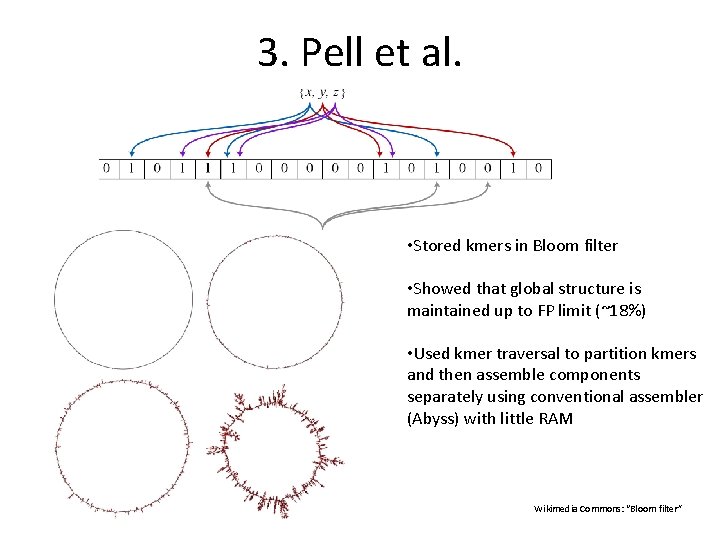
3. Pell et al. • Stored kmers in Bloom filter • Showed that global structure is maintained up to FP limit (~18%) • Used kmer traversal to partition kmers and then assemble components separately using conventional assembler (Abyss) with little RAM Wikimedia Commons: “Bloom filter”
Minia - Main ideas 1) for any node, enumerate its neighbors using Bloom filter 2) sequentially enumerate all nodes using list on disk, use to construct c. FP 3) limit memory use in assembly by using Bloom filter + c. FP set to allow traversal, 4) mark visited complex nodes during traversal
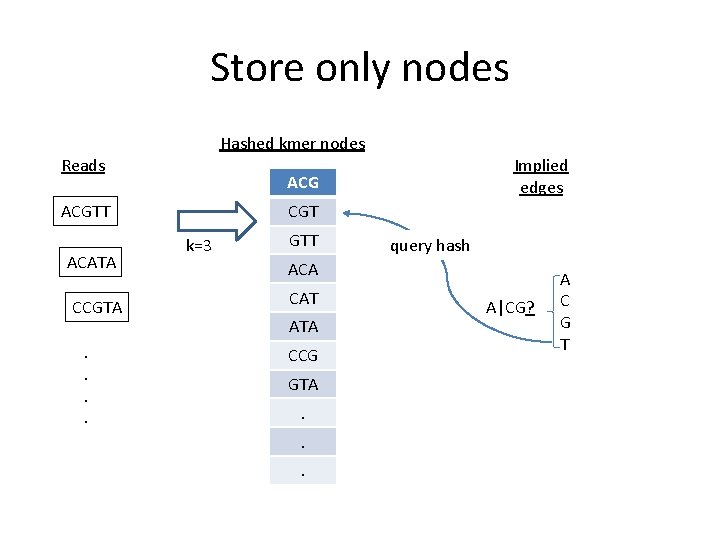
Store only nodes Hashed kmer nodes Reads ACGTT ACATA CCGTA. . Implied edges CGT k=3 GTT query hash ACA CAT ATA CCG GTA. . . A|CG? A C G T
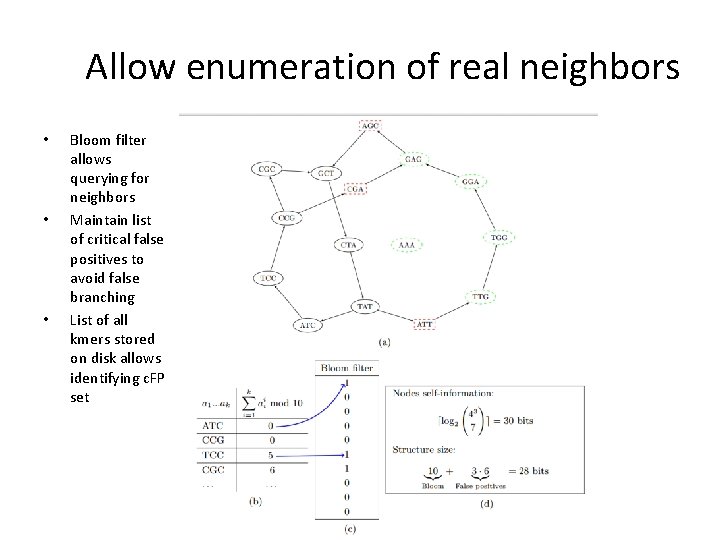
Allow enumeration of real neighbors • • • Bloom filter allows querying for neighbors Maintain list of critical false positives to avoid false branching List of all kmers stored on disk allows identifying c. FP set
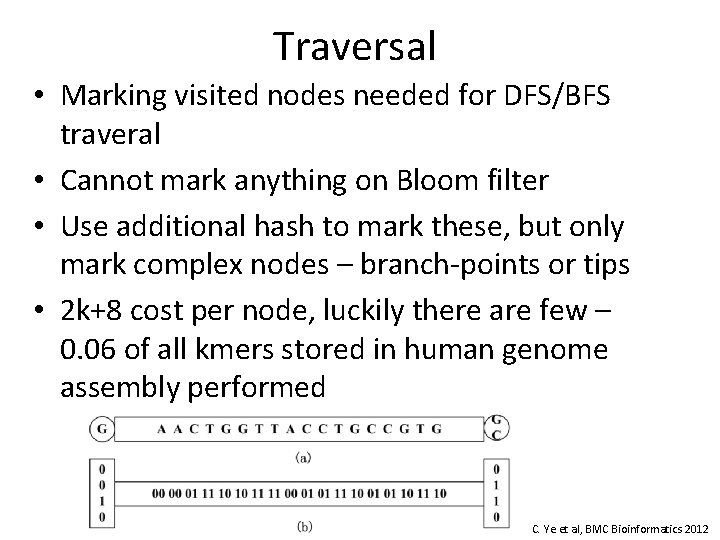
Traversal • Marking visited nodes needed for DFS/BFS traveral • Cannot mark anything on Bloom filter • Use additional hash to mark these, but only mark complex nodes – branch-points or tips • 2 k+8 cost per node, luckily there are few – 0. 06 of all kmers stored in human genome assembly performed C. Ye et al, BMC Bioinformatics 2012
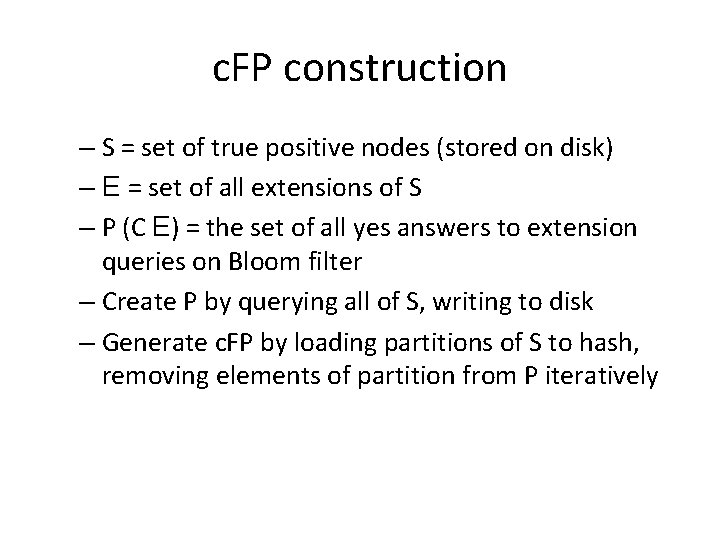
c. FP construction – S = set of true positive nodes (stored on disk) – E = set of all extensions of S – P (C E) = the set of all yes answers to extension queries on Bloom filter – Create P by querying all of S, writing to disk – Generate c. FP by loading partitions of S to hash, removing elements of partition from P iteratively
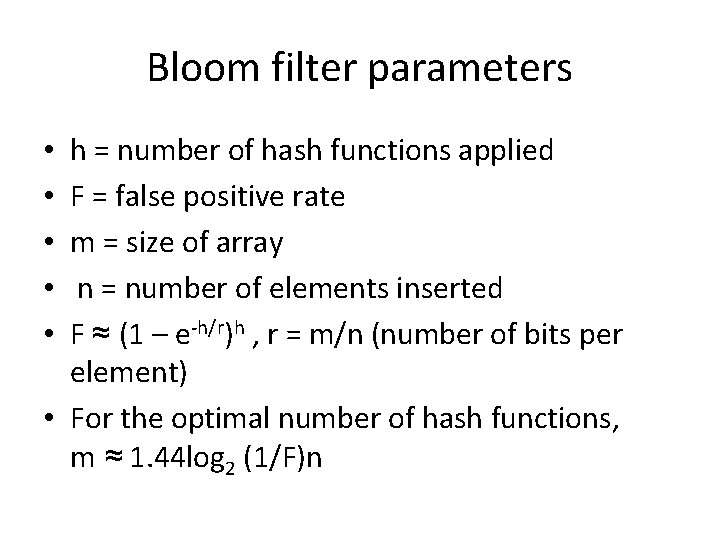
Bloom filter parameters h = number of hash functions applied F = false positive rate m = size of array n = number of elements inserted F ≈ (1 – e-h/r)h , r = m/n (number of bits per element) • For the optimal number of hash functions, m ≈ 1. 44 log 2 (1/F)n • • •
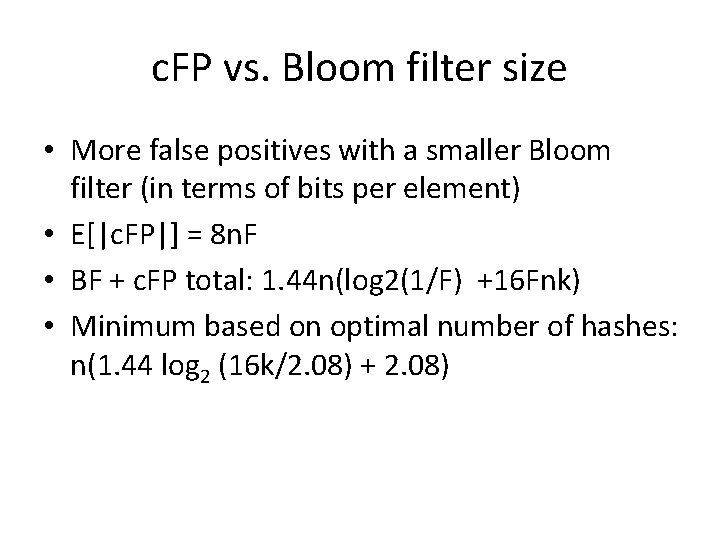
c. FP vs. Bloom filter size • More false positives with a smaller Bloom filter (in terms of bits per element) • E[|c. FP|] = 8 n. F • BF + c. FP total: 1. 44 n(log 2(1/F) +16 Fnk) • Minimum based on optimal number of hashes: n(1. 44 log 2 (16 k/2. 08) + 2. 08)
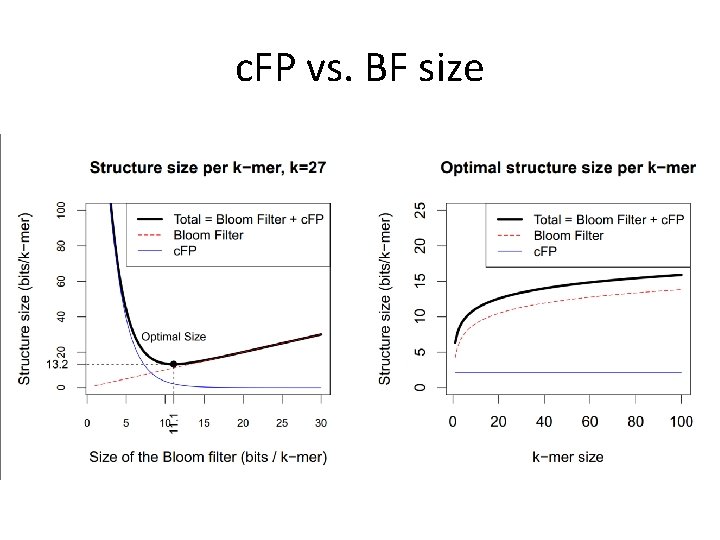
c. FP vs. BF size
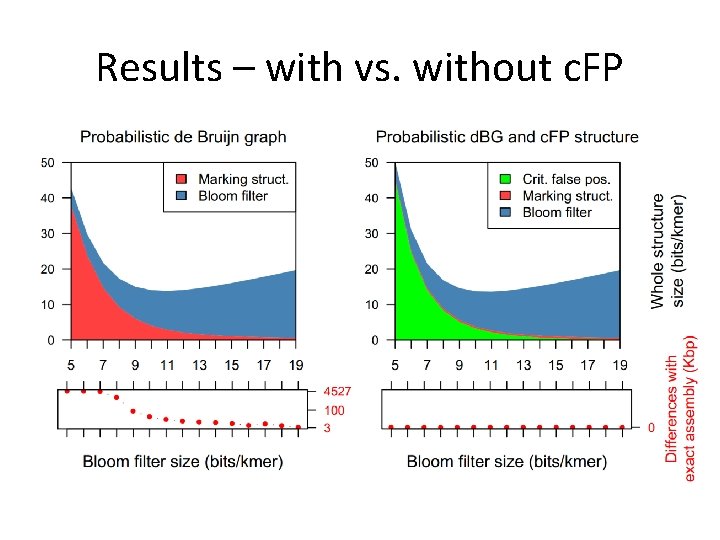
Results – with vs. without c. FP
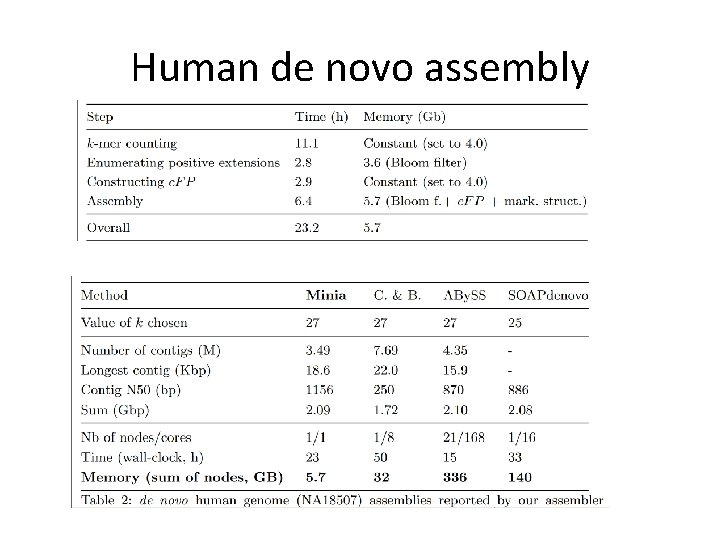
Human de novo assembly
- Slides: 17