
Spaced Retrieval Immediate Activity From Memory No Discussion



- Slides: 26
Spaced Retrieval Immediate Activity From Memory No Discussion No Prompts Explain one strength and one limitation of using official statistics in sociological research. Which social group is the most likely to be excluded from school? What do we mean by the term norms? • Social rules(formal and informal), expectations or standards of behaviour for particular situations. Your thoughts : How might this relate to crime and deviance? What is meant by material deprivation? Your thoughts: How might this link to crime and deviance? Your thoughts: How might this relate to crime and deviance?
Year 13 Sociology: Crime and Deviance. The definitions of Crime and Deviance Big Questions to address in this topic: 1) How are crime and deviance defined, and by whom? 2) How do these definitions vary according to time, culture and location? 3) Why are some actions and individuals seen as more deviant than others? 28 October 2021
What is crime? ? What is deviance? ?
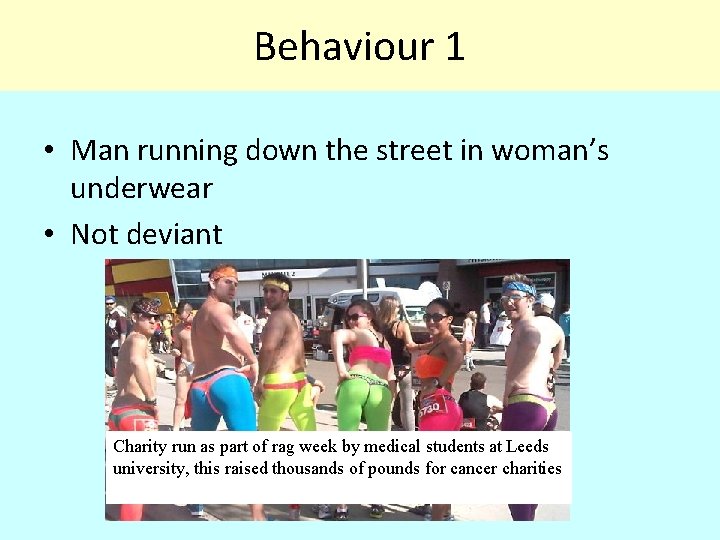
Behaviour 1 • Man running down the street in woman’s underwear • Not deviant Charity run as part of rag week by medical students at Leeds university, this raised thousands of pounds for cancer charities
Behaviour 2 • A man in his fifties offers a child of 8 some wine. • Not deviant In the Catholic Church children can take communion including communion wine from around the age of 7.
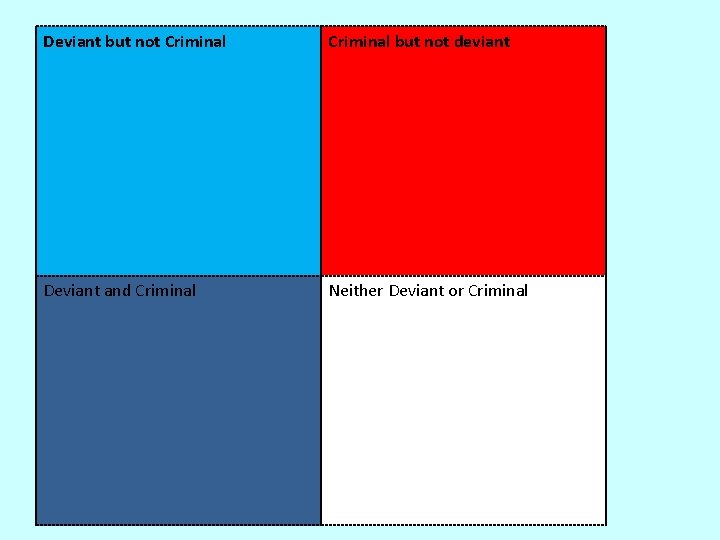
Deviant but not Criminal but not deviant Deviant and Criminal Neither Deviant or Criminal
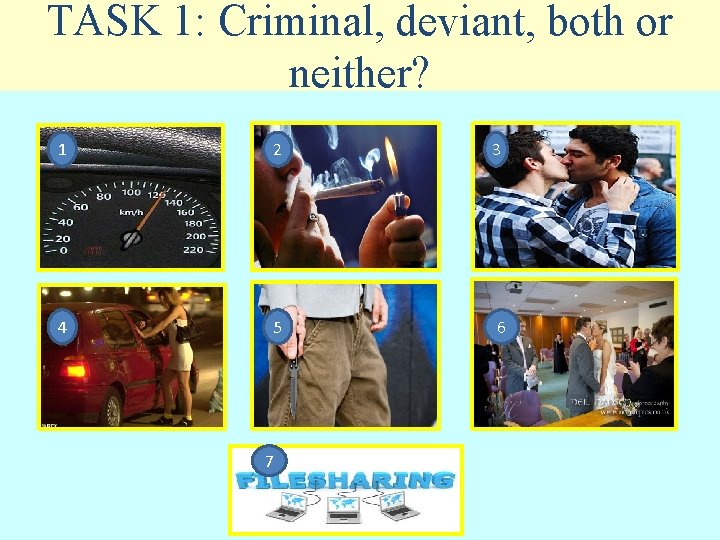
TASK 1: Criminal, deviant, both or neither? 1 2 4 5 7 3 6
So how do sociologists define deviance? • Deviance is behaviour which falls outside the social norms ‘which are accepted by a significant number of people’ (Giddens 1993). • An example of this could be a student swearing in a class room or a person drinking alcohol in a children’s playground as this behaviour is generally regarded as unacceptable by the majority of people. Defining deviance in this way is a ‘normative definition’. • However other sociologists argue that rather than using a normative definition of deviance we should use a ‘reactivist one’ meaning that an act is only deviant if other people label it as deviant and react to it, meaning that no action in itself is deviant. • To use the above examples, some would argue that swearing in class or drinking in a playground is only deviant if the action is witnessed and a sanction is put in place. Key concepts, when you see words in red , we need to define these key concepts and place them in our glossary
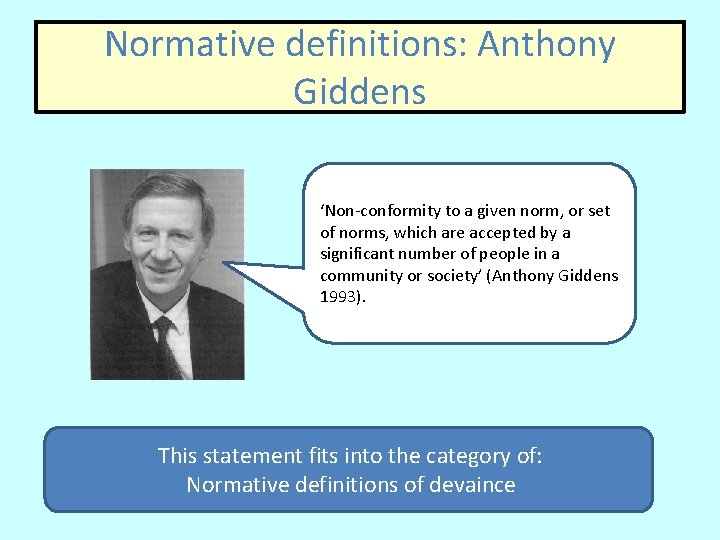
Normative definitions: Anthony Giddens ‘Non-conformity to a given norm, or set of norms, which are accepted by a significant number of people in a community or society’ (Anthony Giddens 1993). This statement fits into the category of: Normative definitions of devaince
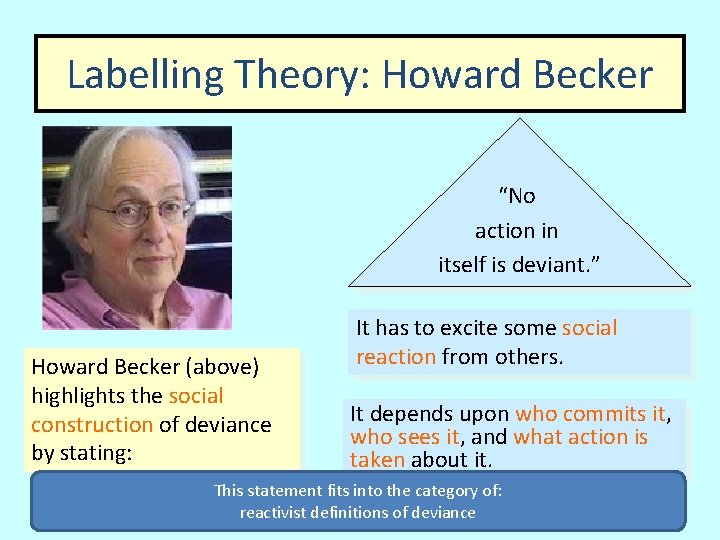
Labelling Theory: Howard Becker “No action in itself is deviant. ” Howard Becker (above) highlights the social construction of deviance by stating: It has to excite some social reaction from others. It depends upon who commits it, who sees it, and what action is taken about it. This statement fits into the category of: reactivist definitions of deviance
All this suggests that…. . • What is considered criminal or deviant will vary across time, place and culture. • Becker suggests that what is considered deviant or criminal will vary further depending upon who commits the ‘deviant’ act, who witnesses it and what the repercussions are. • Therefore we can argue that definitions of crime and deviance are socially constructed.
4 mark question • Outline two ways in which crime and deviance can be seen as a social construction
• What you should be aiming for this lesson. Focus on exam success from the very start! Band 1 Students are able to discuss what makes an action deviant and will begin to consider how this will vary, however this discussion is unlikely to include key terms. References to sociologists may be limited or inaccurately applied. Band 2 Students will be able to explain what makes an action deviant and will be able to explain why this will vary across time, place and culture. References to sociologists will be relevant and applied specifically to the question although they may lack the depth required to reach the higher bands. Band 3 Students can confidently explain why both crime and deviance are relative and will use correct terminology throughout. Detailed references will be made to sociologists showing more than one point of view with a range of examples accurately applied.
Statistics and patterns of crime 1. 2. 3. 4. Learning goals for the topic: Understand different types of crime statistics and the statistical patterns shown in them (AO 1) Apply statistical awareness to current crime trends (AO 2) Analyse strengths and weaknesses of different types of crime statistics (AO 3) Evaluate the reliability and validity of crime statistics (AO 3)
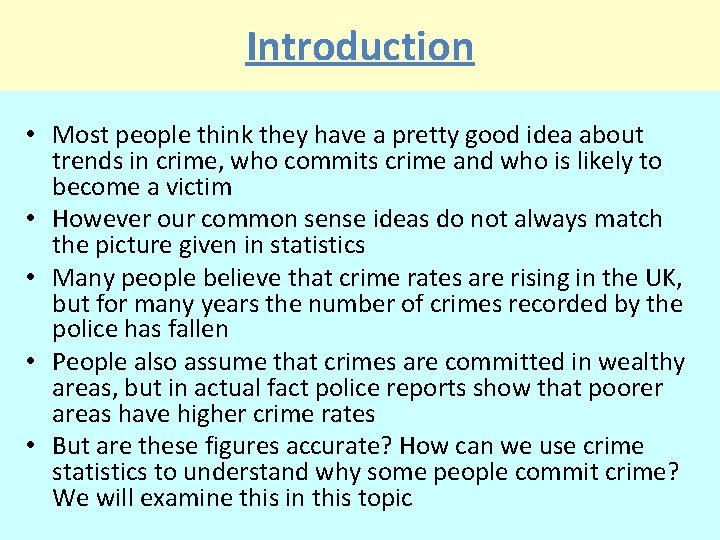
Introduction • Most people think they have a pretty good idea about trends in crime, who commits crime and who is likely to become a victim • However our common sense ideas do not always match the picture given in statistics • Many people believe that crime rates are rising in the UK, but for many years the number of crimes recorded by the police has fallen • People also assume that crimes are committed in wealthy areas, but in actual fact police reports show that poorer areas have higher crime rates • But are these figures accurate? How can we use crime statistics to understand why some people commit crime? We will examine this in this topic
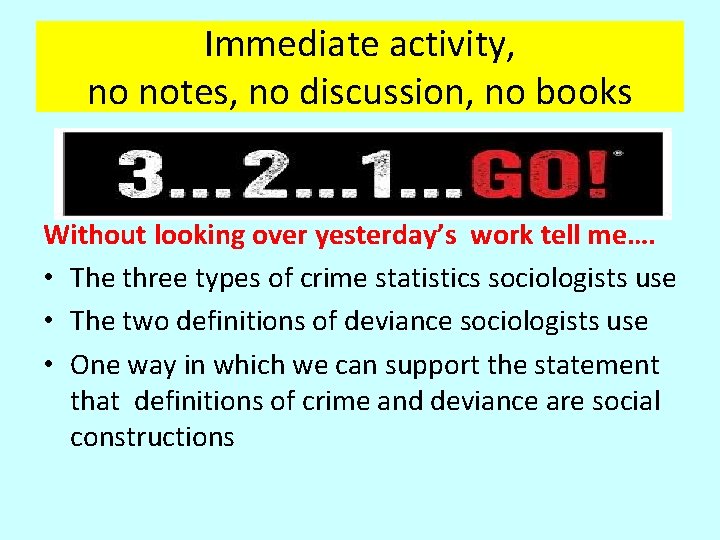
Immediate activity, no notes, no discussion, no books Without looking over yesterday’s work tell me…. • The three types of crime statistics sociologists use • The two definitions of deviance sociologists use • One way in which we can support the statement that definitions of crime and deviance are social constructions
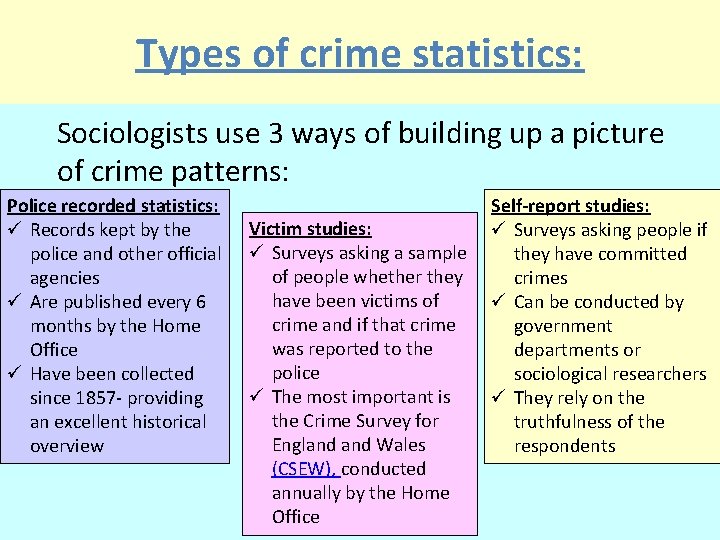
Types of crime statistics: Sociologists use 3 ways of building up a picture of crime patterns: Police recorded statistics: ü Records kept by the police and other official agencies ü Are published every 6 months by the Home Office ü Have been collected since 1857 - providing an excellent historical overview Victim studies: ü Surveys asking a sample of people whether they have been victims of crime and if that crime was reported to the police ü The most important is the Crime Survey for England Wales (CSEW), conducted annually by the Home Office Self-report studies: ü Surveys asking people if they have committed crimes ü Can be conducted by government departments or sociological researchers ü They rely on the truthfulness of the respondents
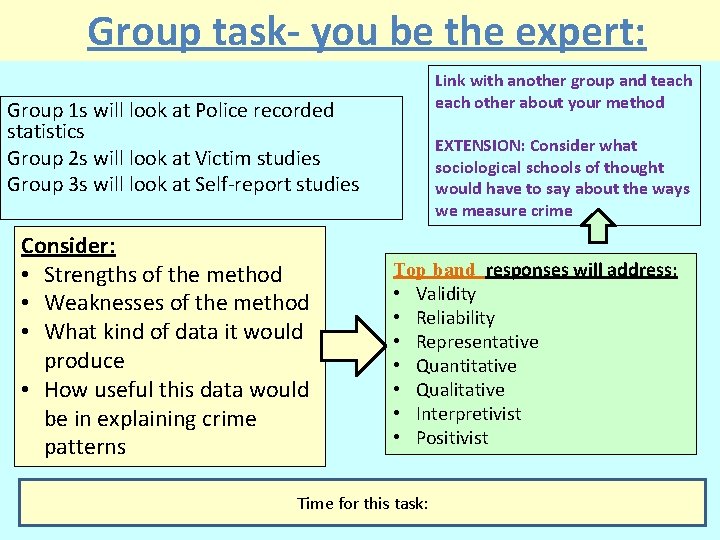
Group task- you be the expert: Link with another group and teach other about your method Group 1 s will look at Police recorded statistics Group 2 s will look at Victim studies Group 3 s will look at Self-report studies Consider: • Strengths of the method • Weaknesses of the method • What kind of data it would produce • How useful this data would be in explaining crime patterns EXTENSION: Consider what sociological schools of thought would have to say about the ways we measure crime Top band responses will address: • Validity • Reliability • Representative • Quantitative • Qualitative • Interpretivist • Positivist Time for this task:
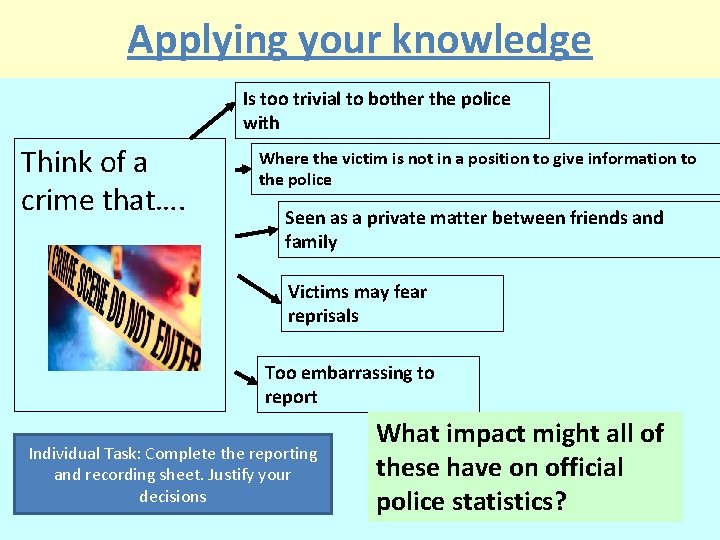
Applying your knowledge Is too trivial to bother the police with Think of a crime that…. Where the victim is not in a position to give information to the police Seen as a private matter between friends and family Victims may fear reprisals Too embarrassing to report Individual Task: Complete the reporting and recording sheet. Justify your decisions What impact might all of these have on official police statistics?
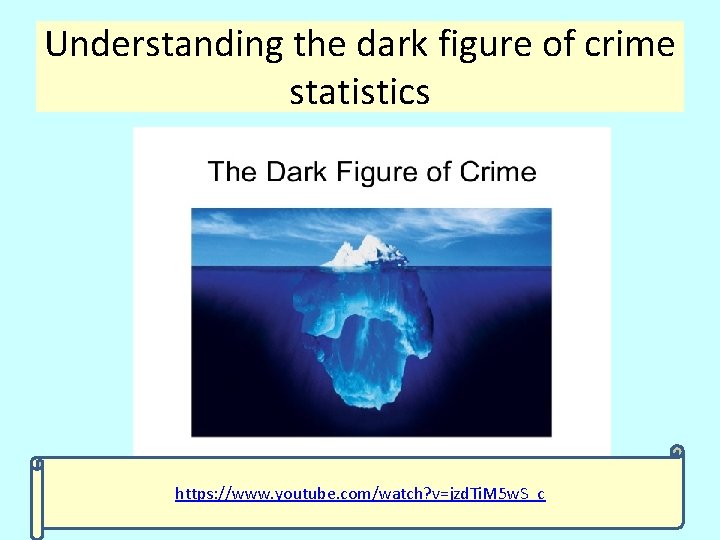
Understanding the dark figure of crime statistics https: //www. youtube. com/watch? v=jzd. Ti. M 5 w. S_c
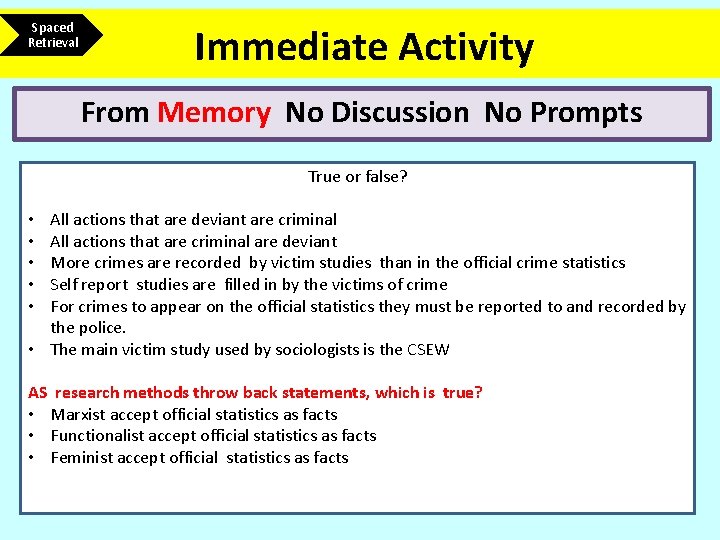
Spaced Retrieval Immediate Activity From Memory No Discussion No Prompts True or false? All actions that are deviant are criminal All actions that are criminal are deviant More crimes are recorded by victim studies than in the official crime statistics Self report studies are filled in by the victims of crime For crimes to appear on the official statistics they must be reported to and recorded by the police. • The main victim study used by sociologists is the CSEW • • • AS research methods throw back statements, which is true? • Marxist accept official statistics as facts • Functionalist accept official statistics as facts • Feminist accept official statistics as facts
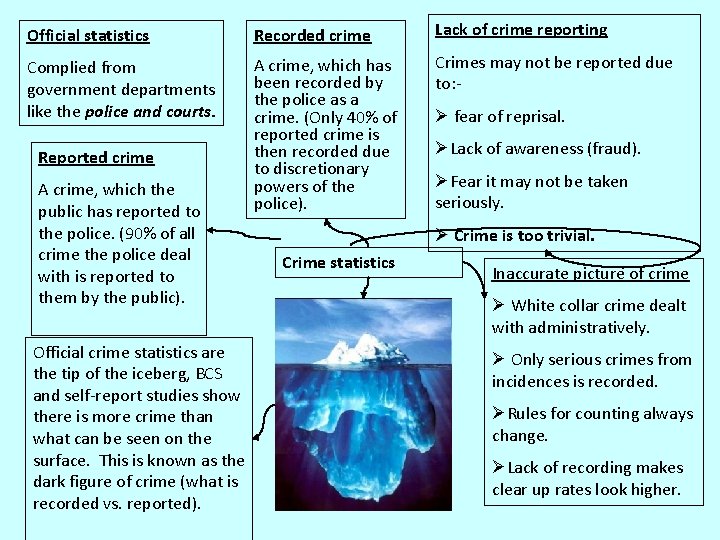
Official statistics Recorded crime Lack of crime reporting Complied from government departments like the police and courts. A crime, which has been recorded by the police as a crime. (Only 40% of reported crime is then recorded due to discretionary powers of the police). Crimes may not be reported due to: - Reported crime A crime, which the public has reported to the police. (90% of all crime the police deal with is reported to them by the public). Official crime statistics are the tip of the iceberg, BCS and self-report studies show there is more crime than what can be seen on the surface. This is known as the dark figure of crime (what is recorded vs. reported). Ø fear of reprisal. ØLack of awareness (fraud). ØFear it may not be taken seriously. Ø Crime is too trivial. Crime statistics Inaccurate picture of crime Ø White collar crime dealt with administratively. Ø Only serious crimes from incidences is recorded. ØRules for counting always change. ØLack of recording makes clear up rates look higher.
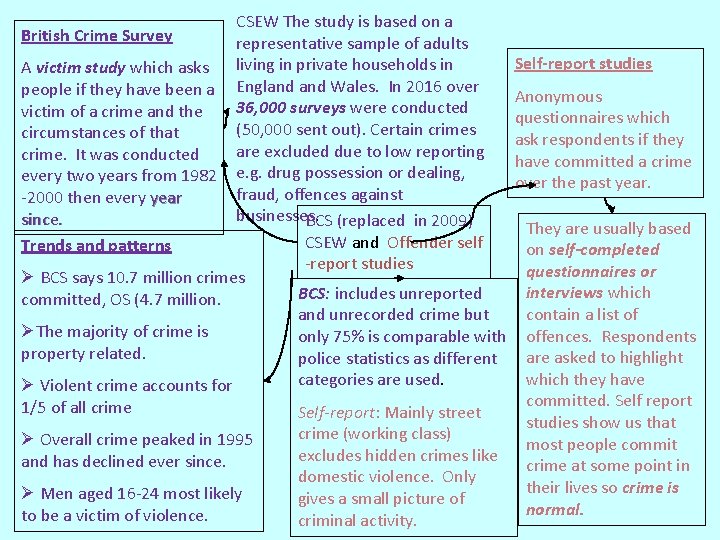
CSEW The study is based on a British Crime Survey representative sample of adults living in private households in A victim study which asks people if they have been a England Wales. In 2016 over 36, 000 surveys were conducted victim of a crime and the (50, 000 sent out). Certain crimes circumstances of that are excluded due to low reporting crime. It was conducted every two years from 1982 e. g. drug possession or dealing, fraud, offences against -2000 then every year businesses. since. BCS (replaced in 2009) CSEW and Offender self Trends and patterns -report studies Ø BCS says 10. 7 million crimes BCS: includes unreported committed, OS (4. 7 million. and unrecorded crime but ØThe majority of crime is only 75% is comparable with property related. police statistics as different categories are used. Ø Violent crime accounts for 1/5 of all crime Ø Overall crime peaked in 1995 and has declined ever since. Ø Men aged 16 -24 most likely to be a victim of violence. Self-report: Mainly street crime (working class) excludes hidden crimes like domestic violence. Only gives a small picture of criminal activity. Self-report studies Anonymous questionnaires which ask respondents if they have committed a crime over the past year. They are usually based on self-completed questionnaires or interviews which contain a list of offences. Respondents are asked to highlight which they have committed. Self report studies show us that most people commit crime at some point in their lives so crime is normal.
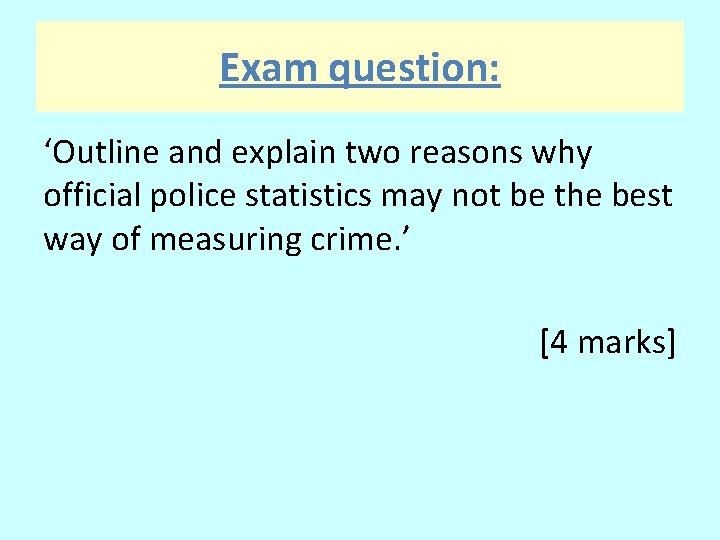
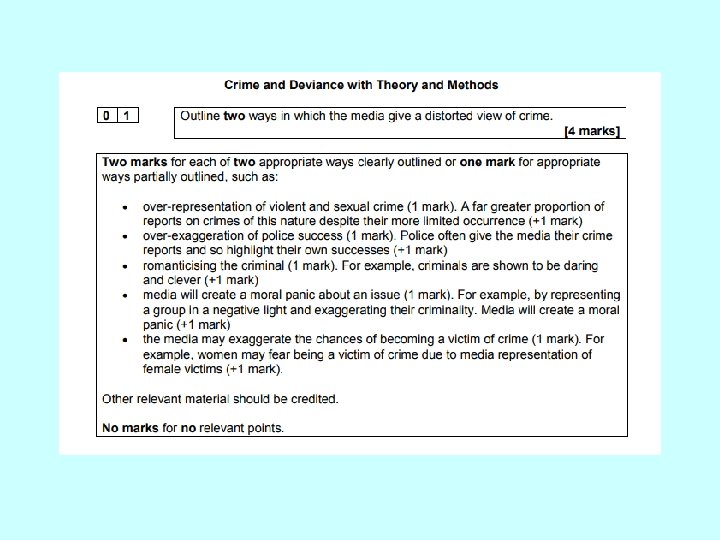
Exam question: ‘Outline and explain two reasons why official police statistics may not be the best way of measuring crime. ’ [4 marks]