
Spacecraft Jitter Prediction using 6 DOF Disturbance Measurements
“Spacecraft Jitter Prediction using 6 -DOF Disturbance Measurements” Bryce Carpenter Oliver Martin Jason Hinkle Sierra Nevada Corporation Space Systems Group IEEE Aerospace Conference March 2009 IEEE Aerospace Conference
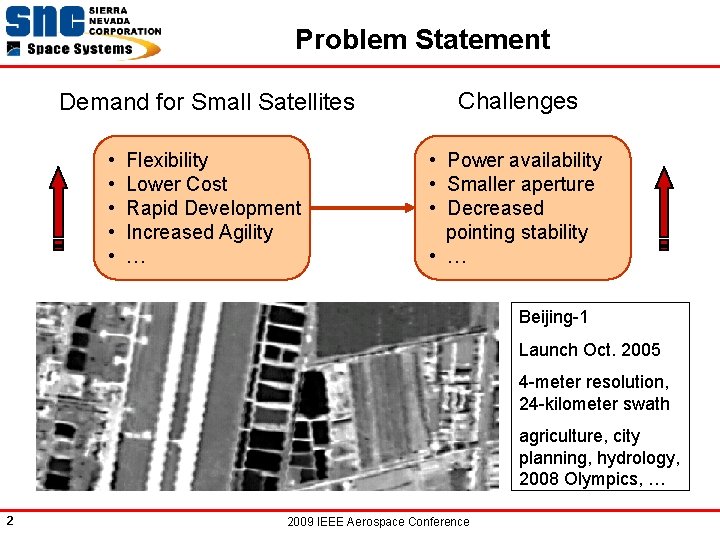
Problem Statement Demand for Small Satellites • • • Flexibility Lower Cost Rapid Development Increased Agility … Challenges • Power availability • Smaller aperture • Decreased pointing stability • … Beijing-1 Launch Oct. 2005 4 -meter resolution, 24 -kilometer swath agriculture, city planning, hydrology, 2008 Olympics, … 2 2009 IEEE Aerospace Conference
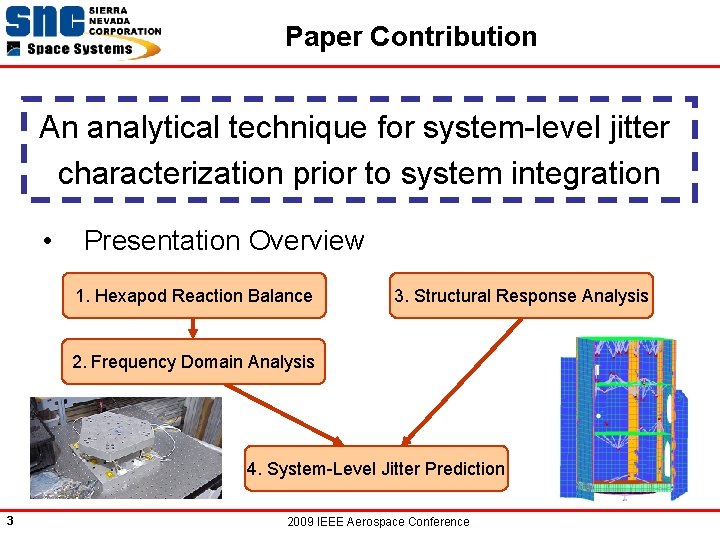
Paper Contribution An analytical technique for system-level jitter characterization prior to system integration • Presentation Overview 1. Hexapod Reaction Balance 3. Structural Response Analysis 2. Frequency Domain Analysis 4. System-Level Jitter Prediction 3 2009 IEEE Aerospace Conference
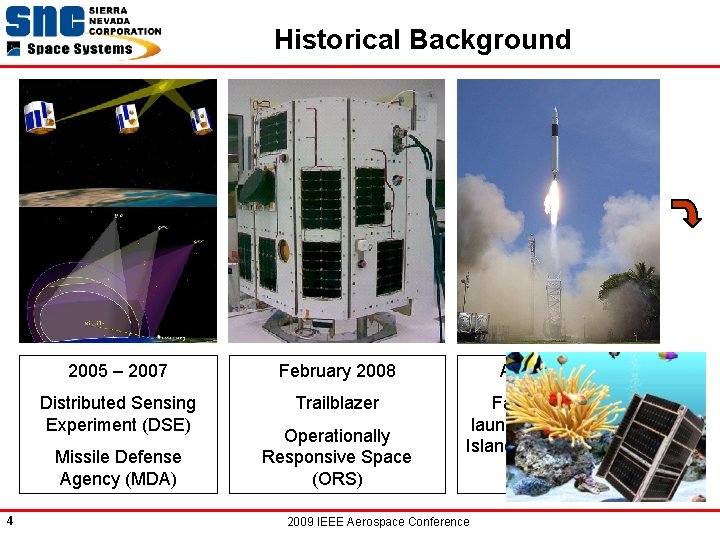
Historical Background 2005 – 2007 February 2008 August 2, 2008 Distributed Sensing Experiment (DSE) Trailblazer Falcon 1, Flight 3 launches from Omelek Island in Kwajalein Atoll Missile Defense Agency (MDA) 4 Operationally Responsive Space (ORS) 2009 IEEE Aerospace Conference Space. X
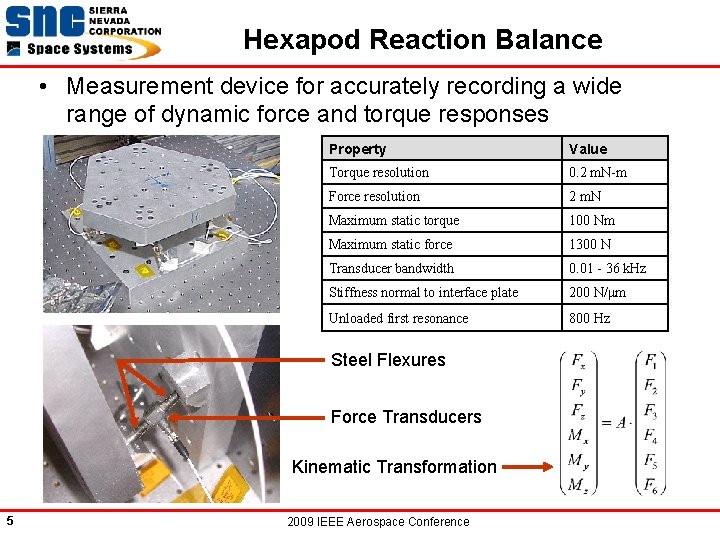
Hexapod Reaction Balance • Measurement device for accurately recording a wide range of dynamic force and torque responses Property Value Torque resolution 0. 2 m. N-m Force resolution 2 m. N Maximum static torque 100 Nm Maximum static force 1300 N Transducer bandwidth 0. 01 - 36 k. Hz Stiffness normal to interface plate 200 N/μm Unloaded first resonance 800 Hz Steel Flexures Force Transducers Kinematic Transformation 5 2009 IEEE Aerospace Conference
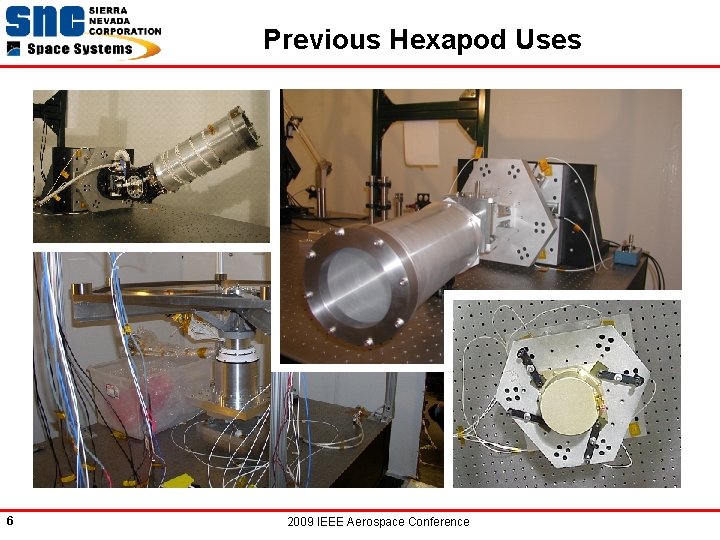
Previous Hexapod Uses 6 2009 IEEE Aerospace Conference
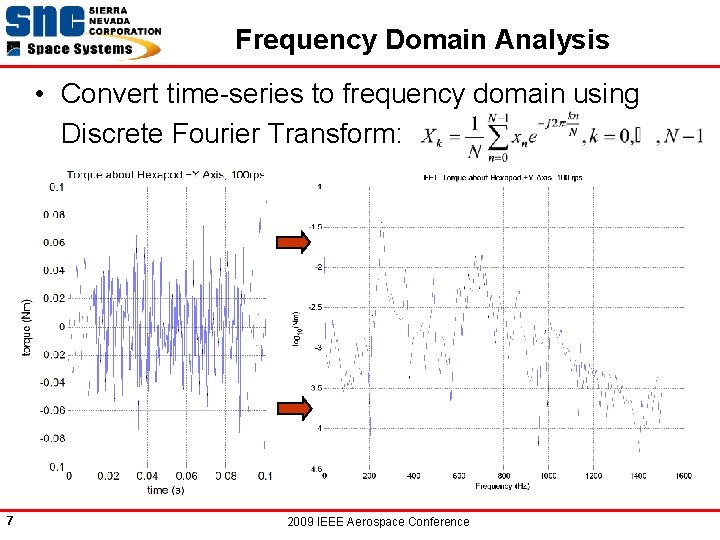
Frequency Domain Analysis • Convert time-series to frequency domain using Discrete Fourier Transform: 7 2009 IEEE Aerospace Conference

+Y Torque Waterfall Plot 8 2009 IEEE Aerospace Conference
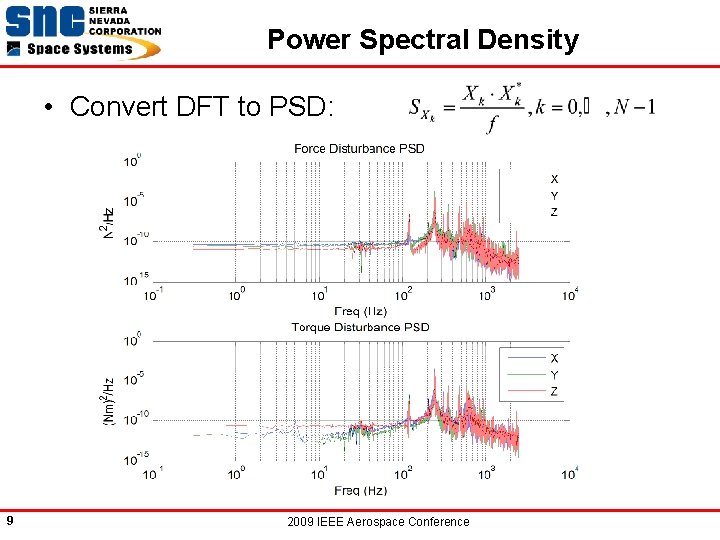
Power Spectral Density • Convert DFT to PSD: 9 2009 IEEE Aerospace Conference
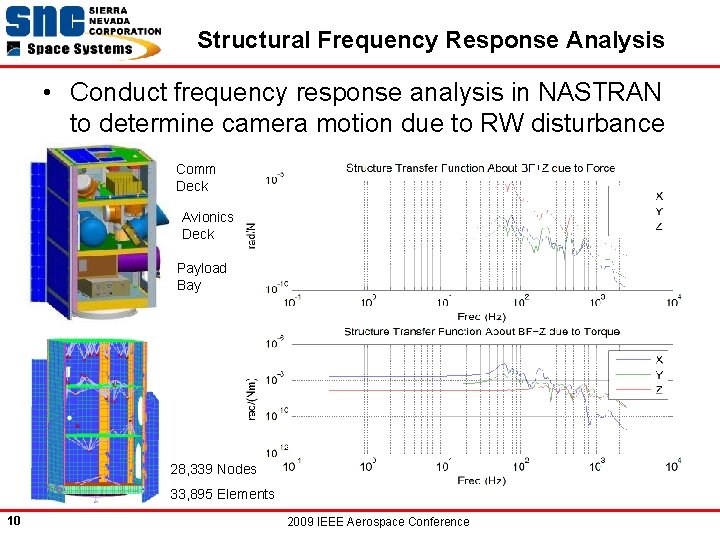
Structural Frequency Response Analysis • Conduct frequency response analysis in NASTRAN to determine camera motion due to RW disturbance Comm Deck Avionics Deck Payload Bay 28, 339 Nodes 33, 895 Elements 10 2009 IEEE Aerospace Conference

System Jitter Prediction Reaction Wheel Disturbance Predicted Payload Jitter Flexible Body Response 11 2009 IEEE Aerospace Conference

Payload Jitter Results 12 2009 IEEE Aerospace Conference
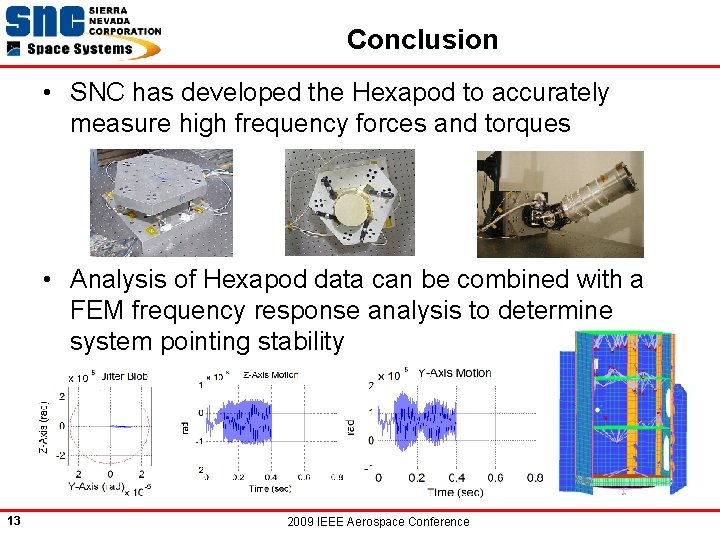
Conclusion • SNC has developed the Hexapod to accurately measure high frequency forces and torques • Analysis of Hexapod data can be combined with a FEM frequency response analysis to determine system pointing stability 13 2009 IEEE Aerospace Conference
Acknowledgments This material is based upon work supported by the U. S. Army Space and Missile Defense Command under Contract No. HQ 0006 -04 -D-0002. ” 14 2009 IEEE Aerospace Conference
- Slides: 14