
SpaceBased Satellite Antenna Maps Impact of Different Satellite
Space-Based Satellite Antenna Maps; Impact of Different Satellite Antenna Maps on LEO & Terrestrial Results Bruce Haines, Yoaz Bar-Sever, Willy Bertiger, Shailen Desai, Aurore Sibois, Frank Webb and Larry Young Jet Propulsion Laboratory California Institute of Technology June 3, 2008 IGS Workshop, Miami USA
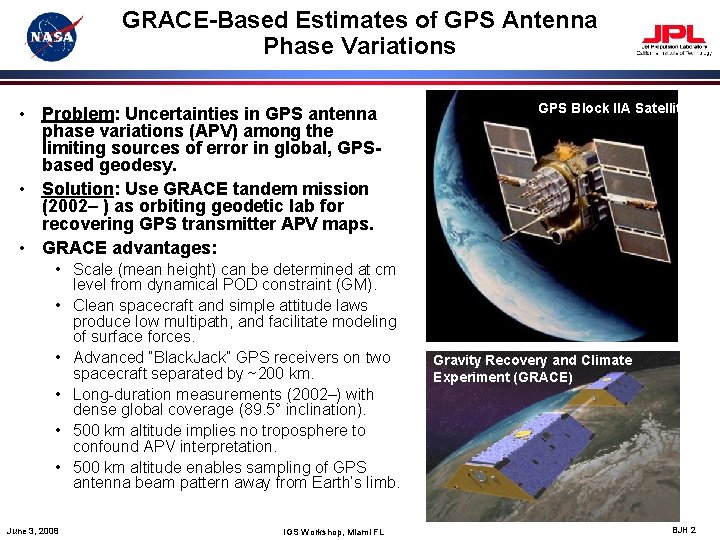
GRACE-Based Estimates of GPS Antenna Phase Variations • Problem: Uncertainties in GPS antenna phase variations (APV) among the limiting sources of error in global, GPSbased geodesy. • Solution: Use GRACE tandem mission (2002– ) as orbiting geodetic lab for recovering GPS transmitter APV maps. • GRACE advantages: • Scale (mean height) can be determined at cm level from dynamical POD constraint (GM). • Clean spacecraft and simple attitude laws produce low multipath, and facilitate modeling of surface forces. • Advanced “Black. Jack” GPS receivers on two spacecraft separated by ~200 km. • Long-duration measurements (2002–) with dense global coverage (89. 5° inclination). • 500 km altitude implies no troposphere to confound APV interpretation. • 500 km altitude enables sampling of GPS antenna beam pattern away from Earth’s limb. June 3, 2008 IGS Workshop, Miami FL GPS Block IIA Satellite Gravity Recovery and Climate Experiment (GRACE) BJH 2
GRACE Processing • Daily precise orbit solutions for 2004– 2006 • One GRACE s/c at a time • Phase (LC) only (High rate 30 -s) • Minimum arc length of 30 min • Dynamical POD to preserve link between scale and GM • CD and 1 cpr acc. reset every rev. per UT/CSR approach. • • • GPS ephemeris and clock offsets fixed to precise, fiducial-free values (JPL/IGSAC) A priori offset of GPS s/c phase-center with respect to CG assumed to be zero. GRACE a priori antenna phase variation model from anechoic chamber: • Postfit residuals binned according to az/el of transmitters. • High rate (30 -s) ionosphere-free phase (LC) • Least-squares fit to antenna map • Iterate until converged – 15 June 3, 2008 0 mm 15 IGS Workshop, Miami FL BJH 3
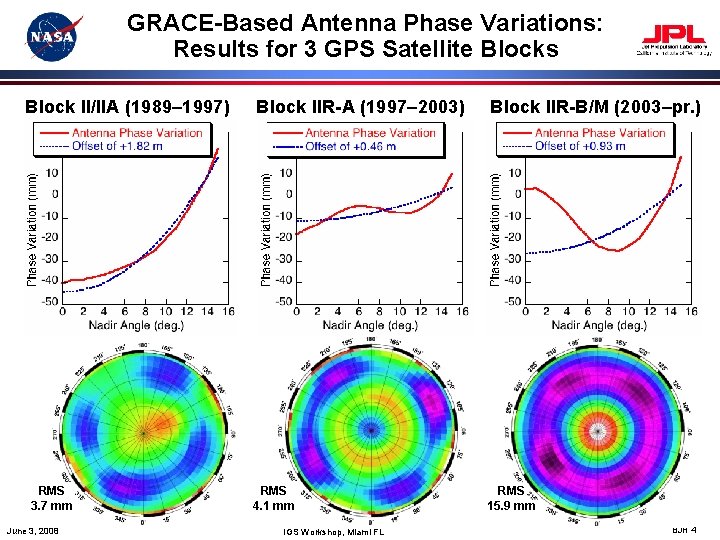
GRACE-Based Antenna Phase Variations: Results for 3 GPS Satellite Blocks Block II/IIA (1989– 1997) RMS 3. 7 mm June 3, 2008 Block IIR-A (1997– 2003) Block IIR-B/M (2003–pr. ) RMS 4. 1 mm RMS 15. 9 mm IGS Workshop, Miami FL BJH 4
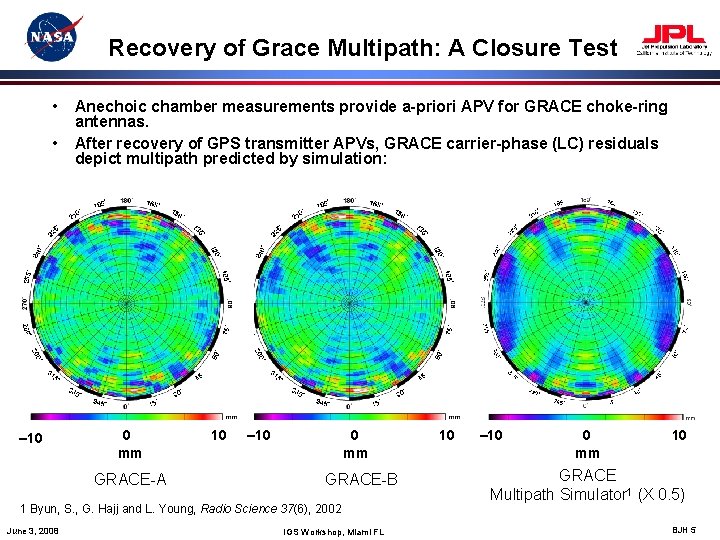
Recovery of Grace Multipath: A Closure Test • • – 10 Anechoic chamber measurements provide a-priori APV for GRACE choke-ring antennas. After recovery of GPS transmitter APVs, GRACE carrier-phase (LC) residuals depict multipath predicted by simulation: 0 mm GRACE-A 10 – 10 0 mm GRACE-B 1 Byun, S. , G. Hajj and L. Young, Radio Science 37(6), 2002 June 3, 2008 IGS Workshop, Miami FL 10 – 10 0 mm 10 GRACE Multipath Simulator 1 (X 0. 5) BJH 5
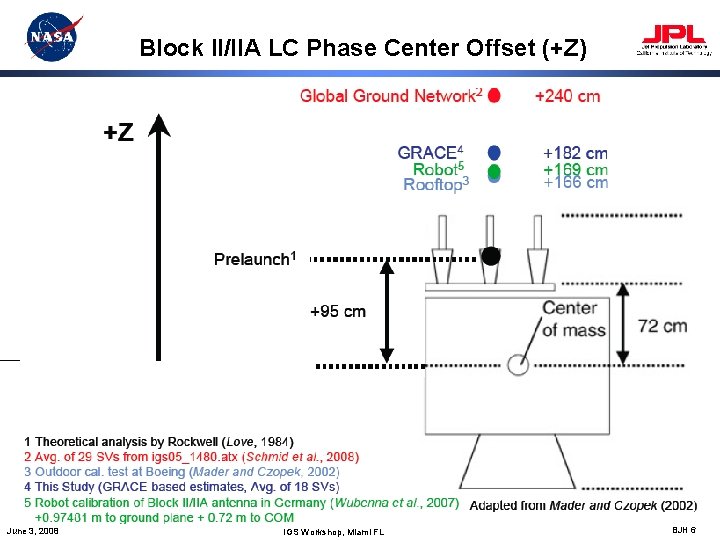
Block II/IIA LC Phase Center Offset (+Z) June 3, 2008 IGS Workshop, Miami FL BJH 6
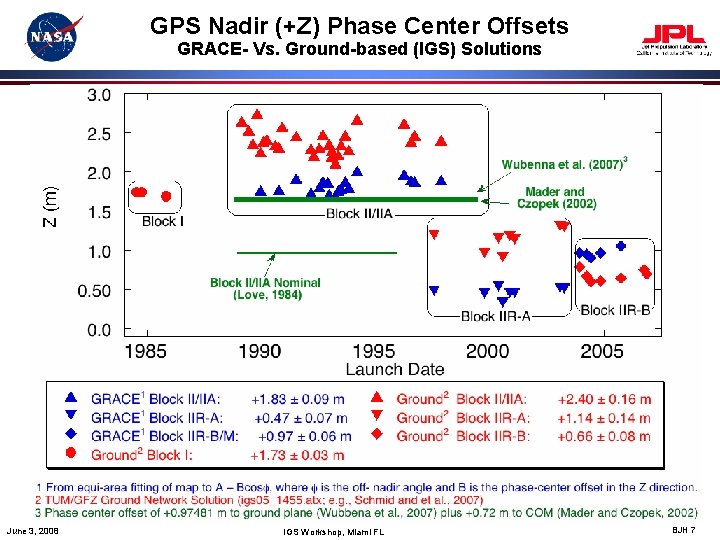
GPS Nadir (+Z) Phase Center Offsets GRACE- Vs. Ground-based (IGS) Solutions June 3, 2008 IGS Workshop, Miami FL BJH 7
TOPEX/POSEIDON and Jason-1 Tests: Antenna Offset Estimates as Proxy for Scale TOPEX/Poseidon (1992– 2005) • • First demo of precise GPS in space ~2 cm radial orbit accuracy from GPS Low multipath (GPS antenna on 4 -m boom) Apparent 5 -cm bias in radial position of antenna • Reported early in mission (e. g. , Bertiger et al. , 1994) • Eluded explanation for over a decade Jason-1 (2001–) • • • Successor altimeter mission to T/P 1 -cm radial orbit accuracy from GPS Apparent 4– 5 cm bias in radial antenna position • Due to errors in modeling of GPS transmit antenna PCO. Specialized Dynamic POD Tests • Enable estimation of mean (daily) antenna phase center offset wrt vehicle CM • Serves as proxy for errors in the TRF (scale) realized by GPS • Exposes errors in the transmitter phase-center locations • Use ionosphere-free phase (LC) alone in dynamic POD soln. June 3, 2008 IGS Workshop, Miami FL BJH 8
GPS Transmitter APV Maps Explain Anomalous Estimated Radial Antenna Offsets for T/P and Jason-1 June 3, 2008 IGS Workshop, Miami FL BJH 9
GPS Transmitter APV Maps Explain Anomalous Estimated Radial Antenna Offsets for Jason-1 June 3, 2008 IGS Workshop, Miami FL BJH 10
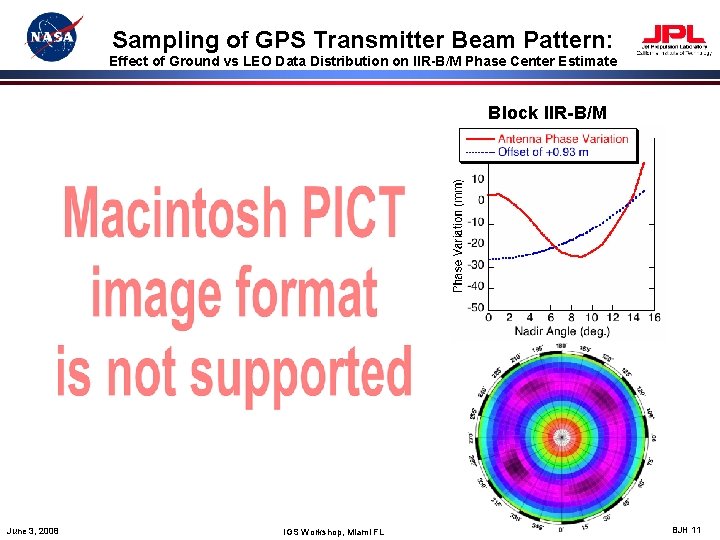
Sampling of GPS Transmitter Beam Pattern: Effect of Ground vs LEO Data Distribution on IIR-B/M Phase Center Estimate Block IIR-B/M June 3, 2008 IGS Workshop, Miami FL BJH 11
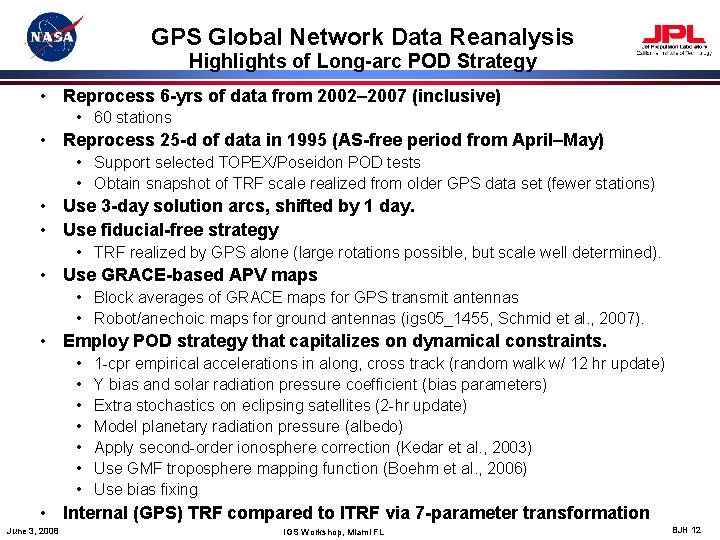
GPS Global Network Data Reanalysis Highlights of Long-arc POD Strategy • Reprocess 6 -yrs of data from 2002– 2007 (inclusive) • 60 stations • Reprocess 25 -d of data in 1995 (AS-free period from April–May) • Support selected TOPEX/Poseidon POD tests • Obtain snapshot of TRF scale realized from older GPS data set (fewer stations) • Use 3 -day solution arcs, shifted by 1 day. • Use fiducial-free strategy • TRF realized by GPS alone (large rotations possible, but scale well determined). • Use GRACE-based APV maps • Block averages of GRACE maps for GPS transmit antennas • Robot/anechoic maps for ground antennas (igs 05_1455, Schmid et al. , 2007). • Employ POD strategy that capitalizes on dynamical constraints. • • 1 -cpr empirical accelerations in along, cross track (random walk w/ 12 hr update) Y bias and solar radiation pressure coefficient (bias parameters) Extra stochastics on eclipsing satellites (2 -hr update) Model planetary radiation pressure (albedo) Apply second-order ionosphere correction (Kedar et al. , 2003) Use GMF troposphere mapping function (Boehm et al. , 2006) Use bias fixing • Internal (GPS) TRF compared to ITRF via 7 -parameter transformation June 3, 2008 IGS Workshop, Miami FL BJH 12
TRF Scale from GPS Alone (2002– 2007): Agreement with ITRF 2005 See also Ge et al. (GRL, 2005) June 3, 2008 Annual Cycle Removed IGS Workshop, Miami FL BJH 13
TRF Scale from GPS Alone (2002– 2007): Agreement with ITRF 2005 See also Ge et al. (GRL, 2005) June 3, 2008 Annual Cycle Removed IGS Workshop, Miami FL BJH 14
Alternative Choke Ring APV Model Reduces Scale Difference to 1 ppb June 3, 2008 IGS Workshop, Miami FL BJH 15
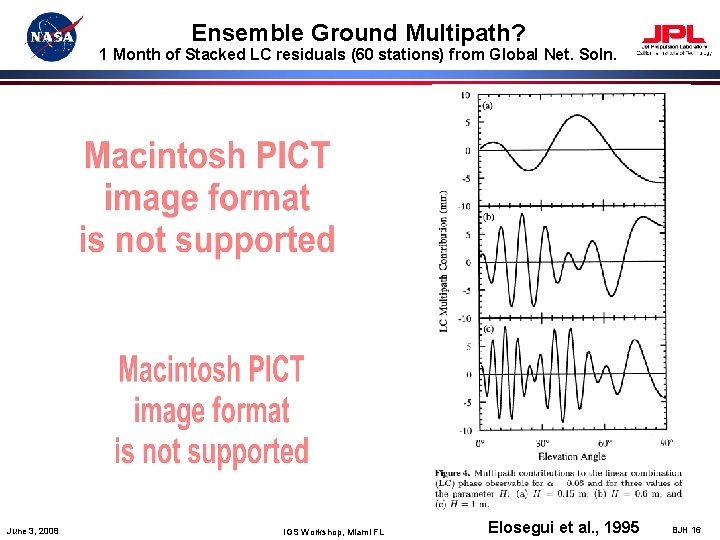
Ensemble Ground Multipath? 1 Month of Stacked LC residuals (60 stations) from Global Net. Soln. June 3, 2008 IGS Workshop, Miami FL Elosegui et al. , 1995 BJH 16
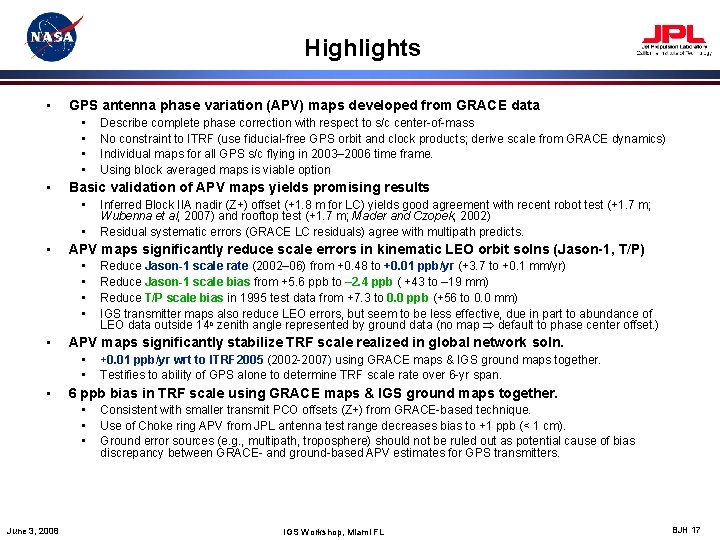
Highlights • GPS antenna phase variation (APV) maps developed from GRACE data • • • Basic validation of APV maps yields promising results • • • +0. 01 ppb/yr wrt to ITRF 2005 (2002 -2007) using GRACE maps & IGS ground maps together. Testifies to ability of GPS alone to determine TRF scale rate over 6 -yr span. 6 ppb bias in TRF scale using GRACE maps & IGS ground maps together. • • • June 3, 2008 Reduce Jason-1 scale rate (2002– 06) from +0. 48 to +0. 01 ppb/yr (+3. 7 to +0. 1 mm/yr) Reduce Jason-1 scale bias from +5. 6 ppb to – 2. 4 ppb ( +43 to – 19 mm) Reduce T/P scale bias in 1995 test data from +7. 3 to 0. 0 ppb (+56 to 0. 0 mm) IGS transmitter maps also reduce LEO errors, but seem to be less effective, due in part to abundance of LEO data outside 14 o zenith angle represented by ground data (no map default to phase center offset. ) APV maps significantly stabilize TRF scale realized in global network soln. • • • Inferred Block IIA nadir (Z+) offset (+1. 8 m for LC) yields good agreement with recent robot test (+1. 7 m; Wubenna et al, 2007) and rooftop test (+1. 7 m; Mader and Czopek, 2002) Residual systematic errors (GRACE LC residuals) agree with multipath predicts. APV maps significantly reduce scale errors in kinematic LEO orbit solns (Jason-1, T/P) • • • Describe complete phase correction with respect to s/c center-of-mass No constraint to ITRF (use fiducial-free GPS orbit and clock products; derive scale from GRACE dynamics) Individual maps for all GPS s/c flying in 2003– 2006 time frame. Using block averaged maps is viable option Consistent with smaller transmit PCO offsets (Z+) from GRACE-based technique. Use of Choke ring APV from JPL antenna test range decreases bias to +1 ppb (< 1 cm). Ground error sources (e. g. , multipath, troposphere) should not be ruled out as potential cause of bias discrepancy between GRACE- and ground-based APV estimates for GPS transmitters. IGS Workshop, Miami FL BJH 17
• Backup June 3, 2008 IGS Workshop, Miami FL BJH 18
GPS Transmitter X/Y Phase Center Offsets From GRACE Maps June 3, 2008 IGS Workshop, Miami FL BJH 19
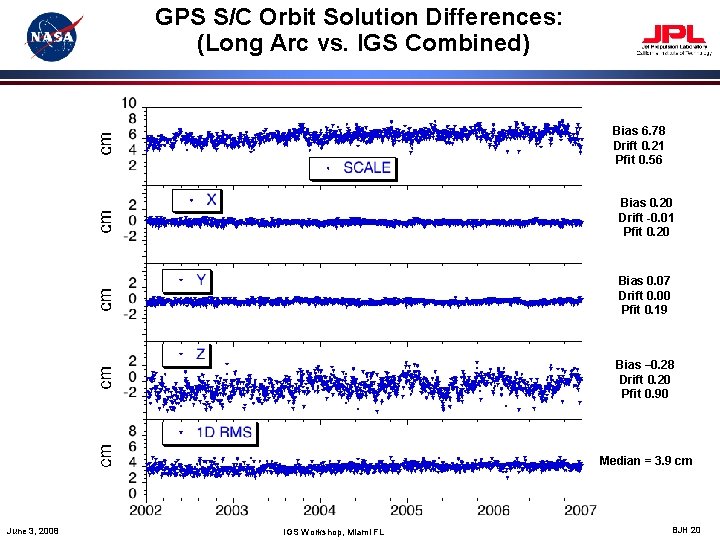
GPS S/C Orbit Solution Differences: (Long Arc vs. IGS Combined) Bias 6. 78 Drift 0. 21 Pfit 0. 56 Bias 0. 20 Drift -0. 01 Pfit 0. 20 Bias 0. 07 Drift 0. 00 Pfit 0. 19 Bias – 0. 28 Drift 0. 20 Pfit 0. 90 Median = 3. 9 cm June 3, 2008 IGS Workshop, Miami FL BJH 20
High Elevation SLR Passes Reveal Significant Reduction in Range Bias to GPS High Elevation Passes from Graz, Mc. Donald Observatory and Monument Peak June 3, 2008 IGS Workshop, Miami FL BJH 21
GPS Orbit & TRF Scale (ppb) June 3, 2008 IGS Workshop, Miami FL BJH 22
GPS Orbit & TRF Scale (cm) June 3, 2008 IGS Workshop, Miami FL BJH 23
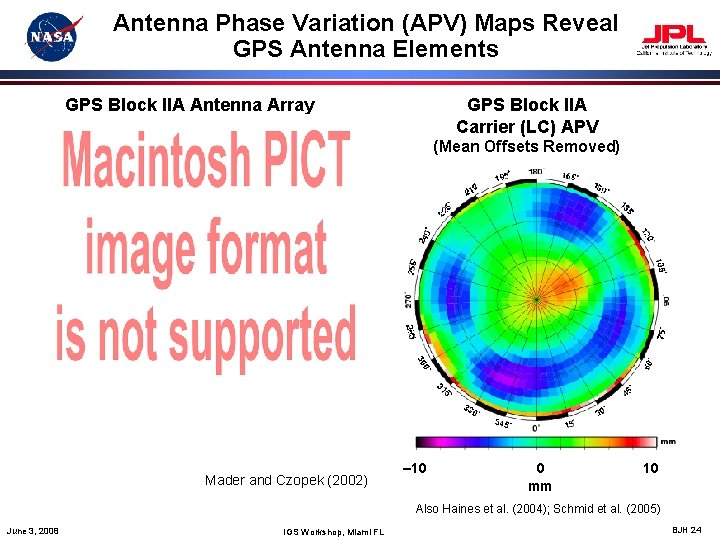
Antenna Phase Variation (APV) Maps Reveal GPS Antenna Elements GPS Block IIA Antenna Array GPS Block IIA Carrier (LC) APV (Mean Offsets Removed) Mader and Czopek (2002) – 10 0 mm 10 Also Haines et al. (2004); Schmid et al. (2005) June 3, 2008 IGS Workshop, Miami FL BJH 24
GPS Transmitter PCV Maps Explain Anomalous Estimated Radial Antenna Offsets for Jason-1 June 3, 2008 IGS Workshop, Miami FL BJH 25
TRF Centering from GPS Alone (2002– 2007): Agreement with ITRF 2005 June 3, 2008 IGS Workshop, Miami FL BJH 26
- Slides: 26