
Space Weather Training 2020 Part 2 CME Analysis
- Slides: 31
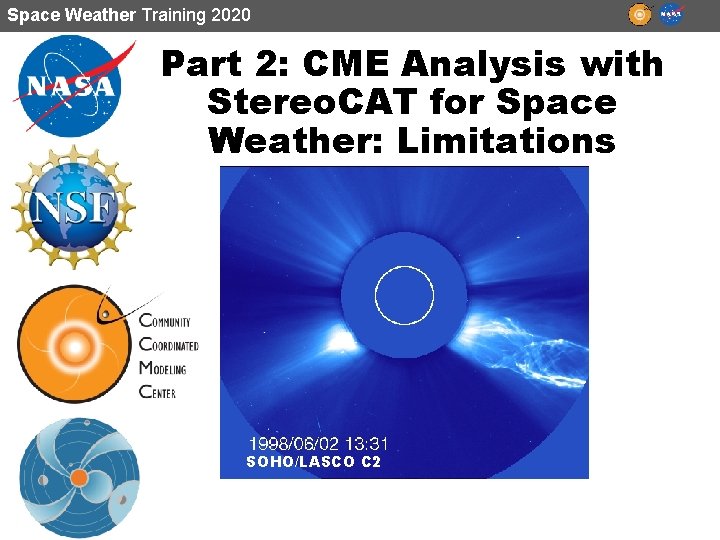
Space Weather Training 2020 Part 2: CME Analysis with Stereo. CAT for Space Weather: Limitations SOHO/LASCO C 2
Space Weather Training 2020 CME Measuring geometries CMEs are typically viewed using a coronagraph. CMEs are large and usually seen as a semi-transparent cloud, so what you see is the CME integrated along the path length of the viewer (like you'd see a cloud of smoke or fog). It is a 2 -D projection of a 3 -D object, and the challenge is to take those 2 -D observations and determine what the "real" 3 D structure is. However, coronagraphs function in a way that is different from your eyes or a "typical" imager. Coronagraphs view photons scattered off of electrons in the corona, and the scattering efficiency of an electron depends on the location of the observer. This complicates things quite a bit!
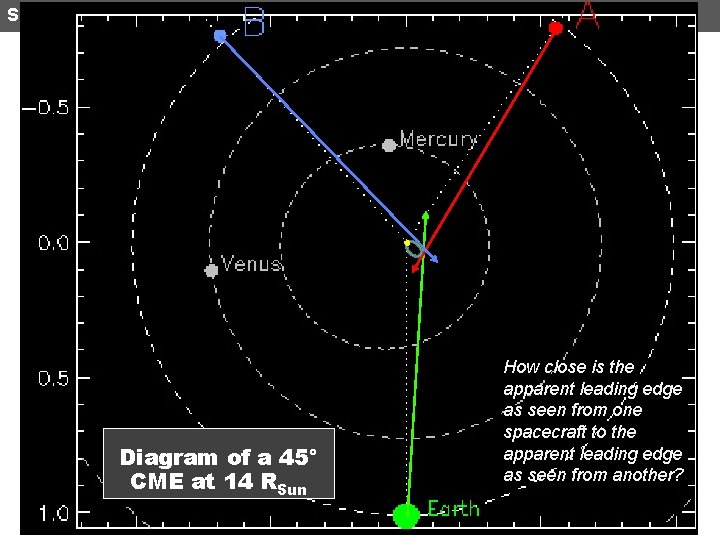
Space Weather Training 2020 CME Measuring geometries Factors involved: 1) Based on viewing angle, where is the apparent leading edge of the CME relative to the *real* leading edge? 2) How close is the apparent leading edge as seen from one spacecraft to the apparent leading edge as seen from another? 3) Based on Thomson scattering geometry, how bright will the leading edge of the CME be relative to the rest of the CME? (For angles > 60° out of the plane of the sky, the mass is basically invisible, and you will only see the part of the CME closer to the image plane. ) 4) How can we determine which spacecraft pairs are most ideal and will produce the most accurate measurements for different viewing geometries?
Space Weather Training 2020 Warning: Stereo. CAT should not be used for halo CMEs, and for wide CMEs (>50 degrees half width) measurements can be very inaccurate. Stereo. CAT is a useful and versatile tool for measuring CMEs. However, Stereo. CAT will *always* give you an answer, even if it makes no sense! You can click anywhere and it will give you an answer. Therefore, Stereo. CAT is a powerful tool in the hands of a knowledgeable user, but you must always be mindful of the measurements and the results that you receive, and keep your eyes open for results that appear "suspicious. ” Let’s go through a few examples…
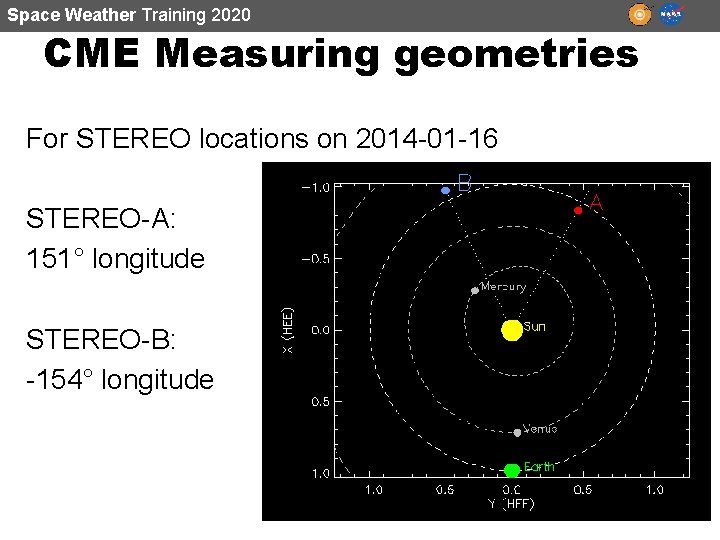
Space Weather Training 2020 CME Measuring geometries For STEREO locations on 2014 -01 -16 STEREO-A: 151° longitude STEREO-B: -154° longitude
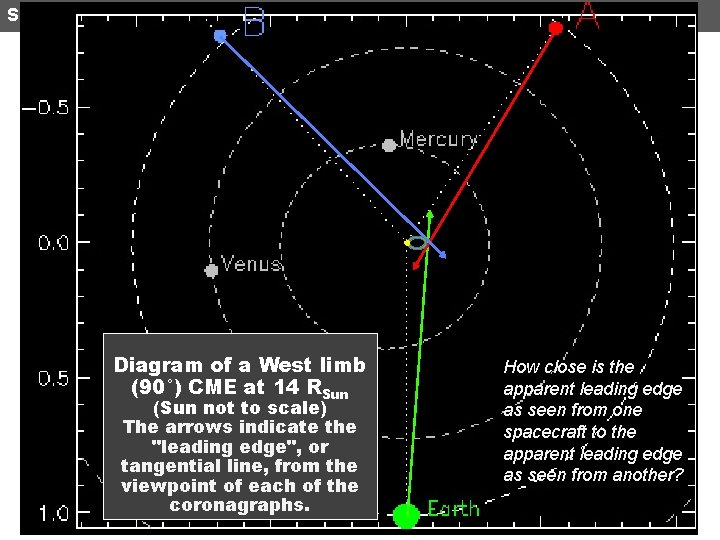
Space Weather Training 2020 Diagram of a West limb (90°) CME at 14 RSun (Sun not to scale) The arrows indicate the "leading edge", or tangential line, from the viewpoint of each of the coronagraphs. How close is the apparent leading edge as seen from one spacecraft to the apparent leading edge as seen from another?
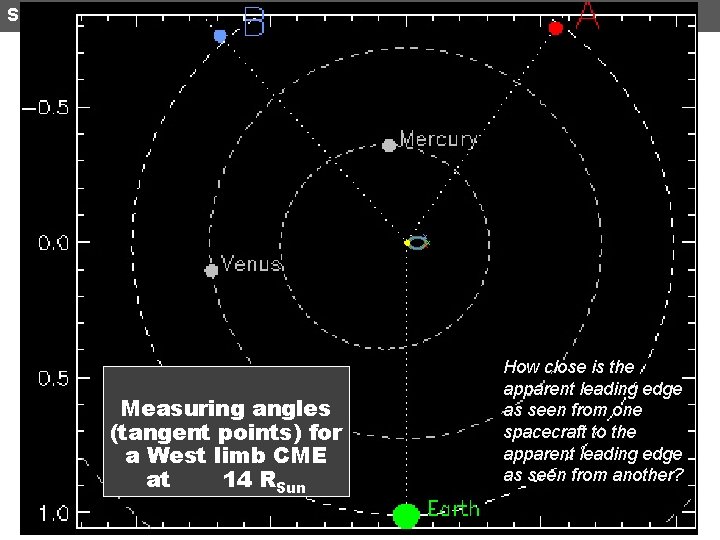
Space Weather Training 2020 x xx Measuring angles (tangent points) for a West limb CME at 14 RSun How close is the apparent leading edge as seen from one spacecraft to the apparent leading edge as seen from another?
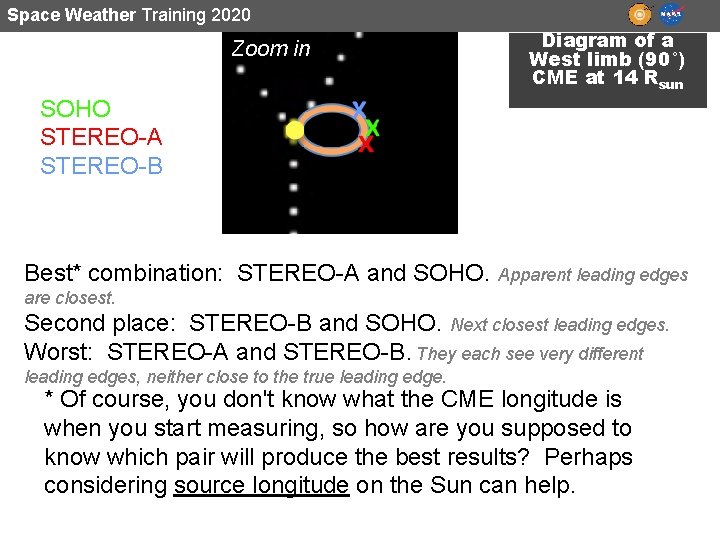
Space Weather Training 2020 Zoom in Diagram of a West limb (90°) CME at 14 Rsun SOHO STEREO-A STEREO-B Best* combination: STEREO-A and SOHO. Apparent leading edges are closest. Second place: STEREO-B and SOHO. Next closest leading edges. Worst: STEREO-A and STEREO-B. They each see very different leading edges, neither close to the true leading edge. * Of course, you don't know what the CME longitude is when you start measuring, so how are you supposed to know which pair will produce the best results? Perhaps considering source longitude on the Sun can help.
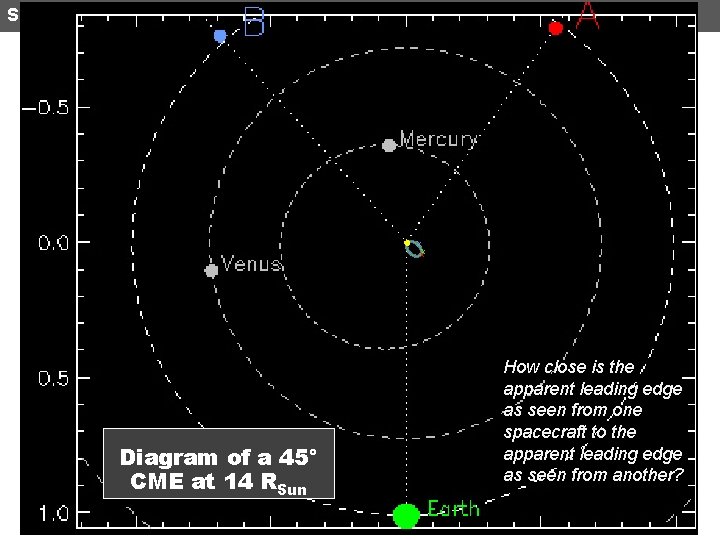
Space Weather Training 2020 Diagram of a 45° CME at 14 RSun How close is the apparent leading edge as seen from one spacecraft to the apparent leading edge as seen from another?
Space Weather Training 2020 x xx Diagram of a 45° CME at 14 RSun How close is the apparent leading edge as seen from one spacecraft to the apparent leading edge as seen from another?
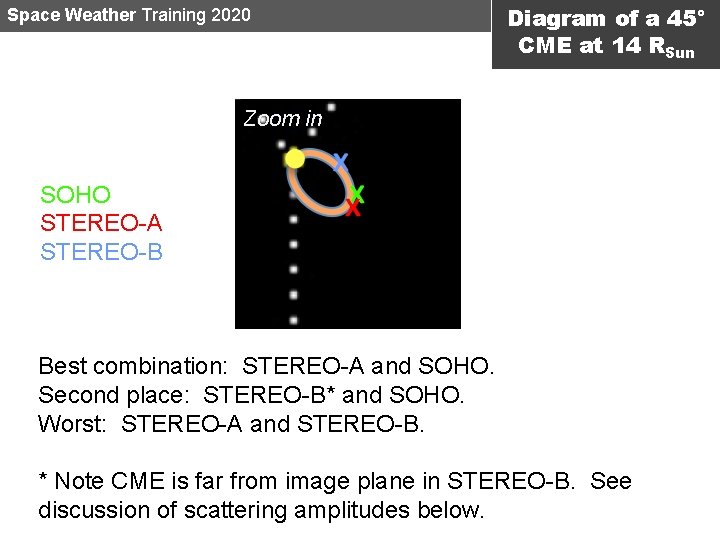
Space Weather Training 2020 Diagram of a 45° CME at 14 RSun Zoom in SOHO STEREO-A STEREO-B Best combination: STEREO-A and SOHO. Second place: STEREO-B* and SOHO. Worst: STEREO-A and STEREO-B. * Note CME is far from image plane in STEREO-B. See discussion of scattering amplitudes below.
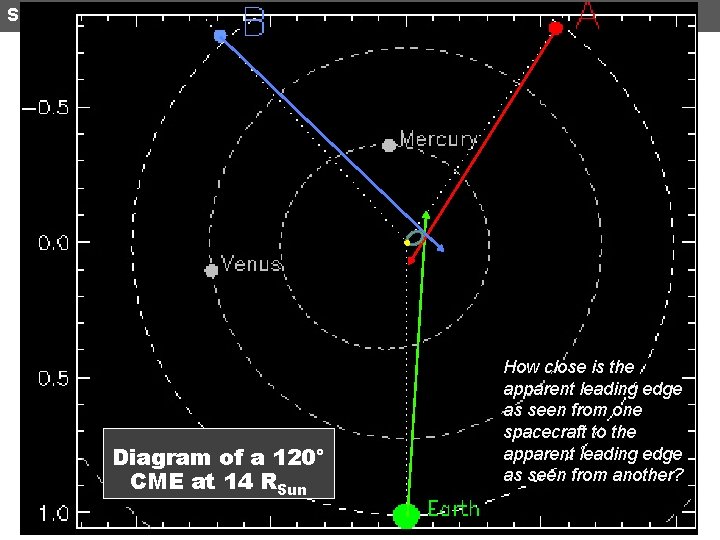
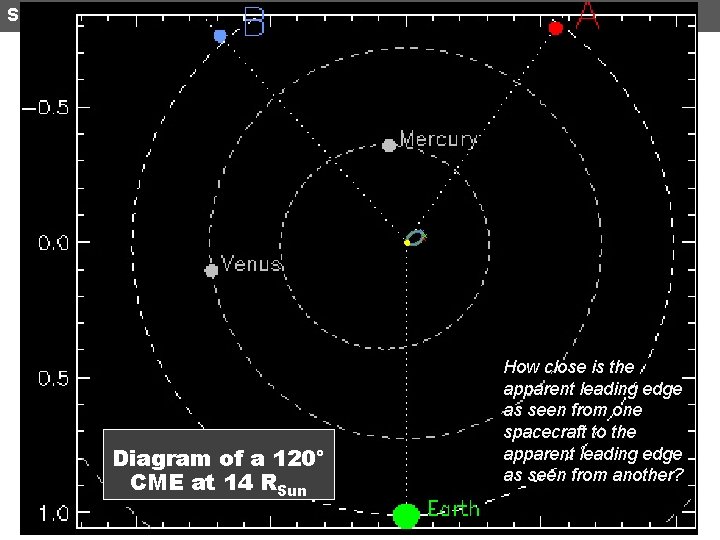
Space Weather Training 2020 Diagram of a 120° CME at 14 RSun How close is the apparent leading edge as seen from one spacecraft to the apparent leading edge as seen from another?
Space Weather Training 2020 xx x Diagram of a 120° CME at 14 RSun How close is the apparent leading edge as seen from one spacecraft to the apparent leading edge as seen from another?
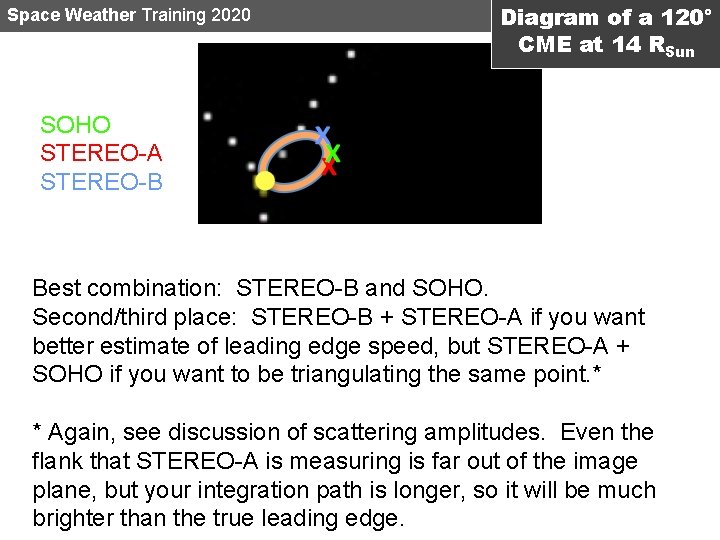
Space Weather Training 2020 Diagram of a 120° CME at 14 RSun SOHO STEREO-A STEREO-B Best combination: STEREO-B and SOHO. Second/third place: STEREO-B + STEREO-A if you want better estimate of leading edge speed, but STEREO-A + SOHO if you want to be triangulating the same point. * * Again, see discussion of scattering amplitudes. Even the flank that STEREO-A is measuring is far out of the image plane, but your integration path is longer, so it will be much brighter than the true leading edge.
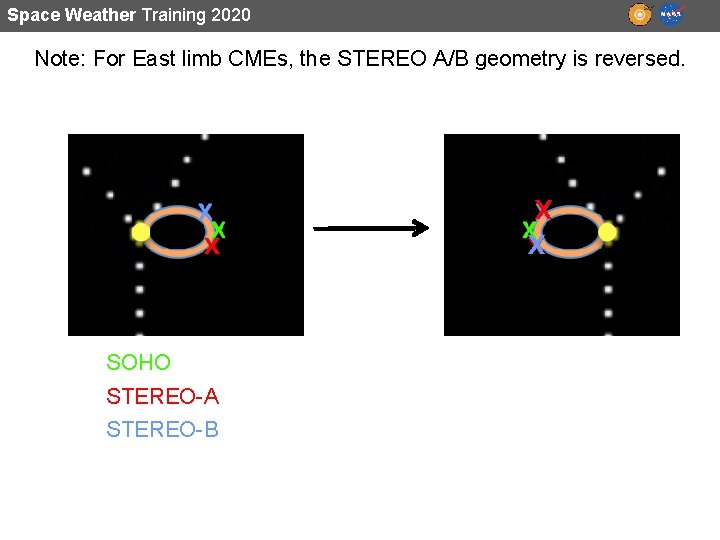
Space Weather Training 2020 Note: For East limb CMEs, the STEREO A/B geometry is reversed. x x SOHO STEREO-A STEREO-B
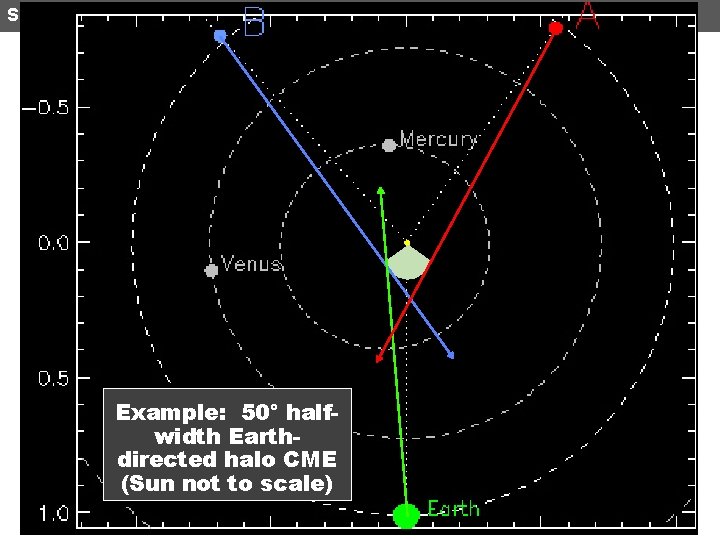
Space Weather Training 2020 Example: 50° halfwidth Earthdirected halo CME (Sun not to scale)
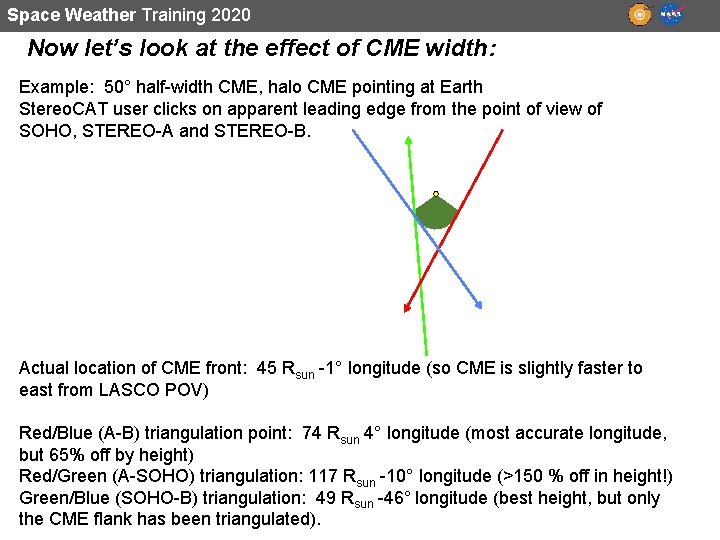
Space Weather Training 2020 Now let’s look at the effect of CME width: Example: 50° half-width CME, halo CME pointing at Earth Stereo. CAT user clicks on apparent leading edge from the point of view of SOHO, STEREO-A and STEREO-B. Actual location of CME front: 45 Rsun -1° longitude (so CME is slightly faster to east from LASCO POV) Red/Blue (A-B) triangulation point: 74 Rsun 4° longitude (most accurate longitude, but 65% off by height) Red/Green (A-SOHO) triangulation: 117 Rsun -10° longitude (>150 % off in height!) Green/Blue (SOHO-B) triangulation: 49 Rsun -46° longitude (best height, but only the CME flank has been triangulated).
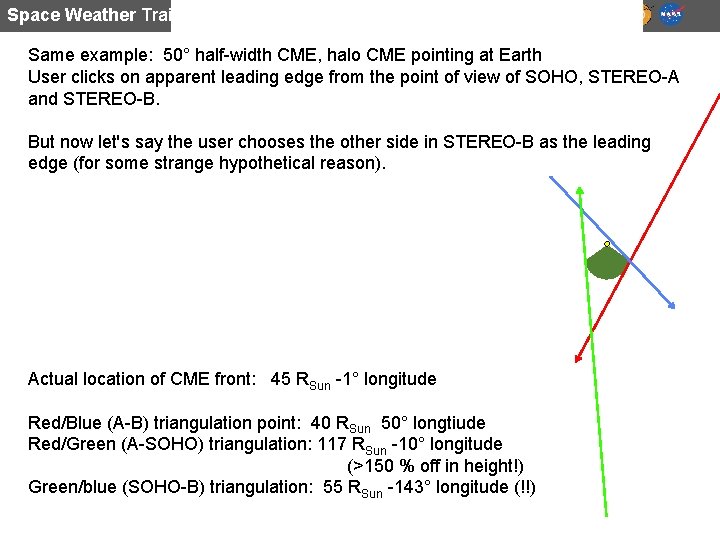
Space Weather Training 2020 Same example: 50° half-width CME, halo CME pointing at Earth User clicks on apparent leading edge from the point of view of SOHO, STEREO-A and STEREO-B. But now let's say the user chooses the other side in STEREO-B as the leading edge (for some strange hypothetical reason). Actual location of CME front: 45 RSun -1° longitude Red/Blue (A-B) triangulation point: 40 RSun 50° longtiude Red/Green (A-SOHO) triangulation: 117 RSun -10° longitude (>150 % off in height!) Green/blue (SOHO-B) triangulation: 55 RSun -143° longitude (!!)
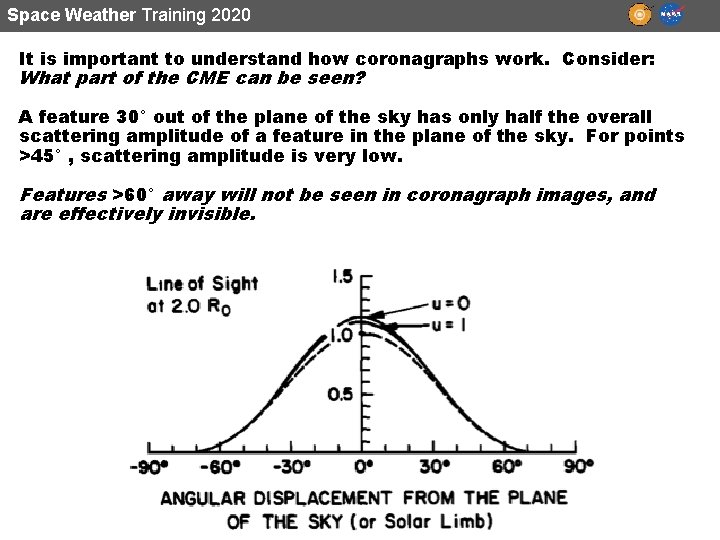
Space Weather Training 2020 It is important to understand how coronagraphs work. Consider: What part of the CME can be seen? A feature 30° out of the plane of the sky has only half the overall scattering amplitude of a feature in the plane of the sky. For points >45° , scattering amplitude is very low. Features >60° away will not be seen in coronagraph images, and are effectively invisible.
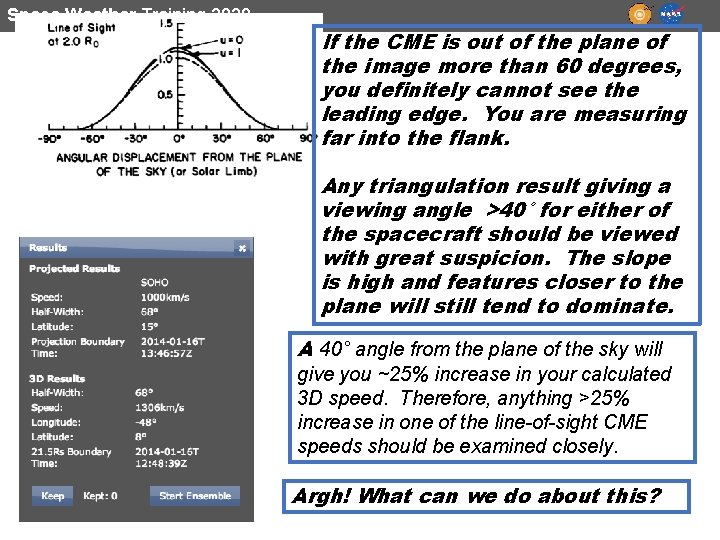
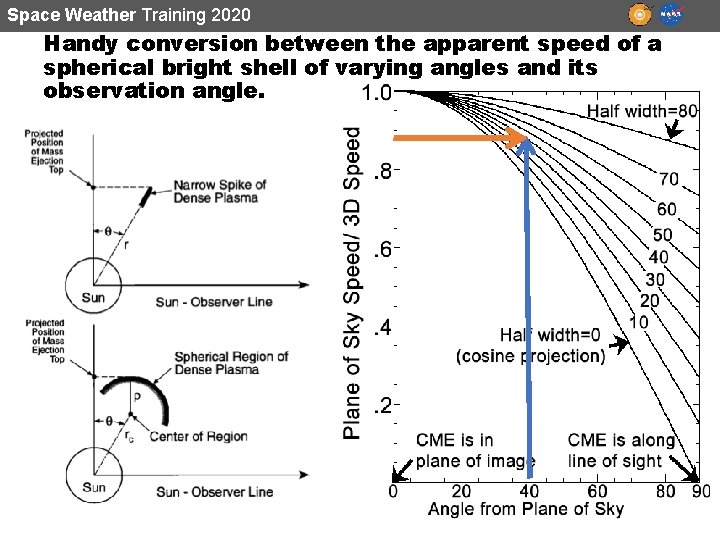
Space Weather Training 2020 If the CME is out of the plane of the image more than 60 degrees, you definitely cannot see the leading edge. You are measuring far into the flank. Any triangulation result giving a viewing angle >40° for either of the spacecraft should be viewed with great suspicion. The slope is high and features closer to the plane will still tend to dominate. A 40° angle from the plane of the sky will give you ~25% increase in your calculated 3 D speed. Therefore, anything >25% increase in one of the line-of-sight CME speeds should be examined closely. Argh! What can we do about this?
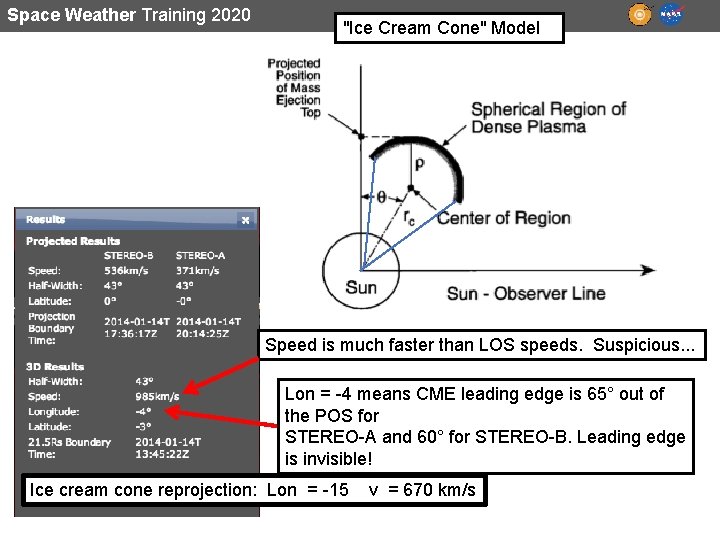
Space Weather Training 2020 "Ice Cream Cone" Model Speed is much faster than LOS speeds. Suspicious. . . Lon = -4 means CME leading edge is 65° out of the POS for STEREO-A and 60° for STEREO-B. Leading edge is invisible! Ice cream cone reprojection: Lon = -15 v = 670 km/s
Space Weather Training 2020 Handy conversion between the apparent speed of a spherical bright shell of varying angles and its observation angle.
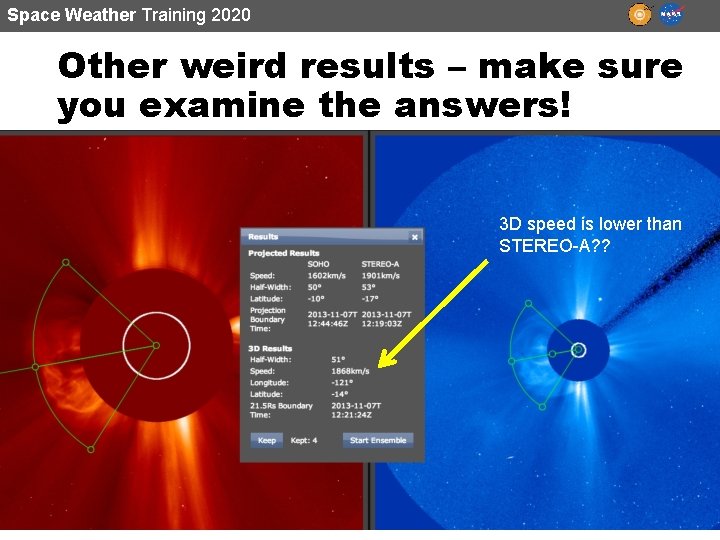
Space Weather Training 2020 Other weird results – make sure you examine the answers! 3 D speed is lower than STEREO-A? ?
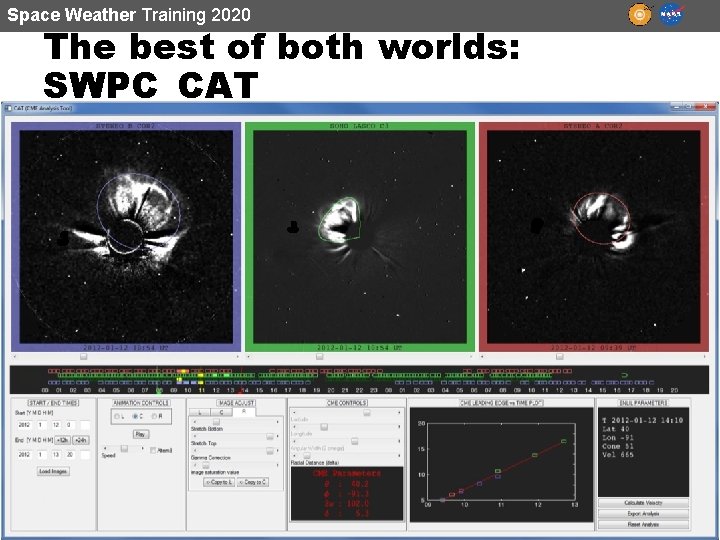
Space Weather Training 2020 The best of both worlds: SWPC_CAT
Space Weather Training 2020 The best of both worlds: SWPC_CAT performs the triangulation measurements like Stereo. CAT does, but it uses a 3 D projection geometry similar to the cone projection model. Additionally: - it be used to can fit halo CMEs (but be careful!) - you can use 1, 2 or 3 viewpoints - the image times do not have to match, after initial fit Just remember how a coronagraph works: features far out of the plane of the sky are invisible, so you'll only see the edges of a halo CME and not the leading edge.
Space Weather Training 2020 Misc. information We have a little more information about analysis that may help guide you in the future. : )
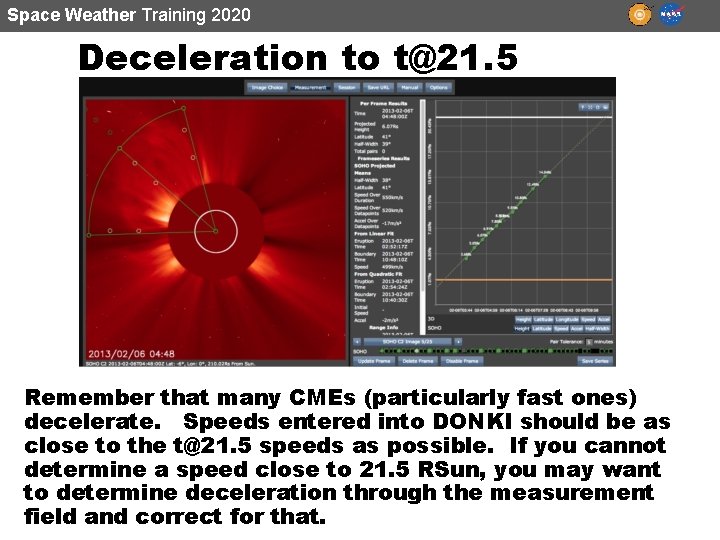
Space Weather Training 2020 Deceleration to t@21. 5 Remember that many CMEs (particularly fast ones) decelerate. Speeds entered into DONKI should be as close to the t@21. 5 speeds as possible. If you cannot determine a speed close to 21. 5 RSun, you may want to determine deceleration through the measurement field and correct for that.
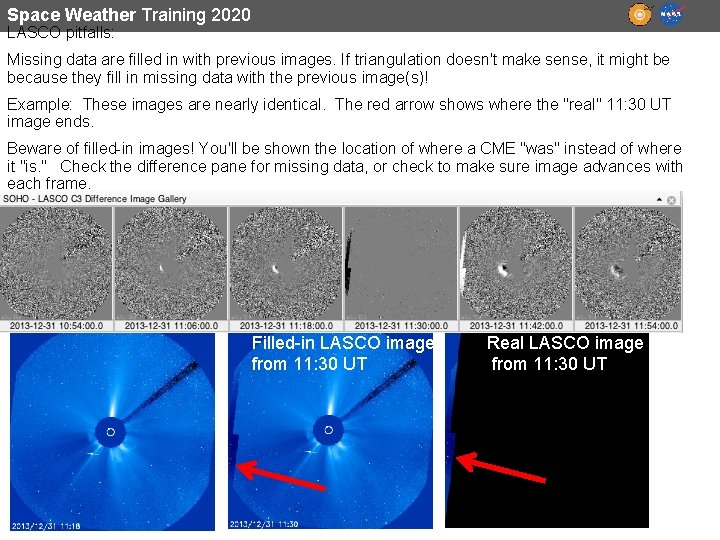
Space Weather Training 2020 LASCO pitfalls: Missing data are filled in with previous images. If triangulation doesn't make sense, it might be because they fill in missing data with the previous image(s)! Example: These images are nearly identical. The red arrow shows where the "real" 11: 30 UT image ends. Beware of filled-in images! You'll be shown the location of where a CME "was" instead of where it "is. " Check the difference pane for missing data, or check to make sure image advances with each frame. Filled-in LASCO image from 11: 30 UT Real LASCO image from 11: 30 UT
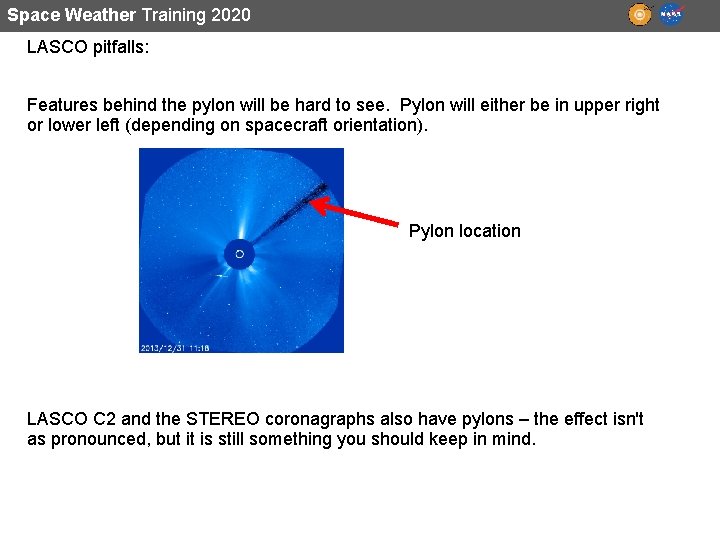
Space Weather Training 2020 LASCO pitfalls: Features behind the pylon will be hard to see. Pylon will either be in upper right or lower left (depending on spacecraft orientation). Filled-in LASCO image from 11: 30 UT Pylon location LASCO C 2 and the STEREO coronagraphs also have pylons – the effect isn't as pronounced, but it is still something you should keep in mind.
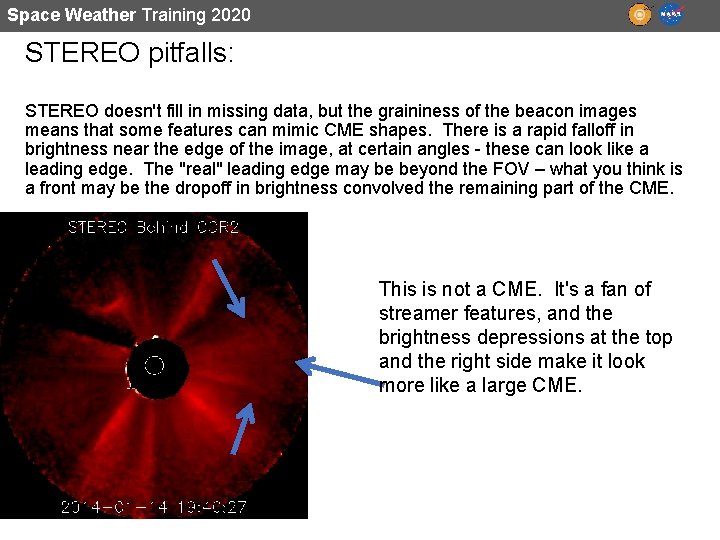
Space Weather Training 2020 STEREO pitfalls: STEREO doesn't fill in missing data, but the graininess of the beacon images means that some features can mimic CME shapes. There is a rapid falloff in brightness near the edge of the image, at certain angles - these can look like a leading edge. The "real" leading edge may be beyond the FOV – what you think is a front may be the dropoff in brightness convolved the remaining part of the CME. This is not a CME. It's a fan of streamer features, and the depressions at the top Filled-in LASCObrightness image from 11: 30 UT and the right side make it look more like a large CME.
Space Weather Training 2020 Conclusions - Choosing viewing angle pairs can greatly influence the resulting CME speed triangulation. - Even if you are able to measure the same point on a CME, projection angle can have a huge impact on the measured speed relative to the true speed of the leading edge. In general, the wider the CME, the less accurate the measured speed (for a spherically expanding CME approximation). - However, for a wide CME it is more likely that much of it will be invisible because of Thomson scattering limitations. A leading edge 30° out of the plane of the sky will have half the scattering efficiency relative to features in the plane of the sky. Features >60° out of the image plane are invisible. - When you only have images from one viewpoint you can use the source signature location as an approximation of the CME lat/lon.