
SPACE WEATHER PREDICTION USING ROBUST DYNAMICAL MODELS IDENTIFICATION
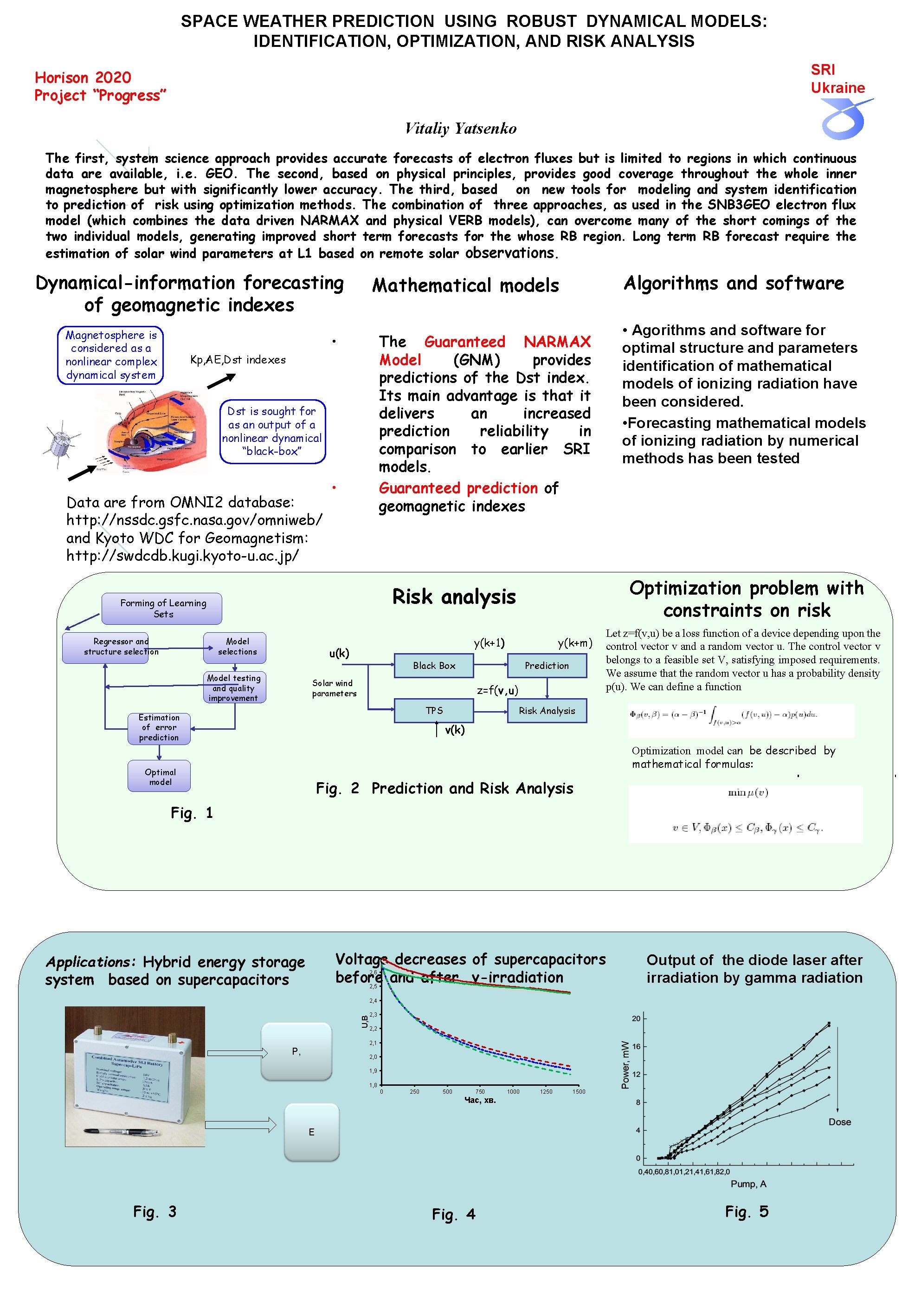
SPACE WEATHER PREDICTION USING ROBUST DYNAMICAL MODELS: IDENTIFICATION, OPTIMIZATION, AND RISK ANALYSIS SRI Ukraine Horison 2020 Project “Progress” Vitaliy Yatsenko The first, system science approach provides accurate forecasts of electron fluxes but is limited to regions in which continuous data are available, i. e. GEO. The second, based on physical principles, provides good coverage throughout the whole inner magnetosphere but with significantly lower accuracy. The third, based on new tools for modeling and system identification to prediction of risk using optimization methods. The combination of three approaches, as used in the SNB 3 GEO electron flux model (which combines the data driven NARMAX and physical VERB models), can overcome many of the short comings of the two individual models, generating improved short term forecasts for the whose RB region. Long term RB forecast require the estimation of solar wind parameters at L 1 based on remote solar observations. Dynamical-information forecasting of geomagnetic indexes Magnetosphere is considered as a nonlinear complex dynamical system • Kp, AE, Dst indexes The Guaranteed NARMAX Model (GNM) provides predictions of the Dst index. Its main advantage is that it delivers an increased prediction reliability in comparison to earlier SRI models. Guaranteed prediction of geomagnetic indexes Dst is sought for as an output of a nonlinear dynamical “black-box” Data are from OMNI 2 database: http: //nssdc. gsfc. nasa. gov/omniweb/ and Kyoto WDC for Geomagnetism: http: //swdcdb. kugi. kyoto-u. ac. jp/ Algorithms and software Mathematical models • Optimization problem with constraints on risk Risk analysis Forming of Learning Sets Regressor and structure selection Model selections y(k+1) u(k) Model testing and quality improvement y(k+m) Black Box Prediction Solar wind parameters z=f(v, u) Device TPS Estimation of error prediction • Agorithms and software for optimal structure and parameters identification of mathematical models of ionizing radiation have been considered. • Forecasting mathematical models of ionizing radiation by numerical methods has been tested Let z=f(v, u) be a loss function of a device depending upon the control vector v and a random vector u. The control vector v belongs to a feasible set V, satisfying imposed requirements. We assume that the random vector u has a probability density p(u). We can define a function Risk Analysis Risk v(k) Optimization model can be described by mathematical formulas: Optimal model Fig. 2 Prediction and Risk Analysis Fig. 1 Voltage decreases of supercapacitors before and after γ-irradiation Applications: Hybrid energy storage system based on supercapacitors 2, 7 2, 6 2, 5 Output of the diode laser after irradiation by gamma radiation U, В 2, 4 2, 3 2, 2 2, 1 P, 2, 0 1, 9 1, 8 0 250 500 750 1000 1250 1500 Час, хв. E Fig. 3 Fig. 4 Fig. 5
- Slides: 1