
Space Weather Measurements Capabilities and Needs Howard J
Space Weather Measurements: Capabilities and Needs Howard J. Singer NOAA Space Environment Center NSF Workshop on Small Satellite Missions for Space Weather and Atmospheric Research George Mason University, Arlington, VA May 17, 2007
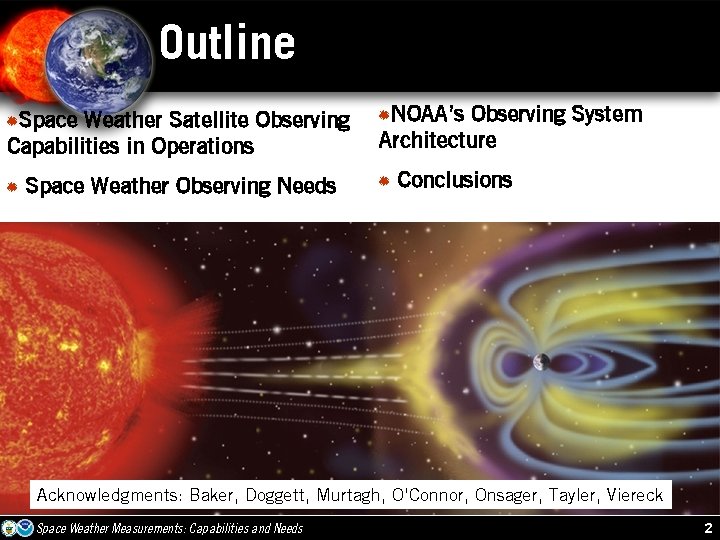
Outline ASpace Weather Satellite Observing Capabilities in Operations A Space Weather Observing Needs ANOAA’s Observing System Architecture A Conclusions Acknowledgments: Baker, Doggett, Murtagh, O’Connor, Onsager, Tayler, Viereck Space Weather Measurements: Capabilities and Needs 2

Monitor, Measure and Specify: Data for Today’s Space Weather • Ground Sites –Magnetometers (NOAA/USGS) –Thule Riometer and Neutron monitor (USAF) –SOON Sites (USAF) –RSTN (USAF) –Telescopes and Magnetographs –Ionosondes (AF, ISES, …) –GPS (CORS) • SOHO (ESA/NASA) –Solar EUV Images –Solar Corona (CMEs) ESA/NASA SOHO • ACE (NASA) –Solar wind speed, density, temperature and energetic particles –Vector Magnetic field L 1 NASA ACE NOAA GOES • GOES (NOAA) –Energetic Particles –Magnetic Field –Solar X-ray Flux –Solar EUV Flux –Solar X-Ray Images Space Weather Measurements: Capabilities and Needs NOAA POES • POES (NOAA) –High Energy Particles –Total Energy Deposition –Solar UV Flux 3
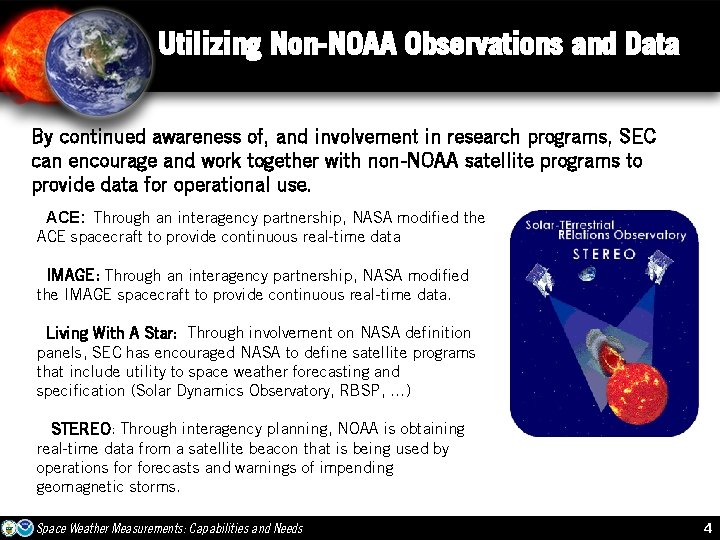
Utilizing Non-NOAA Observations and Data By continued awareness of, and involvement in research programs, SEC can encourage and work together with non-NOAA satellite programs to provide data for operational use. –ACE: Through an interagency partnership, NASA modified the ACE spacecraft to provide continuous real-time data –IMAGE: Through an interagency partnership, NASA modified the IMAGE spacecraft to provide continuous real-time data. –Living With A Star: Through involvement on NASA definition panels, SEC has encouraged NASA to define satellite programs that include utility to space weather forecasting and specification (Solar Dynamics Observatory, RBSP, …) – STEREO: Through interagency planning, NOAA is obtaining real-time data from a satellite beacon that is being used by operations forecasts and warnings of impending geomagnetic storms. Space Weather Measurements: Capabilities and Needs 4

Uses of Space Weather Data AIndicators AInput AData of State of the System to Drive Models Estimated Planetary K index Based on Ground Magnetometers Assimilation AValidate Model Output AInstrument Calibration/Validation AResearch Magnetospheric Specification Model Input parameters: Kp, Dst, Vpc, PC pattern, equatorward boundary auroral precipitation, solar wind velocity and density, IMF, DMSP precip flux, sum Kp Space Weather Measurements: Capabilities and Needs 5
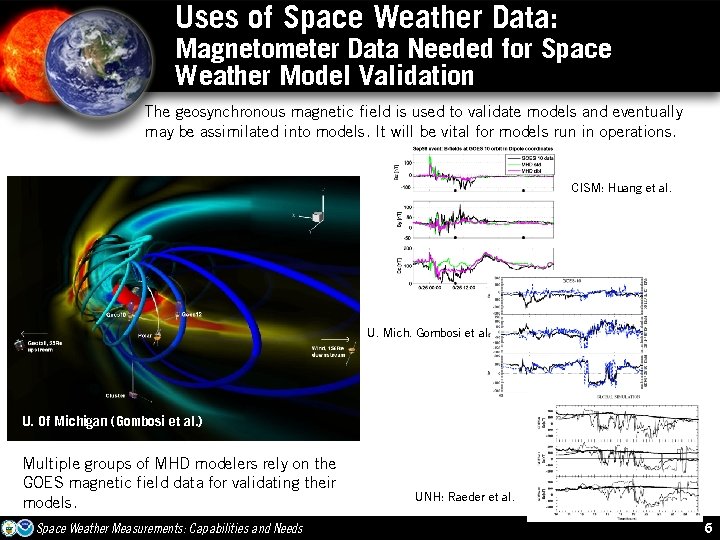
Uses of Space Weather Data: Magnetometer Data Needed for Space Weather Model Validation The geosynchronous magnetic field is used to validate models and eventually may be assimilated into models. It will be vital for models run in operations. CISM: Huang et al. U. Mich. Gombosi et al. U. Of Michigan (Gombosi et al. ) Multiple groups of MHD modelers rely on the GOES magnetic field data for validating their models. Space Weather Measurements: Capabilities and Needs UNH: Raeder et al. 6
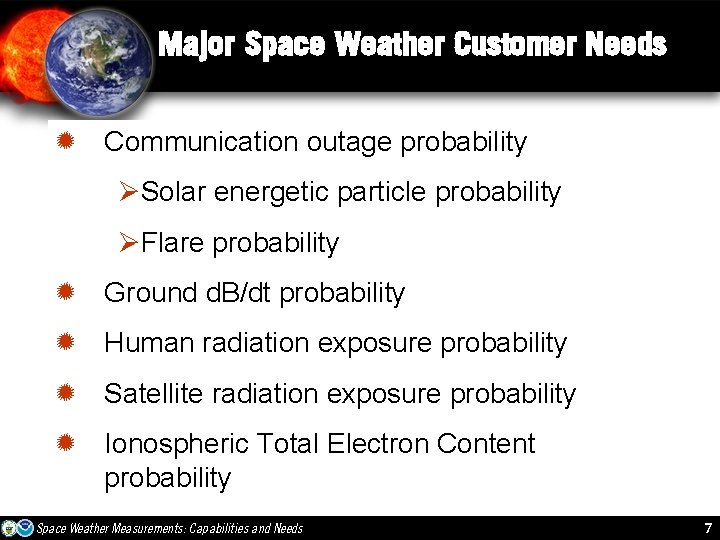
Major Space Weather Customer Needs A Communication outage probability ØSolar energetic particle probability ØFlare probability A Ground d. B/dt probability A Human radiation exposure probability A Satellite radiation exposure probability A Ionospheric Total Electron Content probability Space Weather Measurements: Capabilities and Needs 7
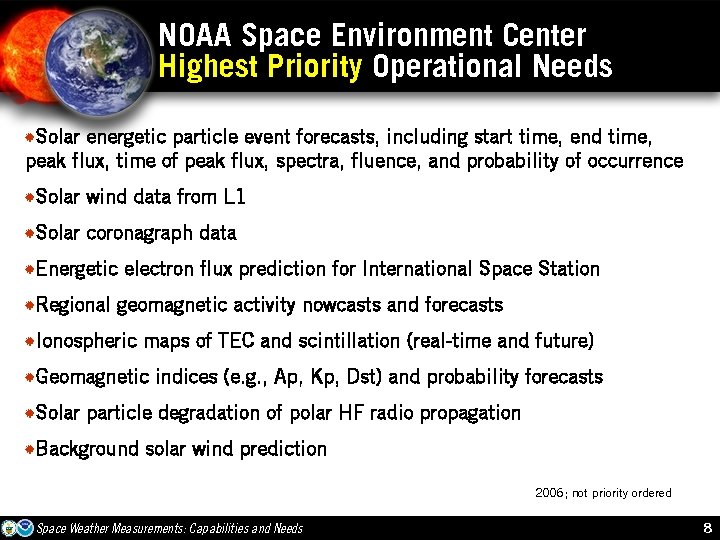
NOAA Space Environment Center Highest Priority Operational Needs ASolar energetic particle event forecasts, including start time, end time, peak flux, time of peak flux, spectra, fluence, and probability of occurrence ASolar wind data from L 1 ASolar coronagraph data AEnergetic ARegional electron flux prediction for International Space Station geomagnetic activity nowcasts and forecasts AIonospheric maps of TEC and scintillation (real-time and future) AGeomagnetic ASolar indices (e. g. , Ap, Kp, Dst) and probability forecasts particle degradation of polar HF radio propagation ABackground solar wind prediction 2006; not priority ordered Space Weather Measurements: Capabilities and Needs 8
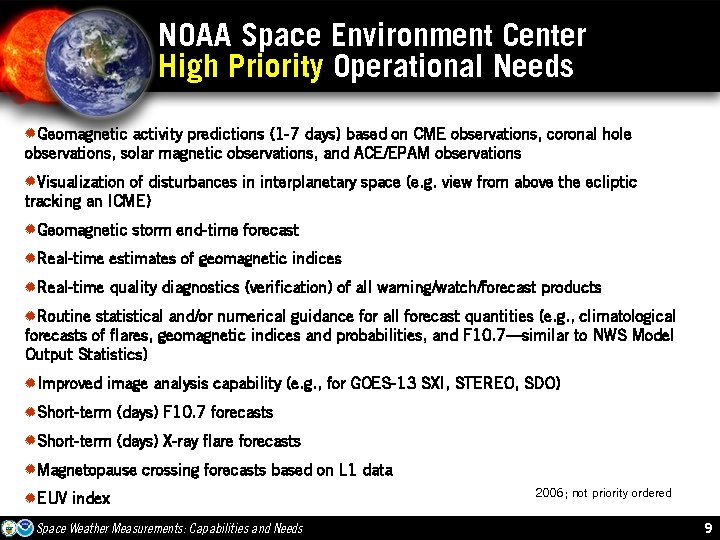
NOAA Space Environment Center High Priority Operational Needs AGeomagnetic activity predictions (1 -7 days) based on CME observations, coronal hole observations, solar magnetic observations, and ACE/EPAM observations AVisualization of disturbances in interplanetary space (e. g. view from above the ecliptic tracking an ICME) AGeomagnetic storm end-time forecast AReal-time estimates of geomagnetic indices AReal-time quality diagnostics (verification) of all warning/watch/forecast products ARoutine statistical and/or numerical guidance for all forecast quantities (e. g. , climatological forecasts of flares, geomagnetic indices and probabilities, and F 10. 7—similar to NWS Model Output Statistics) AImproved image analysis capability (e. g. , for GOES-13 SXI, STEREO, SDO) AShort-term (days) F 10. 7 forecasts AShort-term (days) X-ray flare forecasts AMagnetopause crossing forecasts based on L 1 data AEUV index Space Weather Measurements: Capabilities and Needs 2006; not priority ordered 9
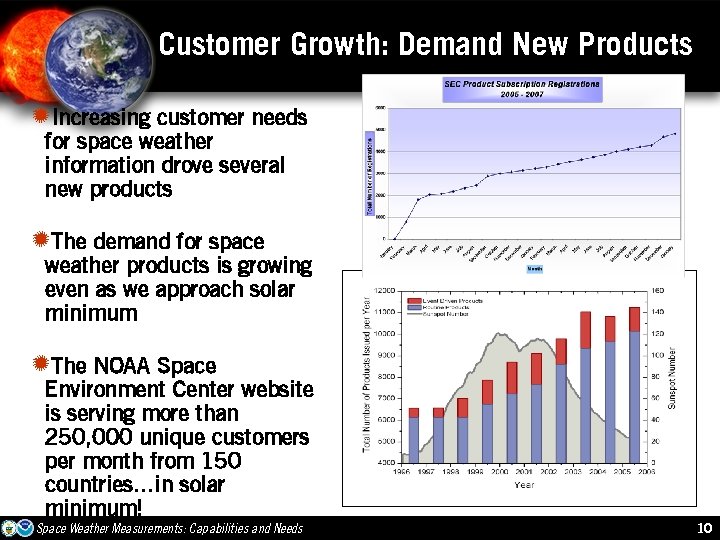
Customer Growth: Demand New Products AIncreasing customer needs for space weather information drove several new products AThe demand for space weather products is growing even as we approach solar minimum AThe NOAA Space Environment Center website is serving more than 250, 000 unique customers per month from 150 countries…in solar minimum! Space Weather Measurements: Capabilities and Needs 10
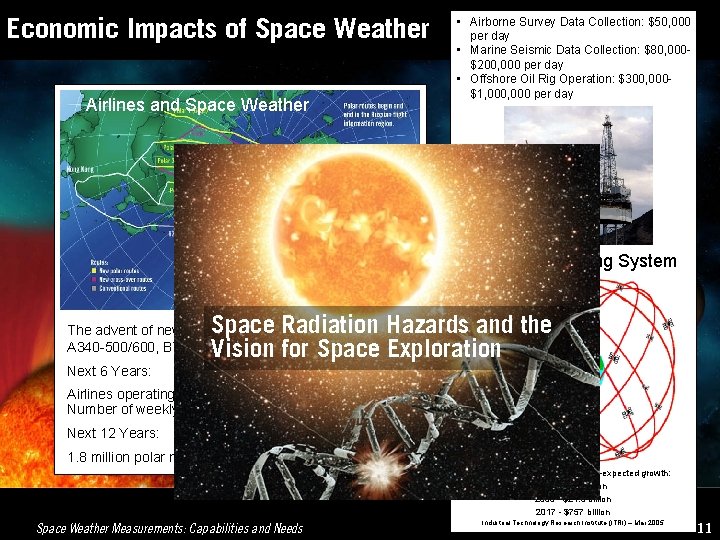
Economic Impacts of Space Weather Customer Uses Airlines and Space Weather • Airborne Survey Data Collection: $50, 000 per day • Marine Seismic Data Collection: $80, 000$200, 000 per day • Offshore Oil Rig Operation: $300, 000$1, 000 per day Global Positioning System Space Radiation Hazards and the Vision for Space Exploration The advent of new long range aircraft such as the A 340 -500/600, B 777 -300 ER and B 777 -200 LR Next 6 Years: Airlines operating China-US routes go from 4 to 9 Number of weekly flights from 54 to 249 Next 12 Years: 1. 8 million polar route passengers by 2019 GPS Global Production Value—expected growth: 2003 - $13 billion 2008 - $21. 5 billion 2017 - $757 billion Space Weather Measurements: Capabilities and Needs Industrial Technology Research Institute (ITRI) – Mar 2005 11
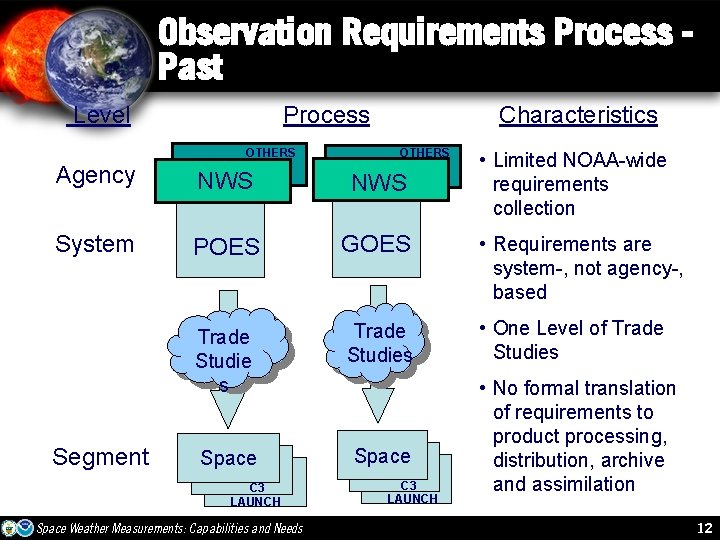
Observation Requirements Process Past Level Process OTHERS Characteristics OTHERS • Limited NOAA-wide requirements collection Agency NWS System POES GOES • Requirements are system-, not agency-, based Trade Studies Studie s Trade Studies • One Level of Trade Studies Segment Space C 3 LAUNCH Space Weather Measurements: Capabilities and Needs Space C 3 LAUNCH • No formal translation of requirements to product processing, distribution, archive and assimilation 12
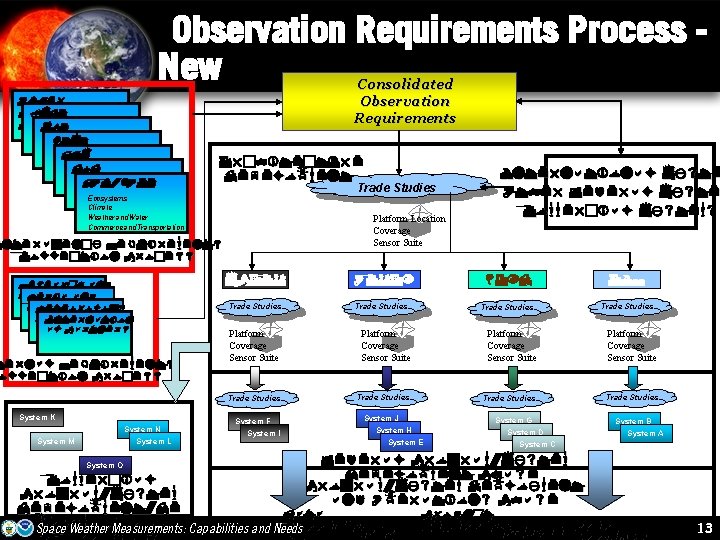
Observation Requirements Process New Other Federal USDA Agencies EPA NASA DHS Do. D DOC/NOAA Ecosystems Climate Weather and Water Commerce and Transportation Consolidated Observation Requirements Architecture Development Trade Studies ? Platform Location Coverage Sensor Suite Interagency Requirements Collection Process SPACE Research and Academic Media and Commercial Meteorologi cal Centers Internation al Partners Trade Studies ? ternal Requirements ollection Process System K System N System M System L System O Commercial Program/System Development/De ployment and International Syste Other Federal System Syste Commercial Systems OCEAN LAND AIR Trade Studies ? ? ? Platform Coverage Sensor Suite Trade Studies System F System I System J System H System E System G System D System C System B System A Federal Program/System Development Phase Program/System Deployment and Operations Phase Data Collecti Space Weather Measurements: Capabilities and Needs Data Product User Generation Archive 13
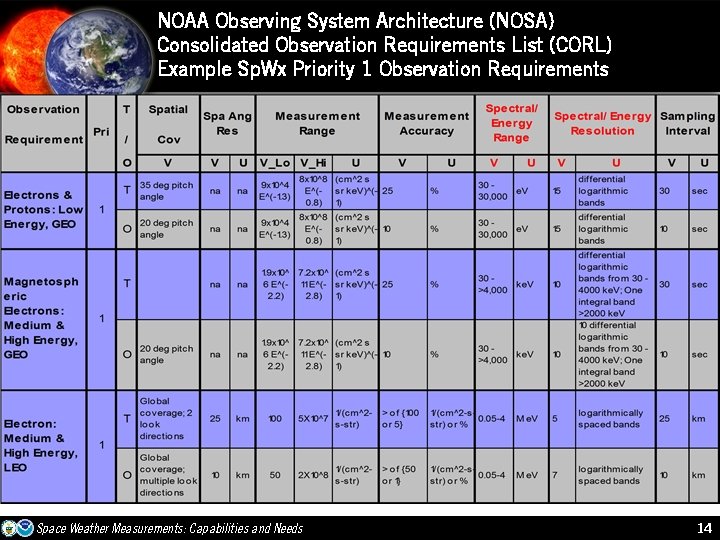
NOAA Observing System Architecture (NOSA) Consolidated Observation Requirements List (CORL) Example Sp. Wx Priority 1 Observation Requirements Space Weather Measurements: Capabilities and Needs 14
Conclusions A A A Described current space weather observations used in operations Identified space weather needs that might be addressed with small satellite missions Illustrated space weather customer growth that demonstrates a need for new observations and products Highligted the value of selecting an NSF small satellite project that supports both research and operations Defined the NOAA observation process that is set up to encourage working with partners and selecting the best platform to meet an observational need Space Weather Measurements: Capabilities and Needs 15
Contact Information: Howard J. Singer, Chief Science and Technology Infusion Branch NOAA Space Environment Center 325 Broadway Boulder, CO 80305 303 497 6959 howard. singer@noaa. gov Space Weather Measurements: Capabilities and Needs 16
- Slides: 16