
Space Weather Magnetic Storms 31 October 2011 William
Space Weather: Magnetic Storms 31 October 2011 William J. Burke Air Force Research Laboratory/Space Vehicles Directorate Boston College Institute for Scientific Research CRESS C/NOFS DMSP
Space Weather Course Overview • • • Lecture 1: Overview and Beginnings Lecture 2: The Aurorae Lecture 3: Basic Physics (painlessly administered) Lecture 4: The Main Players Lecture 5: Solar Wind Interactions with the Earth’s Magnetic Field Lecture 6: Magnetic Storms Lecture 7: Magnetic Substorms Lecture 8: Magnetosphere – Ionosphere Coupling Lecture 9 The Satellite Drag Problem Lecture 10: Verbindung (to help make up for your rash decision not to take Wollen Sie Deutch Sprechen? ) 2
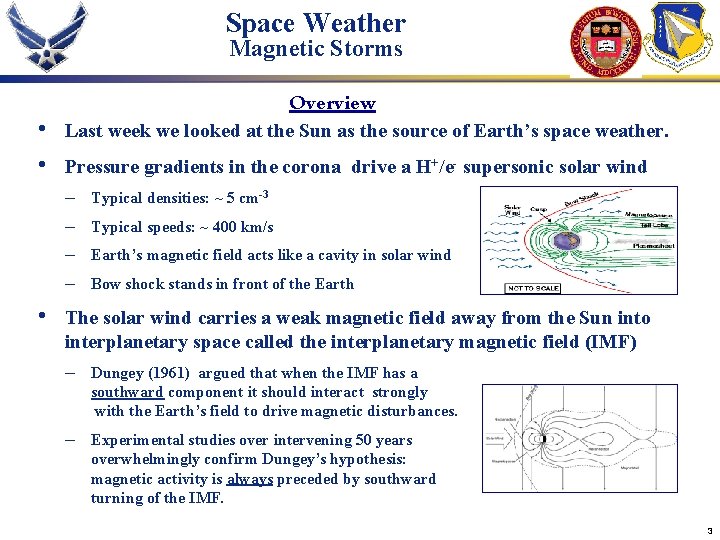
Space Weather Magnetic Storms • • • Overview Last week we looked at the Sun as the source of Earth’s space weather. Pressure gradients in the corona drive a H+/e- supersonic solar wind – Typical densities: ~ 5 cm-3 – Typical speeds: ~ 400 km/s – Earth’s magnetic field acts like a cavity in solar wind – Bow shock stands in front of the Earth The solar wind carries a weak magnetic field away from the Sun into interplanetary space called the interplanetary magnetic field (IMF) – Dungey (1961) argued that when the IMF has a southward component it should interact strongly with the Earth’s field to drive magnetic disturbances. – Experimental studies over intervening 50 years overwhelmingly confirm Dungey’s hypothesis: magnetic activity is always preceded by southward turning of the IMF. 3
Space Weather Magnetic Storms • In preparing this presentation it seemed useful to concentrate on a very simple, but very intense magnetic storm that occurred in November 2003. • ACE was at the first Lagrange point L 1 where measured the solar wind density and speed as well as the interplanetary magnetic field (IMF). • The GRACE satellite was in circular polar orbit near 490 km. - An onboard accelerometer measured the atmospheric drag on the spacecraft. - From the accelerometer measurements we inferred globally-averaged mass densities in thermosphere and its total energy content • We compare interplanetary forcing and thermospheric responses with variations of the stormtime disturbance Dst index - Dst measured as N-S magnetic variations observed at 4 widely spaced stations around globe - Reported at 1 -hour cadence as spatial and temporal average BNS - Linearly proportional to energy in the ring current (Dessler-Parker –Sckopke) 4
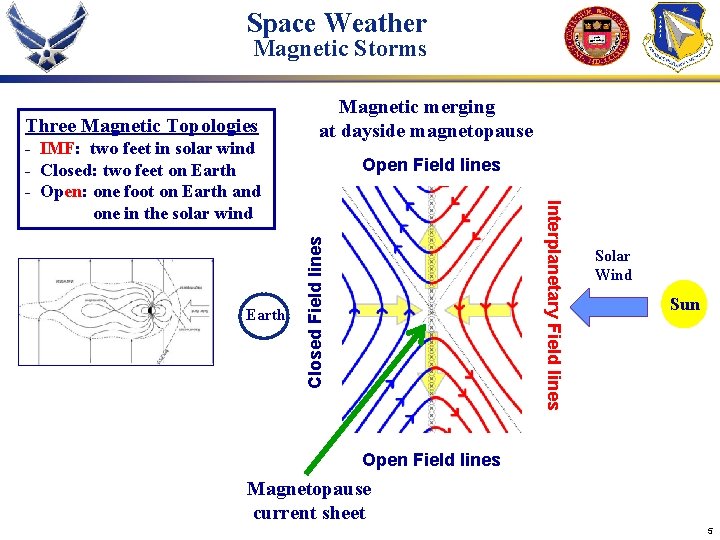
Space Weather Magnetic Storms Earth Open Field lines Interplanetary Field lines - IMF: two feet in solar wind - Closed: two feet on Earth - Open: one foot on Earth and one in the solar wind Closed Field lines Three Magnetic Topologies Magnetic merging at dayside magnetopause Solar Wind Sun Open Field lines Magnetopause current sheet 5

Space Weather Magnetic Storms Magnetic Reconnection in the magnetotail Northern Lobe Plasma Injection Dayside merging site Plasma Ejection Earth Near Earth X-line (activated during substorms) Distant X-line Southern Lobe Dungey’s picture provide a rational for the existence and dynamics of the plasma sheet, then undiscovered storage region from which auroral particles are drawn. 6
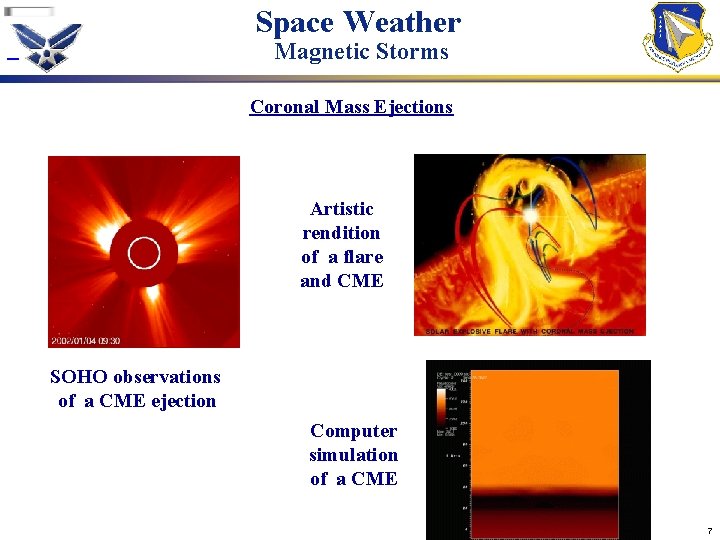
Space Weather Magnetic Storms Coronal Mass Ejections Artistic rendition of a flare and CME SOHO observations of a CME ejection Computer simulation of a CME 7
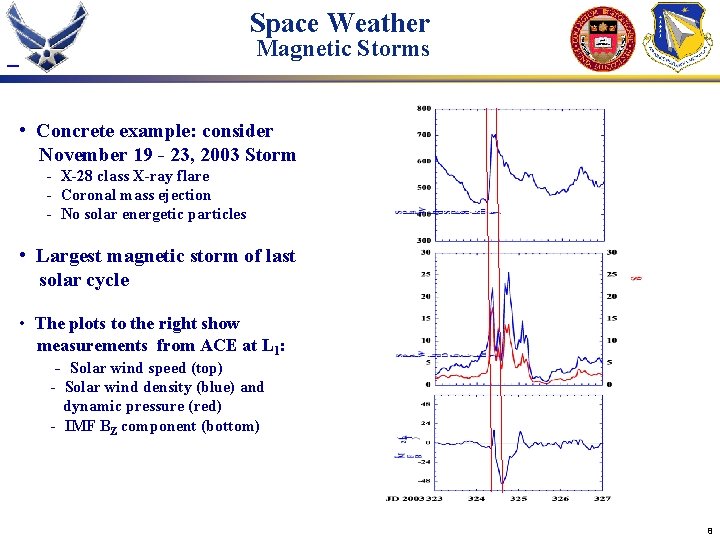
Space Weather Magnetic Storms • Concrete example: consider November 19 - 23, 2003 Storm - X-28 class X-ray flare - Coronal mass ejection - No solar energetic particles • Largest magnetic storm of last solar cycle • The plots to the right show measurements from ACE at L 1: - Solar wind speed (top) - Solar wind density (blue) and dynamic pressure (red) - IMF BZ component (bottom) 8
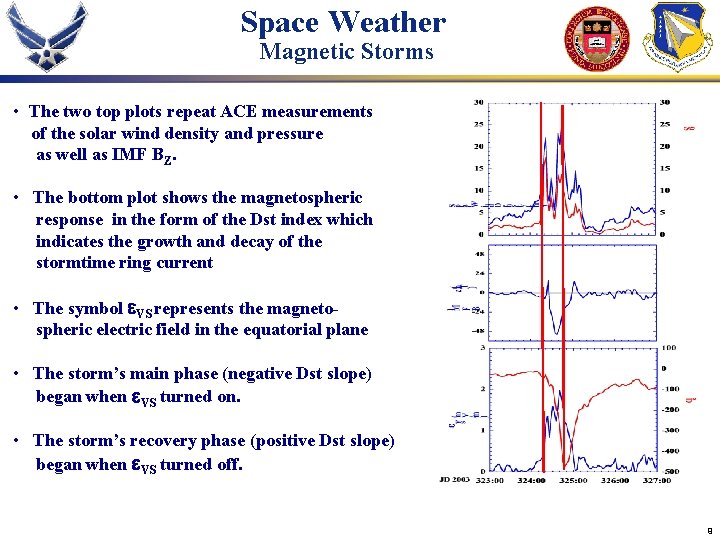
Space Weather Magnetic Storms • The two top plots repeat ACE measurements of the solar wind density and pressure as well as IMF BZ. • The bottom plot shows the magnetospheric response in the form of the Dst index which indicates the growth and decay of the stormtime ring current • The symbol e. VS represents the magnetospheric electric field in the equatorial plane • The storm’s main phase (negative Dst slope) began when e. VS turned on. • The storm’s recovery phase (positive Dst slope) began when e. VS turned off. 9
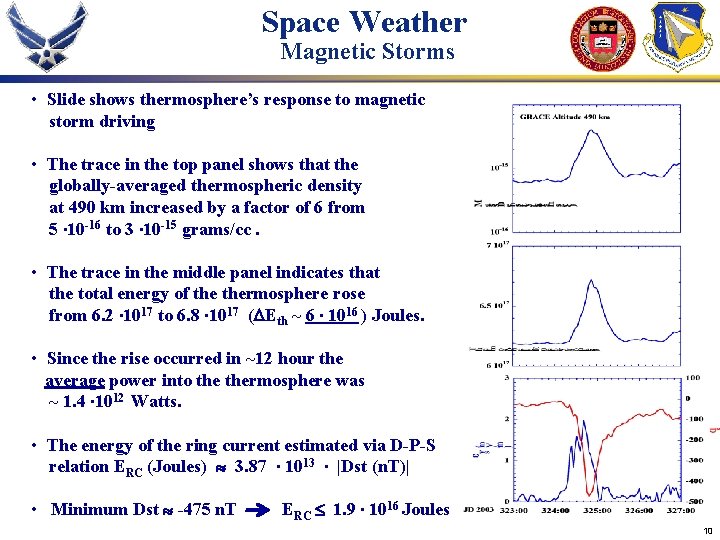
Space Weather Magnetic Storms • Slide shows thermosphere’s response to magnetic storm driving • The trace in the top panel shows that the globally-averaged thermospheric density at 490 km increased by a factor of 6 from 5 ∙ 10 -16 to 3 ∙ 10 -15 grams/cc. • The trace in the middle panel indicates that the total energy of thermosphere rose from 6. 2 ∙ 1017 to 6. 8 ∙ 1017 ( Eth ~ 6 ∙ 1016 ) Joules. • Since the rise occurred in ~12 hour the average power into thermosphere was ~ 1. 4 ∙ 1012 Watts. • The energy of the ring current estimated via D-P-S relation ERC (Joules) 3. 87 ∙ 1013 ∙ |Dst (n. T)| • Minimum Dst -475 n. T ERC 1. 9 ∙ 1016 Joules 10
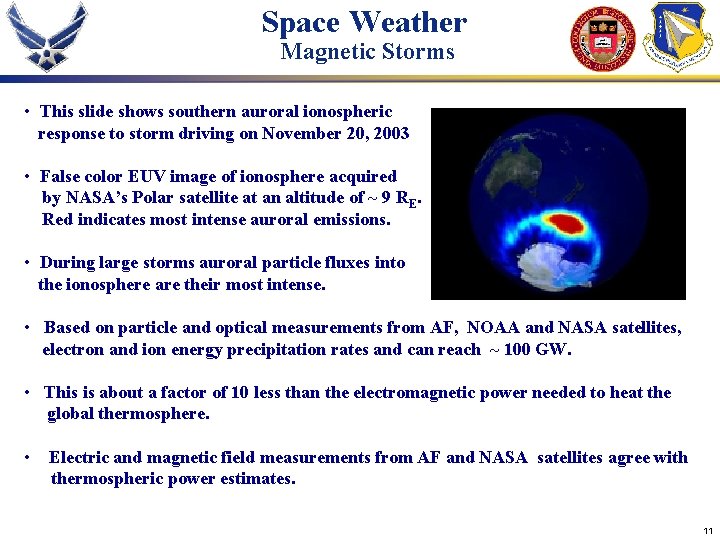
Space Weather Magnetic Storms • This slide shows southern auroral ionospheric response to storm driving on November 20, 2003 • False color EUV image of ionosphere acquired by NASA’s Polar satellite at an altitude of ~ 9 RE. Red indicates most intense auroral emissions. • During large storms auroral particle fluxes into the ionosphere are their most intense. • Based on particle and optical measurements from AF, NOAA and NASA satellites, electron and ion energy precipitation rates and can reach ~ 100 GW. • This is about a factor of 10 less than the electromagnetic power needed to heat the global thermosphere. • Electric and magnetic field measurements from AF and NASA satellites agree with thermospheric power estimates. 11
Space Weather Magnetic Storms Summary and Conclusions • In looking at the magnetic superstorm November 20, 2003 we have been exposed to a wide sampling of what the Sun can throw at us. • Be warned however, it does not represent the full spectrum of consequences: - Halloween storm 2003: severe Me. V particle fluxes generated in the solar flare destroyed ability of ACE to measure solar wind characteristics - March 1989 storm: brought down Hydro Quebec electric grid. AFSPC lost ~3500 space objects that it was tracking. - March 1991 storm: created a new radiation belt in about two minutes. • In next weeks lecture we will turn our attention to substorms the other geomagnetic disturbance that occurs after southward turnings of the IMF. • This type of event involves activations of the near-Earth X line and have much shorter lifetimes than storms, but they can have deadly consequences for satellites in geostationary orbit. 12
13
- Slides: 13