
Space Weather Conditions at the Time of the
- Slides: 22
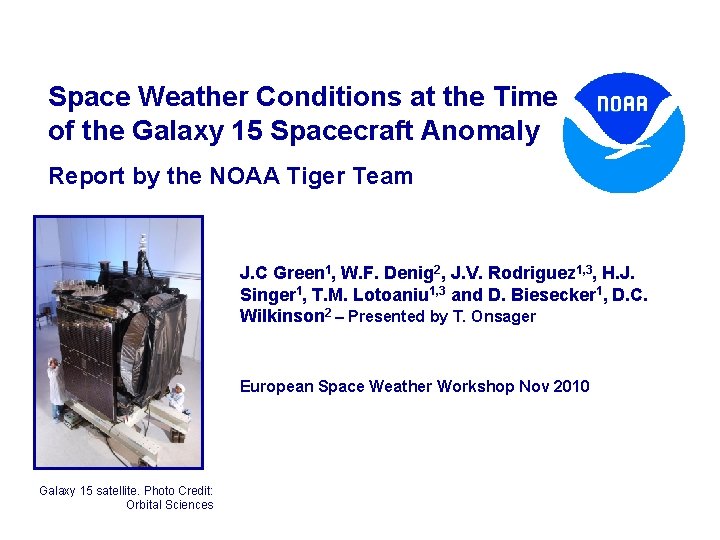
Space Weather Conditions at the Time of the Galaxy 15 Spacecraft Anomaly Report by the NOAA Tiger Team J. C Green 1, W. F. Denig 2, J. V. Rodriguez 1, 3, H. J. Singer 1, T. M. Lotoaniu 1, 3 and D. Biesecker 1, D. C. Wilkinson 2 – Presented by T. Onsager European Space Weather Workshop Nov 2010 Galaxy 15 satellite. Photo Credit: Orbital Sciences
Galaxy 15 NOAA Tiger Team • In April 2010, the Galaxy 15 satellite stopped responding to ground commands. • The Space Weather Prediction Center (SWPC) Director formed a NOAA Tiger Team to document the space environmental conditions experienced by the Galaxy 15 spacecraft surrounding the anomaly. • The team was comprised of representatives from SWPC and the NESDIS National Geophysical Data Center (NGDC). • The report was intended to aide ongoing anomaly analysis but does not include any assessment of the space weather conditions on specific satellite components. 2
OUTLINE Space Weather Conditions – 05 Apr 10 This presentation follows space weather conditions progressing from the sun to near the Galaxy 15 location showing: 1. Events that occurred at the sun 2. Resulting global changes in the near-earth space environment 3. Local changes near Galaxy 15 in the energetic charged particles that can cause satellite charging and electronic component failure Summary ü Solar activity was elevated but not remarkable ü Global geomagnetic activity described by global indices was moderate to extreme ü Local measurements near Galaxy 15 show that a large geomagnetic substorm occurred 48 minutes prior to the anomaly. The substorm caused remarkable increases in the measured local flux of energetic particles known to cause surface or internal satellite charging 3
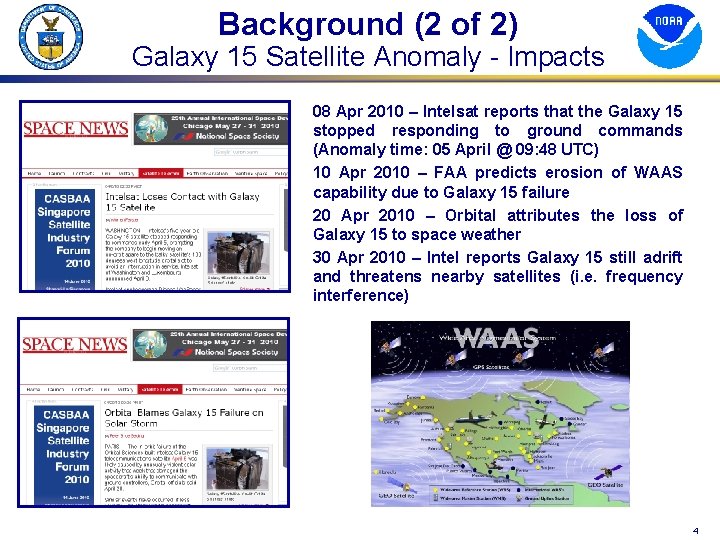
Background (2 of 2) Galaxy 15 Satellite Anomaly - Impacts 08 Apr 2010 – Intelsat reports that the Galaxy 15 stopped responding to ground commands (Anomaly time: 05 April @ 09: 48 UTC) 10 Apr 2010 – FAA predicts erosion of WAAS capability due to Galaxy 15 failure 20 Apr 2010 – Orbital attributes the loss of Galaxy 15 to space weather 30 Apr 2010 – Intel reports Galaxy 15 still adrift and threatens nearby satellites (i. e. frequency interference) 4
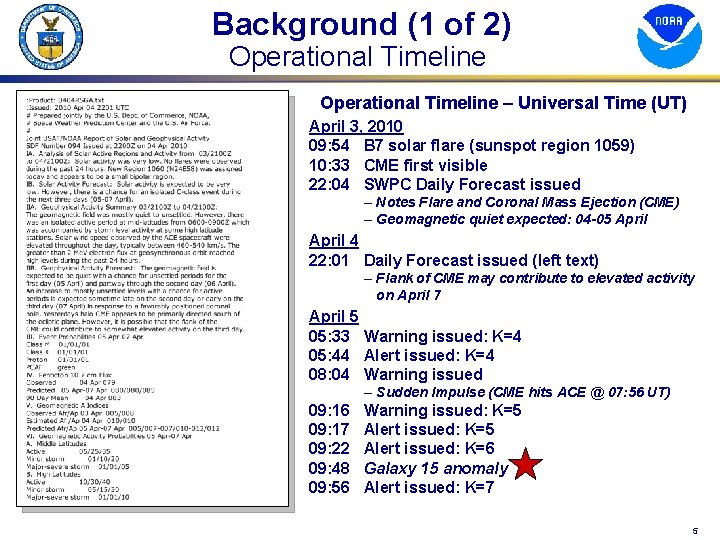
Background (1 of 2) Operational Timeline – Universal Time (UT) April 3, 2010 09: 54 B 7 solar flare (sunspot region 1059) 10: 33 CME first visible 22: 04 SWPC Daily Forecast issued – Notes Flare and Coronal Mass Ejection (CME) – Geomagnetic quiet expected: 04 -05 April 4 22: 01 Daily Forecast issued (left text) – Flank of CME may contribute to elevated activity on April 7 April 5 05: 33 Warning issued: K=4 05: 44 Alert issued: K=4 08: 04 Warning issued – Sudden Impulse (CME hits ACE @ 07: 56 UT) 09: 16 09: 17 09: 22 09: 48 09: 56 Warning issued: K=5 Alert issued: K=6 Galaxy 15 anomaly Alert issued: K=7 5
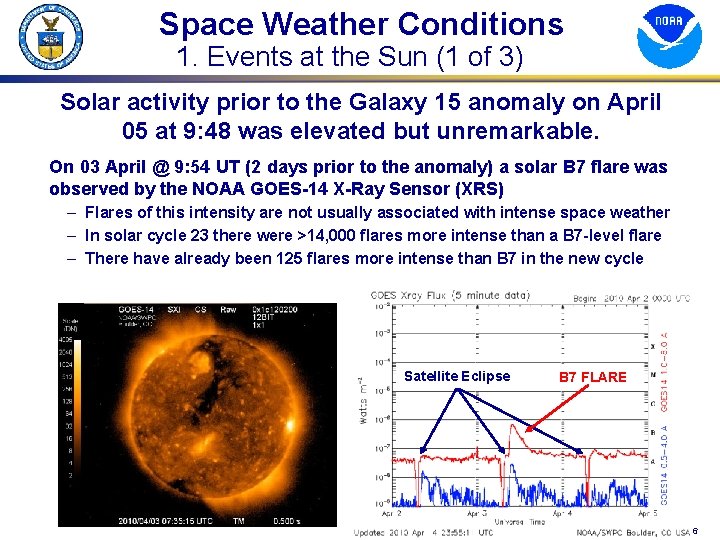
Space Weather Conditions 1. Events at the Sun (1 of 3) Solar activity prior to the Galaxy 15 anomaly on April 05 at 9: 48 was elevated but unremarkable. On 03 April @ 9: 54 UT (2 days prior to the anomaly) a solar B 7 flare was observed by the NOAA GOES-14 X-Ray Sensor (XRS) – Flares of this intensity are not usually associated with intense space weather – In solar cycle 23 there were >14, 000 flares more intense than a B 7 -level flare – There have already been 125 flares more intense than B 7 in the new cycle Satellite Eclipse B 7 FLARE 6
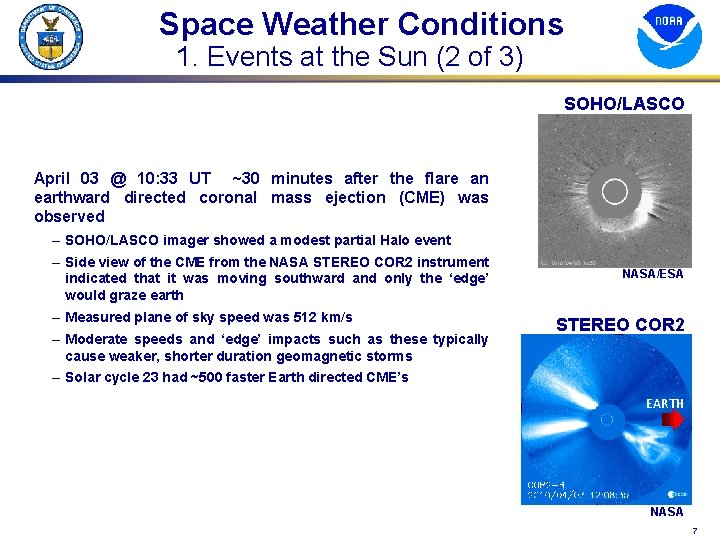
Space Weather Conditions 1. Events at the Sun (2 of 3) SOHO/LASCO April 03 @ 10: 33 UT ~30 minutes after the flare an earthward directed coronal mass ejection (CME) was observed – SOHO/LASCO imager showed a modest partial Halo event – Side view of the CME from the NASA STEREO COR 2 instrument indicated that it was moving southward and only the ‘edge’ would graze earth – Measured plane of sky speed was 512 km/s – Moderate speeds and ‘edge’ impacts such as these typically cause weaker, shorter duration geomagnetic storms NASA/ESA STEREO COR 2 – Solar cycle 23 had ~500 faster Earth directed CME’s EARTH NASA 7
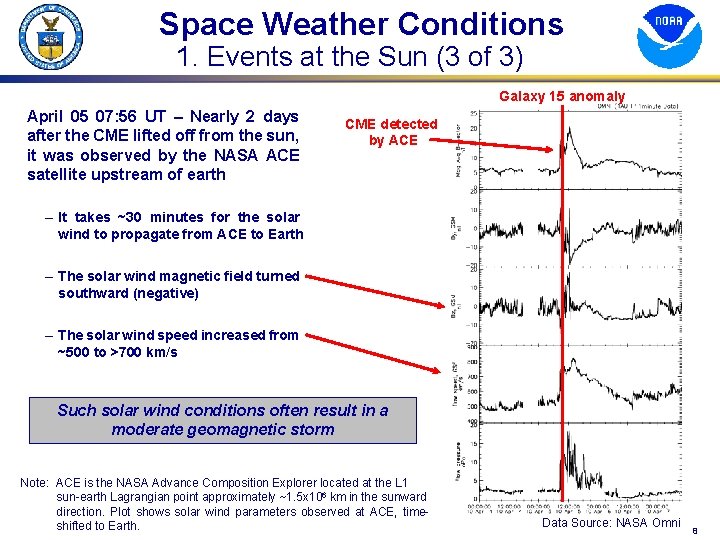
Space Weather Conditions 1. Events at the Sun (3 of 3) Galaxy 15 anomaly April 05 07: 56 UT – Nearly 2 days after the CME lifted off from the sun, it was observed by the NASA ACE satellite upstream of earth CME detected by ACE – It takes ~30 minutes for the solar wind to propagate from ACE to Earth – The solar wind magnetic field turned southward (negative) – The solar wind speed increased from ~500 to >700 km/s Such solar wind conditions often result in a moderate geomagnetic storm Note: ACE is the NASA Advance Composition Explorer located at the L 1 sun-earth Lagrangian point approximately ~1. 5 x 10⁶ km in the sunward direction. Plot shows solar wind parameters observed at ACE, timeshifted to Earth. Data Source: NASA Omni 8
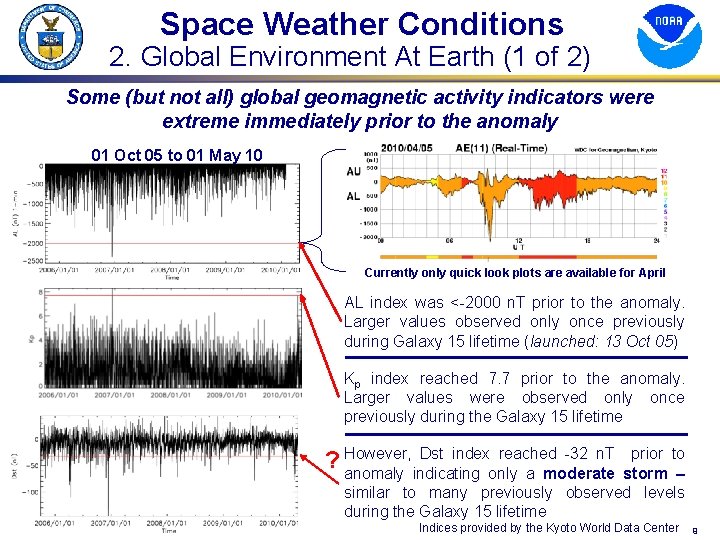
Space Weather Conditions 2. Global Environment At Earth (1 of 2) Some (but not all) global geomagnetic activity indicators were extreme immediately prior to the anomaly 01 Oct 05 to 01 May 10 Currently only quick look plots are available for April AL index was <-2000 n. T prior to the anomaly. Larger values observed only once previously during Galaxy 15 lifetime (launched: 13 Oct 05) Kp index reached 7. 7 prior to the anomaly. Larger values were observed only once previously during the Galaxy 15 lifetime Dst index reached -32 n. T ? However, anomaly indicating only a moderate prior to storm – similar to many previously observed levels during the Galaxy 15 lifetime Indices provided by the Kyoto World Data Center 9
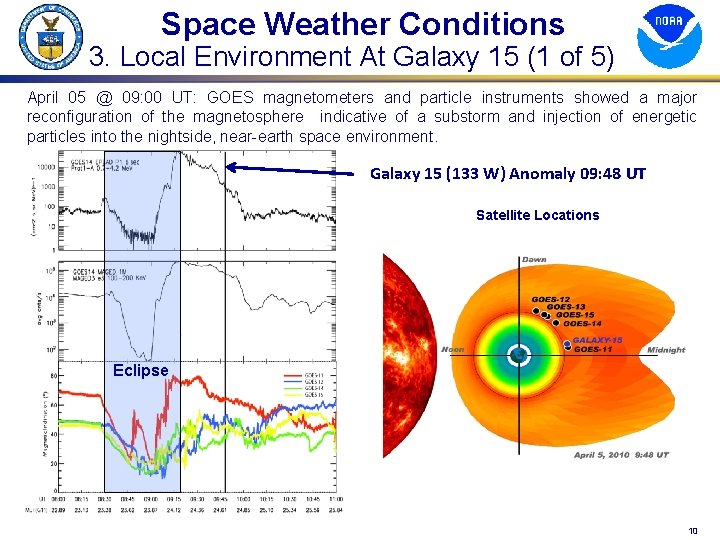
Space Weather Conditions 3. Local Environment At Galaxy 15 (1 of 5) April 05 @ 09: 00 UT: GOES magnetometers and particle instruments showed a major reconfiguration of the magnetosphere indicative of a substorm and injection of energetic particles into the nightside, near-earth space environment. Galaxy 15 (133 W) Anomaly 09: 48 UT Satellite Locations Eclipse 10
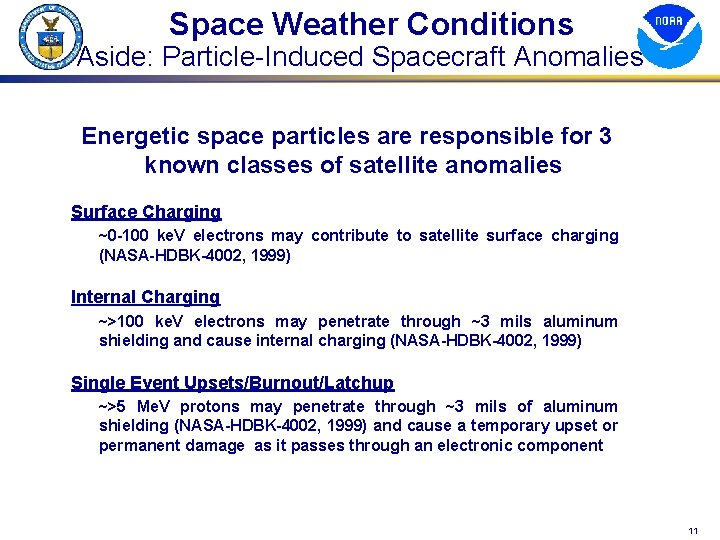
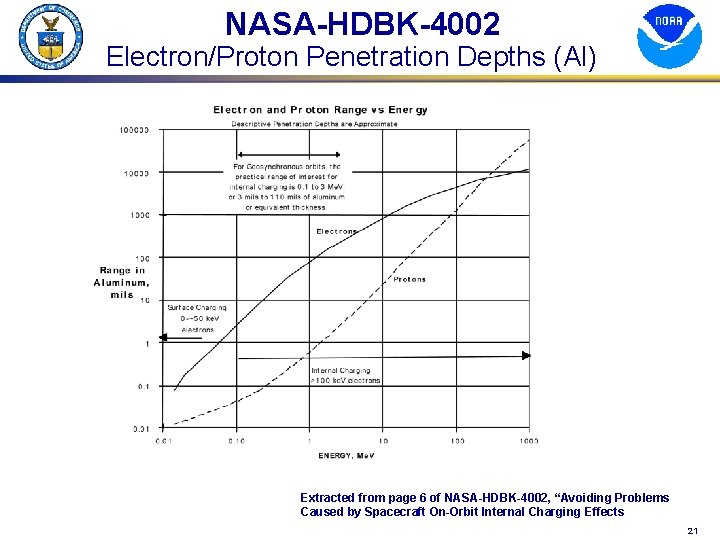
Space Weather Conditions Aside: Particle-Induced Spacecraft Anomalies Energetic space particles are responsible for 3 known classes of satellite anomalies Surface Charging ~0 -100 ke. V electrons may contribute to satellite surface charging (NASA-HDBK-4002, 1999) Internal Charging ~>100 ke. V electrons may penetrate through ~3 mils aluminum shielding and cause internal charging (NASA-HDBK-4002, 1999) Single Event Upsets/Burnout/Latchup ~>5 Me. V protons may penetrate through ~3 mils of aluminum shielding (NASA-HDBK-4002, 1999) and cause a temporary upset or permanent damage as it passes through an electronic component 11
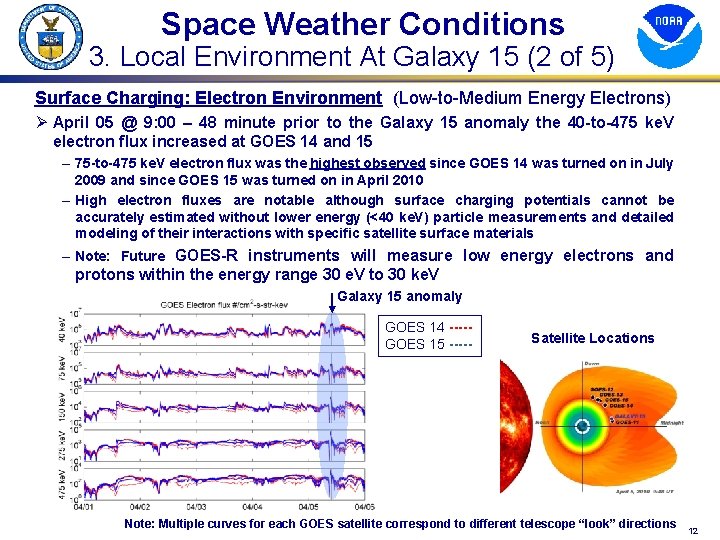
Space Weather Conditions 3. Local Environment At Galaxy 15 (2 of 5) Surface Charging: Electron Environment (Low-to-Medium Energy Electrons) Ø April 05 @ 9: 00 – 48 minute prior to the Galaxy 15 anomaly the 40 -to-475 ke. V electron flux increased at GOES 14 and 15 – 75 -to-475 ke. V electron flux was the highest observed since GOES 14 was turned on in July 2009 and since GOES 15 was turned on in April 2010 – High electron fluxes are notable although surface charging potentials cannot be accurately estimated without lower energy (<40 ke. V) particle measurements and detailed modeling of their interactions with specific satellite surface materials – Note: Future GOES-R instruments will measure low energy electrons and protons within the energy range 30 e. V to 30 ke. V Galaxy 15 anomaly GOES 14 ----GOES 15 ----- Satellite Locations Note: Multiple curves for each GOES satellite correspond to different telescope “look” directions 12
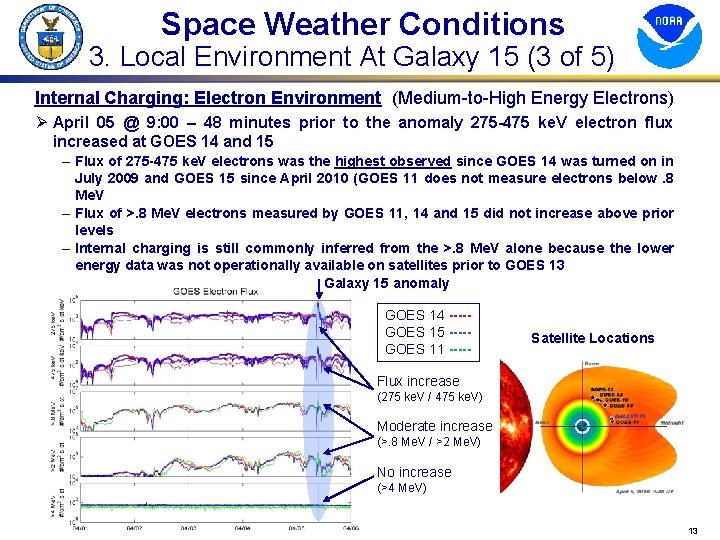
Space Weather Conditions 3. Local Environment At Galaxy 15 (3 of 5) Internal Charging: Electron Environment (Medium-to-High Energy Electrons) Ø April 05 @ 9: 00 – 48 minutes prior to the anomaly 275 -475 ke. V electron flux increased at GOES 14 and 15 – Flux of 275 -475 ke. V electrons was the highest observed since GOES 14 was turned on in July 2009 and GOES 15 since April 2010 (GOES 11 does not measure electrons below. 8 Me. V – Flux of >. 8 Me. V electrons measured by GOES 11, 14 and 15 did not increase above prior levels – Internal charging is still commonly inferred from the >. 8 Me. V alone because the lower energy data was not operationally available on satellites prior to GOES 13 Galaxy 15 anomaly GOES 14 ----GOES 15 ----GOES 11 ----- Satellite Locations Flux increase (275 ke. V / 475 ke. V) Moderate increase (>. 8 Me. V / >2 Me. V) No increase (>4 Me. V) 13
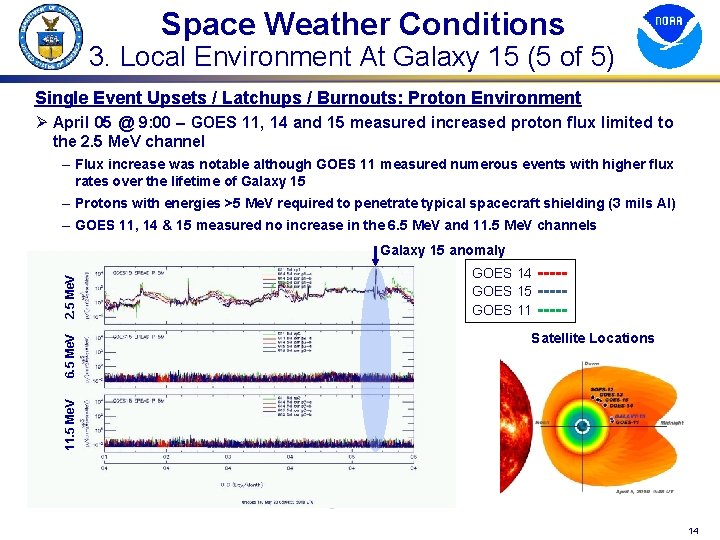
Space Weather Conditions 3. Local Environment At Galaxy 15 (5 of 5) Single Event Upsets / Latchups / Burnouts: Proton Environment Ø April 05 @ 9: 00 – GOES 11, 14 and 15 measured increased proton flux limited to the 2. 5 Me. V channel – Flux increase was notable although GOES 11 measured numerous events with higher flux rates over the lifetime of Galaxy 15 – Protons with energies >5 Me. V required to penetrate typical spacecraft shielding (3 mils Al) – GOES 11, 14 & 15 measured no increase in the 6. 5 Me. V and 11. 5 Me. V channels GOES 14 GOES 15 GOES 11 ------- Satellite Locations 11. 5 Me. V 6. 5 Me. V 2. 5 Me. V Galaxy 15 anomaly 14
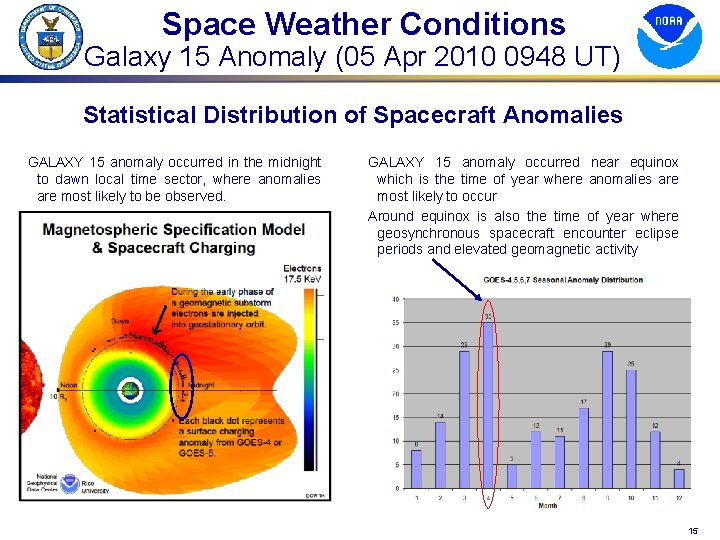
Space Weather Conditions Galaxy 15 Anomaly (05 Apr 2010 0948 UT) Statistical Distribution of Spacecraft Anomalies GALAXY 15 anomaly occurred in the midnight to dawn local time sector, where anomalies are most likely to be observed. GALAXY 15 anomaly occurred near equinox which is the time of year where anomalies are most likely to occur Around equinox is also the time of year where geosynchronous spacecraft encounter eclipse periods and elevated geomagnetic activity 15
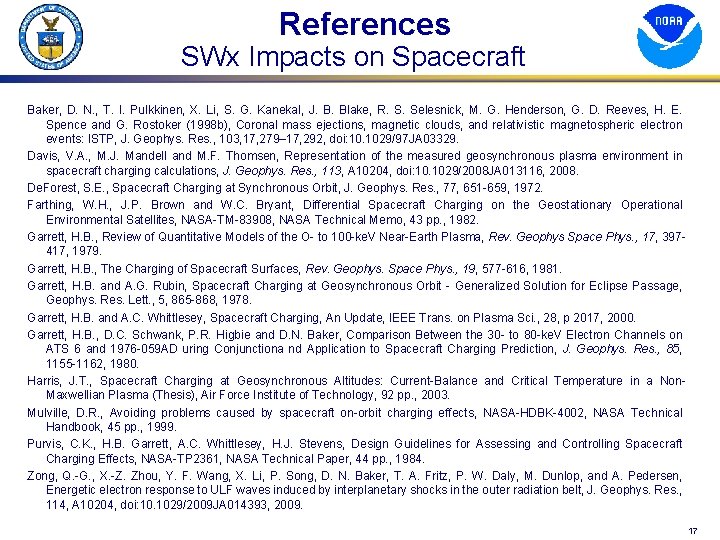
Summary SWx Conditions for Galaxy 15 – 05 Apr 10 Conclusions: Ø Energetic particle flux measurements (protons & electrons) in the GEO space environment near midnight and on the dawn flanks for 05 April 2010 are available for use in Galaxy 15 anomaly investigations Ø Measured electron fluxes at low to moderate energies are consistent with increased risk factors for surface and internal spacecraft charging Ø Measured high-energy proton fluxes are not consistent with increased risk of single-event upsets, latchups and burnouts by sensitive electronic components 16
References SWx Impacts on Spacecraft Baker, D. N. , T. I. Pulkkinen, X. Li, S. G. Kanekal, J. B. Blake, R. S. Selesnick, M. G. Henderson, G. D. Reeves, H. E. Spence and G. Rostoker (1998 b), Coronal mass ejections, magnetic clouds, and relativistic magnetospheric electron events: ISTP, J. Geophys. Res. , 103, 17, 279– 17, 292, doi: 10. 1029/97 JA 03329. Davis, V. A. , M. J. Mandell and M. F. Thomsen, Representation of the measured geosynchronous plasma environment in spacecraft charging calculations, J. Geophys. Res. , 113, A 10204, doi: 10. 1029/2008 JA 013116, 2008. De. Forest, S. E. , Spacecraft Charging at Synchronous Orbit, J. Geophys. Res. , 77, 651 -659, 1972. Farthing, W. H. , J. P. Brown and W. C. Bryant, Differential Spacecraft Charging on the Geostationary Operational Environmental Satellites, NASA-TM-83908, NASA Technical Memo, 43 pp. , 1982. Garrett, H. B. , Review of Quantitative Models of the O- to 100 -ke. V Near-Earth Plasma, Rev. Geophys Space Phys. , 17, 397417, 1979. Garrett, H. B. , The Charging of Spacecraft Surfaces, Rev. Geophys. Space Phys. , 19, 577 -616, 1981. Garrett, H. B. and A. G. Rubin, Spacecraft Charging at Geosynchronous Orbit - Generalized Solution for Eclipse Passage, Geophys. Res. Lett. , 5, 865 -868, 1978. Garrett, H. B. and A. C. Whittlesey, Spacecraft Charging, An Update, IEEE Trans. on Plasma Sci. , 28, p 2017, 2000. Garrett, H. B. , D. C. Schwank, P. R. Higbie and D. N. Baker, Comparison Between the 30 - to 80 -ke. V Electron Channels on ATS 6 and 1976 -059 AD uring Conjunctiona nd Application to Spacecraft Charging Prediction, J. Geophys. Res. , 85, 1155 -1162, 1980. Harris, J. T. , Spacecraft Charging at Geosynchronous Altitudes: Current-Balance and Critical Temperature in a Non. Maxwellian Plasma (Thesis), Air Force Institute of Technology, 92 pp. , 2003. Mulville, D. R. , Avoiding problems caused by spacecraft on-orbit charging effects, NASA-HDBK-4002, NASA Technical Handbook, 45 pp. , 1999. Purvis, C. K. , H. B. Garrett, A. C. Whittlesey, H. J. Stevens, Design Guidelines for Assessing and Controlling Spacecraft Charging Effects, NASA-TP 2361, NASA Technical Paper, 44 pp. , 1984. Zong, Q. -G. , X. -Z. Zhou, Y. F. Wang, X. Li, P. Song, D. N. Baker, T. A. Fritz, P. W. Daly, M. Dunlop, and A. Pedersen, Energetic electron response to ULF waves induced by interplanetary shocks in the outer radiation belt, J. Geophys. Res. , 114, A 10204, doi: 10. 1029/2009 JA 014393, 2009. 17
QUESTIONS? 18
BACKUP SLIDES 19
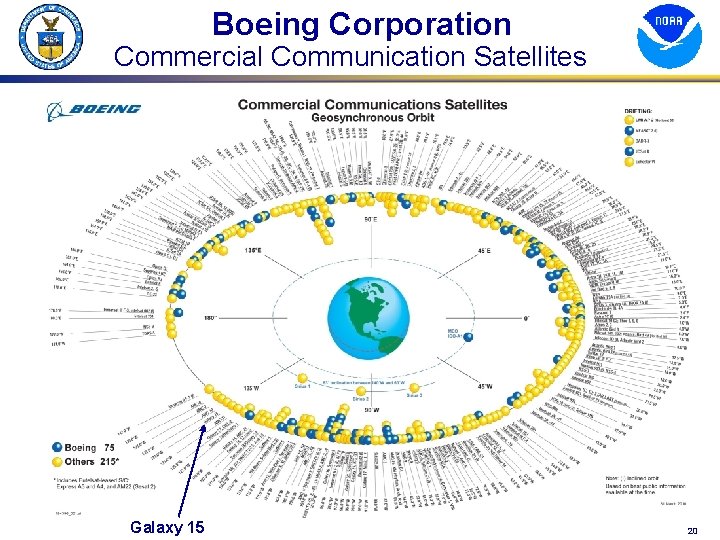
Boeing Corporation Commercial Communication Satellites Galaxy 15 20
NASA-HDBK-4002 Electron/Proton Penetration Depths (Al) Extracted from page 6 of NASA-HDBK-4002, “Avoiding Problems Caused by Spacecraft On-Orbit Internal Charging Effects 21
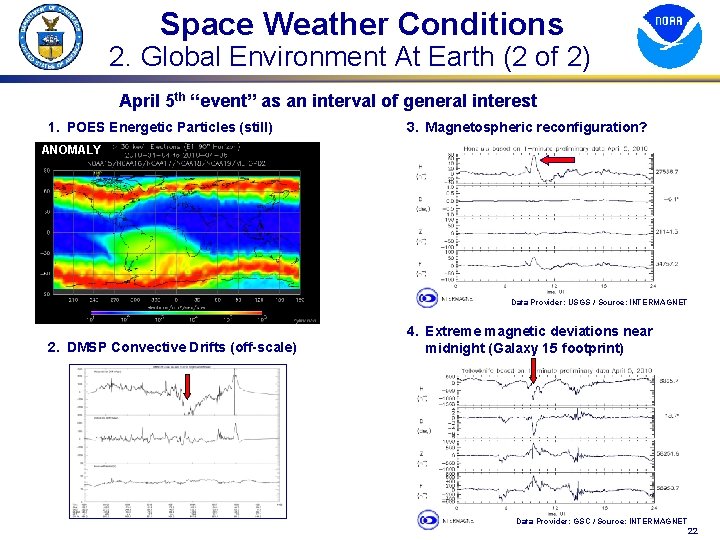
Space Weather Conditions 2. Global Environment At Earth (2 of 2) April 5 th “event” as an interval of general interest 1. POES Energetic Particles (still) 3. Magnetospheric reconfiguration? ANOMALY Data Provider: USGS / Source: INTERMAGNET 2. DMSP Convective Drifts (off-scale) 4. Extreme magnetic deviations near midnight (Galaxy 15 footprint) Data Provider: GSC / Source: INTERMAGNET 22