
Space Weather at Saturn Observations during the 2013
Space Weather at Saturn Observations during the 2013 auroral observing campaign Summary and movies at: http: //saturn. jpl. nasa. gov/newsreleases/newsrelease 20140211/ Sarah Badman Lancaster University, UK
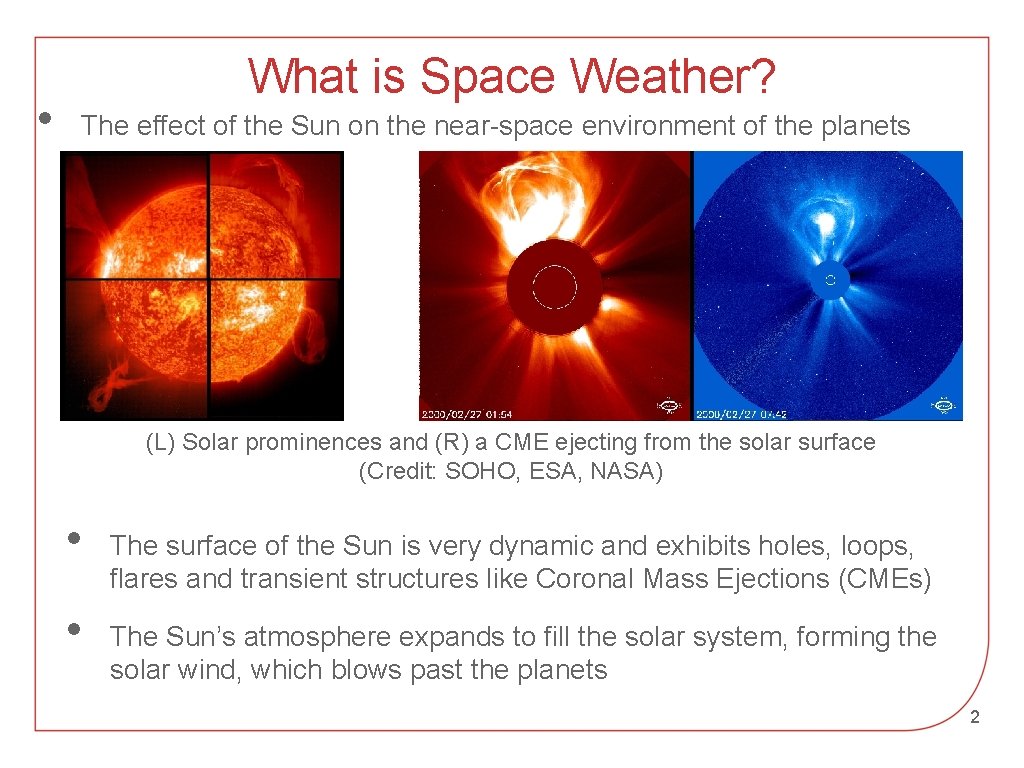
• What is Space Weather? The effect of the Sun on the near-space environment of the planets (L) Solar prominences and (R) a CME ejecting from the solar surface (Credit: SOHO, ESA, NASA) • • The surface of the Sun is very dynamic and exhibits holes, loops, flares and transient structures like Coronal Mass Ejections (CMEs) The Sun’s atmosphere expands to fill the solar system, forming the solar wind, which blows past the planets 2
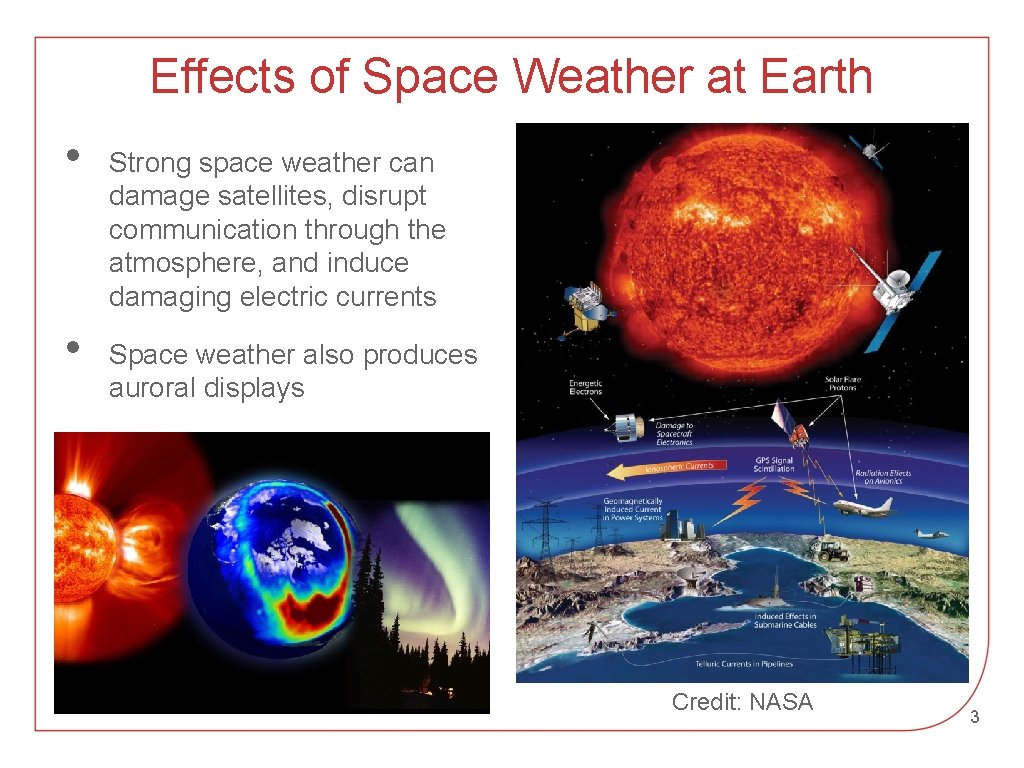
Effects of Space Weather at Earth • • Strong space weather can damage satellites, disrupt communication through the atmosphere, and induce damaging electric currents Space weather also produces auroral displays Credit: NASA 3
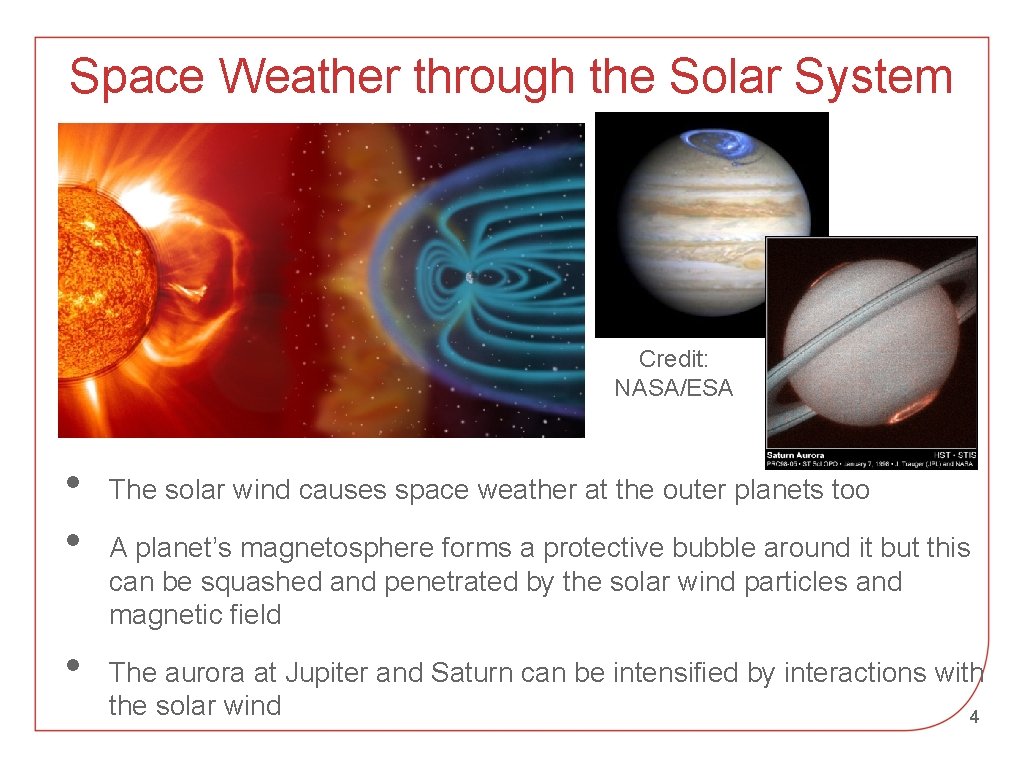
Space Weather through the Solar System Credit: NASA/ESA • • • The solar wind causes space weather at the outer planets too A planet’s magnetosphere forms a protective bubble around it but this can be squashed and penetrated by the solar wind particles and magnetic field The aurora at Jupiter and Saturn can be intensified by interactions with the solar wind 4
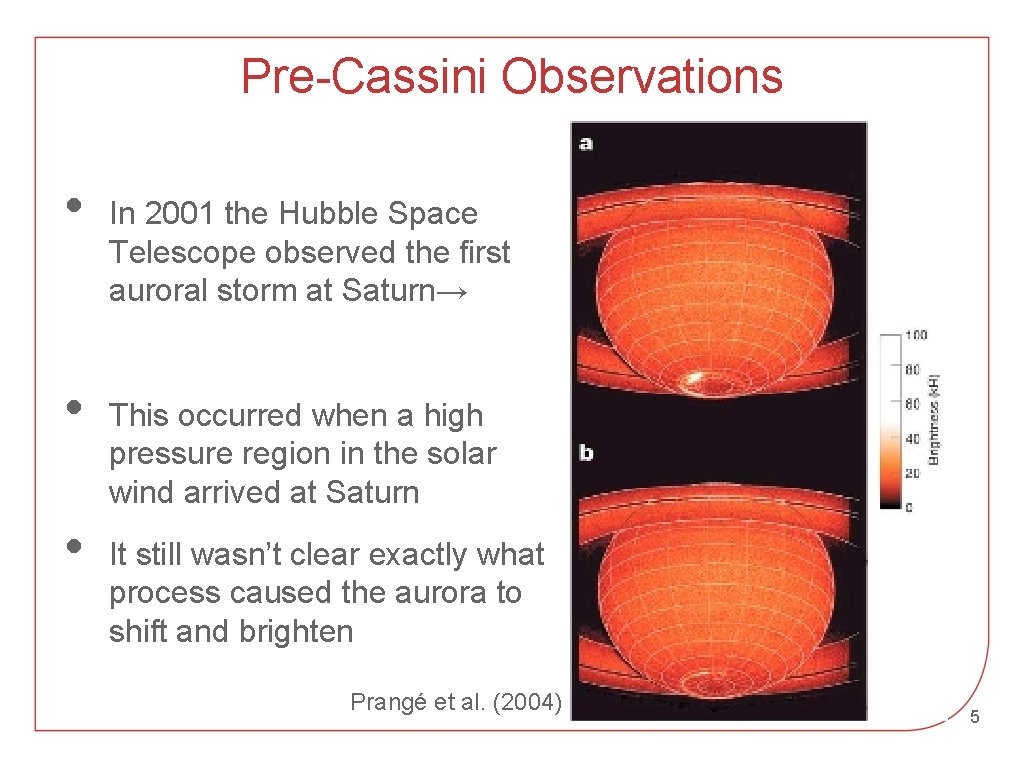
Pre-Cassini Observations • • • In 2001 the Hubble Space Telescope observed the first auroral storm at Saturn→ This occurred when a high pressure region in the solar wind arrived at Saturn It still wasn’t clear exactly what process caused the aurora to shift and brighten Prangé et al. (2004) 5
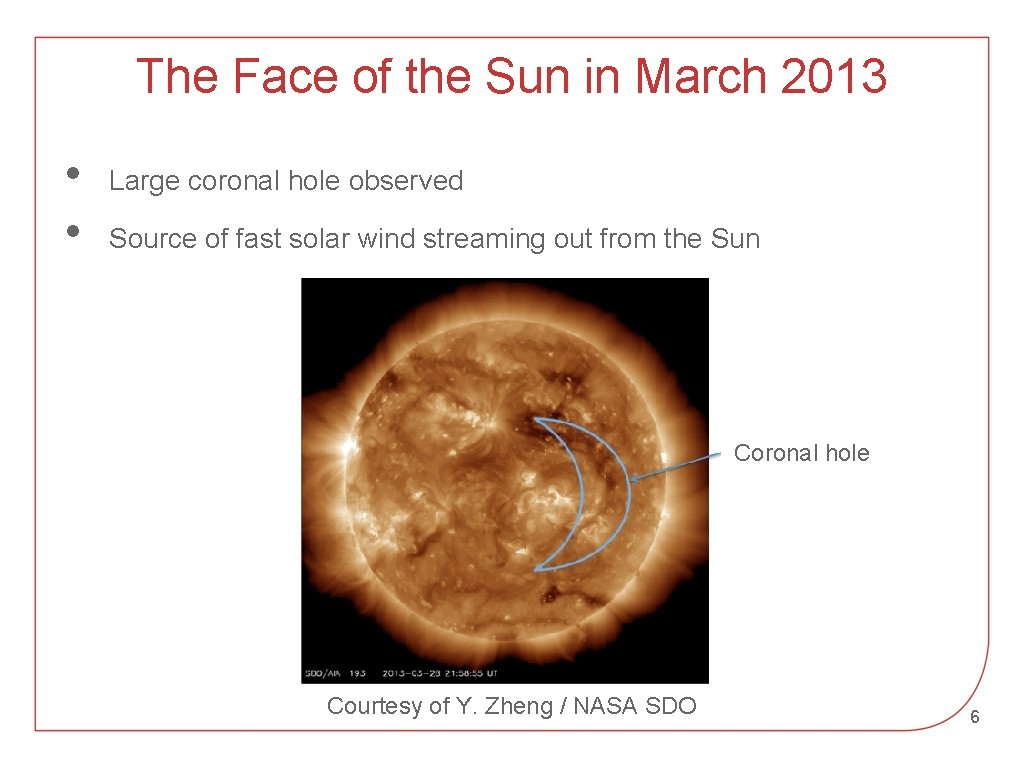
The Face of the Sun in March 2013 • • Large coronal hole observed Source of fast solar wind streaming out from the Sun Coronal hole Courtesy of Y. Zheng / NASA SDO 6
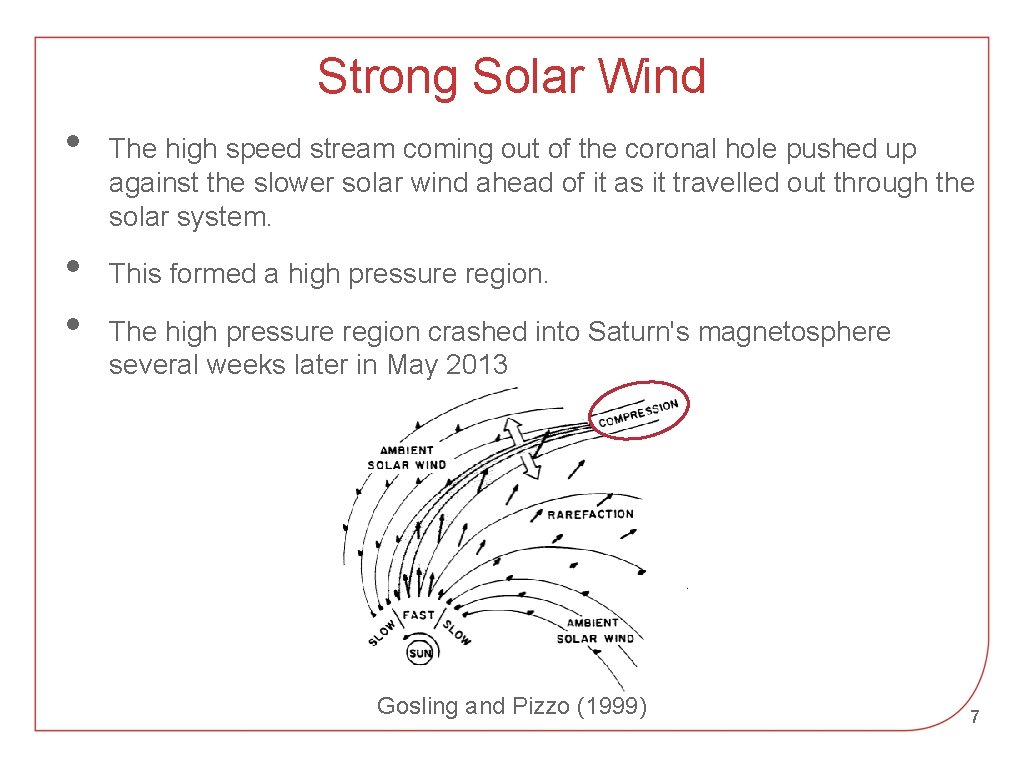
Strong Solar Wind • • • The high speed stream coming out of the coronal hole pushed up against the slower solar wind ahead of it as it travelled out through the solar system. This formed a high pressure region. The high pressure region crashed into Saturn's magnetosphere several weeks later in May 2013 Gosling and Pizzo (1999) 7
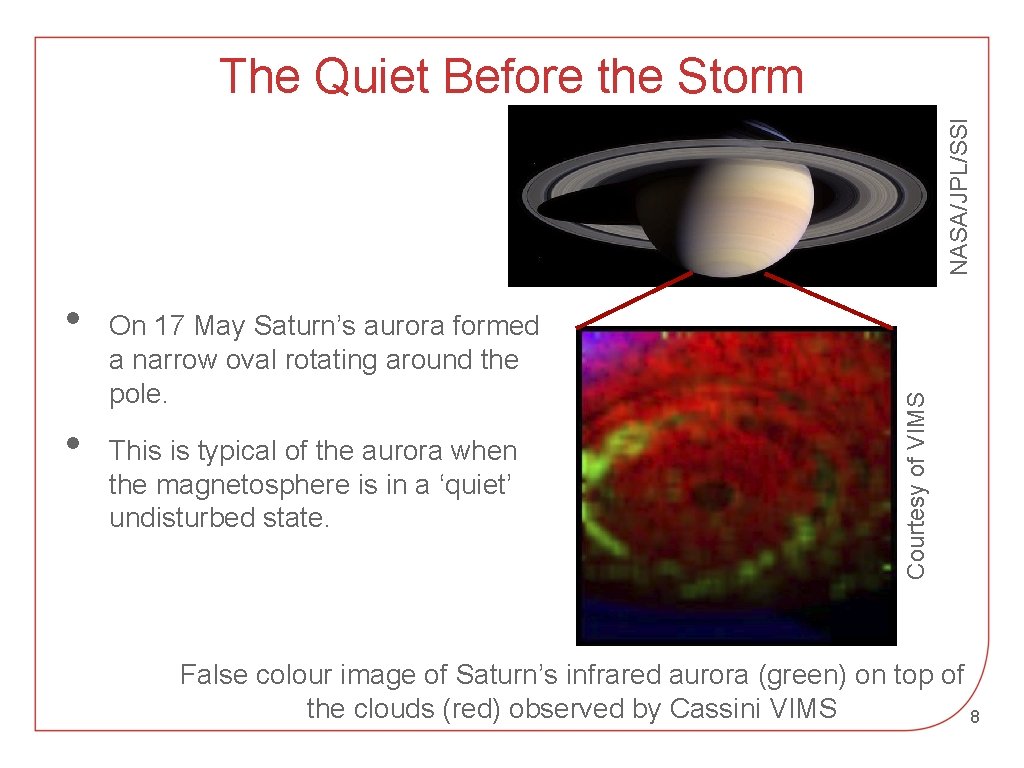
• • On 17 May Saturn’s aurora formed a narrow oval rotating around the pole. This is typical of the aurora when the magnetosphere is in a ‘quiet’ undisturbed state. Courtesy of VIMS NASA/JPL/SSI The Quiet Before the Storm False colour image of Saturn’s infrared aurora (green) on top of the clouds (red) observed by Cassini VIMS 8
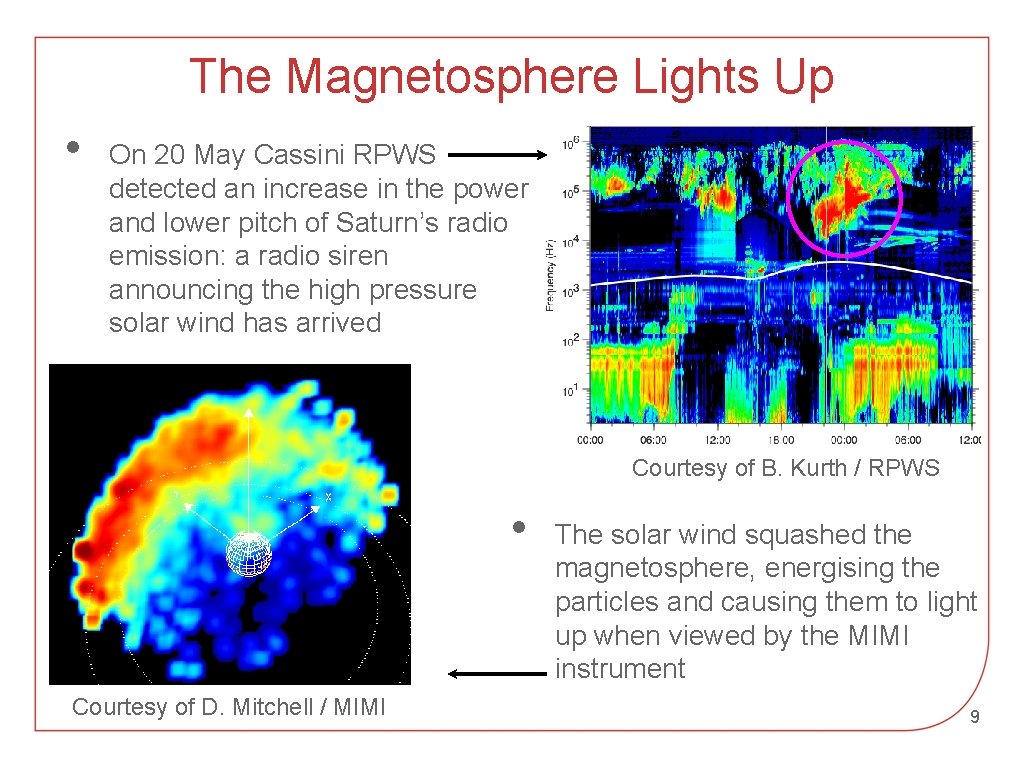
The Magnetosphere Lights Up • On 20 May Cassini RPWS detected an increase in the power and lower pitch of Saturn’s radio emission: a radio siren announcing the high pressure solar wind has arrived Courtesy of B. Kurth / RPWS • Courtesy of D. Mitchell / MIMI The solar wind squashed the magnetosphere, energising the particles and causing them to light up when viewed by the MIMI instrument 9
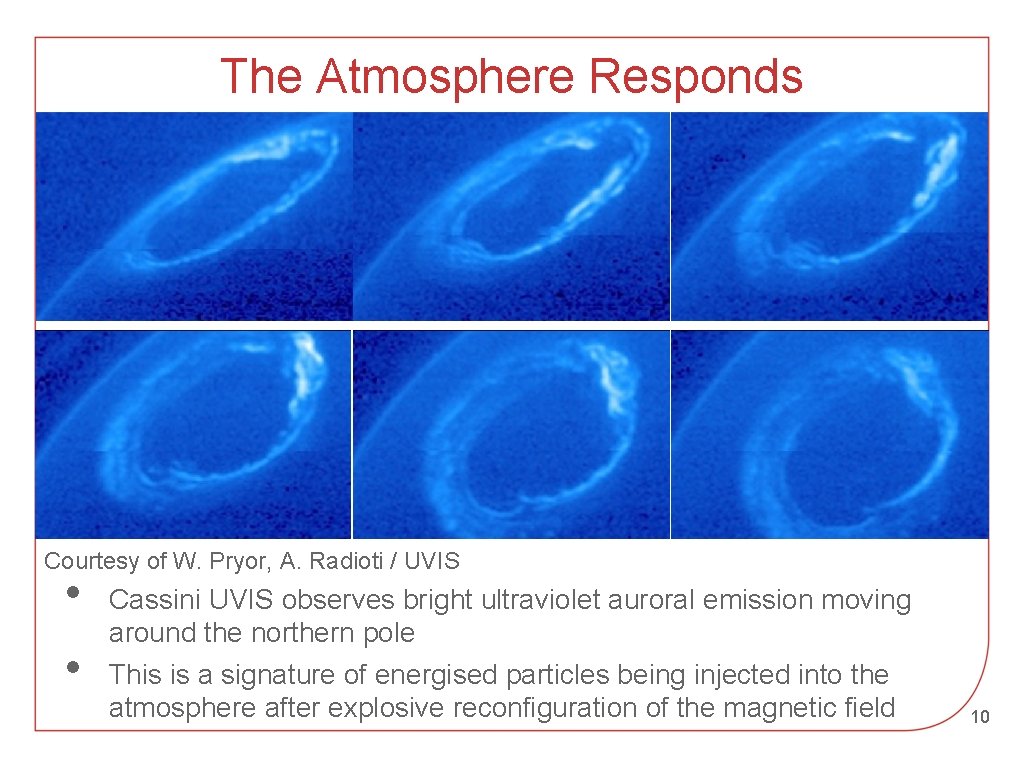
The Atmosphere Responds Courtesy of W. Pryor, A. Radioti / UVIS • • Cassini UVIS observes bright ultraviolet auroral emission moving around the northern pole This is a signature of energised particles being injected into the atmosphere after explosive reconfiguration of the magnetic field 10
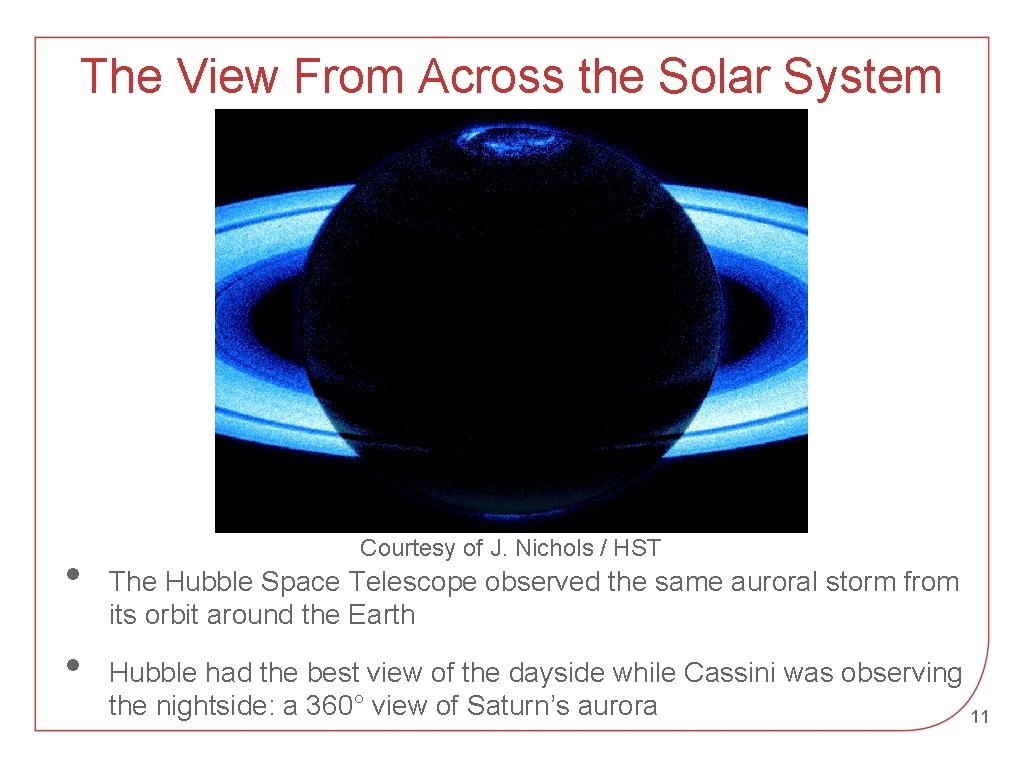
The View From Across the Solar System • • Courtesy of J. Nichols / HST The Hubble Space Telescope observed the same auroral storm from its orbit around the Earth Hubble had the best view of the dayside while Cassini was observing the nightside: a 360° view of Saturn’s aurora 11
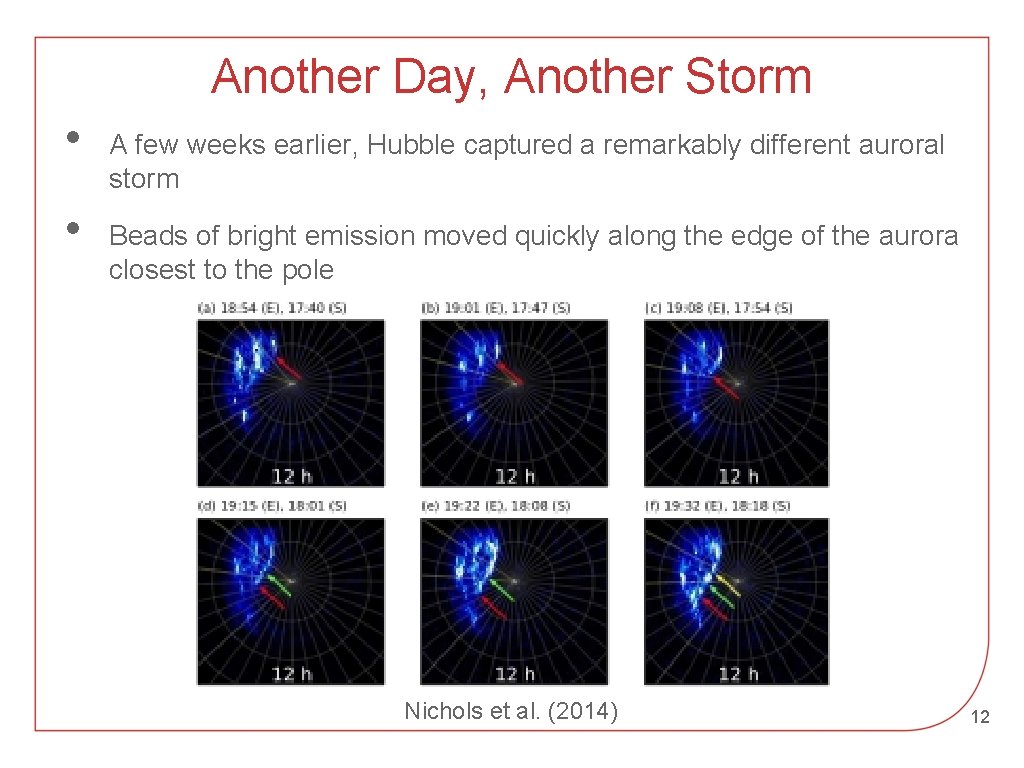
Another Day, Another Storm • • A few weeks earlier, Hubble captured a remarkably different auroral storm Beads of bright emission moved quickly along the edge of the aurora closest to the pole Nichols et al. (2014) 12
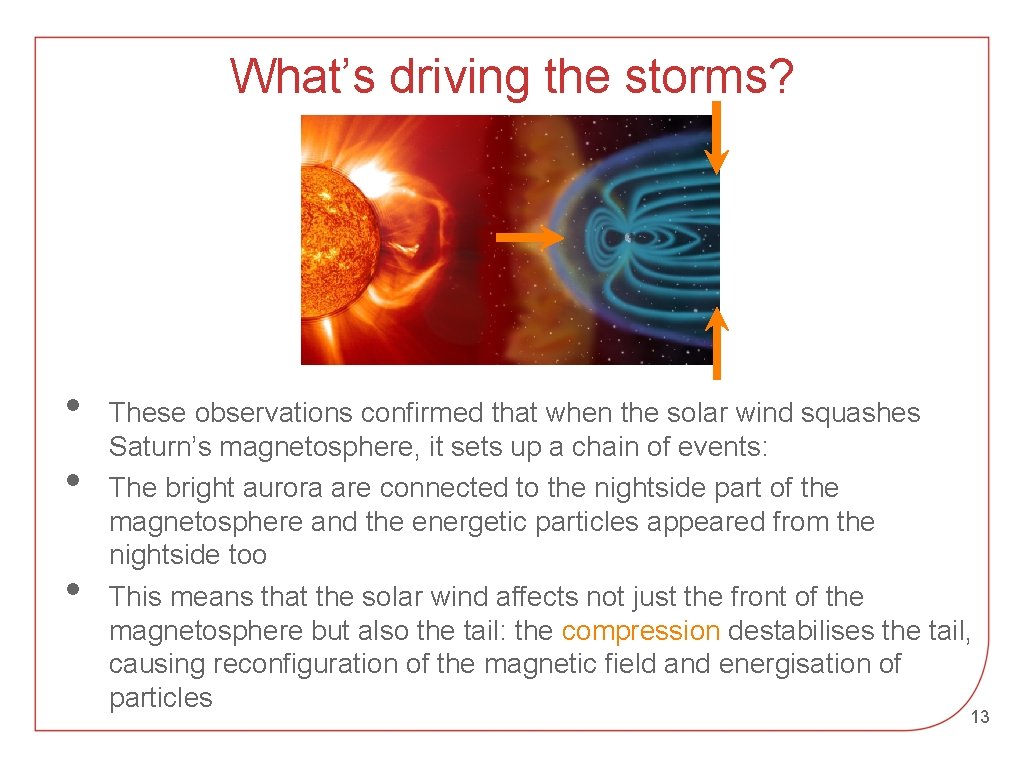
What’s driving the storms? • • • These observations confirmed that when the solar wind squashes Saturn’s magnetosphere, it sets up a chain of events: The bright aurora are connected to the nightside part of the magnetosphere and the energetic particles appeared from the nightside too This means that the solar wind affects not just the front of the magnetosphere but also the tail: the compression destabilises the tail, causing reconfiguration of the magnetic field and energisation of particles 13
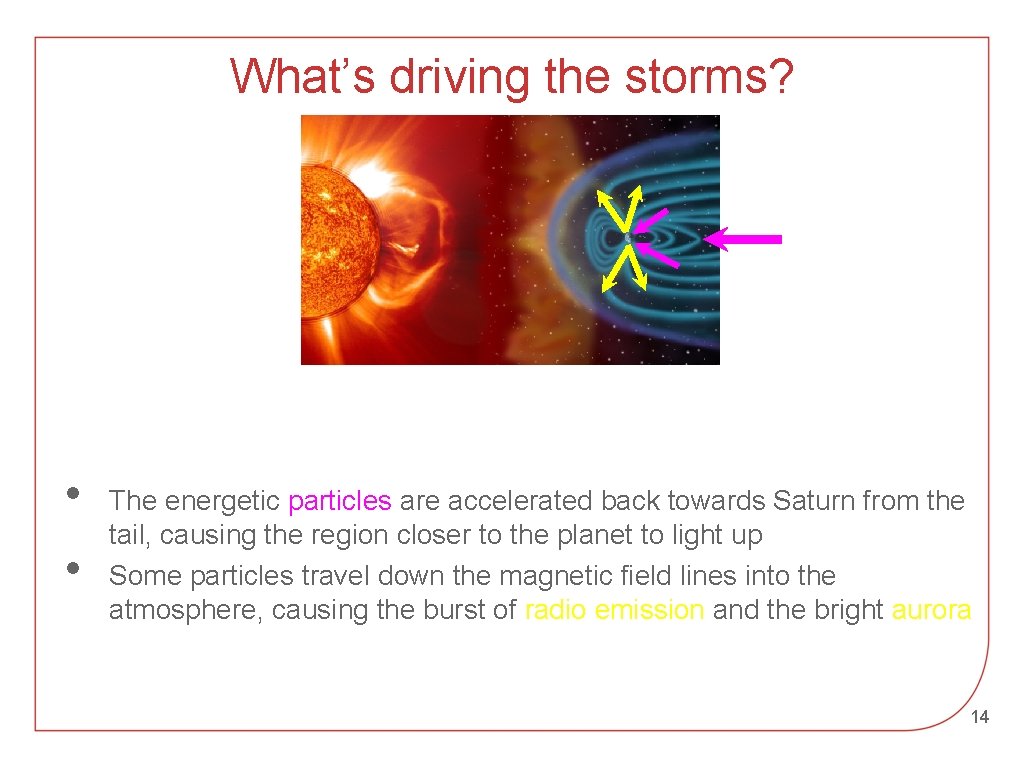
What’s driving the storms? • • The energetic particles are accelerated back towards Saturn from the tail, causing the region closer to the planet to light up Some particles travel down the magnetic field lines into the atmosphere, causing the burst of radio emission and the bright aurora 14
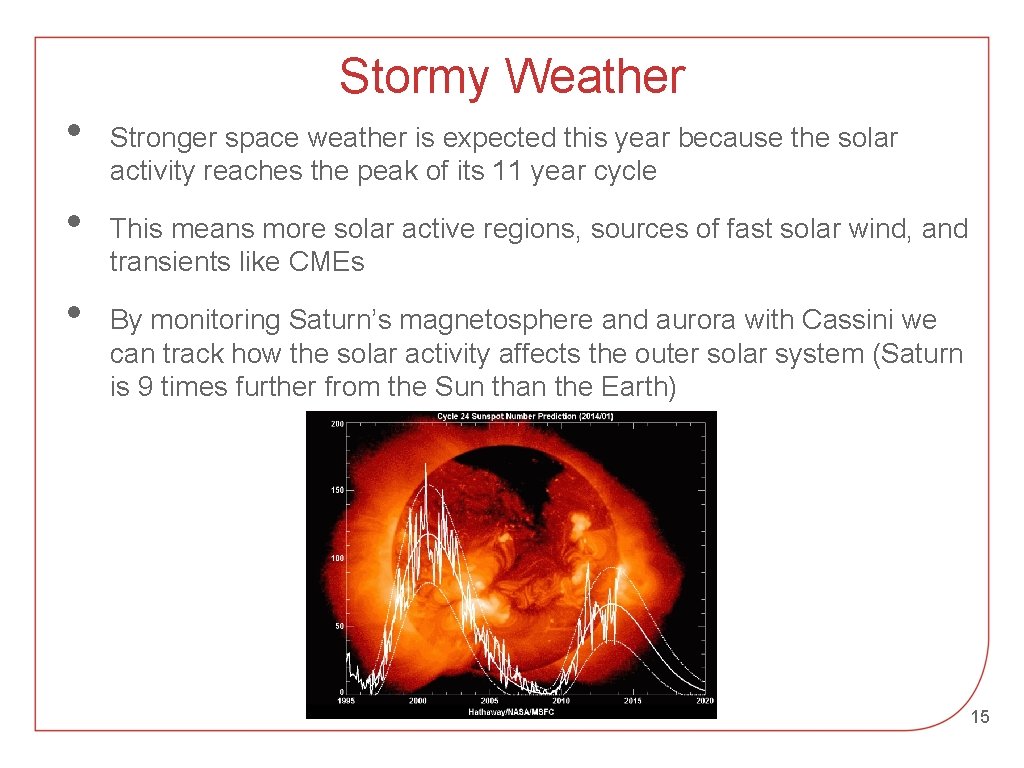
• • • Stormy Weather Stronger space weather is expected this year because the solar activity reaches the peak of its 11 year cycle This means more solar active regions, sources of fast solar wind, and transients like CMEs By monitoring Saturn’s magnetosphere and aurora with Cassini we can track how the solar activity affects the outer solar system (Saturn is 9 times further from the Sun than the Earth) 15
Summary • • • Space weather concerns how the Sun affects the near-space environment of the planets In spring 2013 Saturn’s magnetosphere and aurora were scrutinised by Cassini and Earth-based telescopes to detect space weather at Saturn A high pressure region of the solar wind squashed the magnetosphere, causing a radio siren and the cloud of neutrals surrounding the planet to light up Bright arc structures were observed in the aurora and related to explosive reconfiguration of the magnetic field Hubble viewed the auroral storms at a different angle from across the solar system Cassini is revealing how the Sun affects Saturn over the course of a solar activity cycle 16
- Slides: 16