
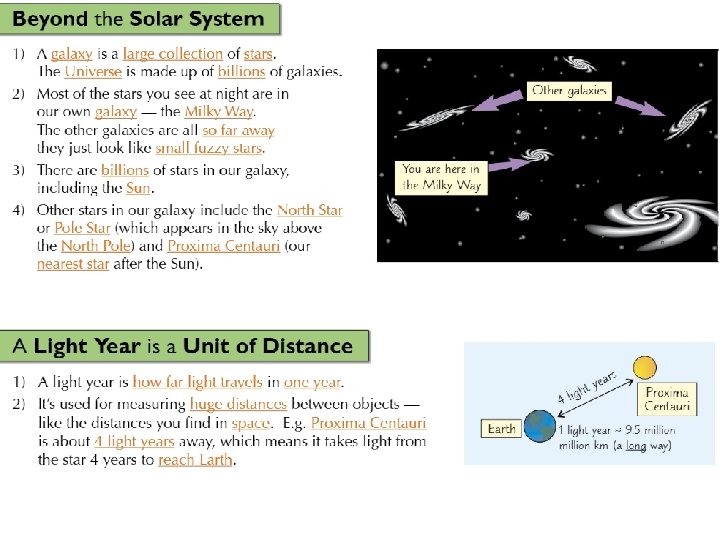
Space The universe contains around 100 billion galaxies
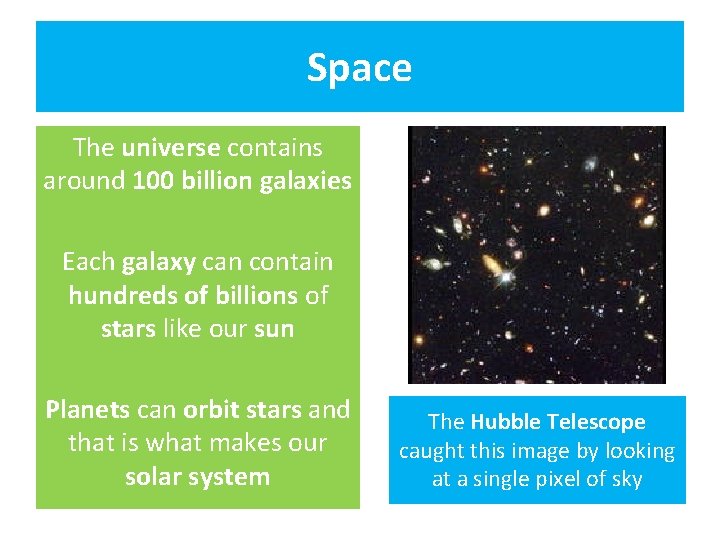
Space The universe contains around 100 billion galaxies Each galaxy can contain hundreds of billions of stars like our sun Planets can orbit stars and that is what makes our solar system The Hubble Telescope caught this image by looking at a single pixel of sky
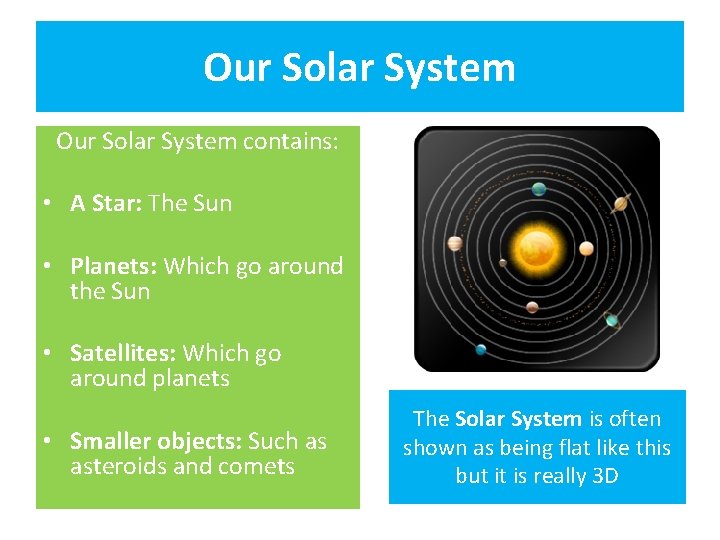
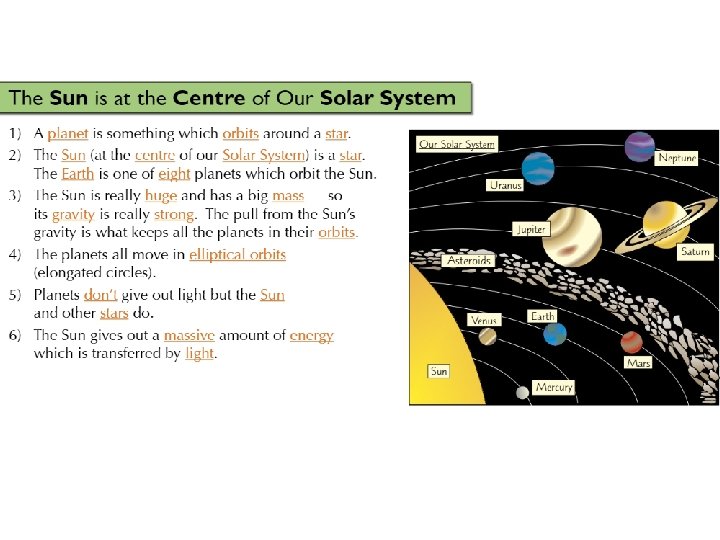
Our Solar System contains: • A Star: The Sun • Planets: Which go around the Sun • Satellites: Which go around planets • Smaller objects: Such as asteroids and comets The Solar System is often shown as being flat like this but it is really 3 D
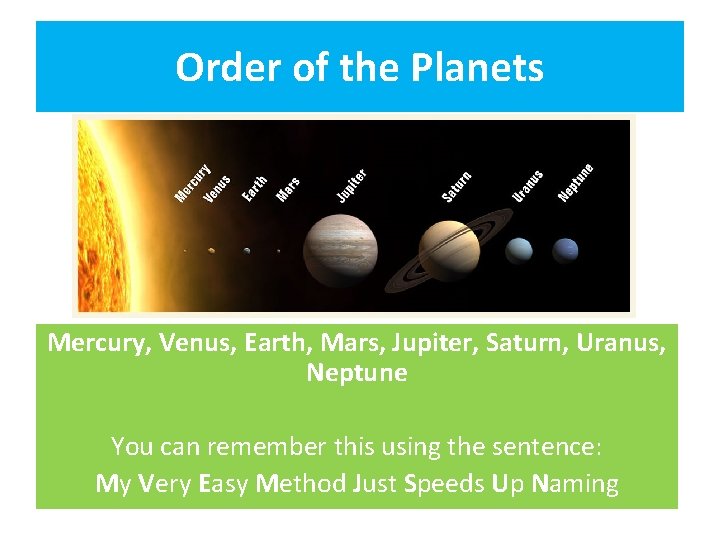
Order of the Planets Mercury, Venus, Earth, Mars, Jupiter, Saturn, Uranus, Neptune You can remember this using the sentence: My Very Easy Method Just Speeds Up Naming

Mnemonic Mercury, Venus, Earth, Mars, Jupiter, Saturn, Uranus, Neptune My Very Easy Method Just Speeds Up Naming Create your own mnemonic to remember the order of the planets M V E M J S U N
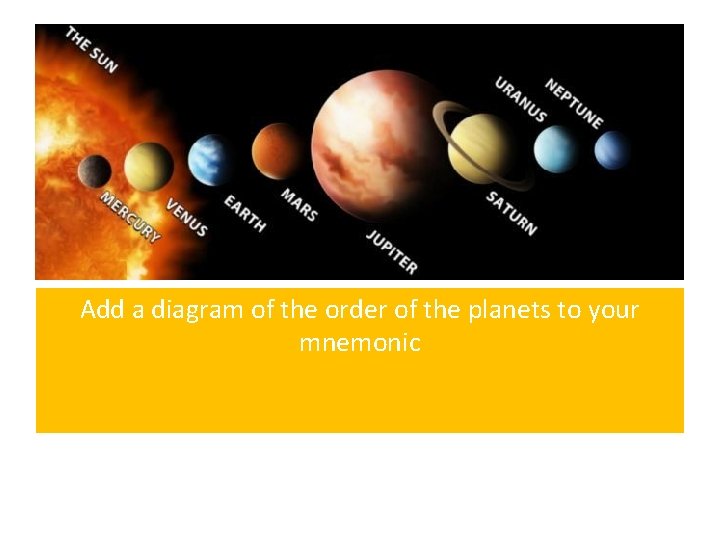
Add a diagram of the order of the planets to your mnemonic
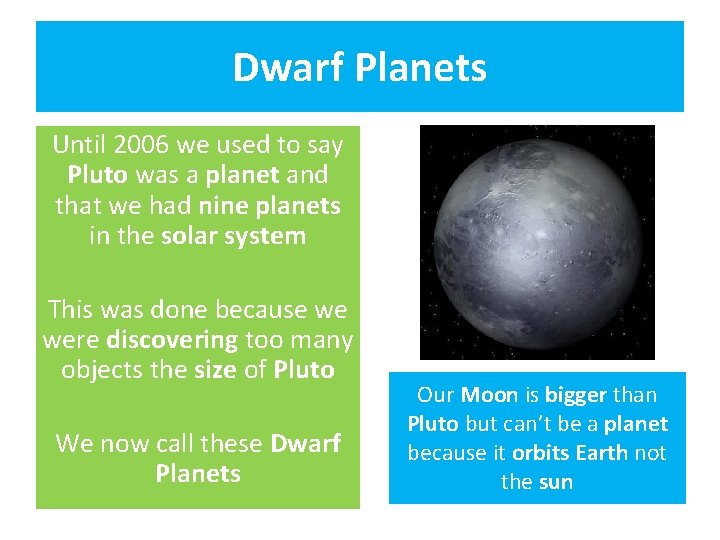
Dwarf Planets Until 2006 we used to say Pluto was a planet and that we had nine planets in the solar system This was done because we were discovering too many objects the size of Pluto We now call these Dwarf Planets Our Moon is bigger than Pluto but can’t be a planet because it orbits Earth not the sun
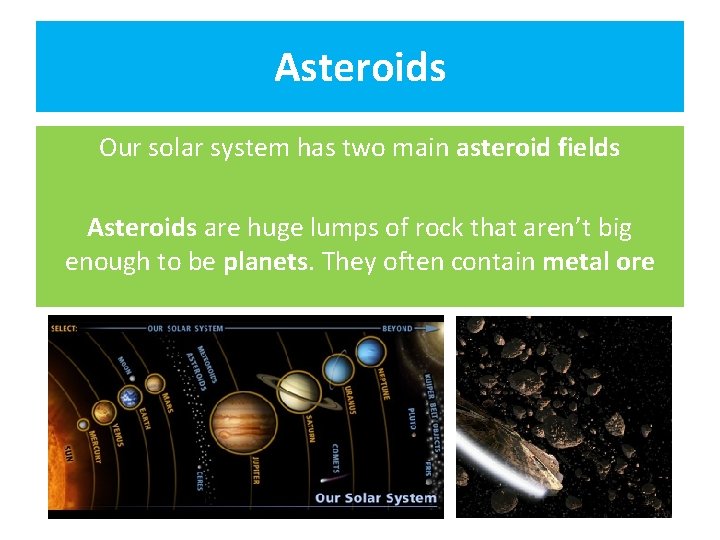
Asteroids Our solar system has two main asteroid fields Asteroids are huge lumps of rock that aren’t big enough to be planets. They often contain metal ore
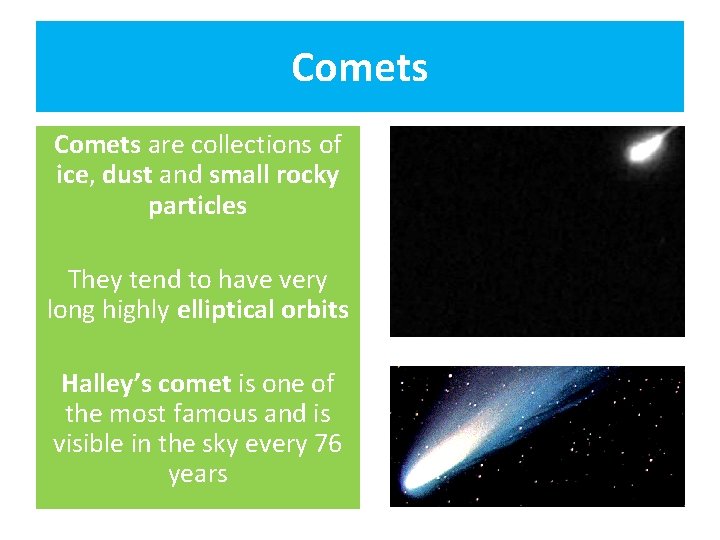
Comets are collections of ice, dust and small rocky particles They tend to have very long highly elliptical orbits Halley’s comet is one of the most famous and is visible in the sky every 76 years
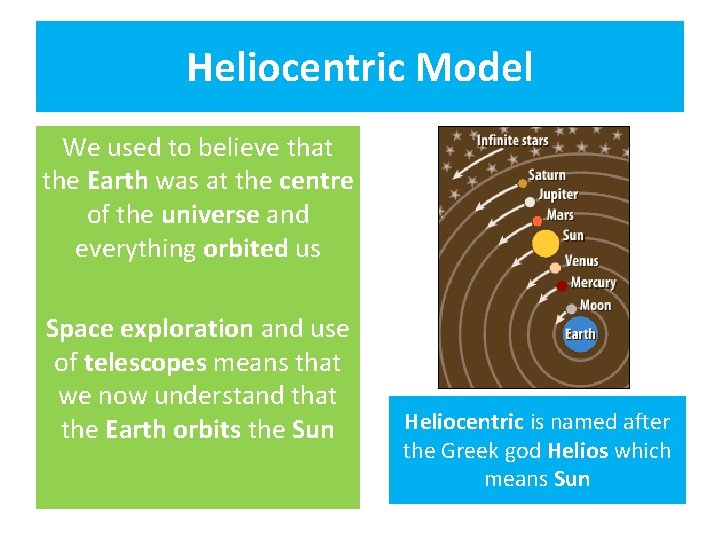
Heliocentric Model We used to believe that the Earth was at the centre of the universe and everything orbited us Space exploration and use of telescopes means that we now understand that the Earth orbits the Sun Heliocentric is named after the Greek god Helios which means Sun
Questions
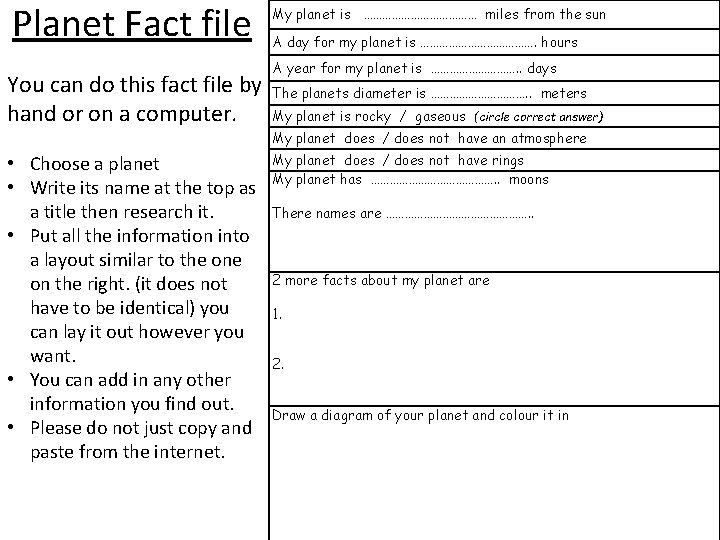
Planet Fact file You can do this fact file by hand or on a computer. My planet is ……………… miles from the sun A day for my planet is ………………. hours A year for my planet is ……………. . days The planets diameter is ……………. . meters My planet is rocky / gaseous (circle correct answer) My planet does / does not have an atmosphere • Choose a planet • Write its name at the top as a title then research it. • Put all the information into a layout similar to the on the right. (it does not have to be identical) you can lay it out however you want. • You can add in any other information you find out. • Please do not just copy and paste from the internet. My planet does / does not have rings My planet has …………………. . moons There names are ……………………. . 2 more facts about my planet are 1. 2. Draw a diagram of your planet and colour it in
- Slides: 13