
Space Telescopes Absorption Light is absorbed by solids
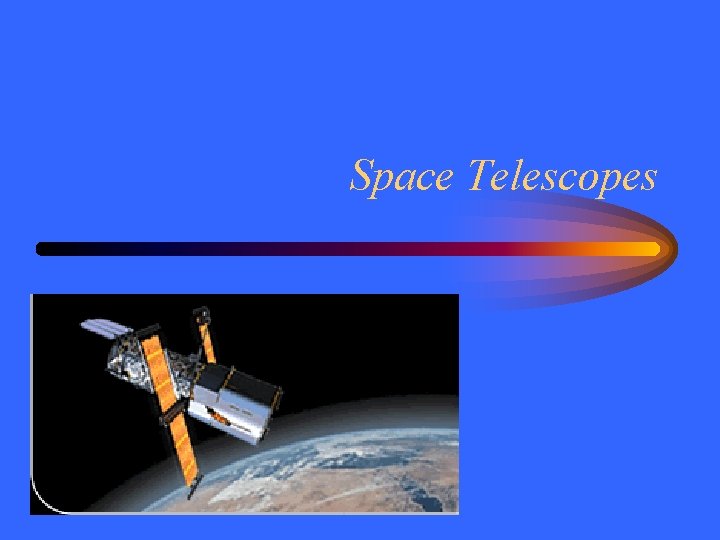
Space Telescopes

Absorption • Light is absorbed by solids, liquids and gases. – Clear vs opaque • Absorption depends on the frequency. • Glass is clear to visible light, and opaque in infrared. COMSOL

Atmospheric Absorption • The atmosphere absorbs radiation, except at visible light, infrared, and radio frequencies.
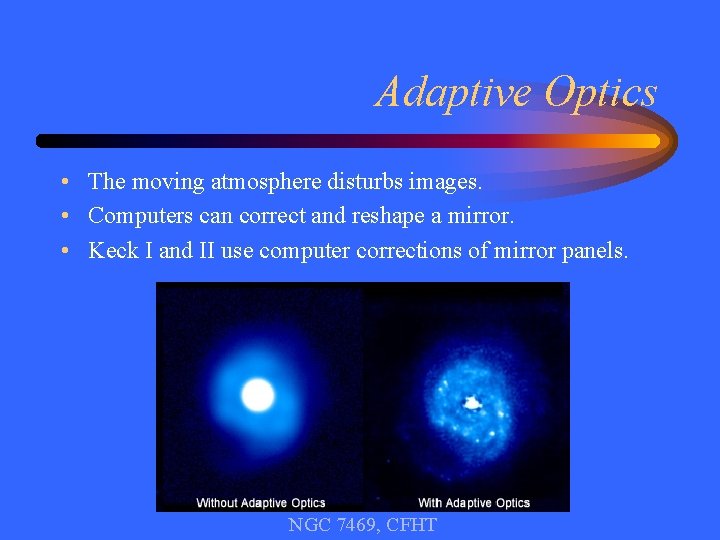
Adaptive Optics • The moving atmosphere disturbs images. • Computers can correct and reshape a mirror. • Keck I and II use computer corrections of mirror panels. NGC 7469, CFHT
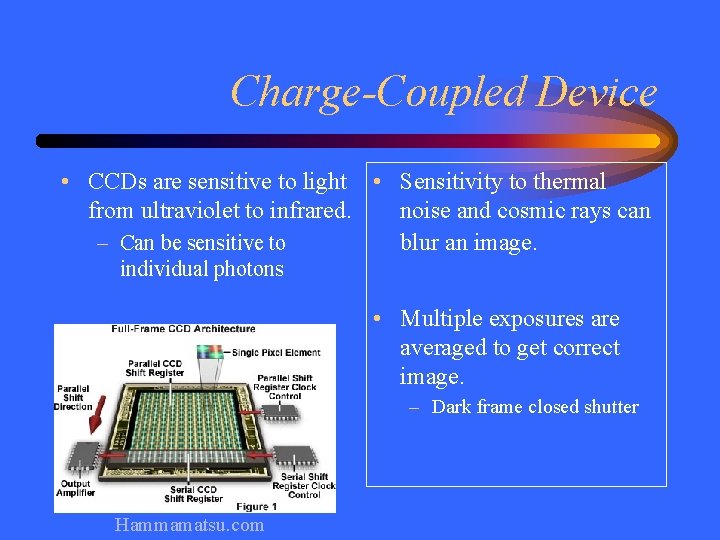
Charge-Coupled Device • CCDs are sensitive to light • Sensitivity to thermal from ultraviolet to infrared. noise and cosmic rays can – Can be sensitive to blur an image. individual photons • Multiple exposures are averaged to get correct image. – Dark frame closed shutter Hammamatsu. com
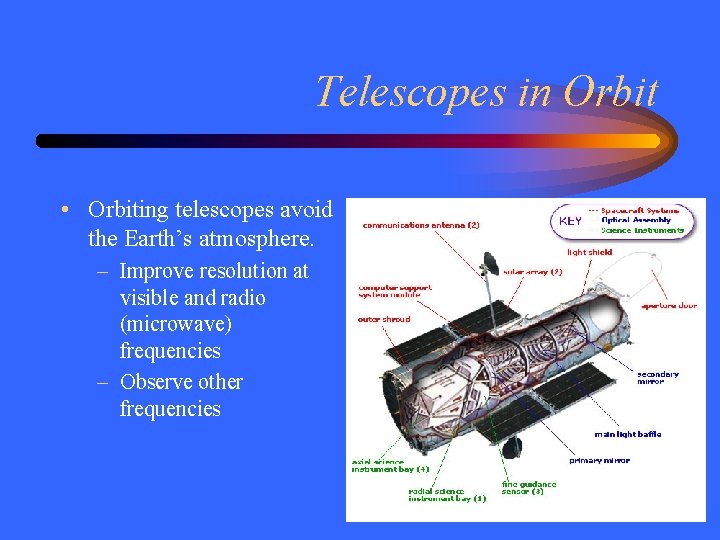
Telescopes in Orbit • Orbiting telescopes avoid the Earth’s atmosphere. – Improve resolution at visible and radio (microwave) frequencies – Observe other frequencies
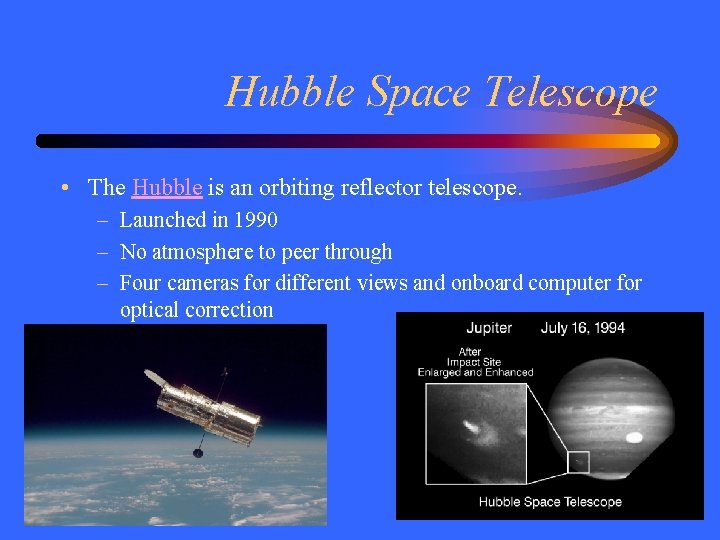
Hubble Space Telescope • The Hubble is an orbiting reflector telescope. – Launched in 1990 – No atmosphere to peer through – Four cameras for different views and onboard computer for optical correction
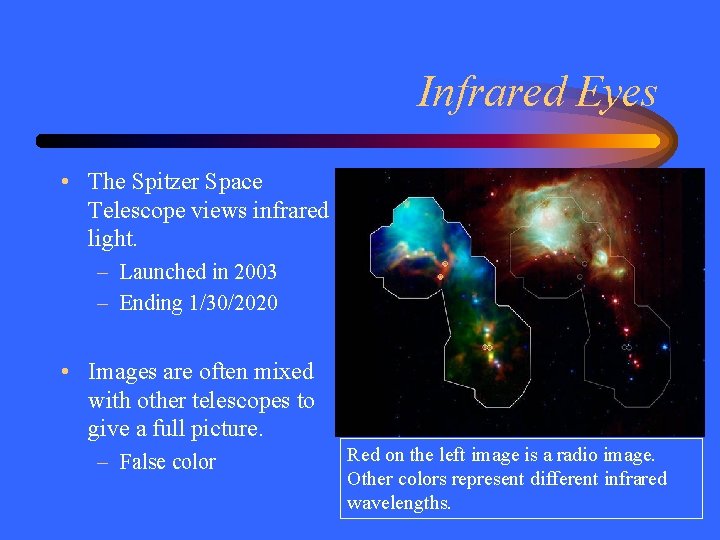
Infrared Eyes • The Spitzer Space Telescope views infrared light. – Launched in 2003 – Ending 1/30/2020 • Images are often mixed with other telescopes to give a full picture. – False color Red on the left image is a radio image. Other colors represent different infrared wavelengths.
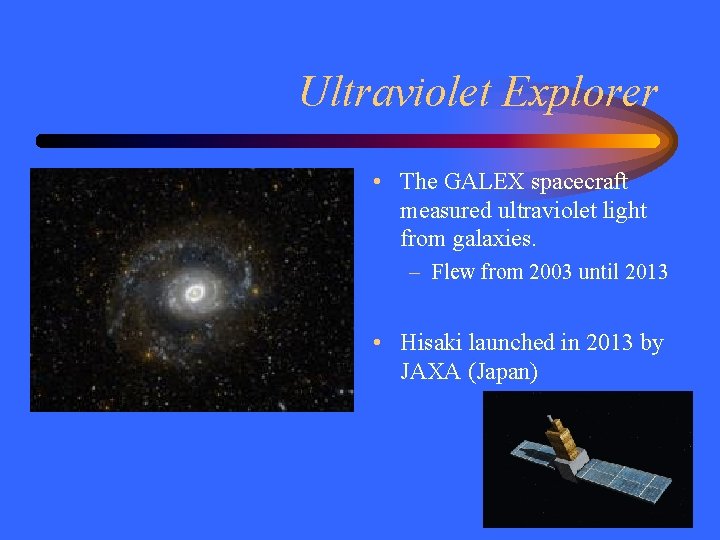
Ultraviolet Explorer • The GALEX spacecraft measured ultraviolet light from galaxies. – Flew from 2003 until 2013 • Hisaki launched in 2013 by JAXA (Japan)
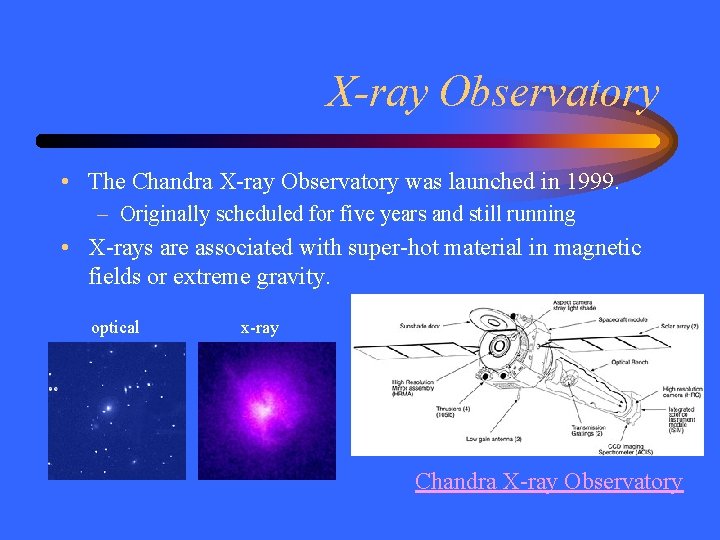
X-ray Observatory • The Chandra X-ray Observatory was launched in 1999. – Originally scheduled for five years and still running • X-rays are associated with super-hot material in magnetic fields or extreme gravity. optical x-ray Chandra X-ray Observatory
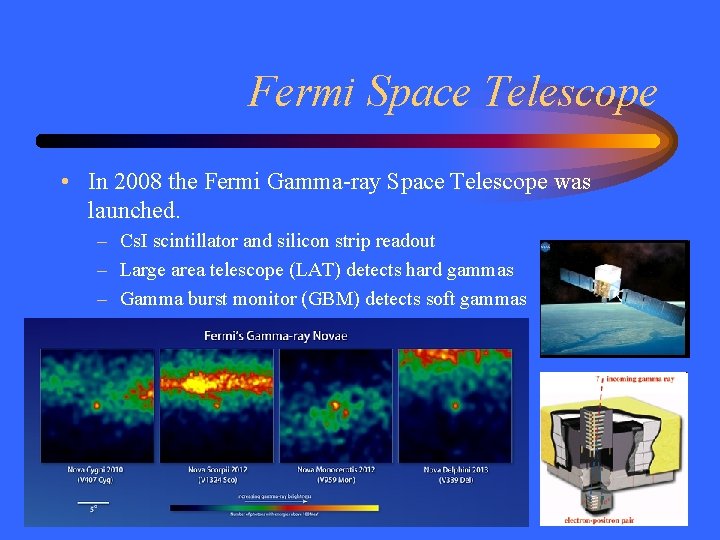
Fermi Space Telescope • In 2008 the Fermi Gamma-ray Space Telescope was launched. – Cs. I scintillator and silicon strip readout – Large area telescope (LAT) detects hard gammas – Gamma burst monitor (GBM) detects soft gammas
- Slides: 11