
SPACE SCIENTISTS What do we already know What
- Slides: 8
SPACE SCIENTISTS
What do we already know? What can you tell me about the seasons on Earth? Can you name them? When are they? How long do they last? How are they different to one another? What causes them? Create a mindmap as a class, considering what we have learned in IPC so far. If you are at home, create your own mindmap on a piece of paper.
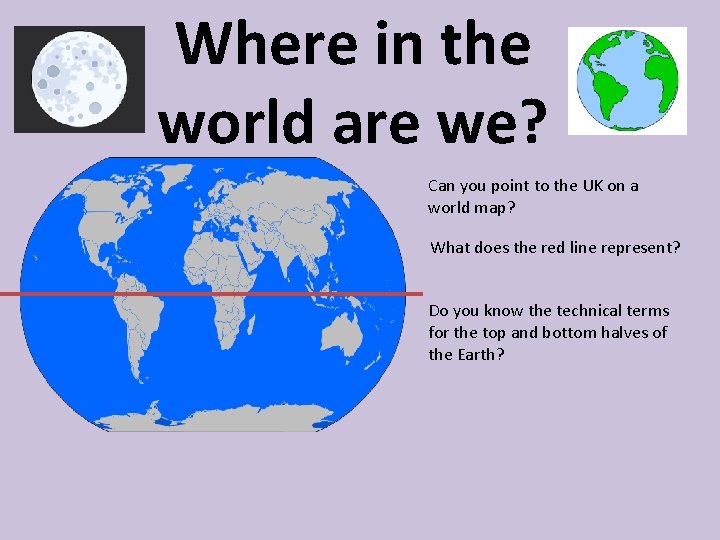
Where in the world are we? Can you point to the UK on a world map? What does the red line represent? Do you know the technical terms for the top and bottom halves of the Earth?
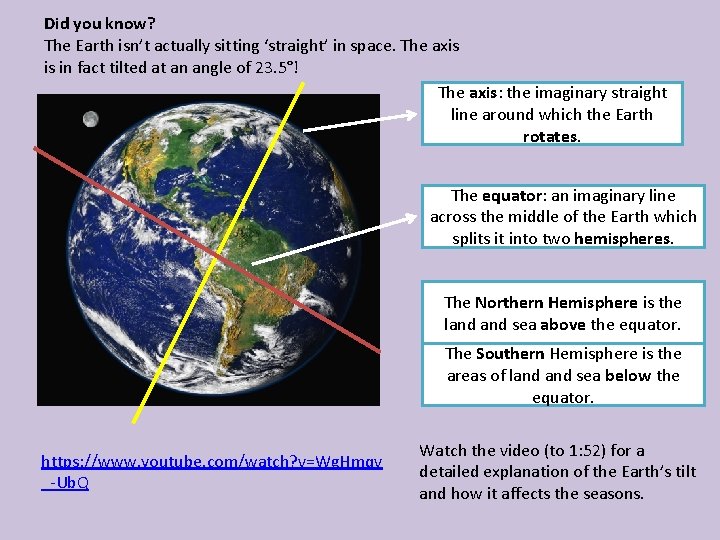
Did you know? The Earth isn’t actually sitting ‘straight’ in space. The axis is in fact tilted at an angle of 23. 5°! The axis: the imaginary straight line around which the Earth rotates. The equator: an imaginary line across the middle of the Earth which splits it into two hemispheres. The Northern Hemisphere is the land sea above the equator. The Southern Hemisphere is the areas of land sea below the equator. https: //www. youtube. com/watch? v=Wg. Hmqv _-Ub. Q Watch the video (to 1: 52) for a detailed explanation of the Earth’s tilt and how it affects the seasons.
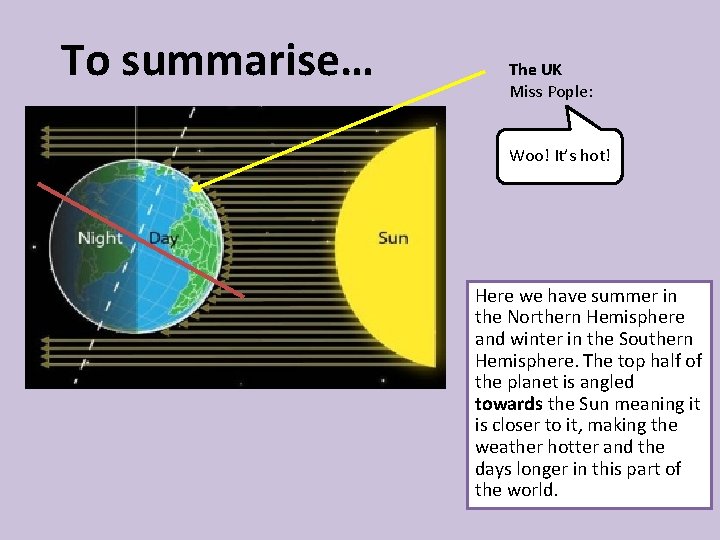
To summarise… The UK Miss Pople: Woo! It’s hot! Here we have summer in the Northern Hemisphere and winter in the Southern Hemisphere. The top half of the planet is angled towards the Sun meaning it is closer to it, making the weather hotter and the days longer in this part of the world.
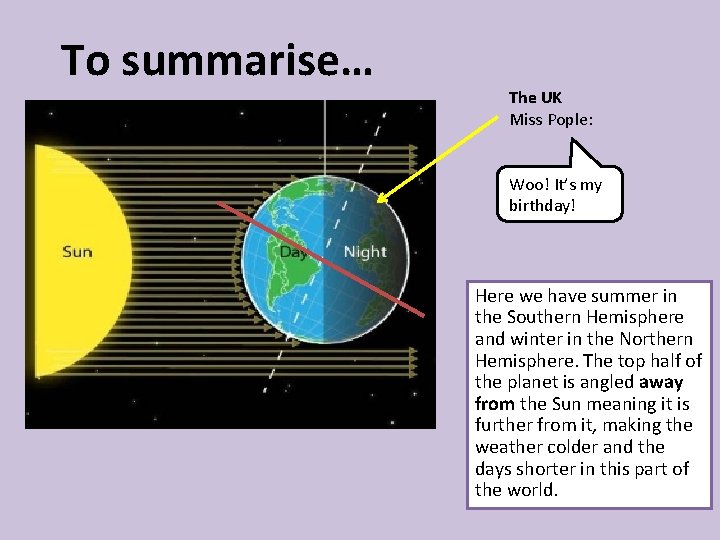
To summarise… The UK Miss Pople: Woo! It’s my birthday! Here we have summer in the Southern Hemisphere and winter in the Northern Hemisphere. The top half of the planet is angled away from the Sun meaning it is further from it, making the weather colder and the days shorter in this part of the world.
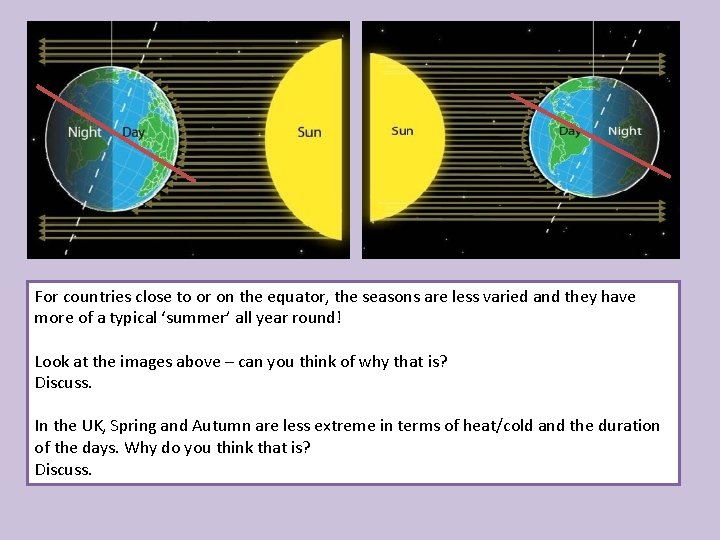
For countries close to or on the equator, the seasons are less varied and they have more of a typical ‘summer’ all year round! Look at the images above – can you think of why that is? Discuss. In the UK, Spring and Autumn are less extreme in terms of heat/cold and the duration of the days. Why do you think that is? Discuss.
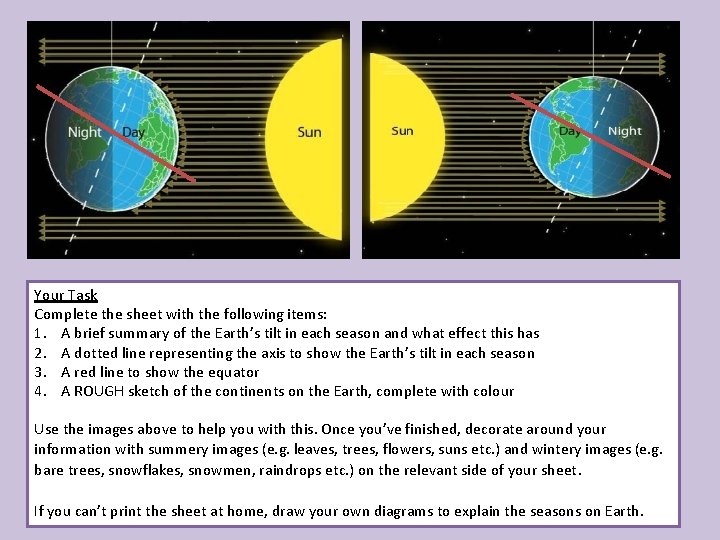
Your Task Complete the sheet with the following items: 1. A brief summary of the Earth’s tilt in each season and what effect this has 2. A dotted line representing the axis to show the Earth’s tilt in each season 3. A red line to show the equator 4. A ROUGH sketch of the continents on the Earth, complete with colour Use the images above to help you with this. Once you’ve finished, decorate around your information with summery images (e. g. leaves, trees, flowers, suns etc. ) and wintery images (e. g. bare trees, snowflakes, snowmen, raindrops etc. ) on the relevant side of your sheet. If you can’t print the sheet at home, draw your own diagrams to explain the seasons on Earth.