
Space Research Centre A REVIEW OF MCP DETECTOR

- Slides: 61
Space Research Centre A REVIEW OF MCP DETECTOR TECHNOLOGIES AND APPLICATIONS Jon Lapington Space Research Centre University of Leicester, UK CERN Detector Seminar, May 2010 1
Summary Microchannel plate (MCP) heritage MCP manufacture MCP fundamentals Design and construction Operational characteristics Image Readout Devices MCP Detector Applications MCP and related Developments Conclusions 2
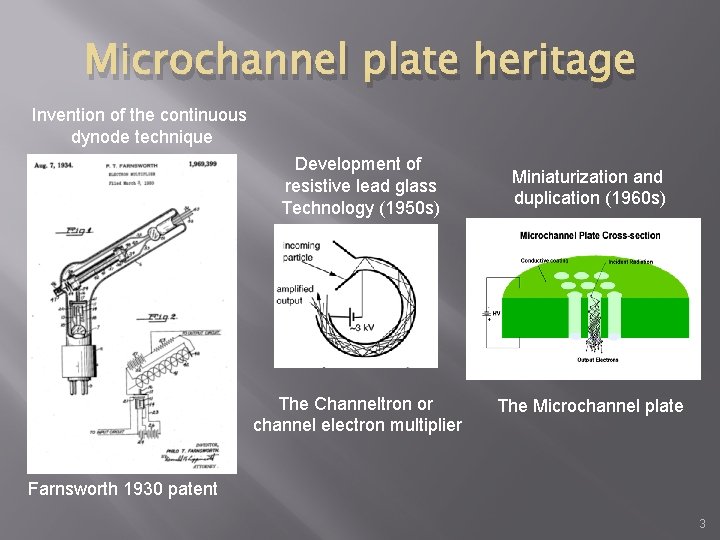
Microchannel plate heritage Invention of the continuous dynode technique Development of resistive lead glass Technology (1950 s) Miniaturization and duplication (1960 s) The Channeltron or channel electron multiplier The Microchannel plate Farnsworth 1930 patent 3
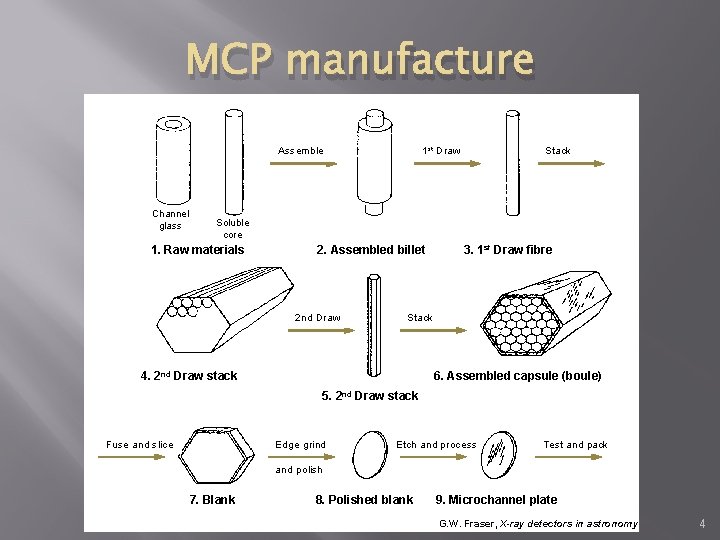
MCP manufacture Assemble Channel glass 1 st Draw Stack Soluble core 1. Raw materials 2. Assembled billet 2 nd Draw 3. 1 st Draw fibre Stack 4. 2 nd Draw stack 6. Assembled capsule (boule) 5. 2 nd Draw stack Fuse and slice Edge grind Etch and process Test and pack and polish 7. Blank 8. Polished blank 9. Microchannel plate G. W. Fraser, X-ray detectors in astronomy 4
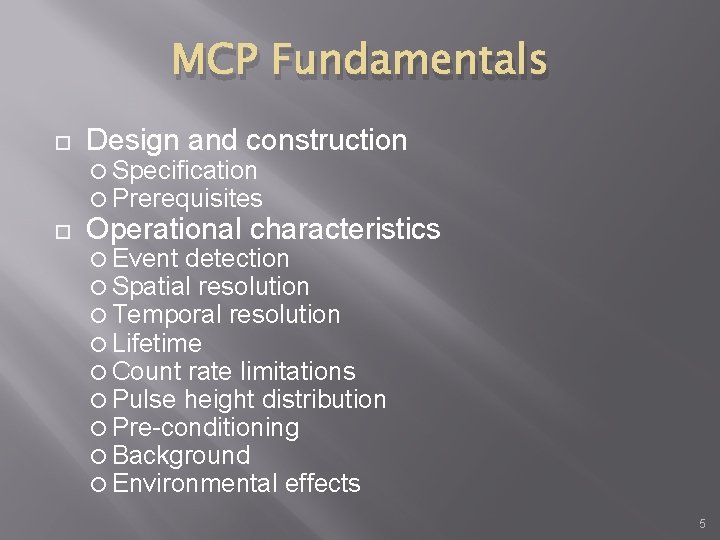
MCP Fundamentals Design and construction Specification Prerequisites Operational characteristics Event detection Spatial resolution Temporal resolution Lifetime Count rate limitations Pulse height distribution Pre-conditioning Background Environmental effects 5
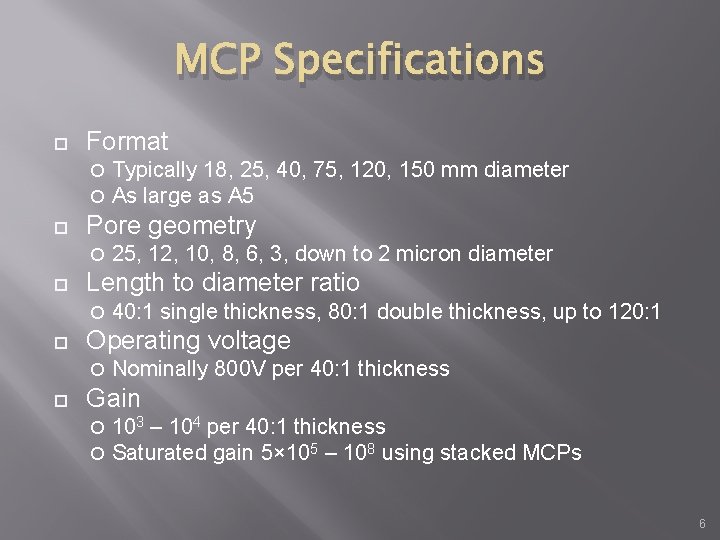
MCP Specifications Format Pore geometry 40: 1 single thickness, 80: 1 double thickness, up to 120: 1 Operating voltage 25, 12, 10, 8, 6, 3, down to 2 micron diameter Length to diameter ratio Typically 18, 25, 40, 75, 120, 150 mm diameter As large as A 5 Nominally 800 V per 40: 1 thickness Gain 103 – 104 per 40: 1 thickness Saturated gain 5× 10⁵ – 108 using stacked MCPs 6
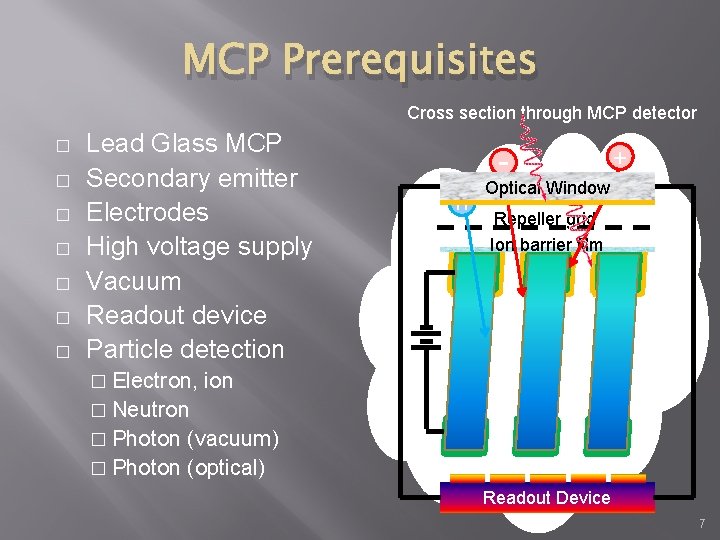
MCP Prerequisites Cross section through MCP detector � � � � Lead Glass MCP Secondary emitter Electrodes High voltage supply Vacuum Readout device Particle detection � Electron, - n + Optical Window Repeller grid Ion barrier film ion � Neutron � Photon (vacuum) � Photon (optical) Readout Device 7
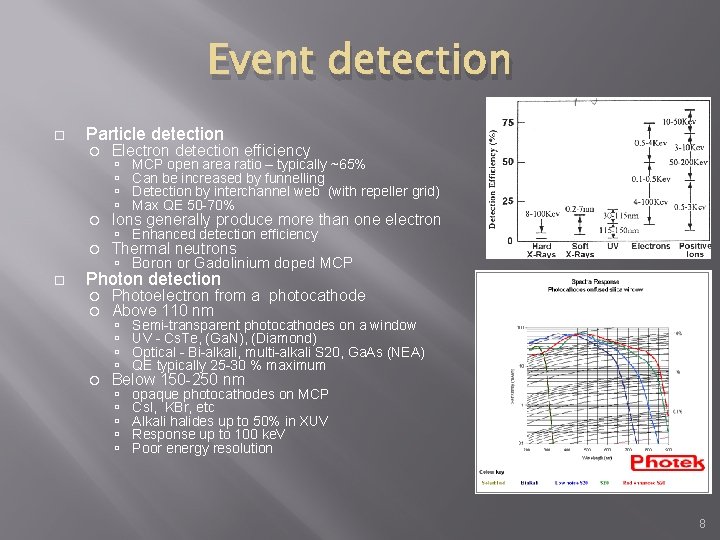
Event detection Particle detection Electron detection efficiency Ions generally produce more than one electron Thermal neutrons MCP open area ratio – typically ~65% Can be increased by funnelling Detection by interchannel web (with repeller grid) Max QE 50 -70% Enhanced detection efficiency Boron or Gadolinium doped MCP Photon detection Photoelectron from a photocathode Above 110 nm Below 150 -250 nm Semi-transparent photocathodes on a window UV - Cs. Te, (Ga. N), (Diamond) Optical - Bi-alkali, multi-alkali S 20, Ga. As (NEA) QE typically 25 -30 % maximum opaque photocathodes on MCP Cs. I, KBr, etc Alkali halides up to 50% in XUV Response up to 100 ke. V Poor energy resolution 8
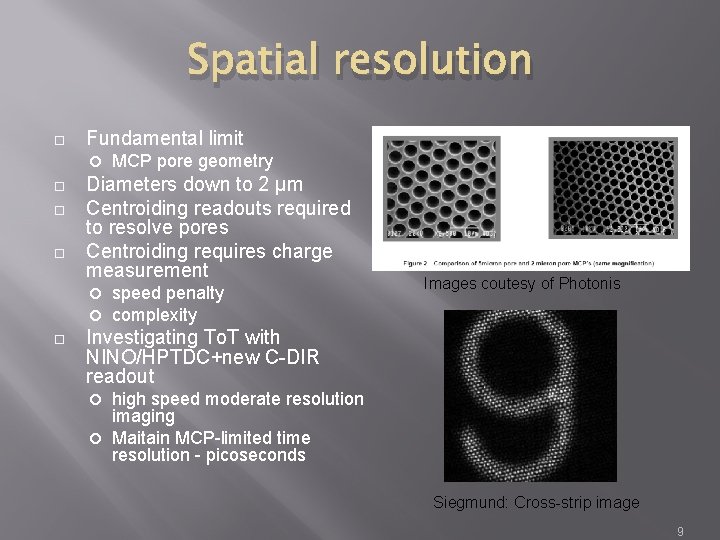
Spatial resolution Fundamental limit Diameters down to 2 µm Centroiding readouts required to resolve pores Centroiding requires charge measurement MCP pore geometry speed penalty complexity Images coutesy of Photonis Investigating To. T with NINO/HPTDC+new C-DIR readout high speed moderate resolution imaging Maitain MCP-limited time resolution - picoseconds Siegmund: Cross-strip image 9
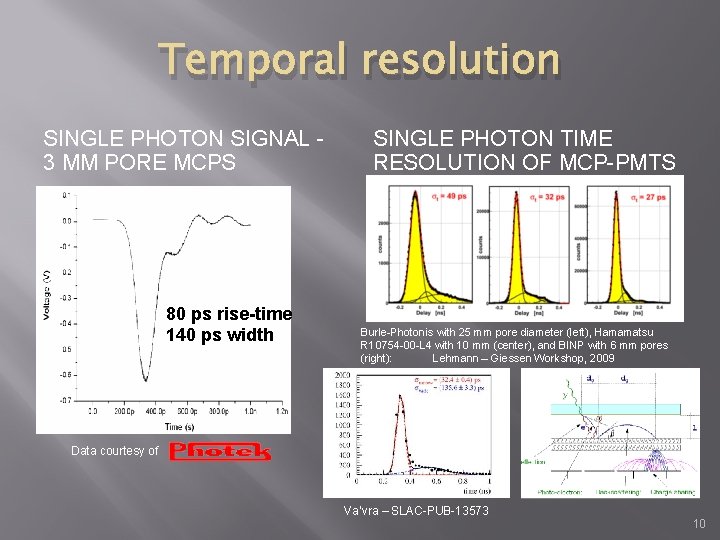
Temporal resolution SINGLE PHOTON SIGNAL 3 ΜM PORE MCPS 80 ps rise-time 140 ps width SINGLE PHOTON TIME RESOLUTION OF MCP-PMTS Burle-Photonis with 25 mm pore diameter (left), Hamamatsu R 10754 -00 -L 4 with 10 mm (center), and BINP with 6 mm pores (right): Lehmann – Giessen Workshop, 2009 Data courtesy of Va’vra – SLAC-PUB-13573 10
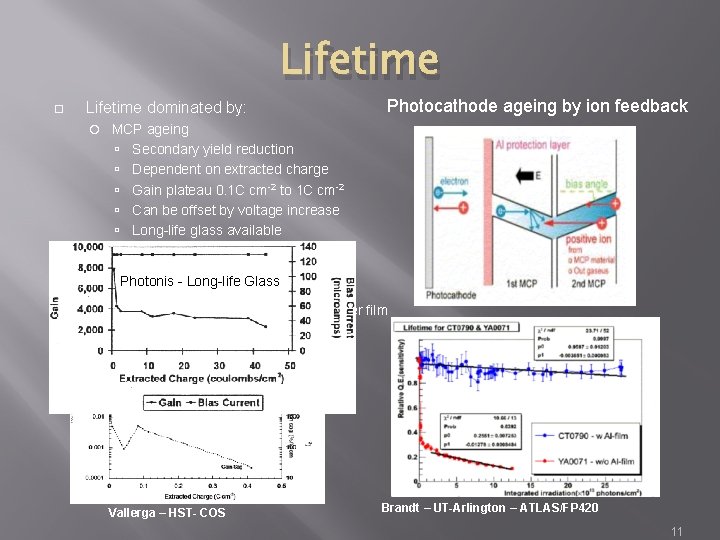
Lifetime dominated by: Photocathode ageing by ion feedback MCP ageing Secondary yield reduction Dependent on extracted charge Gain plateau 0. 1 C cm-2 to 1 C cm-2 Can be offset by voltage increase Long-life glass available Photocathode damage Caused by ion feedback Photonis - Long-life Glass Increases with gain Reduced by pore bias and ion barrier film Vallerga – HST- COS Brandt – UT-Arlington – ATLAS/FP 420 11
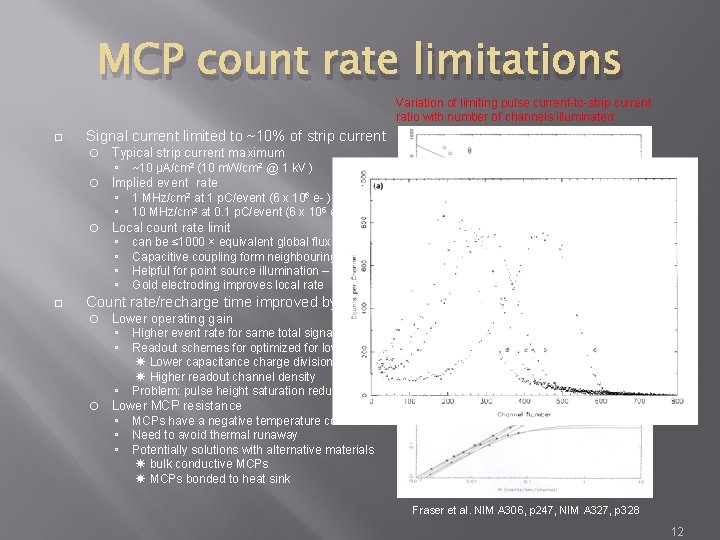
MCP count rate limitations Variation of limiting pulse current-to-strip current ratio with number of channels illuminated Signal current limited to ~10% of strip current Typical strip current maximum Implied event rate 1 MHz/cm 2 at 1 p. C/event (6 x 10⁶ e- ) 10 MHz/cm 2 at 0. 1 p. C/event (6 x 10⁵ e- ) Local count rate limit ~10 µA/cm 2 (10 m. W/cm 2 @ 1 k. V ) can be ≤ 1000 × equivalent global flux Capacitive coupling form neighbouring area Helpful for point source illumination – star fields Gold electroding improves local rate Count rate/recharge time improved by : Lower operating gain Isig/Istrip versus number of counts per channel for different illumination areas Higher event rate for same total signal Readout schemes for optimized for low gain Lower capacitance charge division readout. Recent data: Lehmann, Workshop on Fast Cherenkov Higher readout channel density Detectors, Giessen, 2009 Problem: pulse height saturation reduced Lower MCP resistance MCPs have a negative temperature coefficient Need to avoid thermal runaway Potentially solutions with alternative materials bulk conductive MCPs bonded to heat sink Fraser et al. NIM A 306, p 247, NIM A 327, p 328 12
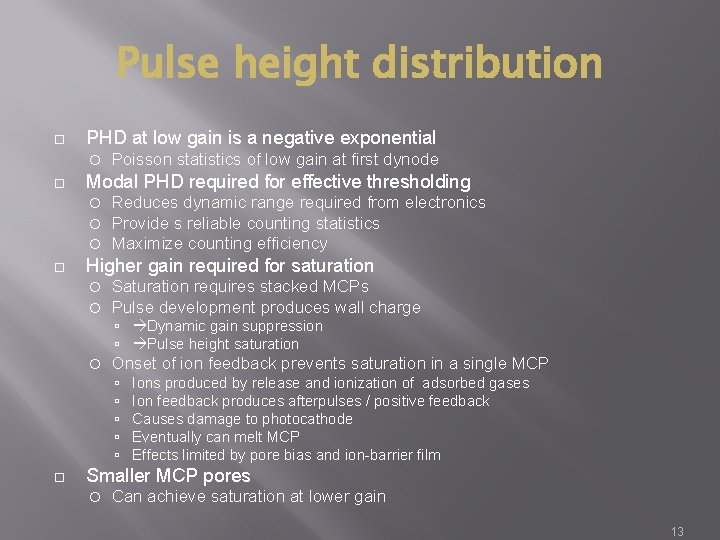
Pulse height distribution PHD at low gain is a negative exponential Modal PHD required for effective thresholding Poisson statistics of low gain at first dynode Reduces dynamic range required from electronics Provide s reliable counting statistics Maximize counting efficiency Higher gain required for saturation Saturation requires stacked MCPs Pulse development produces wall charge Dynamic gain suppression Pulse height saturation Onset of ion feedback prevents saturation in a single MCP Ions produced by release and ionization of adsorbed gases Ion feedback produces afterpulses / positive feedback Causes damage to photocathode Eventually can melt MCP Effects limited by pore bias and ion-barrier film Smaller MCP pores Can achieve saturation at lower gain 13
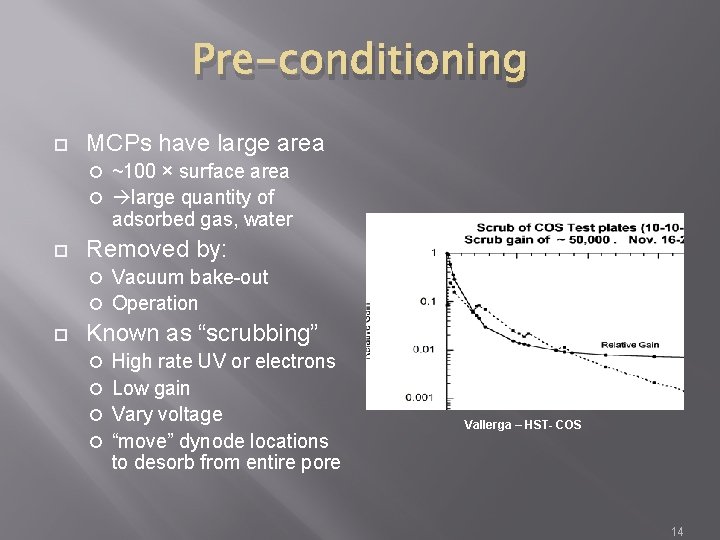
Pre-conditioning MCPs have large area ~100 × surface area large quantity of adsorbed gas, water Removed by: Vacuum bake-out Operation Known as “scrubbing” High rate UV or electrons Low gain Vary voltage “move” dynode locations to desorb from entire pore Vallerga – HST- COS 14
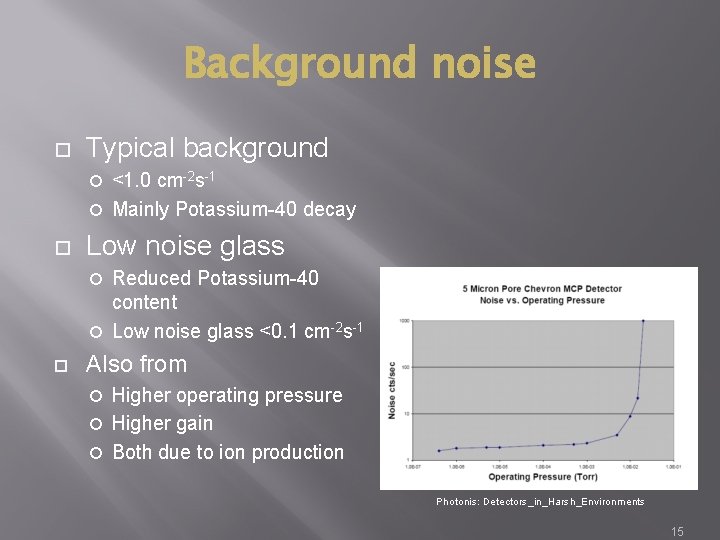
Background noise Typical background <1. 0 cm-2 s-1 Mainly Potassium-40 decay Low noise glass Reduced Potassium-40 content Low noise glass <0. 1 cm-2 s-1 Photonis product literature Also from Higher operating pressure Higher gain Both due to ion production Photonis: Detectors_in_Harsh_Environments 15
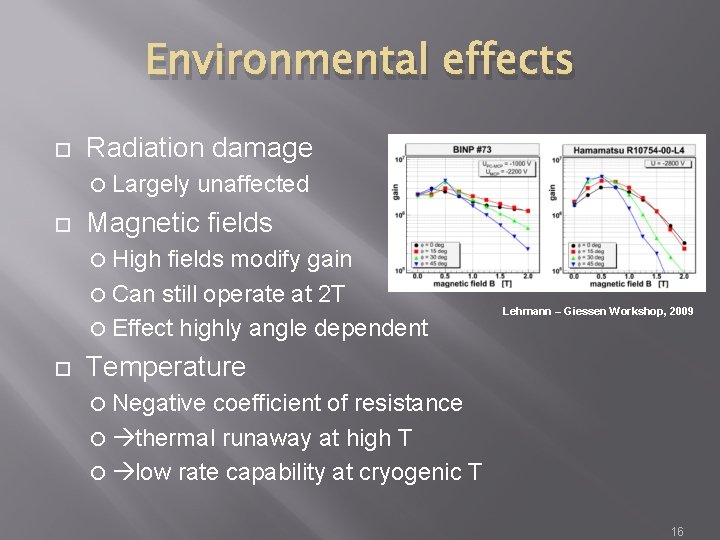
Environmental effects Radiation damage Largely unaffected Magnetic fields High fields modify gain Can still operate at 2 T Effect highly angle dependent Lehmann – Giessen Workshop, 2009 Temperature Negative coefficient of resistance thermal runaway at high T low rate capability at cryogenic T 16
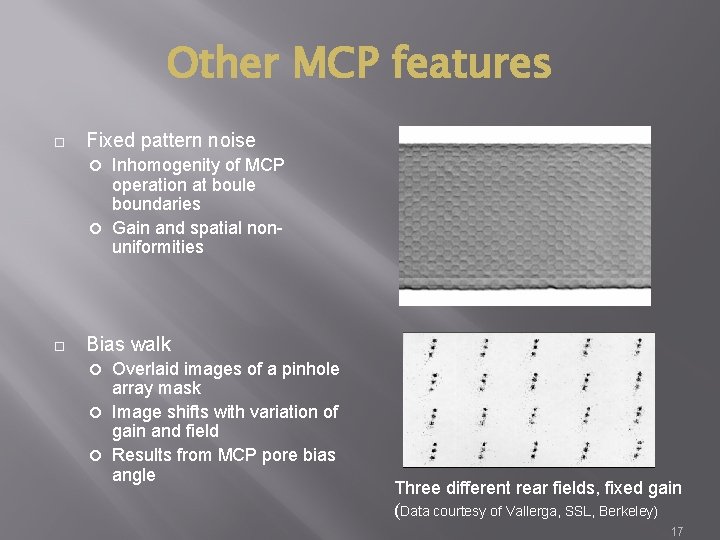
Other MCP features Fixed pattern noise Inhomogenity of MCP operation at boule boundaries Gain and spatial nonuniformities Bias walk Overlaid images of a pinhole array mask Image shifts with variation of gain and field Results from MCP pore bias angle Three different rear fields, fixed gain (Data courtesy of Vallerga, SSL, Berkeley) 17
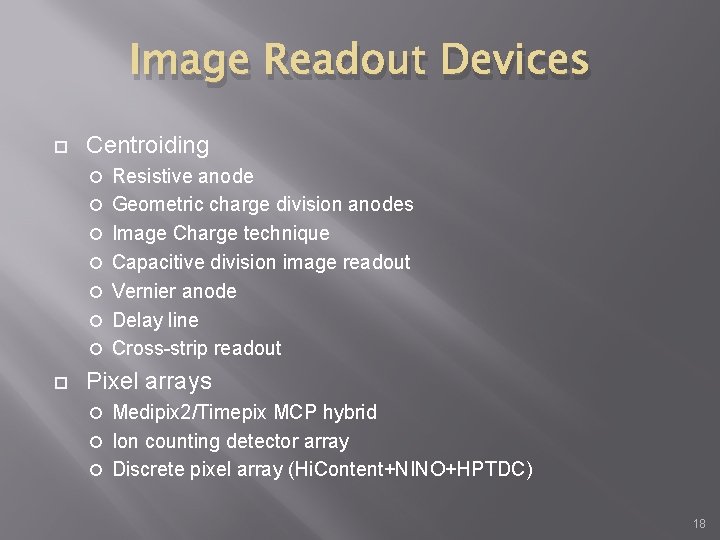
Image Readout Devices Centroiding Resistive anode Geometric charge division anodes Image Charge technique Capacitive division image readout Vernier anode Delay line Cross-strip readout Pixel arrays Medipix 2/Timepix MCP hybrid Ion counting detector array Discrete pixel array (Hi. Content+NINO+HPTDC) 18
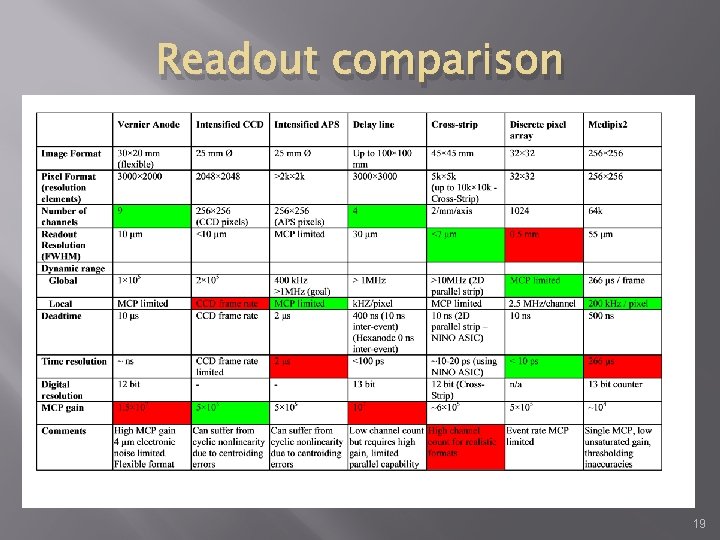
Readout comparison 19
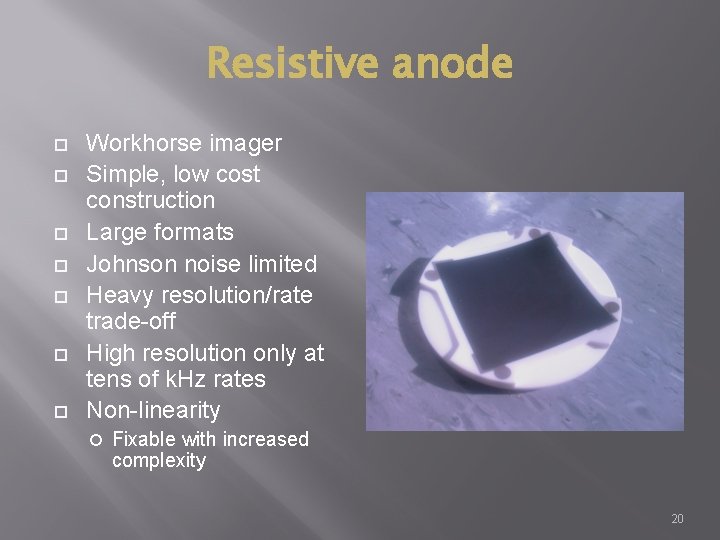
Resistive anode Workhorse imager Simple, low cost construction Large formats Johnson noise limited Heavy resolution/rate trade-off High resolution only at tens of k. Hz rates Non-linearity Fixable with increased complexity 20
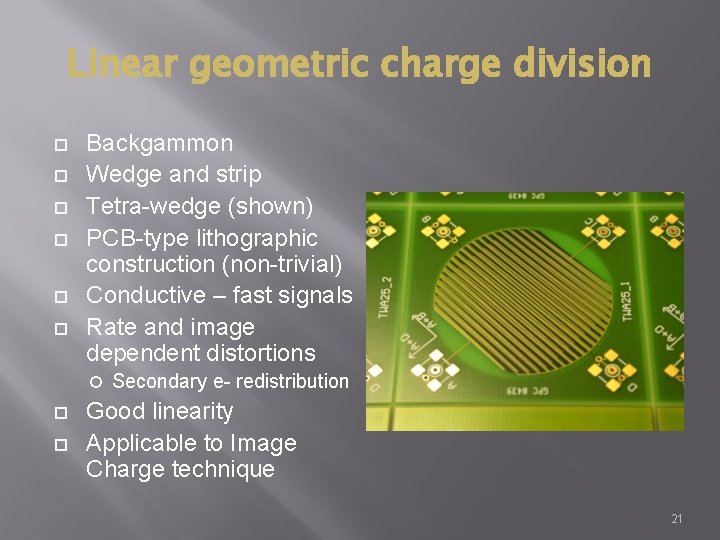
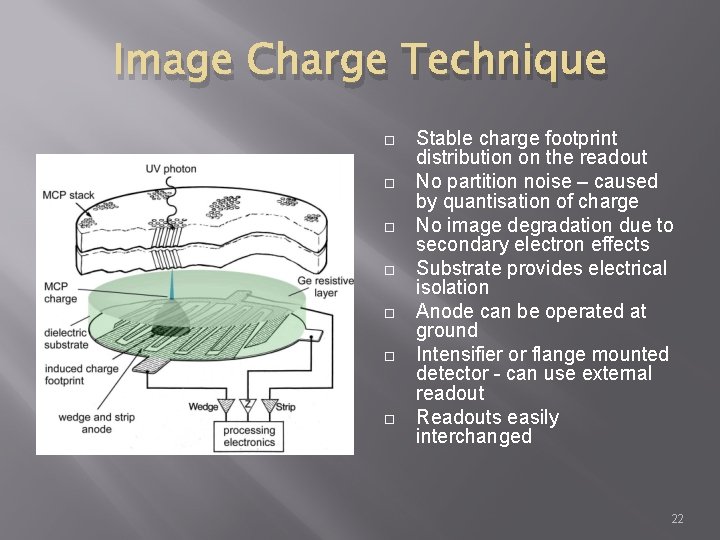
Linear geometric charge division Backgammon Wedge and strip Tetra-wedge (shown) PCB-type lithographic construction (non-trivial) Conductive – fast signals Rate and image dependent distortions Secondary e- redistribution Good linearity Applicable to Image Charge technique 21
Image Charge Technique Stable charge footprint distribution on the readout No partition noise – caused by quantisation of charge No image degradation due to secondary electron effects Substrate provides electrical isolation Anode can be operated at ground Intensifier or flange mounted detector - can use external readout Readouts easily interchanged 22
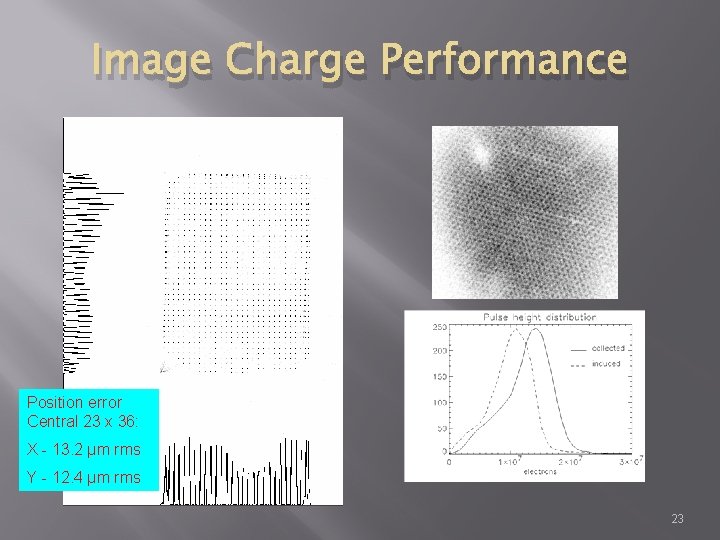
Image Charge Performance Position error Central 23 x 36: X - 13. 2 µm rms Y - 12. 4 µm rms 23
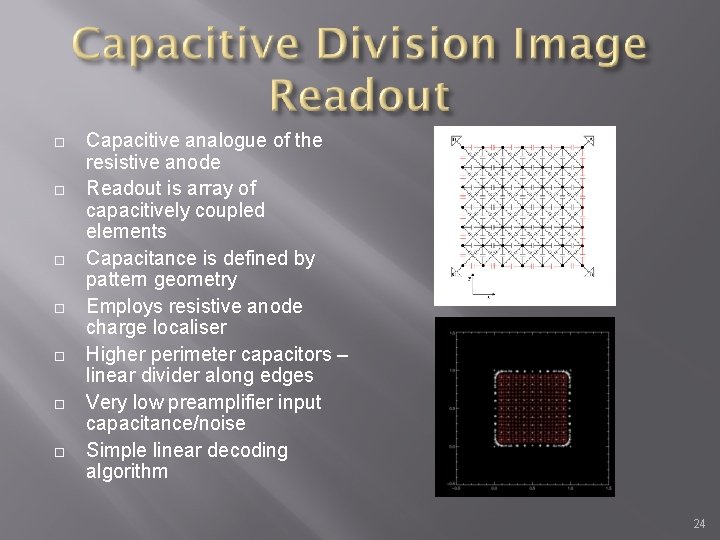
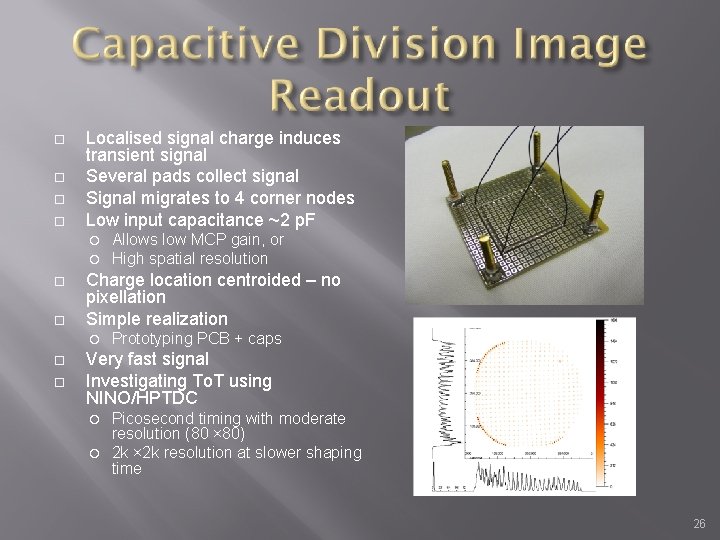
Capacitive analogue of the resistive anode Readout is array of capacitively coupled elements Capacitance is defined by pattern geometry Employs resistive anode charge localiser Higher perimeter capacitors – linear divider along edges Very low preamplifier input capacitance/noise Simple linear decoding algorithm 24
25
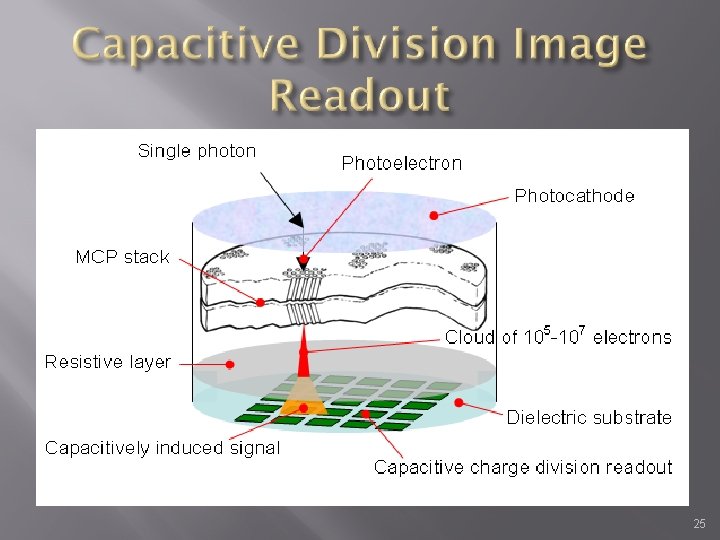
Localised signal charge induces transient signal Several pads collect signal Signal migrates to 4 corner nodes Low input capacitance ~2 p. F Charge location centroided – no pixellation Simple realization Allows low MCP gain, or High spatial resolution Prototyping PCB + caps Very fast signal Investigating To. T using NINO/HPTDC Picosecond timing with moderate resolution (80 × 80) 2 k × 2 k resolution at slower shaping time 26
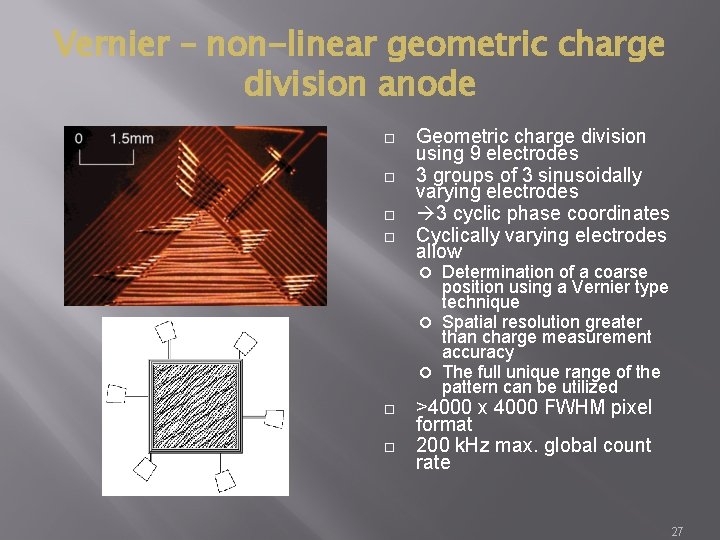
Vernier – non-linear geometric charge division anode Geometric charge division using 9 electrodes 3 groups of 3 sinusoidally varying electrodes 3 cyclic phase coordinates Cyclically varying electrodes allow Determination of a coarse position using a Vernier type technique Spatial resolution greater than charge measurement accuracy The full unique range of the pattern can be utilized >4000 x 4000 FWHM pixel format 200 k. Hz max. global count rate 27
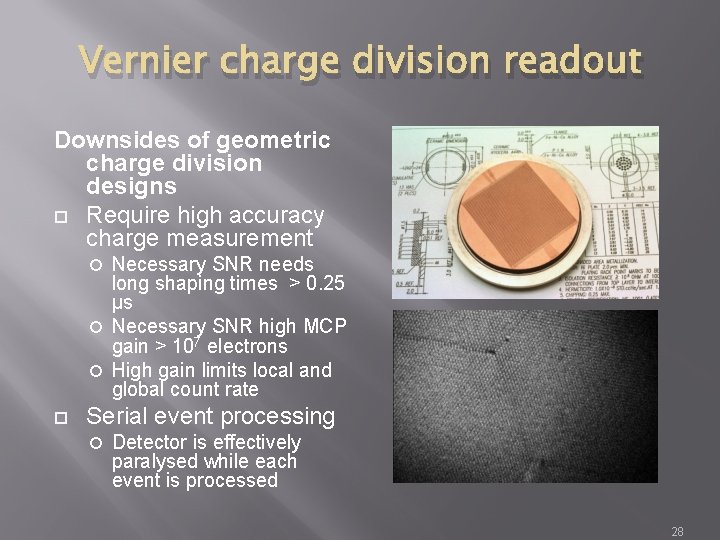
Vernier charge division readout Downsides of geometric charge division designs Require high accuracy charge measurement Necessary SNR needs long shaping times > 0. 25 µs Necessary SNR high MCP gain > 107 electrons High gain limits local and global count rate Serial event processing Detector is effectively paralysed while each event is processed 28
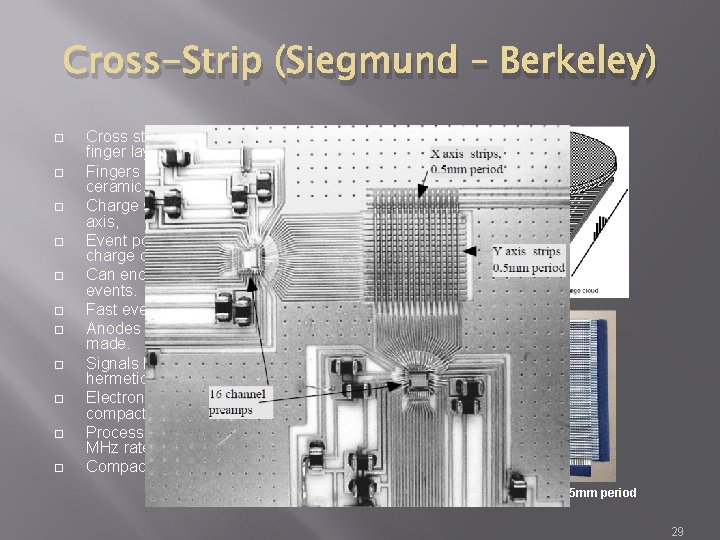
Cross-Strip (Siegmund – Berkeley) Cross strip is a multi-layer cross finger layout. Fingers have ~0. 5 mm period on ceramic. Charge spread over 3 -5 strips per axis, Event position is derived from charge centroid. Can encode multiple simultaneous events. Fast event propagation (few ns). Anodes up to 45 x 45 mm have been made. Signals brought to backside by hermetic vias Electronic packaging can be compact Processing speed should support >> MHz rates Compact and robust (700°C). 32 mm x 32 mm XS anode, 0. 5 mm period 29
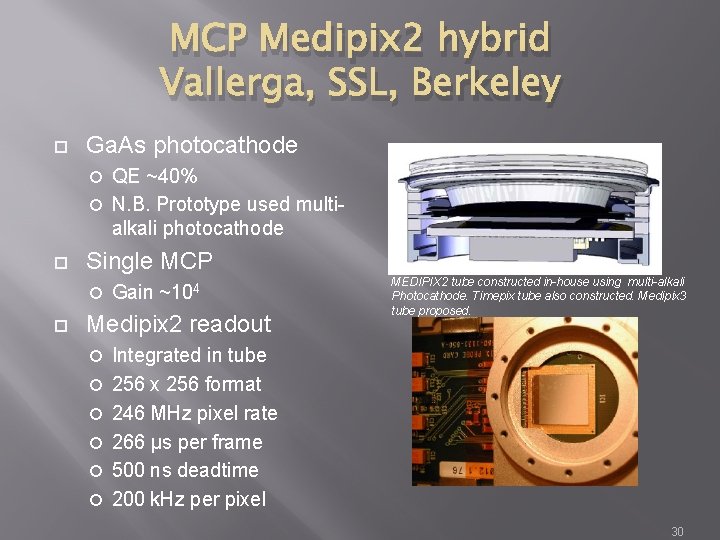
MCP Medipix 2 hybrid Vallerga, SSL, Berkeley Ga. As photocathode QE ~40% N. B. Prototype used multialkali photocathode Single MCP Gain ~104 Medipix 2 readout MEDIPIX 2 tube constructed in-house using multi-alkali Photocathode. Timepix tube also constructed. Medipix 3 tube proposed. Integrated in tube 256 x 256 format 246 MHz pixel rate 266 µs per frame 500 ns deadtime 200 k. Hz per pixel 30
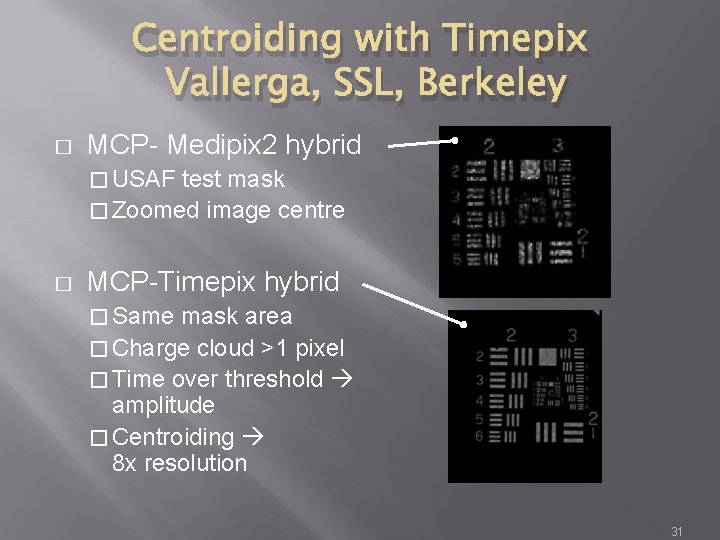
Centroiding with Timepix Vallerga, SSL, Berkeley � MCP- Medipix 2 hybrid � USAF test mask � Zoomed image centre � MCP-Timepix hybrid � Same mask area � Charge cloud >1 pixel � Time over threshold amplitude � Centroiding 8 x resolution 31
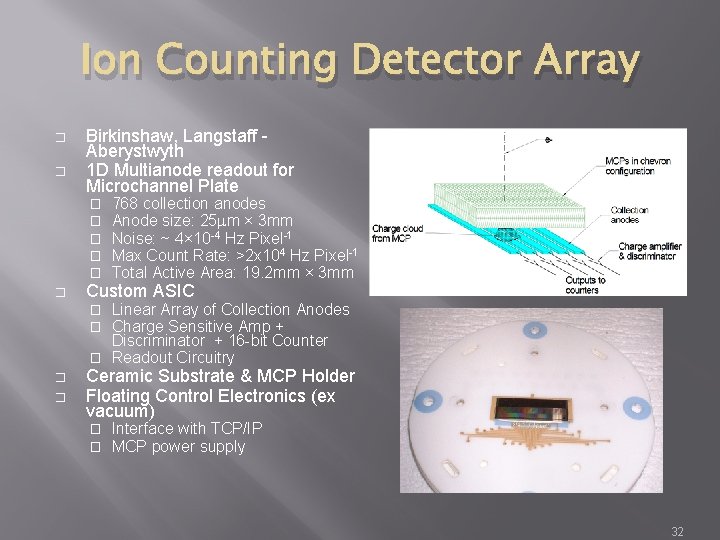
Ion Counting Detector Array � � Birkinshaw, Langstaff Aberystwyth 1 D Multianode readout for Microchannel Plate � � � 768 collection anodes Anode size: 25 mm × 3 mm Noise: ~ 4× 10 -4 Hz Pixel-1 Max Count Rate: >2 x 10⁴ Hz Pixel-1 Total Active Area: 19. 2 mm × 3 mm Custom ASIC Linear Array of Collection Anodes Charge Sensitive Amp + Discriminator + 16 -bit Counter � Readout Circuitry � � Ceramic Substrate & MCP Holder Floating Control Electronics (ex vacuum) � � Interface with TCP/IP MCP power supply 32
MCP Detector Applications Space science Life sciences UV imaging and spectroscopyastronomy, planetary science Ion and electron analysers – magnetospheric studies Time resolved spectroscopy – FLIM, FRET, FCS Optical Diffusion Tomography Luminescence/Phosphor escence Atmospheric chemistry, environment 33
"Hi. Content“ & “IRPICS” - a family of detectors designed specifically for life science applications Detector attributes • Multi-channel / imaging • Photon counting • Time resolved • High throughput • Miniaturized electronics • Flexible, multi-purpose • Commercial product 34
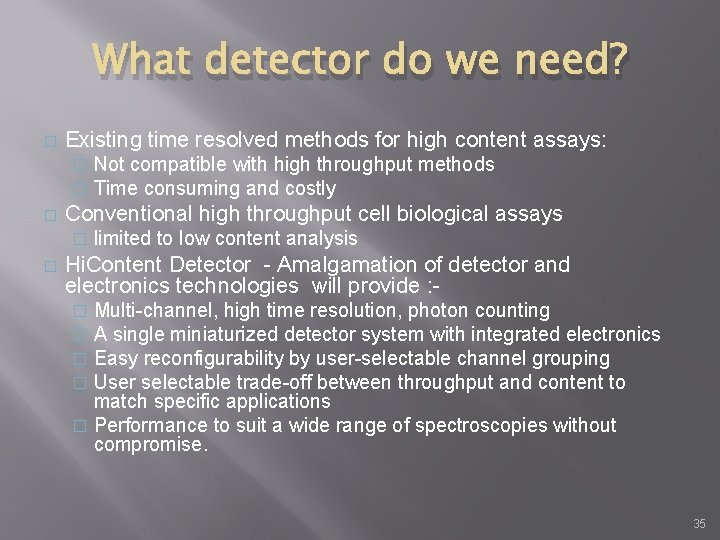
What detector do we need? � Existing time resolved methods for high content assays: � � � Conventional high throughput cell biological assays � � Not compatible with high throughput methods Time consuming and costly limited to low content analysis Hi. Content Detector - Amalgamation of detector and electronics technologies will provide : Multi-channel, high time resolution, photon counting A single miniaturized detector system with integrated electronics Easy reconfigurability by user-selectable channel grouping User selectable trade-off between throughput and content to match specific applications � Performance to suit a wide range of spectroscopies without compromise. � � 35
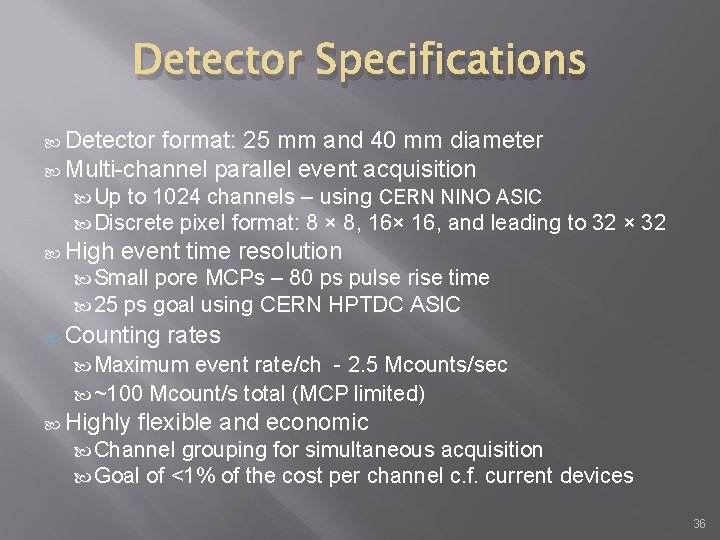
Detector Specifications Detector format: 25 mm and 40 mm diameter Multi-channel parallel event acquisition Up to 1024 channels – using CERN NINO ASIC Discrete pixel format: 8 × 8, 16× 16, and leading High to 32 × 32 event time resolution Small pore MCPs – 80 ps pulse rise time 25 ps goal using CERN HPTDC ASIC Counting rates Maximum event rate/ch - 2. 5 Mcounts/sec ~100 Mcount/s total (MCP limited) Highly flexible and economic Channel grouping for simultaneous acquisition Goal of <1% of the cost per channel c. f. current devices 36
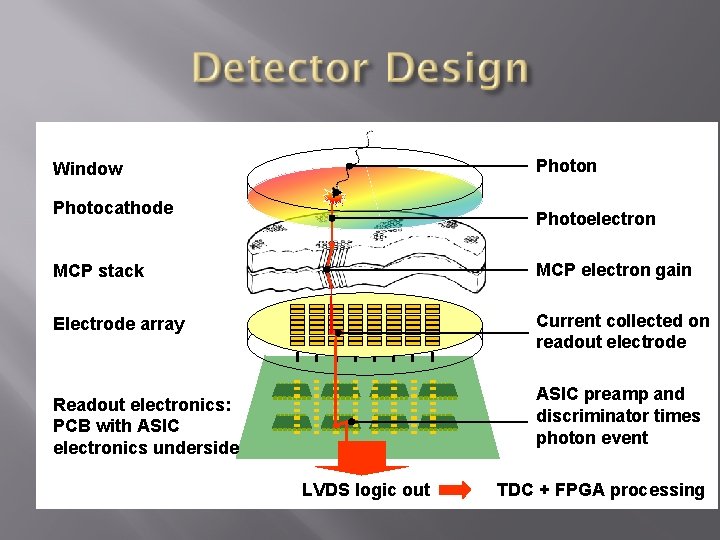
Photon Window Photocathode Photoelectron MCP stack MCP electron gain Electrode array Current collected on readout electrode ASIC preamp and discriminator times photon event Readout electronics: PCB with ASIC electronics underside LVDS logic out TDC + FPGA processing
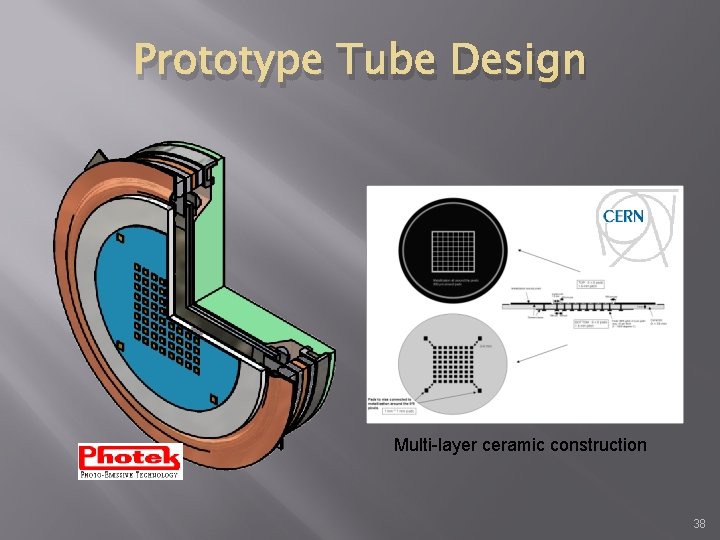
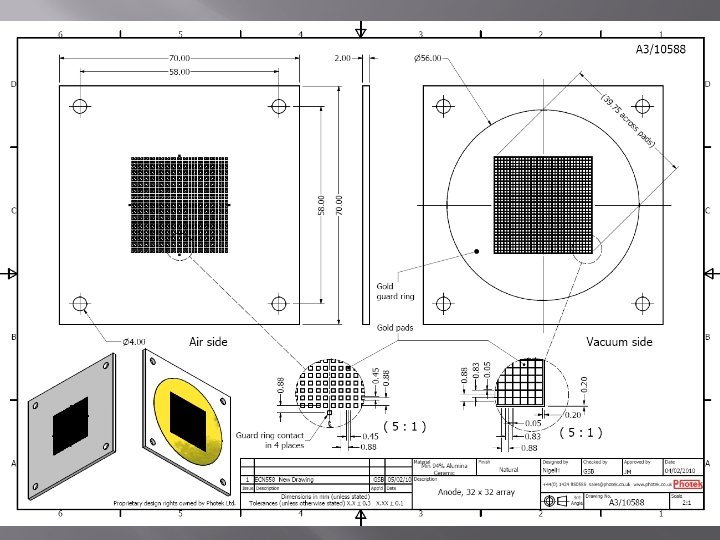
Prototype Tube Design Multi-layer ceramic construction 38
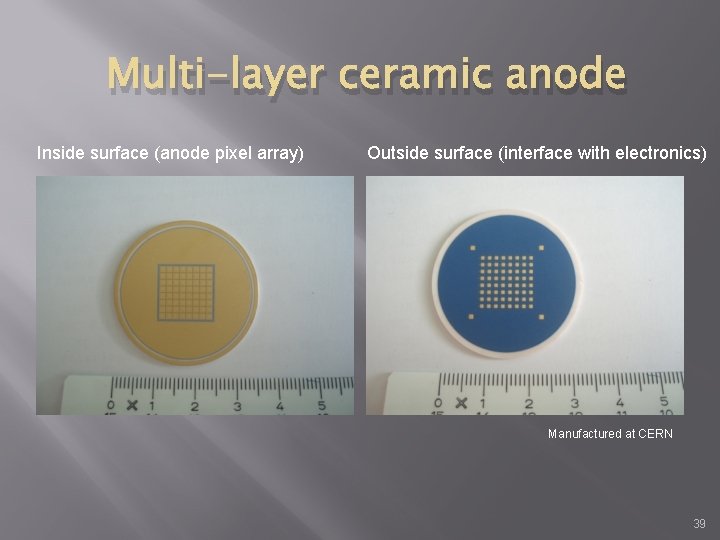
Multi-layer ceramic anode Inside surface (anode pixel array) Outside surface (interface with electronics) Manufactured at CERN 39
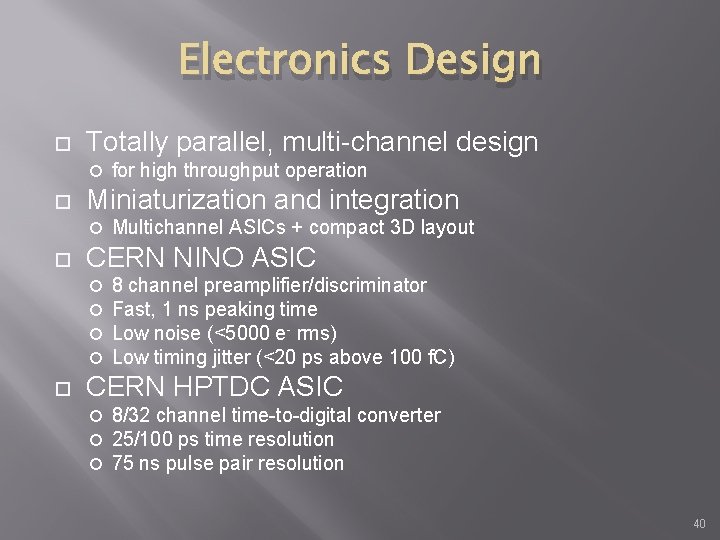
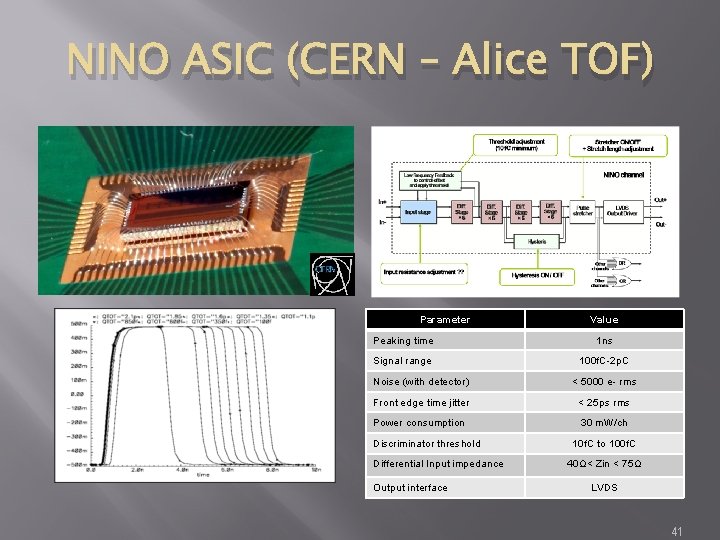
Electronics Design Totally parallel, multi-channel design Miniaturization and integration Multichannel ASICs + compact 3 D layout CERN NINO ASIC for high throughput operation 8 channel preamplifier/discriminator Fast, 1 ns peaking time Low noise (<5000 e- rms) Low timing jitter (<20 ps above 100 f. C) CERN HPTDC ASIC 8/32 channel time-to-digital converter 25/100 ps time resolution 75 ns pulse pair resolution 40
NINO ASIC (CERN – Alice TOF) Parameter Value Peaking time 1 ns Signal range 100 f. C-2 p. C Noise (with detector) < 5000 e- rms Front edge time jitter < 25 ps rms Power consumption 30 m. W/ch Discriminator threshold Differential Input impedance Output interface 10 f. C to 100 f. C 40Ω< Zin < 75Ω LVDS 41
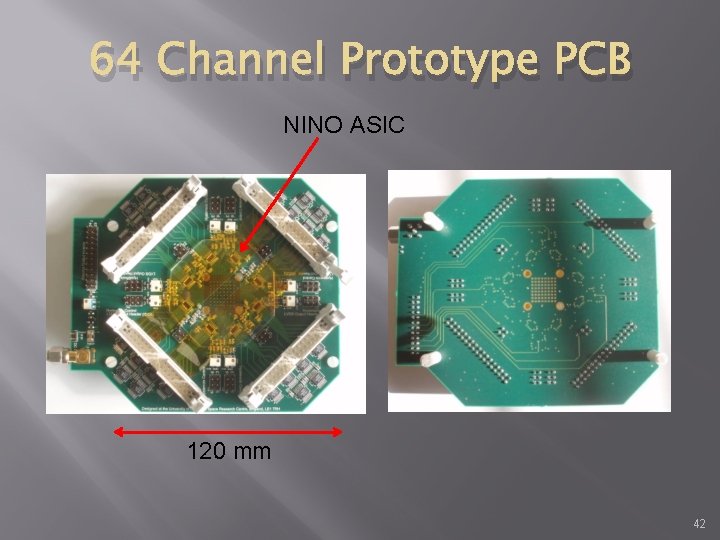
64 Channel Prototype PCB NINO ASIC 120 mm 42
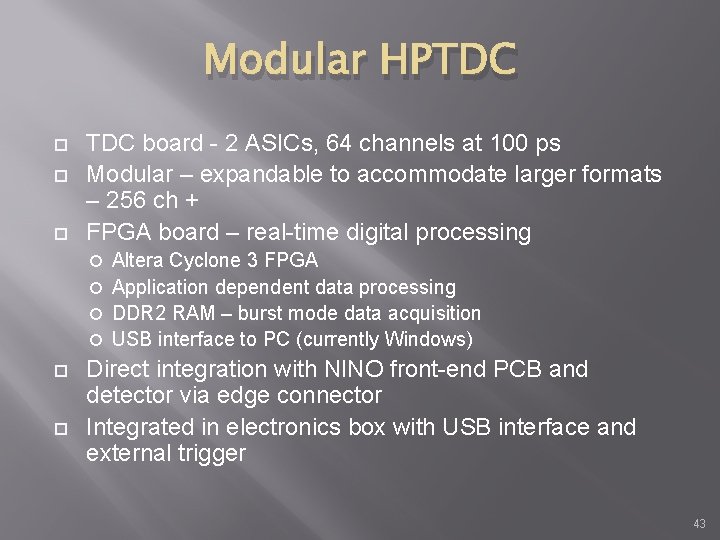
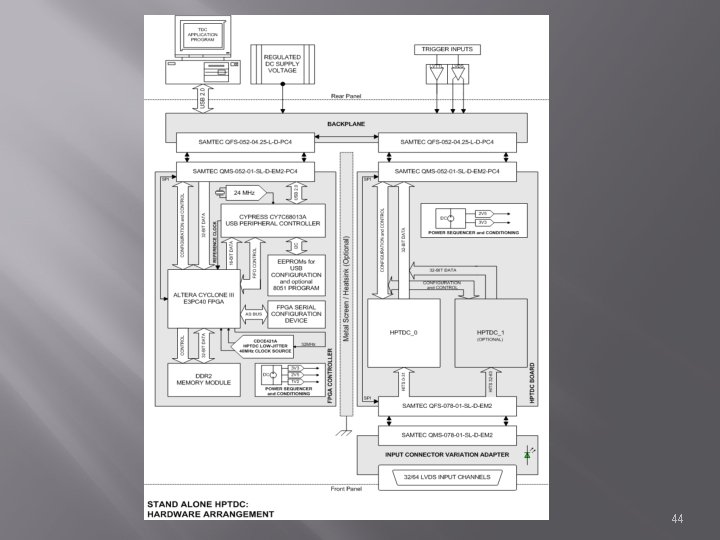
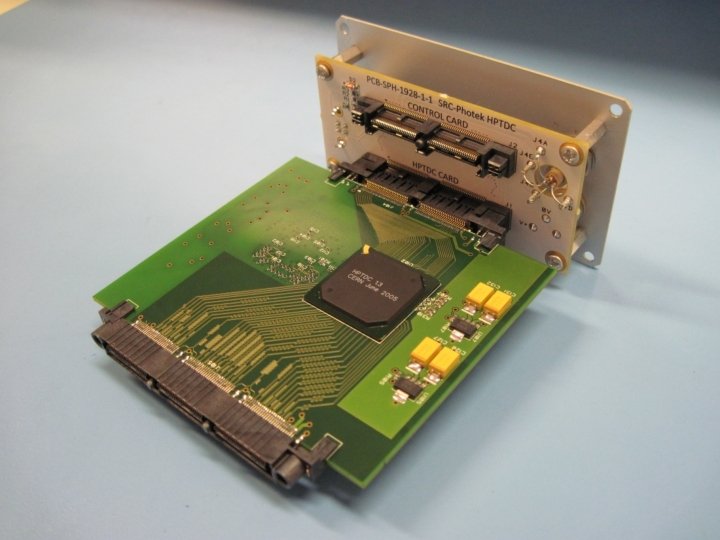
Modular HPTDC board - 2 ASICs, 64 channels at 100 ps Modular – expandable to accommodate larger formats – 256 ch + FPGA board – real-time digital processing Altera Cyclone 3 FPGA Application dependent data processing DDR 2 RAM – burst mode data acquisition USB interface to PC (currently Windows) Direct integration with NINO front-end PCB and detector via edge connector Integrated in electronics box with USB interface and external trigger 43
44
45
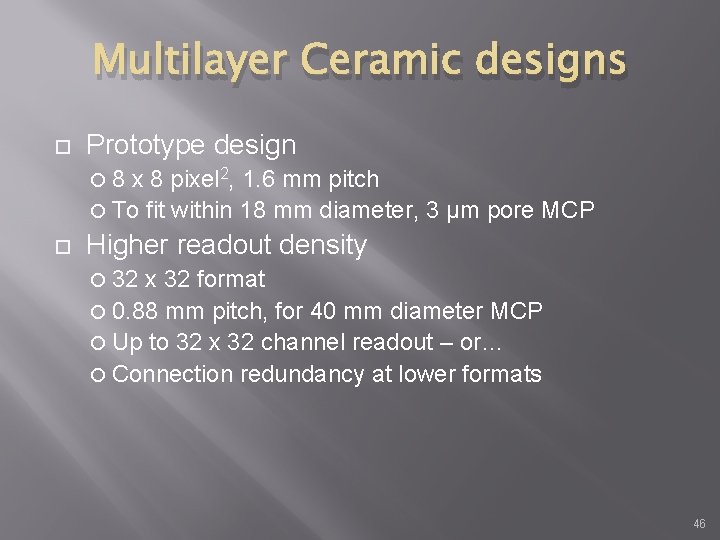
Multilayer Ceramic designs Prototype design 8 x 8 pixel 2, 1. 6 mm pitch To fit within 18 mm diameter, 3 µm pore MCP Higher readout density 32 x 32 format 0. 88 mm pitch, for 40 mm diameter MCP Up to 32 x 32 channel readout – or… Connection redundancy at lower formats 46
47
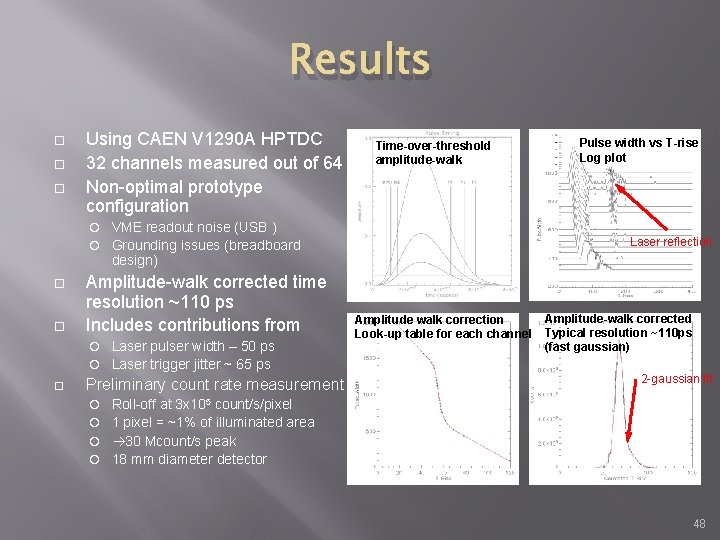
Results Using CAEN V 1290 A HPTDC 32 channels measured out of 64 Non-optimal prototype configuration Time-over-threshold amplitude-walk VME readout noise (USB ) Grounding issues (breadboard design) Pulse width vs T-rise Log plot Amplitude-walk corrected time resolution ~110 ps Includes contributions from Laser pulser width – 50 ps Laser trigger jitter ~ 65 ps Preliminary count rate measurement Laser reflection Amplitude walk correction Look-up table for each channel Amplitude-walk corrected Typical resolution ~110 ps (fast gaussian) 2 -gaussian fit Roll-off at 3 x 10⁵ count/s/pixel 1 pixel = ~1% of illuminated area 30 Mcount/s peak 18 mm diameter detector 48
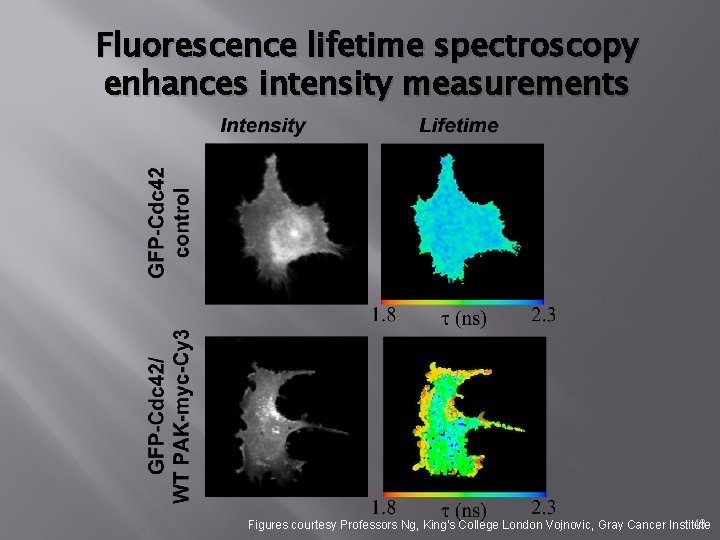
Fluorescence lifetime spectroscopy enhances intensity measurements 49 Figures courtesy Professors Ng, King's College London Vojnovic, Gray Cancer Institute
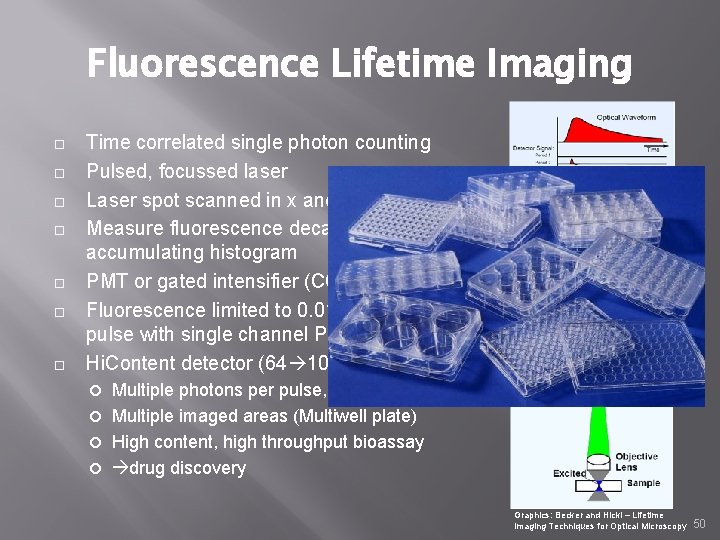
Fluorescence Lifetime Imaging Time correlated single photon counting Pulsed, focussed laser Laser spot scanned in x and y Measure fluorescence decay time (x, y) by accumulating histogram PMT or gated intensifier (CCD) Fluorescence limited to 0. 01 events per laser pulse with single channel PMT Hi. Content detector (64 1024 ch) Multiple photons per pulse, or Multiple imaged areas (Multiwell plate) High content, high throughput bioassay drug discovery Graphics: Becker and Hickl – Lifetime Imaging Techniques for Optical Microscopy 50
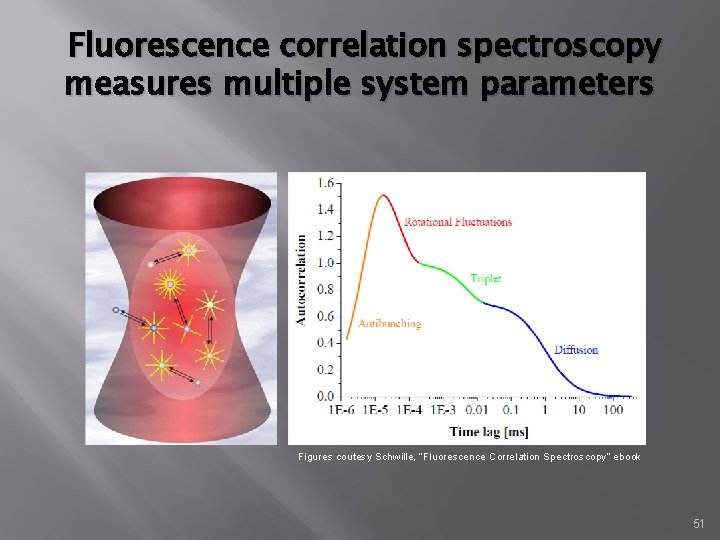
Fluorescence correlation spectroscopy measures multiple system parameters Figures coutesy Schwille, “Fluorescence Correlation Spectroscopy” ebook 51
MCP and related Developments Detection PMT photocathodes now at 45 -50% QE (optical) Can this transfer to MCP-PMTs? Ga. N > 70% in UV Square format, packable MCP detectors Multiplication Small pore, low resistance MCPs MCP fabrication processes ALD coatings – QE and secondary emission enhancement Bulk conductive glass – ion feedback , reliability, and lifetime benefits MEMs manufactured MCPs and other multiplication structures Si, A-Si, ceramic MCPs in development Discrete dynode imagers using novel dynode materials CVD Diamond – SEE >120 e- reported Image readout Integrated, miniaturized readout and electronics High channel density fast front-end ASICs Intelligent architectures – event recognition, parallel event processing Smart pixel arrays – Medipix 2/3, Timepix, Gigatracker 54
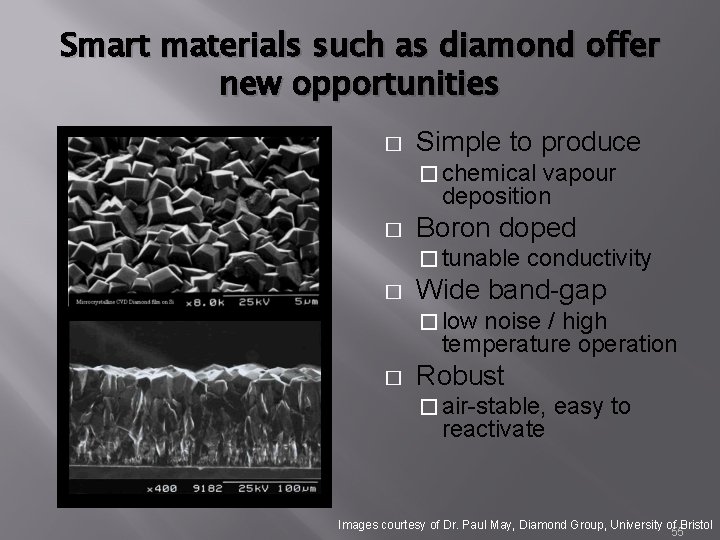
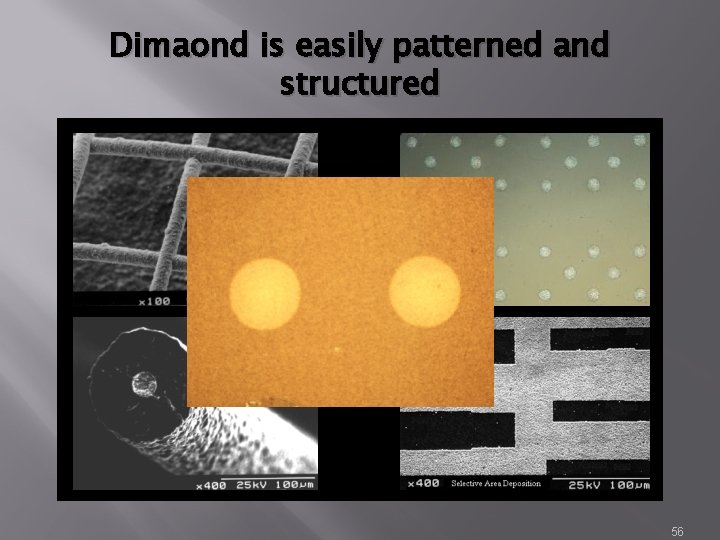
Smart materials such as diamond offer new opportunities � Simple to produce � chemical vapour deposition � Boron doped � tunable � conductivity Wide band-gap � low noise / high temperature operation � Robust � air-stable, reactivate easy to Images courtesy of Dr. Paul May, Diamond Group, University of Bristol 55
Dimaond is easily patterned and structured 56
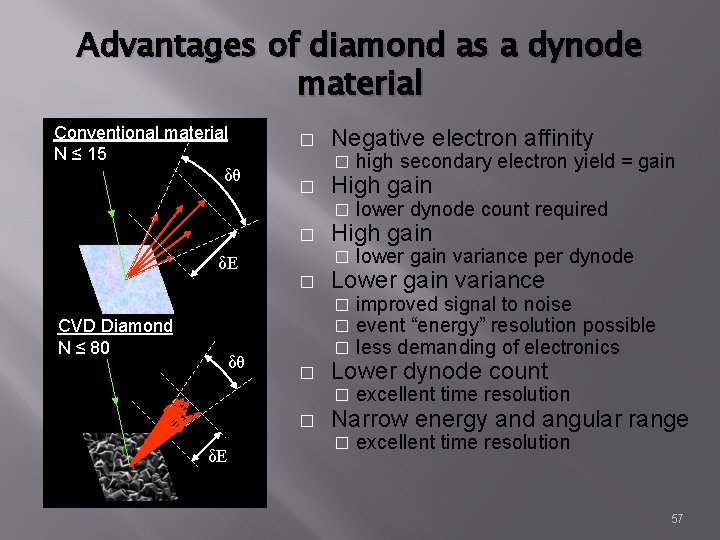
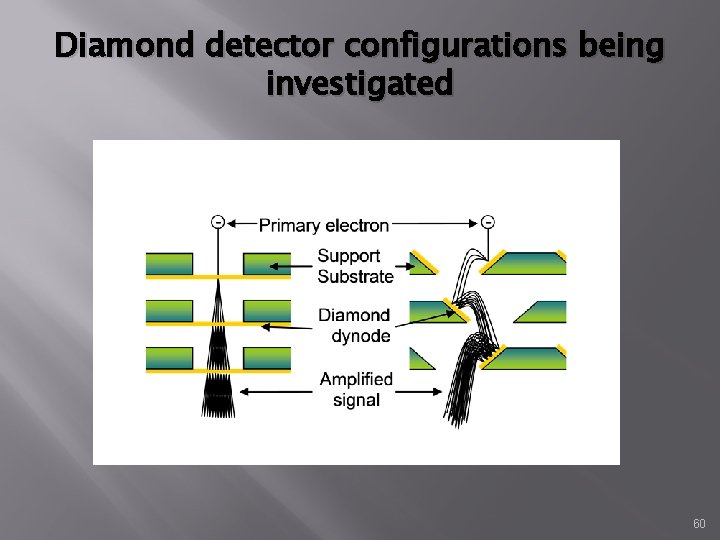
Advantages of diamond as a dynode material Conventional material N ≤ 15 δθ � Negative electron affinity � � High gain � � � CVD Diamond N ≤ 80 δθ δE improved signal to noise event “energy” resolution possible less demanding of electronics Lower dynode count � � lower gain variance per dynode Lower gain variance � � lower dynode count required High gain � δE high secondary electron yield = gain excellent time resolution Narrow energy and angular range � excellent time resolution 57
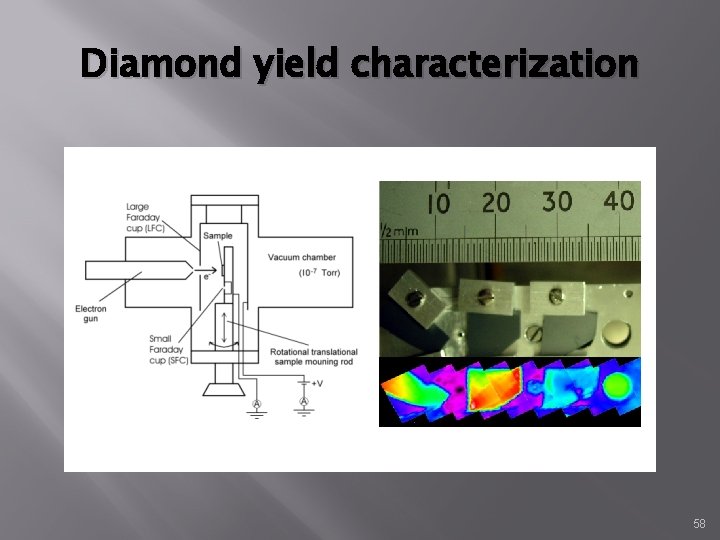
Diamond yield characterization 58
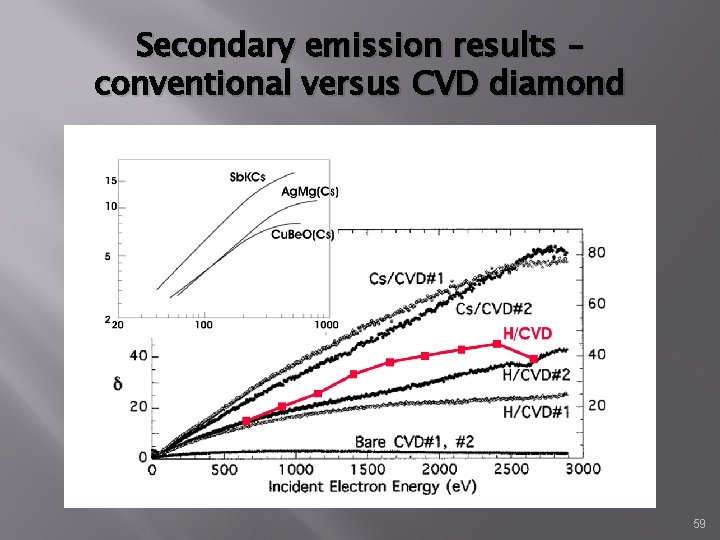
Secondary emission results – conventional versus CVD diamond Conventional dynode materials CVD Diamond 59
Diamond detector configurations being investigated Transmission Reflection 60
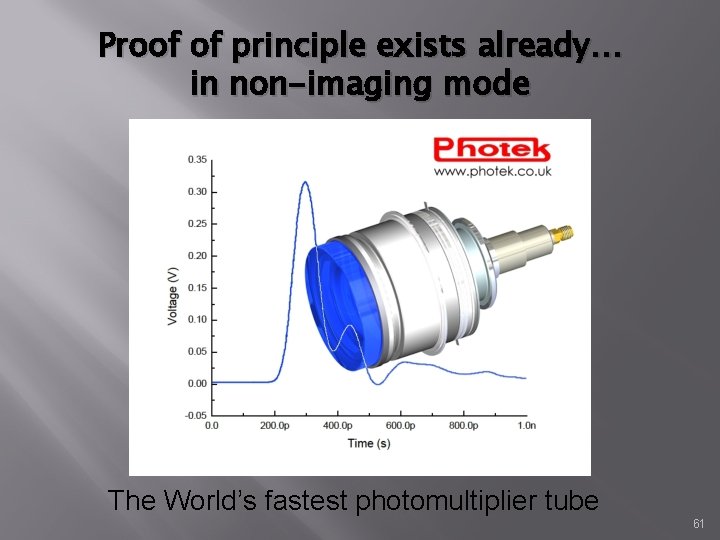
Proof of principle exists already… in non-imaging mode 55 ps rise-time 88 ps FWHM The World’s fastest photomultiplier tube 61
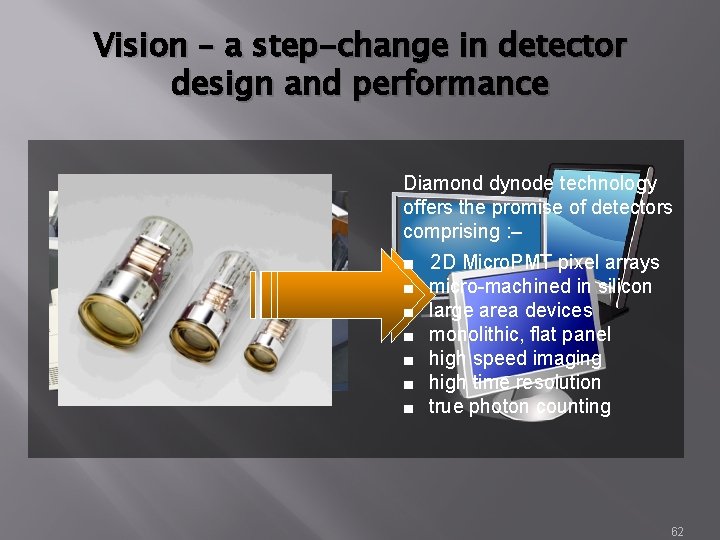
Vision – a step-change in detector design and performance Diamond dynode technology offers the promise of detectors comprising : – ■ 2 D Micro. PMT pixel arrays ■ micro-machined in silicon ■ large area devices ■ monolithic, flat panel ■ high speed imaging ■ high time resolution ■ true photon counting 62
Conclusions More fields/applications require picosecond timing and imaging MCP technology can deliver this now Solid-state is not far behind though (Si. PM, APD, etc. ) Vacuum electron gain technology is still developing We need an equivalent step improvement in photocathode QE Performance goals for the future Large format, flat panel particle/photon detector arrays Integrated, miniaturized electronics Global rates – up to 1 GHz / cm 2 >> 10 MHz / pixel Event time resolution - picoseconds 63