
Space Radiation Effects on Aircraft Captain Bryn Jones
Space Radiation Effects on Aircraft Captain Bryn Jones Solar. Metrics Limited Space Radiation Effects on Aircraft European Space Weather Week: ESWW-II 17 November 2005
Overview ñ Space Radiation Environment ñ Recent Storm Impacts ñ Next Generation Air & Space Transportation ñ Integrating Space Weather into Operations ñ Summary Space Radiation Effects on Aircraft European Space Weather Week: ESWW-II 17 November 2005
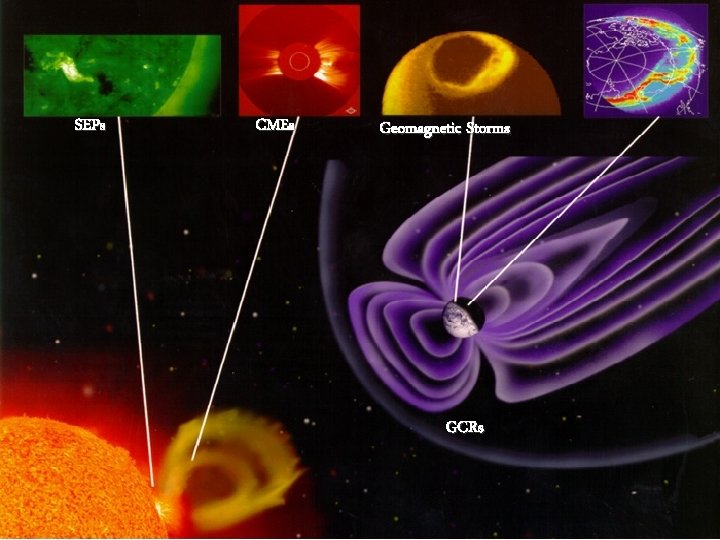
SEPs CMEs Geomagnetic Storms GCRs Space Radiation Effects on Aircraft European Space Weather Week: ESWW-II 17 November 2005

Space Radiation Environment Background Cosmic Radiation Supernovae (+ other energetic astrophysical events) Cause and Effect Space Weather Events Warning time Solar Cosmic Rays 10 -30 mins Coronal Mass Ejection Hours - days 10 -30 mins Solar Flare Coronal Hole Duration 1 -3 days Space Radiation Effects on Aircraft European Space Weather Week: ESWW-II 17 November 2005 4 -12 hours Solar max. Forbush Decrease 1 -6 days 1 -3 days Mins. to hours No time X-rays Decreased Atmospheric Radiation 2 -10 days Magnetic Storm 1 -3 days (high speed solar wind) Increased Atmospheric Radiation Solar min. 11 -year cycle Solar Cycle Atmospheric Radiation at Earth Galactic Cosmic Rays HF Communication Degradation 1 -3 days Navigation Degradation

Space Radiation Environment - Events Galactic Cosmic Rays (GCRs) ñ Constant background ñ Modulated by Space Weather (11 -year solar cycle, Coronal Mass Ejections (Forbush Decrease) etc. ) GCRs at Earth ñ Shielded by Earth’s magnetic field ñ High dose at high latitudes, low dose at low latitudes ñ Variation by a factor of ~2 ñ Atmosphere provides a further barrier ñ Cascade of secondary particles reaches Max Dose Rate at 60, 000 ft ñ From 10, 000 to 60, 000 ft, dose rates double every ~10, 000 ft Space Radiation Effects on Aircraft European Space Weather Week: ESWW-II 17 November 2005
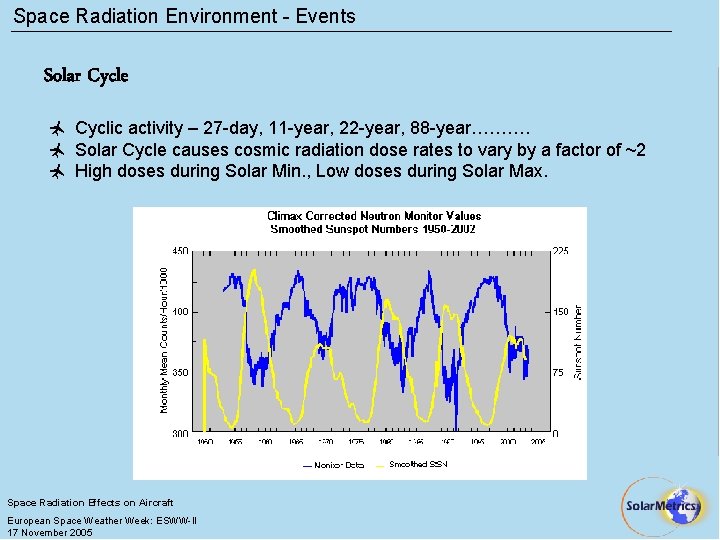
Space Radiation Environment - Events Solar Cycle ñ Cyclic activity – 27 -day, 11 -year, 22 -year, 88 -year………. ñ Solar Cycle causes cosmic radiation dose rates to vary by a factor of ~2 ñ High doses during Solar Min. , Low doses during Solar Max. Space Radiation Effects on Aircraft European Space Weather Week: ESWW-II 17 November 2005
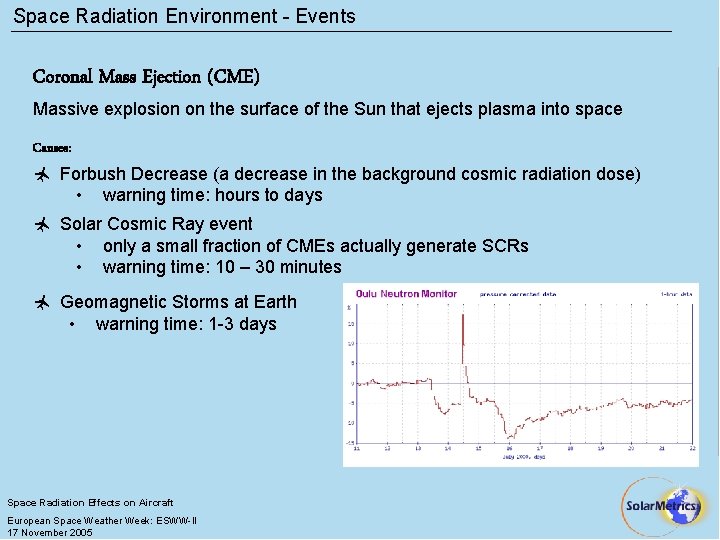
Space Radiation Environment - Events Coronal Mass Ejection (CME) Massive explosion on the surface of the Sun that ejects plasma into space Causes: ñ Forbush Decrease (a decrease in the background cosmic radiation dose) • warning time: hours to days ñ Solar Cosmic Ray event • only a small fraction of CMEs actually generate SCRs • warning time: 10 – 30 minutes ñ Geomagnetic Storms at Earth • warning time: 1 -3 days Space Radiation Effects on Aircraft European Space Weather Week: ESWW-II 17 November 2005
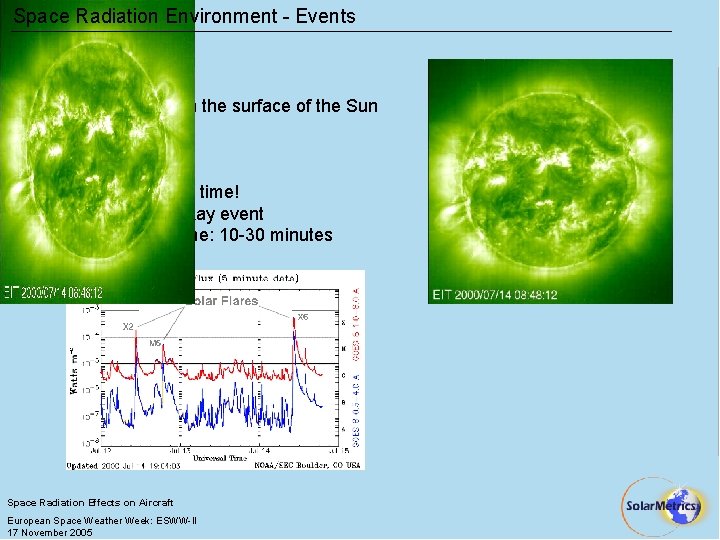
Space Radiation Environment - Events Solar Flares Bright explosion on the surface of the Sun Causes: ñ X-ray burst • no warning time! ñ Solar Cosmic Ray event • warning time: 10 -30 minutes Space Radiation Effects on Aircraft European Space Weather Week: ESWW-II 17 November 2005
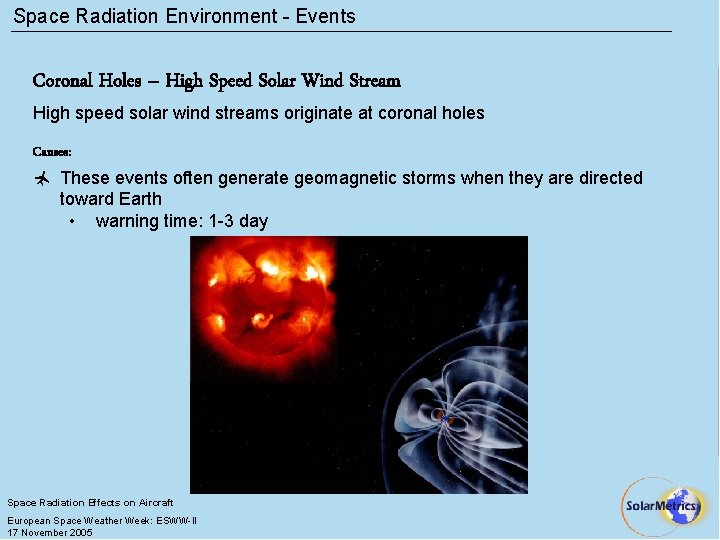
Space Radiation Environment - Events Coronal Holes – High Speed Solar Wind Stream High speed solar wind streams originate at coronal holes Causes: ñ These events often generate geomagnetic storms when they are directed toward Earth • warning time: 1 -3 day Space Radiation Effects on Aircraft European Space Weather Week: ESWW-II 17 November 2005
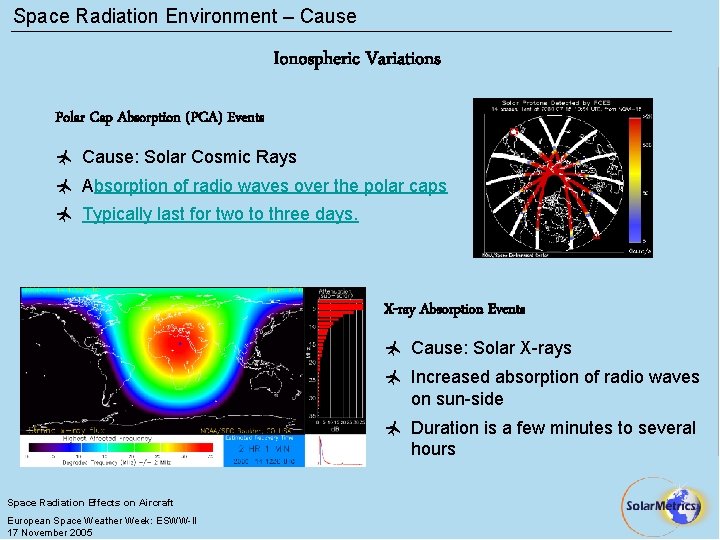
Space Radiation Environment – Cause Ionospheric Variations Polar Cap Absorption (PCA) Events ñ Cause: Solar Cosmic Rays ñ Absorption of radio waves over the polar caps ñ Typically last for two to three days. X-ray Absorption Events ñ Cause: Solar X-rays ñ Increased absorption of radio waves on sun-side ñ Duration is a few minutes to several hours Space Radiation Effects on Aircraft European Space Weather Week: ESWW-II 17 November 2005
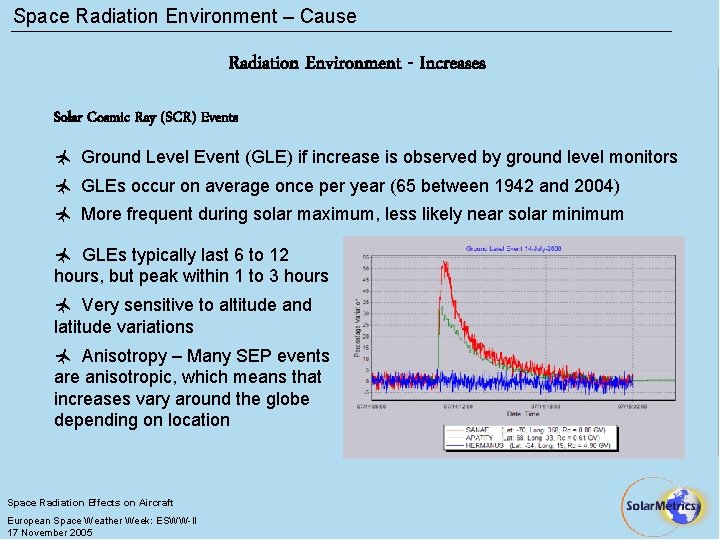
Space Radiation Environment – Cause Radiation Environment - Increases Solar Cosmic Ray (SCR) Events ñ Ground Level Event (GLE) if increase is observed by ground level monitors ñ GLEs occur on average once per year (65 between 1942 and 2004) ñ More frequent during solar maximum, less likely near solar minimum ñ GLEs typically last 6 to 12 hours, but peak within 1 to 3 hours ñ Very sensitive to altitude and latitude variations ñ Anisotropy – Many SEP events are anisotropic, which means that increases vary around the globe depending on location Space Radiation Effects on Aircraft European Space Weather Week: ESWW-II 17 November 2005
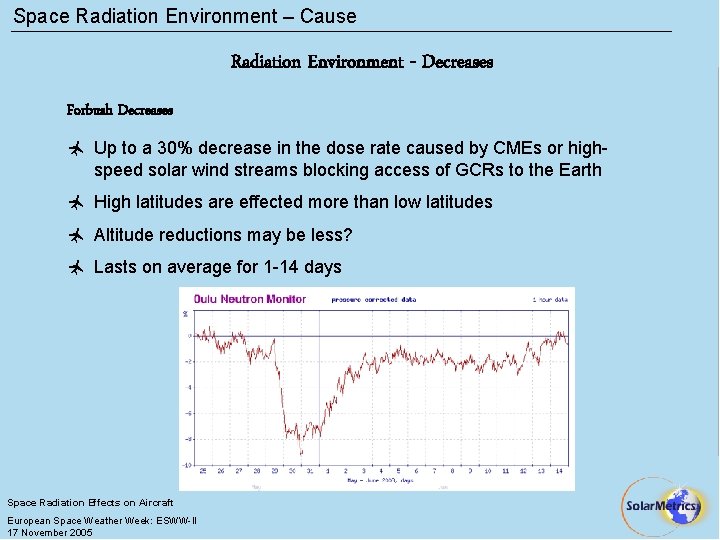
Space Radiation Environment – Cause Radiation Environment - Decreases Forbush Decreases ñ Up to a 30% decrease in the dose rate caused by CMEs or highspeed solar wind streams blocking access of GCRs to the Earth ñ High latitudes are effected more than low latitudes ñ Altitude reductions may be less? ñ Lasts on average for 1 -14 days Space Radiation Effects on Aircraft European Space Weather Week: ESWW-II 17 November 2005
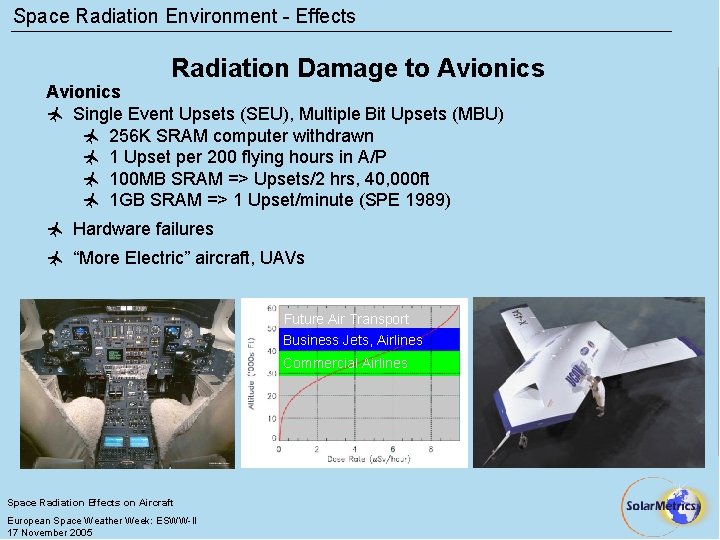
Space Radiation Environment - Effects Radiation Damage to Avionics ñ Single Event Upsets (SEU), Multiple Bit Upsets (MBU) ñ 256 K SRAM computer withdrawn ñ 1 Upset per 200 flying hours in A/P ñ 100 MB SRAM => Upsets/2 hrs, 40, 000 ft ñ 1 GB SRAM => 1 Upset/minute (SPE 1989) ñ Hardware failures ñ “More Electric” aircraft, UAVs Future Air Transport Business Jets, Airlines Commercial Airlines Space Radiation Effects on Aircraft European Space Weather Week: ESWW-II 17 November 2005
Space Radiation Effects on Aircraft European Space Weather Week: ESWW-II 17 November 2005
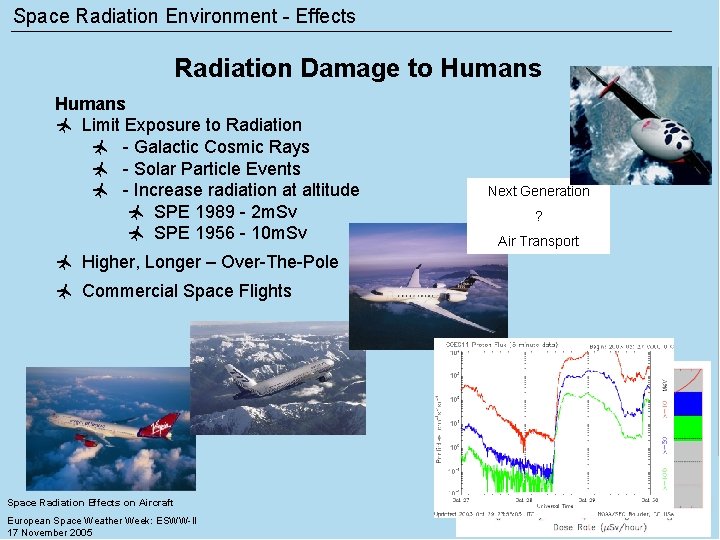
Space Radiation Environment - Effects Radiation Damage to Humans ñ Limit Exposure to Radiation ñ - Galactic Cosmic Rays ñ - Solar Particle Events ñ - Increase radiation at altitude ñ SPE 1989 - 2 m. Sv ñ SPE 1956 - 10 m. Sv Next Generation ? Air Transport ñ Higher, Longer – Over-The-Pole ñ Commercial Space Flights Future Air Transport Business Jets, Airlines Commercial Airlines Space Radiation Effects on Aircraft European Space Weather Week: ESWW-II 17 November 2005
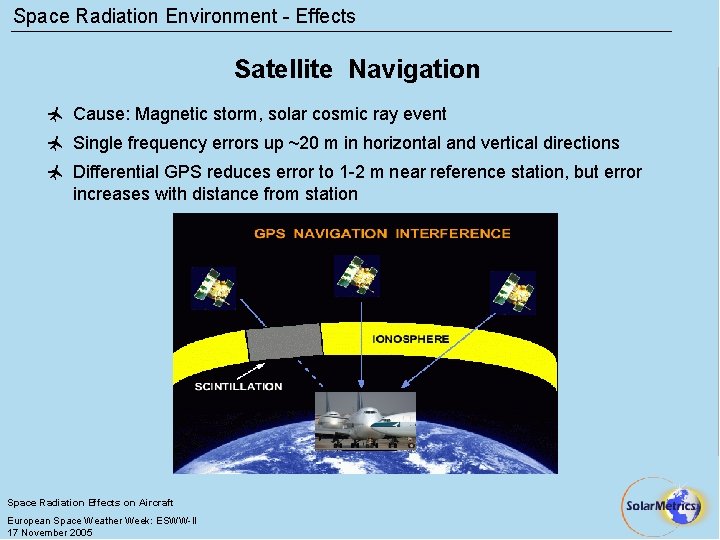
Space Radiation Environment - Effects Satellite Navigation ñ Cause: Magnetic storm, solar cosmic ray event ñ Single frequency errors up ~20 m in horizontal and vertical directions ñ Differential GPS reduces error to 1 -2 m near reference station, but error increases with distance from station Space Radiation Effects on Aircraft European Space Weather Week: ESWW-II 17 November 2005
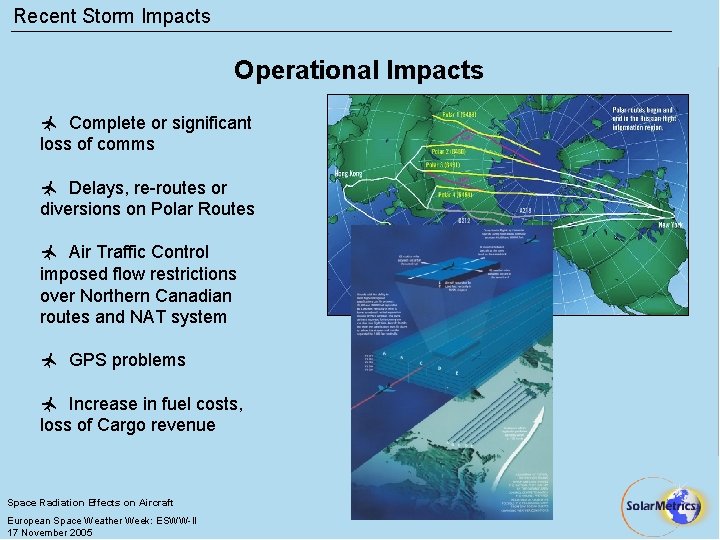
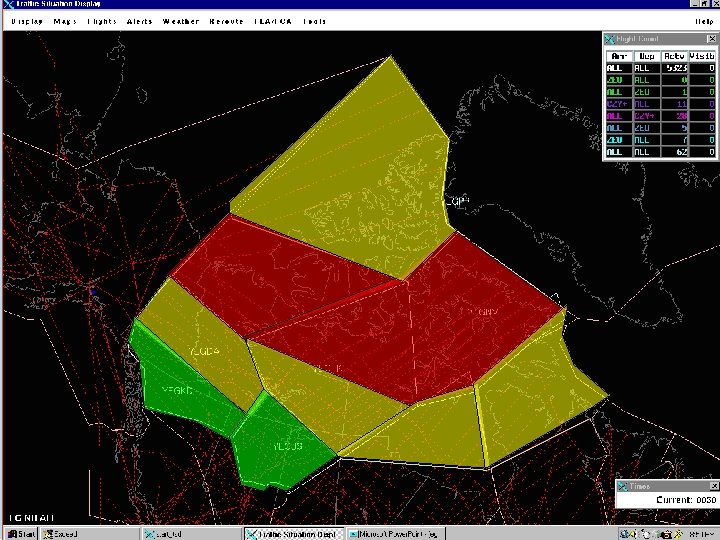
Recent Storm Impacts Operational Impacts ñ Complete or significant loss of comms ñ Delays, re-routes or diversions on Polar Routes ñ Air Traffic Control imposed flow restrictions over Northern Canadian routes and NAT system ñ GPS problems ñ Increase in fuel costs, loss of Cargo revenue Space Radiation Effects on Aircraft European Space Weather Week: ESWW-II 17 November 2005
Space Radiation Effects on Aircraft European Space Weather Week: ESWW-II 17 November 2005
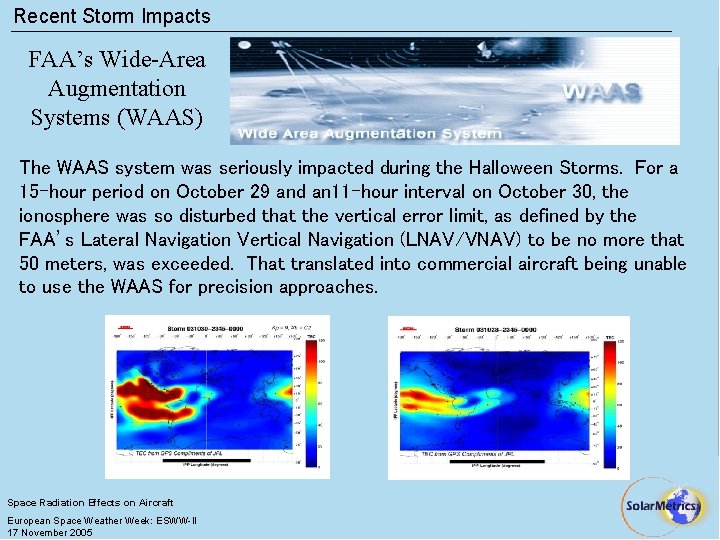
Recent Storm Impacts FAA’s Wide-Area Augmentation Systems (WAAS) The WAAS system was seriously impacted during the Halloween Storms. For a 15 -hour period on October 29 and an 11 -hour interval on October 30, the ionosphere was so disturbed that the vertical error limit, as defined by the FAA’s Lateral Navigation Vertical Navigation (LNAV/VNAV) to be no more that 50 meters, was exceeded. That translated into commercial aircraft being unable to use the WAAS for precision approaches. Space Radiation Effects on Aircraft European Space Weather Week: ESWW-II 17 November 2005
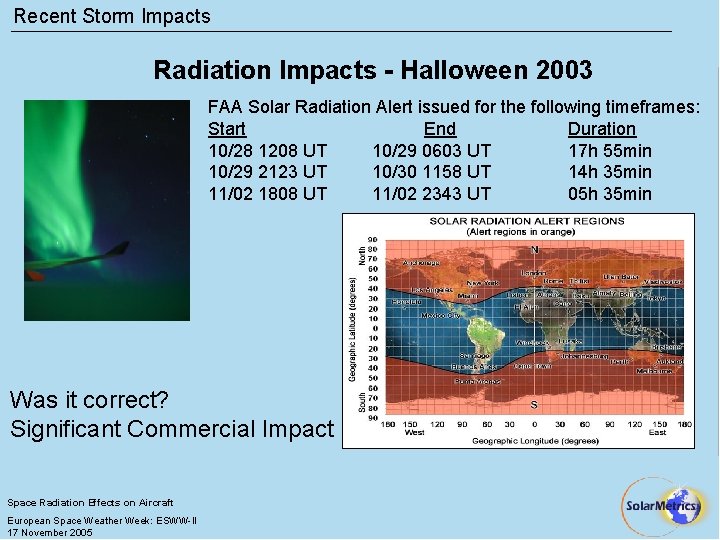
Recent Storm Impacts Radiation Impacts - Halloween 2003 FAA Solar Radiation Alert issued for the following timeframes: Start End Duration 10/28 1208 UT 10/29 0603 UT 17 h 55 min 10/29 2123 UT 10/30 1158 UT 14 h 35 min 11/02 1808 UT 11/02 2343 UT 05 h 35 min Was it correct? Significant Commercial Impact Space Radiation Effects on Aircraft European Space Weather Week: ESWW-II 17 November 2005
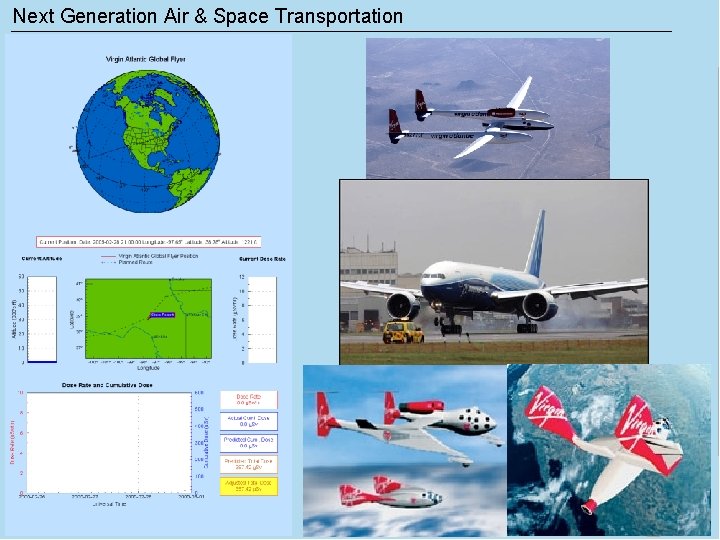
Next Generation Air & Space Transportation Space Radiation Effects on Aircraft European Space Weather Week: ESWW-II 17 November 2005
The Next Generation Air Transportation System Joint Planning and Development Office “Where new ideas are welcome”
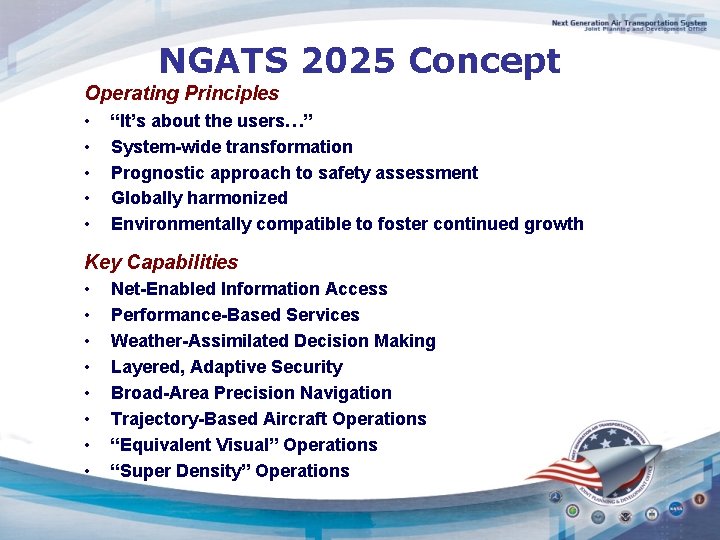
NGATS 2025 Concept Operating Principles • • • “It’s about the users…” System-wide transformation Prognostic approach to safety assessment Globally harmonized Environmentally compatible to foster continued growth Key Capabilities • • Net-Enabled Information Access Performance-Based Services Weather-Assimilated Decision Making Layered, Adaptive Security Broad-Area Precision Navigation Trajectory-Based Aircraft Operations “Equivalent Visual” Operations “Super Density” Operations
Integrating Space Weather into Operations – Policy: Research AMS_SMX Policy Study A flight is about to take off from NY to Hong Kong. NOAA SEC has recently issued an alert for a strong solar radiation storm. ü What does the pilot do? ü What does the airline do? ü What does the air traffic controller do? Space Radiation Effects on Aircraft European Space Weather Week: ESWW-II 17 November 2005
Integrating Space Weather into Operations – Policy: Implementation AMS_SMX Policy Study Our understanding of space weather impacts & risks on the safety & efficiency of airline operations is growing. ü What should FAA, CAA, Euro. Control do? ü What should IATA & ICAO do? ü What should the airlines do? ü What should you do? Space Radiation Effects on Aircraft European Space Weather Week: ESWW-II 17 November 2005
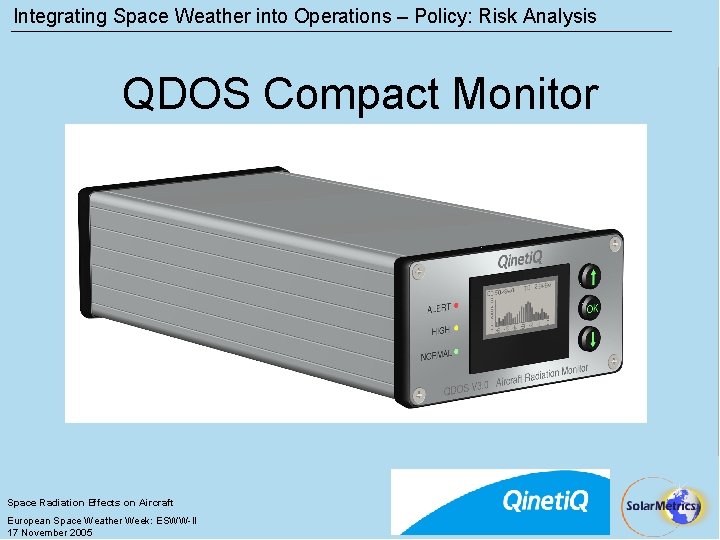
Integrating Space Weather into Operations – Policy: Risk Analysis QDOS Compact Monitor Space Radiation Effects on Aircraft European Space Weather Week: ESWW-II 17 November 2005
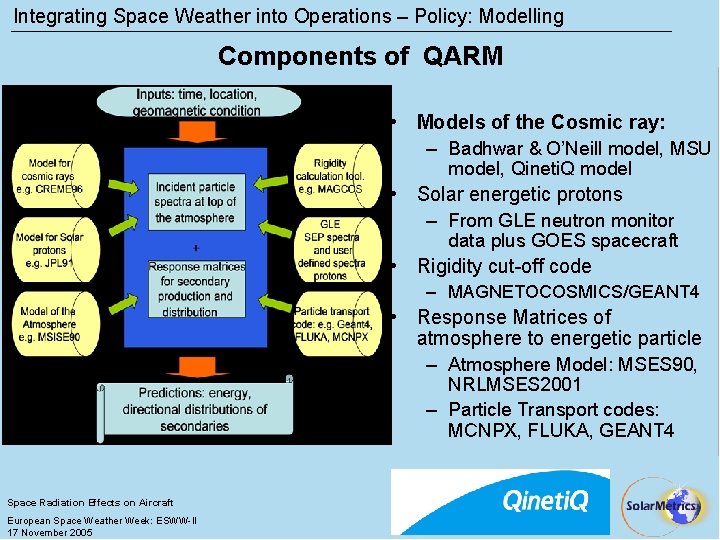
Integrating Space Weather into Operations – Policy: Modelling Components of QARM • Models of the Cosmic ray: – Badhwar & O’Neill model, MSU model, Qineti. Q model • Solar energetic protons – From GLE neutron monitor data plus GOES spacecraft • Rigidity cut-off code – MAGNETOCOSMICS/GEANT 4 • Response Matrices of atmosphere to energetic particle – Atmosphere Model: MSES 90, NRLMSES 2001 – Particle Transport codes: MCNPX, FLUKA, GEANT 4 Space Radiation Effects on Aircraft European Space Weather Week: ESWW-II 17 November 2005
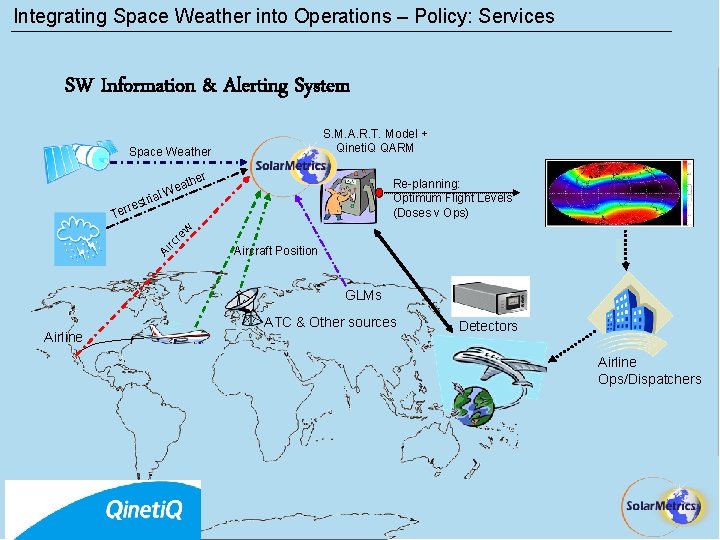
Integrating Space Weather into Operations – Policy: Services SW Information & Alerting System S. M. A. R. T. Model + Qineti. Q QARM Space Weather Re-planning: Optimum Flight Levels (Doses v Ops) Ai rc re w re Ter al stri her at We Aircraft Position GLMs ATC & Other sources Airline Detectors Airline Ops/Dispatchers Space Radiation Effects on Aircraft European Space Weather Week: ESWW-II 17 November 2005
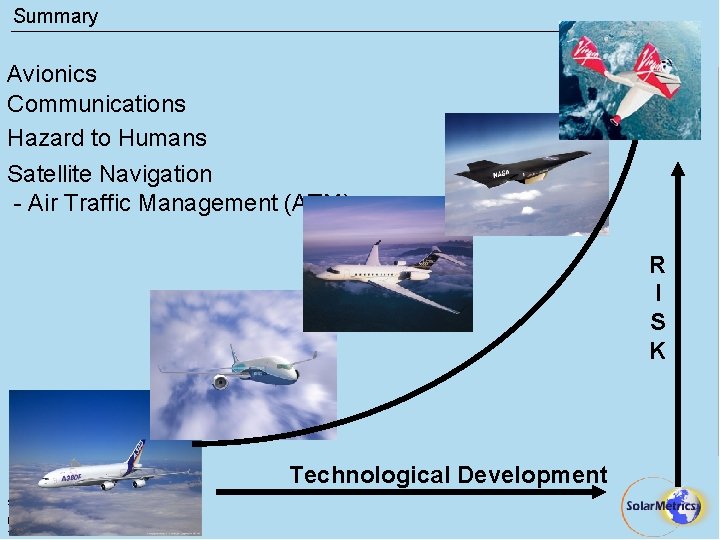
Summary Avionics Communications Hazard to Humans Satellite Navigation - Air Traffic Management (ATM) R I S K Technological Development Space Radiation Effects on Aircraft European Space Weather Week: ESWW-II 17 November 2005
Summary As our understanding of SW impacts on the airlines increases, many people are realising the need for a policy framework. Emerging issues involve: Q Q Q Standardization Legislation Education Better information and forecasts Better dissemination of products Cost/benefit analysis We must also consider how these fit within current international frameworks for aviation safety & operations Space Radiation Effects on Aircraft European Space Weather Week: ESWW-II 17 November 2005
Space Radiation Effects on Aircraft Questions ? Space Radiation Effects on Aircraft European Space Weather Week: ESWW-II 17 November 2005
- Slides: 31