
Space Physics Peter Fisher MIT Working in space
- Slides: 45
Space Physics Peter Fisher - MIT
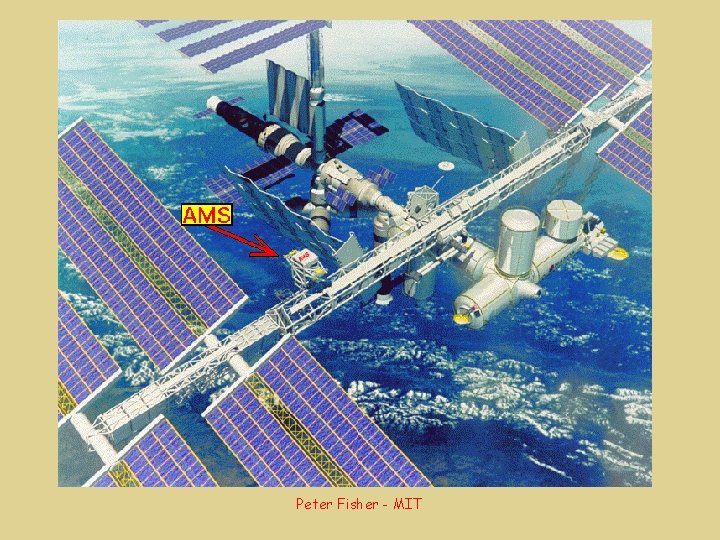
• Working in space - getting there is half the fun • Experiments • Just plain cool - the Tethered Satellite • A long march - Gravity Probe B • “Somebody’s gotta do it” - Alpha Magnetic Spectrometer • Looking for a jerk - SNAP Peter Fisher - MIT
Three big problems in space • The ride uphill • Keeping cool • Telemetry Peter Fisher - MIT
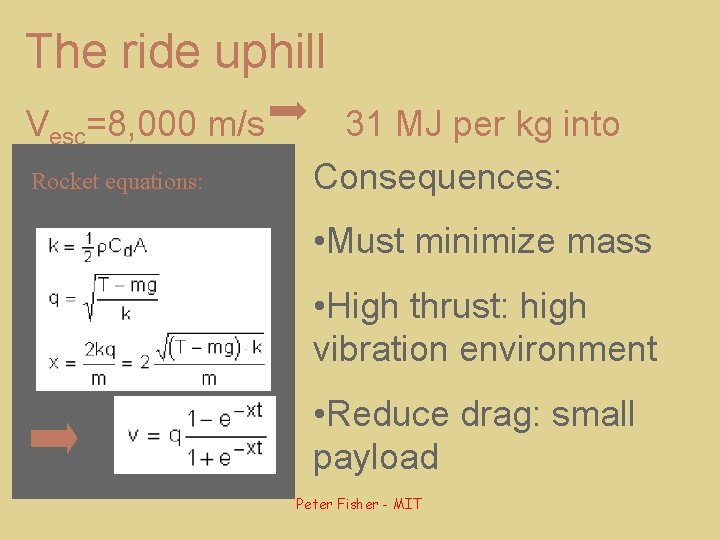
The ride uphill Vesc=8, 000 m/s orbit Rocket equations: 31 MJ per kg into Consequences: • Must minimize mass • High thrust: high vibration environment • Reduce drag: small payload Peter Fisher - MIT
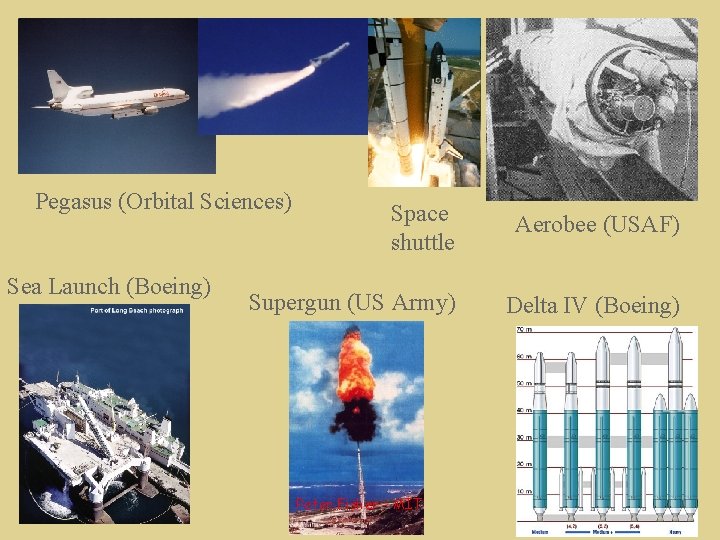
Pegasus (Orbital Sciences) Sea Launch (Boeing) Space shuttle Aerobee (USAF) Supergun (US Army) Delta IV (Boeing) Peter Fisher - MIT
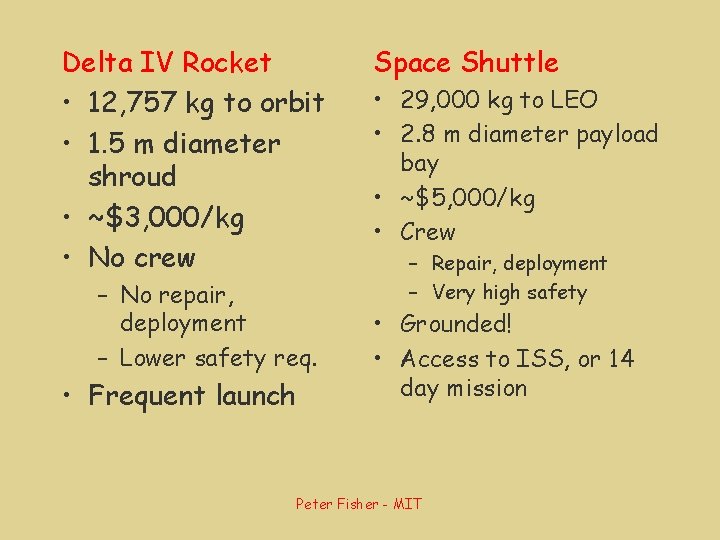
Delta IV Rocket • 12, 757 kg to orbit • 1. 5 m diameter shroud • ~$3, 000/kg • No crew – No repair, deployment – Lower safety req. • Frequent launch Space Shuttle • 29, 000 kg to LEO • 2. 8 m diameter payload bay • ~$5, 000/kg • Crew – Repair, deployment – Very high safety • Grounded! • Access to ISS, or 14 day mission Peter Fisher - MIT
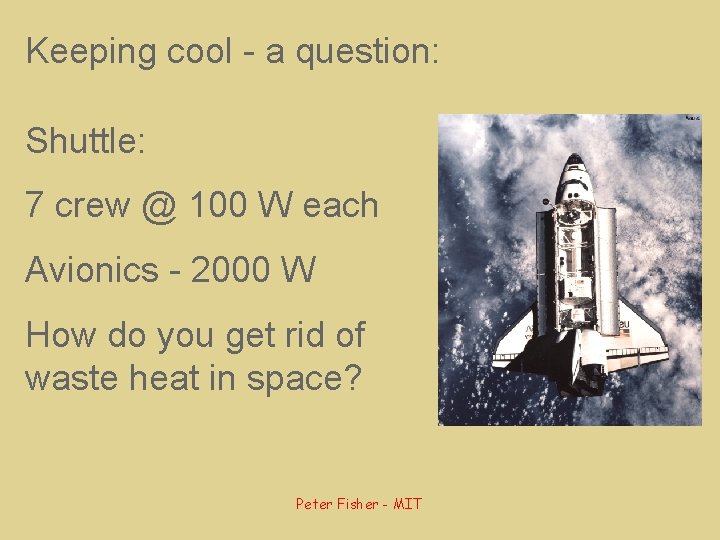
Keeping cool - a question: Shuttle: 7 crew @ 100 W each Avionics - 2000 W How do you get rid of waste heat in space? Peter Fisher - MIT
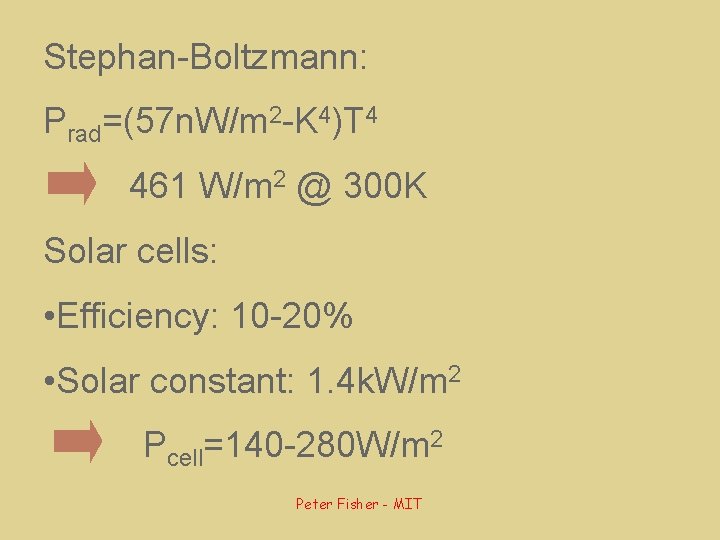
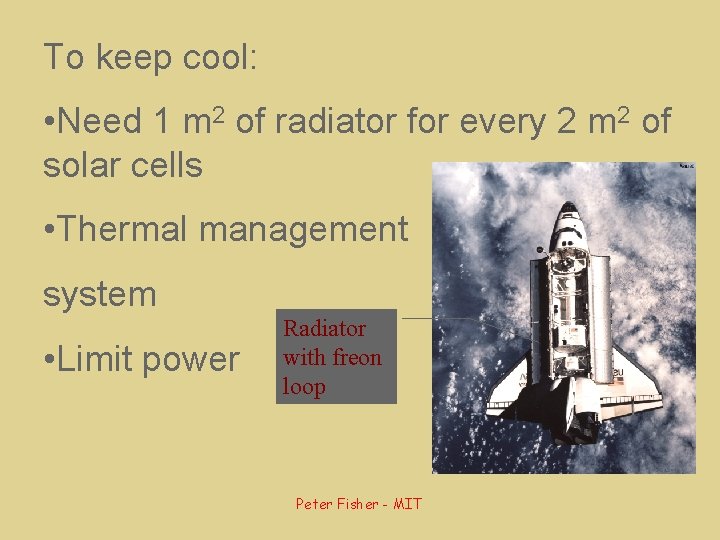
Stephan-Boltzmann: Prad=(57 n. W/m 2 -K 4)T 4 461 W/m 2 @ 300 K Solar cells: • Efficiency: 10 -20% • Solar constant: 1. 4 k. W/m 2 Pcell=140 -280 W/m 2 Peter Fisher - MIT
To keep cool: • Need 1 m 2 of radiator for every 2 m 2 of solar cells • Thermal management system • Limit power Radiator with freon loop Peter Fisher - MIT
Telemetry Space experiments always assume that communications may be lost (“comm-out”) at any time for an unknown duration. In typical orbits, there are frequently comm-out factors of 10 (Shuttle)40(ISS)% Major implications… Peter Fisher - MIT
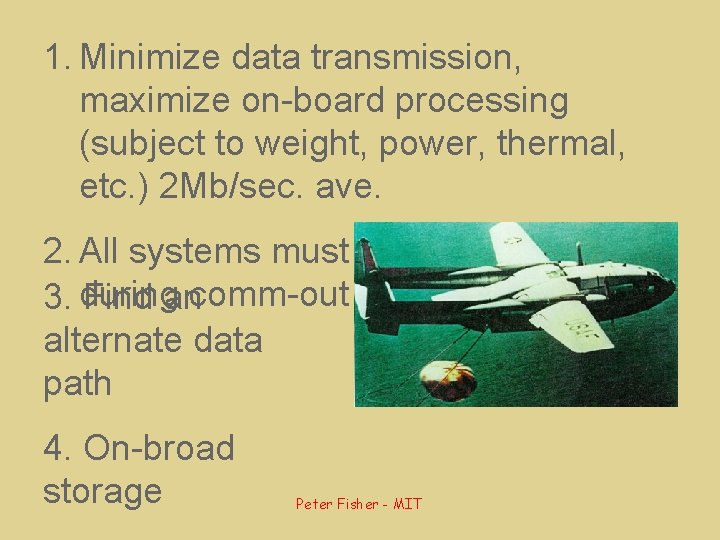
1. Minimize data transmission, maximize on-board processing (subject to weight, power, thermal, etc. ) 2 Mb/sec. ave. 2. All systems must go into safe mode 3. during Find ancomm-out alternate data path 4. On-broad storage Peter Fisher - MIT
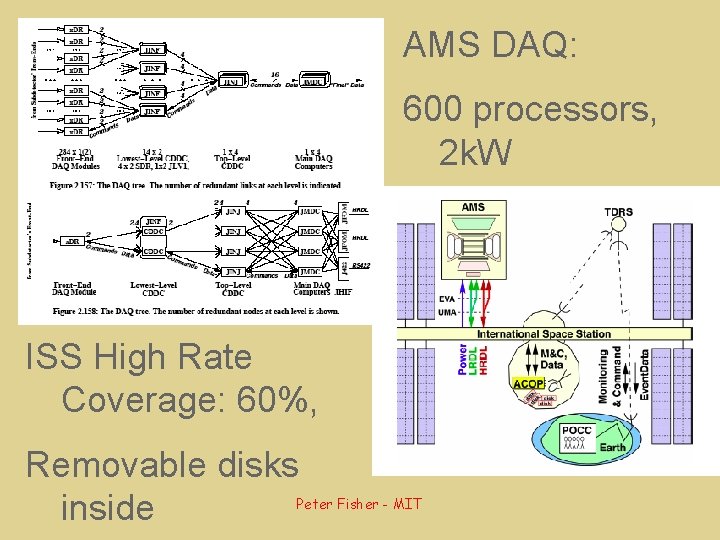
AMS DAQ: 600 processors, 2 k. W ISS High Rate Coverage: 60%, Removable disks inside Peter Fisher - MIT
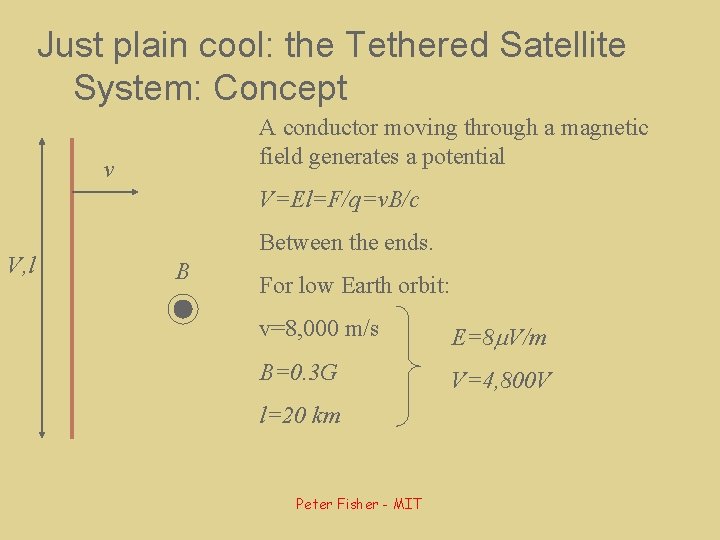
Just plain cool: the Tethered Satellite System: Concept A conductor moving through a magnetic field generates a potential v V=El=F/q=v. B/c V, l Between the ends. B For low Earth orbit: v=8, 000 m/s E=8 m. V/m B=0. 3 G V=4, 800 V l=20 km Peter Fisher - MIT
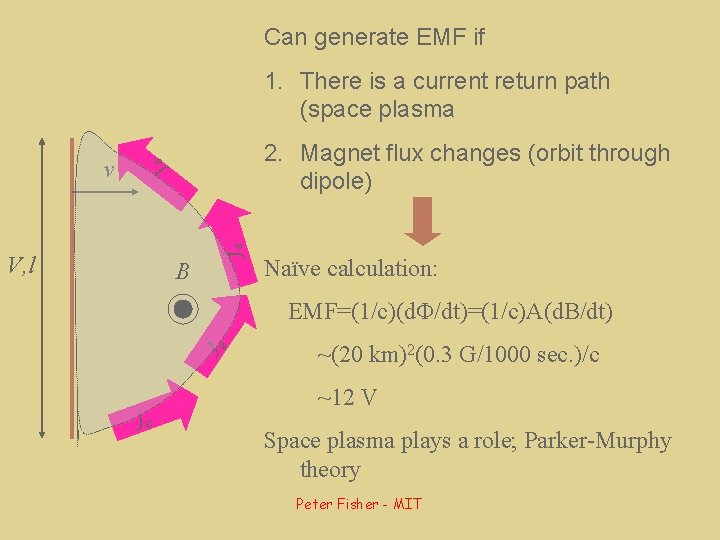
Can generate EMF if 1. There is a current return path (space plasma v 2. Magnet flux changes (orbit through dipole) je je V, l B Naïve calculation: je EMF=(1/c)(d. F/dt)=(1/c)A(d. B/dt) je ~(20 km)2(0. 3 G/1000 sec. )/c ~12 V Space plasma plays a role; Parker-Murphy theory Peter Fisher - MIT
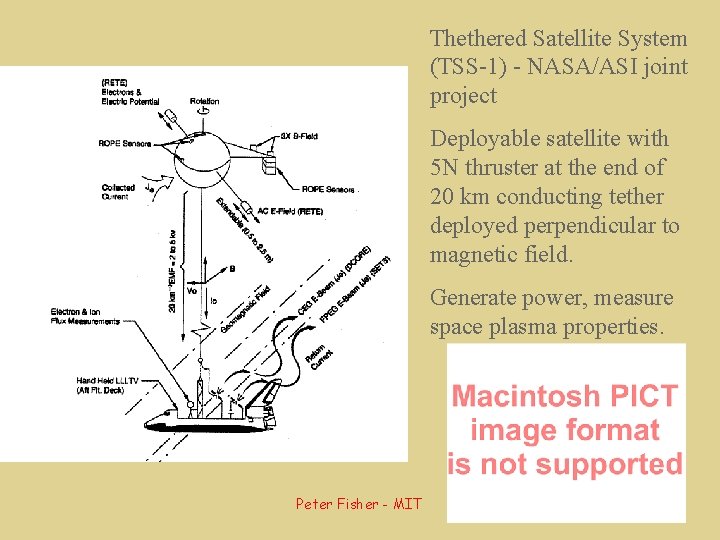
Thethered Satellite System (TSS-1) - NASA/ASI joint project Deployable satellite with 5 N thruster at the end of 20 km conducting tether deployed perpendicular to magnetic field. Generate power, measure space plasma properties. Peter Fisher - MIT
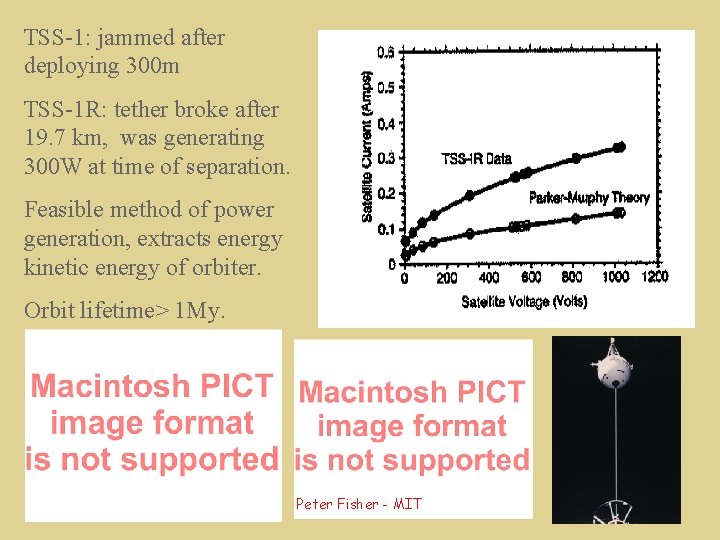
TSS-1: jammed after deploying 300 m TSS-1 R: tether broke after 19. 7 km, was generating 300 W at time of separation. Feasible method of power generation, extracts energy kinetic energy of orbiter. Orbit lifetime> 1 My. Peter Fisher - MIT
A long march - Gravity Probe B The Lense-Thirring effect (1918) Rotating mass gives rise to “gravitomagnetic” field and An object with angular momentum l will precess at rate • a- semi-major axis of orbit • e - eccentricity Peter Fisher - MIT
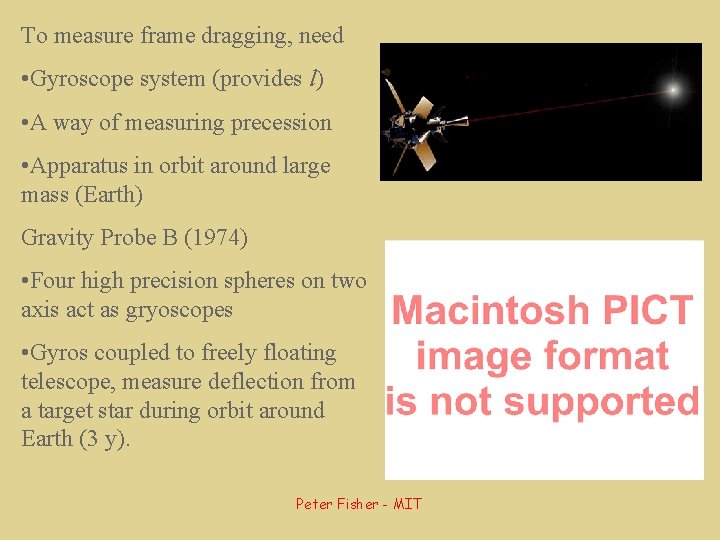
To measure frame dragging, need • Gyroscope system (provides l) • A way of measuring precession • Apparatus in orbit around large mass (Earth) Gravity Probe B (1974) • Four high precision spheres on two axis act as gryoscopes • Gyros coupled to freely floating telescope, measure deflection from a target star during orbit around Earth (3 y). Peter Fisher - MIT
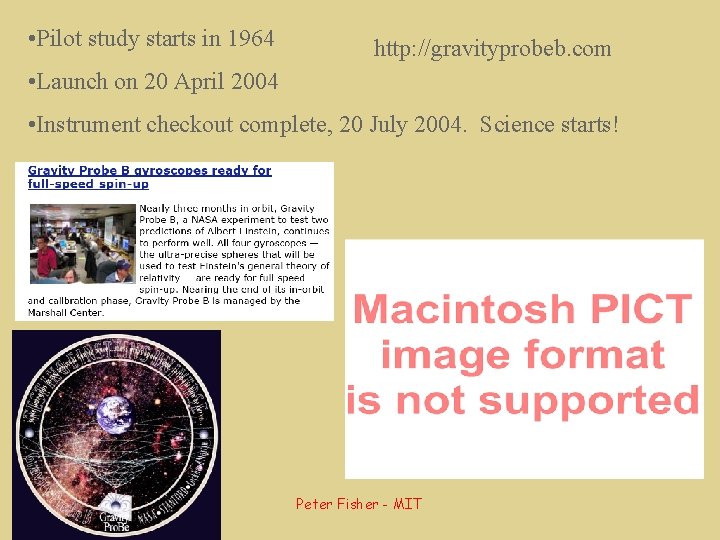
• Pilot study starts in 1964 http: //gravityprobeb. com • Launch on 20 April 2004 • Instrument checkout complete, 20 July 2004. Science starts! Peter Fisher - MIT
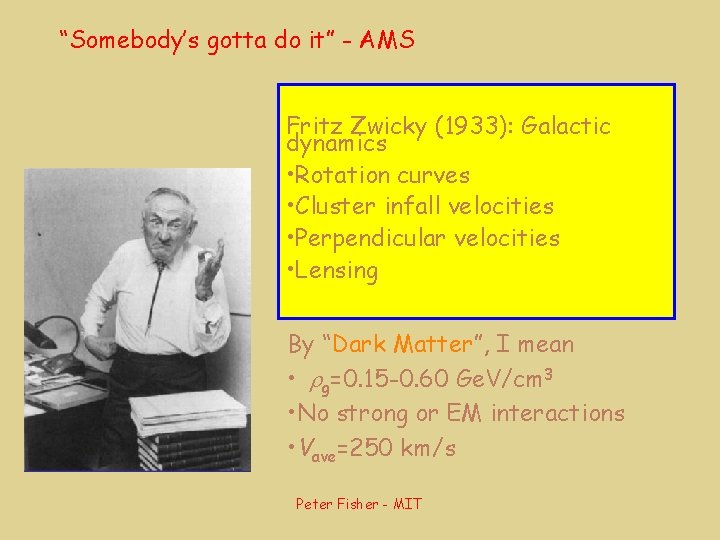
“Somebody’s gotta do it” - AMS Fritz Zwicky (1933): Galactic dynamics • Rotation curves • Cluster infall velocities • Perpendicular velocities • Lensing By “Dark Matter”, I mean • g=0. 15 -0. 60 Ge. V/cm 3 • No strong or EM interactions • Vave=250 km/s Peter Fisher - MIT
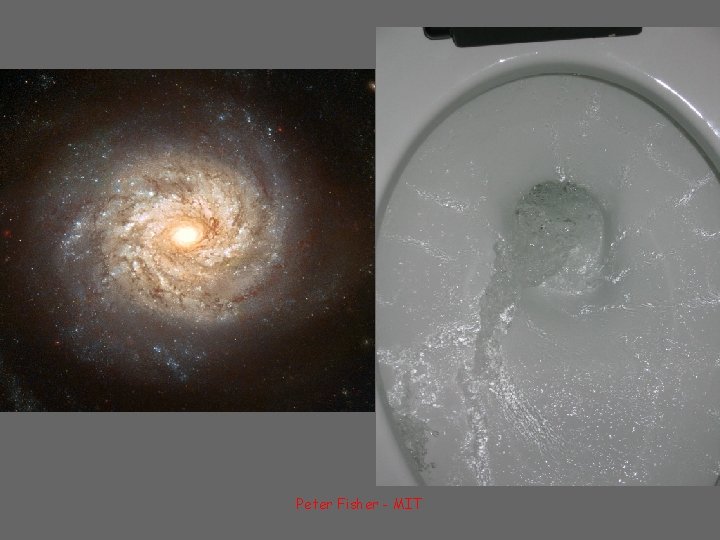
Peter Fisher - MIT
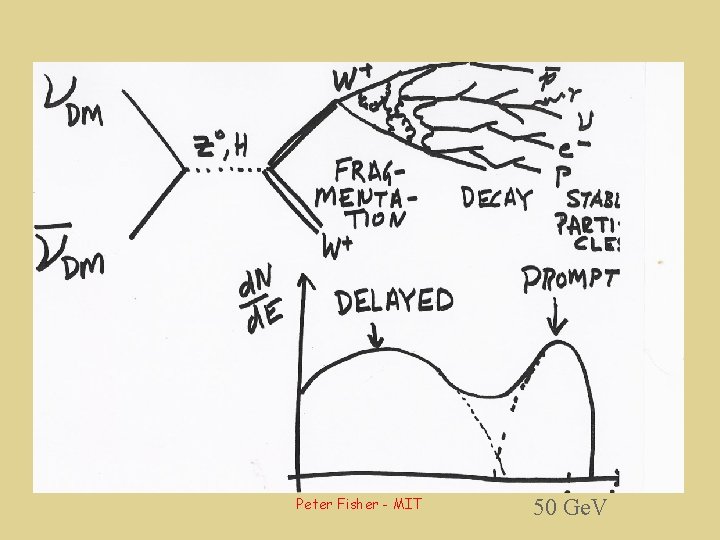
Peter Fisher - MIT 50 Ge. V
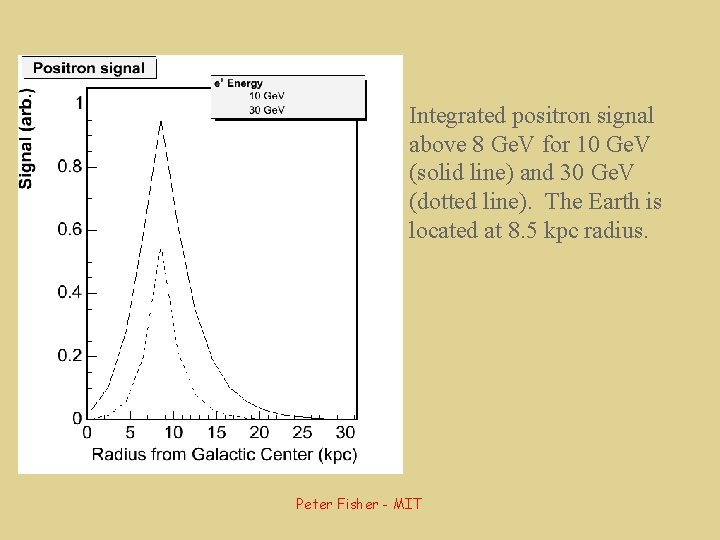
Integrated positron signal above 8 Ge. V for 10 Ge. V (solid line) and 30 Ge. V (dotted line). The Earth is located at 8. 5 kpc radius. Peter Fisher - MIT
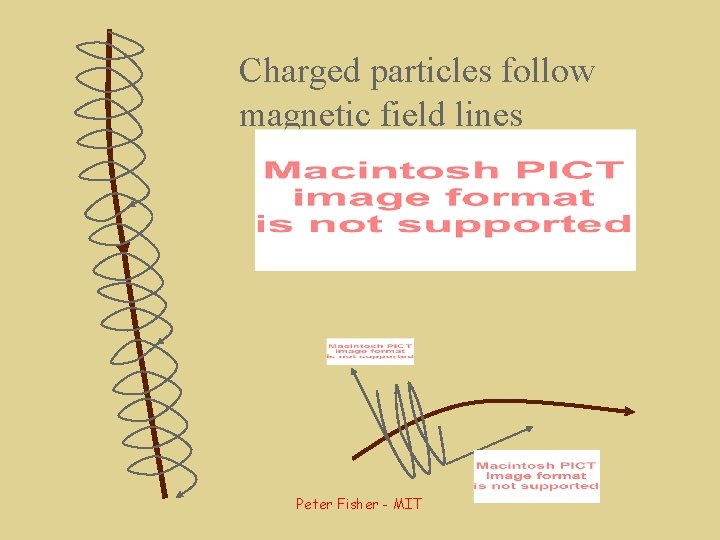
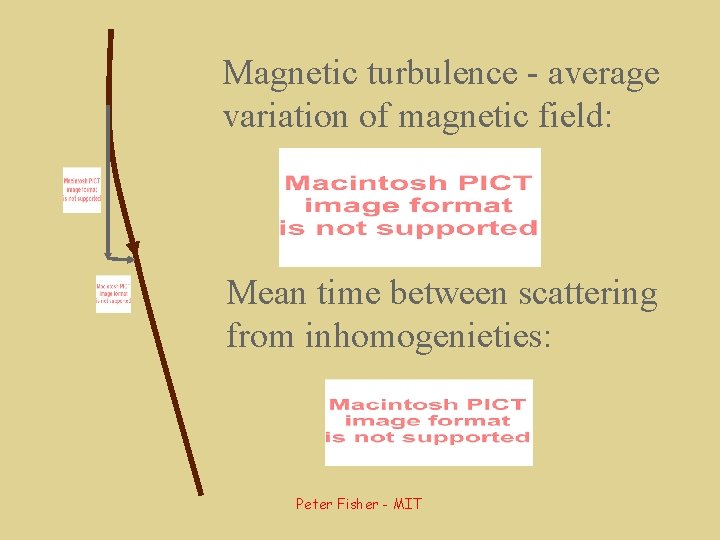
Charged particles follow magnetic field lines Peter Fisher - MIT
Magnetic turbulence - average variation of magnetic field: Mean time between scattering from inhomogenieties: Peter Fisher - MIT
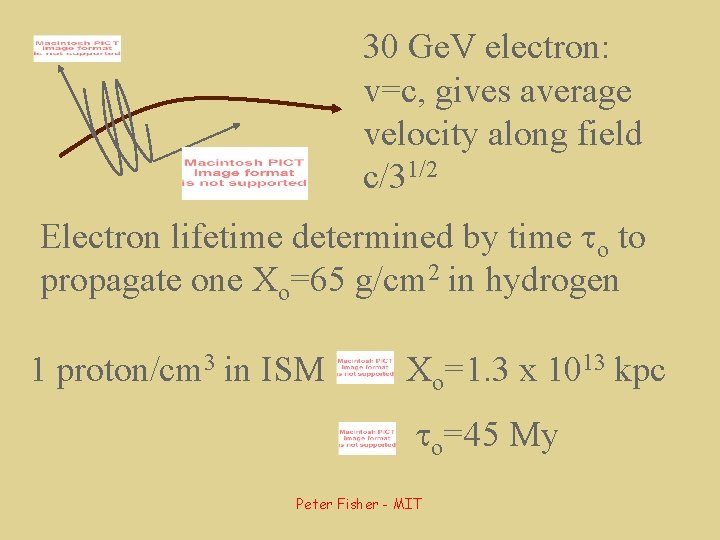
30 Ge. V electron: v=c, gives average velocity along field c/31/2 Electron lifetime determined by time to to propagate one Xo=65 g/cm 2 in hydrogen 1 proton/cm 3 in ISM Xo=1. 3 x 10¹³ kpc to=45 My Peter Fisher - MIT
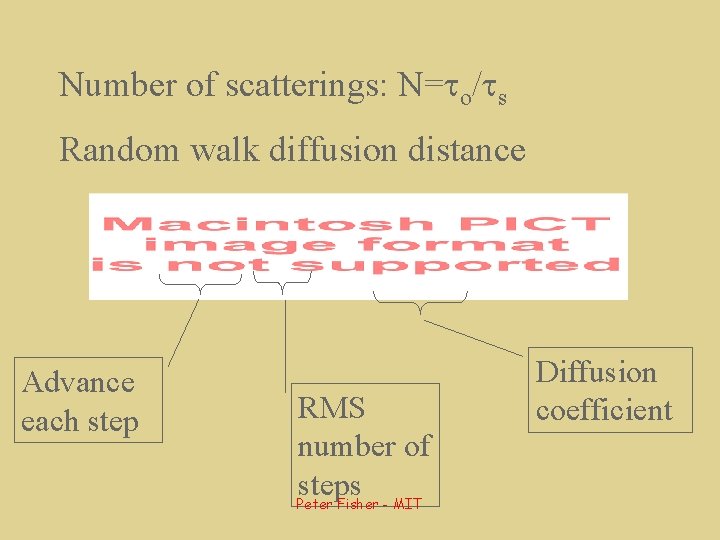
Number of scatterings: N=to/ts Random walk diffusion distance Advance each step RMS number of steps Peter Fisher - MIT Diffusion coefficient
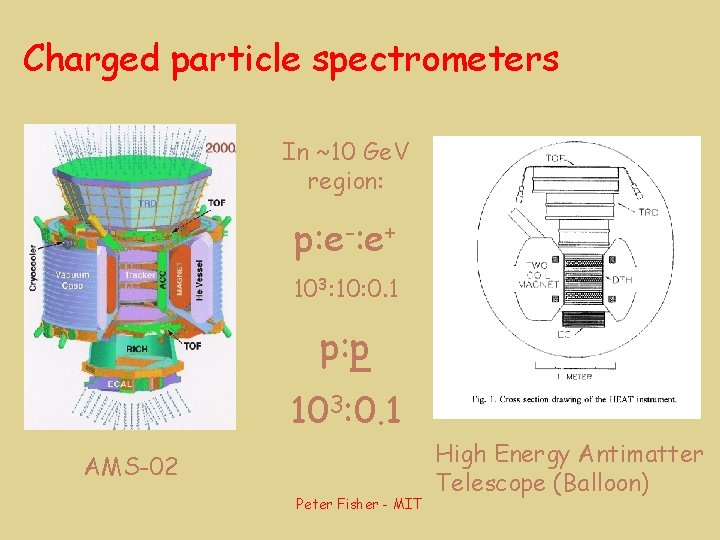
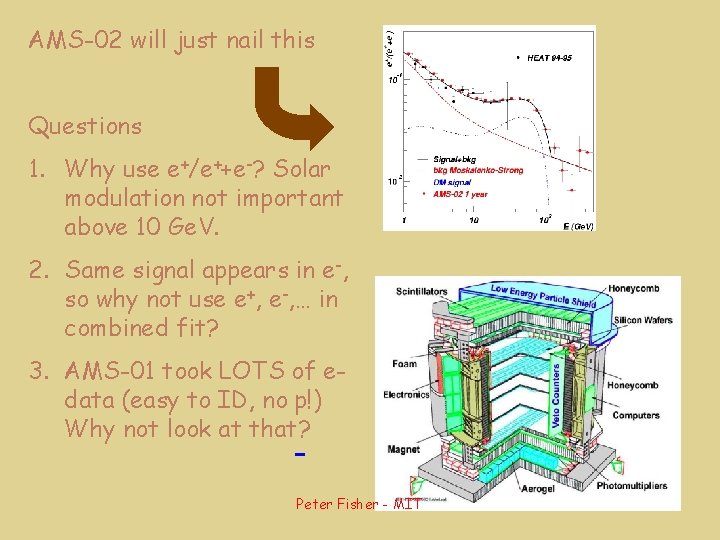
Charged particle spectrometers In ~10 Ge. V region: p: e-: e+ 103: 10: 0. 1 p: p 103: 0. 1 AMS-02 Peter Fisher - MIT High Energy Antimatter Telescope (Balloon)
Peter Fisher - MIT
AMS-02 will just nail this Questions 1. Why use e+/e++e-? Solar modulation not important above 10 Ge. V. 2. Same signal appears in e-, so why not use e+, e-, … in combined fit? 3. AMS-01 took LOTS of edata (easy to ID, no p!) Why not look at that? Peter Fisher - MIT
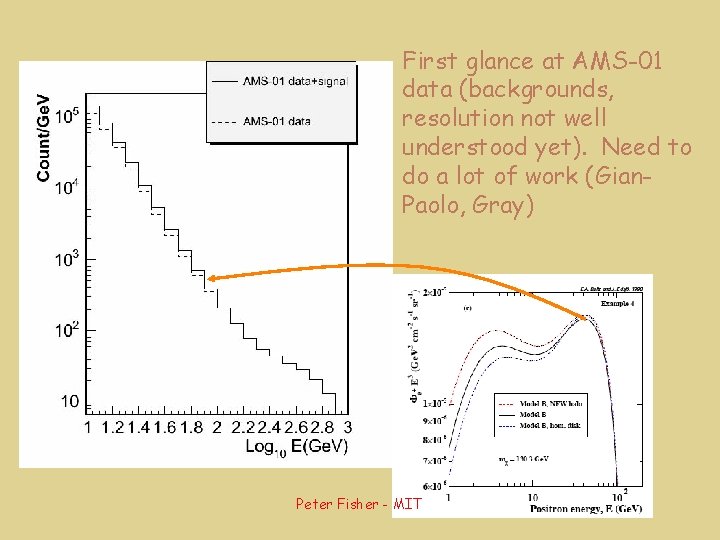
First glance at AMS-01 data (backgrounds, resolution not well understood yet). Need to do a lot of work (Gian. Paolo, Gray) Peter Fisher - MIT
Bumps and Bangs: Terrestrial and solar capture Peter Fisher - MIT
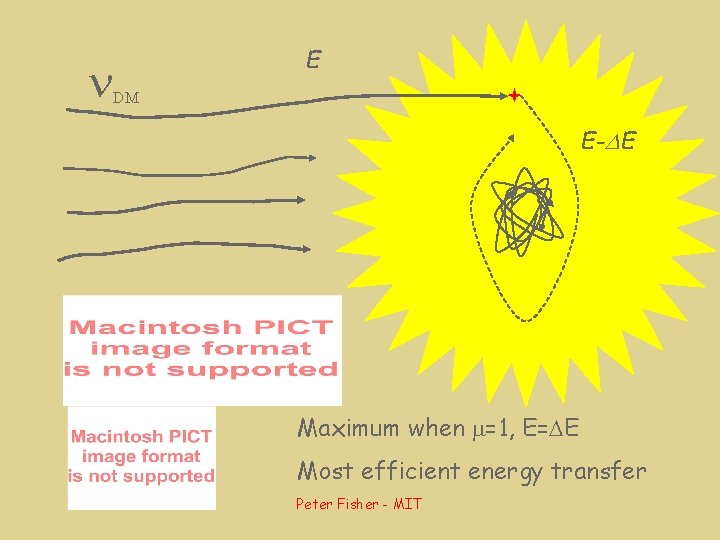
n E DM E-DE Maximum when =1, E=DE Most efficient energy transfer Peter Fisher - MIT
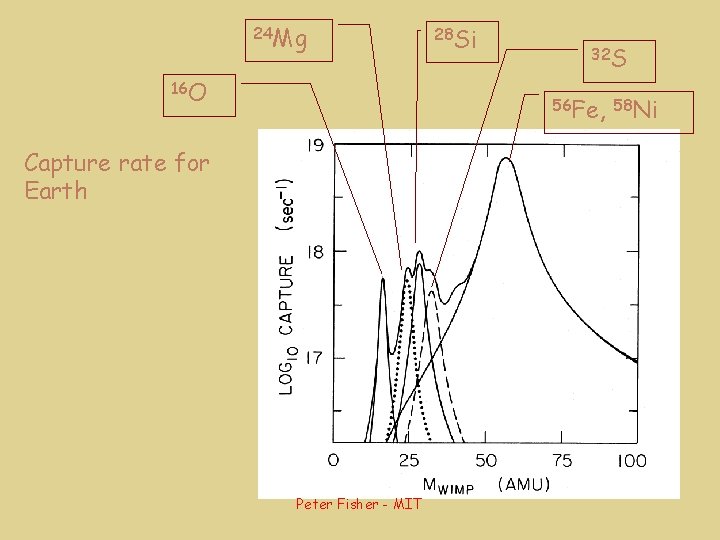
24 Mg 16 O 28 Si 32 S 56 Fe, 58 Ni Capture rate for Earth Peter Fisher - MIT
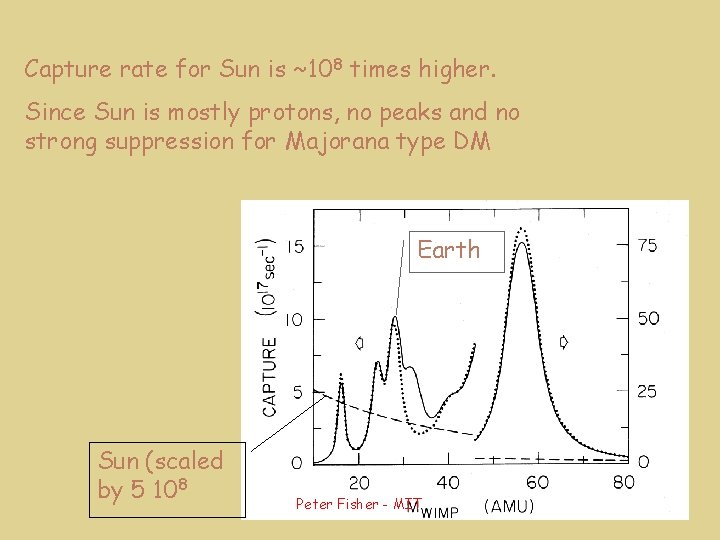
Capture rate for Sun is ~108 times higher. Since Sun is mostly protons, no peaks and no strong suppression for Majorana type DM Earth Sun (scaled by 5 108 Peter Fisher - MIT
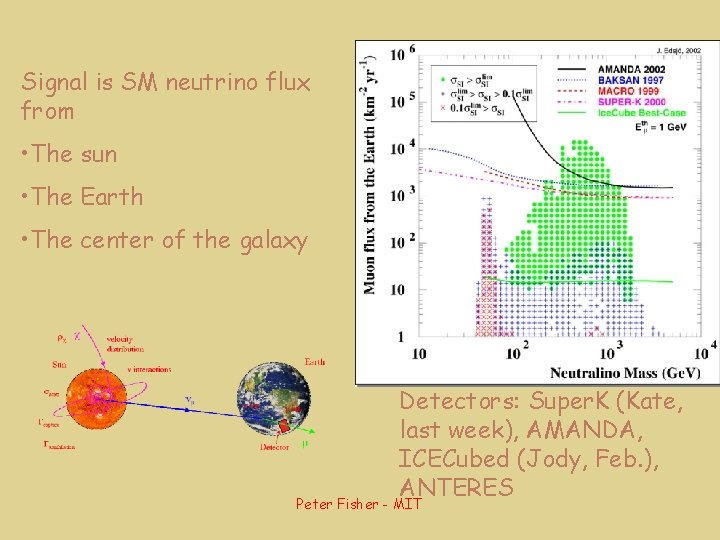
Signal is SM neutrino flux from • The sun • The Earth • The center of the galaxy Detectors: Super. K (Kate, last week), AMANDA, ICECubed (Jody, Feb. ), ANTERES Peter Fisher - MIT
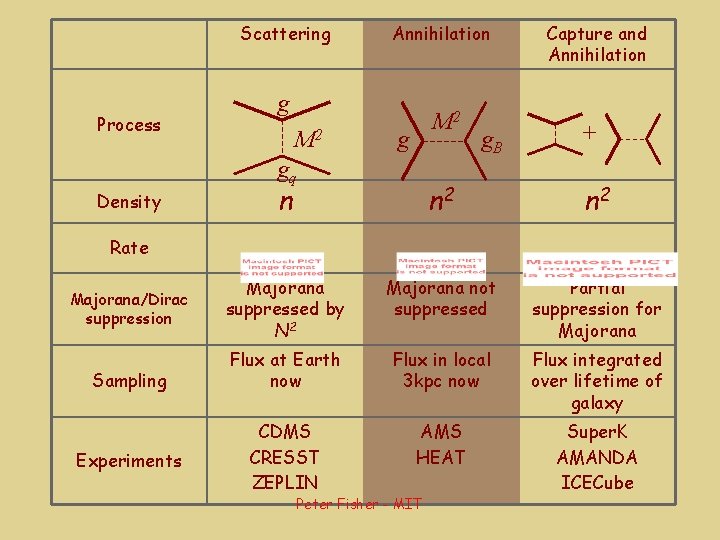
Scattering Process Annihilation g M 2 g gq Density g. B Capture and Annihilation + n n 2 Majorana suppressed by N 2 Majorana not suppressed Partial suppression for Majorana Flux at Earth now Flux in local 3 kpc now Flux integrated over lifetime of galaxy CDMS CRESST ZEPLIN AMS HEAT Super. K AMANDA ICECube Rate Majorana/Dirac suppression Sampling Experiments Peter Fisher - MIT
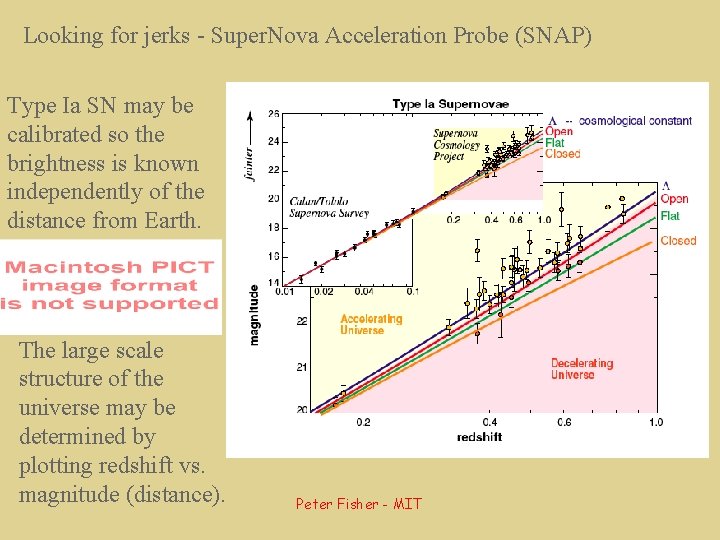
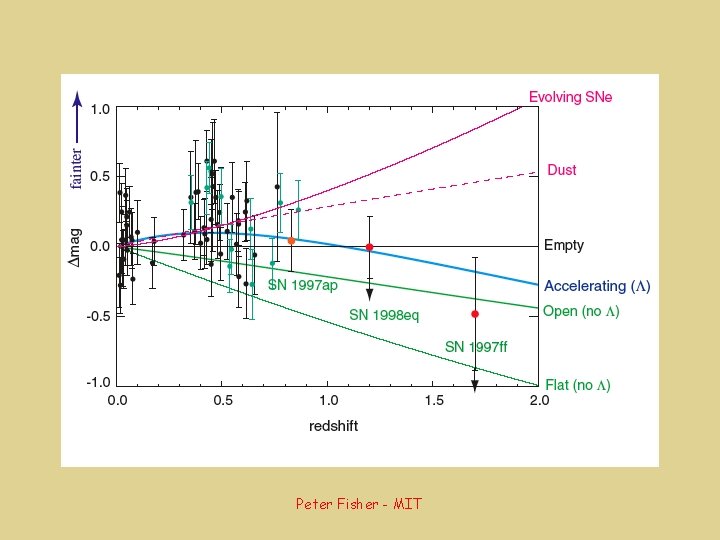
Looking for jerks - Super. Nova Acceleration Probe (SNAP) Type Ia SN may be calibrated so the brightness is known independently of the distance from Earth. The large scale structure of the universe may be determined by plotting redshift vs. magnitude (distance). Peter Fisher - MIT
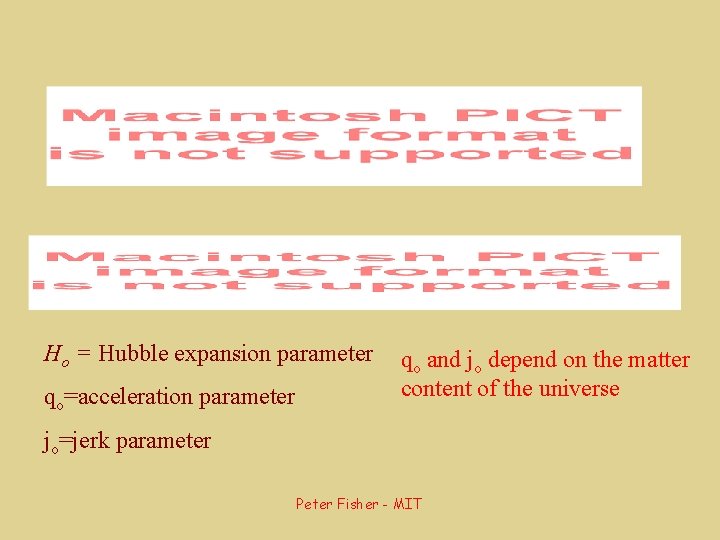
Ho = Hubble expansion parameter qo=acceleration parameter qo and jo depend on the matter content of the universe jo=jerk parameter Peter Fisher - MIT
Peter Fisher - MIT
Peter Fisher - MIT
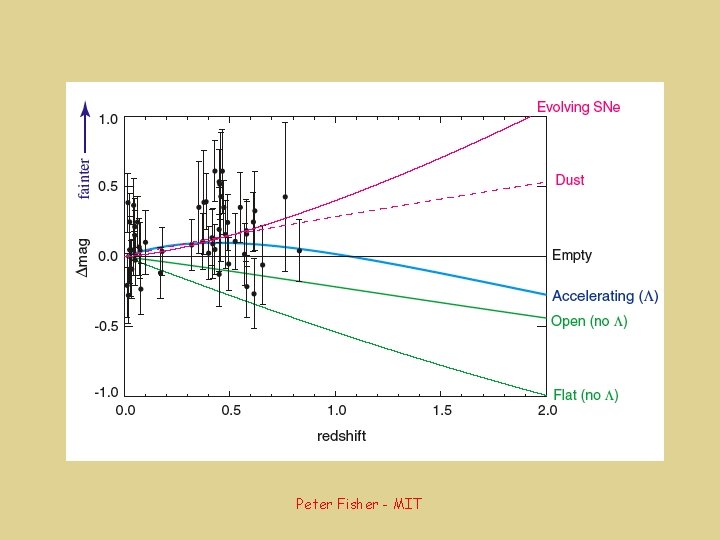
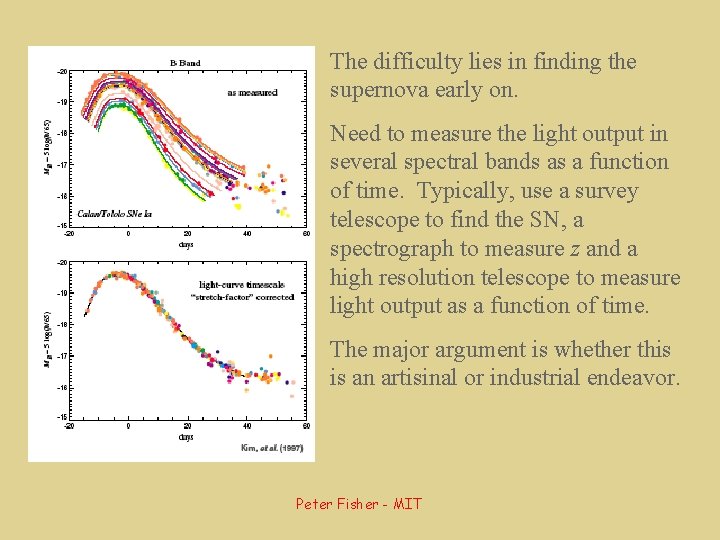
The difficulty lies in finding the supernova early on. Need to measure the light output in several spectral bands as a function of time. Typically, use a survey telescope to find the SN, a spectrograph to measure z and a high resolution telescope to measure light output as a function of time. The major argument is whether this is an artisinal or industrial endeavor. Peter Fisher - MIT
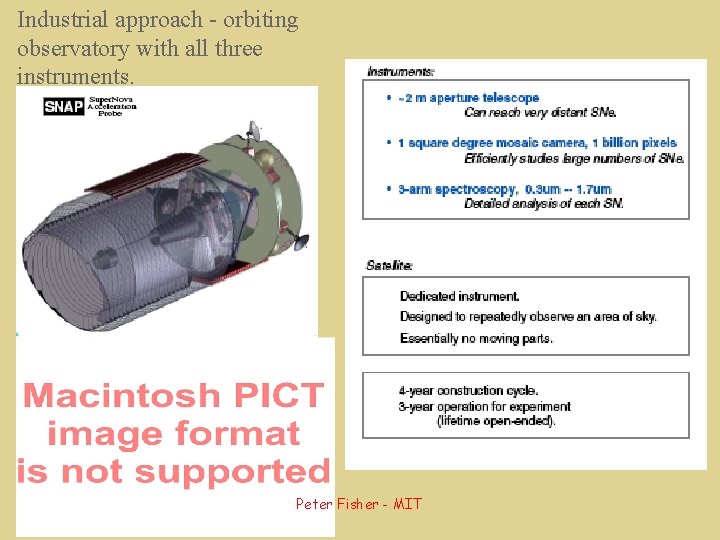
Industrial approach - orbiting observatory with all three instruments. Peter Fisher - MIT
Other major endeavors in the coming years: • JWST - second generation Hubble Space Telescope, 6 m aperture • GLAST - gamma ray observatory, ten times EGRET, launch 2006 • LISA - constellation of three satellites, long baseline gravity wave detection • OWL/Air. Watch - optical sensor satellite to observe cerenkov radiation from high energy cosmic rays in Earth’s atmosphere • Plank - next generation of cosmic background radiation measurement, <1 o resolution, polarization, 2009 Peter Fisher - MIT
Summary Space provides access to fundamental cosmological (SN, CMB) and astrophysical (charged cosmic rays, gamma rays, neutrinos) which impact particle physics. Space is a very challenging place to try to mount an experiment: • Extreme engineering • Extreme political considerations (c. f. Presidential speech of Jan. 14, 2004) Peter Fisher - MIT