
Space Part 1 Rotation Tilt Orbits and Seasons

Space Part 1 Rotation, Tilt, Orbits and Seasons Moon and Tides
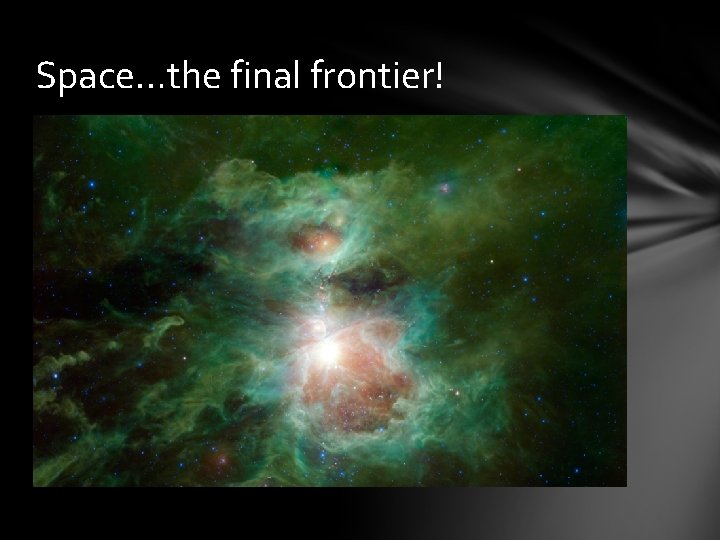
Space…the final frontier!
How big? • If the sun was a golf ball… • Earth would be the ball in a ball point pen and 10 ft from the sun • 2 more feet would take you to Mars • Neptune would be in Lakefield • Alpha Centauri is in Winnipeg • It takes 8. 3 min for the sun’s light to reach us • It takes 4. 3 years for the light from Alpha Centauri to reach us!!
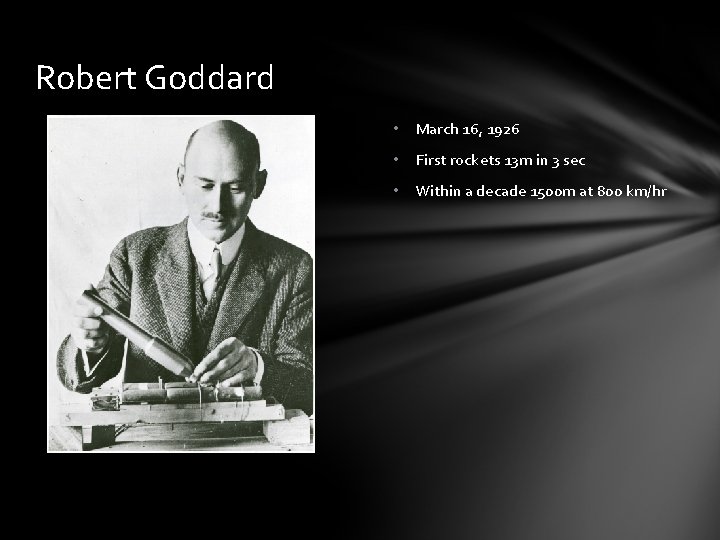
Robert Goddard • March 16, 1926 • First rockets 13 m in 3 sec • Within a decade 1500 m at 800 km/hr
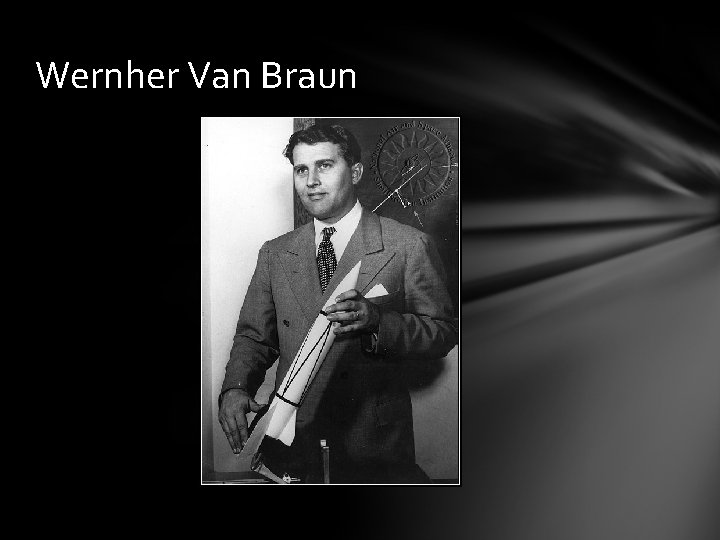
Wernher Van Braun
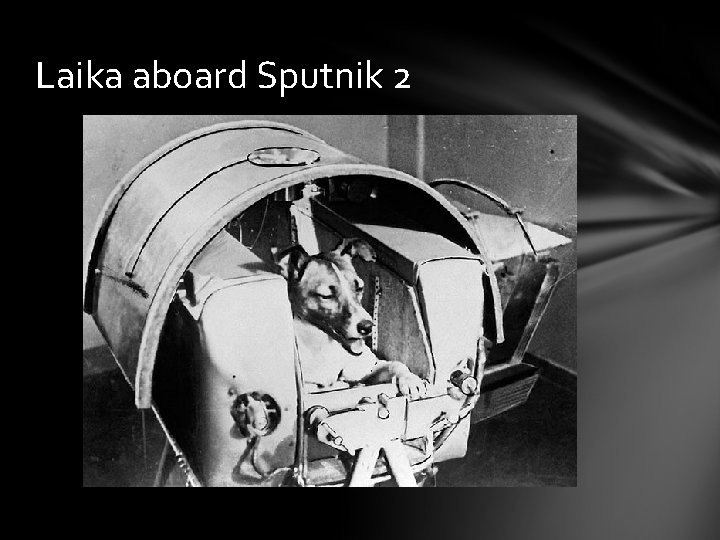
Laika aboard Sputnik 2
Models of the Solar System 1. Geocentric Model • • Geo = earth, Centr= centre Ptolemy during 2 nd century AD (C. E) Lasted 1500 years Earth is the center of the solar system (instead of the sun)
2. Heliocentric model • Helio = sun, centr= centre • Nicolaus Copernicus (early 1500’s) • Orbits with perfect circles 3. Johannes Kepler (1571 -1630) demonstrated elliptical orbits • Current model = heliocentric with elliptical orbits
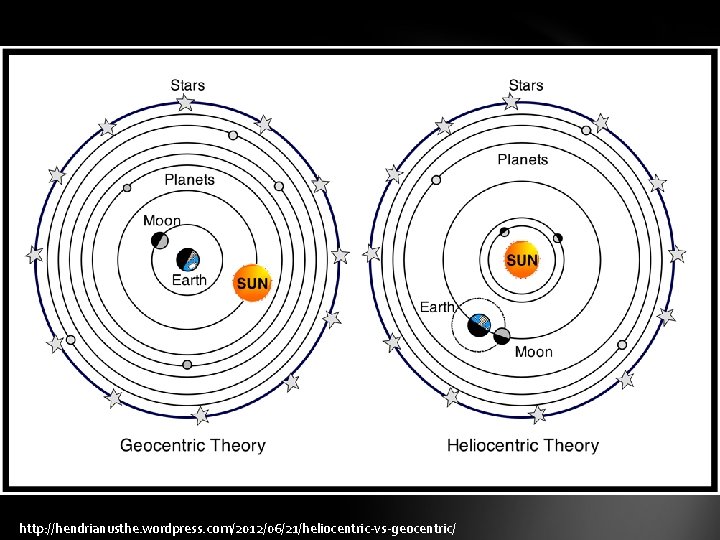
http: //hendrianusthe. wordpress. com/2012/06/21/heliocentric-vs-geocentric/
Orbits Orbit: the closed path a satellite takes around another body - All planets in our solar system orbit the sun - Moons orbit planets - DEMO (ball and string) Gravity: the force which pulls one mass toward another - Examples: - Human down toward the earth - Earth toward the sun - Moon toward the earth - Causes orbits, prevents satellites from flying off in a straight line
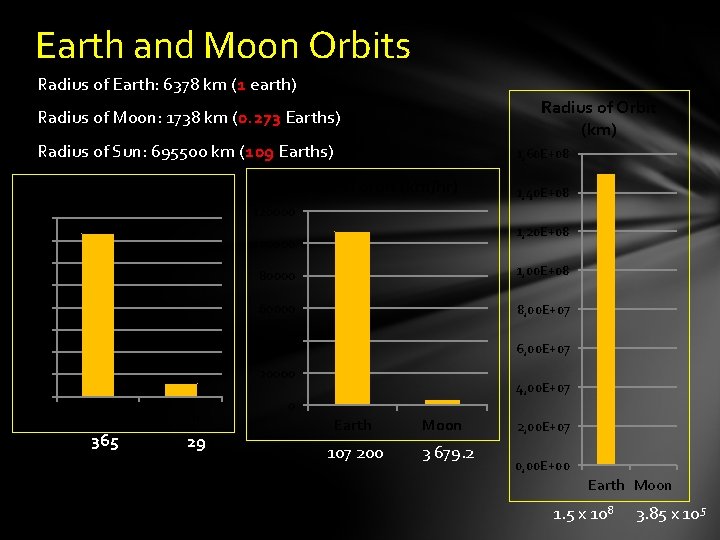
Earth and Moon Orbits Radius of Earth: 6378 km (1 earth) Radius of Orbit (km) Radius of Moon: 1738 km (0. 273 Earths) Radius of Sun: 695500 km (109 Earths) 1, 60 E+08 Speed of orbit (km/hr) Days/orbit 120000 400 350 300 250 200 150 100 50 0 1, 20 E+08 100000 80000 1, 00 E+08 60000 8, 00 E+07 40000 6, 00 E+07 20000 Earth 365 1, 40 E+08 Moon 29 4, 00 E+07 0 Earth 107 200 Moon 3 679. 2 2, 00 E+07 0, 00 E+00 Earth Moon 1. 5 x 10⁸ 3. 85 x 105

Rotation and Tilt Axis of rotation: The invisible line around which a celestial body rotates Orbit: the closed path a satellite takes around another body Tilt: The angle at which the axis lies relative to the perpendicular of its orbital plane (cardboard cutout in the demo)
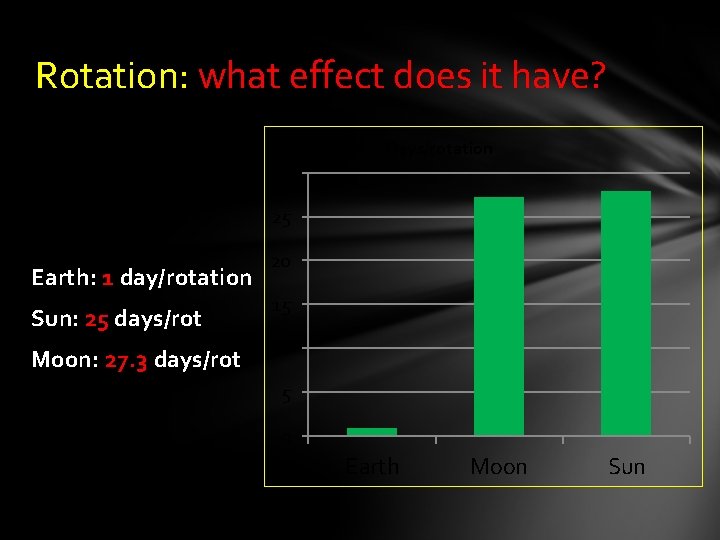
Rotation: what effect does it have? Days/rotation 30 25 Earth: 1 day/rotation Sun: 25 days/rot Moon: 27. 3 days/rot 20 15 10 5 0 Earth Moon Sun
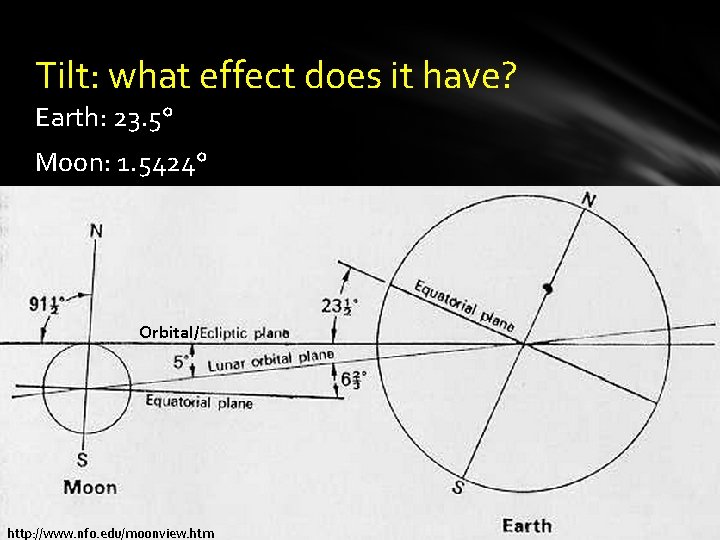
Tilt: what effect does it have? Earth: 23. 5° Moon: 1. 5424° Orbital/ http: //www. nfo. edu/moonview. htm
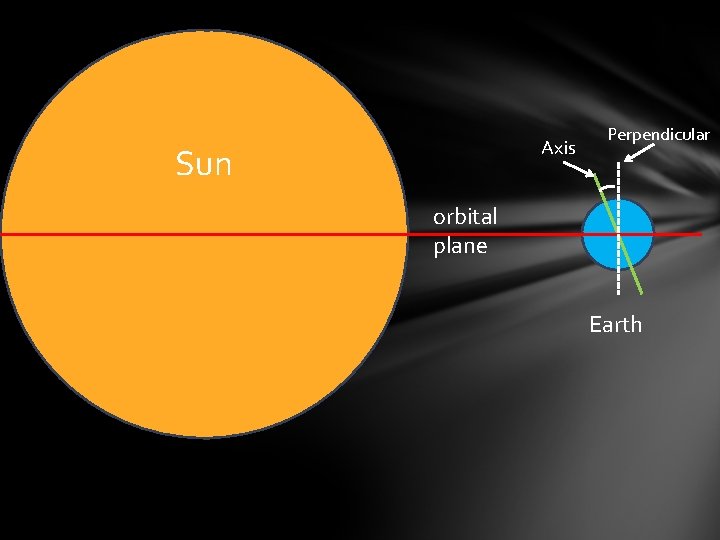
Axis Sun Perpendicular orbital plane Earth
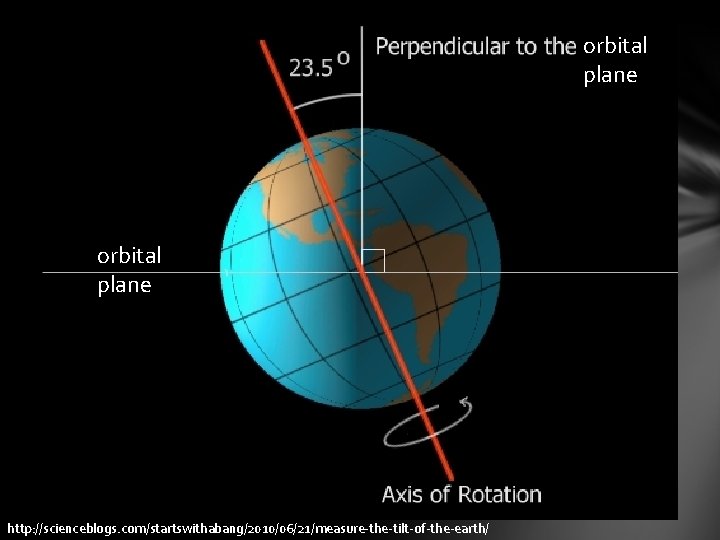
orbital plane http: //scienceblogs. com/startswithabang/2010/06/21/measure-the-tilt-of-the-earth/
Hemisphere Hemi = half Sphere = 3 D circle Hemisphere = half-sphere Demo with half of a broken sun ball
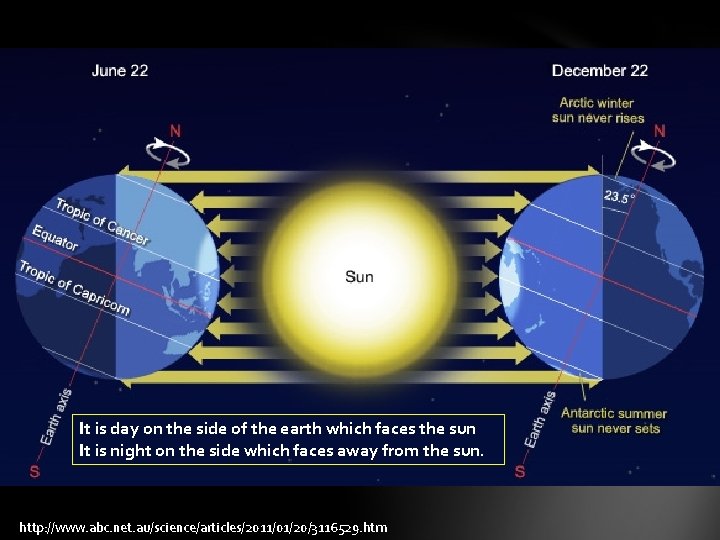
It is day on the side of the earth which faces the sun It is night on the side which faces away from the sun. http: //www. abc. net. au/science/articles/2011/01/20/3116529. htm
Globe and Light Demo (dots) What happens when the globe is tilted toward the sun? Away? Direct radiation: what happens when there is more?
Length of Day and Seasons Longer days when our hemisphere is tilted towards the sun (summer). • More direct radiation. Shorter days when our hemisphere is tilted away from the sun (winter). • Less direct radiation
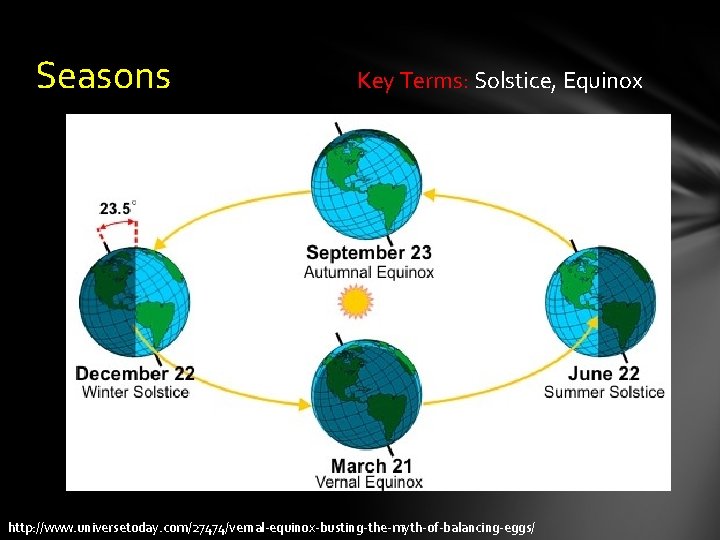
Seasons Key Terms: Solstice, Equinox http: //www. universetoday. com/27474/vernal-equinox-busting-the-myth-of-balancing-eggs/
Seasons Video http: //www. youtube. com/watch? v=Pgq 0 LTh. W 7 QA http: //www. youtube. com/watch? v=a. SNs 15 s. EINM https: //drive. google. com/folderview? id=0 B 0 E MJmnd. Bs_EQ 1 RWYl 9 hbk. Ni. Zl. E&usp=sharing
Homework Reading: pg 320 -328 Textbook Questions: pg. 328 # 2 -11
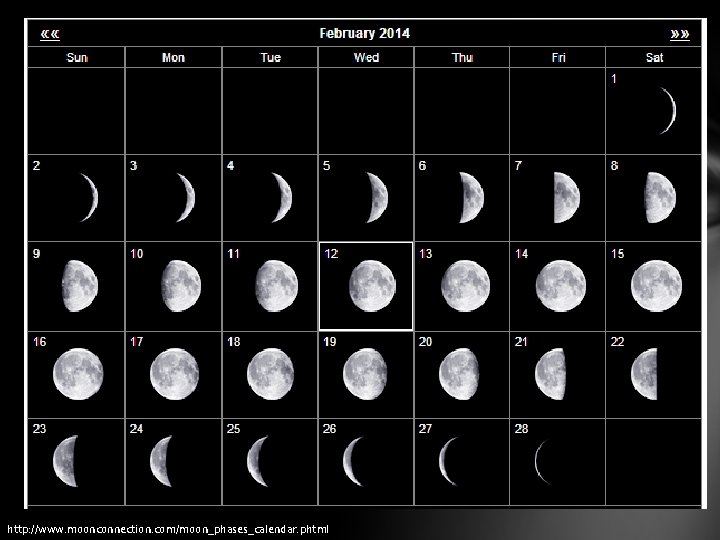
http: //www. moonconnection. com/moon_phases_calendar. phtml
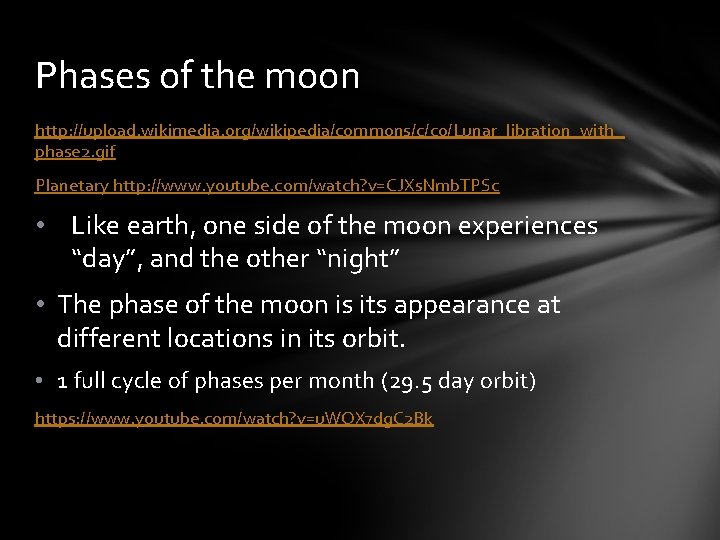
Phases of the moon http: //upload. wikimedia. org/wikipedia/commons/c/c 0/Lunar_libration_with_ phase 2. gif Planetary http: //www. youtube. com/watch? v=CJXs. Nmb. TPSc • Like earth, one side of the moon experiences “day”, and the other “night” • The phase of the moon is its appearance at different locations in its orbit. • 1 full cycle of phases per month (29. 5 day orbit) https: //www. youtube. com/watch? v=u. WOX 7 dg. C 2 Bk

Key phases Waxing moon: The bright portion is getting “larger” and sits on the right side Waning moon: The dark portion is getting “larger” and sits on the right side New moon: The moon is not visible (dark side faces earth) Full moon: The entire moon is bright and circular (light side faces earth)
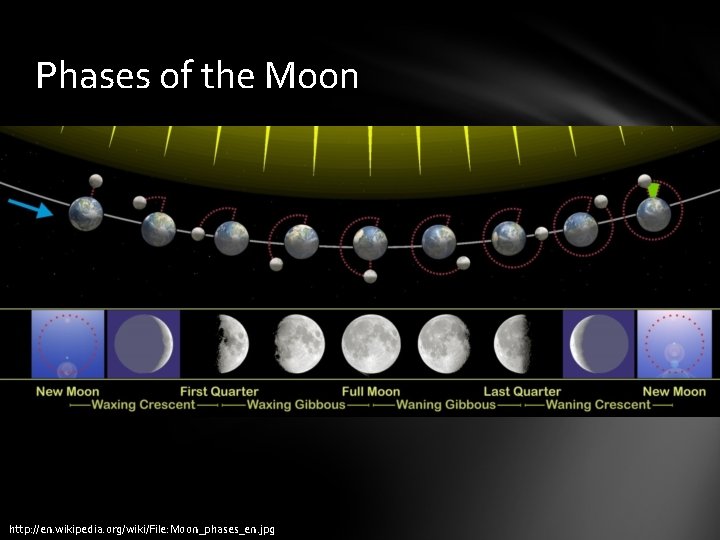
Phases of the Moon http: //en. wikipedia. org/wiki/File: Moon_phases_en. jpg
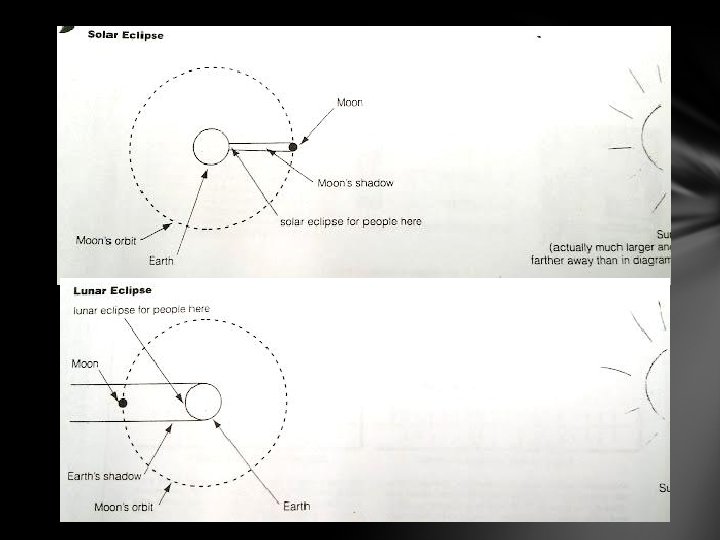
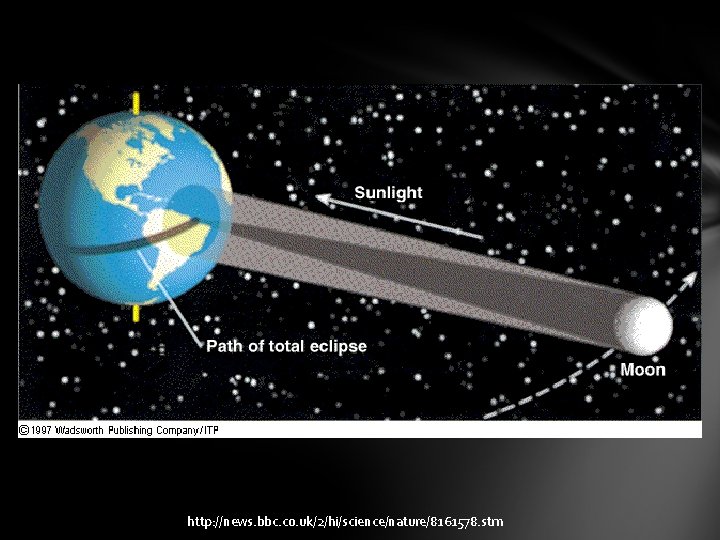
Eclipses Solar Eclipse: When our view of the sun is blocked out by the moon. Can only occur at a new moon, when the moon is between the Earth and Sun. Lunar Eclipse: When the moon is in the Earth’s shadow. Can only occur at a full moon, when the Earth lies between the moon and Sun. Hand Demo **Solar eclipses can only be seen from some locations on the earth. **Lunar eclipses are visible from anywhere with a view of the moon.
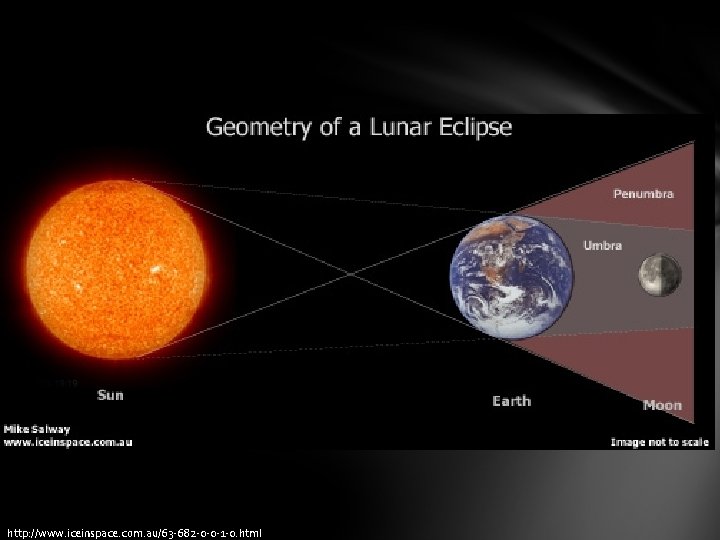
http: //www. iceinspace. com. au/63 -682 -0 -0 -1 -0. html
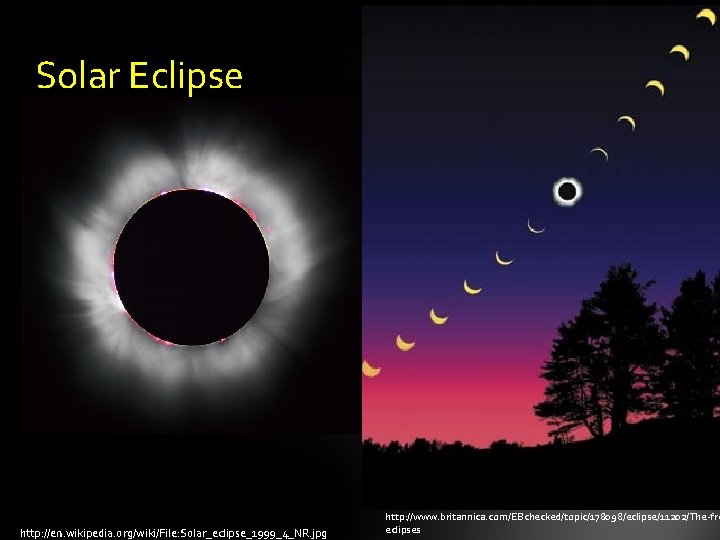
Solar Eclipse http: //en. wikipedia. org/wiki/File: Solar_eclipse_1999_4_NR. jpg http: //www. britannica. com/EBchecked/topic/178098/eclipse/11202/The-fre eclipses
http: //news. bbc. co. uk/2/hi/science/nature/8161578. stm
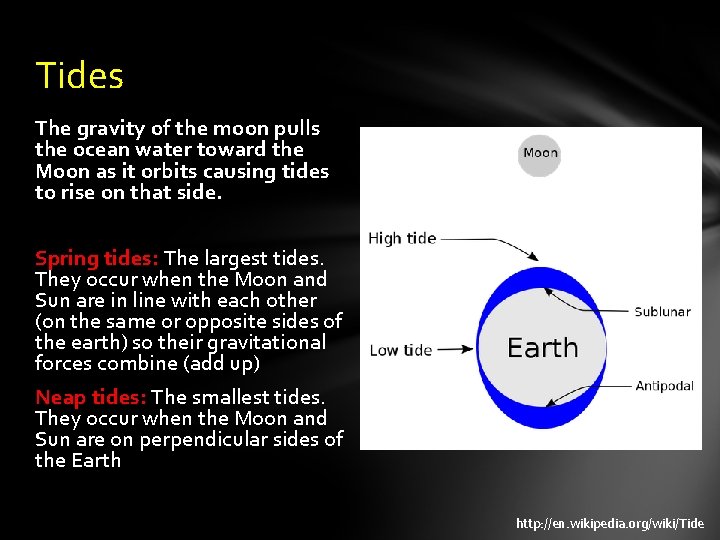
Tides The gravity of the moon pulls the ocean water toward the Moon as it orbits causing tides to rise on that side. Spring tides: The largest tides. They occur when the Moon and Sun are in line with each other (on the same or opposite sides of the earth) so their gravitational forces combine (add up) Neap tides: The smallest tides. They occur when the Moon and Sun are on perpendicular sides of the Earth http: //en. wikipedia. org/wiki/Tide
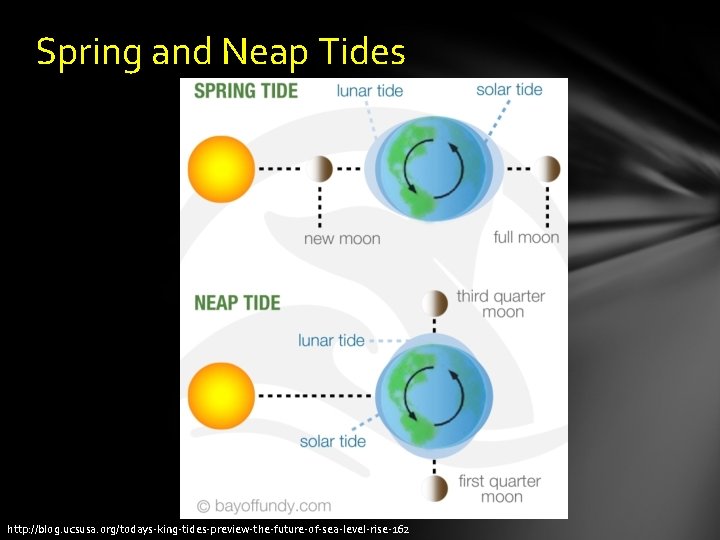
Spring and Neap Tides http: //blog. ucsusa. org/todays-king-tides-preview-the-future-of-sea-level-rise-162
Sources Hamilton, Calvin J. ; Hamilton, Rosanna L. , The Moon, Views of the Solar System, 1995– 2011 Wikipedia: http: //en. wikipedia. org/wiki/Orbit_of_the_Moon http: //en. wikipedia. org/wiki/Earth http: //en. wikipedia. org/wiki/Moon#cite_note-Solar. Views-98 http: //en. wikipedia. org/wiki/Lunar_eclipse
- Slides: 36