
Space Notes 1 Covers Objectives 1 2 Space
Space Notes 1 Covers Objectives 1 & 2
• Space Introduction Video
Celestial Bodies • Refers to a natural object out in space 1) Stars 2) Comets 3) Moons 4) Planets 5) Asteroids
Constellations • Constellations Song - You. Tube • patterns made up of stars 1) Ursa Major (The Great Bear) 2) Ursa Minor (The Little Bear) 3) Orion
Asterisms • smaller groups of stars that are present within constellations 1) The Big Dipper (in Ursa Major) 2) The Little Dipper (in Ursa Minor) 3) Orion's Belt (in Orion)
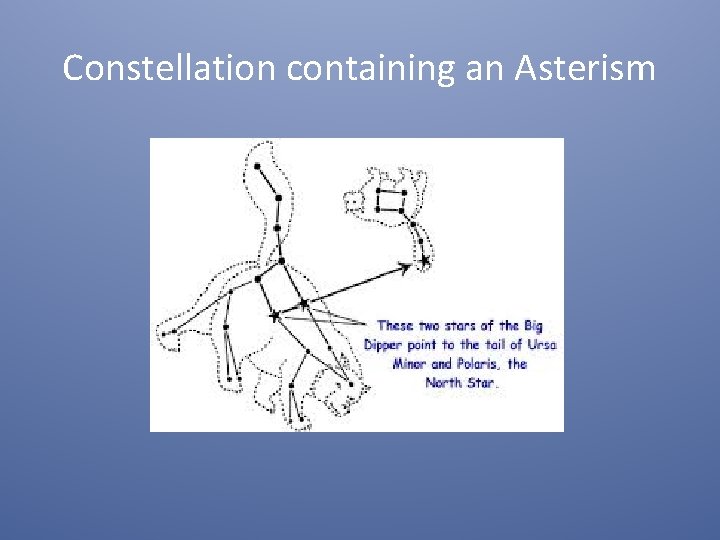
Constellation containing an Asterism
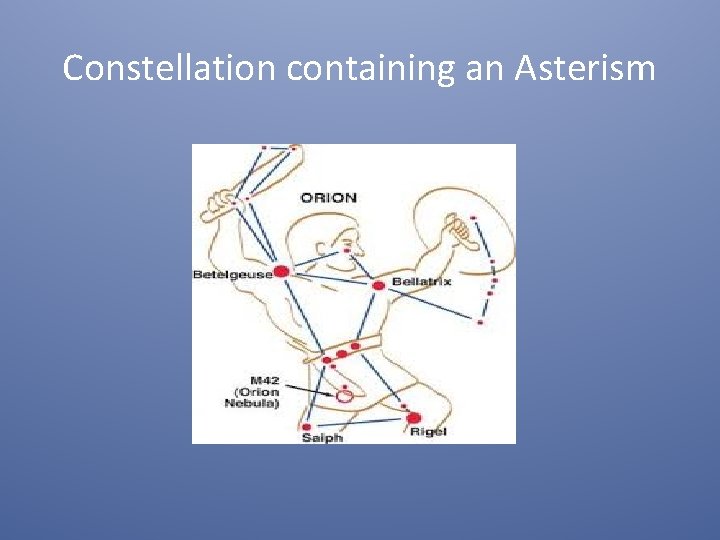
Constellation containing an Asterism
Celestial Body Movement • Celestial bodies move in a cyclic path called an orbit. • Orbits result from gravitational forces • Planets, sun, and moons all revolve on a central axis.
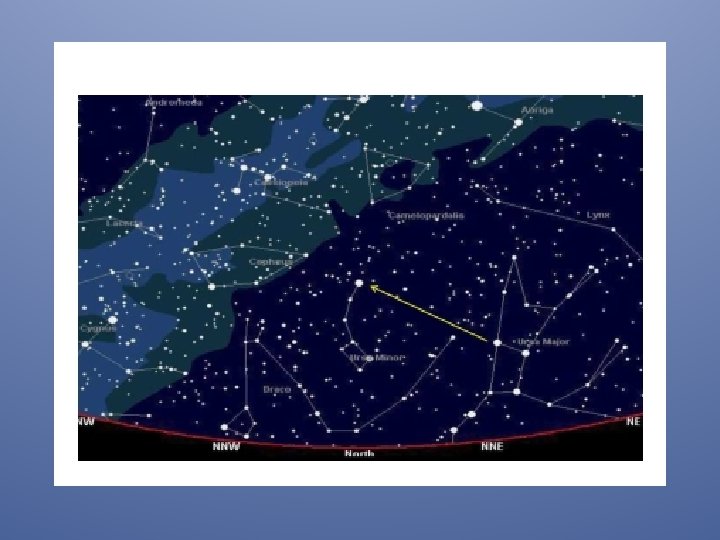
Stars (Ex: Sun) • celestial bodies that give off light and heat but are very far away. • Stars generally move from East to West • the point around which the stars rotate is the north star “Polaris”
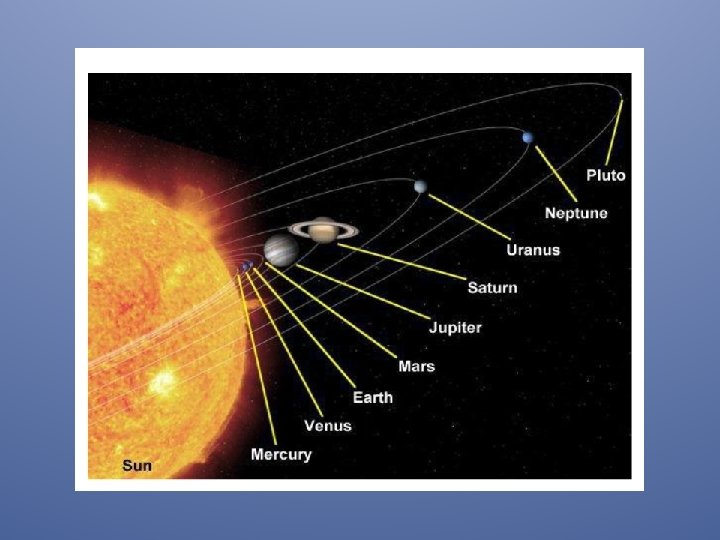
Planets • celestial bodies that orbit (revolve) the sun. • They are held in these elliptical orbits by the gravity of the sun and rotate on a central axis creating day and night. • Solar System Video - You. Tube
Early Models of the Universe • Aristotle(383 -322 B. C. E. ) • Visualized the universe as being geocentric. This means the Earth is the center of the universe and everything else revolves around it. • He believed that the Earth was a sphere due to the curved edges observed during a lunar eclipse.
Ptolemy • Based his model on his observations of Mars. • Mars orbital path creates a loop or s-shape in the sky. • His model showed each planet attached to a crystal sphere with its centre at Earth.
• Each planet was not attached directly to its sphere but to an off-centre wheel (epicycle). • Accepted for nearly 15 oo years. • Geocentric to Heliocentric Video - You. Tube
Copernicus(1473 -1543) • Believed in a heliocentric universe (Sun at the centre). • The Earth rotated on its axis once daily and revolved around the Sun once a year.
Galileo(1564 -1642) • First person to view the “heavens” through a telescope. • Allowed him to see objects about 20 x closer.
• • He observed: Craters on the Moon Spots on the Sun Four “stars” orbiting Jupiter (called the Galilean Moons)
• Now that the Sun was placed at the centre of our solar system, other astronomers could work to understand the motion of the planets. • Improvements in the telescope would show new and strange objects never imagined!
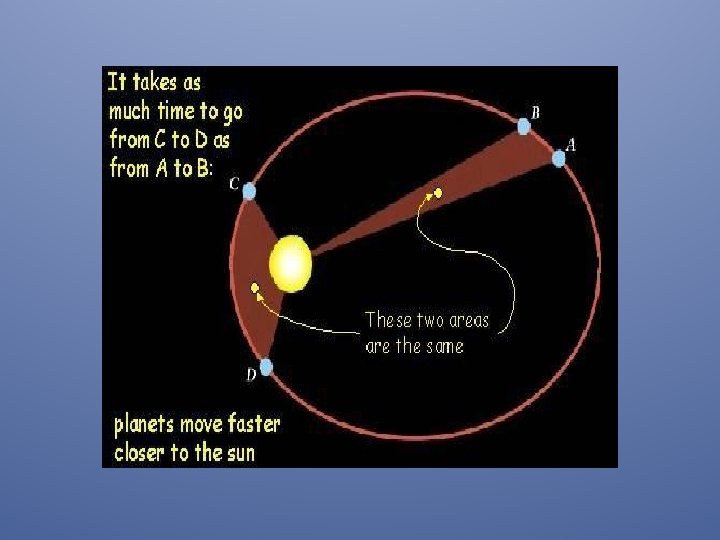
Johannes Kepler(1571 -1630) • Developed 3 Laws of Planetary Motion • 1. All planets move in ellipses with the Sun at one focus. • 2. Planets sweep out at equal areas of their elliptical orbit in equal times.
• 3. The time a planet takes to revolve around the Sun is directly related to how far away it is from the Sun.
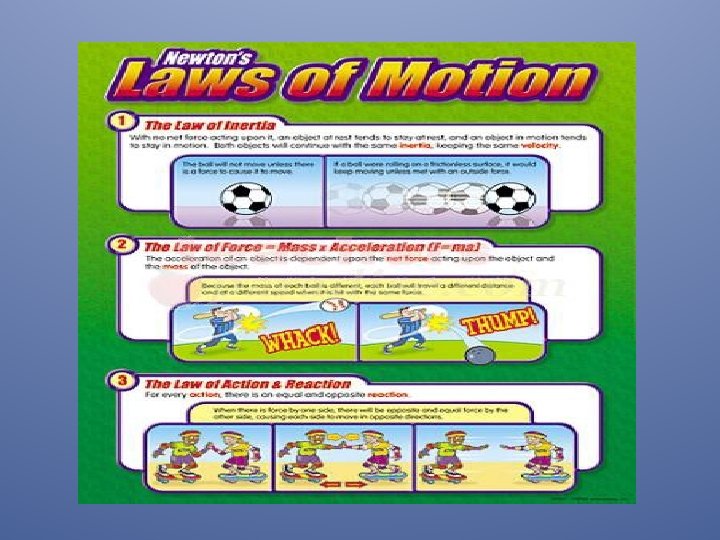
Sir Isaac Newton (1643 -1727) • Developed the three laws of motion. • First to show that the force of gravity affects all celestial bodies, causing them to stay in orbit.
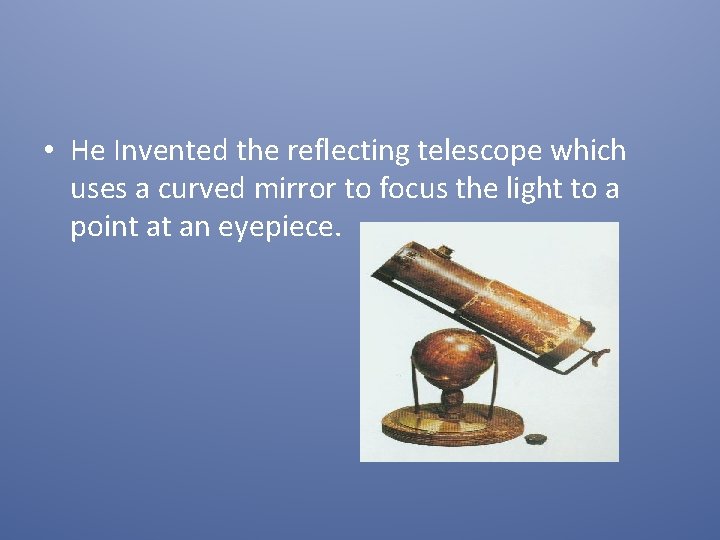
• He Invented the reflecting telescope which uses a curved mirror to focus the light to a point at an eyepiece.
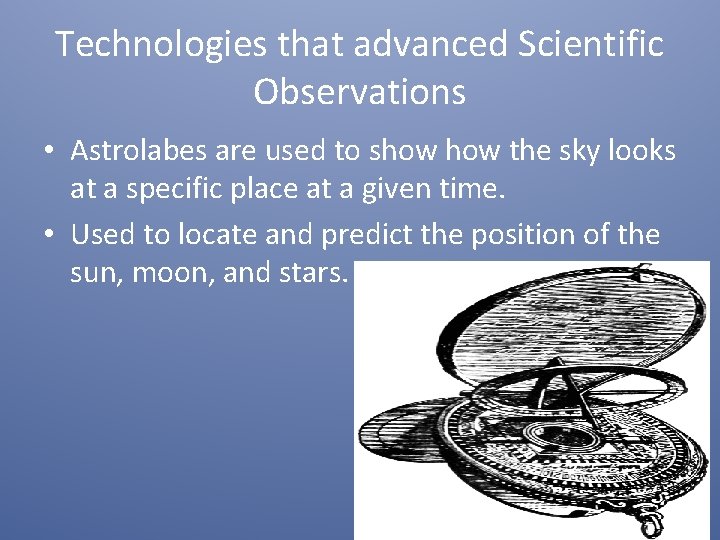
Technologies that advanced Scientific Observations • Astrolabes are used to show the sky looks at a specific place at a given time. • Used to locate and predict the position of the sun, moon, and stars.
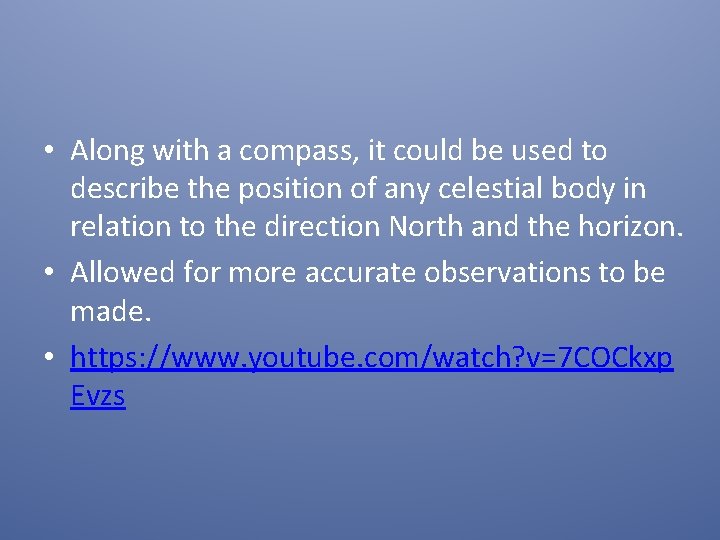
• Along with a compass, it could be used to describe the position of any celestial body in relation to the direction North and the horizon. • Allowed for more accurate observations to be made. • https: //www. youtube. com/watch? v=7 COCkxp Evzs
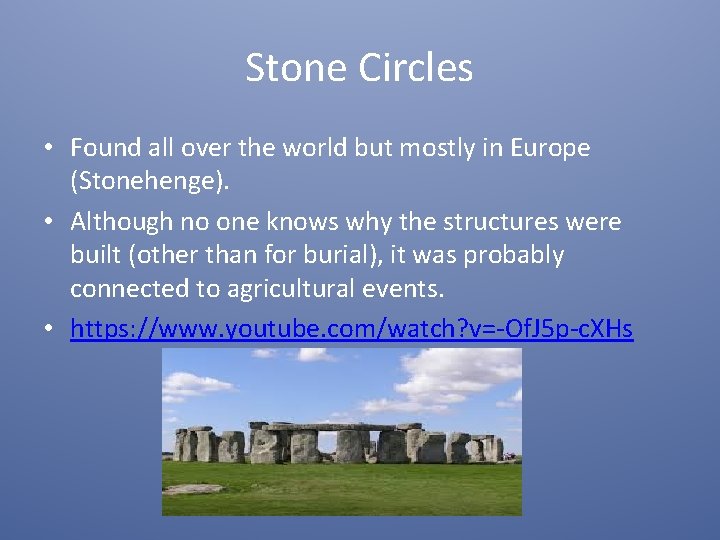
Stone Circles • Found all over the world but mostly in Europe (Stonehenge). • Although no one knows why the structures were built (other than for burial), it was probably connected to agricultural events. • https: //www. youtube. com/watch? v=-Of. J 5 p-c. XHs
Telescope • Allowed people to view objects that could not be seen with the naked eye. • https: //www. youtube. com/watch? v=JCh. DGRh p. Aw. A
Textbook Questions Pg 386 • #2, 4, 8, 9, 13
- Slides: 30