
SPACE EXPLORATION TIMELINE Two countries have dominated space

- Slides: 39
SPACE EXPLORATION TIMELINE Two countries have dominated space exploration: the United States and the Soviet Union. These nations competed in the "space race, " or the race to the Moon, which the U. S. eventually won. Even after man first walked on the Moon, fascination with what is in space has continued.
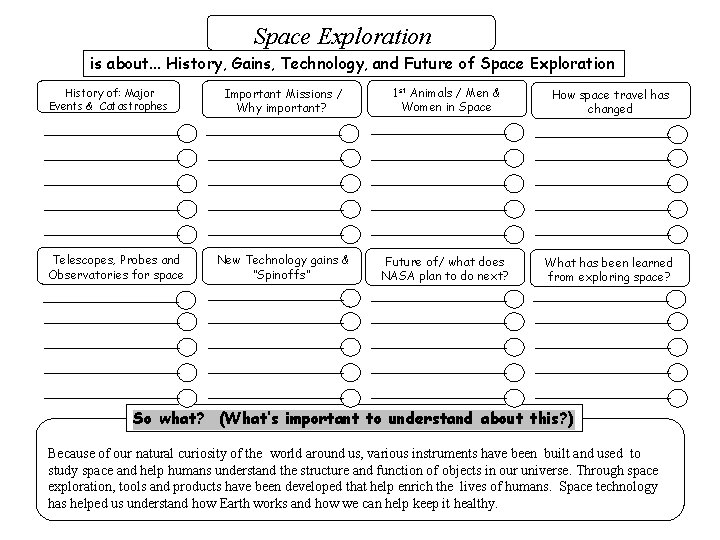
Space Exploration is about. . . History, Gains, Technology, and Future of Space Exploration History of: Major Events & Catastrophes Telescopes, Probes and Observatories for space Important Missions / Why important? 1 st Animals / Men & Women in Space How space travel has changed New Technology gains & “Spinoffs” Future of/ what does NASA plan to do next? What has been learned from exploring space? So what? (What’s important to understand about this? ) Because of our natural curiosity of the world around us, various instruments have been built and used to study space and help humans understand the structure and function of objects in our universe. Through space exploration, tools and products have been developed that help enrich the lives of humans. Space technology has helped us understand how Earth works and how we can help keep it healthy.
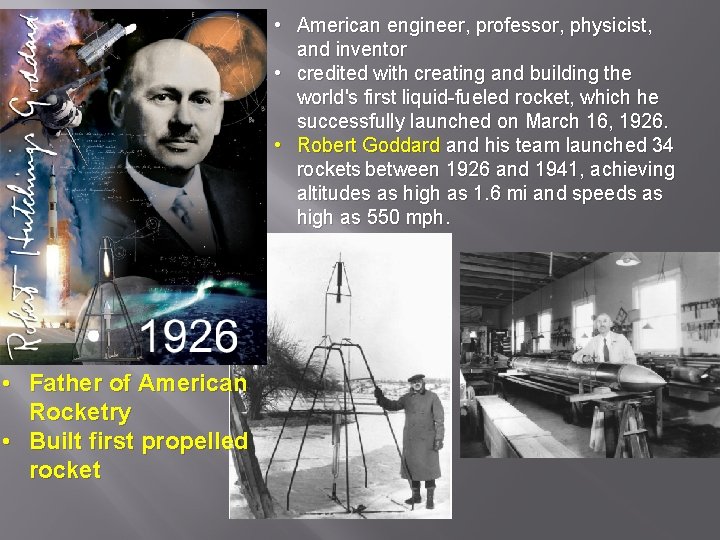
• American engineer, professor, physicist, and inventor • credited with creating and building the world's first liquid-fueled rocket, which he successfully launched on March 16, 1926. • Robert Goddard and his team launched 34 rockets between 1926 and 1941, achieving altitudes as high as 1. 6 mi and speeds as high as 550 mph. • Father of American Rocketry • Built first propelled rocket
Fun Facts
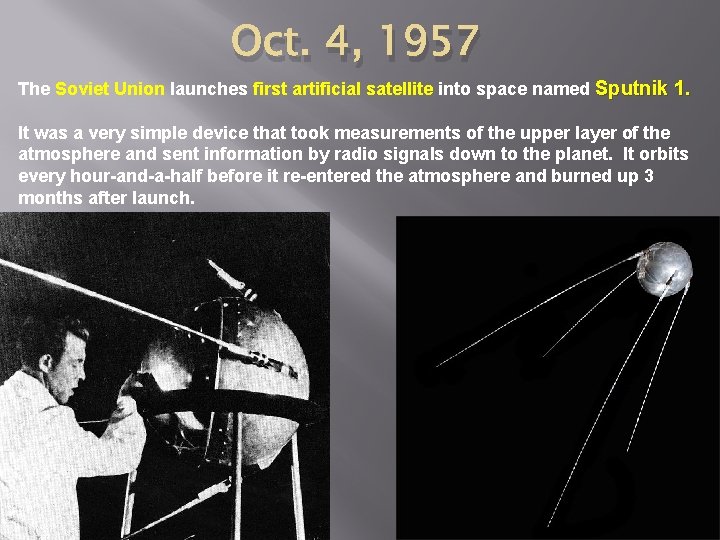
Oct. 4, 1957 The Soviet Union launches first artificial satellite into space named Sputnik 1. It was a very simple device that took measurements of the upper layer of the atmosphere and sent information by radio signals down to the planet. It orbits every hour-and-a-half before it re-entered the atmosphere and burned up 3 months after launch.
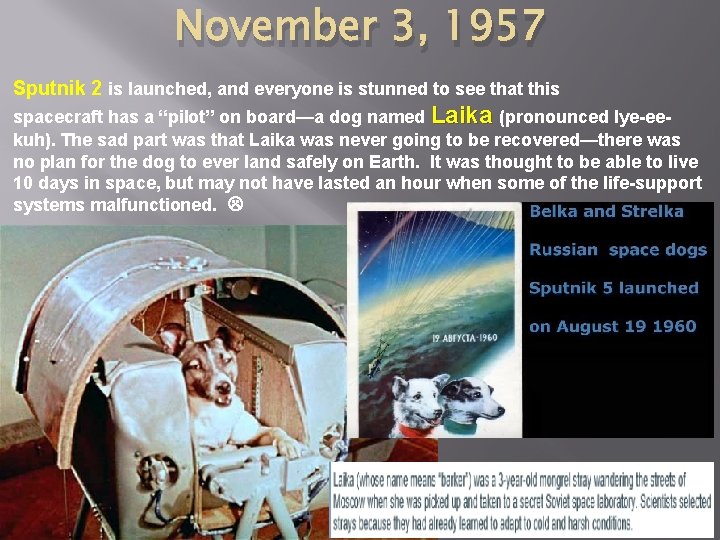
November 3, 1957 Sputnik 2 is launched, and everyone is stunned to see that this spacecraft has a “pilot” on board—a dog named Laika (pronounced lye-eekuh). The sad part was that Laika was never going to be recovered—there was no plan for the dog to ever land safely on Earth. It was thought to be able to live 10 days in space, but may not have lasted an hour when some of the life-support systems malfunctioned.
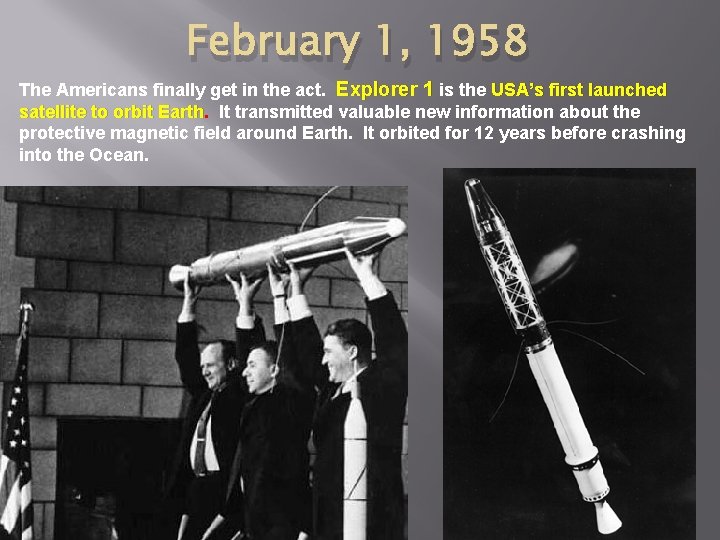
February 1, 1958 The Americans finally get in the act. Explorer 1 is the USA’s first launched satellite to orbit Earth It transmitted valuable new information about the protective magnetic field around Earth. It orbited for 12 years before crashing into the Ocean.
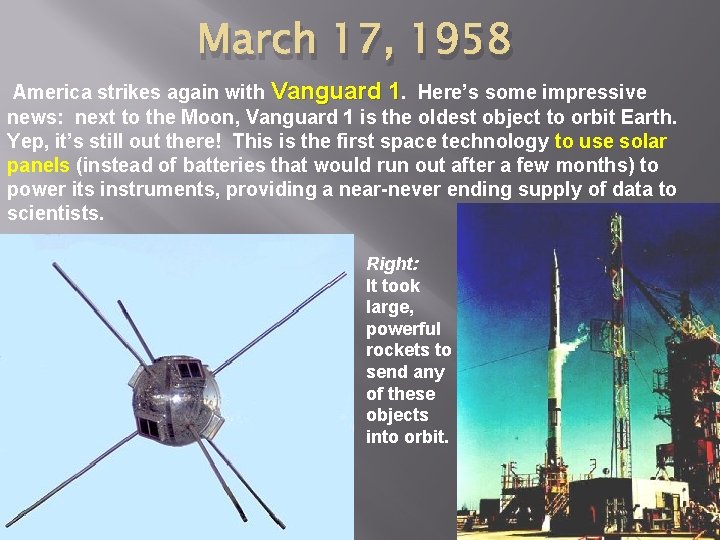
March 17, 1958 America strikes again with Vanguard 1. Here’s some impressive news: next to the Moon, Vanguard 1 is the oldest object to orbit Earth. Yep, it’s still out there! This is the first space technology to use solar panels (instead of batteries that would run out after a few months) to power its instruments, providing a near-never ending supply of data to scientists. Right: It took large, powerful rockets to send any of these objects into orbit.
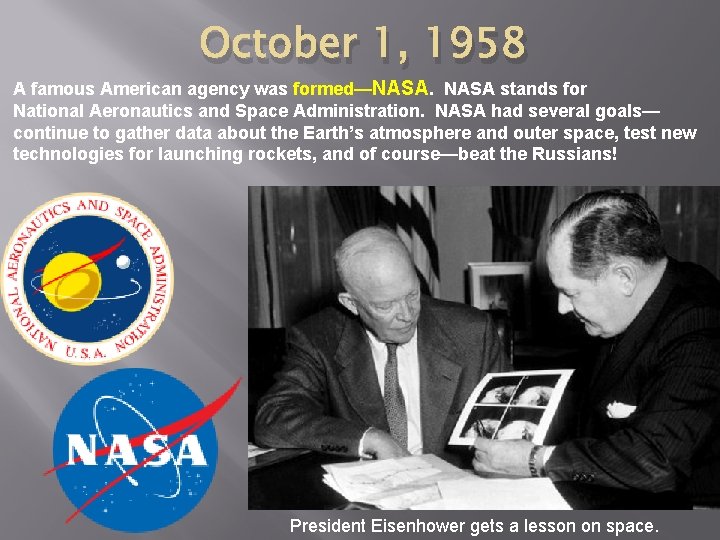
October 1, 1958 A famous American agency was formed—NASA stands for National Aeronautics and Space Administration. NASA had several goals— continue to gather data about the Earth’s atmosphere and outer space, test new technologies for launching rockets, and of course—beat the Russians! President Eisenhower gets a lesson on space.
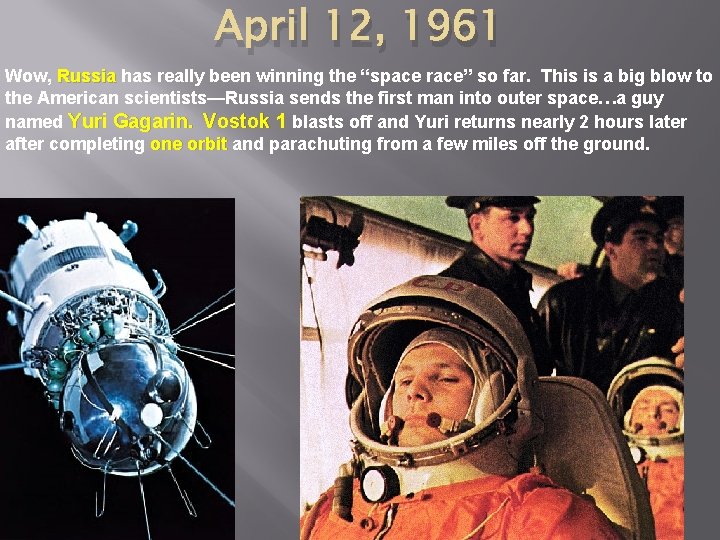
April 12, 1961 Wow, Russia has really been winning the “space race” so far. This is a big blow to the American scientists—Russia sends the first man into outer space…a guy named Yuri Gagarin. Vostok 1 blasts off and Yuri returns nearly 2 hours later after completing one orbit and parachuting from a few miles off the ground.
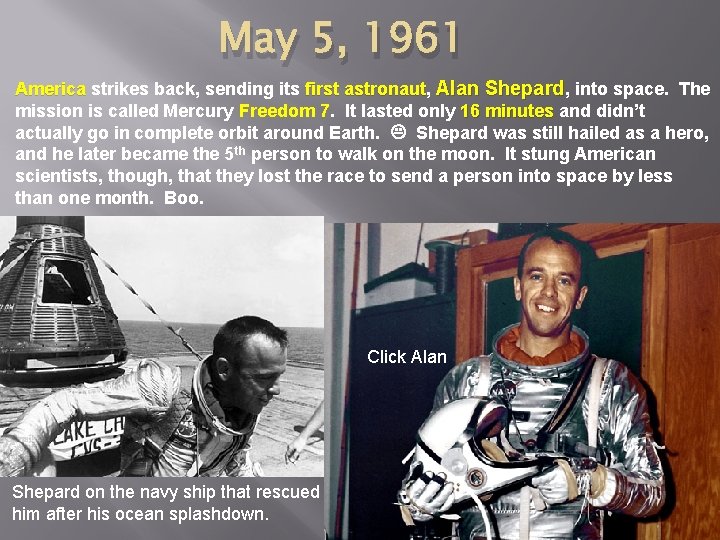
May 5, 1961 America strikes back, sending its first astronaut, astronaut Alan Shepard, into space. The mission is called Mercury Freedom 7. It lasted only 16 minutes and didn’t actually go in complete orbit around Earth. Shepard was still hailed as a hero, and he later became the 5 th person to walk on the moon. It stung American scientists, though, that they lost the race to send a person into space by less than one month. Boo. Click Alan Shepard on the navy ship that rescued him after his ocean splashdown.
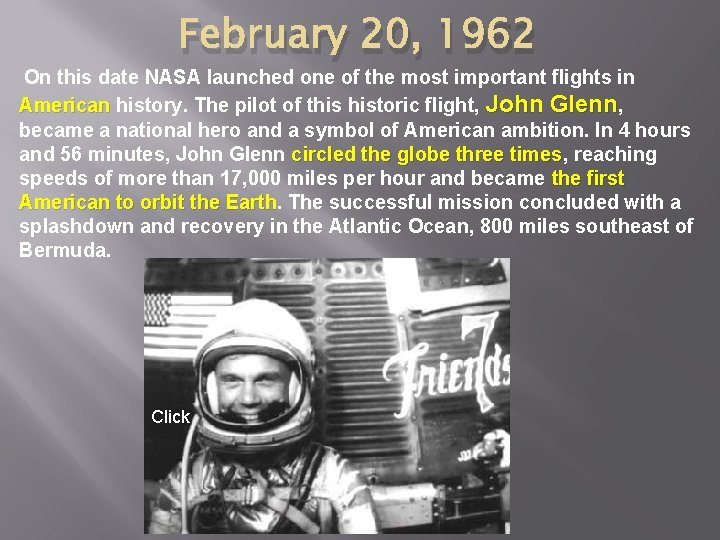
February 20, 1962 On this date NASA launched one of the most important flights in American history. The pilot of this historic flight, John Glenn, became a national hero and a symbol of American ambition. In 4 hours and 56 minutes, John Glenn circled the globe three times, times reaching speeds of more than 17, 000 miles per hour and became the first American to orbit the Earth The successful mission concluded with a splashdown and recovery in the Atlantic Ocean, 800 miles southeast of Bermuda. Click
June 16, 1963 Vostok 6 blasted off in Russia On board was the first woman in space, so the Russians beat us again. Her name was Valentia Tereshkova, Tereshkova and she recorded data about the atmosphere for 3 days before returning safely to Earth.
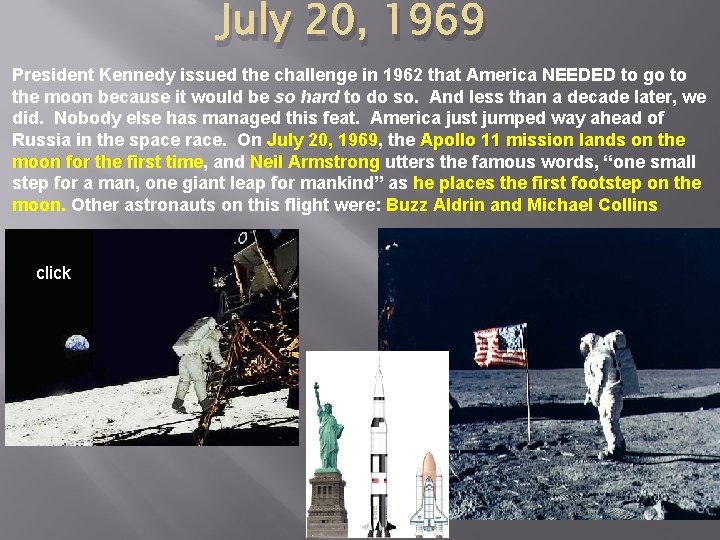
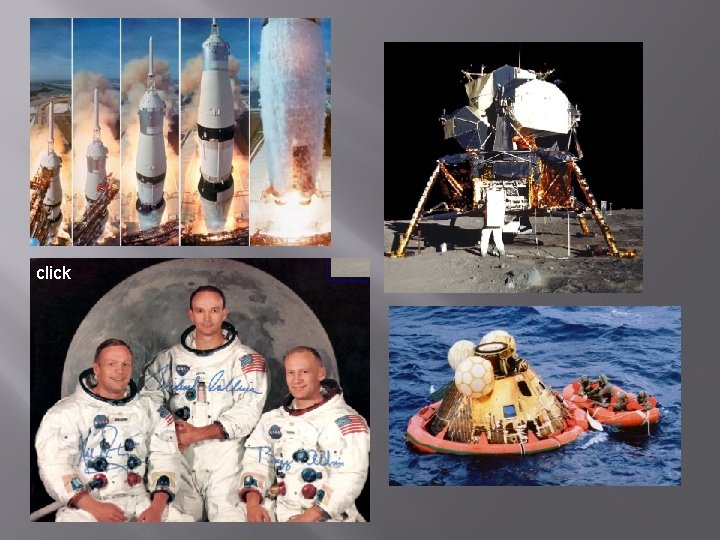
July 20, 1969 President Kennedy issued the challenge in 1962 that America NEEDED to go to the moon because it would be so hard to do so. And less than a decade later, we did. Nobody else has managed this feat. America just jumped way ahead of Russia in the space race. On July 20, 1969, the Apollo 11 mission lands on the moon for the first time, time and Neil Armstrong utters the famous words, “one small step for a man, one giant leap for mankind” as he places the first footstep on the moon. Other astronauts on this flight were: Buzz Aldrin and Michael Collins click
click
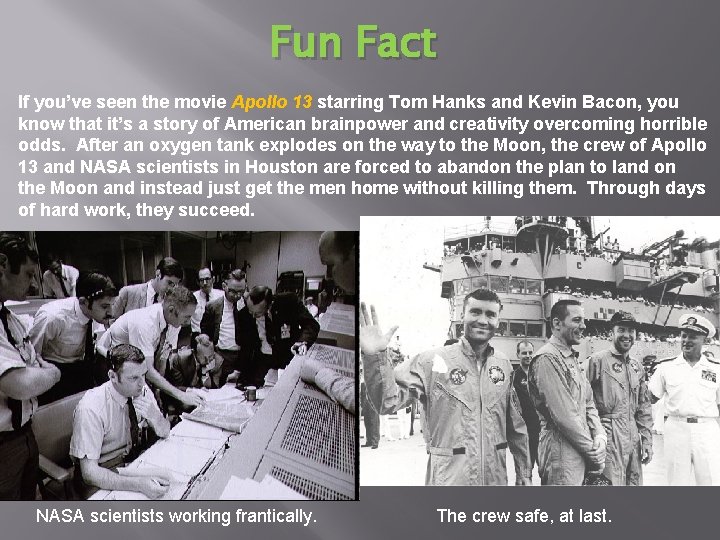
Fun Fact If you’ve seen the movie Apollo 13 starring Tom Hanks and Kevin Bacon, you know that it’s a story of American brainpower and creativity overcoming horrible odds. After an oxygen tank explodes on the way to the Moon, the crew of Apollo 13 and NASA scientists in Houston are forced to abandon the plan to land on the Moon and instead just get the men home without killing them. Through days of hard work, they succeed. NASA scientists working frantically. The crew safe, at last.
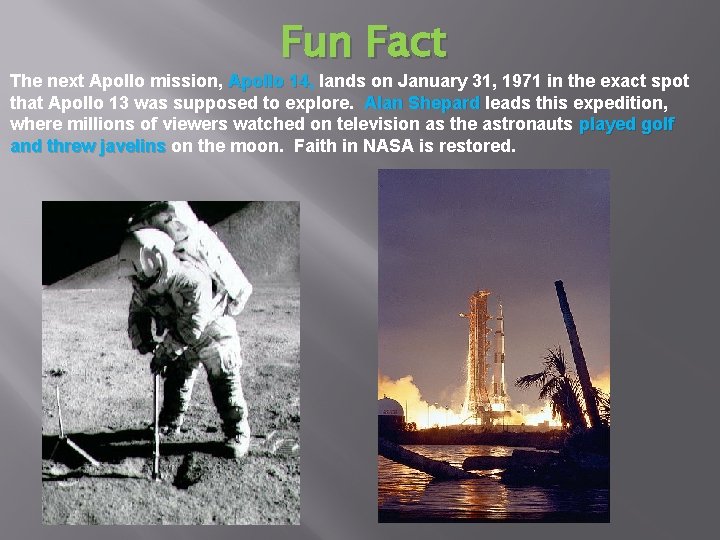
Fun Fact The next Apollo mission, Apollo 14, 14 lands on January 31, 1971 in the exact spot that Apollo 13 was supposed to explore. Alan Shepard leads this expedition, where millions of viewers watched on television as the astronauts played golf and threw javelins on the moon. Faith in NASA is restored.
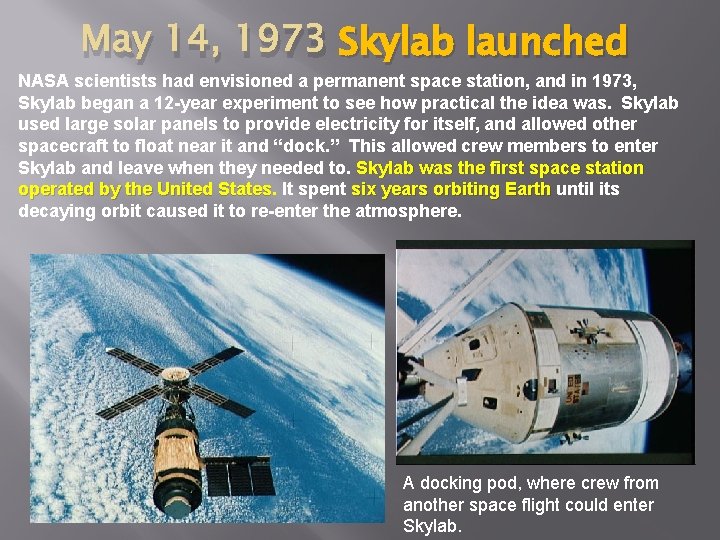
May 14, 1973 Skylab launched NASA scientists had envisioned a permanent space station, and in 1973, Skylab began a 12 -year experiment to see how practical the idea was. Skylab used large solar panels to provide electricity for itself, and allowed other spacecraft to float near it and “dock. ” This allowed crew members to enter Skylab and leave when they needed to. Skylab was the first space station operated by the United States It spent six years orbiting Earth until its decaying orbit caused it to re-enter the atmosphere. A docking pod, where crew from another space flight could enter Skylab.
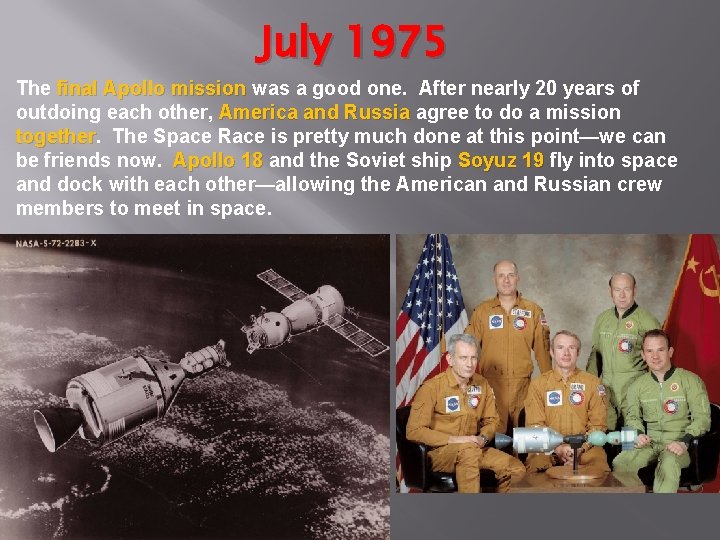
July 1975 The final Apollo mission was a good one. After nearly 20 years of outdoing each other, America and Russia agree to do a mission together The Space Race is pretty much done at this point—we can be friends now. Apollo 18 and the Soviet ship Soyuz 19 fly into space and dock with each other—allowing the American and Russian crew members to meet in space.
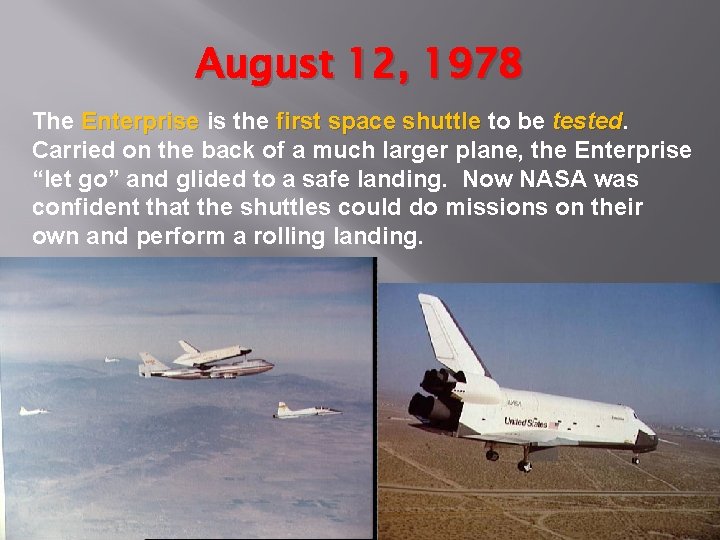
August 12, 1978 The Enterprise is the first space shuttle to be tested Carried on the back of a much larger plane, the Enterprise “let go” and glided to a safe landing. Now NASA was confident that the shuttles could do missions on their own and perform a rolling landing.
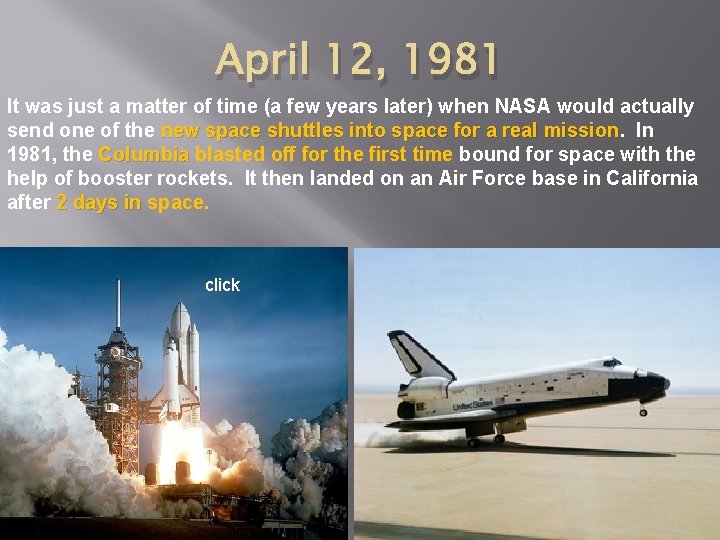
April 12, 1981 It was just a matter of time (a few years later) when NASA would actually send one of the new space shuttles into space for a real mission In 1981, the Columbia blasted off for the first time bound for space with the help of booster rockets. It then landed on an Air Force base in California after 2 days in space. click
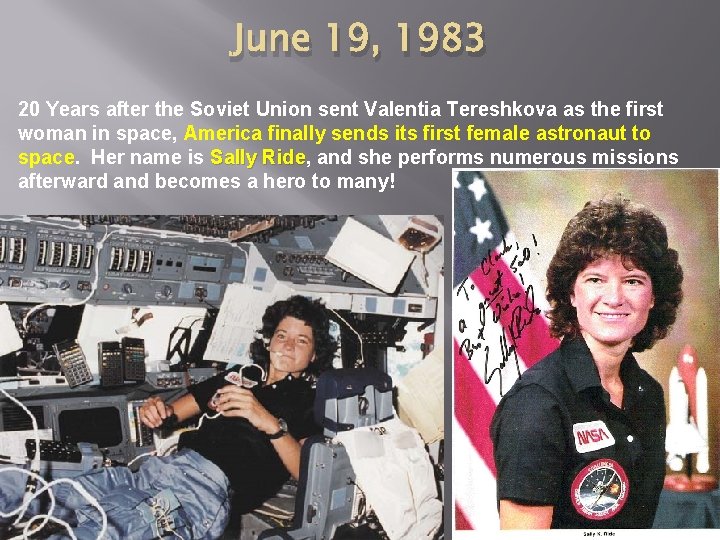
June 19, 1983 20 Years after the Soviet Union sent Valentia Tereshkova as the first woman in space, America finally sends its first female astronaut to space. Her name is Sally Ride, Ride and she performs numerous missions afterward and becomes a hero to many!
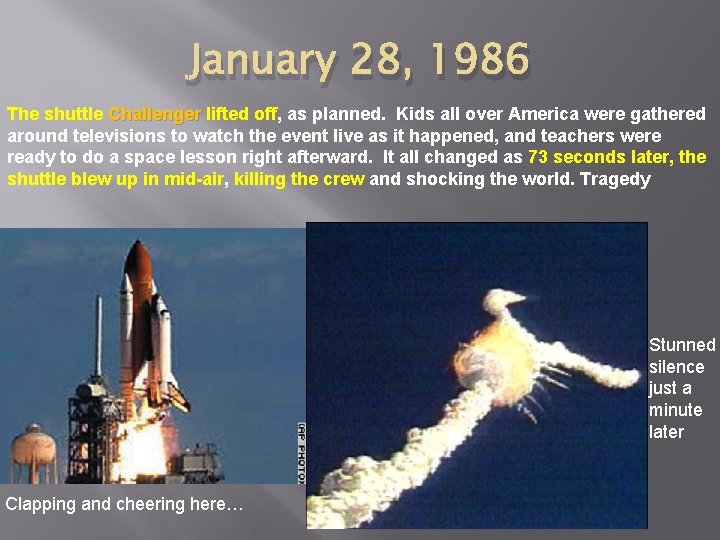
January 28, 1986 The shuttle Challenger lifted off, as planned. Kids all over America were gathered around televisions to watch the event live as it happened, and teachers were ready to do a space lesson right afterward. It all changed as 73 seconds later, the shuttle blew up in mid-air, killing the crew and shocking the world. Tragedy Stunned silence just a minute later Clapping and cheering here…
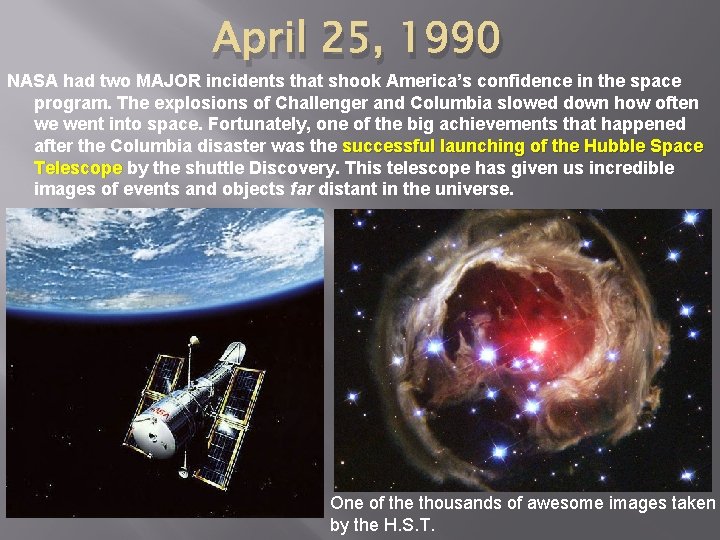
April 25, 1990 NASA had two MAJOR incidents that shook America’s confidence in the space program. The explosions of Challenger and Columbia slowed down how often we went into space. Fortunately, one of the big achievements that happened after the Columbia disaster was the successful launching of the Hubble Space Telescope by the shuttle Discovery. This telescope has given us incredible images of events and objects far distant in the universe. One of the thousands of awesome images taken by the H. S. T.
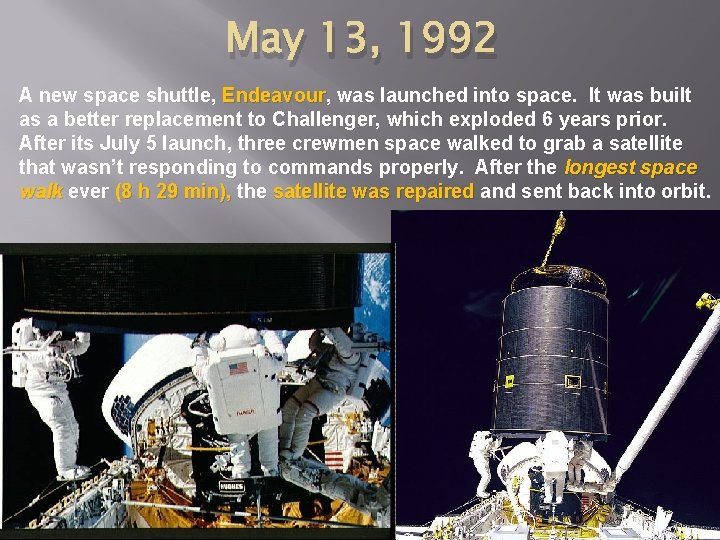
May 13, 1992 A new space shuttle, Endeavour was launched into space. It was built as a better replacement to Challenger, which exploded 6 years prior. After its July 5 launch, three crewmen space walked to grab a satellite that wasn’t responding to commands properly. After the longest space walk ever (8 h 29 min), the satellite was repaired and sent back into orbit.
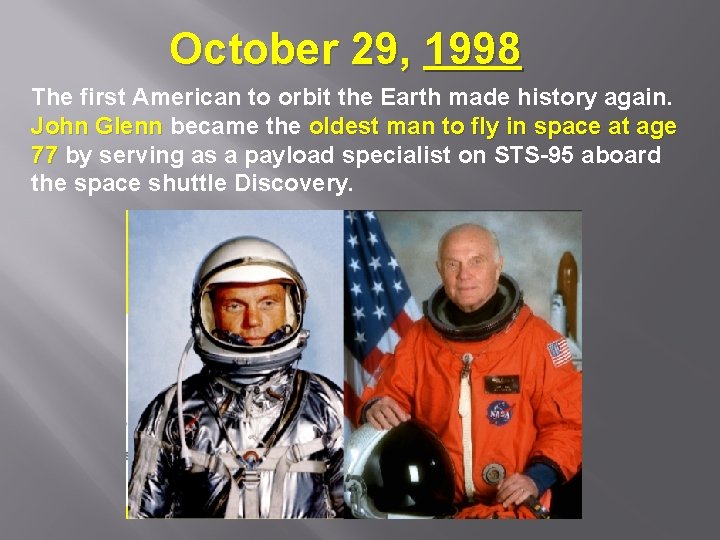
October 29, 1998 The first American to orbit the Earth made history again. John Glenn became the oldest man to fly in space at age 77 by serving as a payload specialist on STS-95 aboard the space shuttle Discovery.
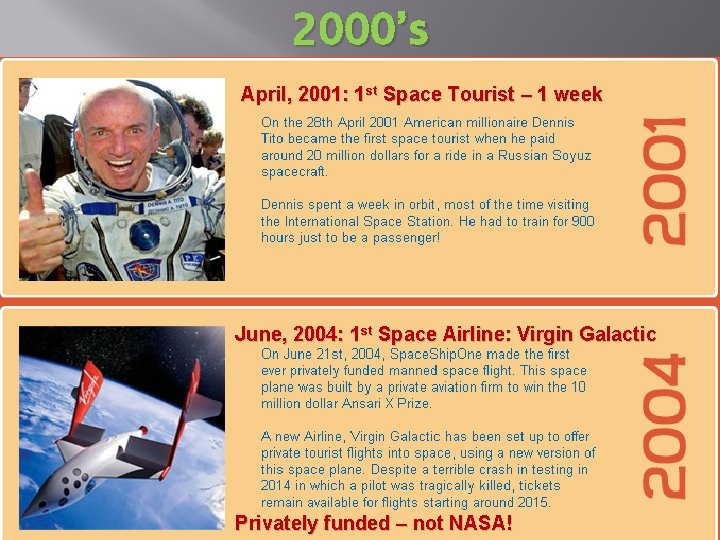
2000’s April, 2001: 1 st Space Tourist – 1 week June, 2004: 1 st Space Airline: Virgin Galactic Privately funded – not NASA!
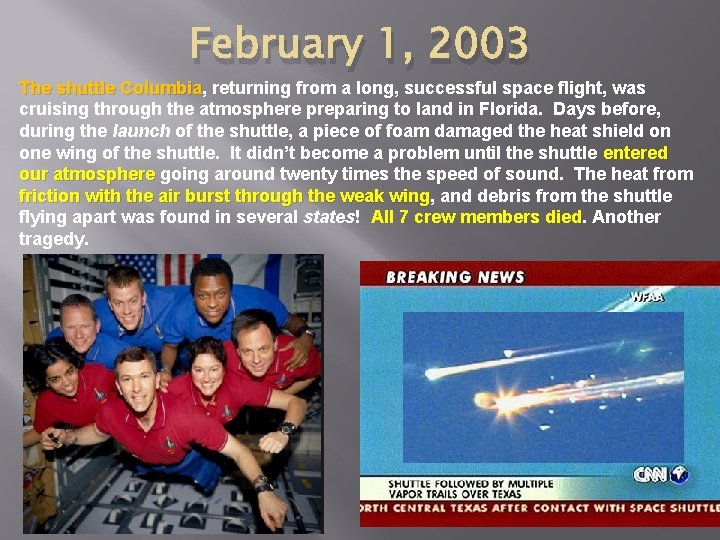
February 1, 2003 The shuttle Columbia, Columbia returning from a long, successful space flight, was cruising through the atmosphere preparing to land in Florida. Days before, during the launch of the shuttle, a piece of foam damaged the heat shield on one wing of the shuttle. It didn’t become a problem until the shuttle entered our atmosphere going around twenty times the speed of sound. The heat from friction with the air burst through the weak wing, wing and debris from the shuttle flying apart was found in several states! All 7 crew members died. Another tragedy.
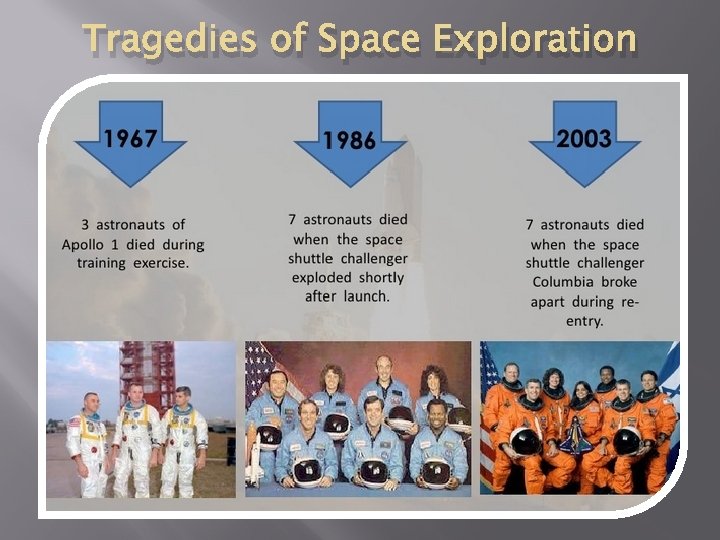
Tragedies of Space Exploration
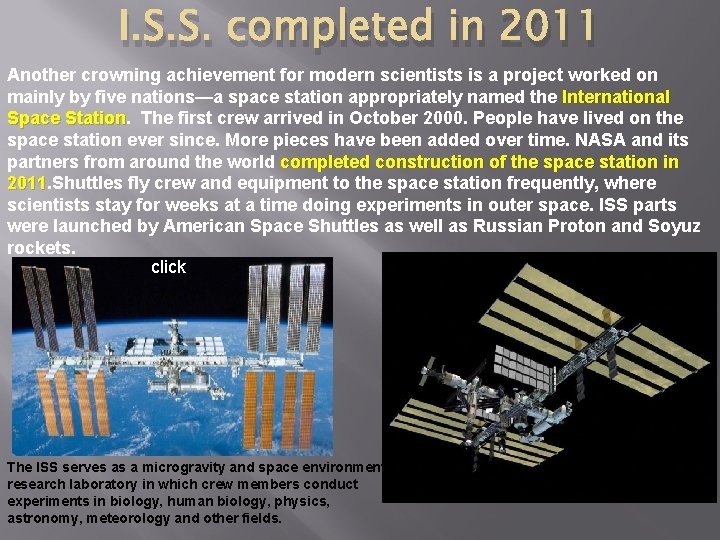
I. S. S. completed in 2011 Another crowning achievement for modern scientists is a project worked on mainly by five nations—a space station appropriately named the International Space Station The first crew arrived in October 2000. People have lived on the space station ever since. More pieces have been added over time. NASA and its partners from around the world completed construction of the space station in 2011. Shuttles fly crew and equipment to the space station frequently, where 2011 scientists stay for weeks at a time doing experiments in outer space. ISS parts were launched by American Space Shuttles as well as Russian Proton and Soyuz rockets. click The ISS serves as a microgravity and space environment research laboratory in which crew members conduct experiments in biology, human biology, physics, astronomy, meteorology and other fields.
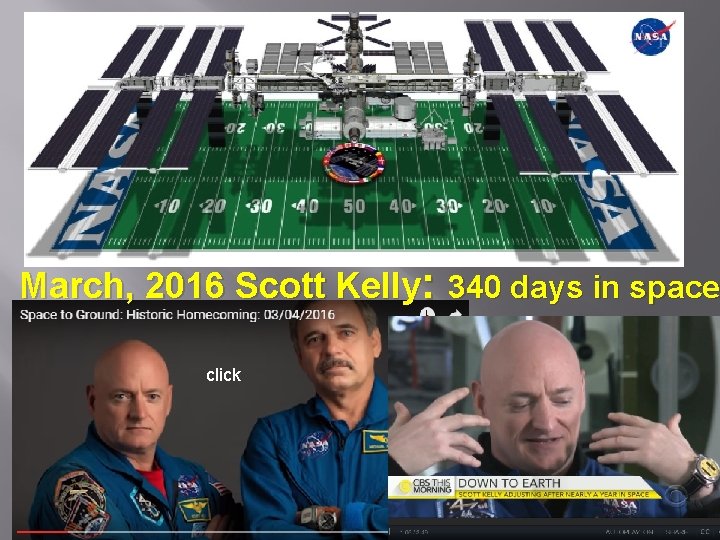
March, 2016 Scott Kelly: 340 days in space click
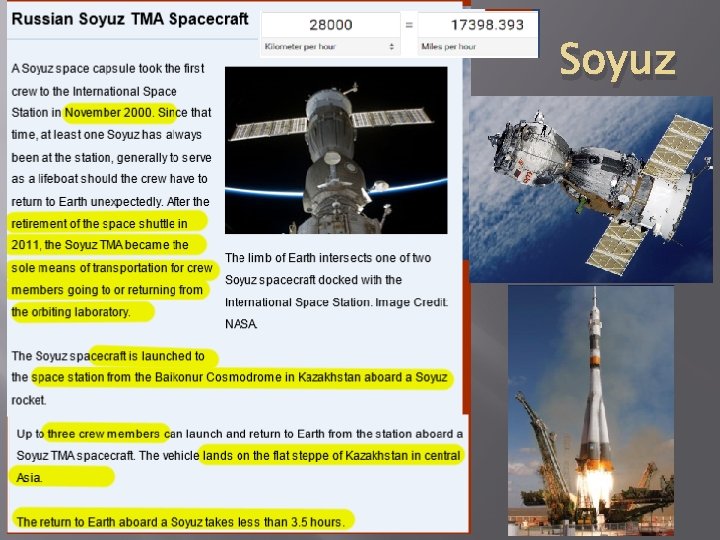
Soyuz
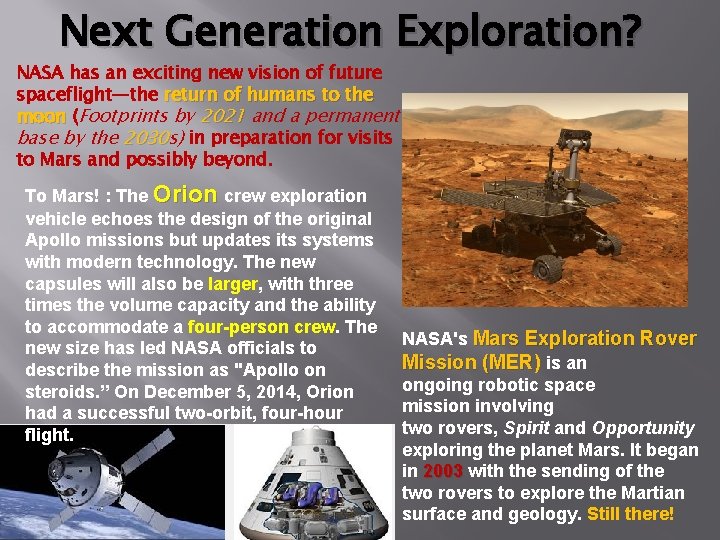
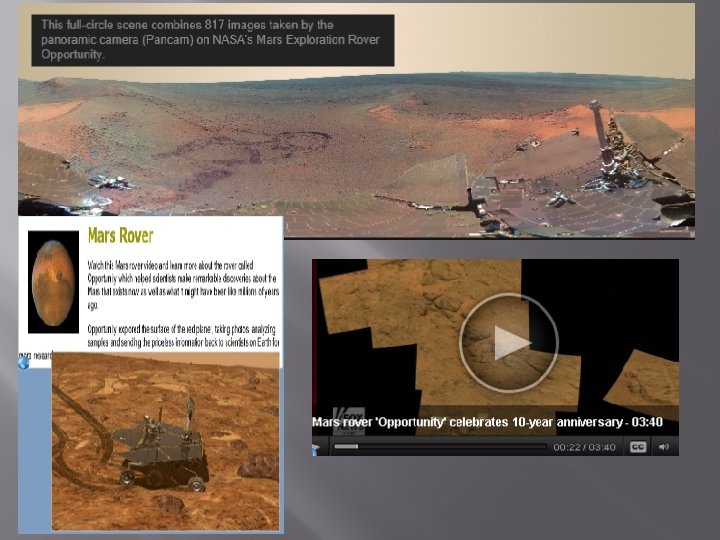
Next Generation Exploration? NASA has an exciting new vision of future spaceflight—the return of humans to the moon (Footprints by 2021 and a permanent base by the 2030 s) 2030 in preparation for visits to Mars and possibly beyond. To Mars! : The Orion crew exploration vehicle echoes the design of the original Apollo missions but updates its systems with modern technology. The new capsules will also be larger, with three times the volume capacity and the ability to accommodate a four-person crew. The new size has led NASA officials to describe the mission as "Apollo on steroids. ” On December 5, 2014, Orion had a successful two-orbit, four-hour flight. NASA's Mars Exploration Rover Mission (MER) (MER is an ongoing robotic space mission involving two rovers, Spirit and Opportunity exploring the planet Mars. It began in 2003 with the sending of the two rovers to explore the Martian surface and geology. Still there!
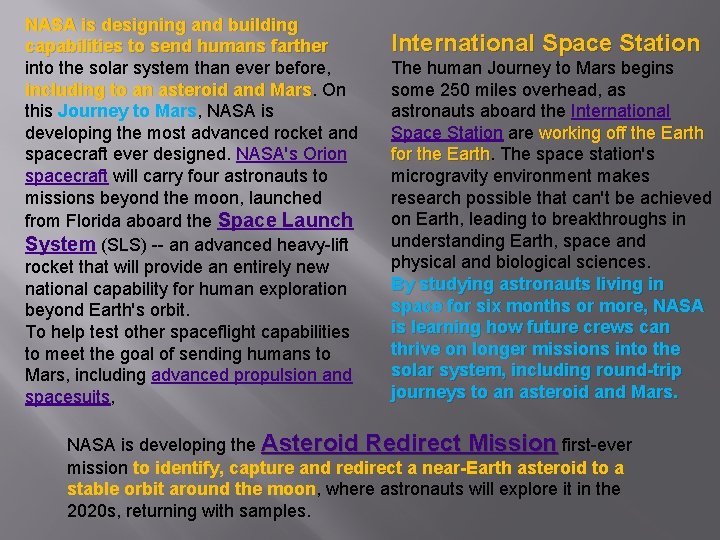
NASA is designing and building capabilities to send humans farther into the solar system than ever before, including to an asteroid and Mars On this Journey to Mars, NASA is developing the most advanced rocket and spacecraft ever designed. NASA's Orion spacecraft will carry four astronauts to missions beyond the moon, launched from Florida aboard the Space Launch System (SLS) -- an advanced heavy-lift rocket that will provide an entirely new national capability for human exploration beyond Earth's orbit. To help test other spaceflight capabilities to meet the goal of sending humans to Mars, including advanced propulsion and spacesuits, International Space Station The human Journey to Mars begins some 250 miles overhead, as astronauts aboard the International Space Station are working off the Earth for the Earth The space station's microgravity environment makes research possible that can't be achieved on Earth, leading to breakthroughs in understanding Earth, space and physical and biological sciences. By studying astronauts living in space for six months or more, NASA is learning how future crews can thrive on longer missions into the solar system, including round-trip journeys to an asteroid and Mars. NASA is developing the Asteroid Redirect Mission first-ever mission to identify, capture and redirect a near-Earth asteroid to a stable orbit around the moon, where astronauts will explore it in the 2020 s, returning with samples.
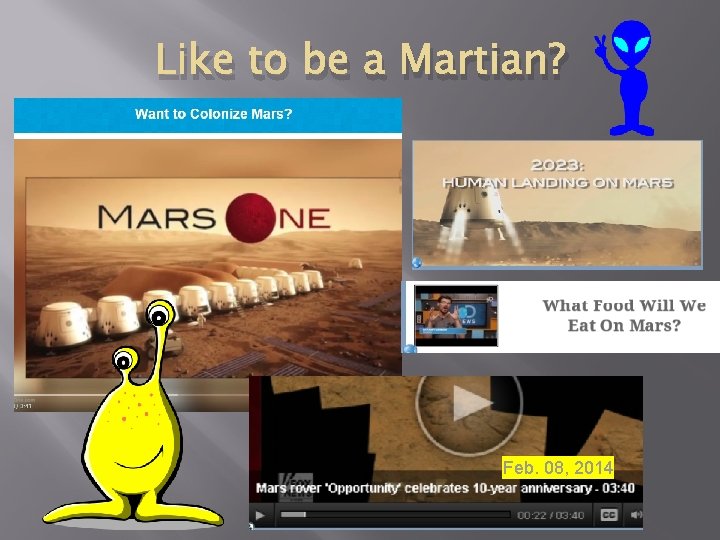
Like to be a Martian? Feb. 08, 2014
So what? � � � � 1. space exploration helps us understand our planet 2. Leads to new scientific/medical findings, useful inventions and technology. 3. 4. International collaboration (like the ISS) 4. Long-term survival (colonize other places? ? ? ) 5. Natural resources (on asteroids, the moon, etc. ? ? ) 6. National security 7. Fulfills the natural curiosity of humans to explore - Discover the answers to big ? s.