
Space Environment Summary Environment Effects Vacuum solar UV
- Slides: 8
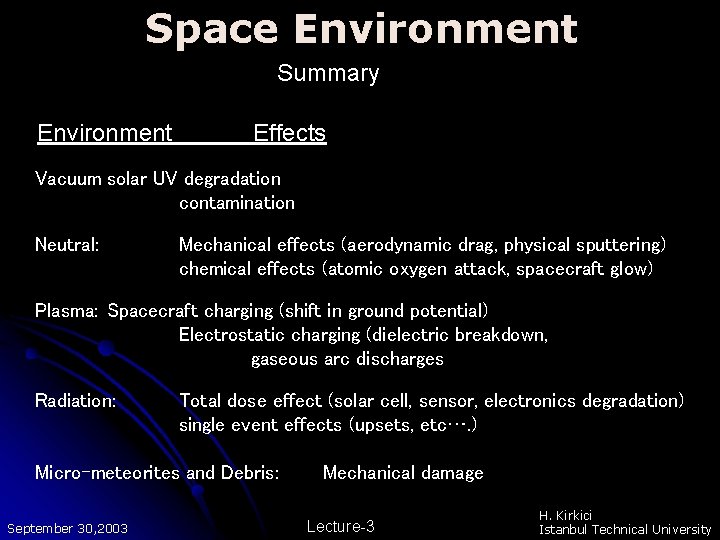
Space Environment Summary Environment Effects Vacuum solar UV degradation contamination Neutral: Mechanical effects (aerodynamic drag, physical sputtering) chemical effects (atomic oxygen attack, spacecraft glow) Plasma: Spacecraft charging (shift in ground potential) Electrostatic charging (dielectric breakdown, gaseous arc discharges Radiation: Total dose effect (solar cell, sensor, electronics degradation) single event effects (upsets, etc…. ) Micro-meteorites and Debris: September 30, 2003 Mechanical damage Lecture-3 H. Kirkici Istanbul Technical University
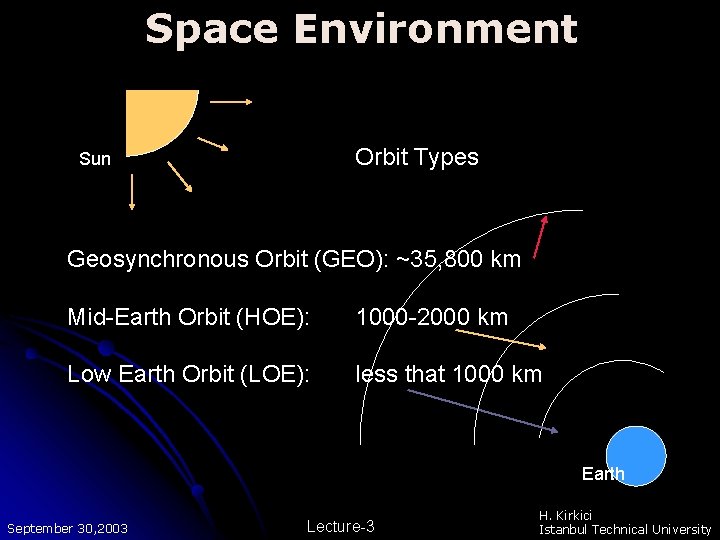
Space Environment Orbit Types Sun Geosynchronous Orbit (GEO): ~35, 800 km Mid-Earth Orbit (HOE): 1000 -2000 km Low Earth Orbit (LOE): less that 1000 km Earth September 30, 2003 Lecture-3 H. Kirkici Istanbul Technical University
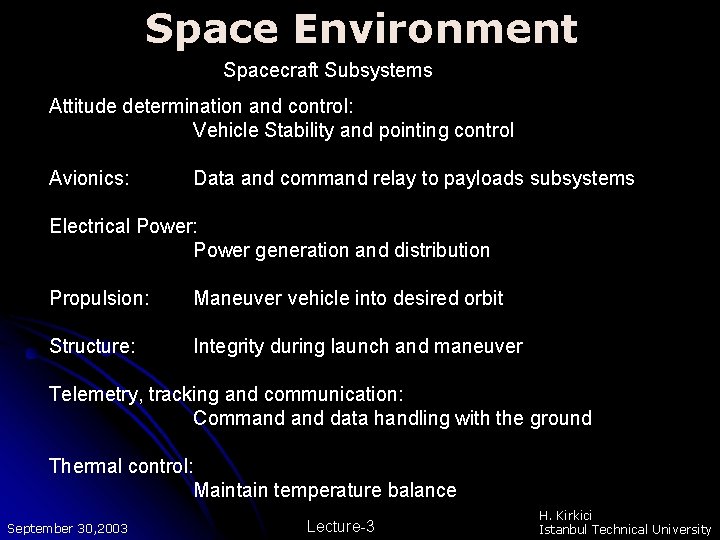
Space Environment Spacecraft Subsystems Attitude determination and control: Vehicle Stability and pointing control Avionics: Data and command relay to payloads subsystems Electrical Power: Power generation and distribution Propulsion: Maneuver vehicle into desired orbit Structure: Integrity during launch and maneuver Telemetry, tracking and communication: Command data handling with the ground Thermal control: Maintain temperature balance September 30, 2003 Lecture-3 H. Kirkici Istanbul Technical University
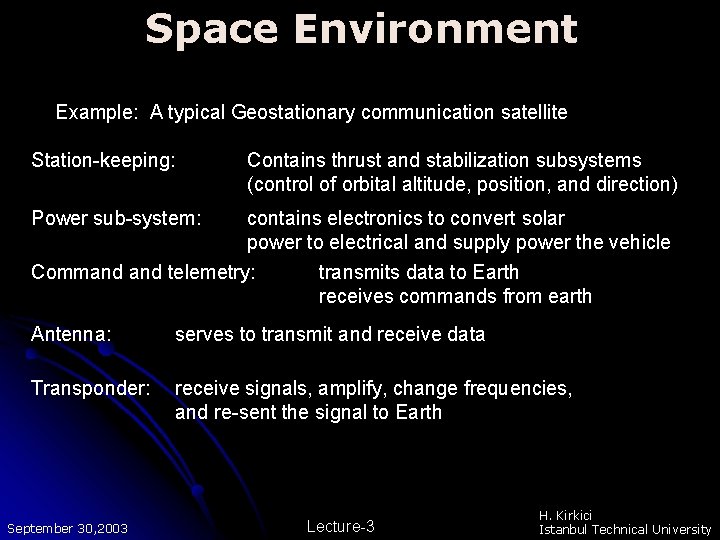
Space Environment Example: A typical Geostationary communication satellite Station-keeping: Contains thrust and stabilization subsystems (control of orbital altitude, position, and direction) Power sub-system: contains electronics to convert solar power to electrical and supply power the vehicle Command telemetry: transmits data to Earth receives commands from earth Antenna: serves to transmit and receive data Transponder: receive signals, amplify, change frequencies, and re-sent the signal to Earth September 30, 2003 Lecture-3 H. Kirkici Istanbul Technical University
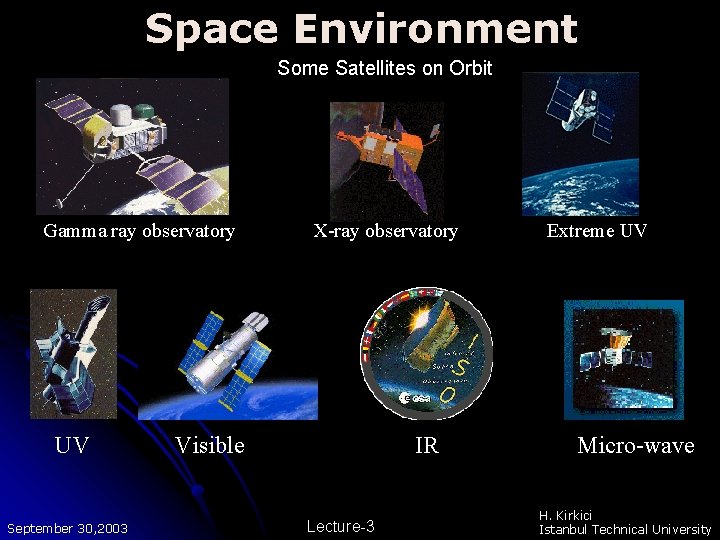
Space Environment Some Satellites on Orbit Gamma ray observatory UV September 30, 2003 X-ray observatory Visible IR Lecture-3 Extreme UV Micro-wave H. Kirkici Istanbul Technical University
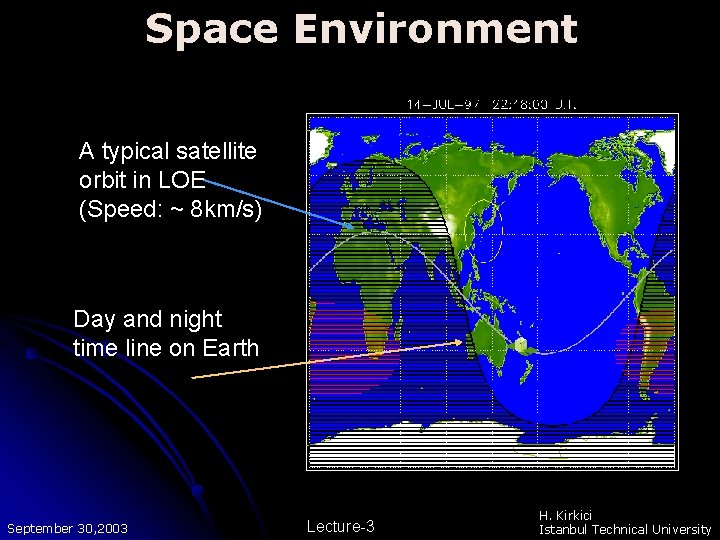
Space Environment A typical satellite orbit in LOE (Speed: ~ 8 km/s) Day and night time line on Earth September 30, 2003 Lecture-3 H. Kirkici Istanbul Technical University
Space Environment HW-1 Due Date: October 1, 2003 1. Give names of at lest for 4 orbital satellite 2. subsystems in a typical communication satellite. 2. Describe the functions of these subsystems listed above 3. in few sentences. 3. When was the last solar storm observed (give the month 4. and year), and what effects were observed by scientism 5. due to this storm on Earth or on satellites? September 30, 2003 Lecture-3 H. Kirkici Istanbul Technical University
Space Environment QUESTIONS? September 30, 2003 Lecture-3 H. Kirkici Istanbul Technical University