
Space Dosimetry using MOSFET M Fragopoulou and M
- Slides: 16
Space Dosimetry using MOSFET M. Fragopoulou , and M. Zamani School of Physics, Nuclear and Elementary Particle Section Aristotle University of Thessaloniki, 541 24, Greece E. Benton and Y. Uchihori Department of Physics, Oklahoma State University, Stillwater, OK 74078 -3072 National Institute of Radiological Sciences, Radiation Measurement Research Section, Chiba 263 -8555, JAPAN Denis O’Sullivan Dublin Institute for Advanced studies, 5 Merrion Square, Dublin 2, Ireland V. A. Shurshakov Institute of Biomedical Problems Russian Academy of Sciences, Moscow Russia S. Siskos, T. Laopoulos, V. Konstantakos and G. Sarrabayrouse* School of Physics, Electronics and Computers Section Aristotle University of Thessaloniki, 541 24, Greece Consultant-gerard. sarrabayrouse@orange. fr
MOSFET applications MOSFETs have been used in several application fields such as: q Medical q q A. B. Rosenfeld Rad. Prot. Dos. 101 (2002) 393 G. Sarrabayrouse S. Siskos 1998. IEEE Instr. Measur. Magaz. 1 (1998)26 q Military q personal dosimetry q S. Kroneberg and G. J. Bruker IEEE Tran. Nuc. Sci. 42 (1995) No 1, 20 q Space radiation (mainly for protons and electrons) q q L. Adams and A. G. Holmes-Siedle IEEE Trans. Nucl. Sci. 25(1978) 1607 I. Thomson Mutation Research 430 (1999) 203 -209 Aristotle University of Thessaloniki, Nuclear and Elementary Particle Department
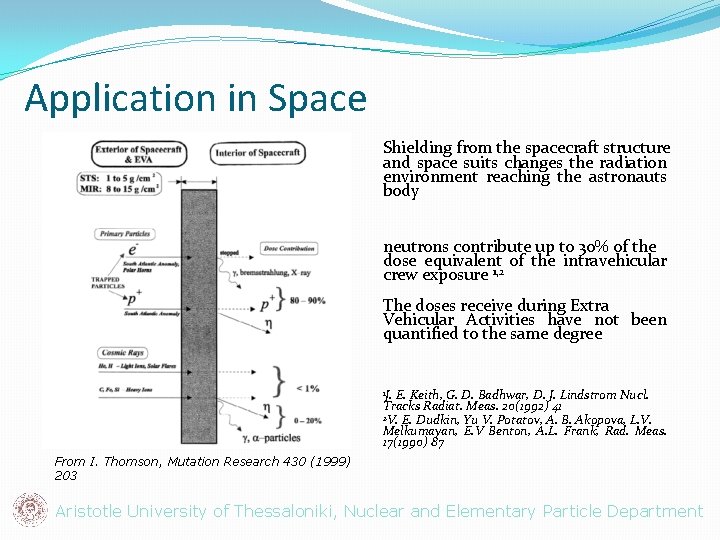
Application in Space Shielding from the spacecraft structure and space suits changes the radiation environment reaching the astronauts body neutrons contribute up to 30% of the dose equivalent of the intravehicular crew exposure 1, 2 The doses receive during Extra Vehicular Activities have not been quantified to the same degree 1 J. E. Keith, G. D. Badhwar, D. J. Lindstrom Nucl. Tracks Radiat. Meas. 20(1992) 41 2 V. E. Dudkin, Yu V. Potatov, A. B. Akopova, L. V. Melkumayan, E. V Benton, A. L. Frank, Rad. Meas. 17(1990) 87 From I. Thomson, Mutation Research 430 (1999) 203 Aristotle University of Thessaloniki, Nuclear and Elementary Particle Department
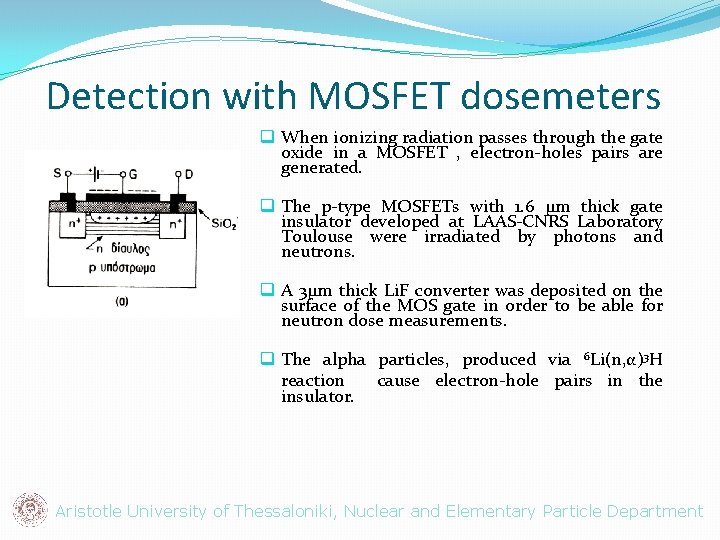
Detection with MOSFET dosemeters q When ionizing radiation passes through the gate oxide in a MOSFET , electron-holes pairs are generated. q The p-type MOSFETs with 1. 6 μm thick gate insulator developed at LAAS-CNRS Laboratory Toulouse were irradiated by photons and neutrons. q A 3μm thick Li. F converter was deposited on the surface of the MOS gate in order to be able for neutron dose measurements. q The alpha particles, produced via 6 Li(n, α)3 H reaction cause electron-hole pairs in the insulator. Aristotle University of Thessaloniki, Nuclear and Elementary Particle Department
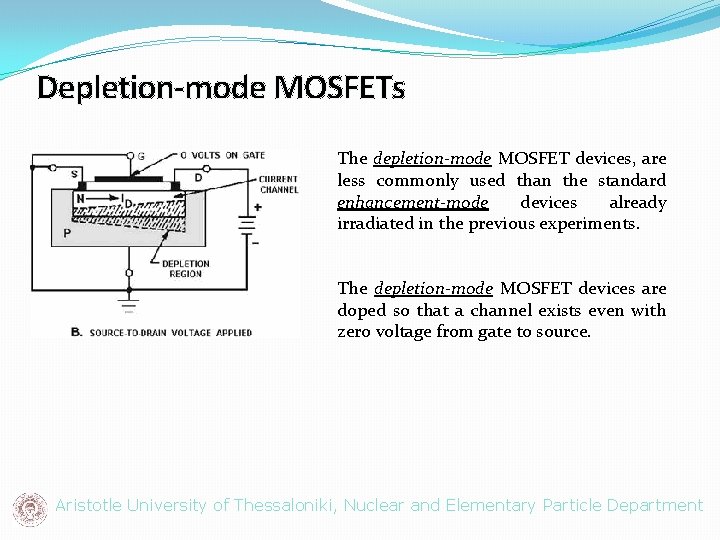
Depletion-mode MOSFETs The depletion-mode MOSFET devices, are less commonly used than the standard enhancement-mode devices already irradiated in the previous experiments. The depletion-mode MOSFET devices are doped so that a channel exists even with zero voltage from gate to source. Aristotle University of Thessaloniki, Nuclear and Elementary Particle Department
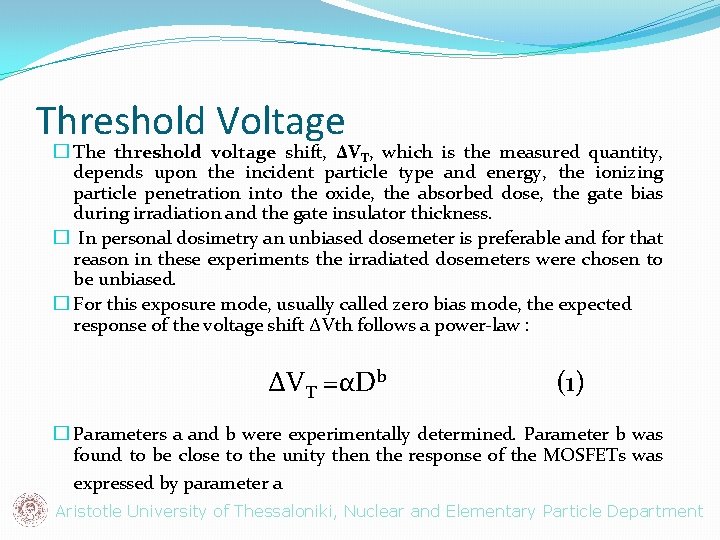
Threshold Voltage � The threshold voltage shift, ΔVT, which is the measured quantity, depends upon the incident particle type and energy, the ionizing particle penetration into the oxide, the absorbed dose, the gate bias during irradiation and the gate insulator thickness. � In personal dosimetry an unbiased dosemeter is preferable and for that reason in these experiments the irradiated dosemeters were chosen to be unbiased. � For this exposure mode, usually called zero bias mode, the expected response of the voltage shift ΔVth follows a power-law : ΔVΤ =αDb (1) � Parameters a and b were experimentally determined. Parameter b was found to be close to the unity then the response of the MOSFETs was expressed by parameter a Aristotle University of Thessaloniki, Nuclear and Elementary Particle Department
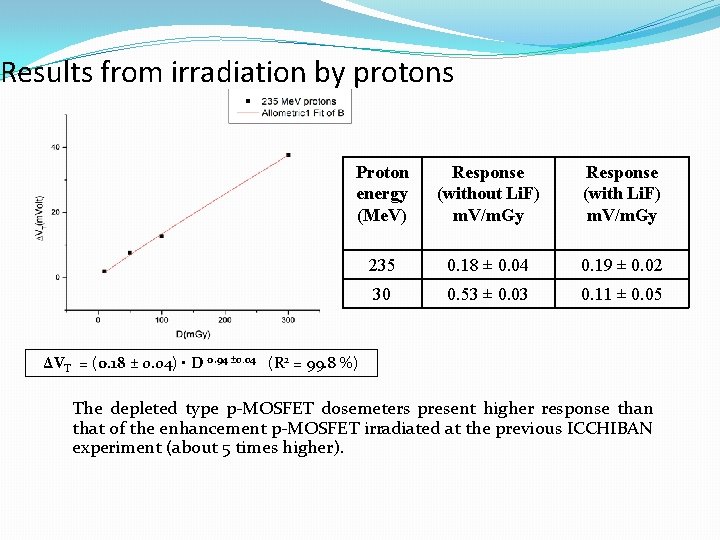
Results from irradiation by protons Proton energy (Me. V) Response (without Li. F) m. V/m. Gy Response (with Li. F) m. V/m. Gy 235 0. 18 ± 0. 04 0. 19 ± 0. 02 30 0. 53 ± 0. 03 0. 11 ± 0. 05 ΔVT = (0. 18 ± 0. 04) • D 0. 94 ± 0. 04 (R 2 = 99. 8 %) The depleted type p-MOSFET dosemeters present higher response than that of the enhancement p-MOSFET irradiated at the previous ICCHIBAN experiment (about 5 times higher).
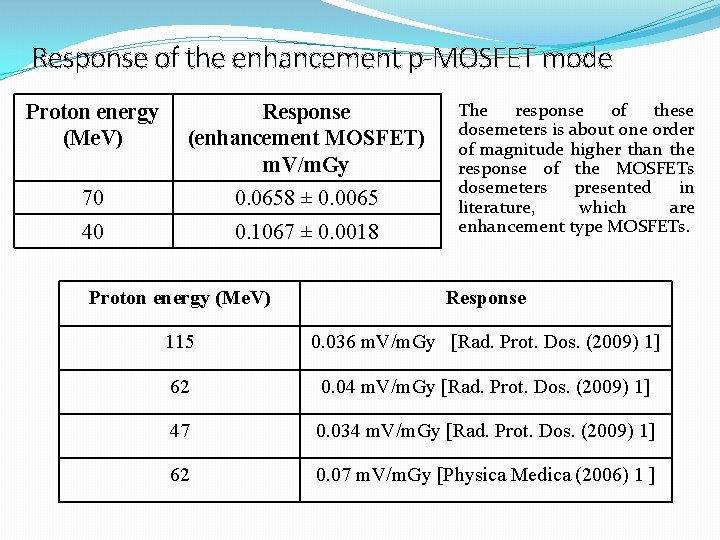
Response of the enhancement p-MOSFET mode Proton energy (Me. V) Response (enhancement MOSFET) m. V/m. Gy 70 0. 0658 ± 0. 0065 40 0. 1067 ± 0. 0018 The response of these dosemeters is about one order of magnitude higher than the response of the MOSFETs dosemeters presented in literature, which are enhancement type MOSFETs. Proton energy (Me. V) Response 115 0. 036 m. V/m. Gy [Rad. Prot. Dos. (2009) 1] 62 0. 04 m. V/m. Gy [Rad. Prot. Dos. (2009) 1] 47 0. 034 m. V/m. Gy [Rad. Prot. Dos. (2009) 1] 62 0. 07 m. V/m. Gy [Physica Medica (2006) 1 ]
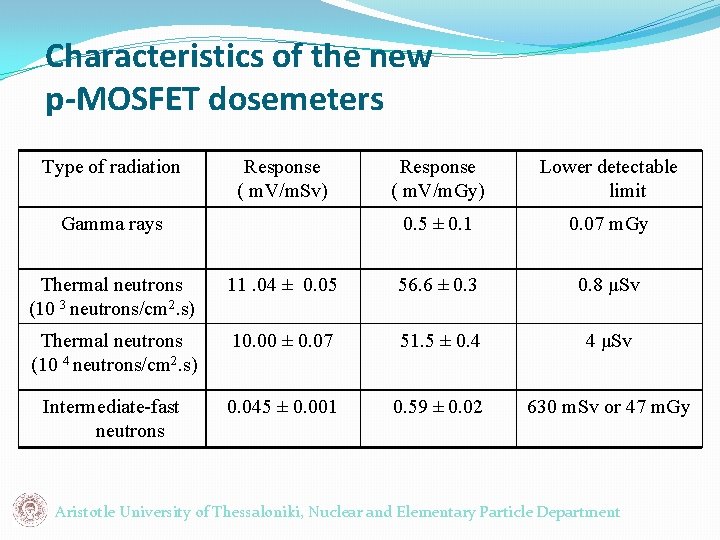
Characteristics of the new p-MOSFET dosemeters Type of radiation Response ( m. V/m. Sv) Gamma rays Response ( m. V/m. Gy) Lower detectable limit 0. 5 ± 0. 1 0. 07 m. Gy Thermal neutrons (10 3 neutrons/cm 2. s) 11. 04 ± 0. 05 56. 6 ± 0. 3 0. 8 μSv Thermal neutrons (10 4 neutrons/cm 2. s) 10. 00 ± 0. 07 51. 5 ± 0. 4 4 μSv Intermediate-fast neutrons 0. 045 ± 0. 001 0. 59 ± 0. 02 630 m. Sv or 47 m. Gy Aristotle University of Thessaloniki, Nuclear and Elementary Particle Department
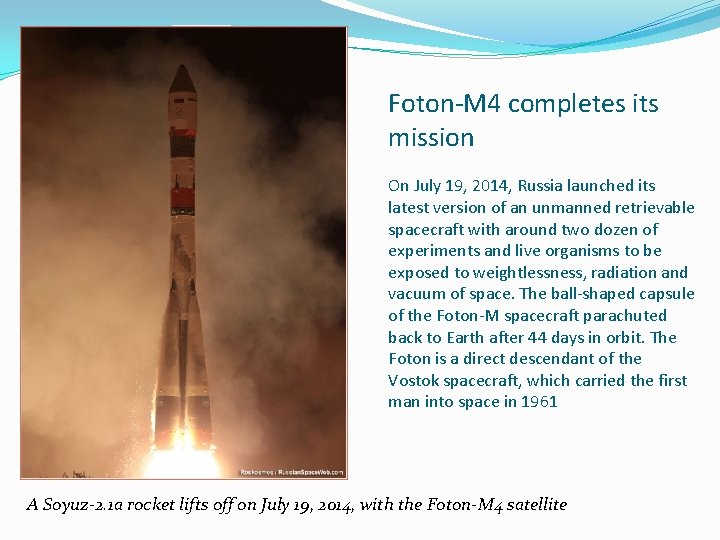
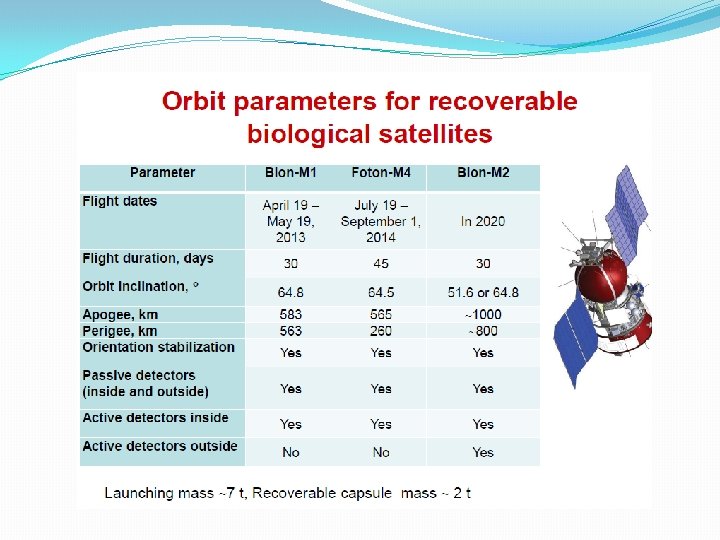
Foton-M 4 completes its mission On July 19, 2014, Russia launched its latest version of an unmanned retrievable spacecraft with around two dozen of experiments and live organisms to be exposed to weightlessness, radiation and vacuum of space. The ball-shaped capsule of the Foton-M spacecraft parachuted back to Earth after 44 days in orbit. The Foton is a direct descendant of the Vostok spacecraft, which carried the first man into space in 1961 A Soyuz-2. 1 a rocket lifts off on July 19, 2014, with the Foton-M 4 satellite
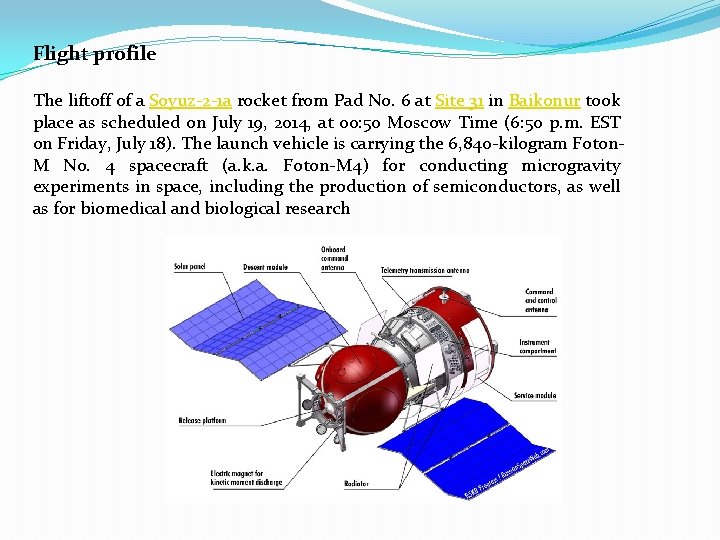
Flight profile The liftoff of a Soyuz-2 -1 a rocket from Pad No. 6 at Site 31 in Baikonur took place as scheduled on July 19, 2014, at 00: 50 Moscow Time (6: 50 p. m. EST on Friday, July 18). The launch vehicle is carrying the 6, 840 -kilogram Foton. M No. 4 spacecraft (a. k. a. Foton-M 4) for conducting microgravity experiments in space, including the production of semiconductors, as well as for biomedical and biological research
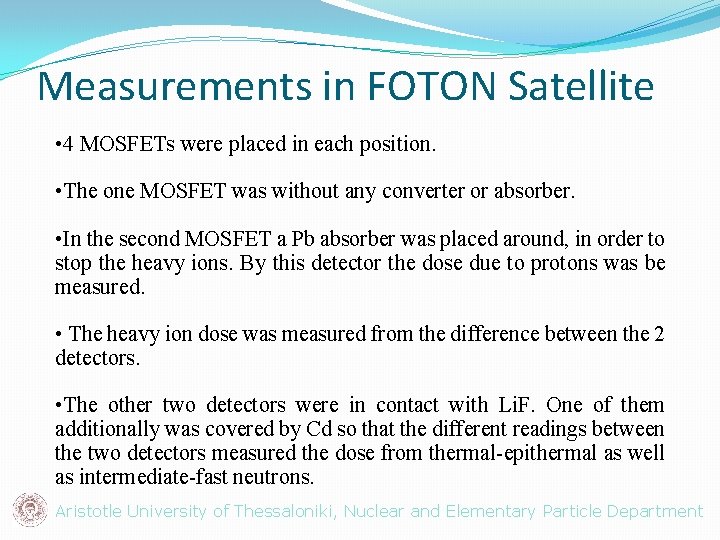
Measurements in FOTON Satellite • 4 MOSFETs were placed in each position. • The one MOSFET was without any converter or absorber. • In the second MOSFET a Pb absorber was placed around, in order to stop the heavy ions. By this detector the dose due to protons was be measured. • The heavy ion dose was measured from the difference between the 2 detectors. • The other two detectors were in contact with Li. F. One of them additionally was covered by Cd so that the different readings between the two detectors measured the dose from thermal-epithermal as well as intermediate-fast neutrons. Aristotle University of Thessaloniki, Nuclear and Elementary Particle Department
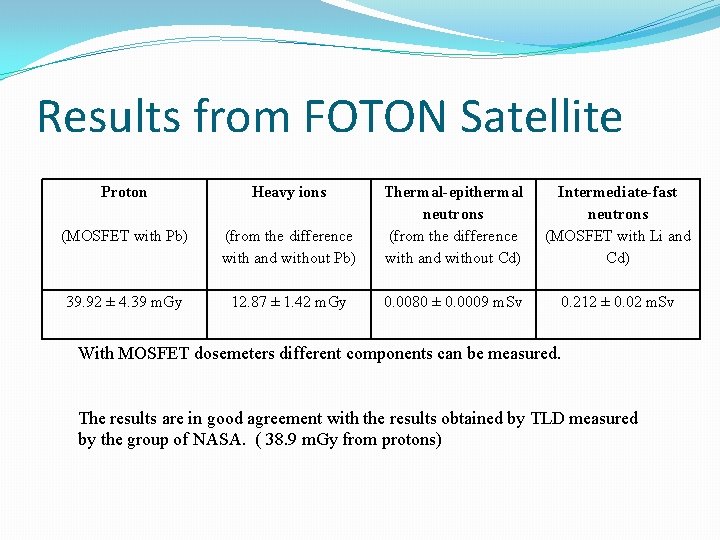
Results from FOTON Satellite Proton Heavy ions (from the difference with and without Pb) Thermal-epithermal neutrons (from the difference with and without Cd) Intermediate-fast neutrons (MOSFET with Li and Cd) (MOSFET with Pb) 39. 92 ± 4. 39 m. Gy 12. 87 ± 1. 42 m. Gy 0. 0080 ± 0. 0009 m. Sv 0. 212 ± 0. 02 m. Sv With MOSFET dosemeters different components can be measured. The results are in good agreement with the results obtained by TLD measured by the group of NASA. ( 38. 9 m. Gy from protons)
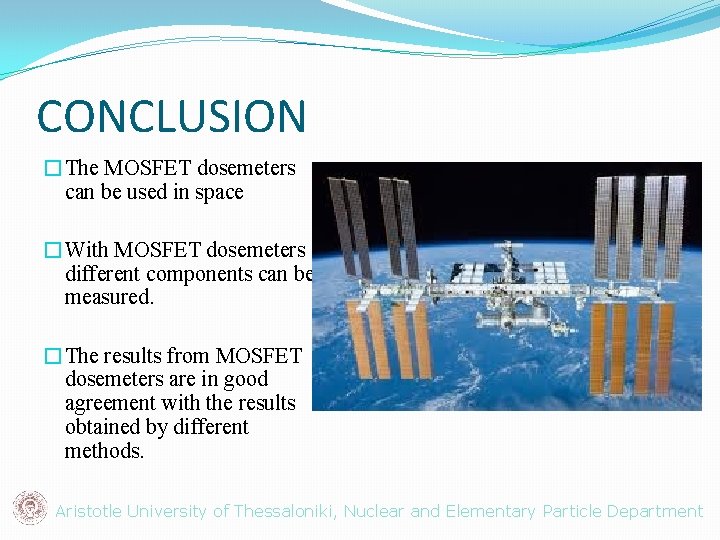
CONCLUSION �The MOSFET dosemeters can be used in space �With MOSFET dosemeters different components can be measured. �The results from MOSFET dosemeters are in good agreement with the results obtained by different methods. Aristotle University of Thessaloniki, Nuclear and Elementary Particle Department