
Space Borne and Ground Based Lidar NASA ARSET

Space Borne and Ground Based Lidar NASA ARSET- AQ DRI Course June 11 - 14, 2012 ARSET - AQ Applied Remote Sensing Education and Training – Air Quality A project of NASA Applied Sciences
CALIOP aboard CALIPSO: instrument and data Meloë Kacenelenbogen 1, meloe. s. kacenelenbogen@nasa. gov Mark Vaughan 2, Jens Redemann 3, 1 NASA AMES, Moffett Field, CA, 2 NASA La. RC, Hampton, VA 3 Bay Area Environmental Research Institute, Sonoma, CA
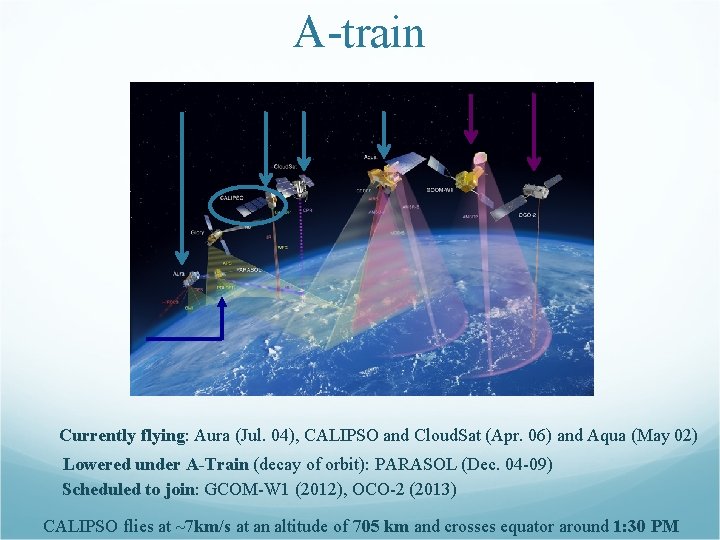
A-train Currently flying: Aura (Jul. 04), CALIPSO and Cloud. Sat (Apr. 06) and Aqua (May 02) Lowered under A-Train (decay of orbit): PARASOL (Dec. 04 -09) Scheduled to join: GCOM-W 1 (2012), OCO-2 (2013) CALIPSO flies at ~7 km/s at an altitude of 705 km and crosses equator around 1: 30 PM
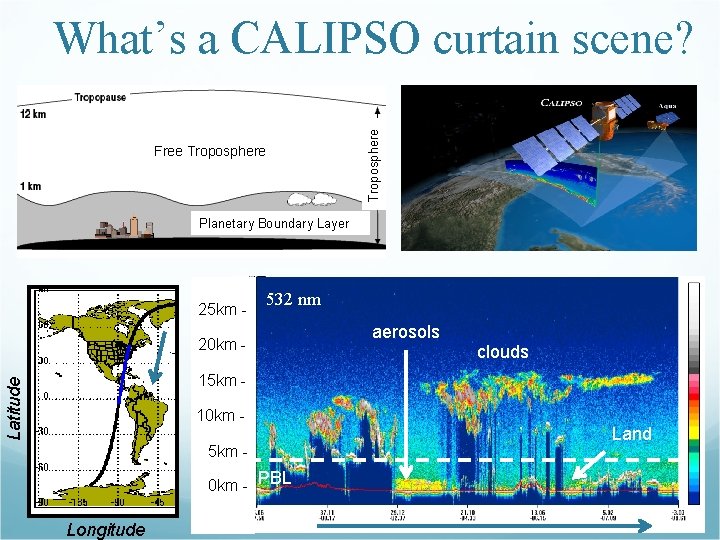
Troposphere What’s a CALIPSO curtain scene? Free Troposphere Planetary Boundary Layer 25 km - 532 nm 20 km - aerosols clouds Latitude 15 km 10 km 5 km 0 km - PBL Longitude Land
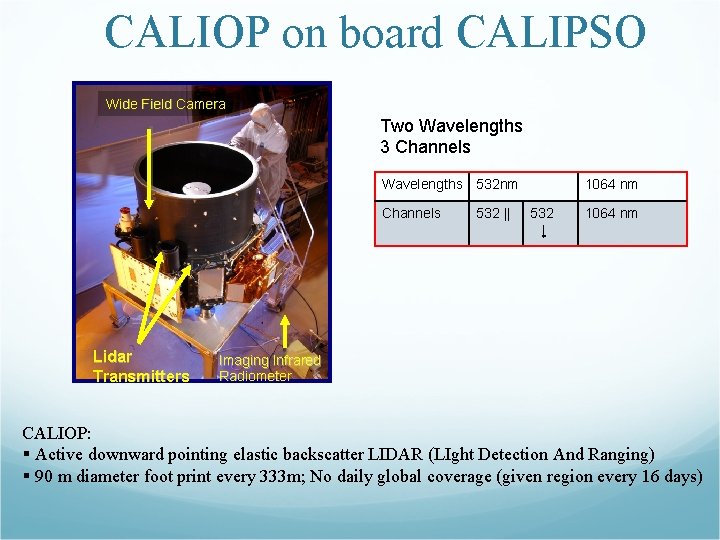
CALIOP on board CALIPSO Wide Field Camera Two Wavelengths 3 Channels Wavelengths 532 nm Channels Lidar Transmitters 532 || 1064 nm 532 | 1064 nm Imaging Infrared Radiometer CALIOP: § Active downward pointing elastic backscatter LIDAR (LIght Detection And Ranging) § 90 m diameter foot print every 333 m; No daily global coverage (given region every 16 days)
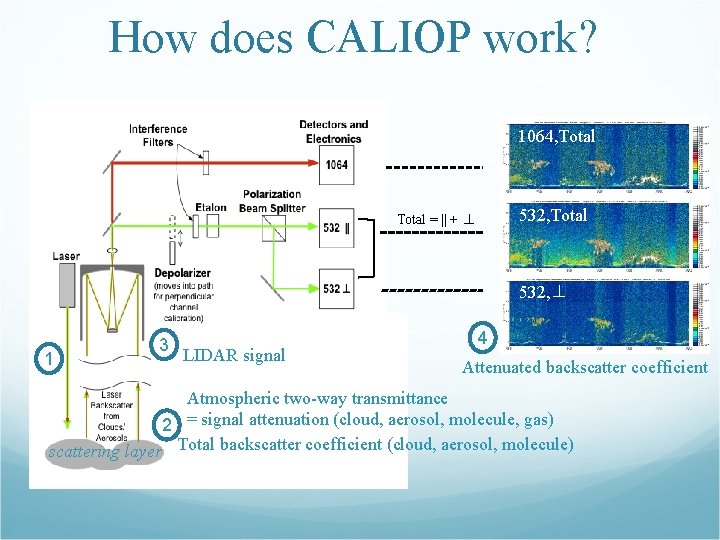
How does CALIOP work? 1064, Total 532, Total = || + ⊥ 532, ⊥ 1 3 LIDAR signal 4 Attenuated backscatter coefficient Atmospheric two-way transmittance 2 = signal attenuation (cloud, aerosol, molecule, gas) scattering layer Total backscatter coefficient (cloud, aerosol, molecule)
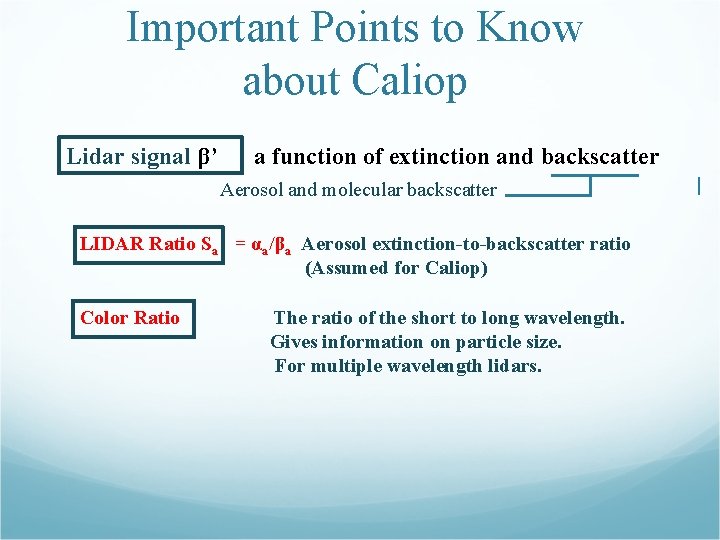
Important Points to Know about Caliop Lidar signal β’ a function of extinction and backscatter Aerosol and molecular backscatter LIDAR Ratio Sa = αa/βa Aerosol extinction-to-backscatter ratio (Assumed for Caliop) Color Ratio The ratio of the short to long wavelength. Gives information on particle size. For multiple wavelength lidars.
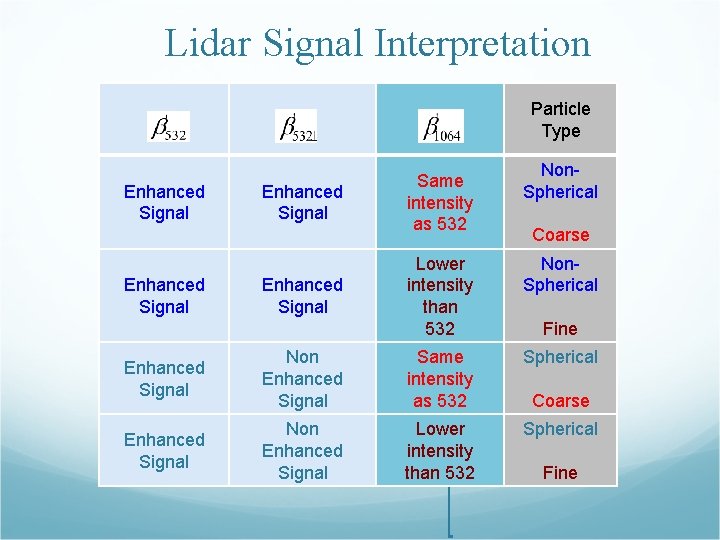
Lidar Signal Interpretation Particle Type Total attenuated backscatter 532 nm Enhanced Signal Enhanced Signal B Same intensity as 532 Non. Spherical Coarse Lower Nonintensity Spherical Enhanced Total attenuated backscatter 1064 nm than Signal 532 Fine A Non Same Spherical Enhanced intensity Signal as 532 Coarse Non Enhanced Signal Lower intensity than 532 Spherical Fine
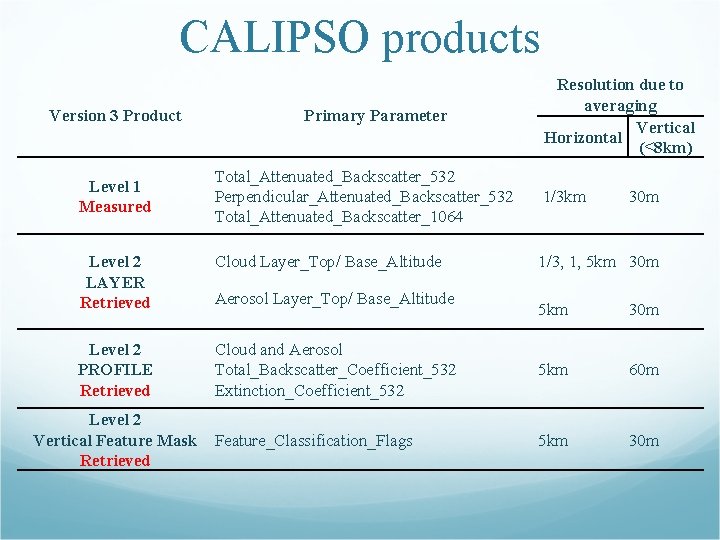
CALIPSO products Version 3 Product Primary Parameter Resolution due to averaging Vertical Horizontal (<8 km) Total_Attenuated_Backscatter_532 Perpendicular_Attenuated_Backscatter_532 Total_Attenuated_Backscatter_1064 1/3 km Level 2 LAYER Retrieved Cloud Layer_Top/ Base_Altitude 1/3, 1, 5 km 30 m Level 2 PROFILE Retrieved Level 1 Measured Level 2 Vertical Feature Mask Retrieved Aerosol Layer_Top/ Base_Altitude 30 m 5 km 30 m Cloud and Aerosol Total_Backscatter_Coefficient_532 Extinction_Coefficient_532 5 km 60 m Feature_Classification_Flags 5 km 30 m
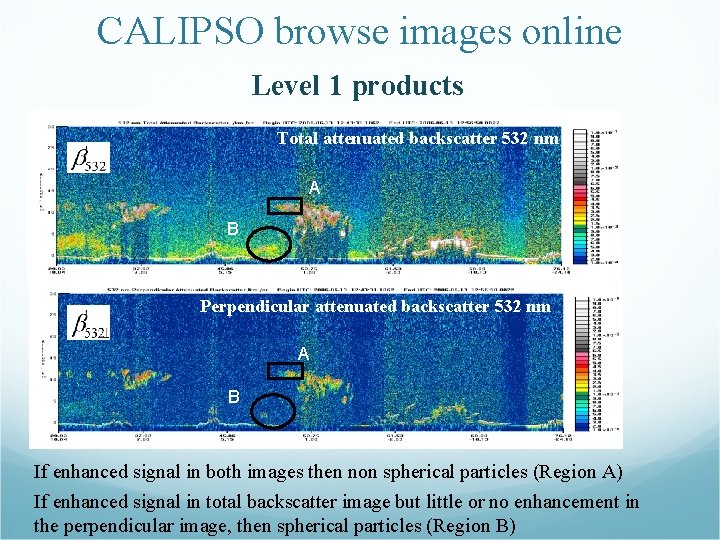
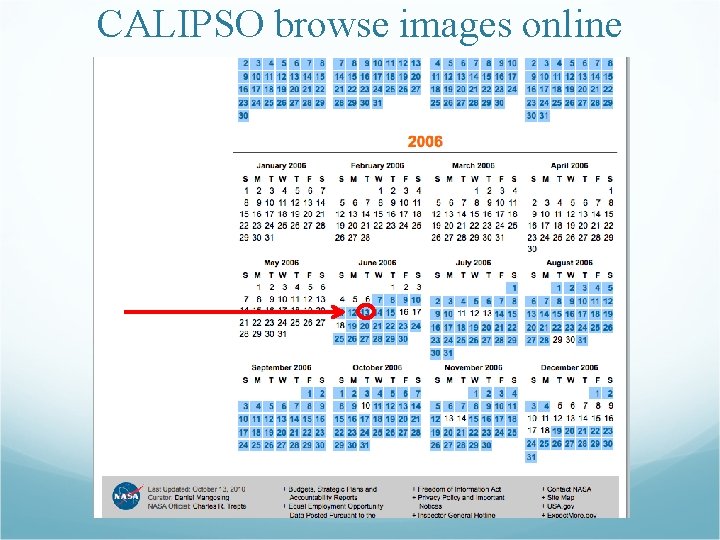
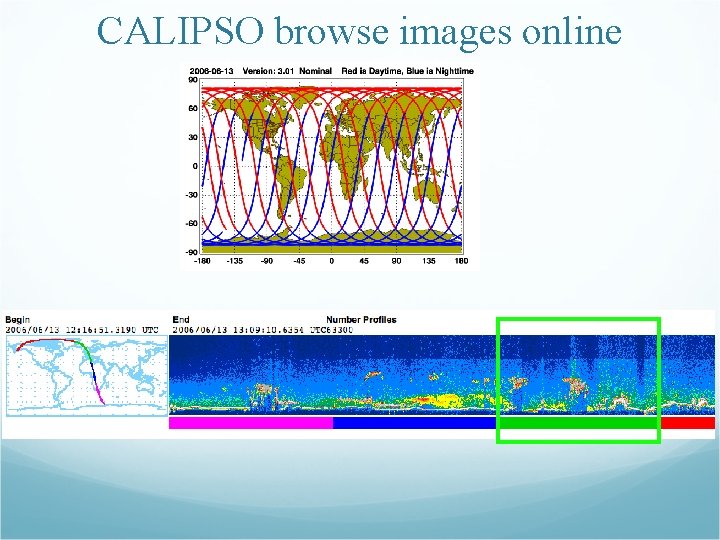
CALIPSO browse images online Level 1 products Total attenuated backscatter 532 nm A B Perpendicular attenuated backscatter 532 nm A B If enhanced signal in both images then non spherical particles (Region A) If enhanced signal in total backscatter image but little or no enhancement in the perpendicular image, then spherical particles (Region B)
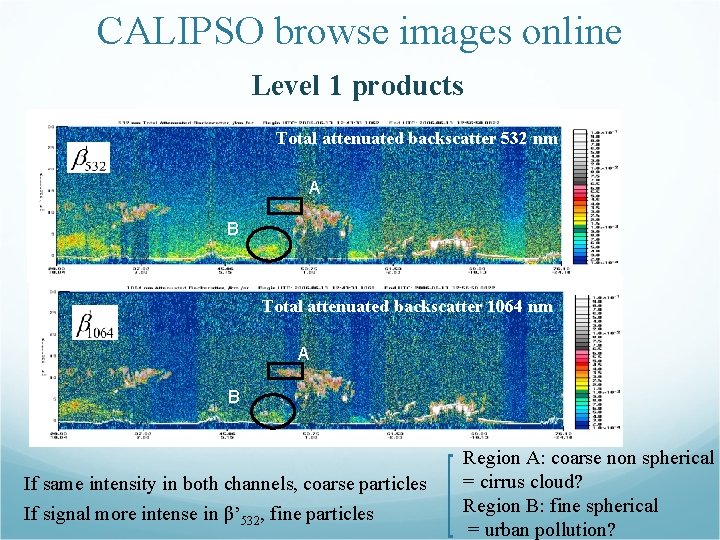
CALIPSO browse images online Level 1 products Total attenuated backscatter 532 nm A B Total attenuated backscatter 1064 nm A B If same intensity in both channels, coarse particles If signal more intense in β’ 532, fine particles Region A: coarse non spherical = cirrus cloud? Region B: fine spherical = urban pollution?
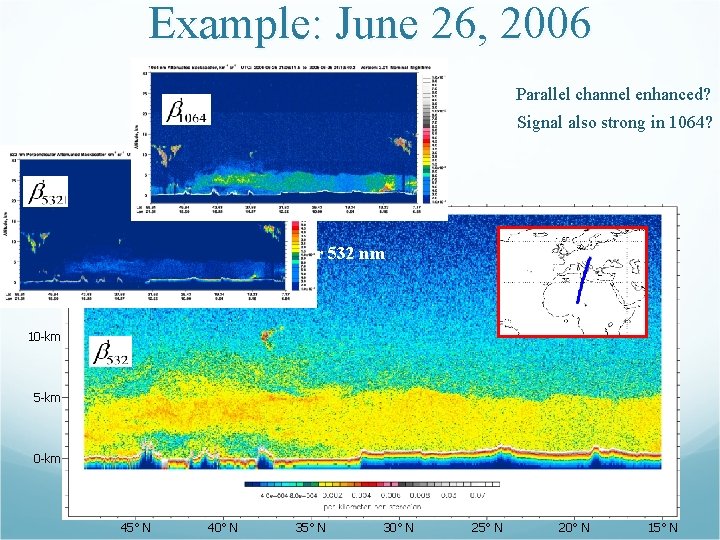
Example: June 26, 2006 Parallel channel enhanced? Signal also strong in 1064? 20 -km Total attenuated backscatter 532 nm 15 -km 10 -km 5 -km 0 -km 45° N 40° N 35° N 30° N 25° N 20° N 15° N
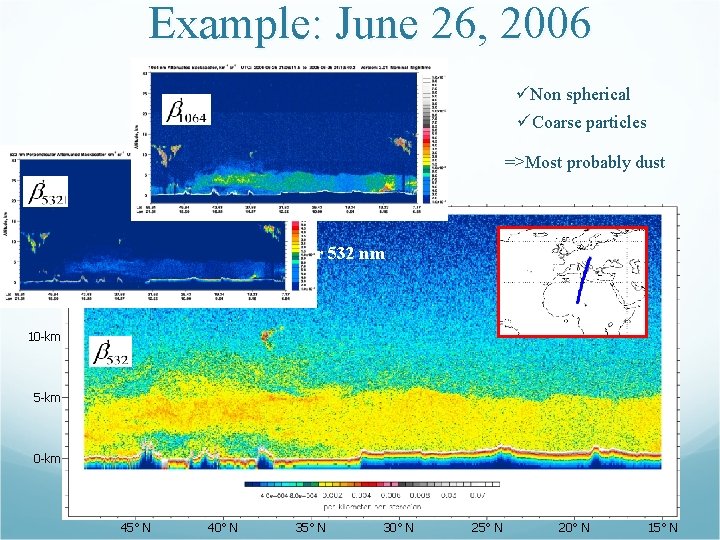
Example: June 26, 2006 üNon spherical üCoarse particles =>Most probably dust 20 -km Total attenuated backscatter 532 nm 15 -km 10 -km 5 -km 0 -km 45° N 40° N 35° N 30° N 25° N 20° N 15° N
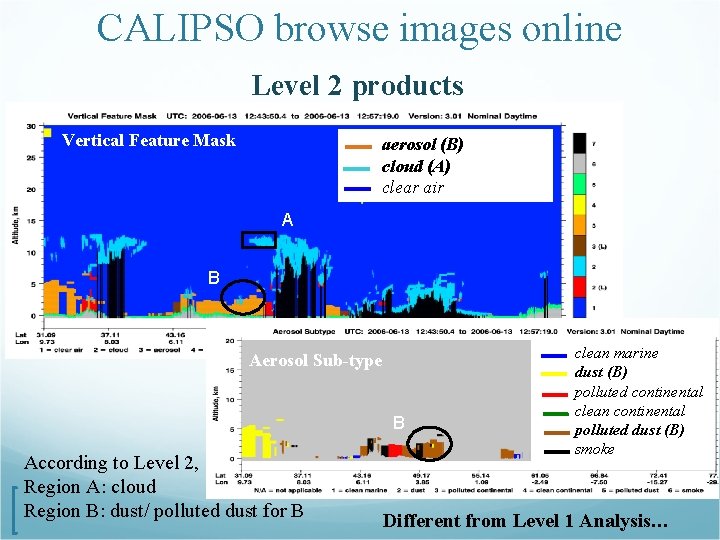
CALIPSO browse images online Level 2 products Vertical Feature Mask aerosol (B) cloud (A) clear air A B Aerosol Sub-type B According to Level 2, Region A: cloud Region B: dust/ polluted dust for B clean marine dust (B) polluted continental clean continental polluted dust (B) smoke Different from Level 1 Analysis…
Which data should I use? • Safest is qualitative use of level 1 latest version (currently 3. 01) attenuated backscatter data in 3 channels => Browse standard product lidar images online • For quantitative use, level 1 data contains less uncertainties than level 2 data • If you use level 2 data, you need to know the associated uncertainties (and most of these are reported in the level 2 data products) Some knowledge on Level 1 -to-level 2 algorithm…
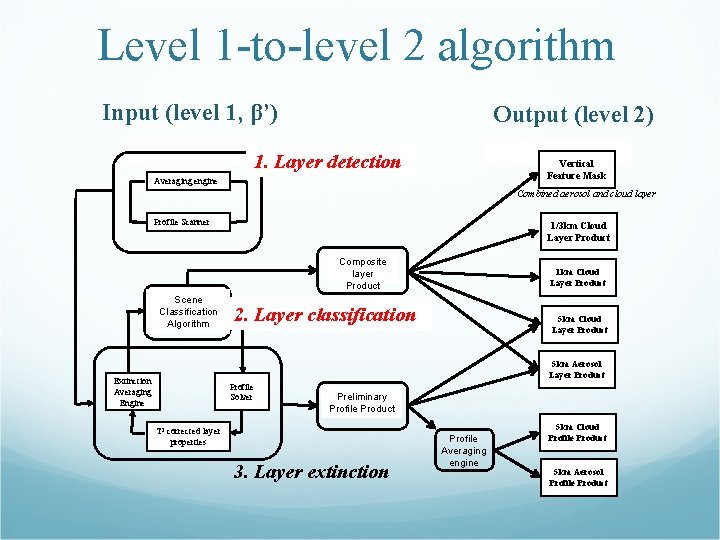
Level 1 -to-level 2 algorithm Input (level 1, β’) Output (level 2) 1. Layer detection Vertical Feature Mask Averaging engine Combined aerosol and cloud layer Profile Scanner 1/3 km Cloud Layer Product Composite layer Product Scene Classification Algorithm 1 km Cloud Layer Product 2. Layer classification 5 km Cloud Layer Product 5 km Aerosol Layer Product Extinction Averaging Engine Profile Solver Preliminary Profile Product T 2 corrected layer properties 3. Layer extinction Profile Averaging engine 5 km Cloud Profile Product 5 km Aerosol Profile Product
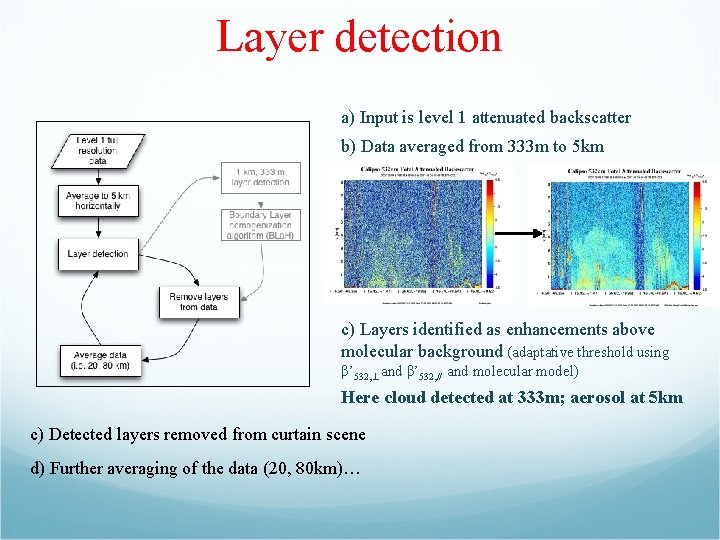
Layer detection a) Input is level 1 attenuated backscatter b) Data averaged from 333 m to 5 km c) Layers identified as enhancements above molecular background (adaptative threshold using β’ 532, ⊥and β’ 532, // and molecular model) Here cloud detected at 333 m; aerosol at 5 km c) Detected layers removed from curtain scene d) Further averaging of the data (20, 80 km)…
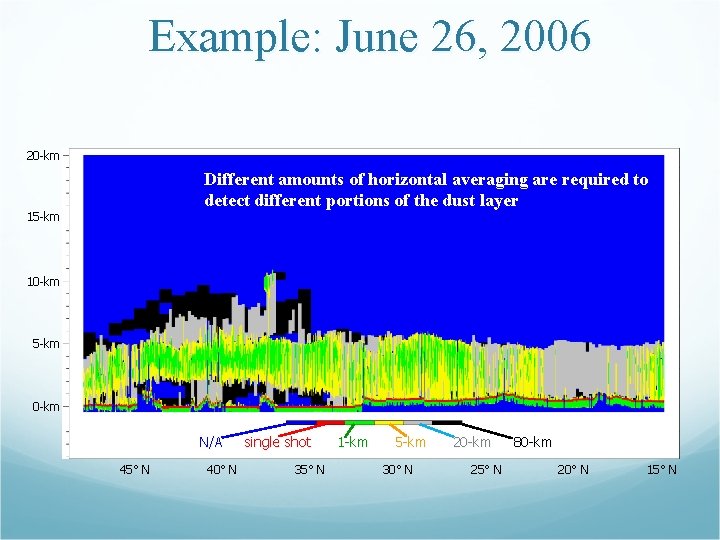
Example: June 26, 2006 20 -km Different amounts of horizontal averaging are required to detect different portions of the dust layer 15 -km 10 -km 5 -km 0 -km N/A 45° N 40° N single shot 35° N 1 -km 5 -km 30° N 20 -km 25° N 80 -km 20° N 15° N
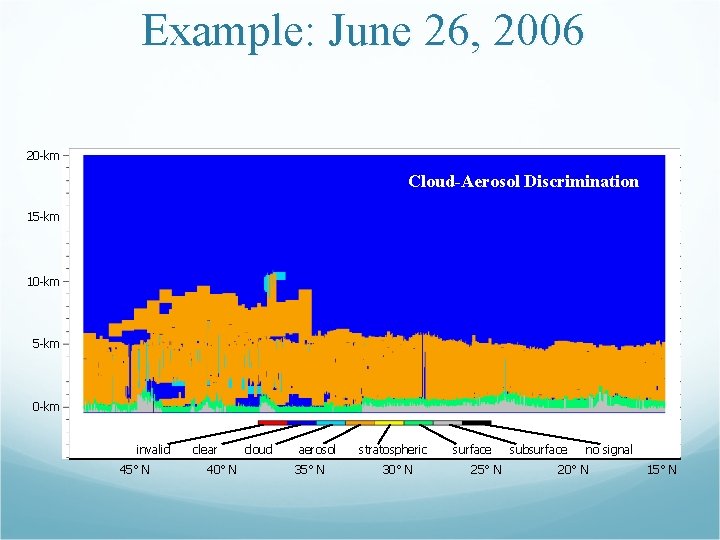
Example: June 26, 2006 20 -km Cloud-Aerosol Discrimination 15 -km 10 -km 5 -km 0 -km invalid 45° N clear 40° N cloud aerosol 35° N stratospheric 30° N surface 25° N subsurface no signal 20° N 15° N
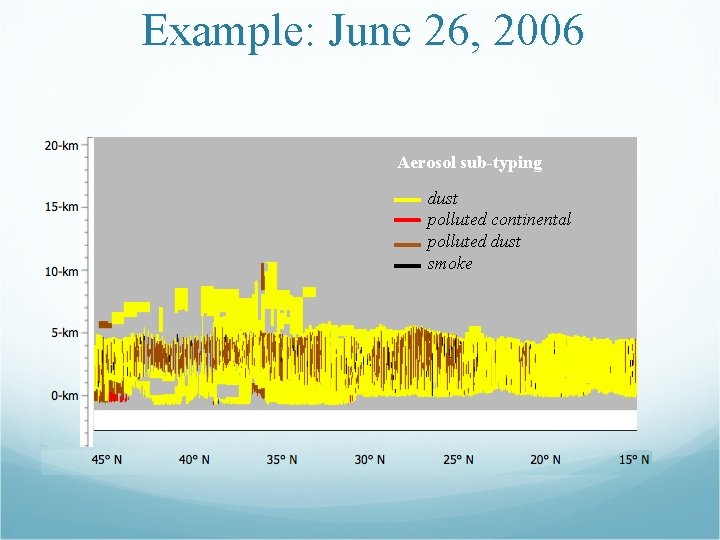
Example: June 26, 2006 Aerosol sub-typing dust polluted continental polluted dust smoke
Take home message CALIOP/ CALIPSO provides aerosol vertical distribution and info on type of particle (size and shape) Safest use of CALIOP data: 1. Qualitative (browse lidar images online) 2. Latest version (currently V 3. 01) 3. Level 1 (contains less uncertainties than level 2 data) Concerning the use of CALIOP Level 2 data, • recognize the unvalidated nature of the data • keep in mind the uncertainties • make sure to read all quality assurance information and to apply the appropriate quality flags (see user guide, http: //www-calipso. larc. nasa. gov/resources/calipso_users_guide/) • If you have any concerns, ask the CALIPSO team
Online • User Guide: http: //www-calipso. larc. nasa. gov/resources/calipso_users_guide/ FAQ, Essential reading, Data Product Descriptions, Data quality summaries (V 3. 01), Example and tools, Order Data, Publications • Data download http: //eosweb. larc. nasa. gov/HBDOCS/langley_web_tool. html http: //www-calipso. larc. nasa. gov/search/ for subset files • LIDAR browse images Level 1 and Level 2 Vertical Feature Mask; No level 2 profile EXPEDITED 12 h-RELEASE with kmz files http: //www-calipso. larc. nasa. gov/products/lidar/browse_images/expedited/ STANDARD PRODUCT for detailed science analysis http: //www-calipso. larc. nasa. gov/products/lidar/browse_images/show_calendar. php/ Also provides horizontal averaging, Ice/ Water phase and aerosol subtype
CALIPSO browse images online
CALIPSO browse images online
MPLNet Ground Based Lidar ARSET - AQ Applied Remote Sensing Education and Training – Air Quality A project of NASA Applied Sciences
Micro-Pulse Lidar Network (MPLNET) Principal Investigator: Judd Welton, NASA GSFC Code 612 Instrumentation & Network Management: Sebastian Stewart, SSAI GSFC Code 612 Tim Berkoff, UMBC GSFC Code 612 Data Processing & Analysis: Larry Belcher, UMBC GSFC Code 612 James Campbell, Naval Research Lab Phillip Haftings, SSA GSFC Code 612 Jasper Lewis, OARU GSF Code 612 Administrative Support: Erin Lee, SSAI GSFC Code 612 CALIPSO Validation Activities: Judd Welton, Tim Berkoff, James Campbell AERONET & Synergy Tool Partnership: Brent Holben, NASA GSFC Code 614. 4 Dave Giles, NASA GSFC Code 614. 4 NASA SMARTLABS Field Deployments: Si-Chee Tsay, NASA GSFC Code 613 Jack Ji, UMCP GSFC Code 613 Carlo Wang, UMCP GSFC Code 613 Site Operations & Science Investigations …. many network partners around the world MPLNET is funded by the NASA Radiation Sciences Program and the Earth Observing System MPLNET information and results shown here are the result of efforts by all of our network partners!
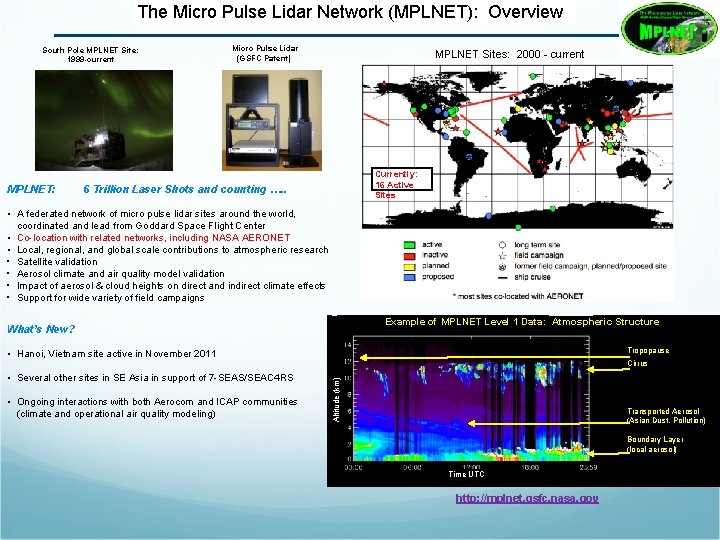
The Micro-Pulse Lidar Network (MPLNET): (MPLNET) Overview South Pole MPLNET Site: 1999 -current MPLNET: Micro Pulse Lidar (GSFC Patent) MPLNET Sites: 2000 - current Currently: 16 Active Sites 6 Trillion Laser Shots and counting …. . • A federated network of micro pulse lidar sites around the world, coordinated and lead from Goddard Space Flight Center • Co-location with related networks, including NASA AERONET • Local, regional, and global scale contributions to atmospheric research • Satellite validation • Aerosol climate and air quality model validation • Impact of aerosol & cloud heights on direct and indirect climate effects • Support for wide variety of field campaigns Example of MPLNET Level 1 Data: Atmospheric Structure What’s New? Tropopause • Hanoi, Vietnam site active in November 2011 • Ongoing interactions with both Aerocom and ICAP communities (climate and operational air quality modeling) Altitude (km) • Several other sites in SE Asia in support of 7 -SEAS/SEAC 4 RS Cirrus Transported Aerosol (Asian Dust, Pollution) Boundary Layer (local aerosol) Time UTC http: //mplnet. gsfc. nasa. gov
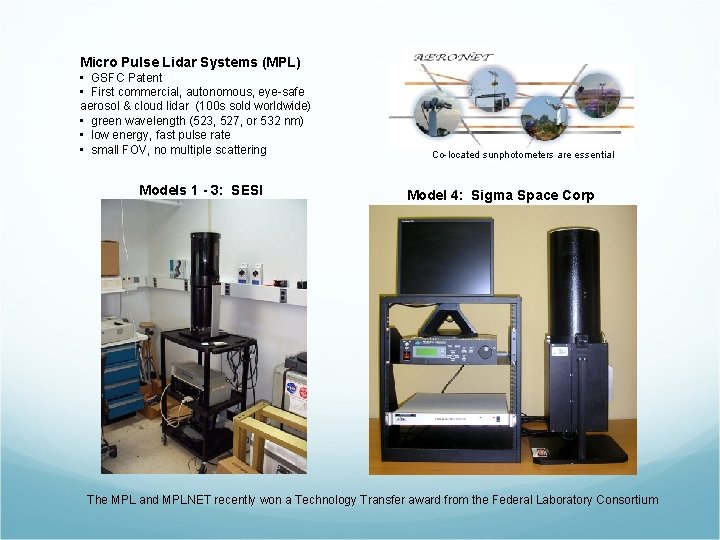
Micro Pulse Lidar Systems (MPL) • GSFC Patent • First commercial, autonomous, eye-safe aerosol & cloud lidar (100 s sold worldwide) • green wavelength (523, 527, or 532 nm) • low energy, fast pulse rate • small FOV, no multiple scattering Models 1 - 3: SESI Co-located sunphotometers are essential Model 4: Sigma Space Corp The MPL and MPLNET recently won a Technology Transfer award from the Federal Laboratory Consortium
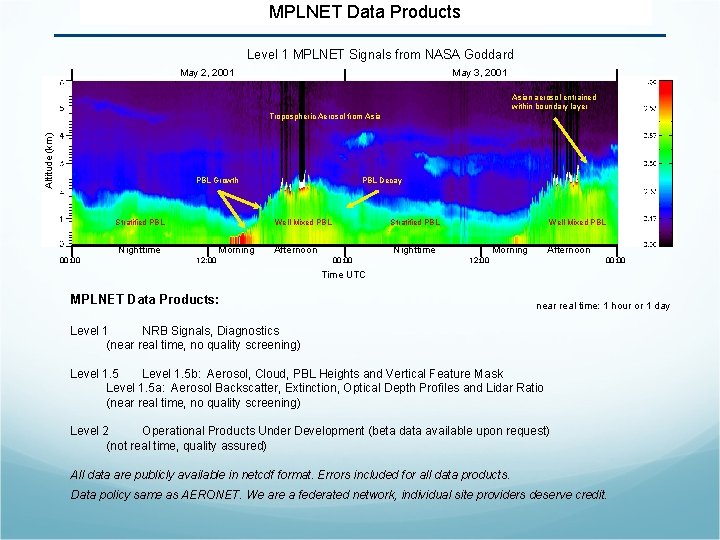
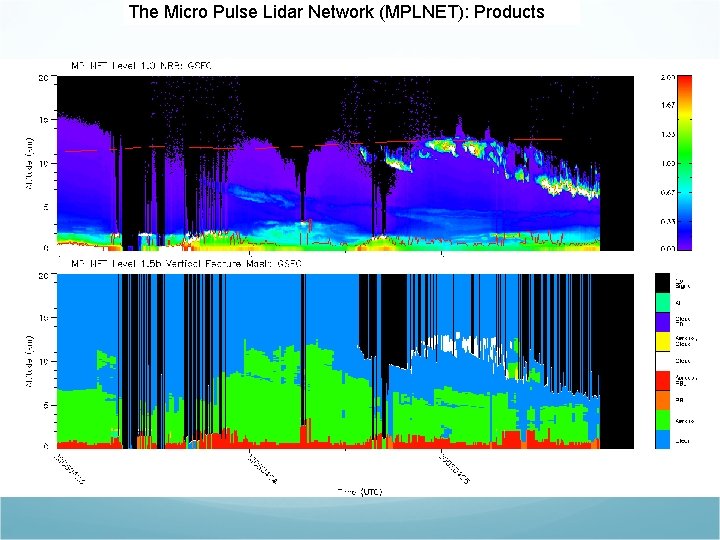
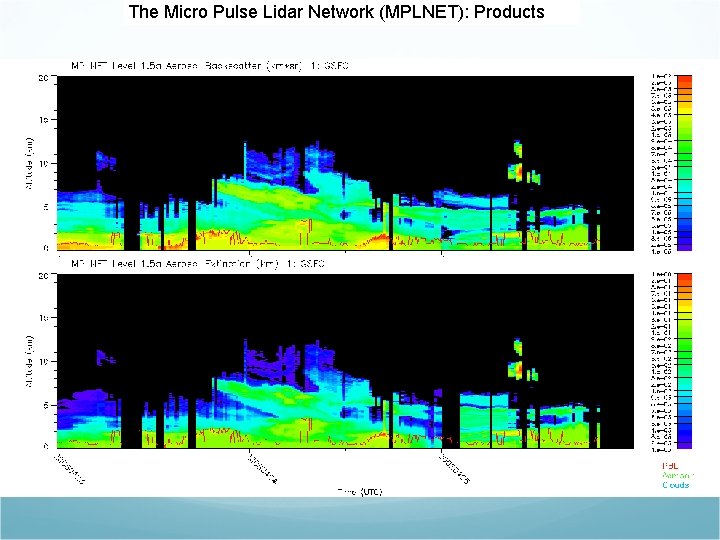
Micro-Pulse MPLNET Lidar. Data Network Products (MPLNET) Level 1 MPLNET Signals from NASA Goddard May 2, 2001 May 3, 2001 Asian aerosol entrained within boundary layer Altitude (km) Tropospheric Aerosol from Asia PBL Growth Stratified PBL Well Mixed PBL Nighttime 00: 00 PBL Decay Morning Stratified PBL Afternoon 12: 00 Well Mixed PBL Nighttime 00: 00 Morning Afternoon 12: 00 00: 00 Time UTC MPLNET Data Products: near real time: 1 hour or 1 day Level 1 NRB Signals, Diagnostics (near real time, no quality screening) Level 1. 5 b: Aerosol, Cloud, PBL Heights and Vertical Feature Mask Level 1. 5 a: Aerosol Backscatter, Extinction, Optical Depth Profiles and Lidar Ratio (near real time, no quality screening) Level 2 Operational Products Under Development (beta data available upon request) (not real time, quality assured) All data are publicly available in netcdf format. Errors included for all data products. Data policy same as AERONET. We are a federated network, individual site providers deserve credit.
The Micro Pulse Lidar Network (MPLNET): Products
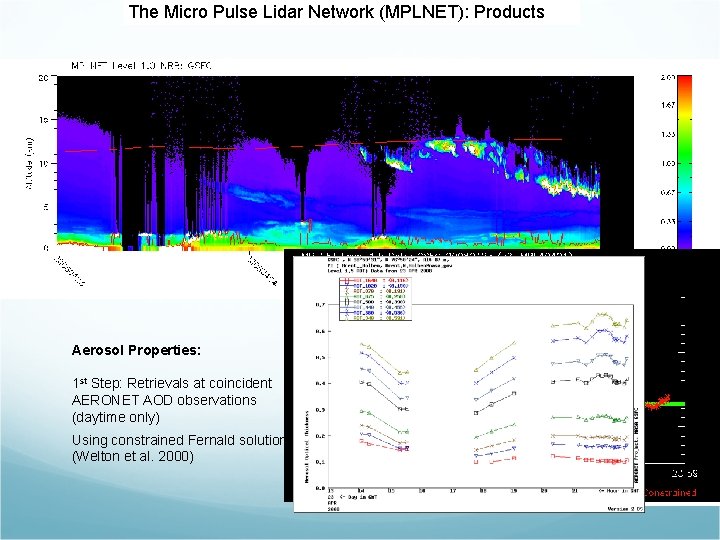
The Micro Pulse Lidar Network (MPLNET): Products Aerosol Properties: 1 st Step: Retrievals at coincident AERONET AOD observations (daytime only) Using constrained Fernald solution (Welton et al. 2000)
The Micro Pulse Lidar Network (MPLNET): Products
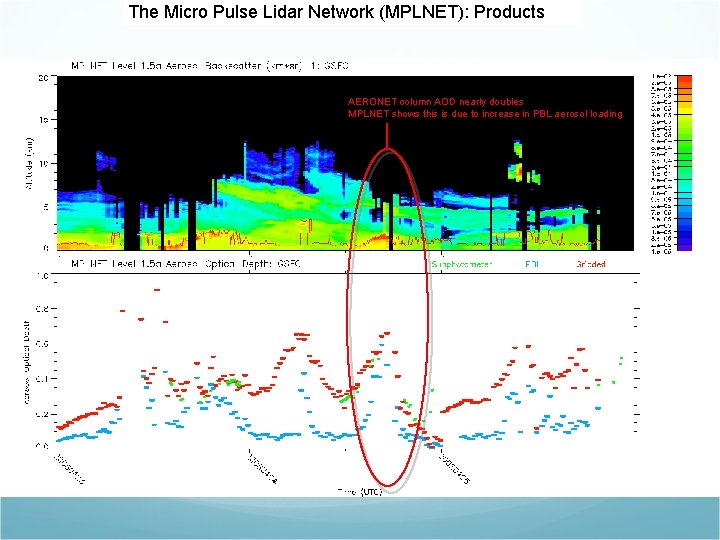
The Micro Pulse Lidar Network (MPLNET): Products AERONET column AOD nearly doubles MPLNET shows this is due to increase in PBL aerosol loading
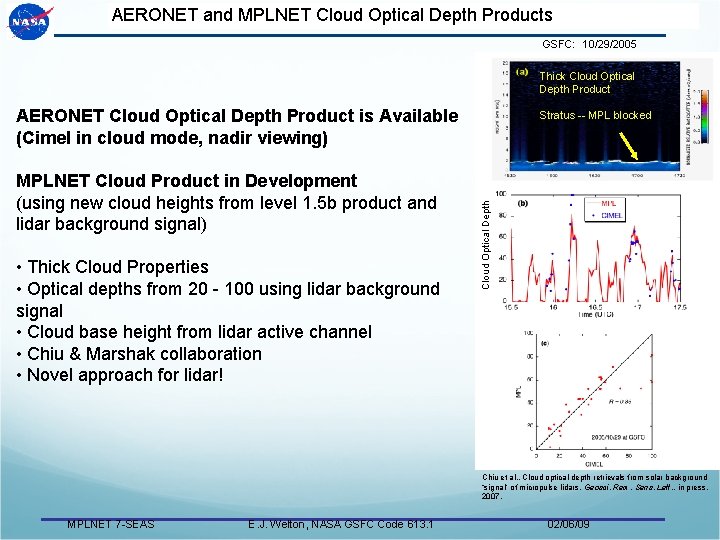
AERONET and MPLNET Cloud Optical Depth Products GSFC: 10/29/2005 Thick Cloud Optical Depth Product AERONET Cloud Optical Depth Product is Available (Cimel in cloud mode, nadir viewing) • Thick Cloud Properties • Optical depths from 20 - 100 using lidar background signal • Cloud base height from lidar active channel • Chiu & Marshak collaboration • Novel approach for lidar! Cloud Optical Depth MPLNET Cloud Product in Development (using new cloud heights from level 1. 5 b product and lidar background signal) Stratus -- MPL blocked Chiu et al. , Cloud optical depth retrievals from solar background “signal” of micropulse lidars, Geosci. Rem. Sens. Lett. , in press, 2007. MPLNET 7 -SEAS E. J. Welton, NASA GSFC Code 613. 1 02/06/09
Conceptually GALION fits GEOSS since it is a Network of Networks and GAW is GEOSS Implementation: Represented Networks: Steering Group (GAW - network heads) Regional/Continental (Dense): Technical Working Groups EARLINET (EUROPE) Technology & Methodology AD-NET (E ASIA) QA/QC CIS-LINET (CIS) Data Dissemination & Outreach CLN (NE United States) Model & Satellite Validation, Data CORALNET (Canada) Assimilation ALINE (Central & South America, Capacity Building Caribbean) Development into other regions Global (Sparse): Integration with Sunphotometer/Satellite MPLNET Meas/Modeling NDACC Initial observation schedule based on EARLINET Minimum 1 obs at sunset on Mon, * Independent Sites Thu If possible, 1 obs midday on Mon

Extras
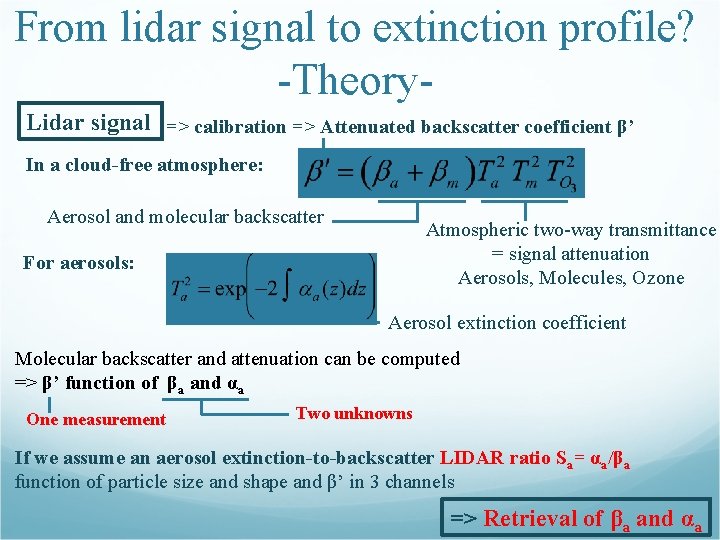
From lidar signal to extinction profile? -Theory. Lidar signal => calibration => Attenuated backscatter coefficient β’ In a cloud-free atmosphere: Aerosol and molecular backscatter Atmospheric two-way transmittance = signal attenuation Aerosols, Molecules, Ozone For aerosols: Aerosol extinction coefficient Molecular backscatter and attenuation can be computed => β’ function of βa and αa One measurement Two unknowns If we assume an aerosol extinction-to-backscatter LIDAR ratio Sa= αa/βa function of particle size and shape and β’ in 3 channels => Retrieval of βa and αa
![Layer classification a) Cloud-Aerosol Discrimination [Liu et al. , 2004, 2009] b) Cloud ice-water](http://slidetodoc.com/presentation_image_h2/5efb730c0af420dd7bb2632280d9254d/image-38.jpg "Layer classification a) Cloud-Aerosol Discrimination [Liu et al. , 2004, 2009] b) Cloud ice-water")
Layer classification a) Cloud-Aerosol Discrimination [Liu et al. , 2004, 2009] b) Cloud ice-water phase discrimination [Hu et al. , 2009] c) Aerosol sub-typing and observation-based lidar ratio Sa: [Omar et al. , 2005, 2009; Liu et al. , 2009] Look Up Table Aerosol Sub-type Initial Sa, 532 biomass burning smoke 70 polluted dust 65 polluted continental 70 clean continental 35 desert dust 40 marine 20
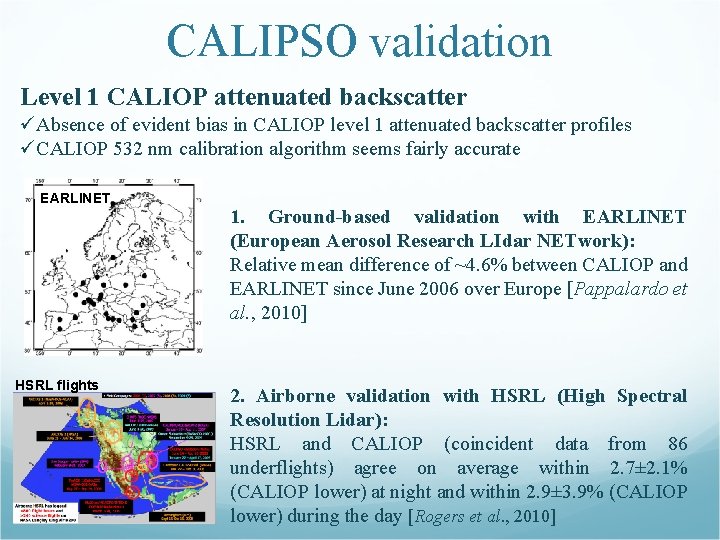
CALIPSO validation Level 1 CALIOP attenuated backscatter üAbsence of evident bias in CALIOP level 1 attenuated backscatter profiles üCALIOP 532 nm calibration algorithm seems fairly accurate EARLINET HSRL flights 1. Ground-based validation with EARLINET (European Aerosol Research LIdar NETwork): Relative mean difference of ~4. 6% between CALIOP and EARLINET since June 2006 over Europe [Pappalardo et al. , 2010] 2. Airborne validation with HSRL (High Spectral Resolution Lidar): HSRL and CALIOP (coincident data from 86 underflights) agree on average within 2. 7± 2. 1% (CALIOP lower) at night and within 2. 9± 3. 9% (CALIOP lower) during the day [Rogers et al. , 2010]
CALIPSO validation Level 2 CALIOP layer boundaries, backscatter and extinction üVery little validation of CALIOP level 2 data: few case studies üSignificant uncertainties associated with level 2 data 1. Ground-based validation with EARLINET Example: CALIPSO underestimates Sa (40 instead of ~50 sr, hence underestimates AOD) during 26– 31 May 2008 Saharan Dust outbreak [Pappalardo et al. , 2010] 2. Airborne validation with HSRL CALIOP overestimates HSRL extinction with an average extinction bias of ~ 24% during CATZ (CALIPSO and Twilight Zone campaign) and ~59% during Go. MACCS (Gulf of Mexico Atmospheric Composition and Climate Study) [Omar et al, 2009]
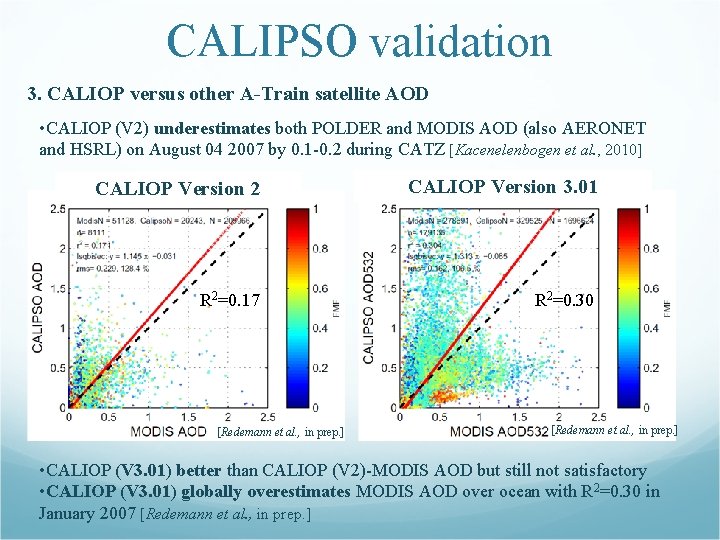
CALIPSO validation 3. CALIOP versus other A-Train satellite AOD • CALIOP (V 2) underestimates both POLDER and MODIS AOD (also AERONET and HSRL) on August 04 2007 by 0. 1 -0. 2 during CATZ [Kacenelenbogen et al. , 2010] CALIOP Version 2 CALIOP Version 3. 01 R 2=0. 17 R 2=0. 30 [Redemann et al. , in prep. ] • CALIOP (V 3. 01) better than CALIOP (V 2)-MODIS AOD but still not satisfactory • CALIOP (V 3. 01) globally overestimates MODIS AOD over ocean with R 2=0. 30 in January 2007 [Redemann et al. , in prep. ]
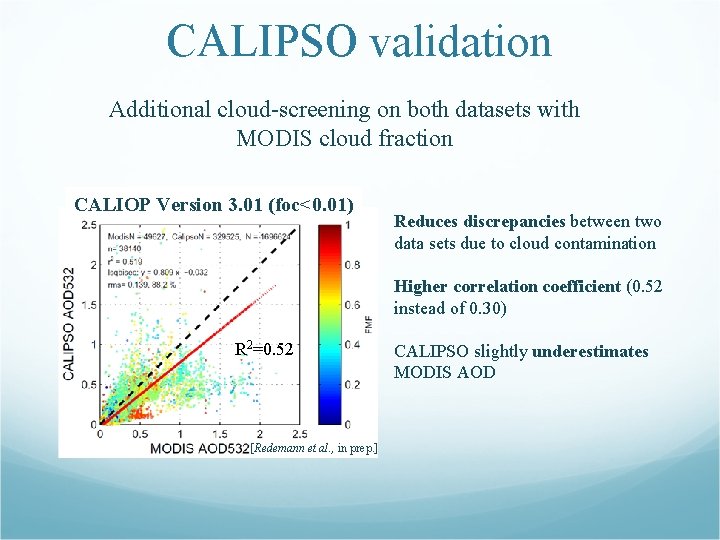
CALIPSO validation Additional cloud-screening on both datasets with MODIS cloud fraction CALIOP Version 3. 01 (foc<0. 01) Reduces discrepancies between two data sets due to cloud contamination Higher correlation coefficient (0. 52 instead of 0. 30) R 2=0. 52 [Redemann et al. , in prep. ] CALIPSO slightly underestimates MODIS AOD
Level 2 data uncertainties i) Low Signal to noise ratio CALIOP will fail to detect layers with aerosol backscatter < 2~4 10 -4 km-1 sr-1 in troposphere [Winker et al. , 2009] (Sa of 50 sr, α of 0. 01 -0. 02 km-1, AOD of 0. 02 -0. 04 in 2 km) => CALIOP not measuring tenuous aerosol layers => Lack of photons returned from underneath highly attenuating layers (dense aerosol or cloud) leading to erroneous or total lack of aerosol identification in the lower part of a given atmospheric profile ii) Miss-classification of layer type (aerosol or cloud) and aerosol subtype (biomass, dust, etc…) => leading to incorrect assumption about lidar ratio Sa iii) Improved calibration technique for the lidar Level 1 532 nm daytime calibration in Version 3. 01 [Powell et al. , 2010] iv) Multiple scattering is assumed negligible in current algorithm => Impact on cases with dense dust plumes recording high AOD where effects of multiple scattering applies
CALIPSO: example of application The detection of aerosols over clouds Aerosols and their radiative effects are a major uncertainty in predictions of future climate change Biomass burning aerosols usually strongly absorbing, may cause local positive radiative forcing when over clouds CALIOP is the only satellite sensor capable of observing aerosol over clouds without any auxiliary data (OMI or POLDER need to combine with MODIS and/ or CALIOP) Before studying aerosol radiative effects over clouds, we need to know where and when aerosol over clouds occur as well as their intensity We use the CALIPSO level 2 aerosol layer product…
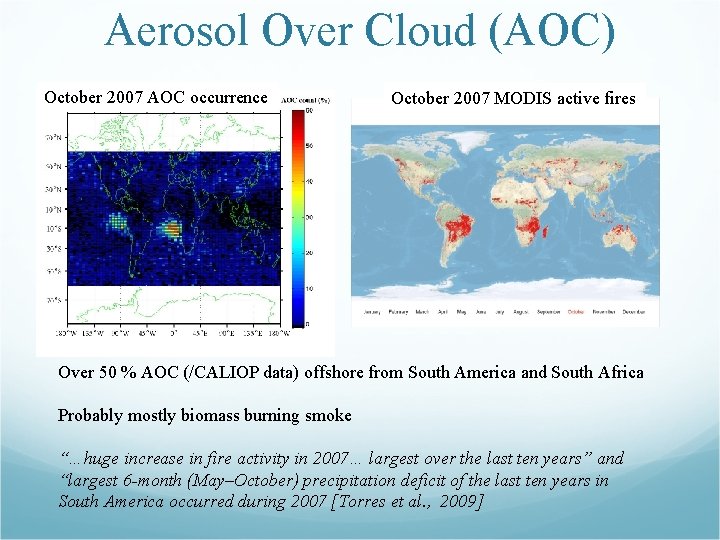
Aerosol Over Cloud (AOC) October 2007 AOC occurrence October 2007 MODIS active fires Over 50 % AOC (/CALIOP data) offshore from South America and South Africa Probably mostly biomass burning smoke “…huge increase in fire activity in 2007… largest over the last ten years” and “largest 6 -month (May–October) precipitation deficit of the last ten years in South America occurred during 2007 [Torres et al. , 2009]
- Slides: 45