
Southwest Asia Today Chapter 6 Dubai UAE Georgia
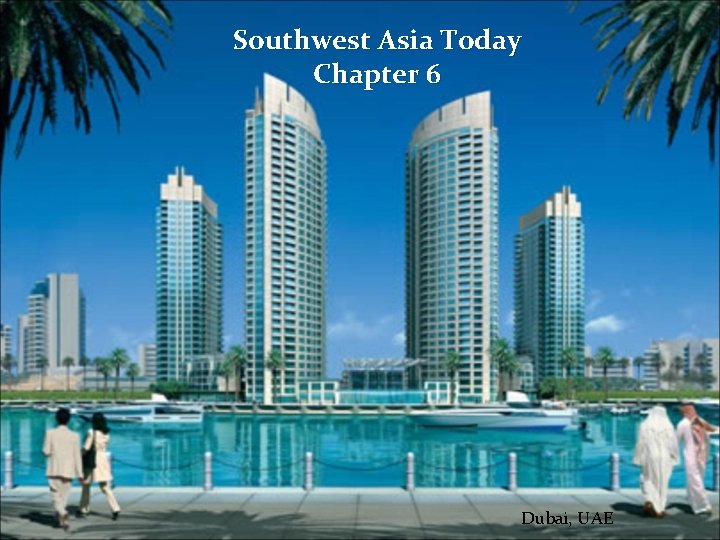
Southwest Asia Today Chapter 6 Dubai, UAE
Georgia th 7 Grade Standards Compare and contrast the economic systems in Israel, Saudi Arabia and Turkey Evaluate how the literacy rate affects the standard of living. Explain the primary function of the Organization of Petroleum Exporting Countries Explain how most countries have a mixed economy located on the continuum between pure market and pure command.
Standard of Living vs. Literacy Rate & GDP per capita Literacy Rate – percentage of the population at a specific age who can read and write GDP per capita – GDP based on population Standard of Living – the degree of wealth and material comfort available to the general population of a country. GDP – total value of all goods and services. Gross Domestic Product Are literacy rate and GDP linked to standard of living?
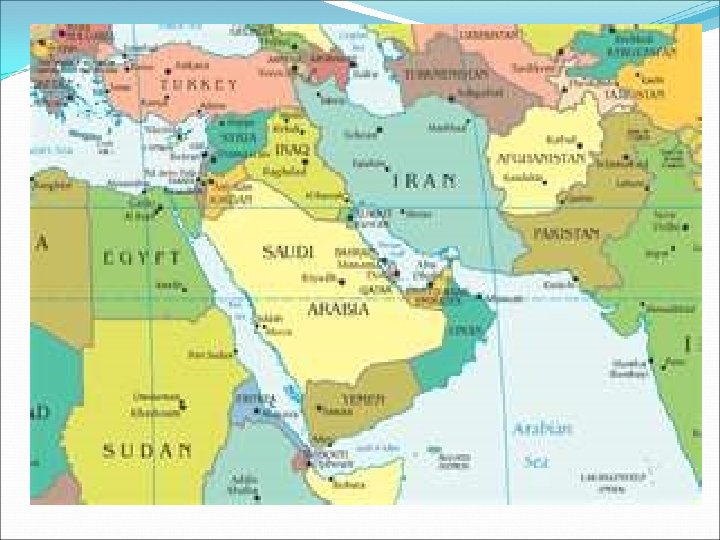
High standards of living vs. Low standards of living Israel Literacy rate – 97% GDP per capita $29800 Manufacturing Saudi Arabia Literacy rate – 79% GDP per capita - $24200 Oil production Yemen Literacy rate – 50% GDP per capita - $2700 Oil production Afghanistan Literacy rate – 28% GDP per capita - $900 Agriculture
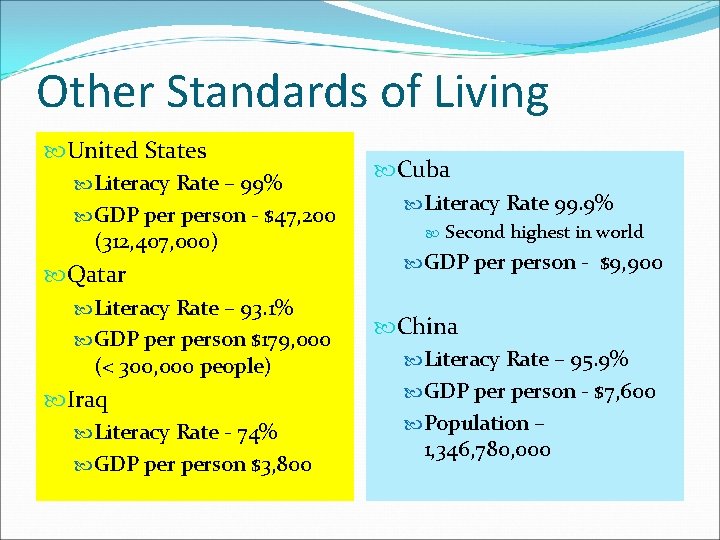
Other Standards of Living United States Literacy Rate – 99% GDP person - $47, 200 (312, 407, 000) Qatar Literacy Rate – 93. 1% GDP person $179, 000 (< 300, 000 people) Iraq Literacy Rate - 74% GDP person $3, 800 Cuba Literacy Rate 99. 9% Second highest in world GDP person - $9, 900 China Literacy Rate – 95. 9% GDP person - $7, 600 Population – 1, 346, 780, 000
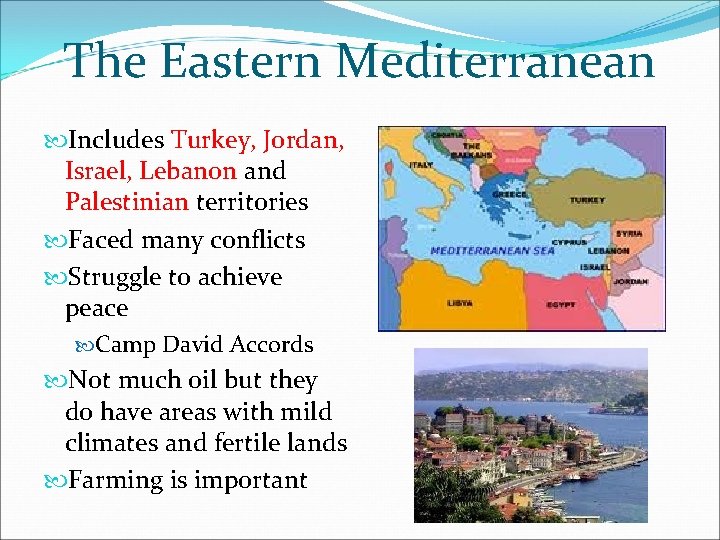
The Eastern Mediterranean Includes Turkey, Jordan, Israel, Lebanon and Palestinian territories Faced many conflicts Struggle to achieve peace Camp David Accords Not much oil but they do have areas with mild climates and fertile lands Farming is important
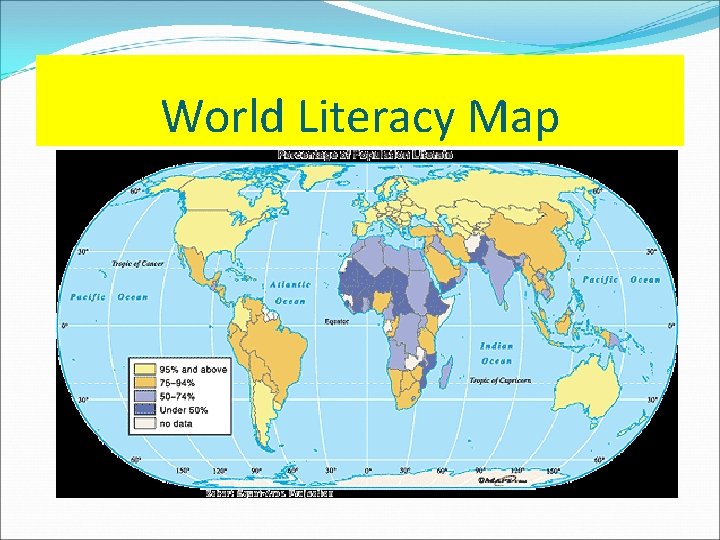
World Literacy Map
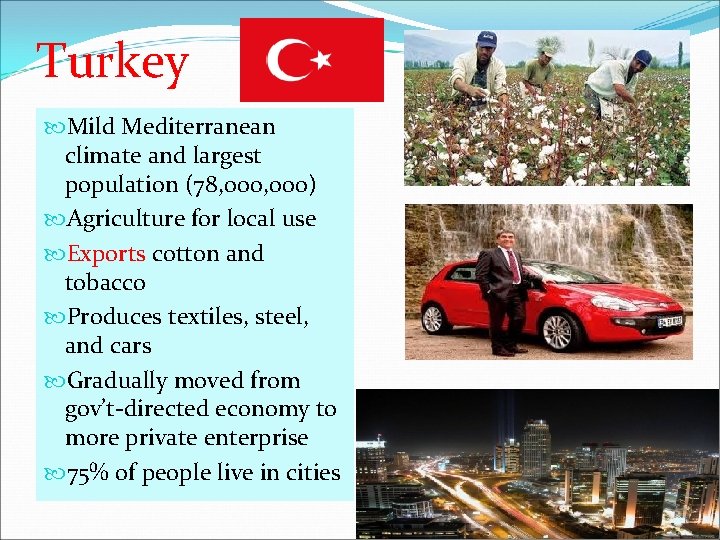
Turkey Mild Mediterranean climate and largest population (78, 000) Agriculture for local use Exports cotton and tobacco Produces textiles, steel, and cars Gradually moved from gov’t-directed economy to more private enterprise 75% of people live in cities
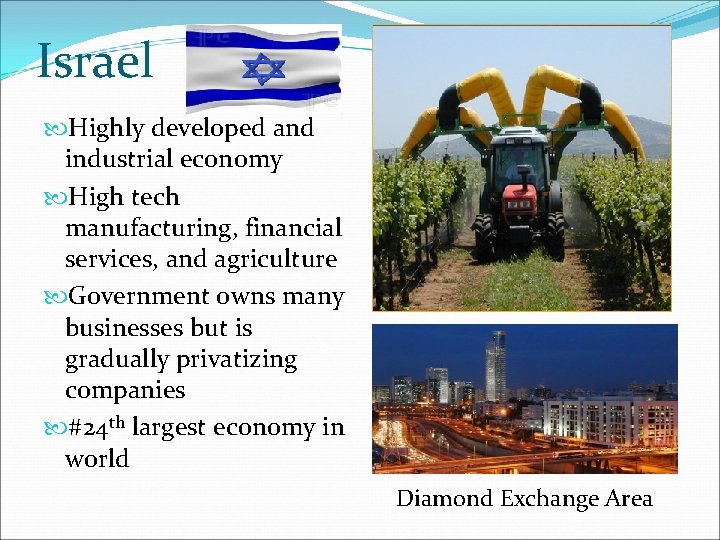
Israel Highly developed and industrial economy High tech manufacturing, financial services, and agriculture Government owns many businesses but is gradually privatizing companies #24 th largest economy in world Diamond Exchange Area
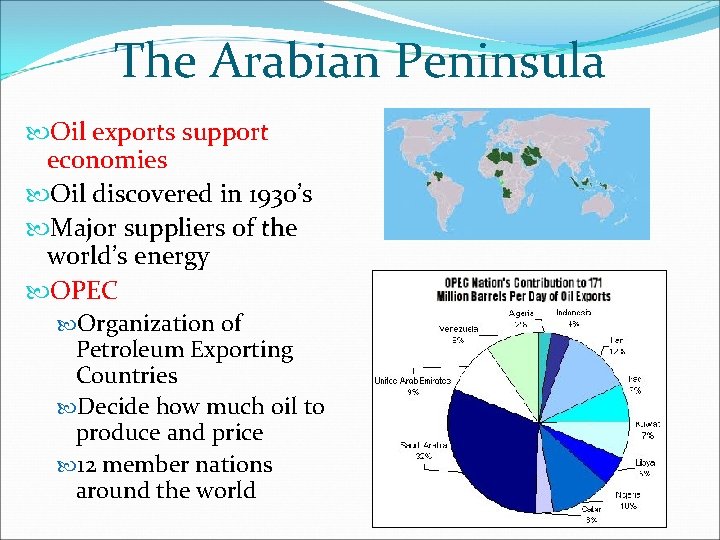
The Arabian Peninsula Oil exports support economies Oil discovered in 1930’s Major suppliers of the world’s energy OPEC Organization of Petroleum Exporting Countries Decide how much oil to produce and price 12 member nations around the world
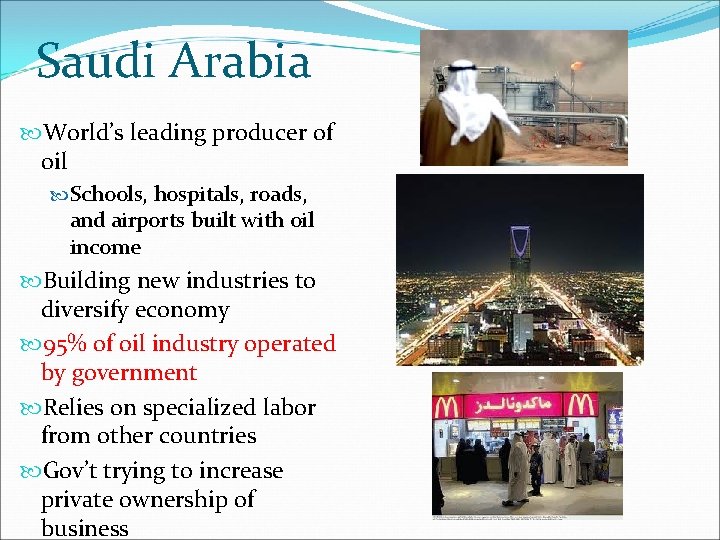
Saudi Arabia World’s leading producer of oil Schools, hospitals, roads, and airports built with oil income Building new industries to diversify economy 95% of oil industry operated by government Relies on specialized labor from other countries Gov’t trying to increase private ownership of business
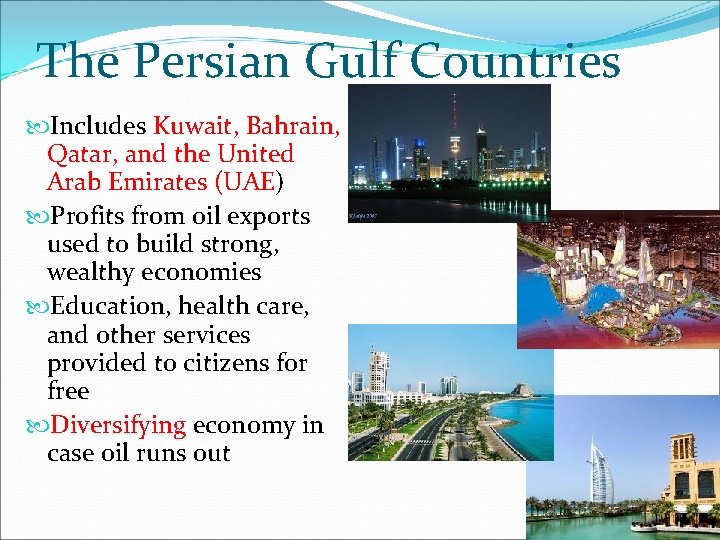
The Persian Gulf Countries Includes Kuwait, Bahrain, Qatar, and the United Arab Emirates (UAE) Profits from oil exports used to build strong, wealthy economies Education, health care, and other services provided to citizens for free Diversifying economy in case oil runs out
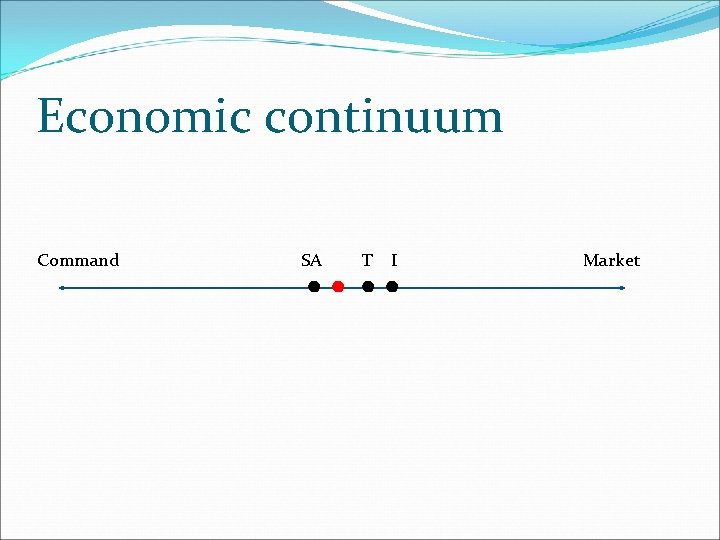
Economic continuum Command SA T I • • Market
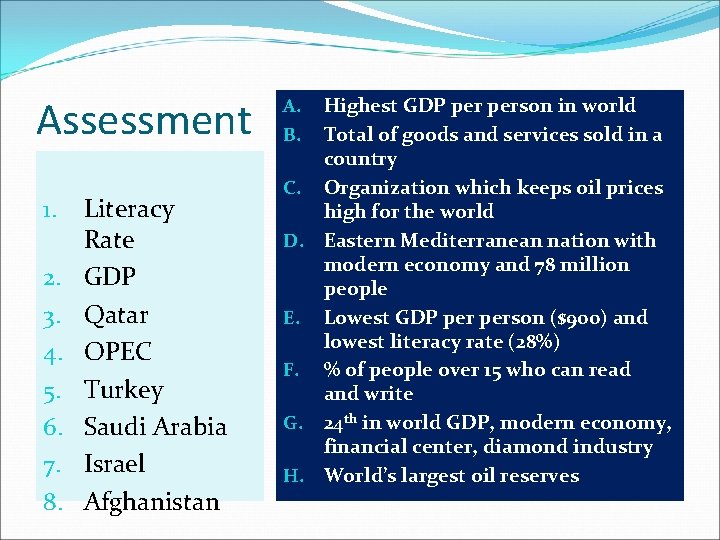
Assessment 1. 2. 3. 4. 5. 6. 7. 8. Literacy Rate GDP Qatar OPEC Turkey Saudi Arabia Israel Afghanistan Highest GDP person in world Total of goods and services sold in a country C. Organization which keeps oil prices high for the world D. Eastern Mediterranean nation with modern economy and 78 million people E. Lowest GDP person ($900) and lowest literacy rate (28%) F. % of people over 15 who can read and write G. 24 th in world GDP, modern economy, financial center, diamond industry H. World’s largest oil reserves A. B.
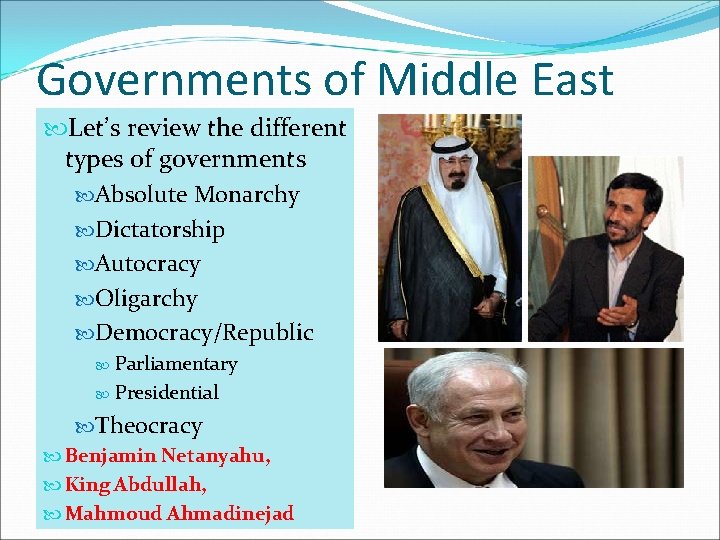
Governments of Middle East Let’s review the different types of governments Absolute Monarchy Dictatorship Autocracy Oligarchy Democracy/Republic Parliamentary Presidential Theocracy Benjamin Netanyahu, King Abdullah, Mahmoud Ahmadinejad
Standard SS 7 CG 5 The student will explain the structures of the national governments of Southwest Asia (Middle East) a. Compare the parliamentary democracy of the State of Israel, the monarchy of the kingdom of Saudi Arabia, and theocracy of the Islamic Republic of Iran, distinguishing the form of leadership and the role of the citizen in terms of voting rights and personal freedoms.
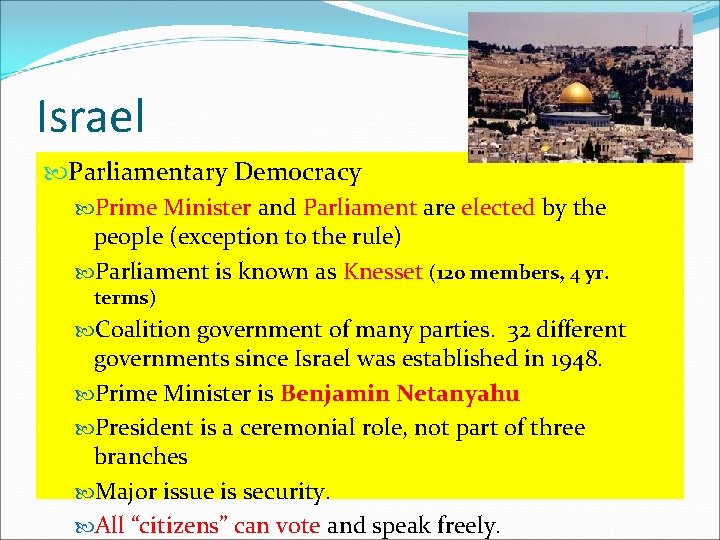
Israel Parliamentary Democracy Prime Minister and Parliament are elected by the people (exception to the rule) Parliament is known as Knesset (120 members, 4 yr. terms) Coalition government of many parties. 32 different governments since Israel was established in 1948. Prime Minister is Benjamin Netanyahu President is a ceremonial role, not part of three branches Major issue is security. All “citizens” can vote and speak freely.
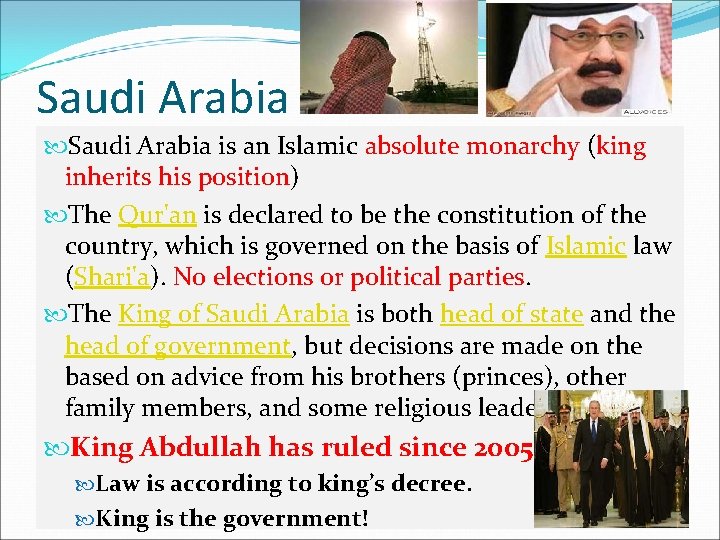
Saudi Arabia is an Islamic absolute monarchy (king inherits his position) The Qur'an is declared to be the constitution of the country, which is governed on the basis of Islamic law (Shari'a). No elections or political parties. The King of Saudi Arabia is both head of state and the head of government, but decisions are made on the based on advice from his brothers (princes), other family members, and some religious leaders. King Abdullah has ruled since 2005. Law is according to king’s decree. King is the government!
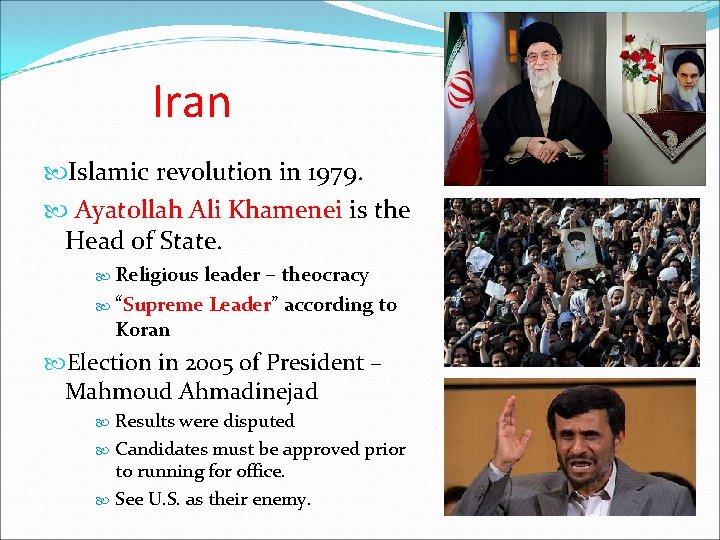
Iran Islamic revolution in 1979. Ayatollah Ali Khamenei is the Head of State. Religious leader – theocracy “Supreme Leader” according to Koran Election in 2005 of President – Mahmoud Ahmadinejad Results were disputed Candidates must be approved prior to running for office. See U. S. as their enemy.
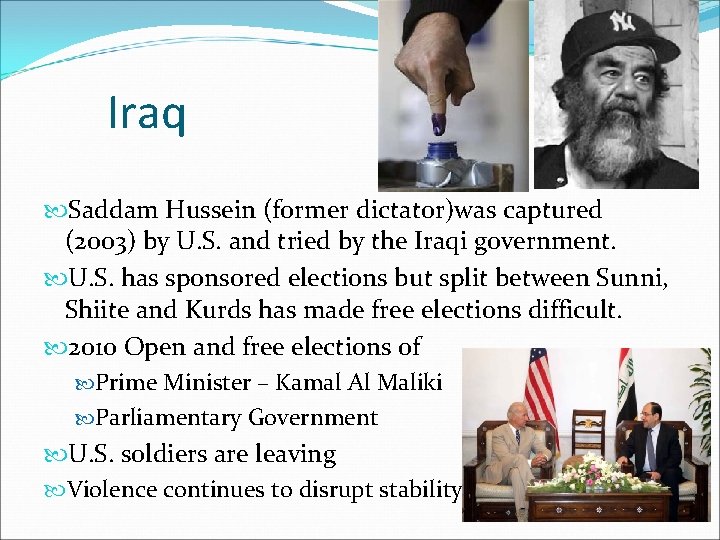
Iraq Saddam Hussein (former dictator)was captured (2003) by U. S. and tried by the Iraqi government. U. S. has sponsored elections but split between Sunni, Shiite and Kurds has made free elections difficult. 2010 Open and free elections of Prime Minister – Kamal Al Maliki Parliamentary Government U. S. soldiers are leaving Violence continues to disrupt stability
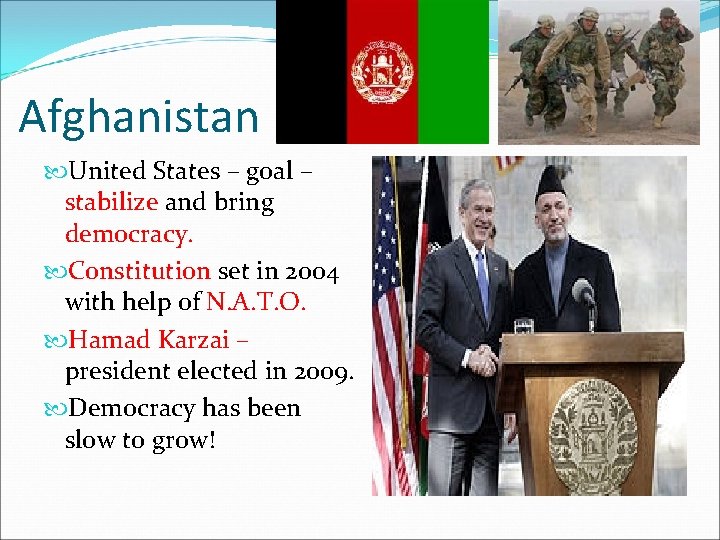
Afghanistan United States – goal – stabilize and bring democracy. Constitution set in 2004 with help of N. A. T. O. Hamad Karzai – president elected in 2009. Democracy has been slow to grow!
Assessment 1. Israel 2. Iran 3. Saudi Arabia a. Democracy b. Monarchy c. Theocracy A. B. C. Ayatollah Khamenei Benjamin Netanyhu King Abdullah
- Slides: 23