
Southern Nevada Fire Operations SNFO Hostile MCI Response
- Slides: 31
Southern Nevada Fire Operations (SNFO) Hostile MCI Response Policy
SNFO Hostile MCI Policy � In 2011 the Clark County Fire Department was like most first response agencies across the U. S. when it came to responding to an active shooter situation. � We were unprepared: No plan. No multi-agency, multi-discipline training or policies.
SNFO Hostile MCI Policy � � As these events continued to become more common across the country there was a growing sense of urgency within not only our organization but all of our local first response agencies. No one knew: � When will it happen here? � How will we respond? � How should we prepare?
SNFO Hostile MCI Policy � � Fortunately a few key things had taken place in recent years that helped us bridge some of the gaps we were facing. The most notable gap was the FDs interactions with local law enforcement (LE).
SNFO Hostile MCI Policy First piece: Southern Nevada Counter Terrorism Center (SNCTC) Fusion Center. One of two Fusion Centers in Nevada. CCFD staffs a Fire Captain in the Fusion Center (modified duty) to act as a liaison between LE at all levels. We had our foot in the door in regards to improving relationships with LE.
SNFO Hostile MCI Policy � Second piece: Southern Nevada Fire Operations � Working group that has its roots all the way back to 2002 when some captains from the local FD heavy rescue teams banned together in an effort to improve relationships between teams and increase the response capabilities available to the community.
SNFO Hostile MCI Policy � Since then those captains have moved up in their respective organizations and in doing so brought those relationships and successes with them. � The end result is SNFO. � Projects accomplished: � RIT Operations, common SOPs, high-rise firefighting plan, tactical work sheets, valley wide multi-agency training and coordination.
SNFO Hostile MCI Policy Given the success of the SNFO group the decision was made to use that same format to address an Active Shooter Policy.
MACTAC – quick note Multiple Assault Counter Terrorism Action Capabilities. LE’s plan for engaging assailants who are actively killing in multiple locations. Very good plan. They are very well trained and prepared. Been around for several years However, no FD/EMS involvement. They assumed we would just follow them into a building to fight a fire or deal with patients during one an event like this.
SNFO Hostile MCI Policy In late 2011 the SNFO Active Shooter committee was formed. Now referred to as the SNFO Hostile MCI Committee. For the first time a SNFO working group had participation from: LE Health District Military Several other specialty personnel
SNFO Hostile MCI Policy The SNFO Active Shooter Committee worked diligently over the course of three years to arrive at our final policy. Hurdles encountered: No current template to refer to. Communications. Unified Command with LE. Firefighter resistance. Developing and holding hands-on training.
Clearing the Hurdles No current template to refer to. When reaching out we found that most everyone else was in the same place we were…. Conceptual plans began to come together. Shared and received experiences from other departments across the country that were working on the same problem. Those conceptual plans morphed constantly because of trial and error.
Clearing the Hurdles Communications: Common radio frequencies: Existed but LE did not have the fleet maps. Cant even talk to each other. LE IC trying to talk to everyone: Quickly became overwhelmed. Terminologies: ICS terms: LE had never used Div/Grp/Branch etc. Other terms: Later slide
Clearing the Hurdles Unified Command with LE: Training side by side. Tactical worksheets. Showing the benefits of accountability. Communications (our radios). Discipline for teams (stay together no matter what).
Clearing the Hurdles Firefighter resistance Like any other thing we do. Risk a lot to save a lot. Provide safety given the use of SOPs, training and coordination. Hands on drills with LE partners. Ballistic PPE.
Clearing the Hurdles Developing and testing ideas via hands-on training. Multiple venues used. Several concepts failed. Crews were very disappointed in what we were doing. Eventually some common positive experiences were found and leaders from both FD & LE were gelling. The rough edges were smoothed out and a policy came to life.
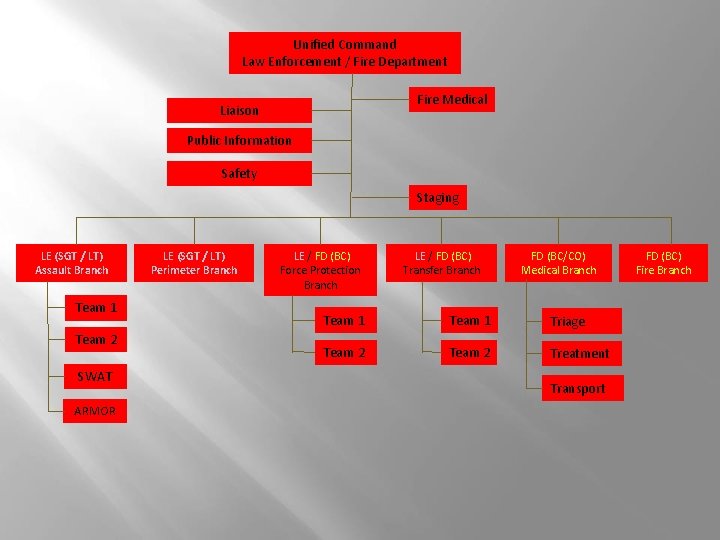
Tactical Worksheet � � � The following slide is an example of a ICS worksheet to be used in the class. Like any ICS worksheet it is not set in stone, only an example of what might develop. Filling of all the Command Staff positions would not be an initial priority.
Unified Command Law Enforcement / Fire Department Fire Medical Liaison Public Information Safety Staging LE (SGT / LT) Assault Branch Team 1 Team 2 SWAT ARMOR LE (SGT / LT) Perimeter Branch LE / FD (BC) Force Protection Branch LE / FD (BC) Transfer Branch FD (BC/CO) Medical Branch Team 1 Triage Team 2 Treatment Transport FD (BC) Fire Branch
Final Training Push During the Spring of 2014 the final draft of the policy was out and training with our local LE partners was beginning. CCFD was to begin our training on June 11 th. Other departments were just wrapping up their training. However June 8 th changed everything.
Murder of two Metro Police Officers � On this Sunday afternoon two suspects intent on killing police officers succeeded. � Ambush in a pizza parlor. � Wal-Mart shooting. � Our policy was tested. � Even before we had officially rolled it out. � Force Protection 1 was deployed and removed the female suspect who was still alive.
Moving on as a community To date training has been completed for all the SNV Fire Departments: CCFD, LVFR, HFD, NLVFD, BCFD, MFD and Bullhead AZ FD. Approximately 1800 FD personnel across 8, 000 square miles. LE agencies involved in the process: LVMPD, NLVFD, NHP, HPD, BCPD, Tribal PD, FBI, UNLV, Nellis AFB and CCSD.
Terms Assault Teams. Force Protection. Hostile MCI Kits. Sift and Sort. Transfer Teams. Clean/Dirty area.
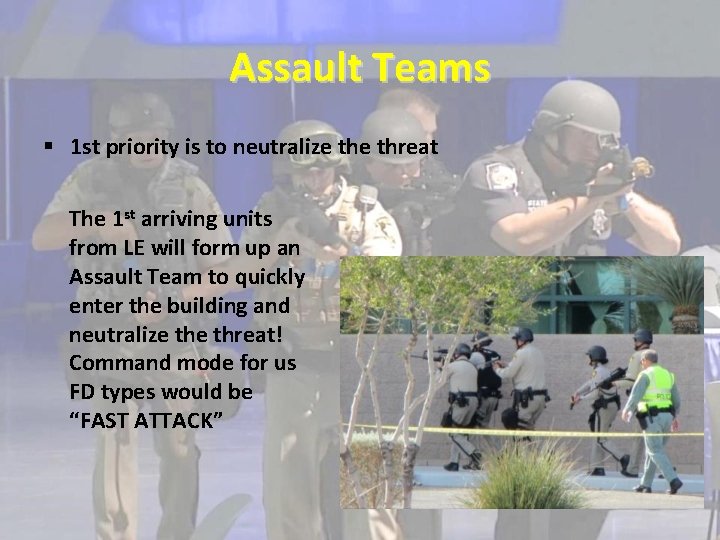
Assault Teams § 1 st priority is to neutralize threat The 1 st arriving units from LE will form up an Assault Team to quickly enter the building and neutralize threat! Command mode for us FD types would be “FAST ATTACK”
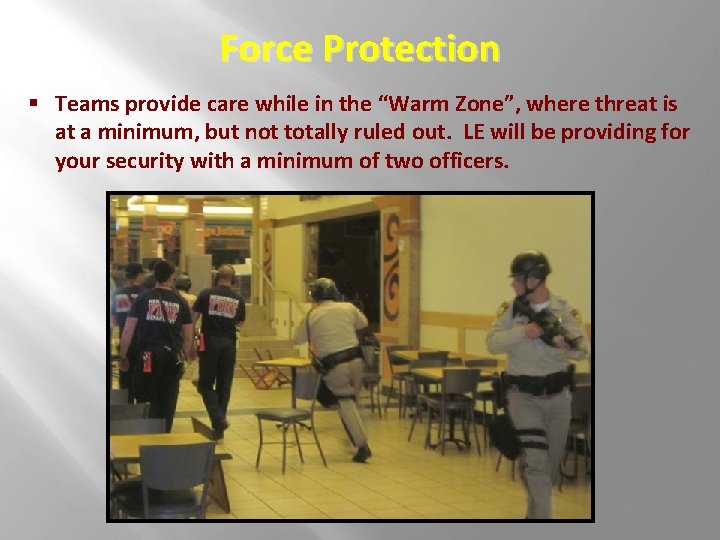
Force Protection § Teams provide care while in the “Warm Zone”, where threat is at a minimum, but not totally ruled out. LE will be providing for your security with a minimum of two officers.
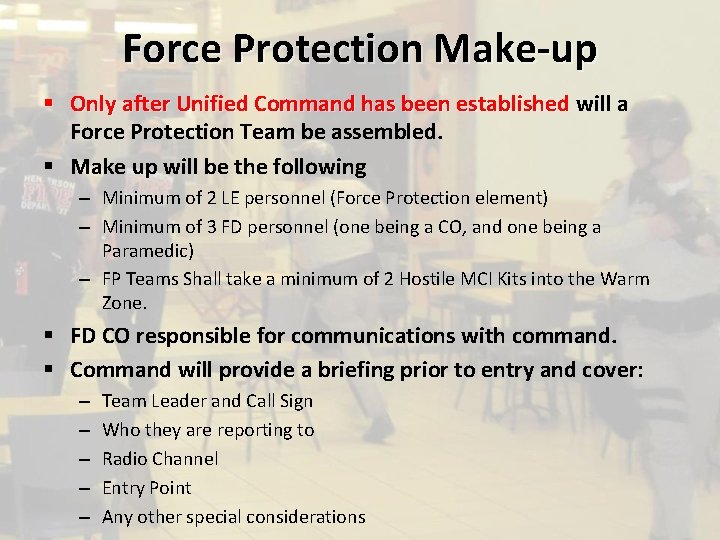
Force Protection Make-up § Only after Unified Command has been established will a Force Protection Team be assembled. § Make up will be the following – Minimum of 2 LE personnel (Force Protection element) – Minimum of 3 FD personnel (one being a CO, and one being a Paramedic) – FP Teams Shall take a minimum of 2 Hostile MCI Kits into the Warm Zone. § FD CO responsible for communications with command. § Command will provide a briefing prior to entry and cover: – – – Team Leader and Call Sign Who they are reporting to Radio Channel Entry Point Any other special considerations
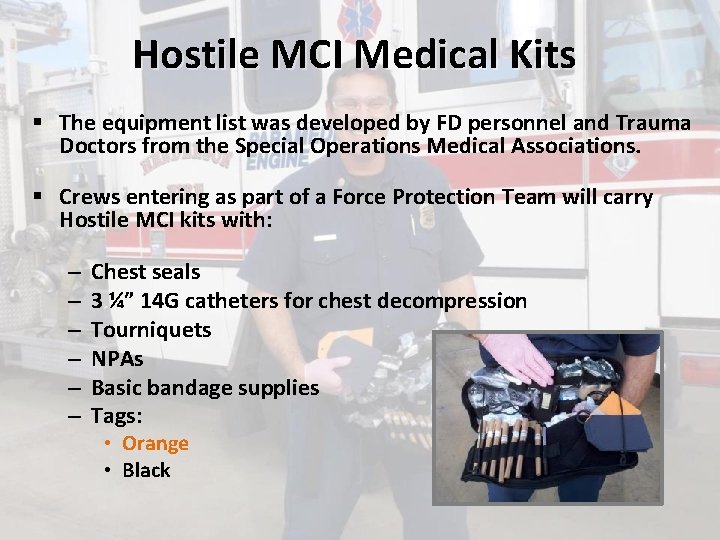
Hostile MCI Medical Kits § The equipment list was developed by FD personnel and Trauma Doctors from the Special Operations Medical Associations. § Crews entering as part of a Force Protection Team will carry Hostile MCI kits with: – – – Chest seals 3 ¼” 14 G catheters for chest decompression Tourniquets NPAs Basic bandage supplies Tags: • Orange • Black
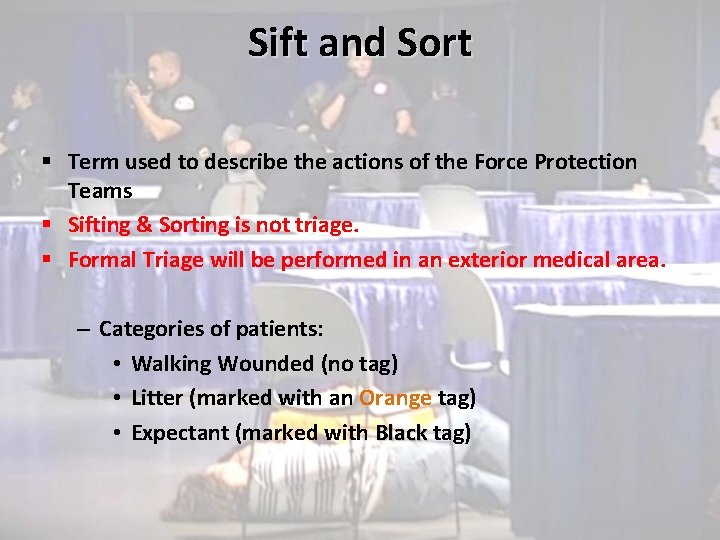
Sift and Sort § Term used to describe the actions of the Force Protection Teams § Sifting & Sorting is not triage. § Formal Triage will be performed in an exterior medical area. – Categories of patients: • Walking Wounded (no tag) • Litter (marked with an Orange tag) • Expectant (marked with Black tag)
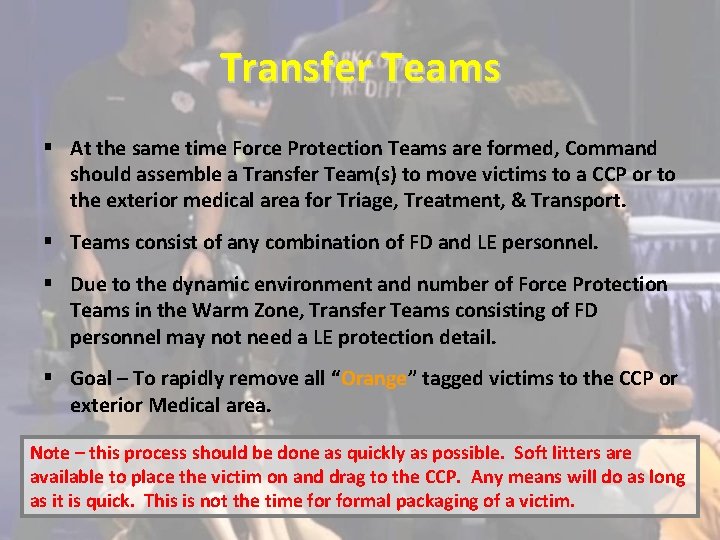
Transfer Teams § At the same time Force Protection Teams are formed, Command should assemble a Transfer Team(s) to move victims to a CCP or to the exterior medical area for Triage, Treatment, & Transport. § Teams consist of any combination of FD and LE personnel. § Due to the dynamic environment and number of Force Protection Teams in the Warm Zone, Transfer Teams consisting of FD personnel may not need a LE protection detail. § Goal – To rapidly remove all “Orange” tagged victims to the CCP or exterior Medical area. Note – this process should be done as quickly as possible. Soft litters are available to place the victim on and drag to the CCP. Any means will do as long as it is quick. This is not the time formal packaging of a victim.
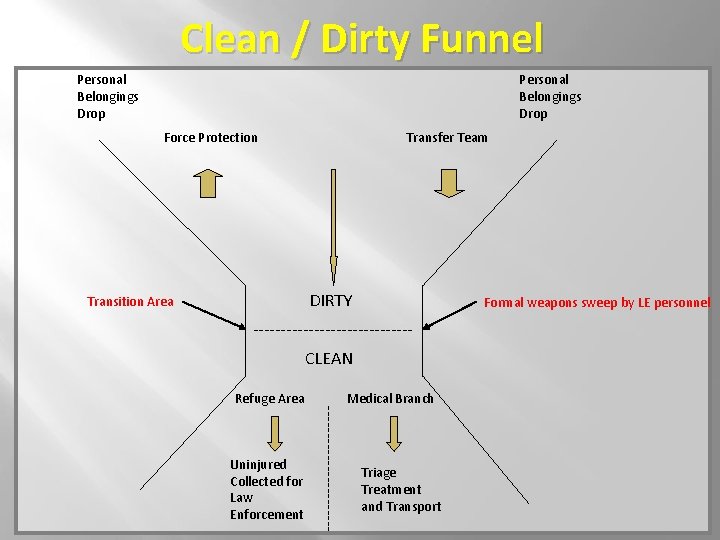
Clean / Dirty Funnel Personal Belongings Drop Force Protection Transfer Team DIRTY Transition Area Formal weapons sweep by LE personnel --------------CLEAN Uninjured Collected for Law Enforcement ------------ Refuge Area Medical Branch Triage Treatment and Transport
Southern Nevada Fire Operations (SNFO) Hostile MCI Response Policy QUESTIONS?