
SOUTHERN COLONIES VIRGINIA Tobacco plants wore out the
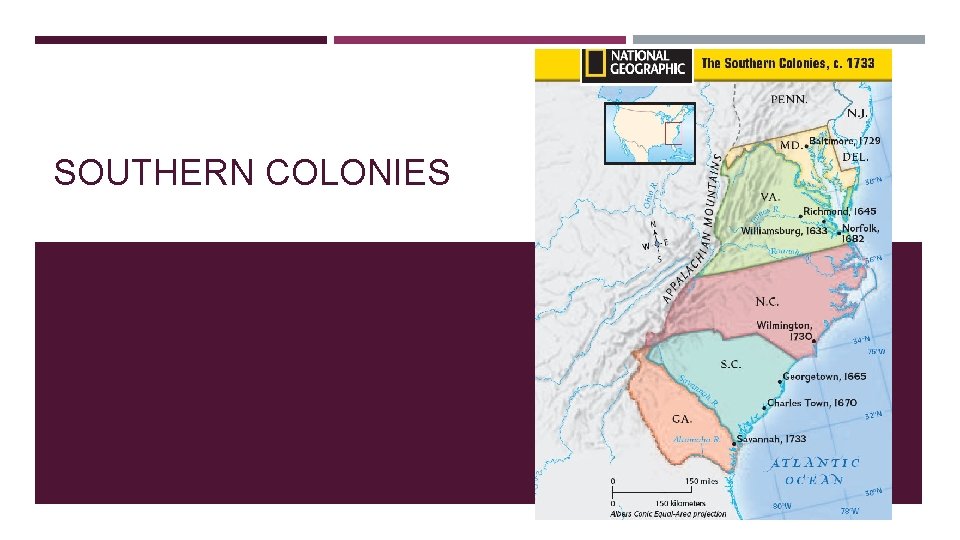
SOUTHERN COLONIES
VIRGINIA • Tobacco plants wore out the soil quickly so planters needed more land planters beg to invade the Powhatan land • 1622 and 1644 Powhatans began to fight back to take their land killed many backcountry settlers • Governor William Berkely in 1646 set up boundary lines to separate the Native America and colonists • Colonists were angry the Berkely recognized the Native Americans had rights to land • Nathaniel Bacon was a wealthy farmer whose farm was attacked by Native Americans – did not like how Berkley dealt with the Native Americans • Bacon got the support of some settlers and attacked the peaceful Pamunkey Indians in • Bacon also burned Jamestown to the ground in September • The rebellion ended in October when Bacon died from an illness and Governor Berkely hanged 23 of Bacon’s followers – Governor Berkely’s actions shocked the King of England Berkley was forced to resign
MARYLAND • English Catholics were looking to America for religious freedom • Lord Baltimore (Catholic landowner from England) wanted to create a colony for Catholi • In 1632 King Charles I give Lord Baltimore a charter for a large piece of land on Chesap Bay • The King named the colony Maryland after his wife Henrietta Maria • Once Lord Baltimore saw there were not enough Catholic immigrants he invited English people of all religions and promised religious toleration • Maryland’s geography and climate were similar to Virginia • Maryland grew tobacco using indentured servants and enslaved Africans • Shipping and trade went on in the port of Batlimore • Plantation owners settled the tidewater region and ran the government • Farmers settled in the backcountry
THE CAROLINAS • North and South Carolina began as one colony set up by Charles I in 1629 , but there were no settlers • In 1663 King Charles II granted 8 men a proprietary charter for some land between Virginia and Florida • In 1700 one settlement succeeded in Charleston, SC • Charleston had an excellent harbor and rich land – the colony grew quickly – and offered religious freedo • Charleston became a wealthy city –planters built second brick homes that faced the bay • Planters stayed in their second homes in the summer to escape the heat – they enjoyed fancy parties and imported fine goods silver, china, silk fabrics • In 1729 England bought the Carolinas and made it royal colony – the king divided it into two colonies – No and South Carolina • South Carolina’s geography and climate were similar to Virginia – large plantation lined the wide rivers • North Carolina could not produce the valuable crops that made South Carolina so rich – North Carolina ha vast forests and provided colonists with wood, tar and pitch (used by the English Navy to seal and waterproo their ships) • Fur and leather became important industries for North Carolina - Farming was also important in the Caro • Poorer immigrants lived in the Carolina’s backcountry and lived in cabins- they traded forest products and grew crops
GEORGIA • Georgia was settled by poor people who were debtors (people who owed money) • England created Georgia in 1732 because James Oglethorpe ( a member of Parliame suggested sending debtors to settle in Georgia- so they could start a new life and protec the British empire • 1732 King George II granted Oglethorpe a royal charter for land for the “poor persons London” – in November 35 debtors’ families and Oglethorpe set sail for Georgia • Oglethorpe established a friendly relationship with the Creek Indians who gave settler land in the tidewater • Oglethorpe carefully controlled the fur trade between settlers and the Creek Indians • Georgia was the only colony to ban alcohol and slavery • In 1742 the trustees of Georgia lifted the ban on liquor and 8 years later they allowed Slavery-
SLAVERY • Enslaved Africans lived and worked on plantations • They did all the hard work like in the fields • Some worked as servants in the home and some were artisans who made tools, wheels, horseshoes and other things the plantations needed • A small number of free Africans farmed the land in the backcountry or they came to the colonies as indentured servants • Some Africans worked as laborers, craftsmen, and sailors • Some enslaved Africans were set free or gained their freedom by escaping the plantatio • Most Africans in the South were not free • In parts of Virginia and South Carolina enslaved Africans soon outnumbered whites • They did back breaking work from dawn to dusk, they lived in small, crowded cabins an to rely on their owners for food and clothes – plantation owners outlawed African customs
TRANSPORTATION • Travel in the South was slow – most people preferred to travel by water in ocean- going ships or river canoes • People could travel by horse and wagon – there were not many good roads – most road were bumpy and full of holes and when it rained they became streams of mud • In late 1600 s a post road was built – a route used by postal service to deliver mail • The post road went from Maine to Georgia • More and more travelers would use the post road
GEOGRAPHY AND CLIMATE • Southern colonies have many rivers, bays and swamps • Coastal area was called the tidewater because it had rivers affected by ocean tides • Tidewater ended at the fall line • Easy access to ocean • Many rivers meant ocean-going boats could go far inland • Climate – growing season lasted 7 -8 months because it was warm and there was lots of rain
AGRICULTURE • Corn was an important crop – used to feed farmers and animals • Cash crops (crops grown to be sold) were grown in the southern colonies such as tobacco, rice, indigo • The crops were grown on plantations (large farms where most of the labor was done by Africans) • The wet coastline of South Carolina was better for growing rice then tobacco • Colonists learned from Africans the best ways to plant, harvest and polish the rice • South Carolina also grew indigo plants (thanks to Eliza Lucas who experimented with many plants on her father’s plantation) – indigo plants were used to make blue dye • Lucas and other planters would ship and trade products on riverbanks near their homes
IMPORTS AND EXPORTS • Half of the southern crops were exports (or shipped to other countries to be sold) • With the south’s ideal geography and the forced work of enslaved Africans , tobacco, ric and indigo became 3 of most valuable exports for colonies • Plantation owners imported only a few items such as metal pots and fine luxury goods Europe • Charleston planters imported fine goods silver, china, silk fabrics
GOVERNMENT • In 1619 Virginia create the House of Burgesses to make laws for the colony • A burgess is a representative or someone who speaks for other people • All free men in Virginia could vote to elect the burgesses • Virginia created the first representative government in the colonies giving the citizens a clear voice in their government • England passed a new law in 1651 The First Navigation Act – this limited colonial trade and meant England got most of the profit from tobacco – rich planters in the colonies got what little profit was left • The House of Burgesses (which was controlled by wealthy planters) passed laws that favored the owners of large plantations • From 1675 on, The House of Burgesses allowed settlers to live wherever they choose which meant Native Americans were given smaller and smaller pieces of land to live on • There were few southern towns with colonial governments
PLANTATIONS AND FARMS • Plantations were large farms and they produced surplus (extra) crops to sell for a profit • Plantations were like small villages with bakeries, blacksmiths, and craft workshops • Live in teachers taught the planter’s children • Workers on plantations were enslaved and were not paid and could not quit • Some plantations were huge (300, 000 acres) with 700 enslaved Africans • Some plantations were small with 20 – 100 enslaved workers • Both men and women ran plantations – Husbands directed the fieldwork and wives hand the household work • • Most southerners did not live on plantations or own enslaved people They worked on farms in the backcountry of the Piedmont They grew their own crops and used plantation owner’s docks for shipping Women helped in the fields
CROSSROADS AND PORTS • Inns were center of local life – they were meetinghouses, taverns and post offices and were found at crossroads • Also at Inns travelers brought news and local residents gave directions • Letters and newspapers were laid out on tables until people came to claim them • Charleston was a port city and a city of culture and trade – rice and indigo planters brought their crops to Charleston – Jews, Scots- Irish, French and Africans lived here • Tradespeople such as metalsmiths, cabinet makers, and carriage makers did well working for Charleston’s rich planters – many were free Africans
- Slides: 13