
Southern California Earthquake Center The SCEC Broadband Platform
Southern California Earthquake Center The SCEC Broadband Platform: Computational Infrastructure For Transparent And Reproducible Ground Motion Simulation Philip J. Maechling [1], Fabio Silva [1], Scott Callaghan [1], Thomas H. Jordan [1] Southern California Earthquake Center Session T 19: Introduction To Engineering Uses Of Physics-Based Ground Motion Simulations 10 NCEE: 10 th U. S. National Conference on Earthquake Engineering July 22, 2014 Anchorage Alaska
Southern California Earthquake Center Agenda 1. 2. 3. 4. 5. Overview of the Broadband Platform Basic Capabilities of the Broadband Platform Establish Support for Engineering Validation Processes From Research Software To Community Software Conclusions 2
Southern California Earthquake Center What Is the Broadband Platform? The Broadband Platform (BBP) is an open-source software distribution that: • Calculates earthquake ground motions at frequencies above 10 Hz across regional distances. • Contains software tools for comparing simulation results against GMPEs and observed ground motion recordings. • Can run large numbers of ground motion simulations and manage the simulation results. • Available for download at: http: //scec. usc. edu/scecpedia/Broadband_Platform. 3
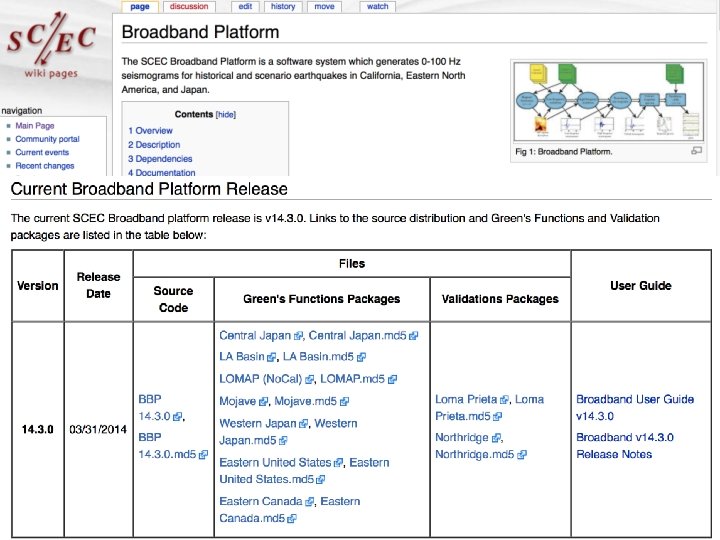
Supported Broadband Platform Software Release Southern California Earthquake Center 4
Southern California Earthquake Center Agenda 1. 2. 3. 4. 5. Overview of the Broadband Platform Basic Capabilities of the Broadband Platform Establish Support for Engineering Validation Processes From Research Software To Community Software Conclusions 5

Southern California Earthquake Center Broadband Platform Usage Modes SCEC Broadband Platform Capabilities: Use Case 1: Calculate Historical Seismograms – User selects a validation event and the platform calculates broadband synthetic seismograms at selected locations and compares synthetic seismograms to observed data. Use Case 2: Calculate Scenario Seismograms - User defines parameters for a scenario earthquake, selects modules to use, and calculates broadband seismograms for the event. 6
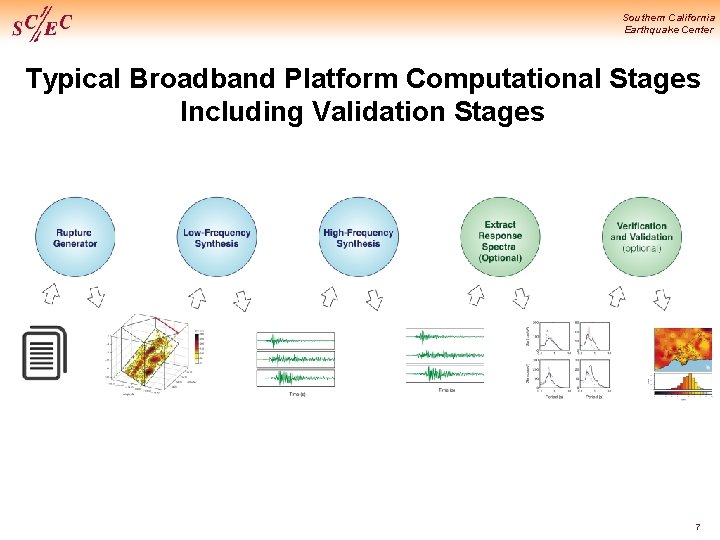
Southern California Earthquake Center Typical Broadband Platform Computational Stages Including Validation Stages 7
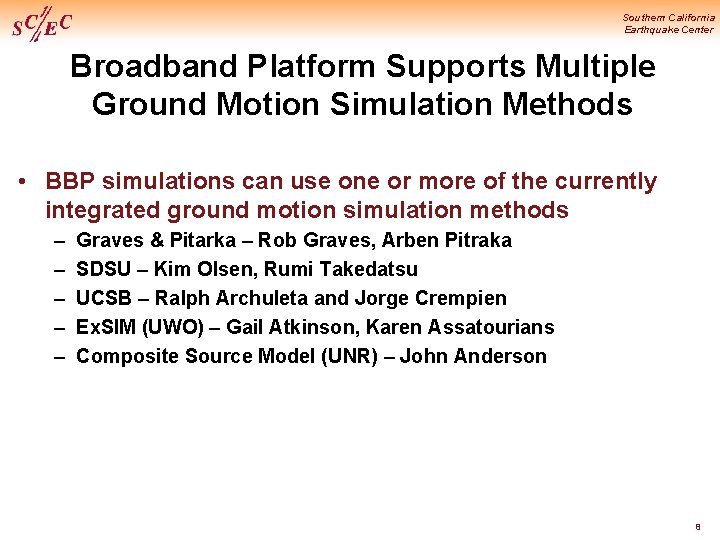
Southern California Earthquake Center Broadband Platform Supports Multiple Ground Motion Simulation Methods • BBP simulations can use one or more of the currently integrated ground motion simulation methods – – – Graves & Pitarka – Rob Graves, Arben Pitraka SDSU – Kim Olsen, Rumi Takedatsu UCSB – Ralph Archuleta and Jorge Crempien Ex. SIM (UWO) – Gail Atkinson, Karen Assatourians Composite Source Model (UNR) – John Anderson 8
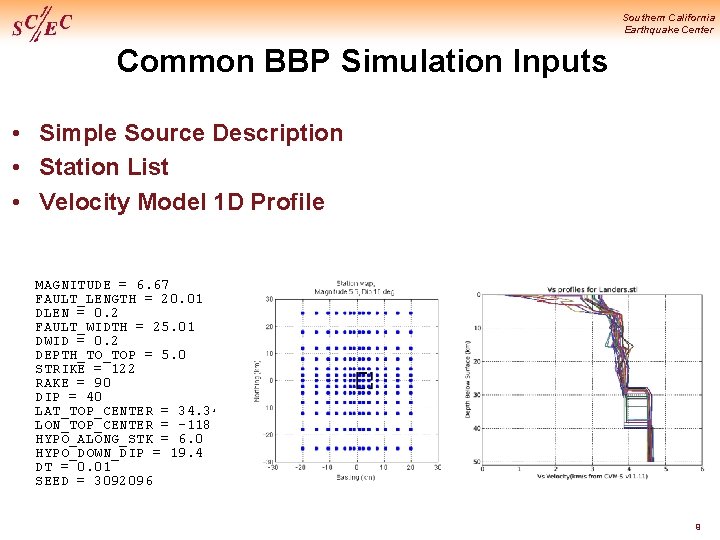
Southern California Earthquake Center Common BBP Simulation Inputs • Simple Source Description • Station List • Velocity Model 1 D Profile MAGNITUDE = 6. 67 FAULT_LENGTH = 20. 01 DLEN = 0. 2 FAULT_WIDTH = 25. 01 DWID = 0. 2 DEPTH_TO_TOP = 5. 0 STRIKE = 122 RAKE = 90 DIP = 40 LAT_TOP_CENTER = 34. 344 LON_TOP_CENTER = -118. 515 HYPO_ALONG_STK = 6. 0 HYPO_DOWN_DIP = 19. 4 DT = 0. 01 SEED = 3092096 9
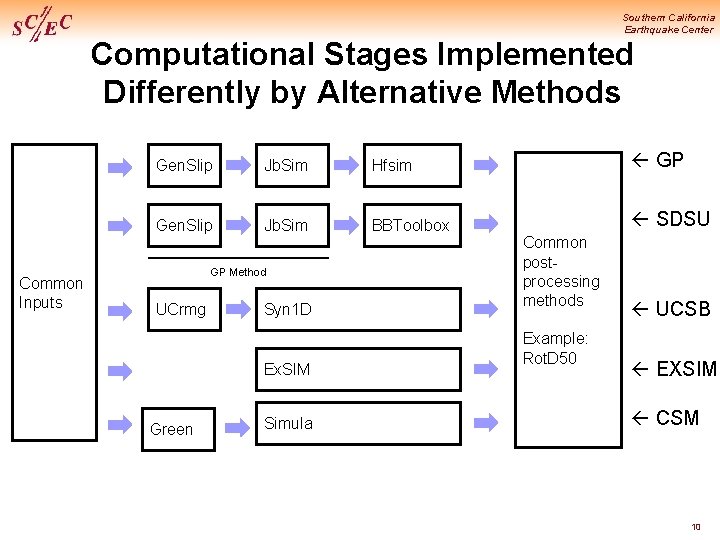
Southern California Earthquake Center Computational Stages Implemented Differently by Alternative Methods Common Inputs Gen. Slip Jb. Sim Hfsim GP Gen. Slip Jb. Sim BBToolbox SDSU GP Method UCrmg Syn 1 D Ex. SIM Green Simula Common postprocessing methods Example: Rot. D 50 UCSB EXSIM CSM 10
Southern California Earthquake Center Broadband Platform Usage Modes SCEC Broadband Platform Capabilities: Use Case 1: Calculate Historical Seismograms – User selects a validation event and the platform calculates broadband synthetic seismograms at selected locations and compares synthetic seismograms to observed data. Use Case 2: Calculate Scenario Seismograms - User defines parameters for a scenario earthquake, selects modules to use, and calculates broadband seismograms for the event. 11
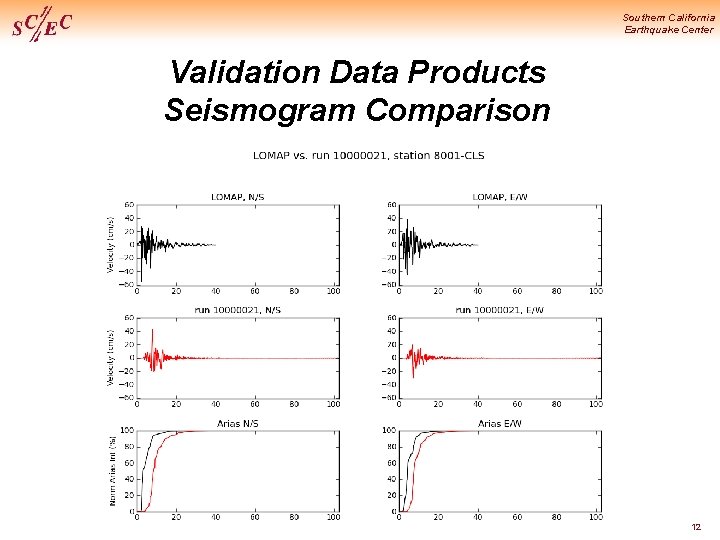
Southern California Earthquake Center Validation Data Products Seismogram Comparison Goodness-of-fit 12

Southern California Earthquake Center Comparison Data Products Goodness-of-fit Spectral response comparison Seismogram MAP based comparison Goodness-of-fit 13
Southern California Earthquake Center Broadband Platform Usage Modes SCEC Broadband Platform Capabilities: Use Case 1: Calculate Historical Seismograms – User selects a validation event and the platform calculates broadband synthetic seismograms at selected locations and compares synthetic seismograms to observed data. Use Case 2: Calculate Scenario Seismograms - User defines parameters for a scenario earthquake, selects modules to use, and calculates broadband seismograms for the event. 14
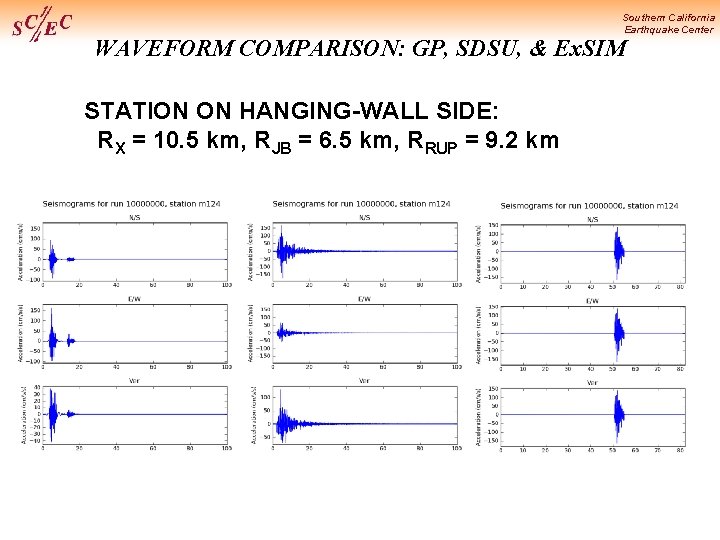
Southern California Earthquake Center WAVEFORM COMPARISON: GP, SDSU, & Ex. SIM STATION ON HANGING-WALL SIDE: RX = 10. 5 km, RJB = 6. 5 km, RRUP = 9. 2 km
Southern California Earthquake Center 16
Southern California Earthquake Center Agenda 1. 2. 3. 4. 5. Overview of the Broadband Platform Basic Capabilities of the Broadband Platform Establish Support for Engineering Validation Processes From Research Software To Community Software Conclusions 17
Southern California Earthquake Center Large collaborative validation of the SCEC Broadband platform • SCEC is collaborating with SWUS and PEER to improve the usefulness of the BBP software • Broadband improvements motivated by need of seismic hazard projects to supplement the recorded datasets – PEER NGA-West projects – South-Western U. S. utilities (SWUS) – PEER NGA-East project (new CEUS hazard model)
Southern California Earthquake Center Large collaborative validation of the SCEC Broadband platform improvements • Integration and testing of 5 simulation methods • Multiple pre and post-processing tools Validation against • Western US, Japan, Eastern North American past earthquake scenarios – – Multiple environments and tectonic regions Cover different fault mechanisms and geometries Span wide magnitude range (Mw 4. 64 to 7. 62) ~40 stations per event (at least 17 scenarios) • Western U. S. empirical models Simulation ensemble runs • Include multiple source realizations for each method • Summarized in large number of plots for evaluation
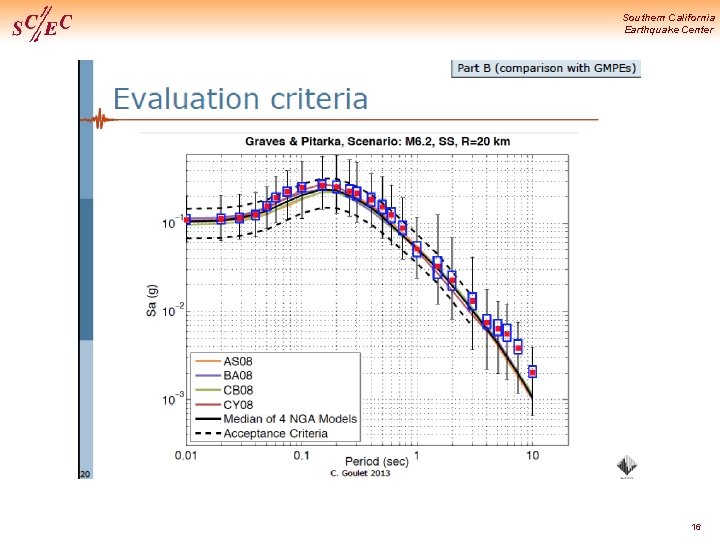
Southern California Earthquake Center Description of What is Needed to Support Engineering Validation Process • Demonstrate that the simulations work – Comparison with ground motions from past earthquakes (part A) – Check of the method to simulate future earthquakes (Part B) • Repeatable results (stable versions) – Move from researcher codes (frequent tinkering) to fixed versions • Usable by someone other than author of method – Clear guidelines on how to implement the methods – IT Support for running methods • Reviewable – Peer review by someone other than author of code needs to be possible • Reasonable costs 20
Southern California Earthquake Center Agenda 1. 2. 3. 4. 5. Overview of the Broadband Platform Basic Capabilities of the Broadband Platform Establish Support for Engineering Validation Processes From Research Software To Community Software Conclusions 21
Southern California Earthquake Center Broadband Platform Development History § 2006 – Scripted and Pegasus Version Developed § 2008 – Python Version Developed (First Hanging Wall Problem) § 2010 – First Supported Software Release of Platform § 2011 – Second Version Released (v 11. 2. 2) (Second Hanging Wall Problem) § 2013 – SWUS Release of Broadband Platform (v 13. 9. 1) § 2014 – NGA-E Release of Broadband Platform (v 14. 3. 0) 22
Southern California Earthquake Center Broadband Platform Development Support • PGE, APS, SCE, PEER Support during 2012 -2014 – – – Add new validation event data sets Add new validation processing and GOF Run large scale simulations Add new modules Improve scalability by prepare code to run on Cluster • SCEC NSF-SI 2 project funding over three years. – – Prepare open-source scientific software distribution Use modern software engineering development techniques Add new modules Increase scalability of scientific software 23
Southern California Earthquake Center SCEC Software Engineering Improvements to Research Codes 1. 2. 3. 4. 5. 6. 7. 8. Source code Version Control : Subversion Selected Coding Standards: Python PEP 8 Style Guide Use of Code Checker: pylint Simplified Codebase: Removed unneeded features Reduced required compilers: Now Gnu and Intel. Documentation: Online Installation and User Guide Open-Source License: Apache 2 Validation: Scientific Review of Results on Standard Problems by SWUS and NGA-E 9. Public Software Release: Open-source distributions provide transparency Sept 2013, March 2014
Southern California Earthquake Center SCEC Performs Forward Modeling: Ensembles of Earthquake Scenarios • Implement software tools to support large suites of simulations for scenario earthquakes • Configured the BBP to run on SCEC server and on USC Cluster, so that it is capable of running large ensembles of simulations. • Scenario runs are conducted by person other than developer of modules
Southern California Earthquake Center Agenda 1. 2. 3. 4. 5. Overview of the Broadband Platform Basic Capabilities of the Broadband Platform Establish Support for Engineering Validation Processes From Research Software To Community Software Conclusions 26
Southern California Earthquake Center SCEC’s Broadband Platform software sustainability strategies 1. Keep the software development costs at a modest level (~2 -3 FTE). 2. Integrate the best available scientific modules into the software. 3. Regularly release improved versions of Broadband as open-source software. 4. Release the software under a license (Apache 2) that is acceptable to commercial companies, and state and Federal agencies. 5. Continue the ongoing group verification and validation exercises to build user confidence in the software. 6. Implement software features and enhancements guided by a users needs and priorities 27
Southern California Earthquake Center Thank you! The BBP Software is available for download at: http: //scec. usc. edu/scecpedia/Broadband_Platform
- Slides: 28