
Southern California Earthquake Center SCEC 5 Planning for


- Slides: 20
Southern California Earthquake Center SCEC 5 Planning for Scientific Computing and NSF Data Management Plan SCEC Leadership Retreat 2 June 2015
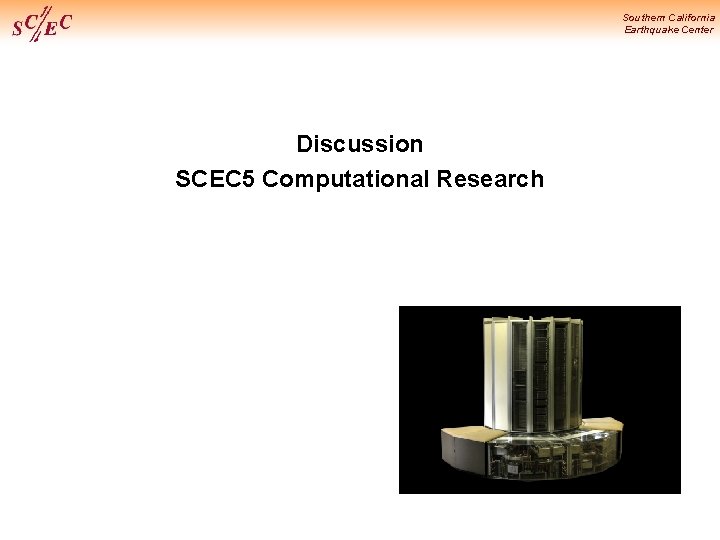
Southern California Earthquake Center Discussion SCEC 5 Computational Research
Southern California Earthquake Center SCEC 5 Scientific Computing Scientific computing software development is a valuable capability within core SCEC and within Special Projects. SCEC 5 planning should include Scientific Computing, for several reasons, including: • Scientific Computing is Expensive • Scientific Computing Could Lead to SCEC 5 Growth In this session, I’ll present issues and suggestions for SCEC 5 scientific computing for discussion.
Southern California Earthquake Center SCEC 5 Scientific Computing SCEC computer activities under several names including: • Scientific Computing • Research Computing • High Performance Computing • Big Data Processing • Computer Science • Community Modeling Environment • Information Technology • Computational Science SCEC 5 scientific computing includes but is not limited to High Performance Computing
Southern California Earthquake Center SCEC 5 Scientific Software Capabilities SCEC’s core computing skill is scientific software. Both core SCEC and Special Projects have this capability: Core SCEC researchers develop new scientific codes, often to do individual research. Special projects often develop software to perform largescale community calculations.
SCEC 5 Scientific Computing Southern California Earthquake Center • SCEC 5 should focus on developing scientific software and using the software to perform research. • SCEC 5 should avoid spending significant resources building and operating large-scale computer hardware.
Scientific Computing Core SCEC Southern California Earthquake Center Core SCEC researchers should continue to create, evaluate, improve research software. Collaborative Computational Research Activities are Very Valuable: • Source Inversion • Site Response • Dynamic Rupture Comparison • Utilization of Ground Motion Simulations Core SCEC would benefit from a software developer available to the community. However, even if funding existed, finding the right person, and setting appropriate priorities would be a challenge.
CME Software Eco-System Southern California Earthquake Center • The SCEC Community Modeling Environment (CME) software means computing related to the computational pathways designed to improve ground motion forecasting. • CME software represents an inter-related set of computational tools from CVM’s, to UCERF 3, to Cyber. Shake, to Full 3 D Tomography. • SCEC CME software is a collection of scientific codes that together provide a full range of seismic hazard analysis tools including SCEC Velocity Models, UCVM, Dynamic Rupture Codes, 1 D Broadband, 3 D AWP-ODC, 3 D Hercules, Open. SHA, Cyber. Shake, and full 3 D tomography. • In NSF OCI terminology, these programs form an software “eco-system” of inter-related and inter-dependent modeling tools that can be used to calculate physics-based probabilistic seismic hazard models.
SCEC Scientific Computing Successes Southern California Earthquake Center • SCEC’s most productive scientific computing collaborations are organized around an important seismic hazard data product or calculation that can be improved using advanced computational techniques. • The scientific challenge defines the computational goal, and computing techniques are introduced as needed to reach the goal. • SCEC scientific computing projects are integrative, bringing together inter-related SCEC structural and computational models. SCEC 5 should continue to organize and focus integrative, science-driven, broad-impact, scientific computing projects.
Southern California Earthquake Center SCEC Scientific Computing In Special Projects Within Special Projects, the most successful SCEC scientific computing projects have been multi-disciplinary collaborations that include scientists, engineers, computer scientists, and software developers. Examples Include: • Open. SHA • Broadband Platform • Cyber. Shake • OEF • CSEP Having software developers work with scientists and engineers is our key strategy to avoiding wasting software developer time, or developing software nobody uses.
SCEC Scientific Computing Successes Southern California Earthquake Center • SCEC special projects are often a mechanism for extending the computational capabilities of individual research codes into community-based, practical, computational data products. • Special project calculations often represent more of a community calculation, rather than an individual researcher calculation. • Core SCEC 5 computational science should play an increased role in identifying the best available codes that should be used in special project calculations.
SCEC Scientific Computing Successes Southern California Earthquake Center • Due to the important of scientific software, SCEC 5 should initiate efforts to improve software development capabilities within both scientific and research staff. • SCEC should train scientific staff in software basics, such as the material covered in “Software Carpentry” and other software engineering overviews. (e. g. By end of SCEC 5, SCEC researchers should use version control for their research software. ) • Due to the rapidly changing software field, SCEC software staff should be required to perform annual training to keep skills current. SCEC computer training likely needs to be increased. • Increasing interactions between SCEC computational science and CEO might enable CEO to support SCEC computer training.
Project Sizes Southern California Earthquake Center • SCEC has most success coordinating the efforts of small software teams, working on well-focused research activities. • We recommend that SCEC 5 special software projects should be organized around project teams with approximately 6 people or less. • If SCEC software project groups grow to larger sizes, SCEC will need to re-organize how groups are organized and managed.
Software Staff-related Issues Southern California Earthquake Center To maintain a software staff, SCEC 5 management must recognize that most software staff people are not academics. Often, the software developer’s goal is to produce working software, used by a community, or used to produce an important result, rather than to publish papers. Also, In the fast-paced software field, forward career motion is important to software people. To retain talented software staff, SCEC 5 will need to provide a non-academic software staff career path through which staff members can reasonably progress. Staff software developer career path should define positions with gradually increasing responsibilities, and each SCEC position should be linked to an appropriate official USC staff positions. The career paths should enable staff to progress into either advanced technical, or management roles.
Finding Good Software Staff Southern California Earthquake Center Special projects best source of staff software developers has been the Use. IT Intern program. Use. IT was a highly effective as a way to attract student interest in SCEC research, and evaluate the students’ readiness to contribute to SCEC software project. The SCEC intern programs work as a farm team for SCEC’s wider computational science program. If SCEC 5 must maintain a significant software staff, operating a Use. IT type intern programs could be very valuable for recruitment.
Obtaining HPC Time Southern California Earthquake Center Both core SCEC and SCEC special project need HPC time. But special projects need more. If special projects are funded, including Keck and Central California, the importance of computing time will increase. To avoid shortfall, SCEC will need to dedicate personnel to obtaining, managing, and reporting on supercomputer hours. At the large proposed scales, the staff will not be able to both raise the computing hours and have time to perform the research. The cost of a person to raise the computing hours will be less than directly purchasing the cost of the computing time.
Obtaining HPC Time Southern California Earthquake Center An important SCEC 5 strategy to obtain large-scale computing activities will be to SCEC 5 should work to stay qualified on largest systems to meet needs of HPC research. To stay qualified on a new system often requires a new, or re-written version of a high-performance code. SCEC wave propagation codes, which are being pushed to higher and higher frequencies, are good candidates for codes that SCEC can develop to keep us qualified on the newest and largest HPC systems. Participating with HPC centers developing next generation supercomputers (co-Design concept) is advanced HPC. It would require several more SCEC people including senior computer scientists involved. High-risk, highreward, with greatest danger to SCEC that no research computing gets done, only system testing software.
Sustainability Strategy Southern California Earthquake Center SCEC 5 can benefit from a computational science group, and avoid wasting software development time by doing the following: • Integrate the best available core SCEC scientific software into important broad impact data products such as CSEP, UCERF, Broadband, Cyber. Shake, High-F, and Full 3 D tomography. • Evaluate all USGS seismological data products including EEW, Shake. Map, UCERF, Hazard Maps, OEF, and identify ways core SCEC research can improve them. • Where clear improvements are possible, implement a multidisciplinary group to implement the improvements.
Additional Topics (in HPC White Paper) • Key Software Needed for SCEC 5 • Computational Science Contributing to SCEC Visibility • Additional Software Sustainability Strategies Southern California Earthquake Center
Southern California Earthquake Center End