
South West Genomic Laboratory Hub SWGLH Update Laura
South West Genomic Laboratory Hub (SWGLH) Update Laura Yarram-Smith SWGLH Solid Tumour Laboratory Lead 06/11/2019
Aims of Today’s Session What we are trying to achieve • Awareness of the infrastructure underpinning the delivery of genetic testing nationally and in the South West • Understand what that means locally for adaption of current genetic/genomic test eligibility and requesting processes: ü What can be tested? ü What will be reported? ü Turn around times ü Funding models ü Understanding reports and GTAB support • Provide an understanding of the national requirement for delivering non-WGS genetic/genomic testing as defined in the national genomic testing directory (NGTD) What this session is not about • • • Mapping the details of local pathways Confirming local transport arrangements Addressing local resourcing concerns 2
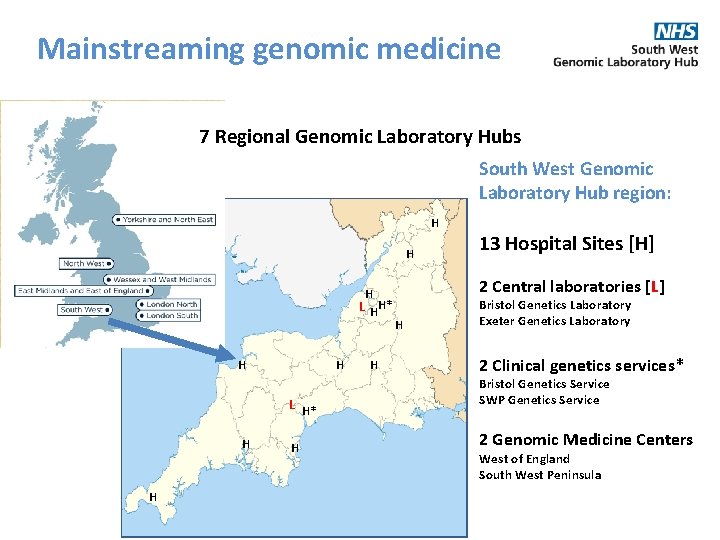
Mainstreaming genomic medicine 7 Regional Genomic Laboratory Hubs South West Genomic Laboratory Hub region: H H H L HH* H H 2 Central laboratories [L] H H L H* H H 13 Hospital Sites [H] Bristol Genetics Laboratory Exeter Genetics Laboratory 2 Clinical genetics services* Bristol Genetics Service SWP Genetics Service 2 Genomic Medicine Centers H Population: >5, 000 Span: >200 miles GMCs: 2 West of England South West Peninsula
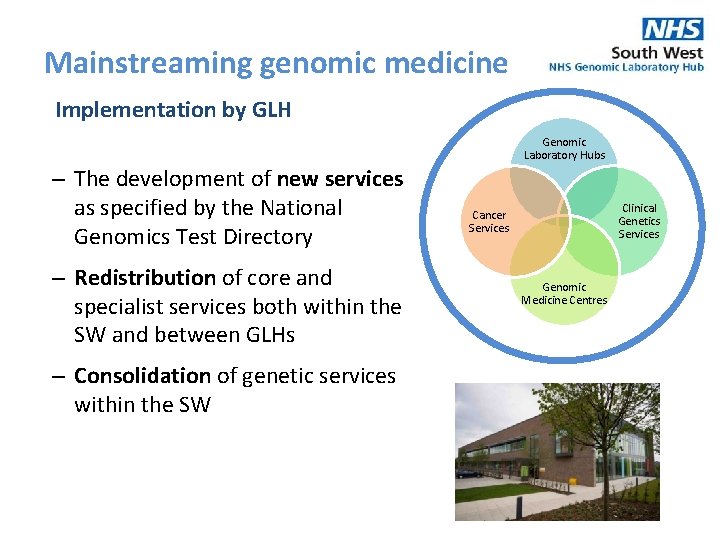
Mainstreaming genomic medicine Implementation by GLH Genomic Laboratory Hubs – The development of new services as specified by the National Genomics Test Directory – Redistribution of core and specialist services both within the SW and between GLHs – Consolidation of genetic services within the SW Clinical Genetics Services Cancer Services Genomic Medicine Centres
Mainstreaming genomic medicine • National Genomics Test Directory (NGTD) https: //www. england. nhs. uk/publication/national-genomic-testdirectories/ • Defined list of funded tests allows development of regional and national diagnostic algorithms • • Network guidelines Clinical input required into gene panel content and reporting • Encompasses Whole Genome Sequencing (WGS) and non-WGS testing • Centrally funded genomic testing, accessible through the local GLH, from April 2020 • Equity of access to most clinically appropriate genomic testing • Expanded range of non-WGS testing • Develop IT infrastructure • Develop transport logistics 5

Mainstreaming genomic medicine • Tru. Sight Oncology 500 (TSO 500) • Pan-cancer NGS assay using DNA and RNA simultaneously – Targets 523 genes for SNV’s, indels & CNVs and 55 genes for fusions – Captures known and novel fusions • Includes key and emerging biomarkers • Anatomical sites include (but not limited to): 164 211; 56% Non. TSO 500 6

Sample Transport Key Hospitals in region Routine transport to Bristol from north territory Weston Urgent transport to Bristol from north territory Routine transport to Bristol from South territory WGS Routine transport From South territory Urgent transport to Bristol from South territory Exeter Inter-site transport Routine transport to Exeter from North territory Urgent transport to Exeter from North territory Routine transport to Exeter from South territory Urgent transport to Exeter from South territory Honicknowle Methods of transport Inter-site transport/Royal mail 1 st class Inter-site transport/Taxi/Courier Royal Mail (non-WGS) HPV transport (WGS) HPV transport/Courier Royal mail 1 st class Royal mail Special Delivery/Courier Inter-site transport/Honicknowle/Royal mail 1 st class Inter-site transport/Honicknowle/Courier 7
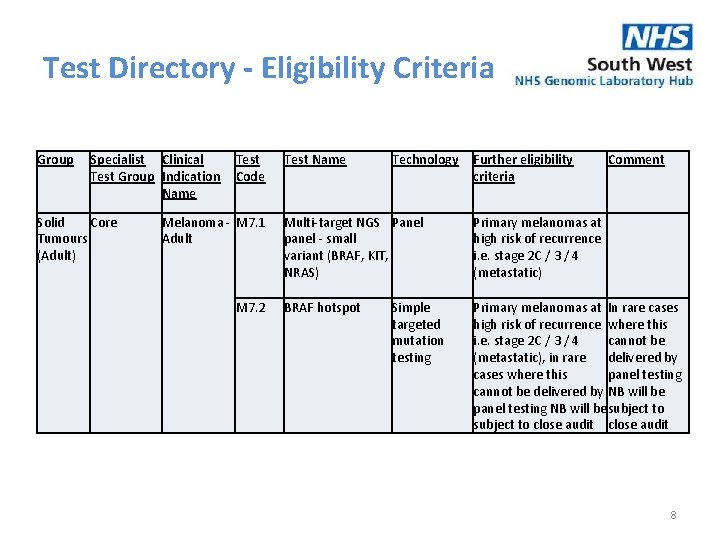
Test Directory - Eligibility Criteria Group Specialist Clinical Test Group Indication Name Solid Core Tumours (Adult) Test Code Melanoma - M 7. 1 Adult M 7. 2 Test Name Technology Further eligibility criteria Comment Multi-target NGS Panel panel - small variant (BRAF, KIT, NRAS) Primary melanomas at high risk of recurrence i. e. stage 2 C / 3 / 4 (metastatic) BRAF hotspot Primary melanomas at In rare cases high risk of recurrence where this i. e. stage 2 C / 3 / 4 cannot be (metastatic), in rare delivered by cases where this panel testing cannot be delivered by NB will be panel testing NB will be subject to close audit Simple targeted mutation testing 8
Germline/Somatic Variants Professor Clare Turnbull of Genomics England - somatic and germline genomes in Cancer 9
The systematic application of genomic technologies has the potential to transform patient’s lives by: • matching people to the most effective medications and interventions, reducing the likelihood of an adverse drug reaction • increasing the number of people surviving cancer each year because of more accurate and early diagnosis and more effective use of therapies • There also significant benefits for research and development that can be leveraged on behalf of the NHS, taxpayers and the wider economy. https: //www. england. nhs. uk/genomics/nhsgenomic-med-service/ 10

Genomic Tumour Assessment Boards 11
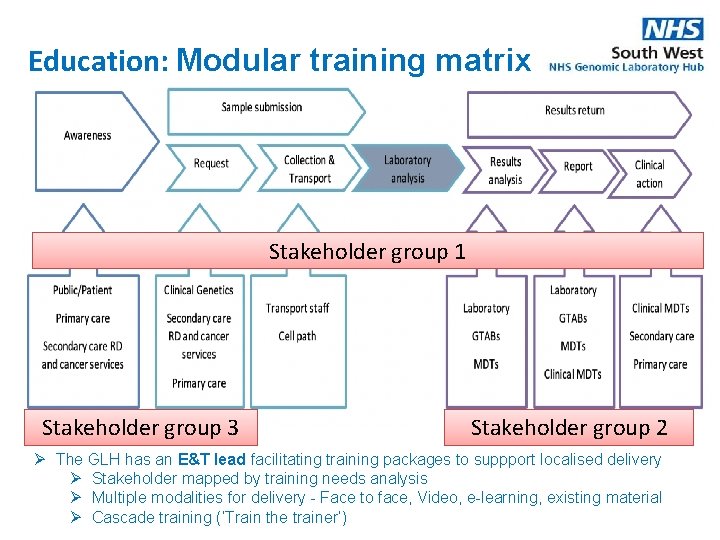
Education: Modular training matrix Stakeholder group 1 Stakeholder group 3 Stakeholder group 2 Ø The GLH has an E&T lead facilitating training packages to suppport localised delivery Ø Stakeholder mapped by training needs analysis Ø Multiple modalities for delivery - Face to face, Video, e-learning, existing material Ø Cascade training (‘Train the trainer’)
Regional Cancer Event 29/01/2020 Genomic Medicine Service Cancer Education Programme Venue: Taunton Racecourse Outcomes Attendees will be provided with an understanding of genomic medicine applied in practice • An understanding of the relevance of genomic testing in cancer care • Evidence/case studies to illustrate clinical utility • An update on the NHS Genomic Medicine Service • An opportunity to inform the future provision of genomic testing in cancer—the design of solid tumour panel testing • An opportunity to inform the future provision of genomic testing in cancer— mechanisms to feedback relevant results to clinical teams and patients • An understanding of the role of genomic medicine from the perspective of key regional partners (Cancer Alliance, AHSN, SW Clinical Senate) Aimed at: Professionals working in both primary and secondary care across the multi -disciplinary teams, including Clinical Nurse Specialists, oncologists, surgeons, histopathologists, radiologists and MDT co-ordinators https: //www. eventbrite. co. uk/e/genomic-medicine-service-cancer-educationprogramme-tickets-76421555931 13

Thank you!
- Slides: 14