
SOUTH SEMINOLE MIDDLE SCHOOL Getting to Know Marzanos



- Slides: 35
SOUTH SEMINOLE MIDDLE SCHOOL Getting to Know Marzano’s Teacher Evaluation Model
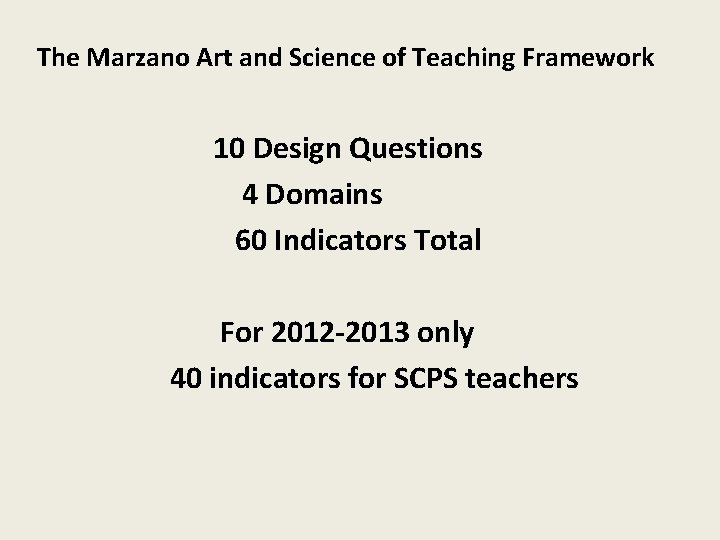
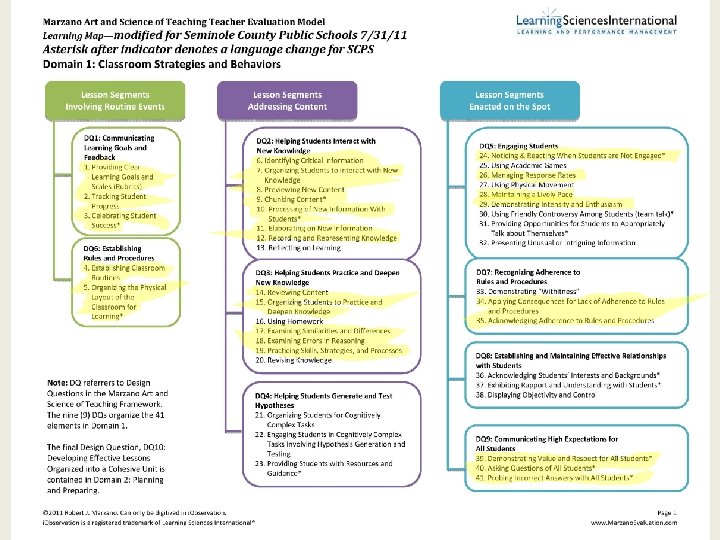
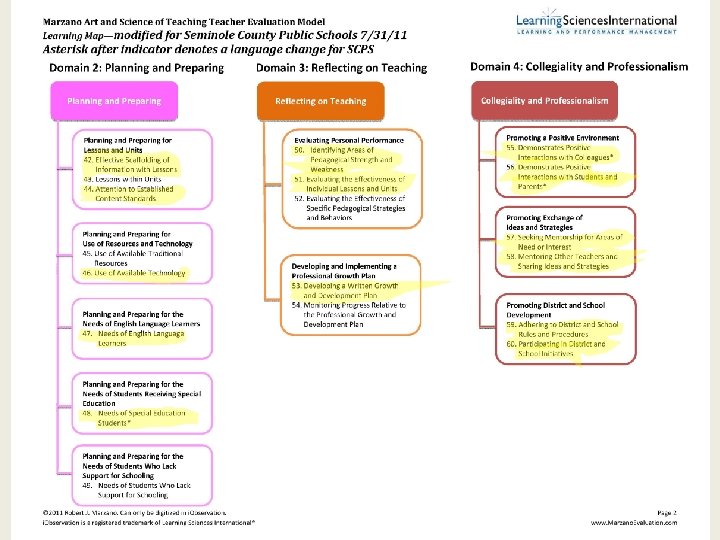
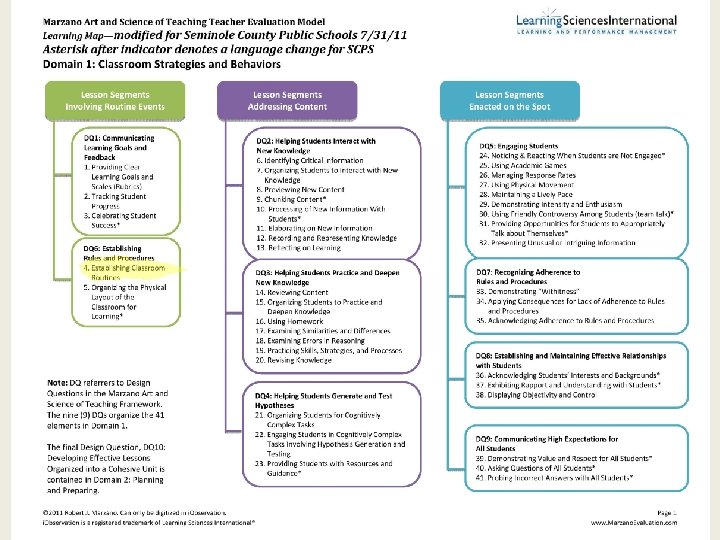
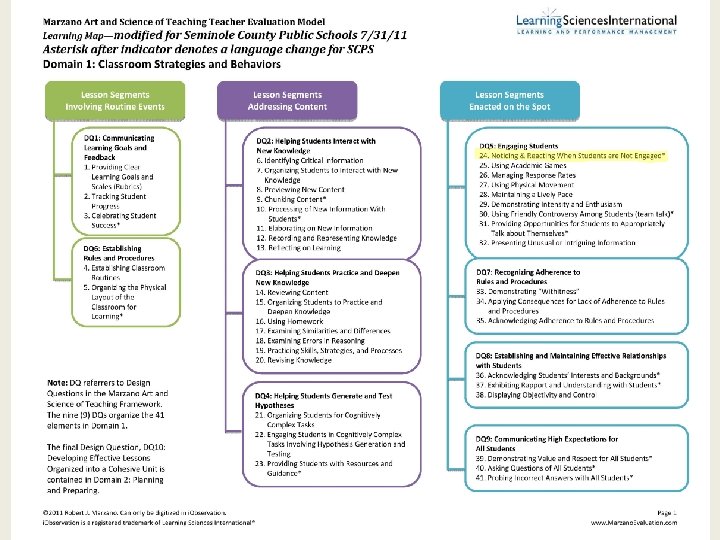
The Marzano Art and Science of Teaching Framework 10 Design Questions 4 Domains 60 Indicators Total For 2012 -2013 only 40 indicators for SCPS teachers
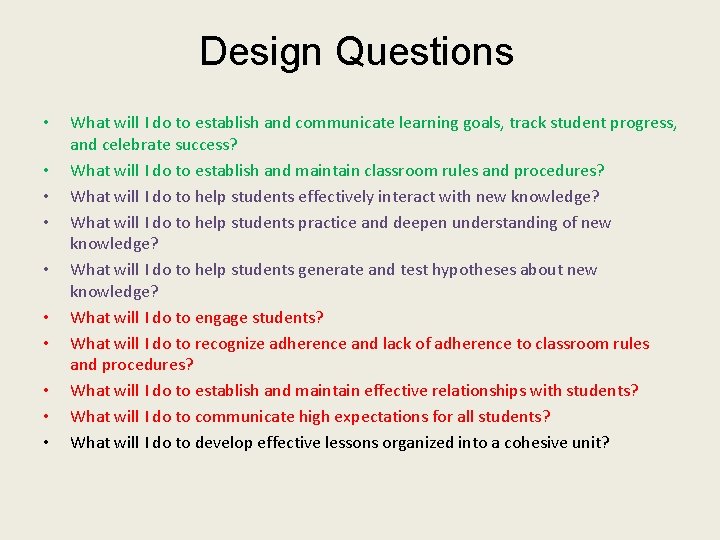
Design Questions • • • What will I do to establish and communicate learning goals, track student progress, and celebrate success? What will I do to establish and maintain classroom rules and procedures? What will I do to help students effectively interact with new knowledge? What will I do to help students practice and deepen understanding of new knowledge? What will I do to help students generate and test hypotheses about new knowledge? What will I do to engage students? What will I do to recognize adherence and lack of adherence to classroom rules and procedures? What will I do to establish and maintain effective relationships with students? What will I do to communicate high expectations for all students? What will I do to develop effective lessons organized into a cohesive unit?
Here are the 40 Indicators for the 2012 -13 school year!
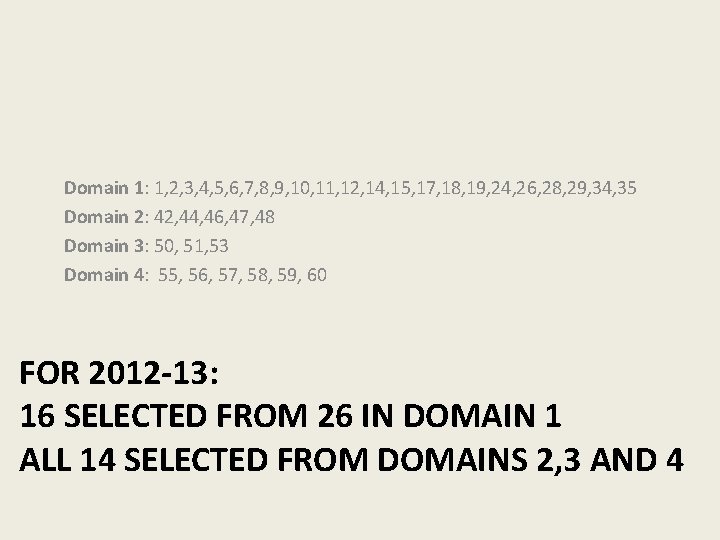
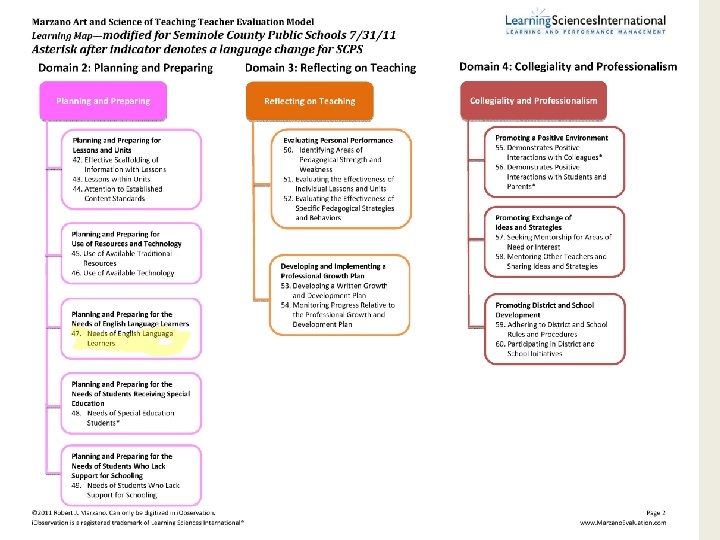
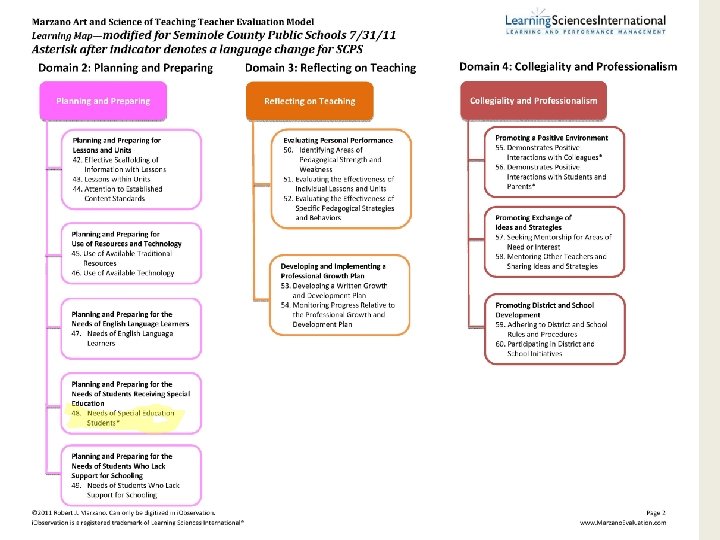
Domain 1: 1, 2, 3, 4, 5, 6, 7, 8, 9, 10, 11, 12, 14, 15, 17, 18, 19, 24, 26, 28, 29, 34, 35 Domain 2: 42, 44, 46, 47, 48 Domain 3: 50, 51, 53 Domain 4: 55, 56, 57, 58, 59, 60 FOR 2012 -13: 16 SELECTED FROM 26 IN DOMAIN 1 ALL 14 SELECTED FROM DOMAINS 2, 3 AND 4
6
7
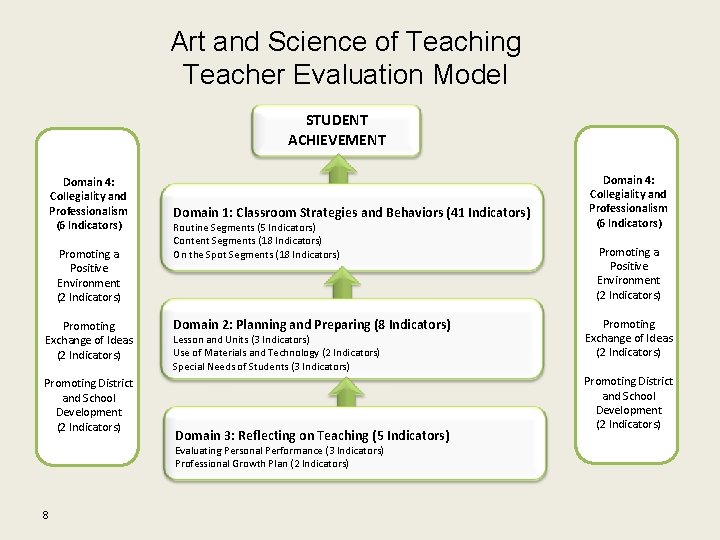
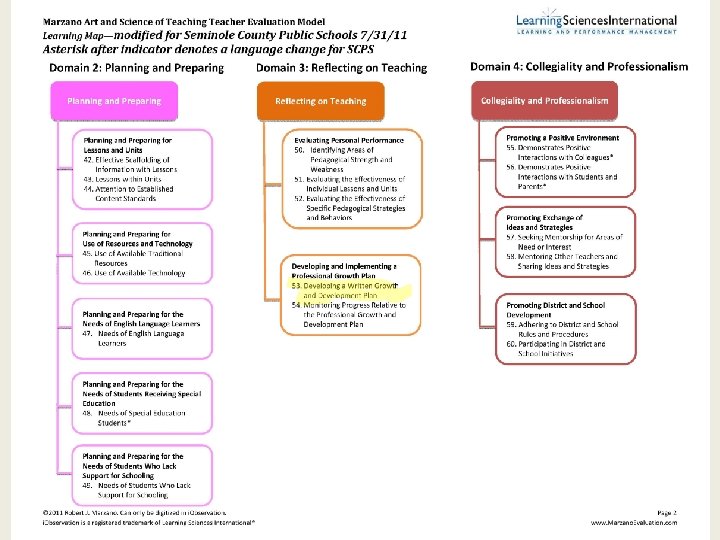
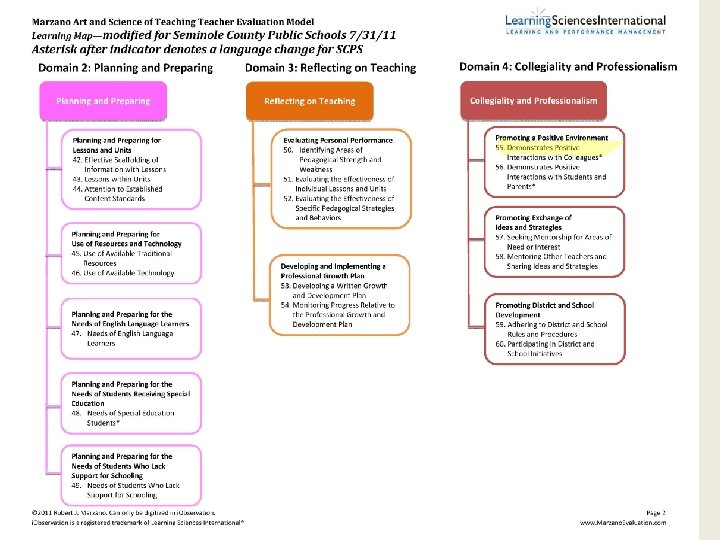
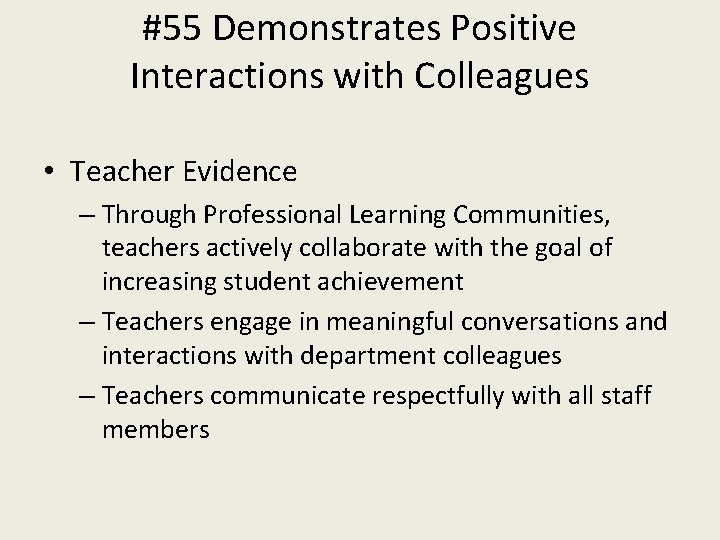
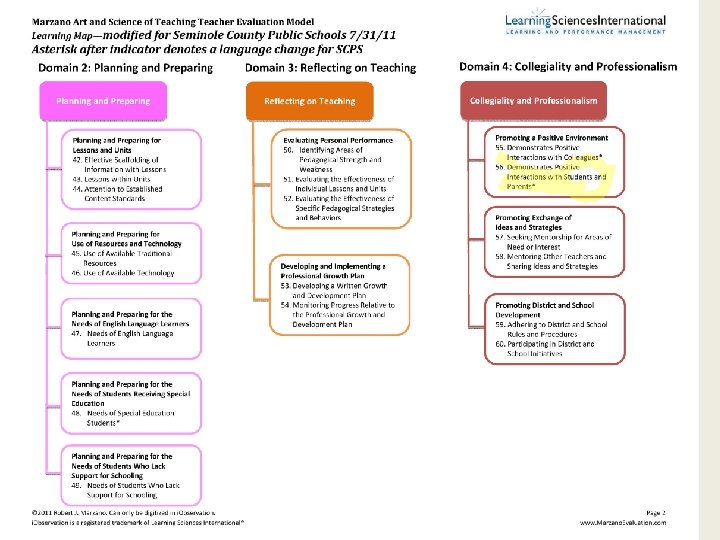
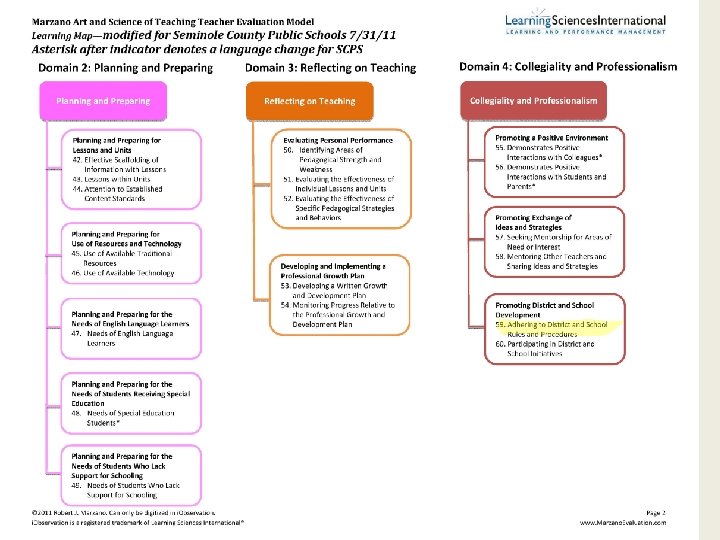
Art and Science of Teaching Teacher Evaluation Model STUDENT ACHIEVEMENT Domain 4: Collegiality and Professionalism (6 Indicators) Promoting a Positive Environment (2 Indicators) Promoting Exchange of Ideas (2 Indicators) Promoting District and School Development (2 Indicators) Domain 1: Classroom Strategies and Behaviors (41 Indicators) Routine Segments (5 Indicators) Content Segments (18 Indicators) On the Spot Segments (18 Indicators) Domain 2: Planning and Preparing (8 Indicators) Lesson and Units (3 Indicators) Use of Materials and Technology (2 Indicators) Special Needs of Students (3 Indicators) Domain 3: Reflecting on Teaching (5 Indicators) Evaluating Personal Performance (3 Indicators) Professional Growth Plan (2 Indicators) 8 Domain 4: Collegiality and Professionalism (6 Indicators) Promoting a Positive Environment (2 Indicators) Promoting Exchange of Ideas (2 Indicators) Promoting District and School Development (2 Indicators)
SOME EXAMPLES…
10
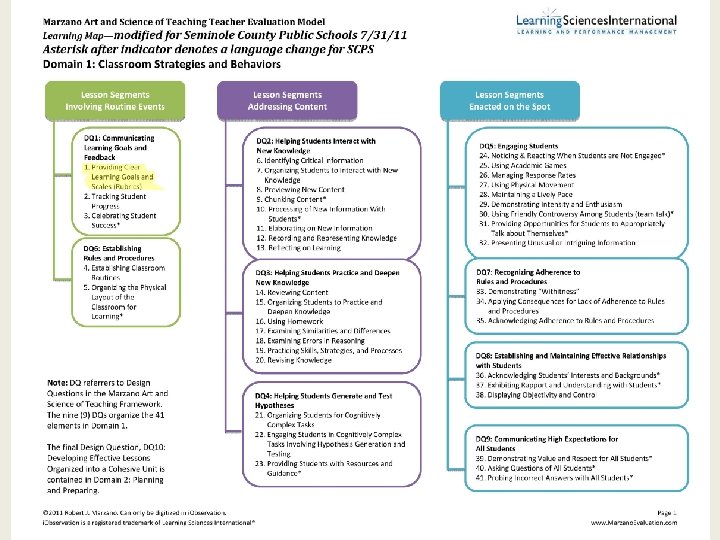
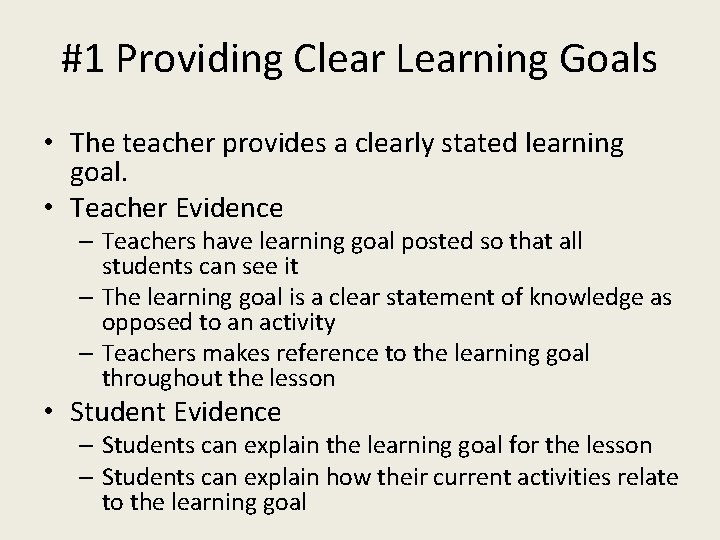
#1 Providing Clear Learning Goals • The teacher provides a clearly stated learning goal. • Teacher Evidence – Teachers have learning goal posted so that all students can see it – The learning goal is a clear statement of knowledge as opposed to an activity – Teachers makes reference to the learning goal throughout the lesson • Student Evidence – Students can explain the learning goal for the lesson – Students can explain how their current activities relate to the learning goal
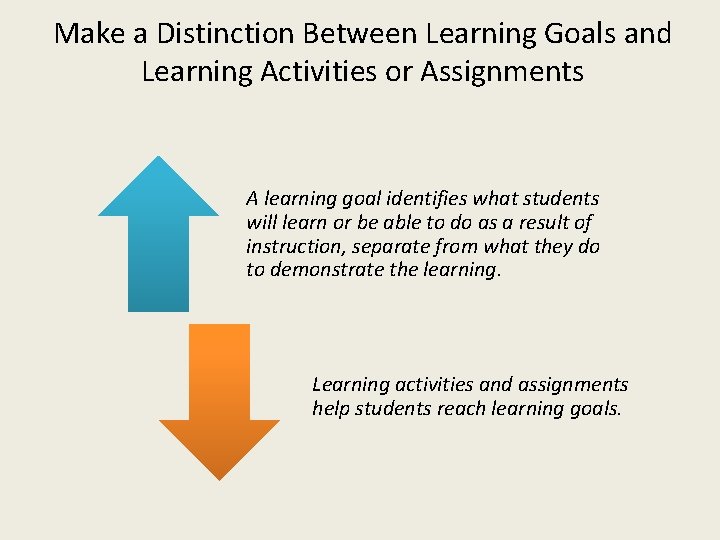
Make a Distinction Between Learning Goals and Learning Activities or Assignments A learning goal identifies what students will learn or be able to do as a result of instruction, separate from what they do to demonstrate the learning. Learning activities and assignments help students reach learning goals.
13
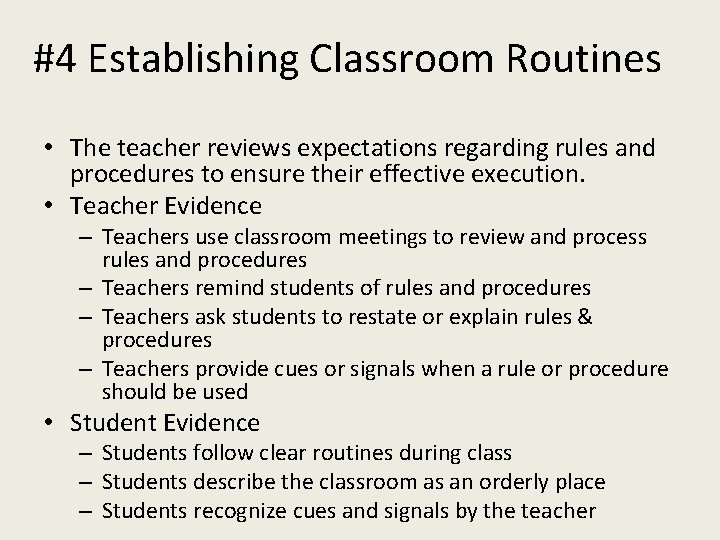
#4 Establishing Classroom Routines • The teacher reviews expectations regarding rules and procedures to ensure their effective execution. • Teacher Evidence – Teachers use classroom meetings to review and process rules and procedures – Teachers remind students of rules and procedures – Teachers ask students to restate or explain rules & procedures – Teachers provide cues or signals when a rule or procedure should be used • Student Evidence – Students follow clear routines during class – Students describe the classroom as an orderly place – Students recognize cues and signals by the teacher
15
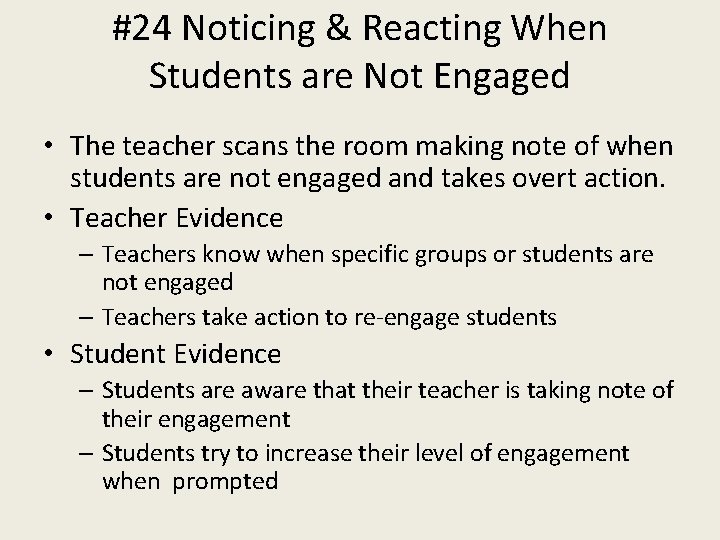
#24 Noticing & Reacting When Students are Not Engaged • The teacher scans the room making note of when students are not engaged and takes overt action. • Teacher Evidence – Teachers know when specific groups or students are not engaged – Teachers take action to re-engage students • Student Evidence – Students are aware that their teacher is taking note of their engagement – Students try to increase their level of engagement when prompted
Student engagement happens as a result of a teacher’s careful planning and implementation of specific strategies.
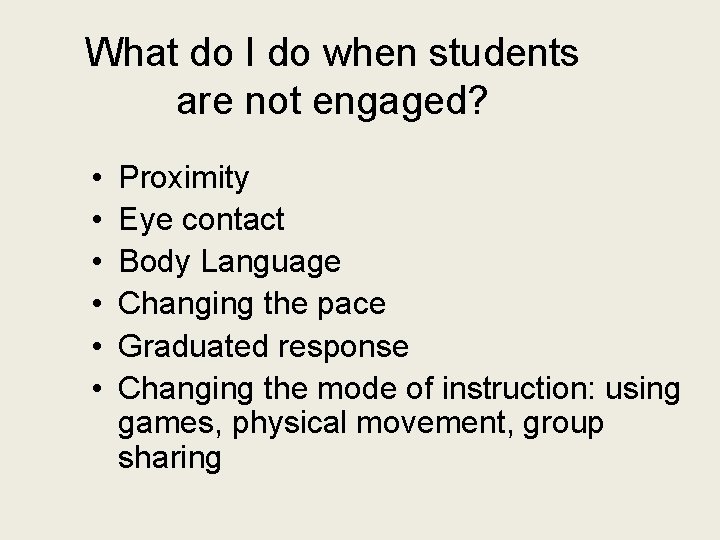
What do I do when students are not engaged? • • • Proximity Eye contact Body Language Changing the pace Graduated response Changing the mode of instruction: using games, physical movement, group sharing
19
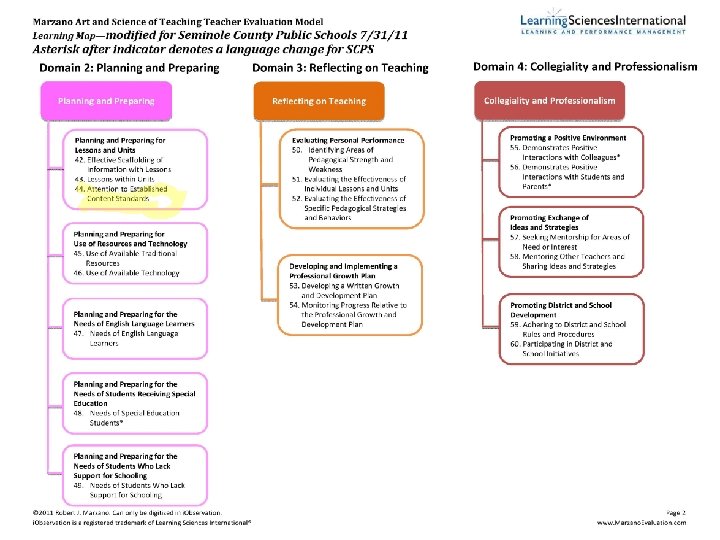
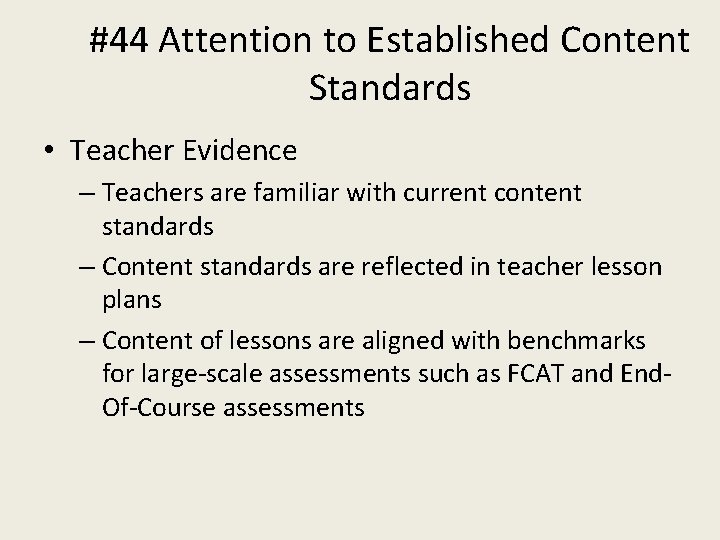
#44 Attention to Established Content Standards • Teacher Evidence – Teachers are familiar with current content standards – Content standards are reflected in teacher lesson plans – Content of lessons are aligned with benchmarks for large-scale assessments such as FCAT and End. Of-Course assessments
21
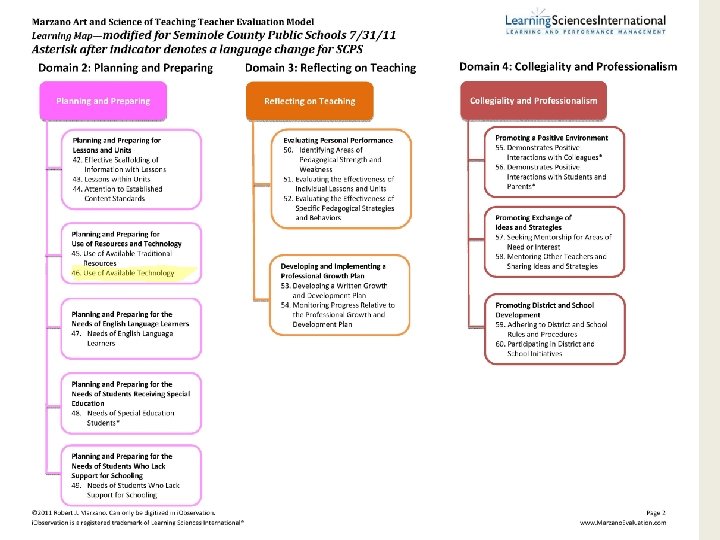
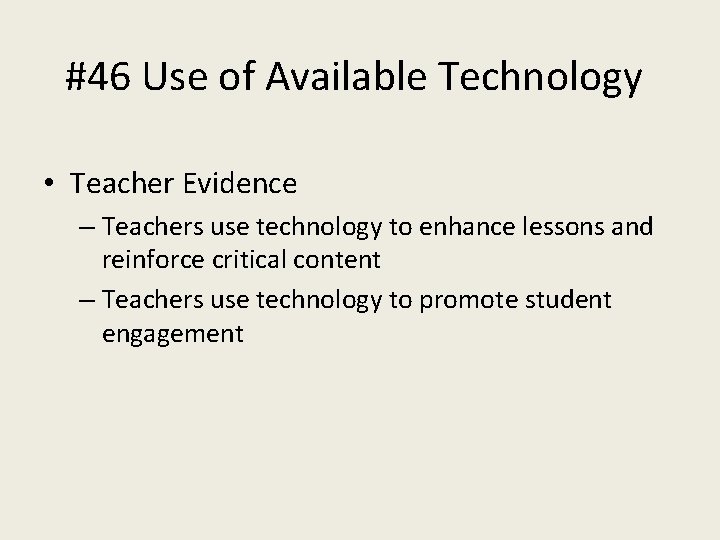
#46 Use of Available Technology • Teacher Evidence – Teachers use technology to enhance lessons and reinforce critical content – Teachers use technology to promote student engagement
23
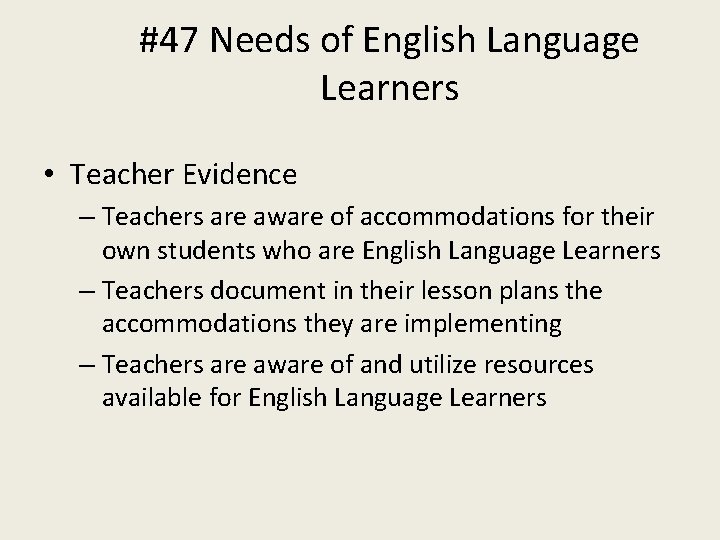
#47 Needs of English Language Learners • Teacher Evidence – Teachers are aware of accommodations for their own students who are English Language Learners – Teachers document in their lesson plans the accommodations they are implementing – Teachers are aware of and utilize resources available for English Language Learners
25
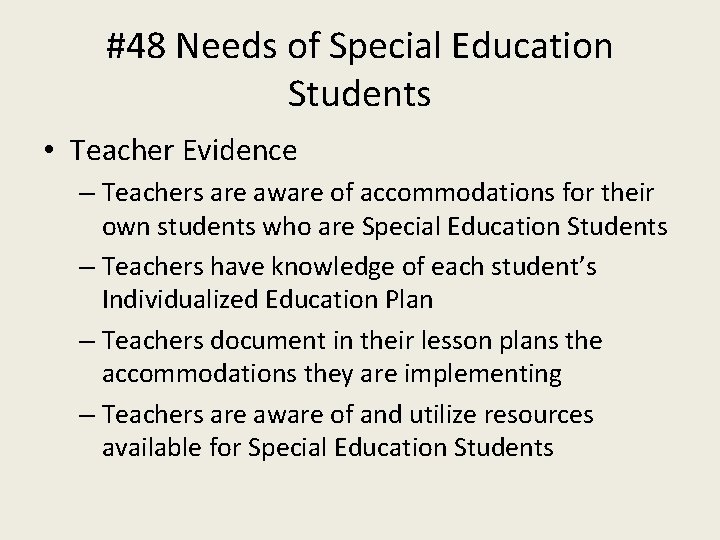
#48 Needs of Special Education Students • Teacher Evidence – Teachers are aware of accommodations for their own students who are Special Education Students – Teachers have knowledge of each student’s Individualized Education Plan – Teachers document in their lesson plans the accommodations they are implementing – Teachers are aware of and utilize resources available for Special Education Students
27
#53 Developing a Written Growth and Development Plan • Teacher Evidence – Individualized Professional Development Plan – Teachers are up to date with certifications and required professional development
29
#55 Demonstrates Positive Interactions with Colleagues • Teacher Evidence – Through Professional Learning Communities, teachers actively collaborate with the goal of increasing student achievement – Teachers engage in meaningful conversations and interactions with department colleagues – Teachers communicate respectfully with all staff members
p 31
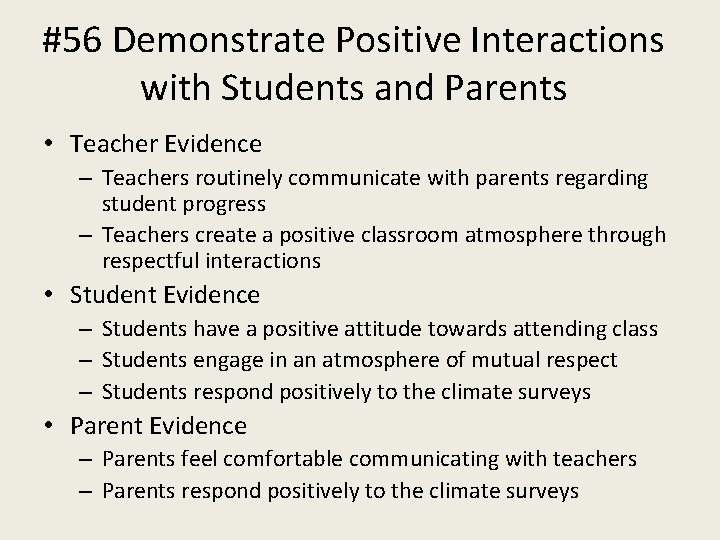
#56 Demonstrate Positive Interactions with Students and Parents • Teacher Evidence – Teachers routinely communicate with parents regarding student progress – Teachers create a positive classroom atmosphere through respectful interactions • Student Evidence – Students have a positive attitude towards attending class – Students engage in an atmosphere of mutual respect – Students respond positively to the climate surveys • Parent Evidence – Parents feel comfortable communicating with teachers – Parents respond positively to the climate surveys
p 33
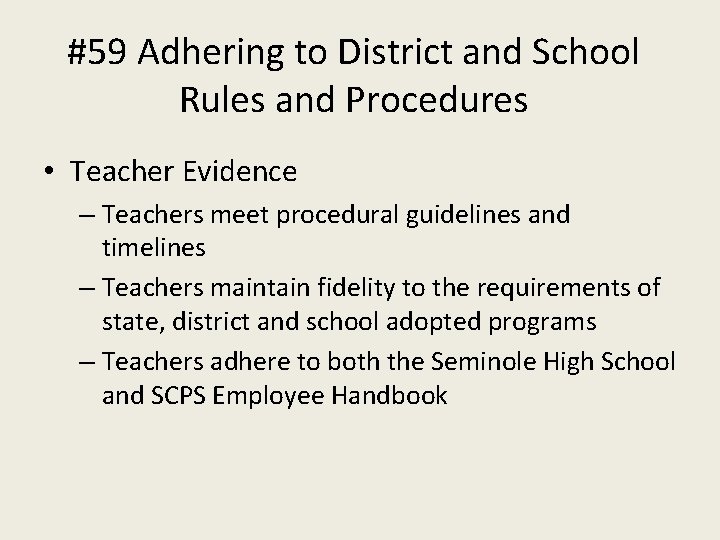
#59 Adhering to District and School Rules and Procedures • Teacher Evidence – Teachers meet procedural guidelines and timelines – Teachers maintain fidelity to the requirements of state, district and school adopted programs – Teachers adhere to both the Seminole High School and SCPS Employee Handbook
SOUTH SEMINOLE MIDDLE SCHOOL Getting to Know Marzano’s Teacher Evaluation Model Post Questions, Comments, Concerns on Lead 21 -SSMS for community collaboration