
SOUTH LAKE LEISURE CENTRE POOL TECHNICAL OPERATING PROCEDURES

![SECTION COMPLETED You have now completed Pool Technical Operating Procedures [Section A] and are](https://slidetodoc.com/presentation_image_h2/66d372cb45515f84a7dd4d8ea50beaa9/image-82.jpg "SECTION COMPLETED You have now completed Pool Technical Operating Procedures [Section A] and are")
![Click here to start ASSESSMENT POOL TECHNICAL OPERATING PROCEDURES [ SECTION A ]](https://slidetodoc.com/presentation_image_h2/66d372cb45515f84a7dd4d8ea50beaa9/image-83.jpg "Click here to start ASSESSMENT POOL TECHNICAL OPERATING PROCEDURES [ SECTION A ]")
- Slides: 83
SOUTH LAKE LEISURE CENTRE POOL TECHNICAL OPERATING PROCEDURES SECTION A
Introduction: Our intention is to provide a swimming pool technical operation that is safe, healthy and environmentally friendly for all users. We aim to maintain close compliance with the PWTAG Code of Practice and, where relevant, other national standards. The Operational Manager will be responsible for writing and annual review of the PTOP for South Lake Leisure Centre. Additionally. if there is any major adaptation that take place or notable incident affecting pool water safety the procedures will be reviewed All qualifications and training for the key staff at the facility will be maintained within current guidelines to wherever possible to enable them to undertake key roles as deemed essential to comply as close as possible with PWTAG Code of Practice.
Staff Structure Description of Pools Normal Operating Procedure Emergency Procedures
Staff Structure: The Maintenance Technician team will assume full responsible for ensuring the Swimming & Spa pool operates within normal parameters in relation to water quality and hygiene for all users. For this facility, a Maintenance Technician will be on call when not on duty and, as a back-up procedure, the Plant Operators of other ABC Council pools will be available for assistance or advice if required.
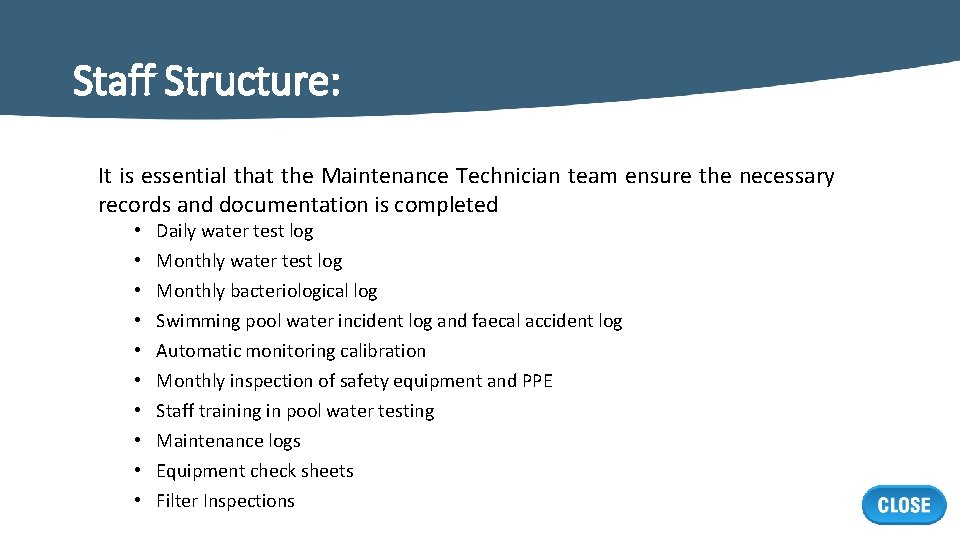
Staff Structure: It is essential that the Maintenance Technician team ensure the necessary records and documentation is completed • • • Daily water test log Monthly bacteriological log Swimming pool water incident log and faecal accident log Automatic monitoring calibration Monthly inspection of safety equipment and PPE Staff training in pool water testing Maintenance logs Equipment check sheets Filter Inspections
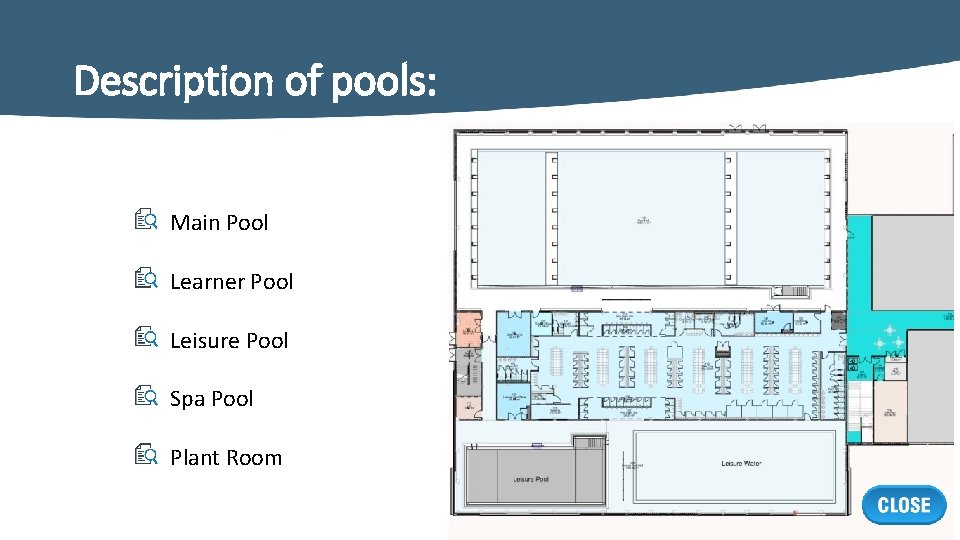
Description of pools: Main Pool Learner Pool Leisure Pool Spa Pool Plant Room
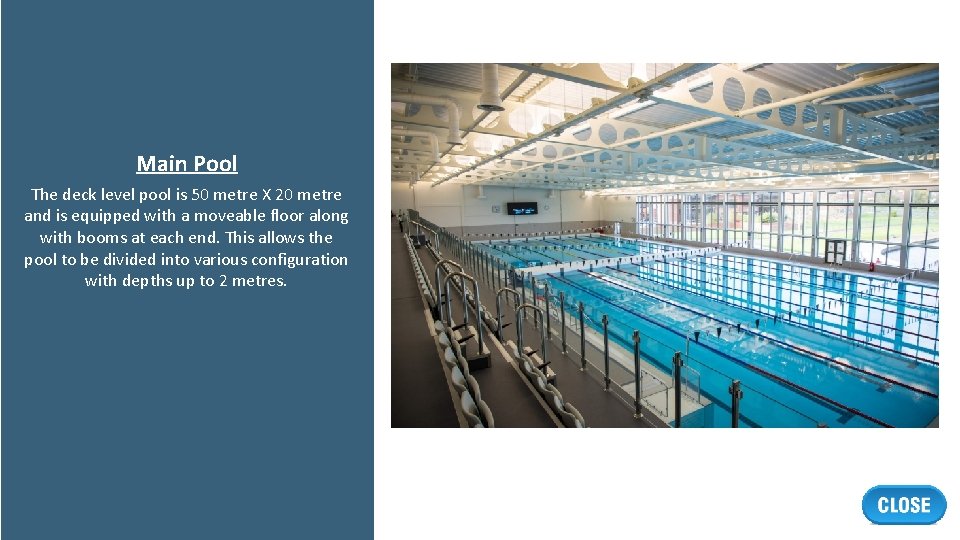
Main Pool The deck level pool is 50 metre X 20 metre and is equipped with a moveable floor along with booms at each end. This allows the pool to be divided into various configuration with depths up to 2 metres.
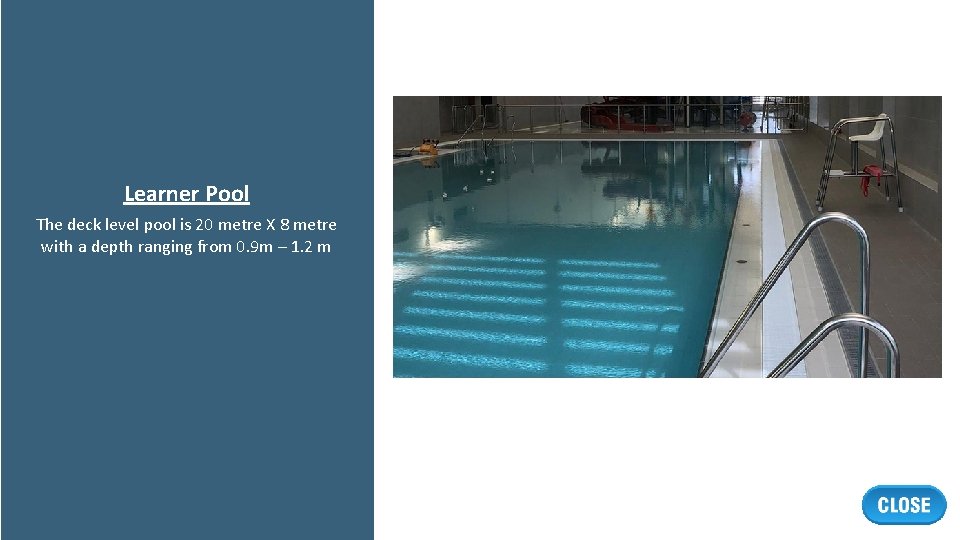
Learner Pool The deck level pool is 20 metre X 8 metre with a depth ranging from 0. 9 m – 1. 2 m
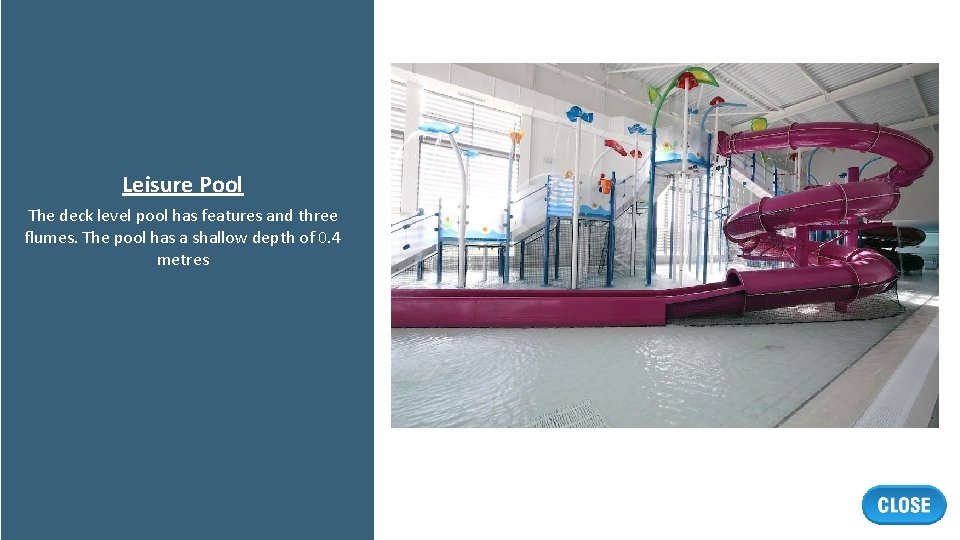
Leisure Pool The deck level pool has features and three flumes. The pool has a shallow depth of 0. 4 metres
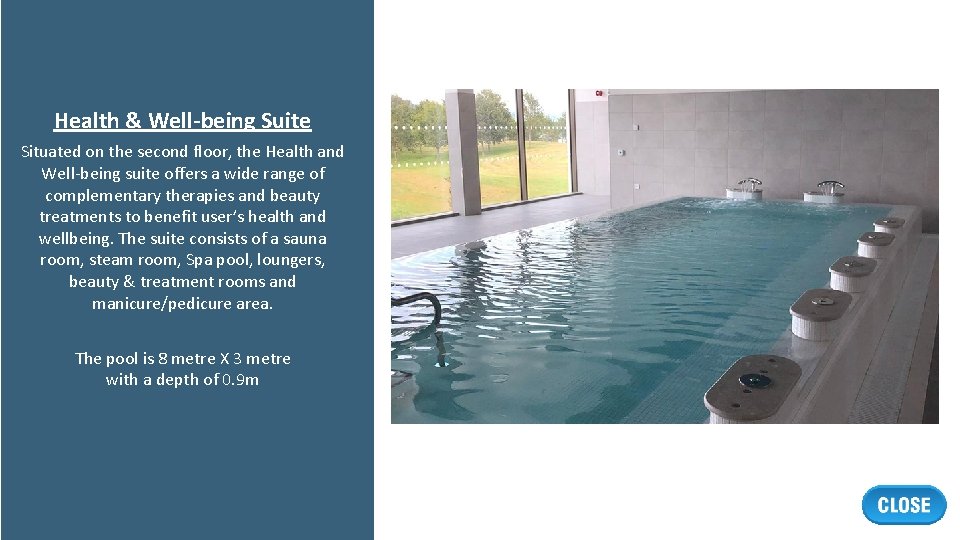
Health & Well-being Suite Situated on the second floor, the Health and Well-being suite offers a wide range of complementary therapies and beauty treatments to benefit user’s health and wellbeing. The suite consists of a sauna room, steam room, Spa pool, loungers, beauty & treatment rooms and manicure/pedicure area. The pool is 8 metre X 3 metre with a depth of 0. 9 m
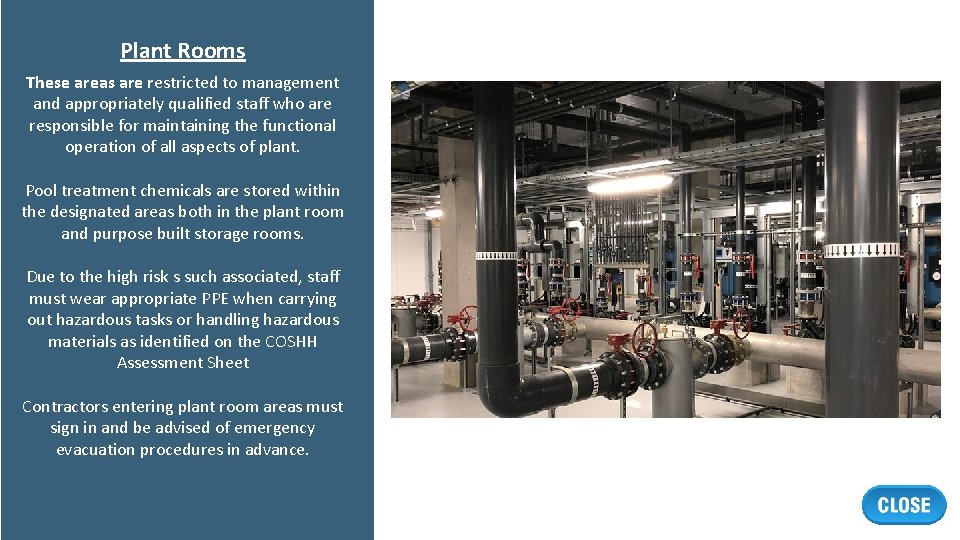
Plant Rooms These areas are restricted to management and appropriately qualified staff who are responsible for maintaining the functional operation of all aspects of plant. Pool treatment chemicals are stored within the designated areas both in the plant room and purpose built storage rooms. Due to the high risk s such associated, staff must wear appropriate PPE when carrying out hazardous tasks or handling hazardous materials as identified on the COSHH Assessment Sheet Contractors entering plant room areas must sign in and be advised of emergency evacuation procedures in advance.
Normal Operating Procedures: Public health hazards Pool Operation Safe Systems Heating & Ventilation
Public Health Hazards: The risk assessment for this pool considers the following hazards: § Death through drowning, including hair and limb entrapment § Serious Injury to Bathers such as neck and head injuries from diving into shallow water or hitting other swimmers § Injuries from falls, slipping, etc. § Ingestion of pool water containing pathogens including the protozoal parasites Cryptosporidium and Giardia that can cause gastroenteritis § Contact with contaminated water, especially in contact with open wounds § Inhalation of aerosols containing hazards e. g. Legionella species in distributed water, such as when using showers.
Public Health Hazards: The risk assessment for this pool considers the following hazards: § Skin infections of the feet, including warts, verruca’s and athlete’s foot § Possible exacerbation of asthma due to excessive disinfection byproducts in the air § Illness from water contaminated by chemicals § Potential drowning where cloudy water prevents surveillance of swimmers under the water § Cuts and abrasions due to sharp edges, cracked tiles etc.
Bather Hygiene Procedures: We have notices within the changing rooms saying that bathers: § Should shower before using the pool § Should use the toilet facilities before using the pool § With infections should not use the pool § With diarrhoea must not swim or for 48 hours after symptoms have stopped. § Who have been diagnosed with cryptosporidiosis must not swim for 14 days after diarrhoea has stopped.
Mains Water Quality: The water treatment system takes into account the mains water characteristics and on a monthly basis, the Maintenance Technicians will test the source water. It is essential that the source water is tested monthly to establish a starting point for balance water.
Pool Water Clarity: Clarity of pool water is critical. It is essential that lifeguards can clearly see the bottom of the pool at all points. If not, there is an immediate danger to anyone in distress, as well as the likelihood of discomfort to bathers because of the poor condition of the water. For this reason, the pool water quality is regularly monitored to ensure no danger to bathers. In the event that water clarity is of concern, the Maintenance Technician and/or Duty Manager will visually assess and determine if all bathers must leave the water until such times as water quality is restored.
Dilution with Fresh Water: As part of the regular water treatment process fresh mains water will replace pool water with up to 30 litres per bather according to pool bather usage and recommended guidelines.
Bathing Loads: The maximum bathing load allowed at any one time is calculated using the current HSG 179 recommendation for occupancy ratio of 3 m 2 of water pool user. Main Pool = 333 bathers Learner Pool = 53 bathers Leisure Pool = 45 bathers Spa Pool = 8 bathers
Water Circulation: This pool operates the water treatment system continuously. The circulation rate, which is the flow of pool water through the circulation system, is calculated using PWTAG’s recommended rate of maximum bathing load multiplied by 1. 7
Surface Water Removal: All pool areas use a deck level system, which will remove 80 -100% surface pollution. The basic principle is that the water level comes up to the deck level and flows in to a surrounding channel that drains by gravity into a balance tank. When bathers enter the pool, the equivalent volume of water is displaced into the balance tank, which is then pumped back in when the bather leaves.
Inlets and Outlets: Inlets and outlets, grilles are in accordance with BS EN 13451 -3 and PWTAG’S guidance of 8 mm gaps. Visual inspections are carried out every day as part of the pool opening procedures and a closer examination for obstruction, impact damage and vandalism carried out monthly by the Maintenance Technicians. If they are damaged or missing, swimming will be suspended immediately until such times an assessment determines they are still in accordance with guidance or the grill is replaced. The water velocity entering the pool should be less than 1. 5 m per second and to minimise the hazard of entrapment the speed of the water passing through them should not exceed 0. 5 m per second.
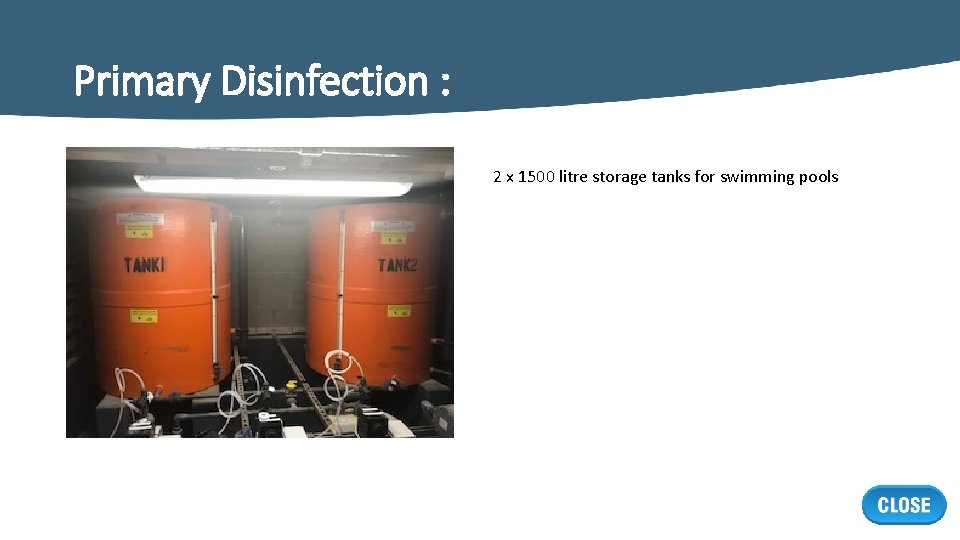
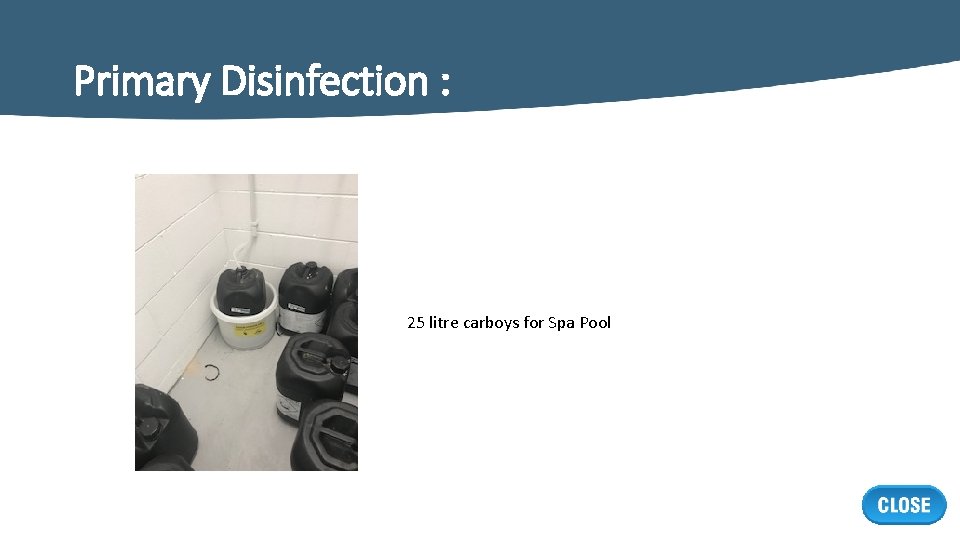
Primary Disinfection : The primary disinfection used at South Lake Leisure Centre is Sodium Hypochlorite [PURECHLOR] which is monitored and dosed through an automatic system. The main storage tank for the swimming pools is located in the specific built store room close to vehicle barrier and is pumped in to the day tanks within the bunded area in the store. For the Spa Pool the store room is located on the lake side of the building and the is delivered in 25 litre carboys.
Primary Disinfection : 2 x 1500 litre storage tanks for swimming pools
Primary Disinfection : 25 litre carboys for Spa Pool
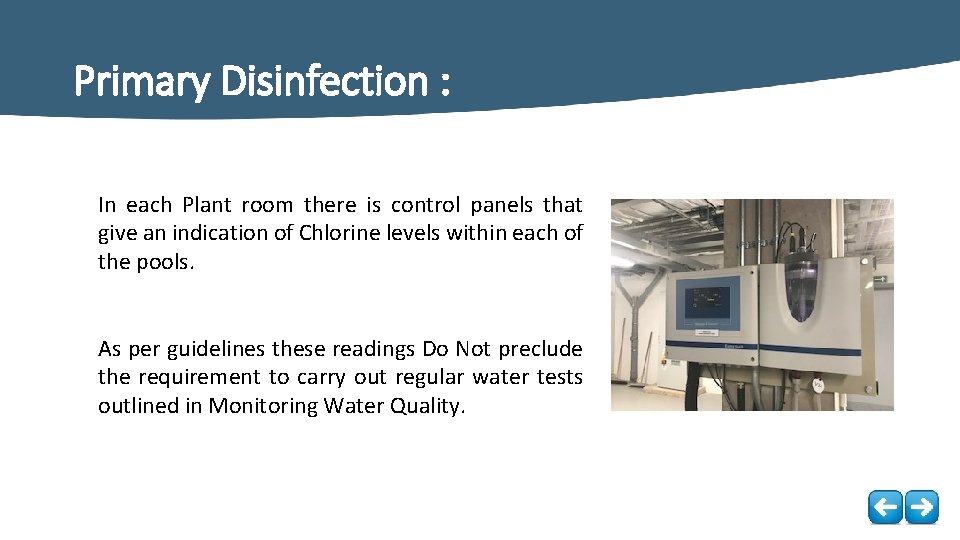
Primary Disinfection : In each Plant room there is control panels that give an indication of Chlorine levels within each of the pools. As per guidelines these readings Do Not preclude the requirement to carry out regular water tests outlined in Monitoring Water Quality.
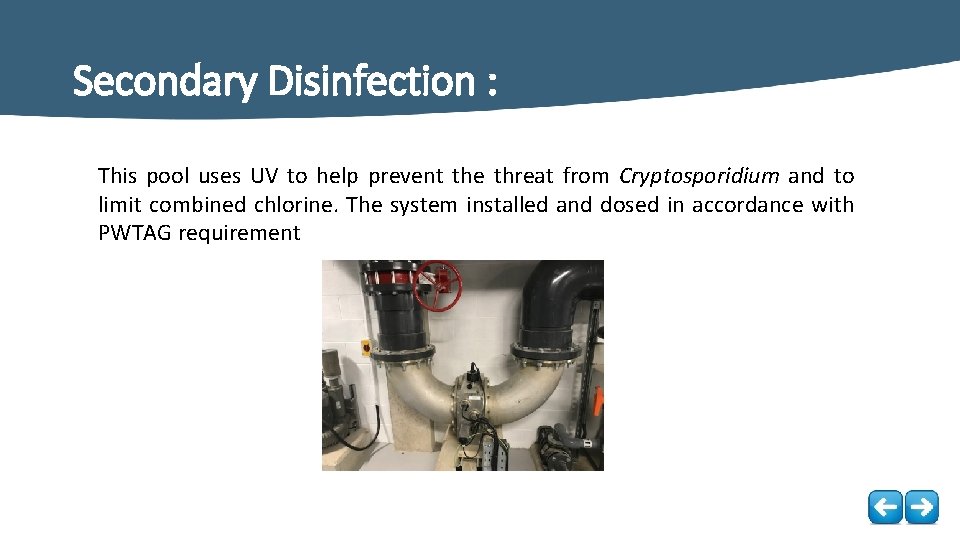
Secondary Disinfection : This pool uses UV to help prevent the threat from Cryptosporidium and to limit combined chlorine. The system installed and dosed in accordance with PWTAG requirement
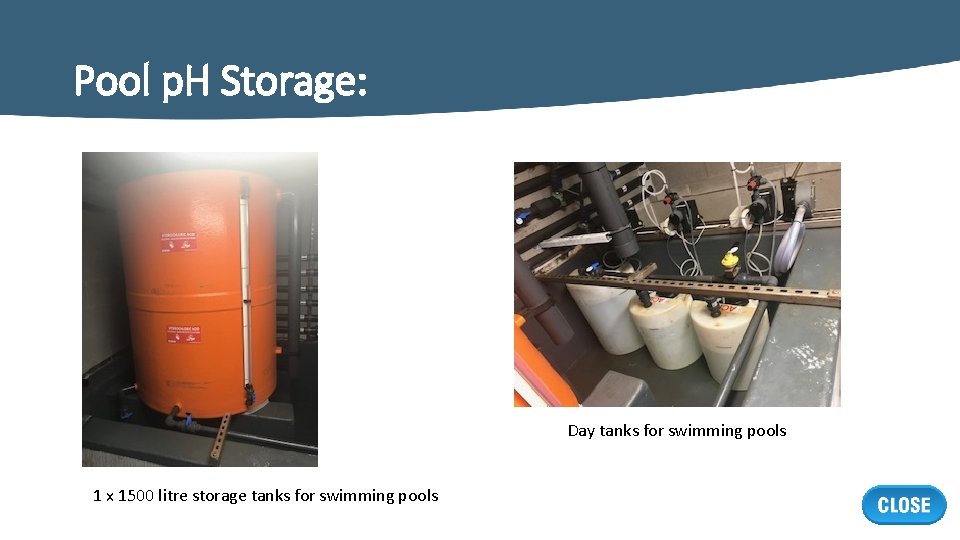
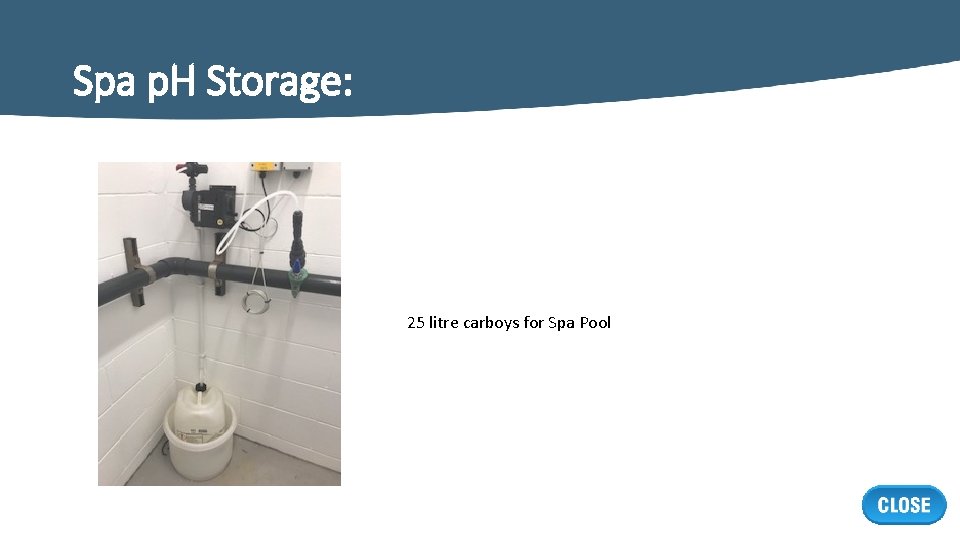
p. H: The p. H corrector used at South Lake Leisure Centre is Hydrochloric Acid at 10% WW nominal strength which is monitored and dosed through an automatic system. The main storage tank for the swimming pools is located in the specific built store room close to vehicle barrier and is pumped in to the day tanks within the bunded area in the store. For the Spa Pool the store room is located on the lake side of the building and is delivered in 25 litre carboys.
Pool p. H Storage: Day tanks for swimming pools 1 x 1500 litre storage tanks for swimming pools
Spa p. H Storage: 25 litre carboys for Spa Pool
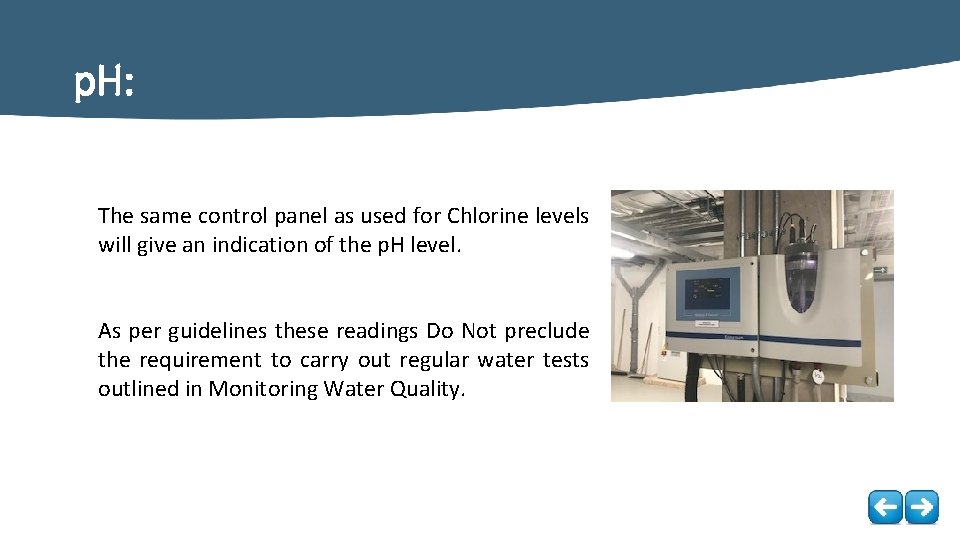
p. H: The same control panel as used for Chlorine levels will give an indication of the p. H level. As per guidelines these readings Do Not preclude the requirement to carry out regular water tests outlined in Monitoring Water Quality.
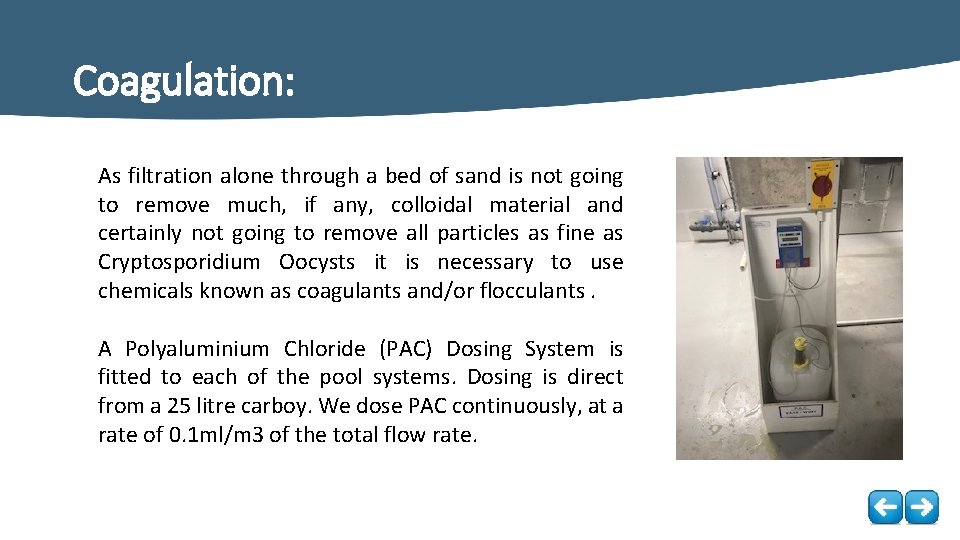
Coagulation: As filtration alone through a bed of sand is not going to remove much, if any, colloidal material and certainly not going to remove all particles as fine as Cryptosporidium Oocysts it is necessary to use chemicals known as coagulants and/or flocculants. A Polyaluminium Chloride (PAC) Dosing System is fitted to each of the pool systems. Dosing is direct from a 25 litre carboy. We dose PAC continuously, at a rate of 0. 1 ml/m 3 of the total flow rate.
Turnover Period: Main Pool – 3 hrs 39 mins (575 m 3/hr) Learner Pool – 1 hr 30 mins (120 m 3/hr) Leisure Pool – 8 mins (270 m 3/hr) Spa Pool – 48 mins (24 m 3/hr)
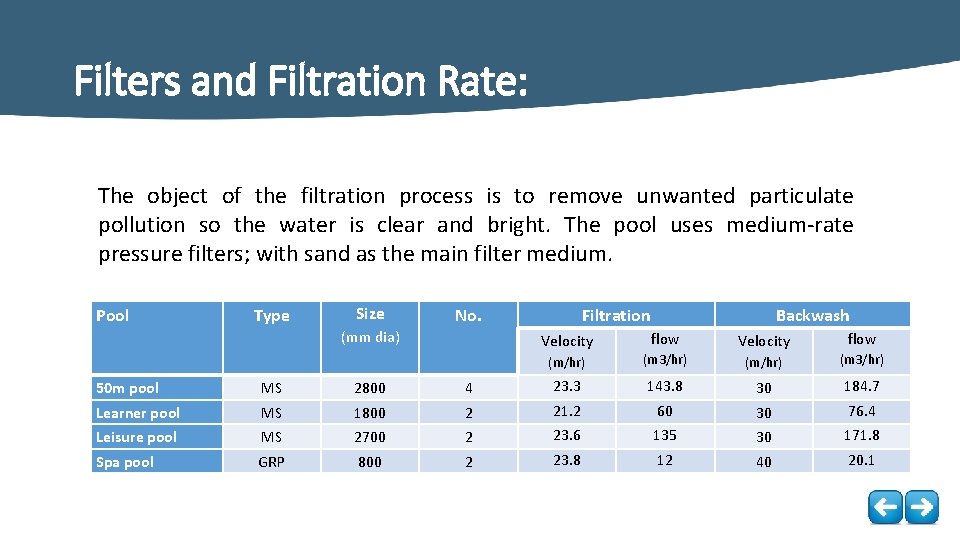
Filters and Filtration Rate: The object of the filtration process is to remove unwanted particulate pollution so the water is clear and bright. The pool uses medium-rate pressure filters; with sand as the main filter medium. Pool Type Size No. (mm dia) Filtration Backwash Velocity flow (m/hr) (m 3/hr) 50 m pool MS 2800 4 23. 3 143. 8 30 184. 7 Learner pool MS 1800 2 21. 2 60 30 76. 4 Leisure pool MS 2700 2 23. 6 135 30 171. 8 Spa pool GRP 800 2 23. 8 12 40 20. 1
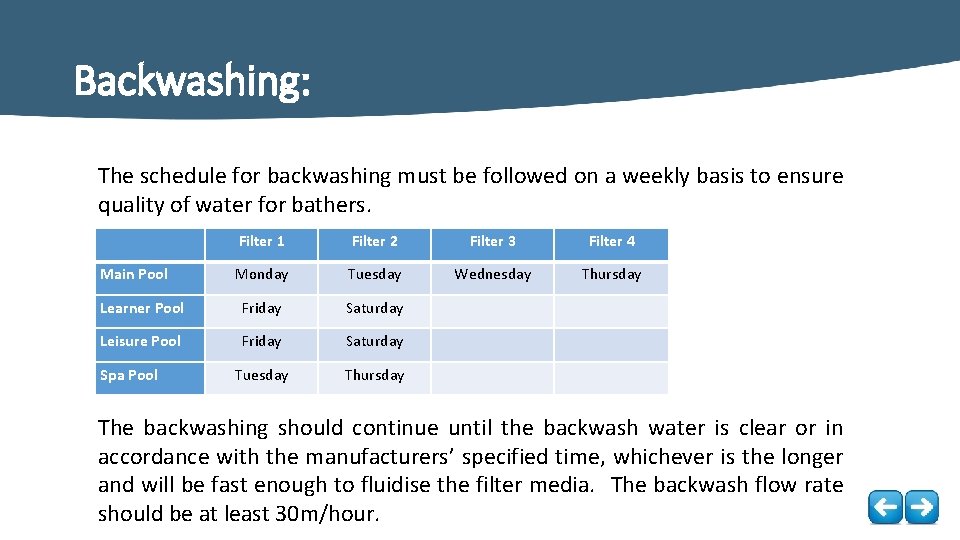
Backwashing: The schedule for backwashing must be followed on a weekly basis to ensure quality of water for bathers. Filter 1 Filter 2 Filter 3 Filter 4 Monday Tuesday Wednesday Thursday Learner Pool Friday Saturday Leisure Pool Friday Saturday Tuesday Thursday Main Pool Spa Pool The backwashing should continue until the backwash water is clear or in accordance with the manufacturers’ specified time, whichever is the longer and will be fast enough to fluidise the filter media. The backwash flow rate should be at least 30 m/hour.
Backwashing: For pools with more than one filter, it is important that filters are backwash individually with the other isolated during the procedure. In the event that water circulation has stopped for a long period of time a backwash needs to be carried out prior to the pool re-opening for public use. Only the Maintenance Technician or a competent trained & qualified person must carry out pool backwashes. A step by step guide on ‘How to Perform a Backwash’ is located within the Plant Room for guidance. Backwashing protocol is critical; when neglected, it can for example be a factor in outbreaks of cryptosporidiosis.
Filter Inspection: The swimming pool media for each filter should undergo an annual inspection to ensure there is no mud balling, inactive parts of the bed, fissures, chemical crystallisation and sand loss. The Spa pool, due to the increased relative pollution needs to be checked every 6 months. Inspection records are located in the Duty Managers Office. Based on regular inspections the filter sand may be subject to change every five to seven years.
Pool Cleaning – equipment/surfaces: Floor surface around the pool, changing rooms, showers and toilets are cleaned by attendants as part of the on-going cleaning regime. Adequate measures are taken to ensure that floor-cleaning materials do not enter the pool water. Maintenance Technician to report to the Duty Manager any concerns that cleaning materials is entering and contaminating the pool water.
Legionella: Flushing is carried out inline with the Legionella guidance, with water temperatures recorded. Showers are cleaned and descaled to control legionella bacteria in hot and cold water systems and an external company performs monthly checks to ensure temperatures comply.
Balance Tanks: Inline with PWTAG advice, balance tanks should be inspected once a year and cleaned if necessary or more frequent if there are bacteriological problems. Only personnel who are appropriately trained and qualified to work in confined spaces should perform the task.
Pool Bottom: The pool bottom is kept clear of contamination, algae, and general debris by regular sweeping and the use of a suction vacuum cleaner. Vacuum cleaning shall only be carried out when no bathers are present. Maintenance Technician to report to the Duty Manager any concerns that the pool bottom is not being kept at the required standard.
Monitoring Water Quality: Procedures for testing the pool water are in place which follow industry guidance. Operators are trained in the use of the test kits and other test equipment so that they can monitor pool water quality. The procedures also include actions to take if there are unexpected test results, especially if they show the pool water chemical composition is either below or exceeding safe limits.
Automatic Monitoring: The readouts on the display of the controller are checked daily against the results from manual tests of the sample and regular calibration of the p. H and Disinfection system is carried out by a Maintenance Technician or trained manager based on Water Sample Tests Water Testing Microbiological Testing
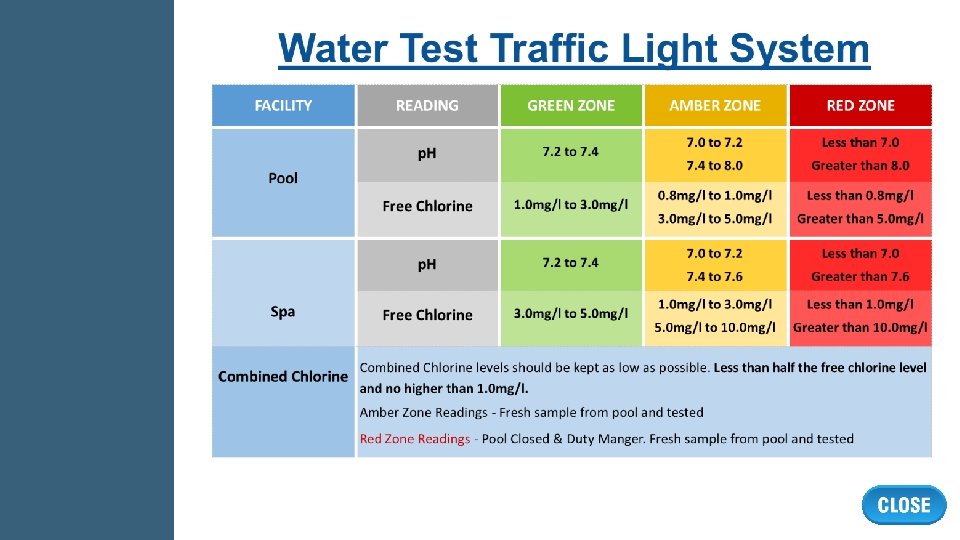
Water Testing: The water is tested regularly throughout the day in-line with guidance. As the pool uses hypochlorite, and assuming the p. H value is 7. 2, the free chlorine levels should be maintained at 1 mg/l or below. This assumes satisfactory microbiological monitoring results. § Free chlorine 1. 0 mg/l to 3. 0 mg/l § Combined chlorine levels should be less than half the free chlorine, and no more than 1 mg/l no matter what the level of free chlorine
Water Testing: On a weekly basis we test the water for balance and chemical levels § Calcium hardness between 80 and 200 mg/l § Alkalinity between 80 and 200 mg/l § TDS no more than 1000 above the source water (max 3000) A copy of the step by step procedures on how to carryout daily water test are kept beside the water testing machine along with guidance on what action to take if readings are outside normal parameters
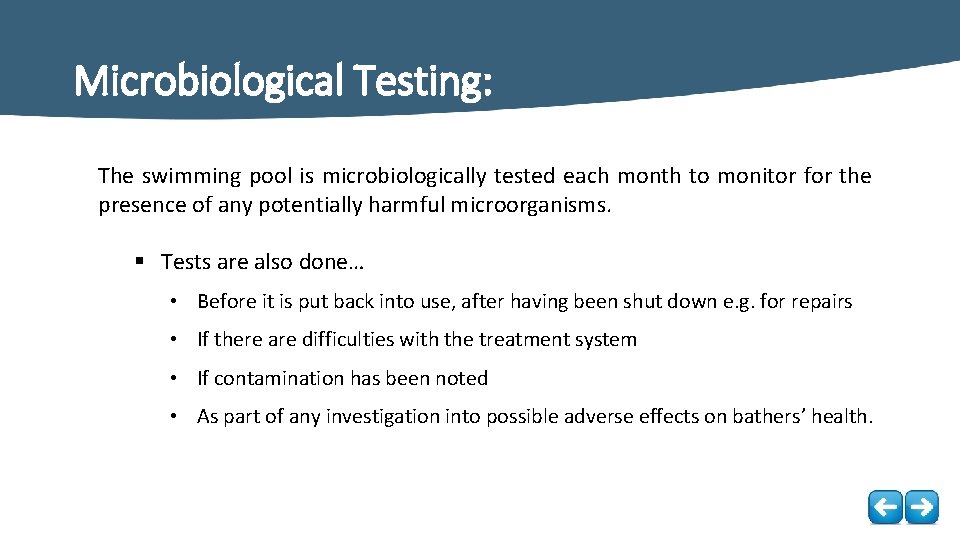
Microbiological Testing: The swimming pool is microbiologically tested each month to monitor for the presence of any potentially harmful microorganisms. § Tests are also done… • Before it is put back into use, after having been shut down e. g. for repairs • If there are difficulties with the treatment system • If contamination has been noted • As part of any investigation into possible adverse effects on bathers’ health.
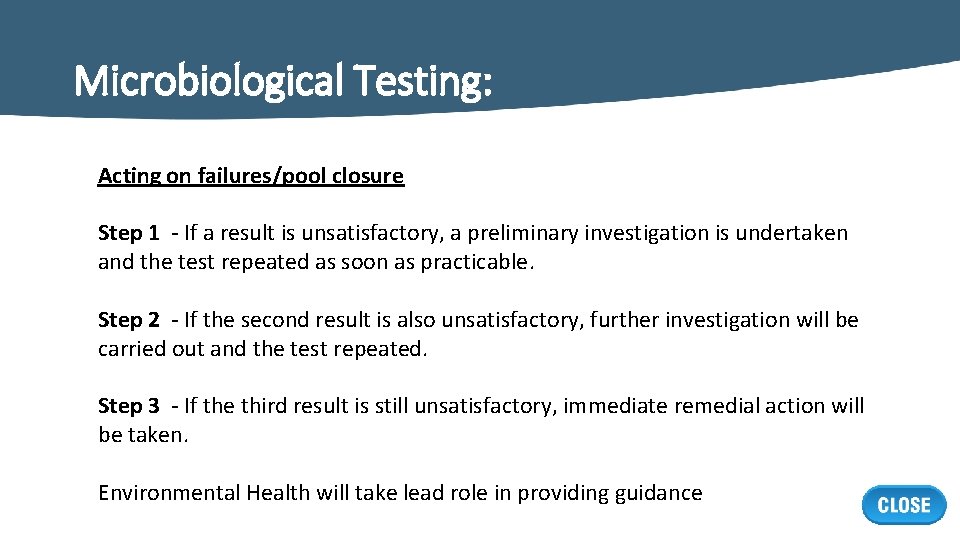
Microbiological Testing: Acting on failures/pool closure Step 1 - If a result is unsatisfactory, a preliminary investigation is undertaken and the test repeated as soon as practicable. Step 2 - If the second result is also unsatisfactory, further investigation will be carried out and the test repeated. Step 3 - If the third result is still unsatisfactory, immediate remedial action will be taken. Environmental Health will take lead role in providing guidance
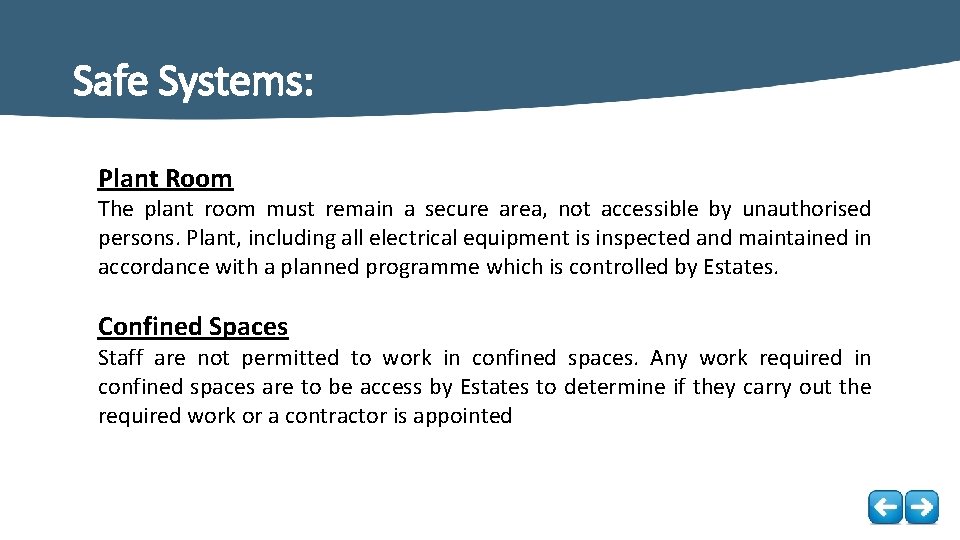
Safe Systems: Plant Room The plant room must remain a secure area, not accessible by unauthorised persons. Plant, including all electrical equipment is inspected and maintained in accordance with a planned programme which is controlled by Estates. Confined Spaces Staff are not permitted to work in confined spaces. Any work required in confined spaces are to be access by Estates to determine if they carry out the required work or a contractor is appointed
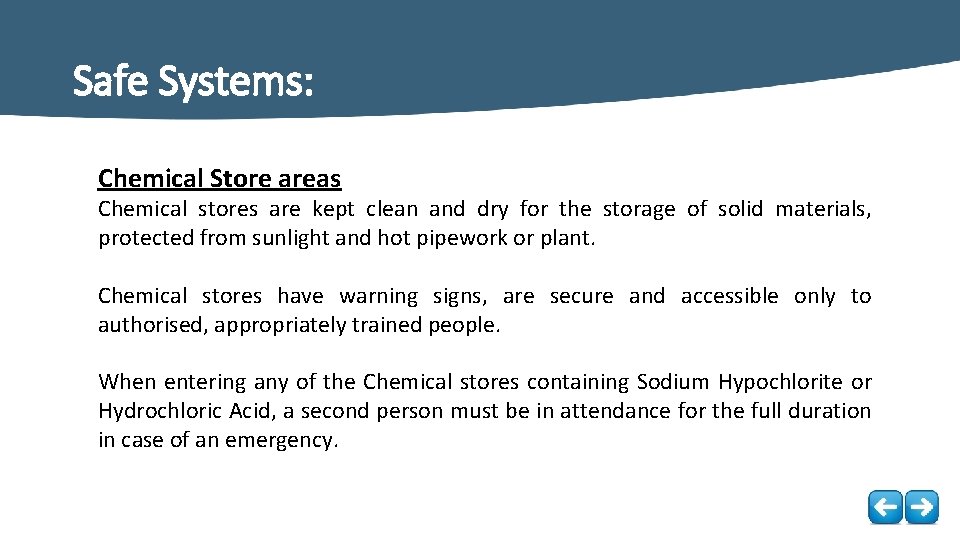
Safe Systems: Chemical Store areas Chemical stores are kept clean and dry for the storage of solid materials, protected from sunlight and hot pipework or plant. Chemical stores have warning signs, are secure and accessible only to authorised, appropriately trained people. When entering any of the Chemical stores containing Sodium Hypochlorite or Hydrochloric Acid, a second person must be in attendance for the full duration in case of an emergency.
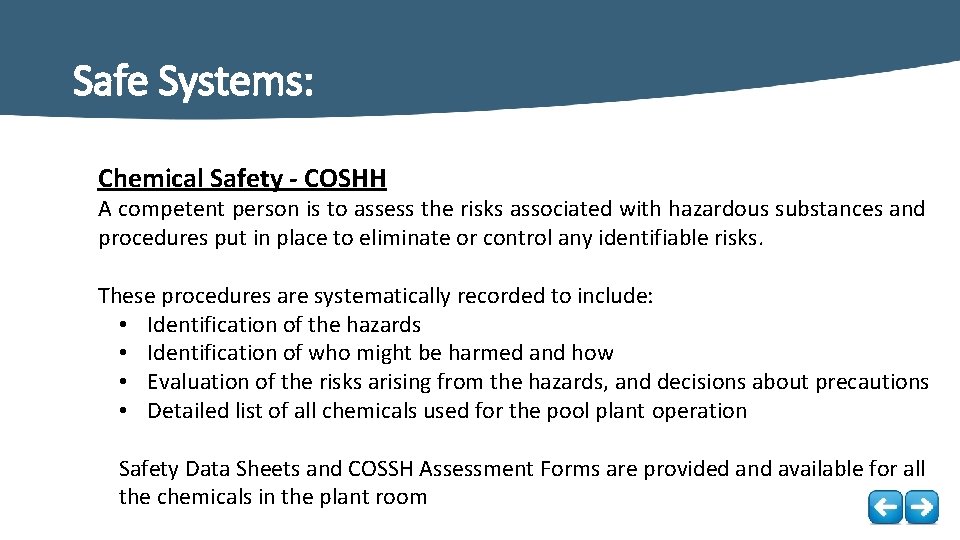
Safe Systems: Chemical Safety - COSHH A competent person is to assess the risks associated with hazardous substances and procedures put in place to eliminate or control any identifiable risks. These procedures are systematically recorded to include: • Identification of the hazards • Identification of who might be harmed and how • Evaluation of the risks arising from the hazards, and decisions about precautions • Detailed list of all chemicals used for the pool plant operation Safety Data Sheets and COSSH Assessment Forms are provided and available for all the chemicals in the plant room
Safe Systems: Chemical Handling All staff involved in the handling and use of chemicals will be appropriately trained on the safe handling and transportation of chemicals. Personal Protective Equipment (PPE) Personal Protective Equipment is held in the plant room. All items are to be maintained in accordance with the planned programme. Regular inspection of personal protective equipment is carried out to check its continuing suitability any items not fit for purpose are to be replaced prior to further use. For replacement or additional required items please contact the Operational Manager/Duty Manager.
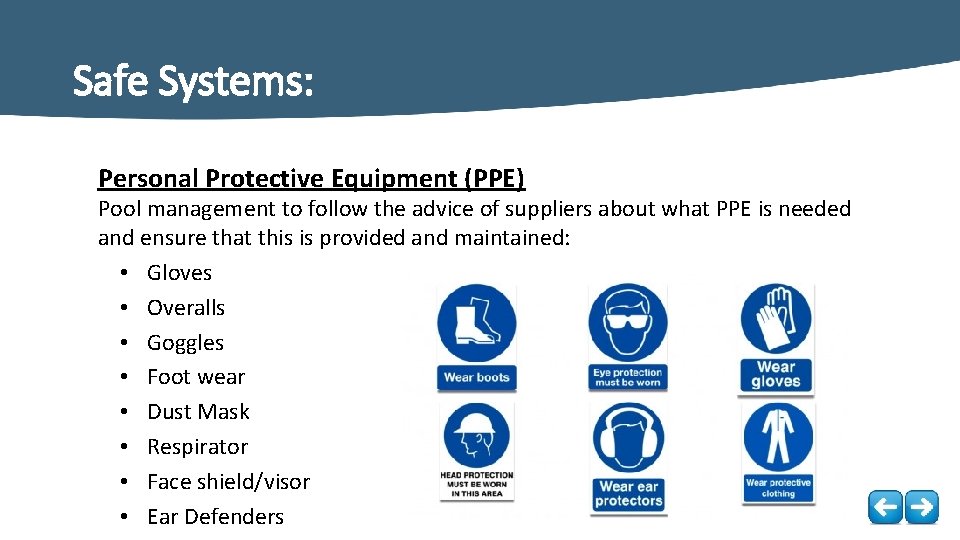
Safe Systems: Personal Protective Equipment (PPE) Pool management to follow the advice of suppliers about what PPE is needed and ensure that this is provided and maintained: • Gloves • Overalls • Goggles • Foot wear • Dust Mask • Respirator • Face shield/visor • Ear Defenders
Safe Systems: First Aid First aid provision including equipment for dealing with the consequences of direct contact with chemicals is provided which includes. • Eyewash facilities are located in close proximity to the hazard to enable immediate action. • A wash-basin with running water is provided in case chemicals come into contact with the skin or eyes. • Trained first aider are located within the building.
Safe Systems: Delivery of Chemicals All employees involved in the transport, handling and storage of pool chemicals receives initial and refresher training, as required, in the procedures involved. Deliveries proceed only when a trained staff member is available to receive and check the materials. PPE must be worn for all deliveries of chemicals. Bulk delivery of Sodium Hypochlorite Bulk delivery of Hydrochloric Acid Delivery of Carboys or other containers
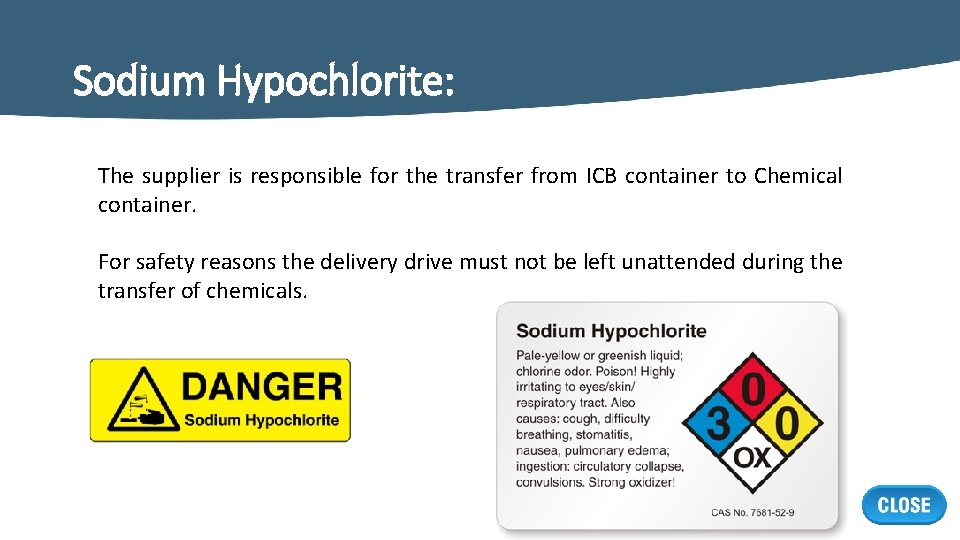
Sodium Hypochlorite: The supplier is responsible for the transfer from ICB container to Chemical container. For safety reasons the delivery drive must not be left unattended during the transfer of chemicals.
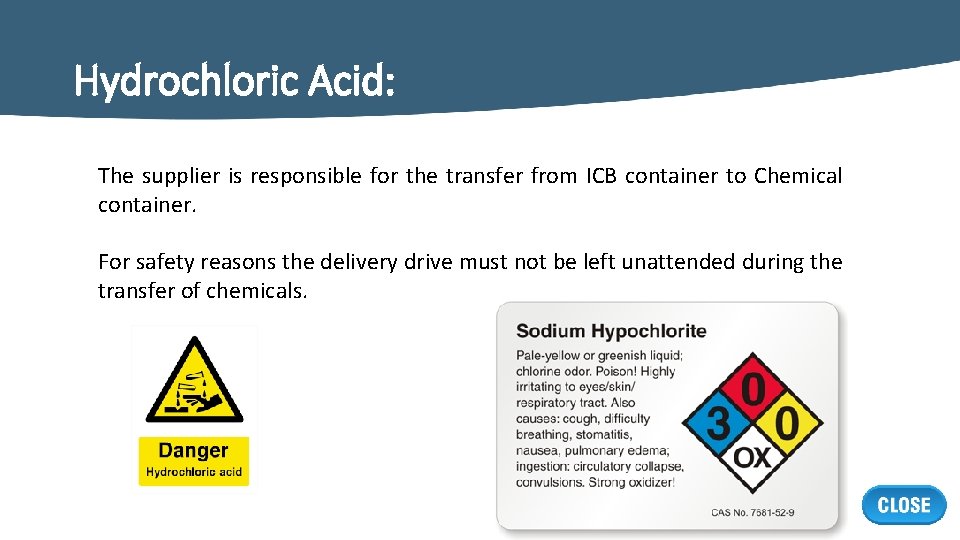
Hydrochloric Acid: The supplier is responsible for the transfer from ICB container to Chemical container. For safety reasons the delivery drive must not be left unattended during the transfer of chemicals.
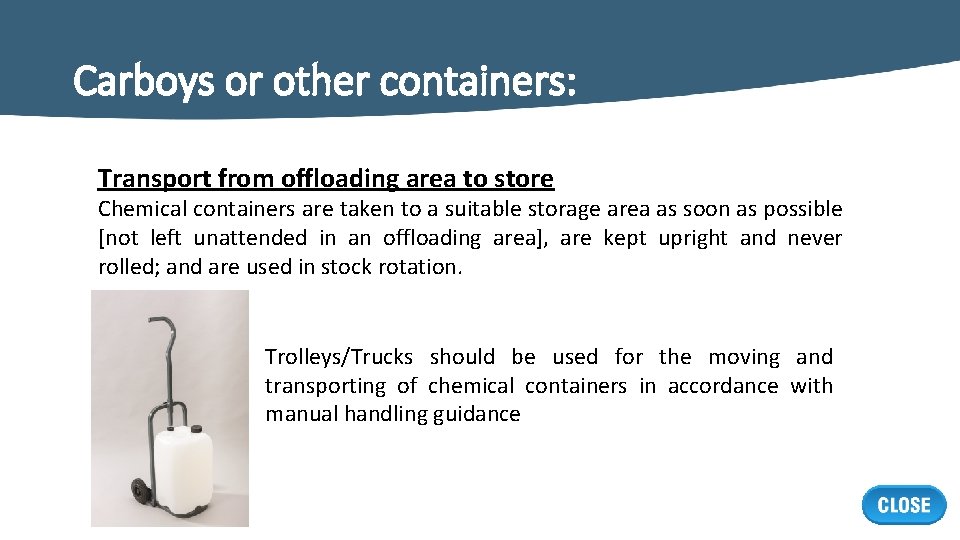
Carboys or other containers: Transport from offloading area to store Chemical containers are taken to a suitable storage area as soon as possible [not left unattended in an offloading area], are kept upright and never rolled; and are used in stock rotation. Trolleys/Trucks should be used for the moving and transporting of chemical containers in accordance with manual handling guidance
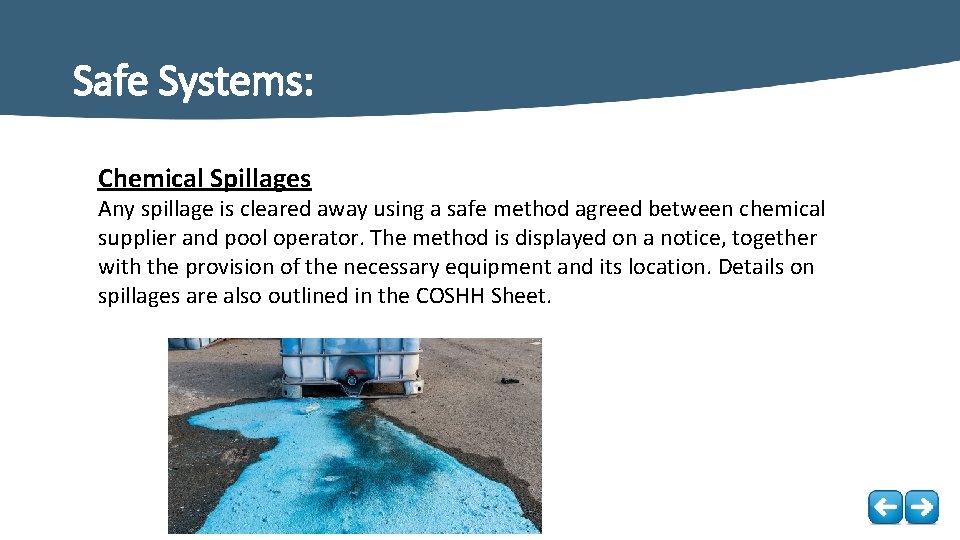
Safe Systems: Chemical Spillages Any spillage is cleared away using a safe method agreed between chemical supplier and pool operator. The method is displayed on a notice, together with the provision of the necessary equipment and its location. Details on spillages are also outlined in the COSHH Sheet.
Safe Systems: Leaks in the Piping or discharge hose Close the primary valve at the base of the storage tank. In leaks in piping or hoses, closing a valve between the leak and the source of the material (tank) will minimise the loss. Small Spillages If the spillage is under 45 litres, diluted with large quantities of water and then if local regulations allow, run to drain with copious amounts of water. Otherwise, absorb and dispose of as per regulations.
Safe Systems: Large Spillages If the spillage is over 45 litres, immediately evacuate the area; remove sources of ignition; provide maximum ventilation by opening Emergency Exit doors if safe to access. If the risk to people or environment is considerable, call the emergency services. Only personnel with proper respiratory and eye/skin protection should be permitted in the area. Dam and absorb spillages with dry sand, soil or other inert material. Do not use combustible adsorbents such as sawdust.
Safe Systems: Then collect the absorbed material in containers, seal securely (with a vent) and deliver for disposal according to local regulations. Containers with collected absorbed material must be properly labelled with correct contents and hazard symbol. Wash spillage site well with water and detergent; be aware of the potential for surfaces to become slippery. Continue to ventilate the site of the spillage. Spillages or uncontrolled discharges into watercourse, drains or sewers must be notified immediately to Environmental Health and the Rivers Agency or other appropriate regulatory body.
Safe Systems: Chemical Dosing Chemical dosing system monitors and automatic controls are interlinked with the circulation pumps and the circulation of water through the system, so that dosing stops if there is pump failure or significant loss of pumping rate. These systems are designed to always fail to safety and require manual restart when circulation is restored.
Safe Systems: Chemical Dosing Manual dosing of the pool is not permitted unless carried out by the Maintenance Technician and the pool is empty of bathers. Once the appropriate time has elapsed to ensure adequate circulation a water test should be performed prior to permitting bathers back into the pool. Manual dosing must never be undertaken on the poolside for safety reasons. Chemicals are added to water and never the other way round when preparing solutions. Non-liquid chemicals are kept dry until dissolved in water. All incidents of manual dosing must be recorded.
Heating & Ventilation: Be. MS The Building Energy Management System monitors and controls services such as heating, ventilation and air-conditioning, to ensure the building operates at maximum levels of efficiency thus removing wasted energy usage and associated costs. The optimal level of efficiency is achieved by continuously maintaining the correct balance between operating requirements, external and internal environmental conditions, and energy usage. Access to this system is restricted to the Maintenance Technician Team and Management Team.
Heating & Ventilation: Pool Hall Air The pool hall air temperatures are maintained at no more than 1 deg C above or below that of the water temperature. Air temperatures over 30°C are not acceptable. If air temperature rises to 31°C or above measures should be implemented to lower. Relative humidity is maintained at a level of 60% (no less than 50%, no more than 70%) throughout the pool hall area. Ventilation systems are designed and operated to provide a level of fresh air for each occupant of the pool hall (bathers, staff and spectators).
Heating & Ventilation: Temperature targets Main Pool – 29 o. C Learner Pool – 30 o. C Leisure Pool – 30 o. C Spa Pool – 35 o. C to 38 o. C
Faecal contamination Emergency Procedures: Pool water contamination Pool surround contamination Unsatisfactory Water Test Water Clarity problems
Faecal Contamination: If the pool is contaminated with faeces, action must be taken quickly in order to prevent any possible illness in users. This is particularly important with diarrhoea, which may contain the chlorine-resistant organism Cryptosporidium (‘Crypto’). If faecal contamination has only been reported, and there is some doubt about the accuracy of the report, its presence should be confirmed by pool staff. If it cannot be confirmed, the Manager must assess the risk and decide if the risk of harmful contamination is low and as such allow bathing to continue (as long as p. H and disinfection are within normal limits) All faeces contain potentially harmful microorganisms. The actual risk to pool users depends on whether the faeces are solid or runny.
Faecal Contamination: Solid faeces are relatively easy to deal with. It is unlikely that the perpetrator is suffering from an acute gastrointestinal illness. The microorganisms in it are relatively contained. 1. The stools should immediately be removed from the pool using a scoop or fine mesh net and flushed down the toilet (not put in any pool drains). 2. There must be certainty that all the faeces have been captured and disposed of. If not, and there is possible widespread distribution of the faeces in the pool, then the pool should be closed and the advice below for runny faeces considered.
Faecal Contamination: 3. All equipment that has been used in this process should be disinfected using a 1% solution of hypochlorite. 4. If the pool is operating properly with appropriate disinfectant residuals and p. H values, no further action is necessary. 5. Depending on the extent of the contamination, and how quickly it can be dealt with, clearing the pool of bathers for, up to 30 minutes while steps 14 are undertaken may be an option. Closing for a period of time is certainly necessary if the faeces has broken up. Bathing should not resume until all the faeces have been removed.
Faecal Contamination: Runny faeces If the stool is watery, runny or soft (something like diarrhoea), the risk of infection is greater: the perpetrator is more likely to be carrying enteric pathogens, and if so they are likely to be spread through the pool water. Most bacteria and viruses that cause diarrhoea – Ecoli, Shigella, norovirus, for example – are killed within minutes in a satisfactorily disinfected pool water. However, if the diarrhoea contains oocysts of the chlorine-resistant protozoa Cryptosporidium, normal levels of chlorine will not be effective. Crypto is a significant cause of relatively serious gastroenteritis, particularly in pools. Young children are both the likeliest sources of the infection, and those worst affected (along with the immunocompromised).
Faecal Contamination: As you will not know if Crypto is involved, the safest option is to assume that it is and immediately close the pool. The main emphasis is on filtration, which if effective should remove some 99% of the Cryptosporidium oocysts in each pass of pool water through the filter. Coagulation is critical and should be continuous, and the residence time must be long enough for flocculation to happen 1. Close the pool – If people transfer to another pool, perhaps from the Leaner pool to the main pool, they should shower first using soap and water. 2. Maintain the free chlorine at the top of its recommended range up to 10 ppm if possible and the p. H value at the bottom of the set range (p. H 7. 0 - 7. 2). This will maintain the normal level of microbiological protection.
Faecal Contamination: 3. Ensure that the coagulant dose is correct 4. Filter for six turnover cycles. Monitor disinfection residuals throughout this period 5. Vacuum and sweep the pool. Cleaning equipment, including automatic cleaners, should be disinfected after use. This should remove any contamination off surfaces. 6. Make sure the pool treatment plant is operating as it should (filters, circulation, disinfection) 7. After six turnovers, backwash the filters.
Faecal Contamination: 9. Allow the filter media to settle by running water to drain for a few minutes before reconnecting the filter to the pool. 10. Circulation of the water for a period of up to 8 hours may need to be carried out. This will remove any remaining oocyst contamination of the pool and allow the filters to ripen. It is optional. 11. Check disinfection levels and p. H. If they are satisfactory, re-open the pool. 12. The Maintenance Technician may consider secondary disinfection such as super-chlorination; however, it can generate unwelcome by-products.
Pool Water Contamination: Blood If significant amounts of blood are spilled into the pool, it must be temporarily cleared of people, to allow the pollution to disperse and any infective particles to be neutralised by the residual disinfectant. When confirmed that disinfectant residuals and p. H values are within the recommended ranges only then can bathing resume.
Pool Water Contamination: Vomit In line with PWTAG guidelines (see Technical note on faecal contamination) vomiting will result in temporarily clearing the pool of people, scooping up vomit where possible and allowing the pollution to disperse and any infective particles to be neutralised by the residual disinfectant. The period of closure will depend on the amount of vomit. When confirmed that disinfectant residuals and p. H values are within the recommended ranges, only then can bathing resume.
Pool Water Contamination: Vomit However if there is severe vomiting into a pool (full contents of the stomach) the bather may be suffering from a gastrointestinal infection and if that is cryptosporidiosis, infective, chlorine- resistant Cryptosporidium oocysts will be present. In these circumstance the procedures for dealing with runny faeces may be the best option.
Pool Surround Contamination: Any blood or vomit spillage on the poolside is dealt with using Soak Up. The blood/vomit is covered with Soak Up & paper towels, and left for at least two minutes before it is cleared away. Then the area is then gently flooded with a disinfectant and washed down into pool side drainage (not the pool). All paper towels etc. should be disposed of using a yellow hazard bag and not put in general waste bins
Unsatisfactory Water Test: The pool is to be closed immediately if there is chemical or physical evidence of unsatisfactory disinfection e. g. very low/high free chlorine concentration. The pool will also be closed if microbiological testing indicates gross contamination, which means one of two things: • E. coli over 10 per 10 ml PLUS either colony count over 10 cfu per ml or Pseudomonas aeruginosa over 10 per 100 ml (or, of course, both) • Pseudomonas aeruginosa over 50 per 100 ml plus colony count over 100 per ml. The pool will only reopen once it has been confirm the water clarity and all tests results are of a satisfactory level.
Water Clarity: In the event that water clarity is of concern, the Maintenance Technician and/or Duty Manager will visually assess and determine if all bathers must leave the water until such times as water quality is restored.
SECTION COMPLETED You have now completed Pool Technical Operating Procedures [Section A] and are ready to take the assessment. Click on the forward arrow link to move forward to the assessment page or if you feel you need review any of the information again please click on the back-arrow link
Click here to start ASSESSMENT POOL TECHNICAL OPERATING PROCEDURES [ SECTION A ]