
SOUTH LAKE LEISURE CENTRE EMERGENCY ACTION PLAN Introduction

- Slides: 71
SOUTH LAKE LEISURE CENTRE EMERGENCY ACTION PLAN
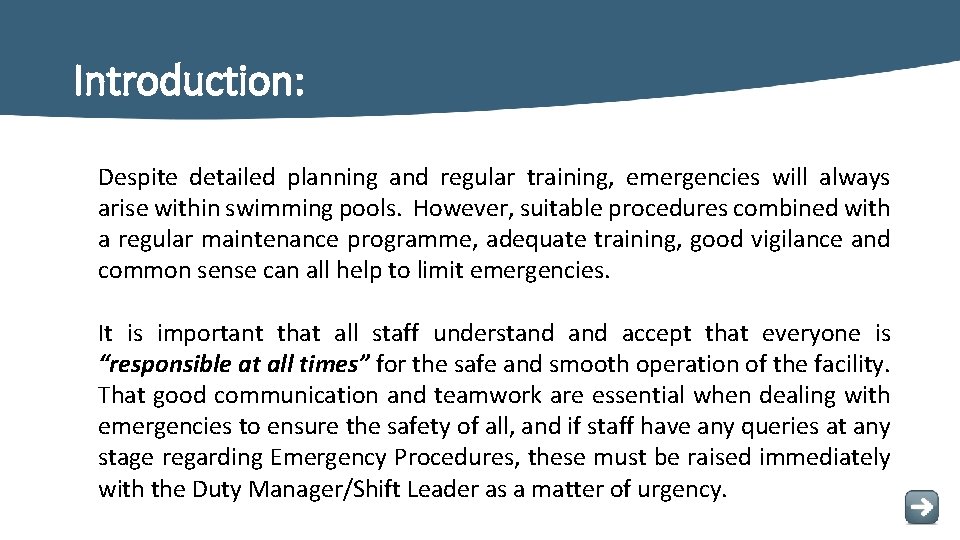
Introduction: Despite detailed planning and regular training, emergencies will always arise within swimming pools. However, suitable procedures combined with a regular maintenance programme, adequate training, good vigilance and common sense can all help to limit emergencies. It is important that all staff understand accept that everyone is “responsible at all times” for the safe and smooth operation of the facility. That good communication and teamwork are essential when dealing with emergencies to ensure the safety of all, and if staff have any queries at any stage regarding Emergency Procedures, these must be raised immediately with the Duty Manager/Shift Leader as a matter of urgency.
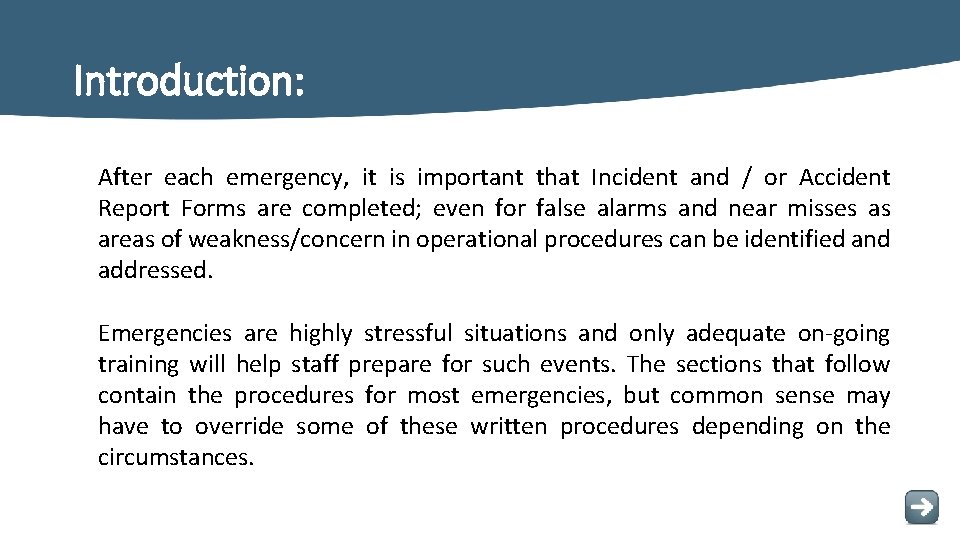
Introduction: After each emergency, it is important that Incident and / or Accident Report Forms are completed; even for false alarms and near misses as areas of weakness/concern in operational procedures can be identified and addressed. Emergencies are highly stressful situations and only adequate on-going training will help staff prepare for such events. The sections that follow contain the procedures for most emergencies, but common sense may have to override some of these written procedures depending on the circumstances.
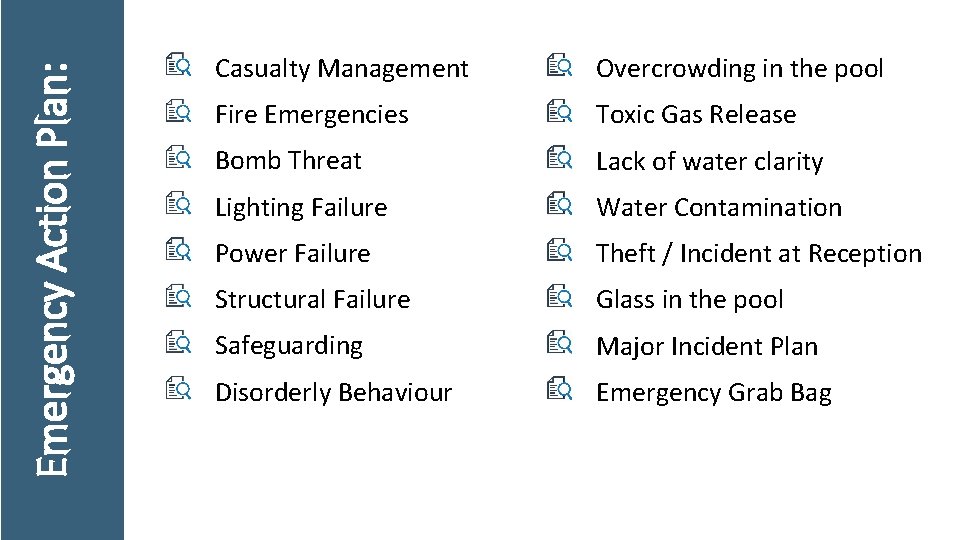
Emergency Action Plan: Casualty Management Overcrowding in the pool Fire Emergencies Toxic Gas Release Bomb Threat Lack of water clarity Lighting Failure Water Contamination Power Failure Theft / Incident at Reception Structural Failure Glass in the pool Safeguarding Major Incident Plan Disorderly Behaviour Emergency Grab Bag
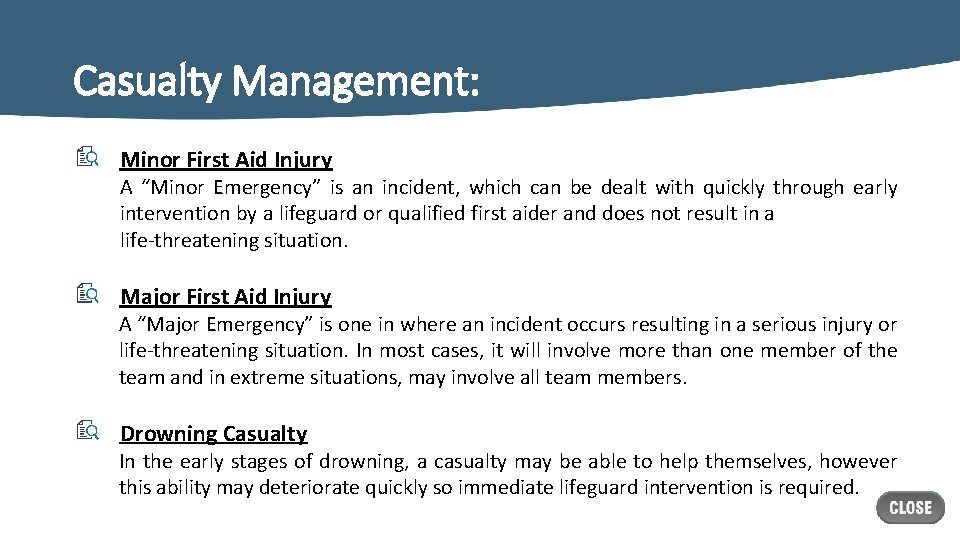
Casualty Management: Minor First Aid Injury A “Minor Emergency” is an incident, which can be dealt with quickly through early intervention by a lifeguard or qualified first aider and does not result in a life-threatening situation. Major First Aid Injury A “Major Emergency” is one in where an incident occurs resulting in a serious injury or life-threatening situation. In most cases, it will involve more than one member of the team and in extreme situations, may involve all team members. Drowning Casualty In the early stages of drowning, a casualty may be able to help themselves, however this ability may deteriorate quickly so immediate lifeguard intervention is required.
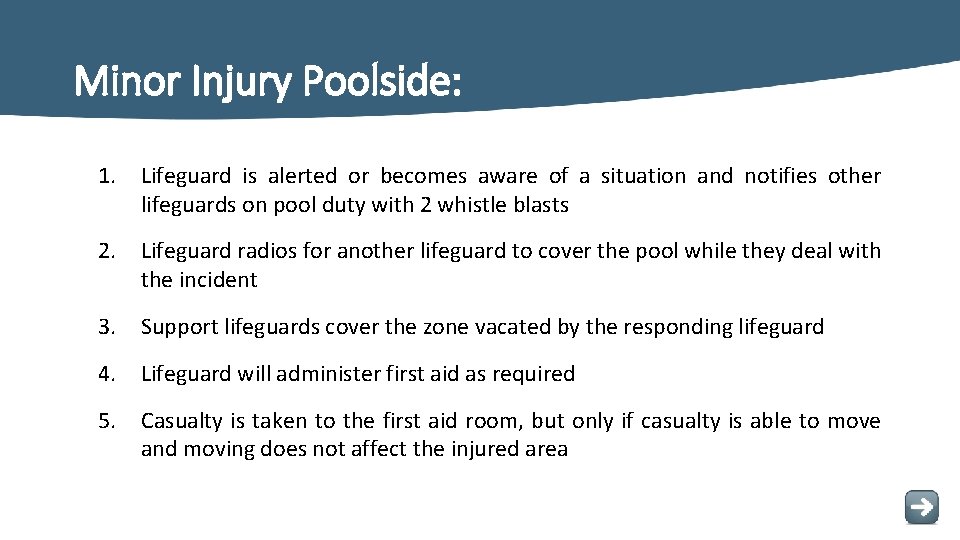
Minor Injury Poolside: 1. Lifeguard is alerted or becomes aware of a situation and notifies other lifeguards on pool duty with 2 whistle blasts 2. Lifeguard radios for another lifeguard to cover the pool while they deal with the incident 3. Support lifeguards cover the zone vacated by the responding lifeguard 4. Lifeguard will administer first aid as required 5. Casualty is taken to the first aid room, but only if casualty is able to move and moving does not affect the injured area
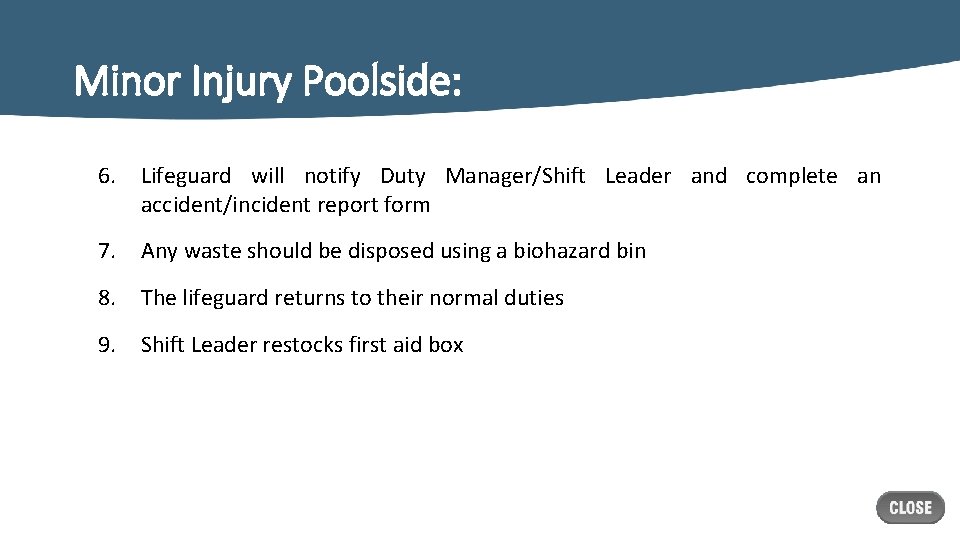
Minor Injury Poolside: 6. Lifeguard will notify Duty Manager/Shift Leader and complete an accident/incident report form 7. Any waste should be disposed using a biohazard bin 8. The lifeguard returns to their normal duties 9. Shift Leader restocks first aid box
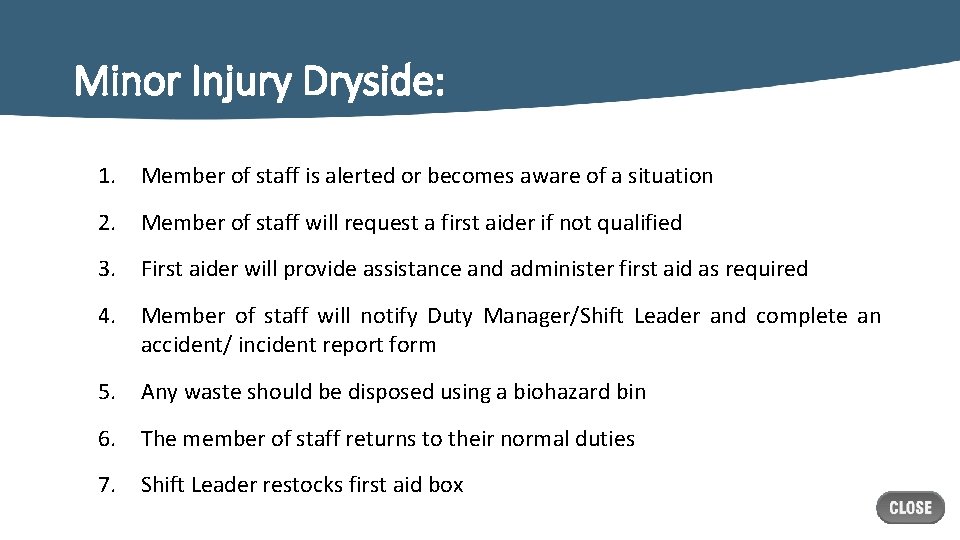
Minor Injury Dryside: 1. Member of staff is alerted or becomes aware of a situation 2. Member of staff will request a first aider if not qualified 3. First aider will provide assistance and administer first aid as required 4. Member of staff will notify Duty Manager/Shift Leader and complete an accident/ incident report form 5. Any waste should be disposed using a biohazard bin 6. The member of staff returns to their normal duties 7. Shift Leader restocks first aid box
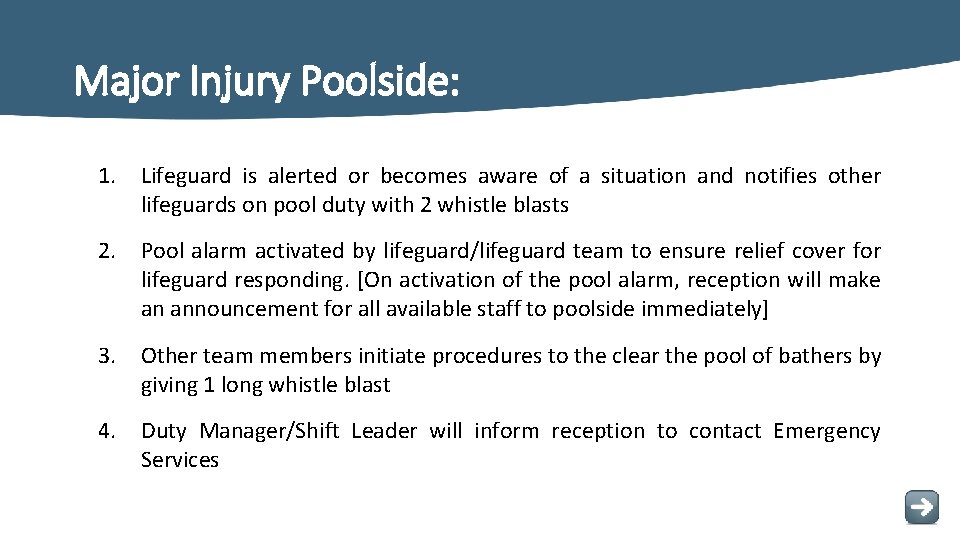
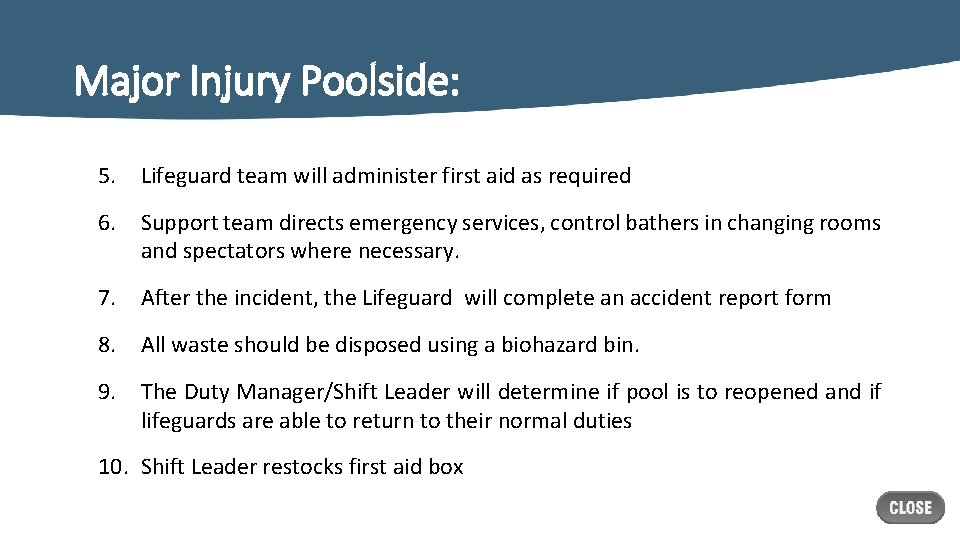
Major Injury Poolside: 1. Lifeguard is alerted or becomes aware of a situation and notifies other lifeguards on pool duty with 2 whistle blasts 2. Pool alarm activated by lifeguard/lifeguard team to ensure relief cover for lifeguard responding. [On activation of the pool alarm, reception will make an announcement for all available staff to poolside immediately] 3. Other team members initiate procedures to the clear the pool of bathers by giving 1 long whistle blast 4. Duty Manager/Shift Leader will inform reception to contact Emergency Services
Major Injury Poolside: 5. Lifeguard team will administer first aid as required 6. Support team directs emergency services, control bathers in changing rooms and spectators where necessary. 7. After the incident, the Lifeguard will complete an accident report form 8. All waste should be disposed using a biohazard bin. 9. The Duty Manager/Shift Leader will determine if pool is to reopened and if lifeguards are able to return to their normal duties 10. Shift Leader restocks first aid box
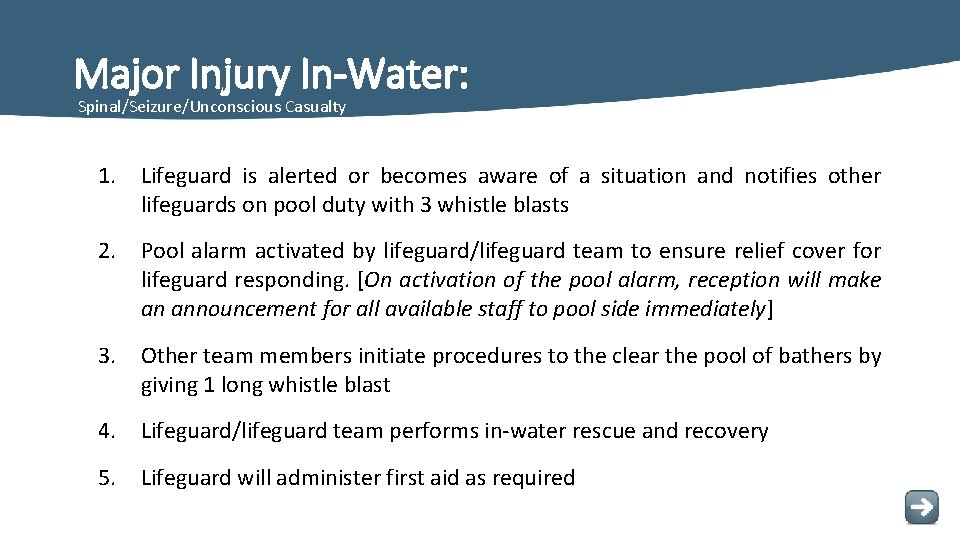
Major Injury In-Water: Spinal/Seizure/Unconscious Casualty 1. Lifeguard is alerted or becomes aware of a situation and notifies other lifeguards on pool duty with 3 whistle blasts 2. Pool alarm activated by lifeguard/lifeguard team to ensure relief cover for lifeguard responding. [On activation of the pool alarm, reception will make an announcement for all available staff to pool side immediately] 3. Other team members initiate procedures to the clear the pool of bathers by giving 1 long whistle blast 4. Lifeguard/lifeguard team performs in-water rescue and recovery 5. Lifeguard will administer first aid as required
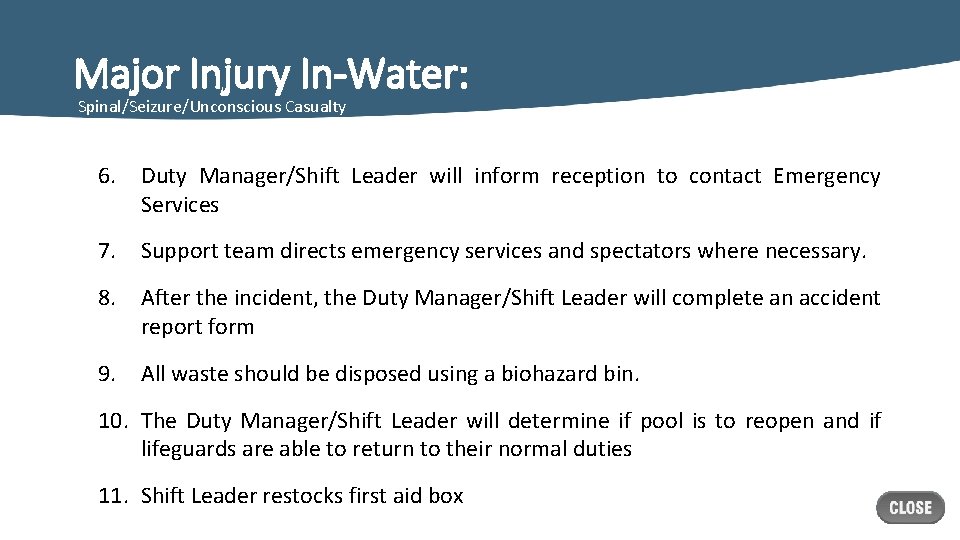
Major Injury In-Water: Spinal/Seizure/Unconscious Casualty 6. Duty Manager/Shift Leader will inform reception to contact Emergency Services 7. Support team directs emergency services and spectators where necessary. 8. After the incident, the Duty Manager/Shift Leader will complete an accident report form 9. All waste should be disposed using a biohazard bin. 10. The Duty Manager/Shift Leader will determine if pool is to reopen and if lifeguards are able to return to their normal duties 11. Shift Leader restocks first aid box
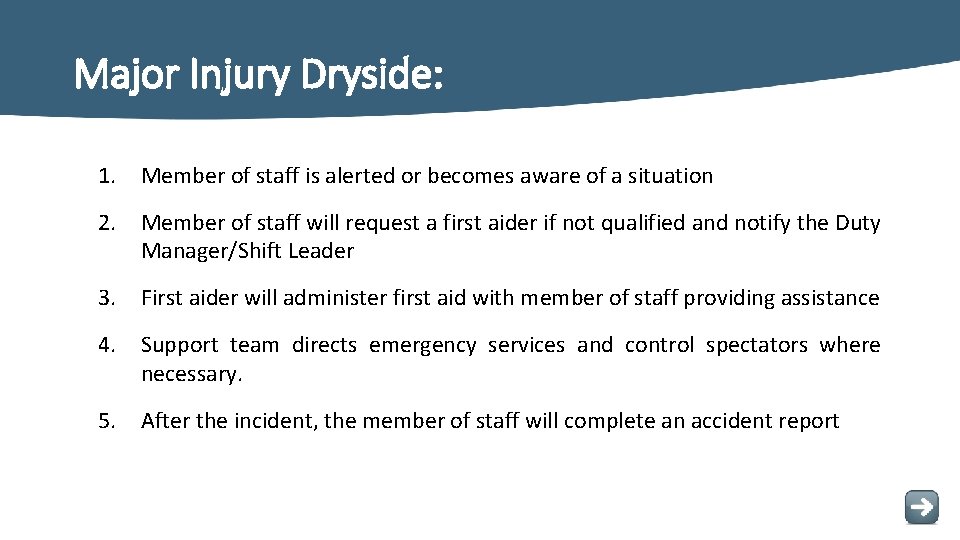
Major Injury Dryside: 1. Member of staff is alerted or becomes aware of a situation 2. Member of staff will request a first aider if not qualified and notify the Duty Manager/Shift Leader 3. First aider will administer first aid with member of staff providing assistance 4. Support team directs emergency services and control spectators where necessary. 5. After the incident, the member of staff will complete an accident report
Major Injury Dryside: 6. Any waste is put in a yellow biohazard waste bag and disposed of in biohazard bin. 7. The Duty Manager/Shift Leader will determine if members of staff involved in incident are able to return to their normal duties 8. Shift Leader restocks first aid box
Poolside Rescue: Reaching and throwing rescues are extremely effective where a casualty is within easy reaching distance 1. Lifeguard is alerted or becomes aware of a situation and notifies other lifeguards on pool duty with 3 whistle blasts 2. Pool alarm activated by lifeguard/lifeguard team to ensure relief cover for lifeguard responding. [On activation of the pool alarm, reception will make an announcement for all available staff to pool side immediately] 3. Other lifeguards cover the zone vacated by the responding lifeguard 4. Lifeguard performs poolside rescue
Poolside Rescue: 5. Lifeguard will administer first aid or provide assistance if required 6. Lifeguard refers casualty to appropriate location, i. e. shallow end, changing room, etc. 7. Lifeguard will notify Duty Manager/Shift Leader and complete an incident report form 8. The lifeguard returns to their normal duties
In-Water Rescue: An in-water rescue may sometimes be the quickest way to rescue and support a casualty. 1. Lifeguard is alerted or becomes aware of a situation and notifies other lifeguards on pool duty with 3 whistle blasts 2. Pool alarm activated by lifeguard/lifeguard team to ensure relief cover for lifeguard responding. [On activation of the pool alarm, reception will make an announcement for all available staff to pool side immediately] 3. Other lifeguards cover the zone vacated by the responding lifeguard. 4. Lifeguard performs in-water rescue
In-Water Rescue: 5. Lifeguard will administer first aid and provide assistance if required 6. Duty Manager/Shift Leader may need to inform reception to contact Emergency Services 7. Lifeguard refers casualty to appropriate location, i. e. shallow end, changing room, etc. 8. After the incident, the Duty Manager/Shift Leader will complete an accident report form 9. The lifeguard changes uniform and returns to their normal duties
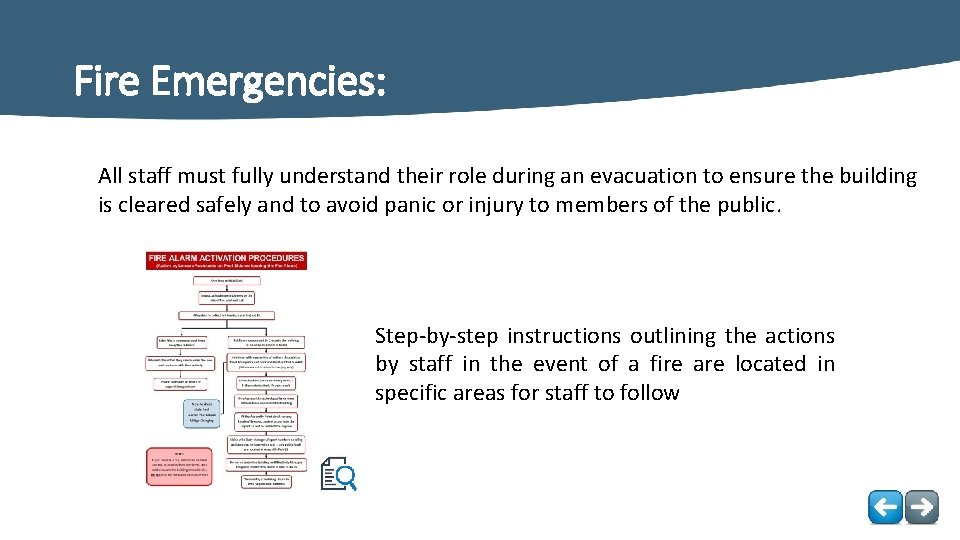
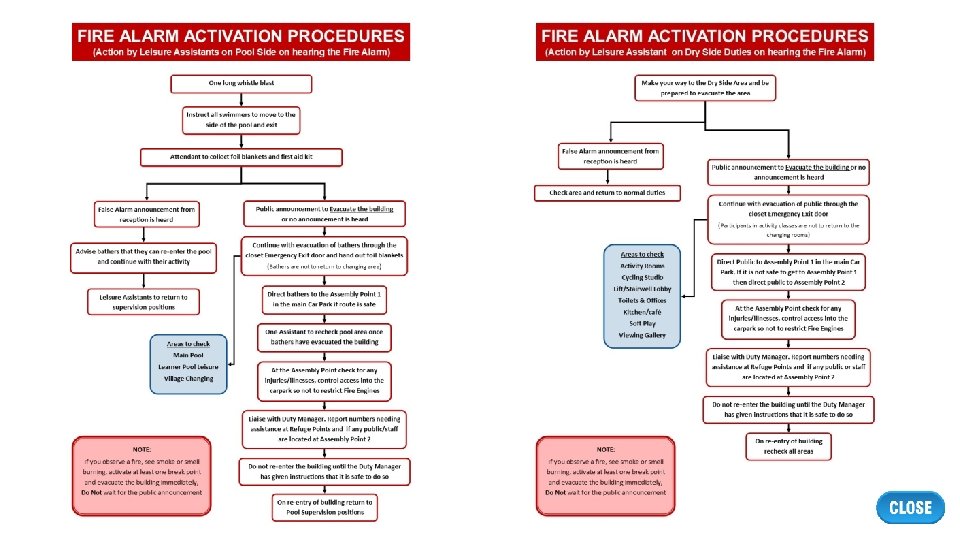
Fire Emergencies: All staff must fully understand their role during an evacuation to ensure the building is cleared safely and to avoid panic or injury to members of the public. Step-by-step instructions outlining the actions by staff in the event of a fire are located in specific areas for staff to follow
Discovery of a Fire: 1. Sound the fire alarm at the nearest break glass point 2. Do not attempt emergency firefighting unless you have received training, the fire is small in nature (paper bin size) and it does not impede your mean of escape 3. Direct public away from the fire towards the nearest emergency exit and to the assembly point 4. Once other areas of the building have been searched to ensure that everyone has evacuated the building, use nearest emergency exit and go to the assembly point 4. Do not allow anyone back into the building until the Duty Manager has given the “all clear” 5. Under no circumstances should you take unnecessary personal risks.
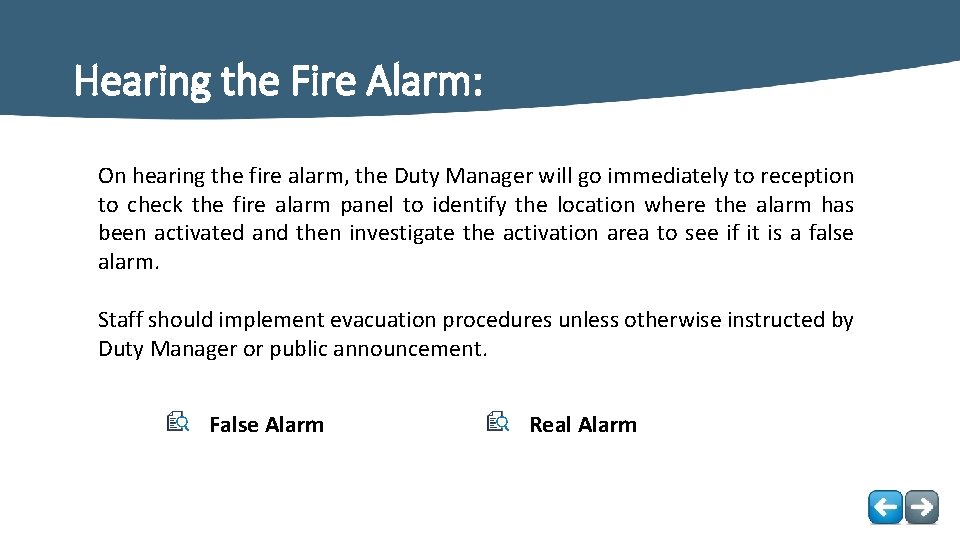
Hearing the Fire Alarm: On hearing the fire alarm, the Duty Manager will go immediately to reception to check the fire alarm panel to identify the location where the alarm has been activated and then investigate the activation area to see if it is a false alarm. Staff should implement evacuation procedures unless otherwise instructed by Duty Manager or public announcement. False Alarm Real Alarm
Hearing the Fire Alarm: False Alarm In the event of a false alarm, the Duty Manager will rest the alarm panel, recheck the activation point and replace any break glass. The Customer Advisor will make a public announcement “This is a public announcement. Please continue with your activity at this time, this has been a false alarm” If the fire alarm re activates shortly after resetting, further investigation by the Duty Manager will need to be carried out to establish the cause.
Hearing the Fire Alarm: Real Alarm In the event of a genuine alarm, the Duty Manager will instruct the Customer Advisor to make a public announcement for building evacuation “This is a public announcement. Will all members of the public evacuate the building using the nearest Emergency Exit immediately ” All staff will continue with the evacuation of public to the designated assembly point
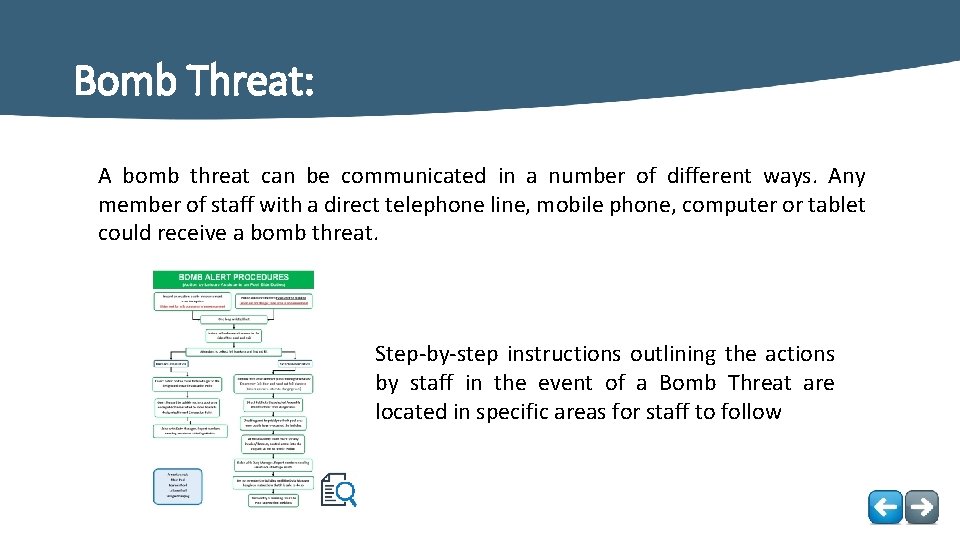
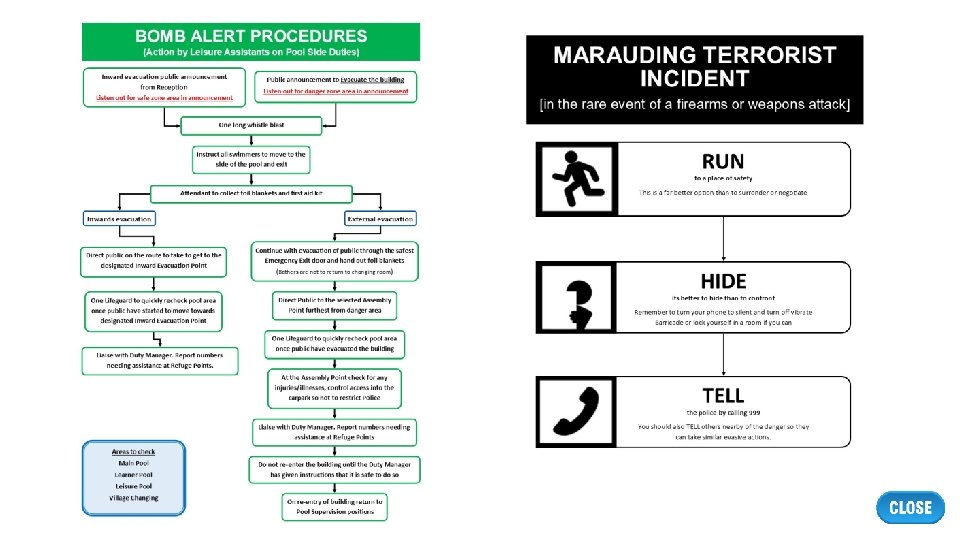
Bomb Threat: A bomb threat can be communicated in a number of different ways. Any member of staff with a direct telephone line, mobile phone, computer or tablet could receive a bomb threat. Step-by-step instructions outlining the actions by staff in the event of a Bomb Threat are located in specific areas for staff to follow
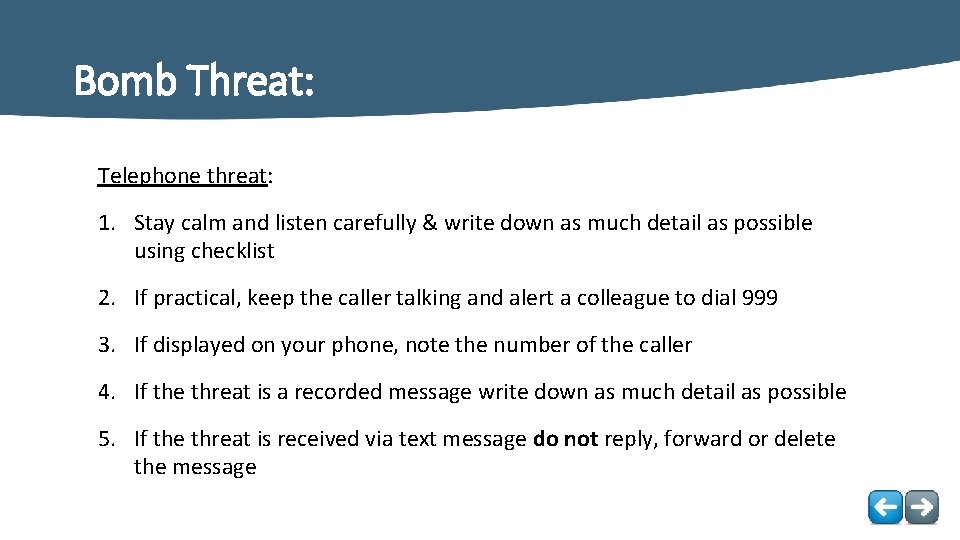
Bomb Threat: Telephone threat: 1. Stay calm and listen carefully & write down as much detail as possible using checklist 2. If practical, keep the caller talking and alert a colleague to dial 999 3. If displayed on your phone, note the number of the caller 4. If the threat is a recorded message write down as much detail as possible 5. If the threat is received via text message do not reply, forward or delete the message
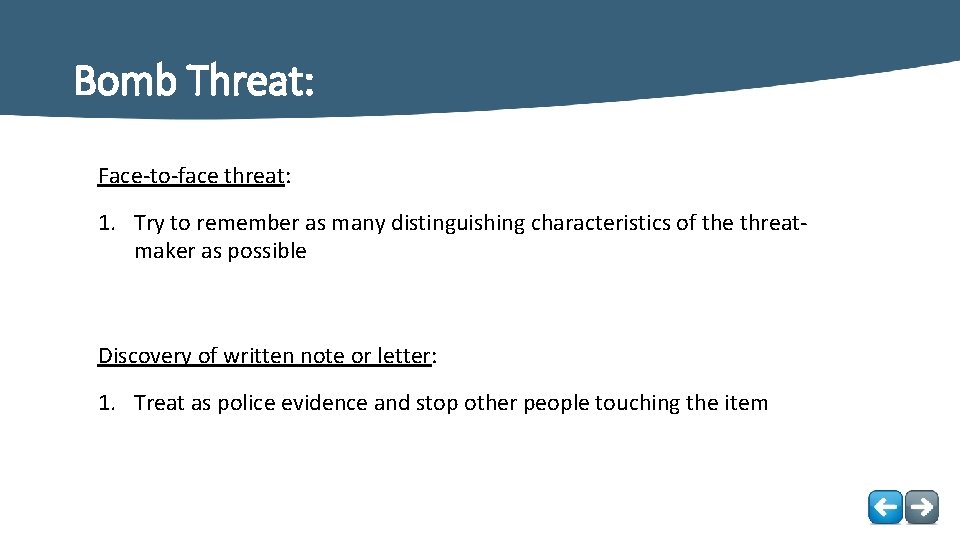
Bomb Threat: Face-to-face threat: 1. Try to remember as many distinguishing characteristics of the threatmaker as possible Discovery of written note or letter: 1. Treat as police evidence and stop other people touching the item
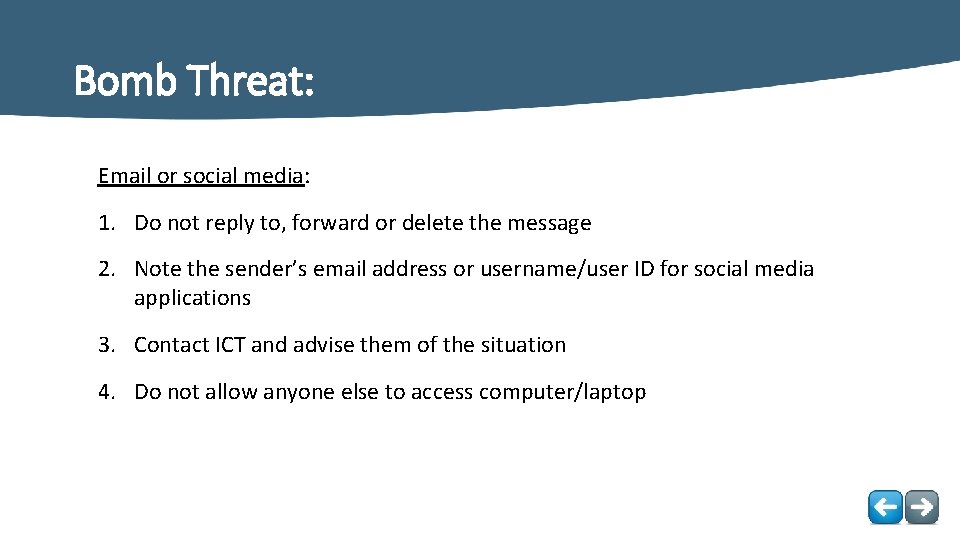
Bomb Threat: Email or social media: 1. Do not reply to, forward or delete the message 2. Note the sender’s email address or username/user ID for social media applications 3. Contact ICT and advise them of the situation 4. Do not allow anyone else to access computer/laptop
Bomb Threat: Postal threat or suspicious object: 1. evacuate the immediate area 2. treat as police evidence and stop other people touching or going near the item Staff should understand the actions required of them, 1. The Customer Advisors will immediately inform the Duty Manager. There will be no more admissions to the building until the emergency is over 2. The Duty Manager will inform the police (unless the original call was from the police) and will take advice from them
Bomb Threat: 3. If necessary, the building should be evacuated as per evacuation procedure 4. Staff will clear the building and direct customers to the designated assembly point 5. Only when the emergency services have declared the area safe will the building reopen for normal duties to resume
Lighting Failure: In the event of a lighting failure, the emergency lighting system will be automatically activated. The Duty Manager should advise Customer Advisers to stop further admissions and then investigate the cause of the problem by checking trip switches. During daylight hours, evacuation may not be necessary if there is adequate natural light. The Duty Manager will make a decision on whether each area of the building can remain open, if extra staff are needed in particular areas or whether the building should be evacuated. However, if at any time the ability to safely see all bathers or the bottom of the pool is in question, then the pool must be cleared immediately
Lighting Failure: If there is not enough natural light or the problem cannot be resolved within 30 minutes, the Duty Manager will make the decision that the specific area/building is to close, and everyone should leave. The emergency lighting will be sufficient to allow bathers time to get dressed and leave safely. Small children may be particularly frightened and people with mobility or sight impairments should always be offered extra help and support.
Power Failure: In the event of a power failure throughout the building, the emergency lighting system will be automatically activated. The emergency lighting will remain illuminated for up to 3 hours allowing enough time to evacuate the building safely. The building must remain closed to the public until the power has returned. § Customer Advisor will stop further admissions § The Duty Manager to ascertain the possible duration of the failure and determine if areas of the building are to be evacuated are the building should be evacuated.
Power Failure: § Duty Manager will The Duty Manager will decide if credit is to be given to customers when leaving § The Duty Manager will stay in the building until power has been restored in order to manage the plant room § It may be necessary to use mobile phones in the case of an emergency, as normal phone lines will not function
Structural Failure: Should a structural failure occur, or the facility structure becomes unsafe as to render it dangerous for use by the public, the following procedures should be adopted: § The public should be moved immediately from the affected area to a safer location § Prevent public or staff accessing the area § Request attendance by Duty Manager § If instructed by Duty Manager evacuate the building as per fire evacuation procedures § Once the area/building has been cleared and secured the Duty Manager should contact the relevant departments/personnel [Health & Safety Officer, General Manager, Maintenance Department, Building Control]
Safeguarding: MISSING CHILD In the event of a child going missing and a member of staff is alerted to the problem, 1. Raise the alarm by informing the Duty Manager/Shift Leader immediately 2. The Duty Manager/Shift Leader will direct reception to… a) put out an announcement for all available staff to come to reception b) stop further admissions c) make an announcement for the child to make themselves known to a member of staff
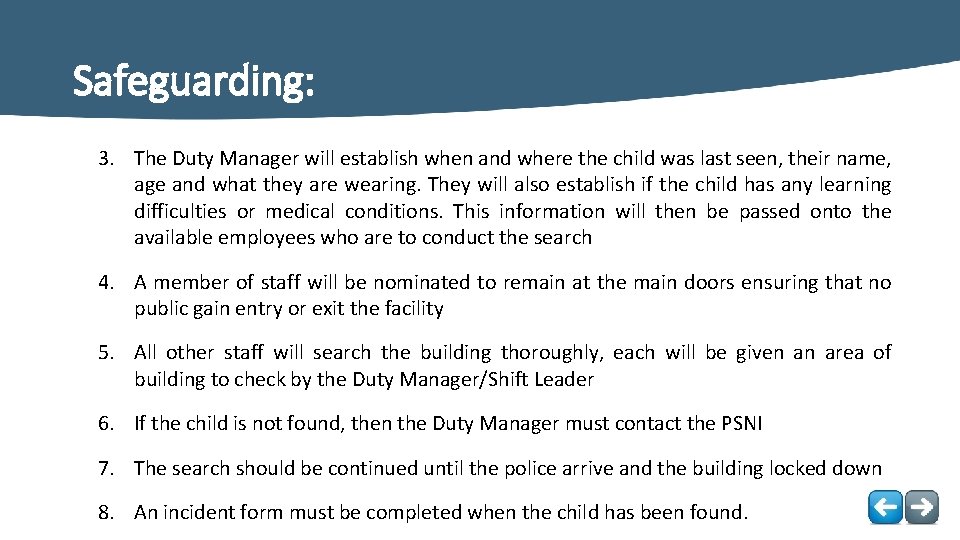
Safeguarding: 3. The Duty Manager will establish when and where the child was last seen, their name, age and what they are wearing. They will also establish if the child has any learning difficulties or medical conditions. This information will then be passed onto the available employees who are to conduct the search 4. A member of staff will be nominated to remain at the main doors ensuring that no public gain entry or exit the facility 5. All other staff will search the building thoroughly, each will be given an area of building to check by the Duty Manager/Shift Leader 6. If the child is not found, then the Duty Manager must contact the PSNI 7. The search should be continued until the police arrive and the building locked down 8. An incident form must be completed when the child has been found.
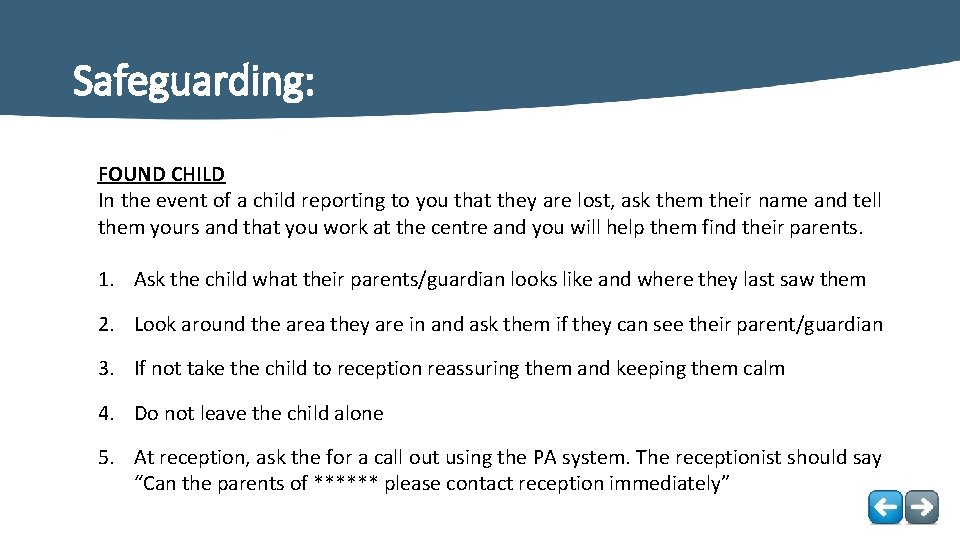
Safeguarding: FOUND CHILD In the event of a child reporting to you that they are lost, ask them their name and tell them yours and that you work at the centre and you will help them find their parents. 1. Ask the child what their parents/guardian looks like and where they last saw them 2. Look around the area they are in and ask them if they can see their parent/guardian 3. If not take the child to reception reassuring them and keeping them calm 4. Do not leave the child alone 5. At reception, ask the for a call out using the PA system. The receptionist should say “Can the parents of ****** please contact reception immediately”
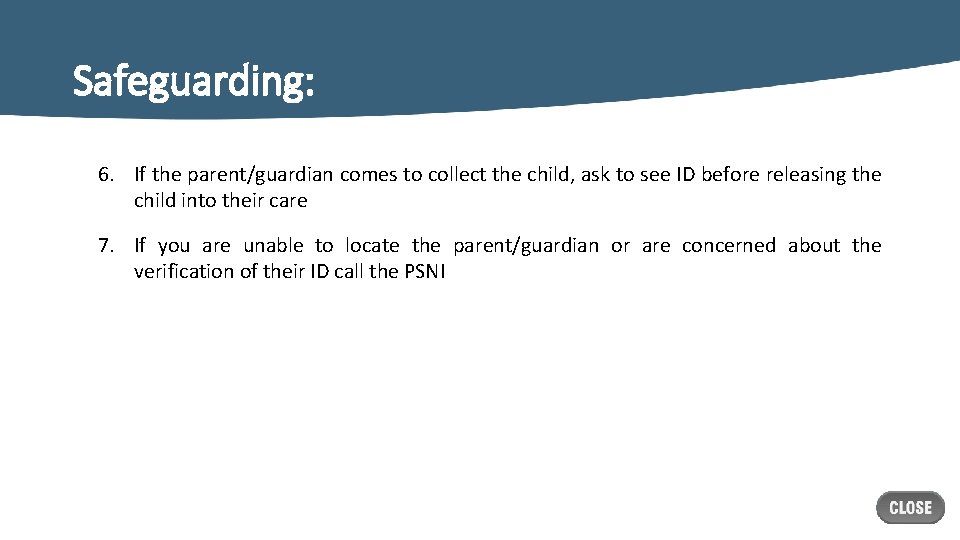
Safeguarding: 6. If the parent/guardian comes to collect the child, ask to see ID before releasing the child into their care 7. If you are unable to locate the parent/guardian or are concerned about the verification of their ID call the PSNI
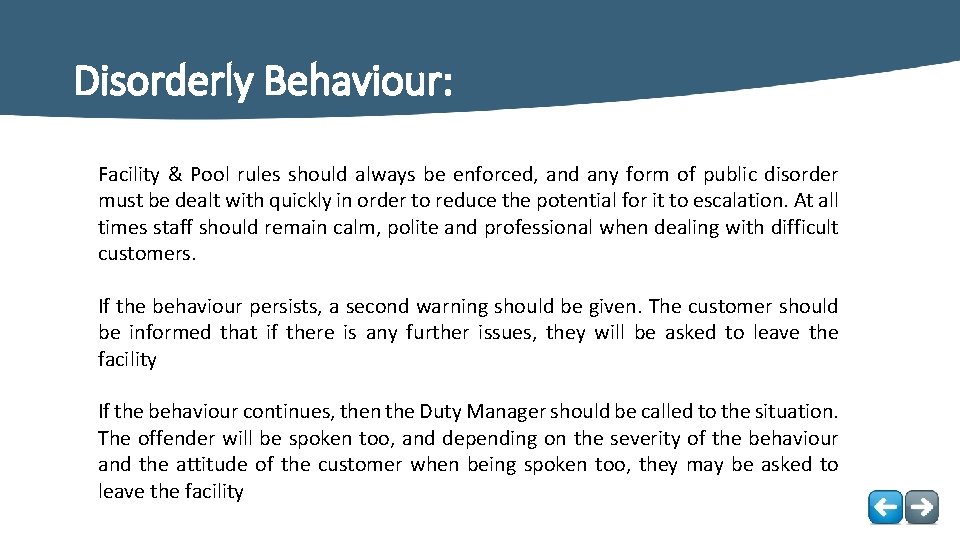
Disorderly Behaviour: Facility & Pool rules should always be enforced, and any form of public disorder must be dealt with quickly in order to reduce the potential for it to escalation. At all times staff should remain calm, polite and professional when dealing with difficult customers. If the behaviour persists, a second warning should be given. The customer should be informed that if there is any further issues, they will be asked to leave the facility If the behaviour continues, then the Duty Manager should be called to the situation. The offender will be spoken too, and depending on the severity of the behaviour and the attitude of the customer when being spoken too, they may be asked to leave the facility
Disorderly Behaviour: If the customer has been asked to leave, their behaviour is to be monitored until they have left the building. Continuation of the offence or refusal to leave could result in the PSNI being contacted. Any dangerous behaviour; or behaviour that is likely to cause harm to other users of the facility should be immediately stopped. In the event of physical violence, staff members must not become involved. The Duty Manager must be called immediately, who will in turn contact the PSNI. Staff should not compromise their own safety, position or other member of the public.
Overcrowding: Overcrowding should not readily occur; staff on pool duty are responsible for the constant monitoring of bather's numbers in the pool and communicating with Duty Manager/Shift Leader when bather loads reach 75% maximum bather load capacity. However, even with restriction on ticket sales, the movement of customers through the changing areas and from other areas such as the Health & Beauty Suite or Gym make it possible that overcrowding can occur. If a pool becomes overcrowded, the staff on pool duty should assess bather numbers in other pools to see whether young or non-swimmers can be asked to move from the main pool to the learner pool or if older or stronger swimmers can be asked to go into the main pool until numbers have reduced.
Overcrowding: The Duty Manager/Shift Leader should deploy additional lifeguards to assist pool supervision until bather numbers drop below the 75% maximum bather load capacity. The Duty Manager will inform reception when ticket sales may resume.
Toxic Gas: The emission of toxic gas would most likely come from the incorrect mixing of two chemicals. In the event of an emission of toxic gasses, the immediate area should be evacuated immediately, closing doors if possible, to prevent the gases escaping to other occupied areas. The Duty Manager should determine if the building should be cleared and the emergency services contacted. If evacuating, escape routes and emergency exits should be used which lead customers away from the danger area. No one must re-enter the building until advised by the emergency services that it is safe to do so
Toxic Gas: CHLORINE GAS Although chlorine gas is not stored on site in gas cylinders, the accidental manufacture of Chlorine gas is possible. If an accidental release of Chlorine gas occurs the building should be cleared per the evacuation procedures for fire and the emergency services contacted highlighting the high risk. Due to wind direction, one or both assembly points may not be usable; the Duty Manager should make a dynamic risk assessment and determine an alternative assembly point. To limit the risk of accidental manufacture of Chlorine gas only staff trained in pool plant operations should be permitted access to the Plant Room unsupervised
Toxic Gas: If a contractor requires access to the area, a trained pool plant member of staff must accompany them. The correct PPE must be worn in this area at all times. Any person who has been gassed by chlorine should be taken to hospital immediately. The accident will be reportable to under RIDDOR. If the Chlorine Gas alarm is activated, staff should not enter the plant room and the Emergency Services should be informed immediately upon arrival to the scene if anyone may be in the plant room.
Lack of Water Clarity: In the event where lifeguards have concerns with regards their ability to see the pool floor due to the clarity of the water, the following procedure should be followed… 1. Lifeguard contacts the Duty Manager/Shift Leader immediately 2. The Duty Manager/Shift Leader will assess the situation and decide if the pool should be shut until remedial action is carried out or if additional lifeguards are required 3. A water test will be carried out and appropriate remedial action taken. 4. If immediate remedial action is not possible, the pool should be closed until the problem is resolved 5. Only when water clarity returns to normal and water test readings are within parameters will the pool reopen for normal use
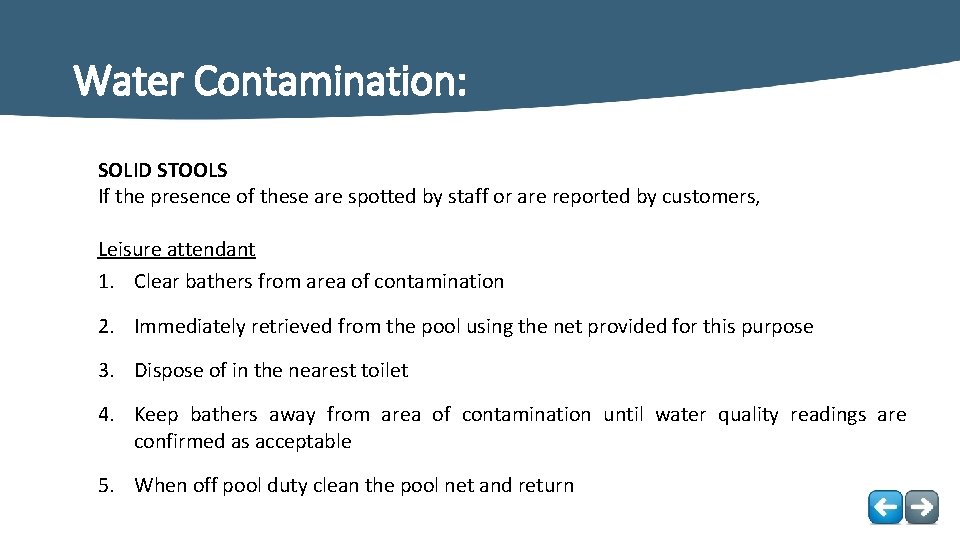
Water Contamination: If the pool is contaminated, quick action must be taken in order to prevent illness of users. This is especially important in the event of faecal contamination, as they can contain potential harmful microorganisms. Solid stools Diarrhoea Blood Vomit
Water Contamination: SOLID STOOLS If the presence of these are spotted by staff or are reported by customers, Leisure attendant 1. Clear bathers from area of contamination 2. Immediately retrieved from the pool using the net provided for this purpose 3. Dispose of in the nearest toilet 4. Keep bathers away from area of contamination until water quality readings are confirmed as acceptable 5. When off pool duty clean the pool net and return
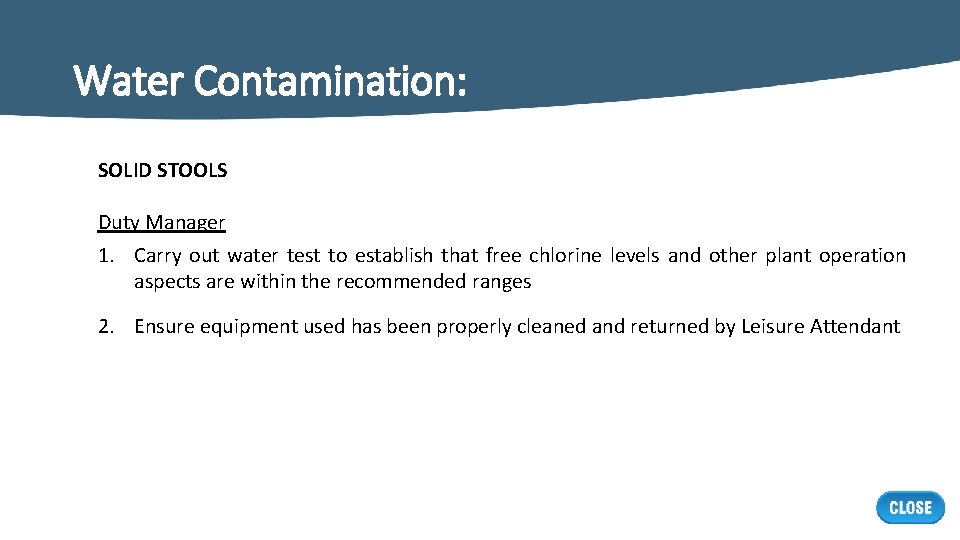
Water Contamination: SOLID STOOLS Duty Manager 1. Carry out water test to establish that free chlorine levels and other plant operation aspects are within the recommended ranges 2. Ensure equipment used has been properly cleaned and returned by Leisure Attendant
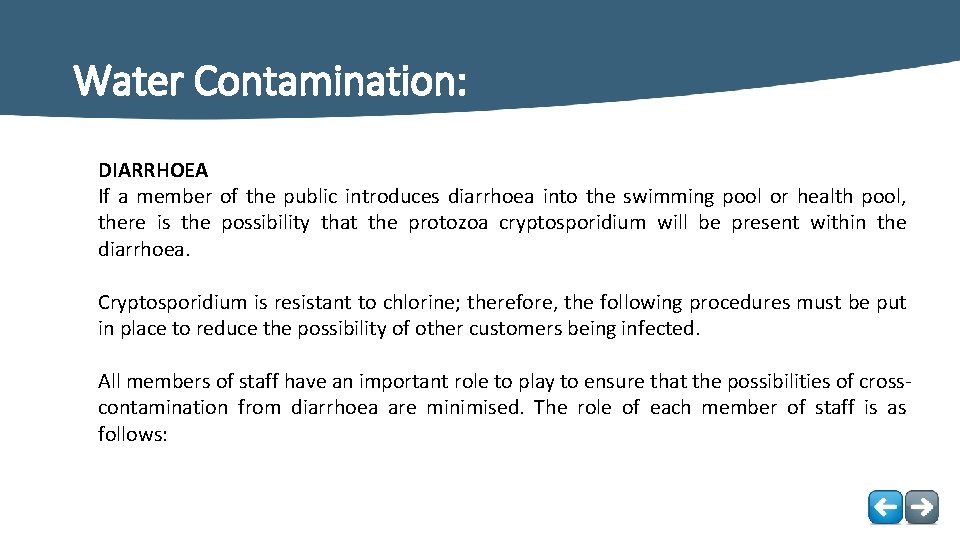
Water Contamination: DIARRHOEA If a member of the public introduces diarrhoea into the swimming pool or health pool, there is the possibility that the protozoa cryptosporidium will be present within the diarrhoea. Cryptosporidium is resistant to chlorine; therefore, the following procedures must be put in place to reduce the possibility of other customers being infected. All members of staff have an important role to play to ensure that the possibilities of crosscontamination from diarrhoea are minimised. The role of each member of staff is as follows:
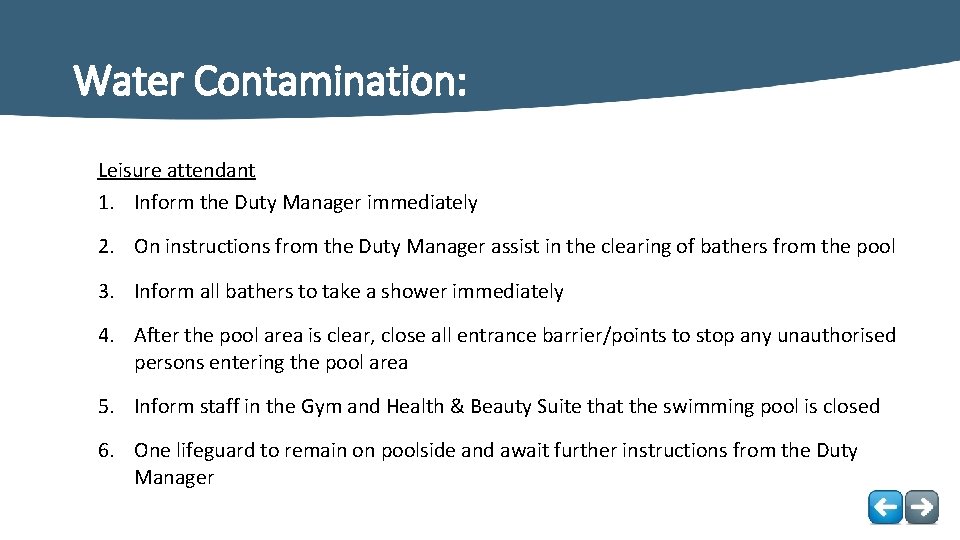
Water Contamination: Leisure attendant 1. Inform the Duty Manager immediately 2. On instructions from the Duty Manager assist in the clearing of bathers from the pool 3. Inform all bathers to take a shower immediately 4. After the pool area is clear, close all entrance barrier/points to stop any unauthorised persons entering the pool area 5. Inform staff in the Gym and Health & Beauty Suite that the swimming pool is closed 6. One lifeguard to remain on poolside and await further instructions from the Duty Manager
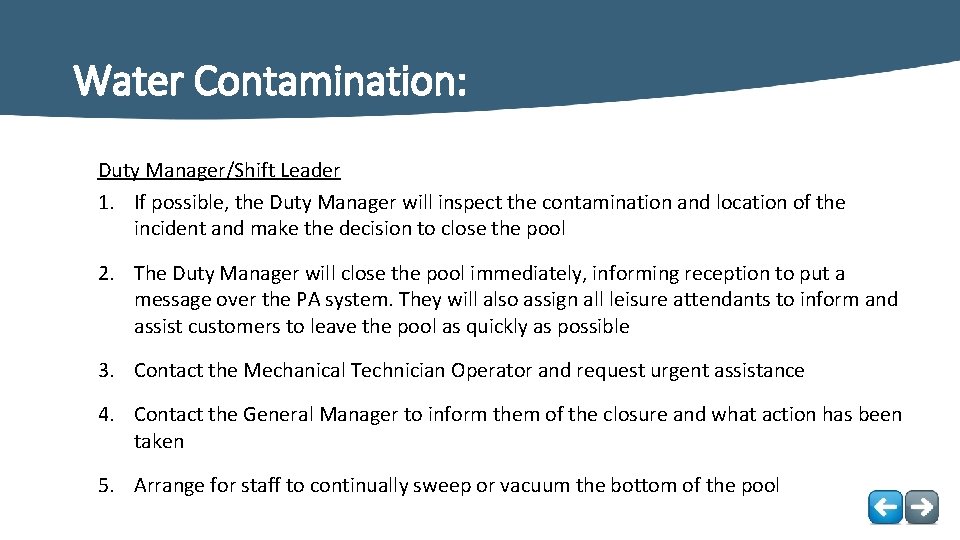
Water Contamination: Duty Manager/Shift Leader 1. If possible, the Duty Manager will inspect the contamination and location of the incident and make the decision to close the pool 2. The Duty Manager will close the pool immediately, informing reception to put a message over the PA system. They will also assign all leisure attendants to inform and assist customers to leave the pool as quickly as possible 3. Contact the Mechanical Technician Operator and request urgent assistance 4. Contact the General Manager to inform them of the closure and what action has been taken 5. Arrange for staff to continually sweep or vacuum the bottom of the pool
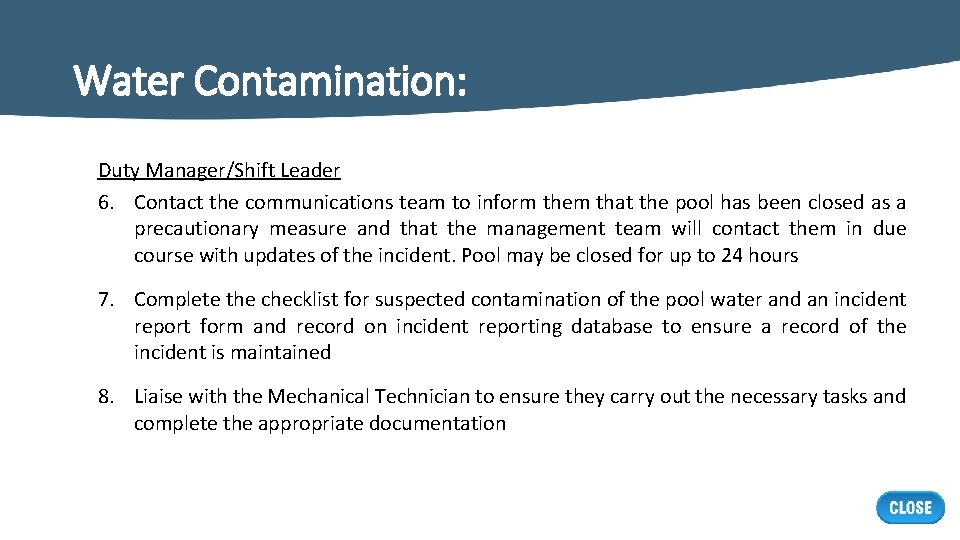
Water Contamination: Duty Manager/Shift Leader 6. Contact the communications team to inform them that the pool has been closed as a precautionary measure and that the management team will contact them in due course with updates of the incident. Pool may be closed for up to 24 hours 7. Complete the checklist for suspected contamination of the pool water and an incident report form and record on incident reporting database to ensure a record of the incident is maintained 8. Liaise with the Mechanical Technician to ensure they carry out the necessary tasks and complete the appropriate documentation
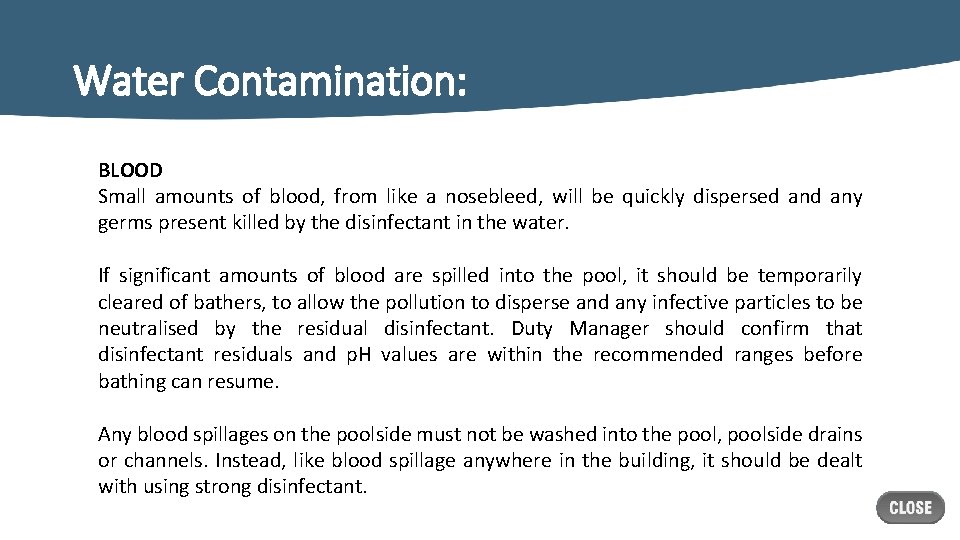
Water Contamination: BLOOD Small amounts of blood, from like a nosebleed, will be quickly dispersed any germs present killed by the disinfectant in the water. If significant amounts of blood are spilled into the pool, it should be temporarily cleared of bathers, to allow the pollution to disperse and any infective particles to be neutralised by the residual disinfectant. Duty Manager should confirm that disinfectant residuals and p. H values are within the recommended ranges before bathing can resume. Any blood spillages on the poolside must not be washed into the pool, poolside drains or channels. Instead, like blood spillage anywhere in the building, it should be dealt with using strong disinfectant.
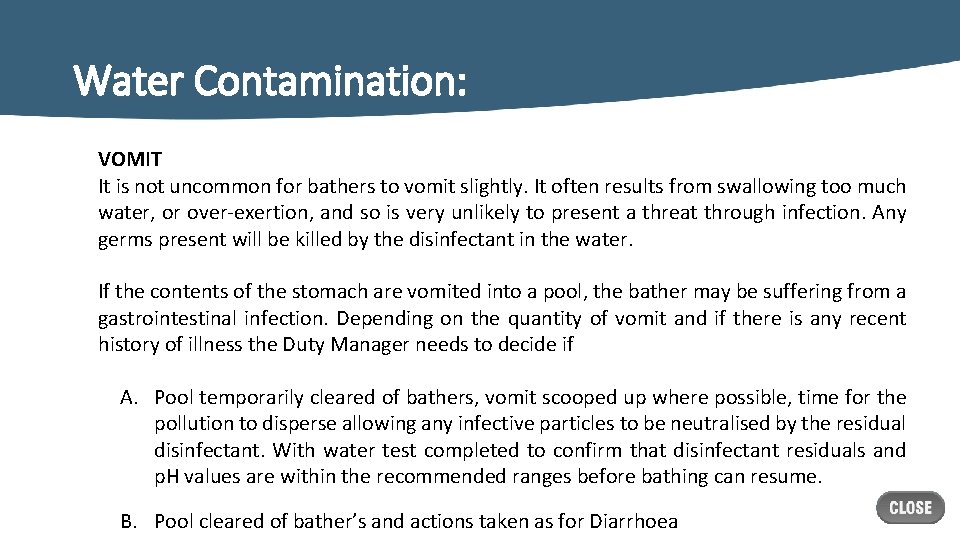
Water Contamination: VOMIT It is not uncommon for bathers to vomit slightly. It often results from swallowing too much water, or over-exertion, and so is very unlikely to present a threat through infection. Any germs present will be killed by the disinfectant in the water. If the contents of the stomach are vomited into a pool, the bather may be suffering from a gastrointestinal infection. Depending on the quantity of vomit and if there is any recent history of illness the Duty Manager needs to decide if A. Pool temporarily cleared of bathers, vomit scooped up where possible, time for the pollution to disperse allowing any infective particles to be neutralised by the residual disinfectant. With water test completed to confirm that disinfectant residuals and p. H values are within the recommended ranges before bathing can resume. B. Pool cleared of bather’s and actions taken as for Diarrhoea
Theft / Incident at Reception: In the interest of your safety, you are required to adhere as far is reasonably possible to the following procedure. • If confronted by a robber, never risk personal injury or injury to others • You should obey exactly the instructions of the robber. The Council is insured against robbery so do not put your life at risk • Any items asked for by the robber belonging to the Council should be handed over. Any request for personal belongings are at the discretion of the individual, however care should be taken not to put yourself or others at the risk of injury by refusal
Theft / Incident at Reception: • During a robbery situation involving a demand for cash, hand over the highest denomination notes first so as not to antagonise the robber, then any coinage if demanded • Attempt to remember as much as possible about the robber i. e. height, hair colour, accent, dress, complexion/skin colour, any distinguishing features • Note which direction the robber left the building, • Do not follow or try to prevent the robber from leaving the building • Activate your emergency alarm as soon as you feel it is safe to do so • Once the robber has left the building, contact the Duty Manager who in turn will contact the PSNI
Glass in the Pool: Broken glass is a hazardous occurrence in a swimming pool and as such, glass items of any description are not permitted on poolside. If you suspect, there is glass in the pool immediately clear the pool and contact the Shift Leader/Duty Manager. The situation needs to be assessed to determine how much glass, type of glass and where the glass is in relation to the pool outlets. Three possible options for the removal of the glass are available…. Empty, hose and sweep the pool Manual pool sweep without emptying Pool vacuum cleaner without emptying
Glass in the Pool: Empty, hose and sweep the pool Empty all the water out of the pool and pick up the large pieces of glass using appropriate personal protection equipment. Then hose and sweep the water and any remaining glass towards the outlet grids. When the pool is being refilled, continue scouring the entire pool bottom with a fine sweeping brush, sweeping the water and any remaining fragments through the outlet grids where they will be eventually collected on the filter bed and ultimately washed to drain during backwashing.
Glass in the Pool: Manual pool sweep without emptying Turn off the circulation for a time only re-starting when settlement has taken place and sweeping to drain, or similar process is about to commence. Sweep the pool bottom with a pool brush, and then manually remove any large pieces of glass with care wearing suitable protection. It will help if you work to a predicted sweeping pattern. Repeat this procedure two to three times varying the pattern.
Glass in the Pool: Pool vacuum cleaner without emptying Sweep the pool bottom with a pool brush, and then manually remove any large pieces of glass with care wearing suitable protection. Then vacuum the pool bottom ensuring the full area has been covered. As in the case with a vacuum sweeper, this is best achieved by sweeping the pool bottom in a strict pattern. Then repeat this procedure two to three times using varying patterns.
Glass in the Pool: If you suspect that the glass has shattered into very fine shards that could be suspended in the general body of the water then allow the pool water to settle for a considerable period, two to three turnover periods or equivalent, prior to attempting to remove through manual sweeping or pool vacuum.
Major Incident Plan: A major incident is characterised as any emergency that will require more than one of the emergency services and includes situations resulting in multiple casualties or a fatality. Employees will immediately inform the Operational Manager regarding the nature and location of the incident. The Operational Manager will assume the role of Incident Co-ordinator and retain overall responsibility for dealing with all aspects of the incident. However, employees will retain control of the situation until the Operational Manager arrives on the scene. In the absence of the Operational Manager, the Duty Manager will become Incident Co-ordinator. Multiple casualties Fatality
Major Incident Plan: Multiple casualties Any of the emergencies detailed in the previous sections may, through the specific emergency or because of the evacuation, escalate to trigger the rescue, treatment or evacuation of a large number of people or casualties. A need for combined resources of the emergency services may be required to deal and handle the situation. The handling of a large number of enquires likely to be generated, both from the public and the news media
Major Incident Plan: Fatality The following immediate action will then be taken: 1. Notify Duty Officer immediately so admissions can be stopped immediately 2. Staff should clear the immediate area of all customers. The Duty Officer should then subsequently take a decision to evacuate and close down the facility. 3. The scene should be preserved and locked down to allow for the police and Health & Safety to visit the site. All equipment related to the incident must also be retained and where possible left in situ. 4. The Duty Manager is responsible for the completion of an Accident & Incident Reporting form and a RIDDOR form. The Duty Manager should also interview all witnesses as far as reasonably possible. A list of witnesses should be passed to the General Manager at the earliest opportunity.
Major Incident Plan: 5. The Duty Manager will arrange for relief cover for all employees involved in dealing with the incident 6. The General Manager will contact the Head of Department and the Health & Safety Officer 7. HR Department will contact the Union Representative for all Unions with employees in the facility 8. If the PSNI have not already arrived with the NI Ambulance Service, the Duty Manager will contact them on 101
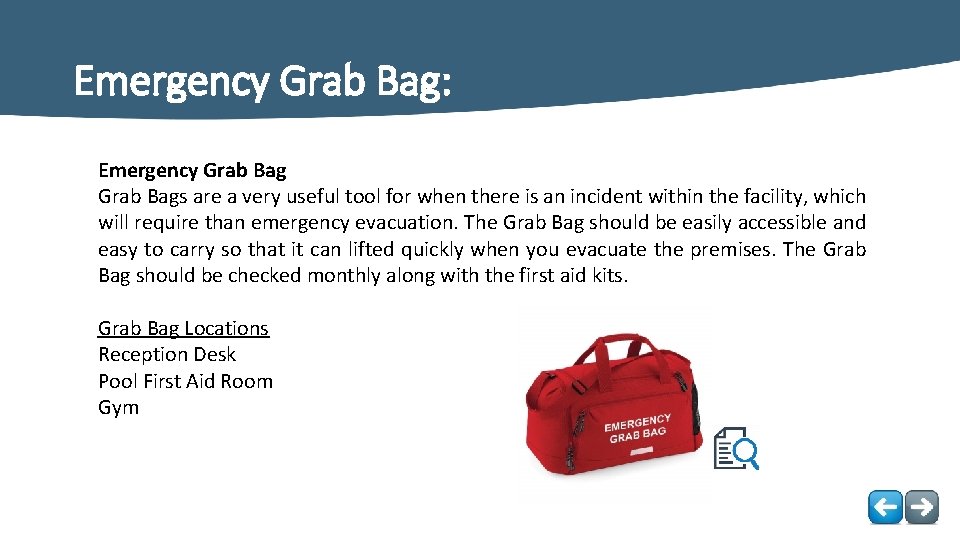
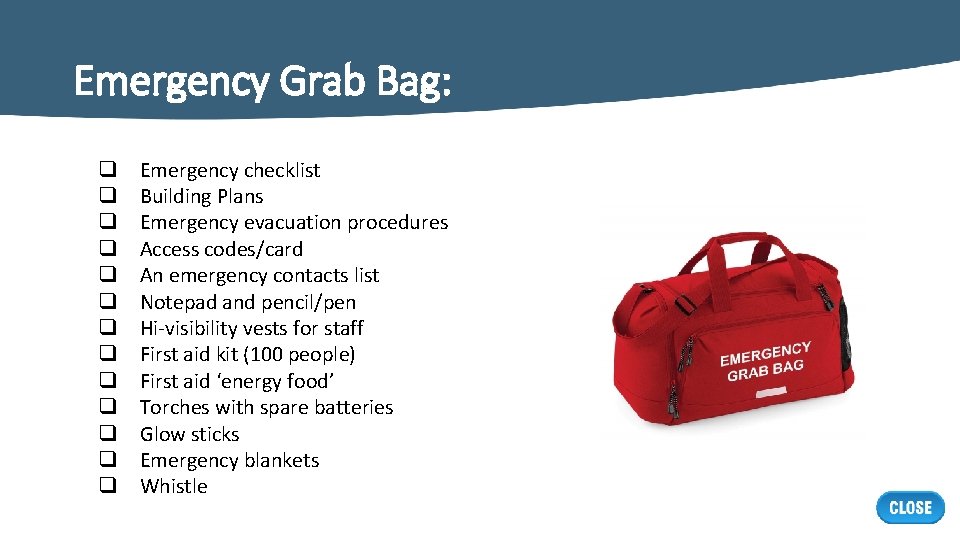
Emergency Grab Bag: Emergency Grab Bags are a very useful tool for when there is an incident within the facility, which will require than emergency evacuation. The Grab Bag should be easily accessible and easy to carry so that it can lifted quickly when you evacuate the premises. The Grab Bag should be checked monthly along with the first aid kits. Grab Bag Locations Reception Desk Pool First Aid Room Gym
Emergency Grab Bag: q q q q Emergency checklist Building Plans Emergency evacuation procedures Access codes/card An emergency contacts list Notepad and pencil/pen Hi-visibility vests for staff First aid kit (100 people) First aid ‘energy food’ Torches with spare batteries Glow sticks Emergency blankets Whistle
SECTION COMPLETED Congratulations! You have now completed the Emergency Action Plan Section and are ready to complete the practical based Assessment element.