
South Fork Eel River Sacramento Pikeminnow Study Abundance
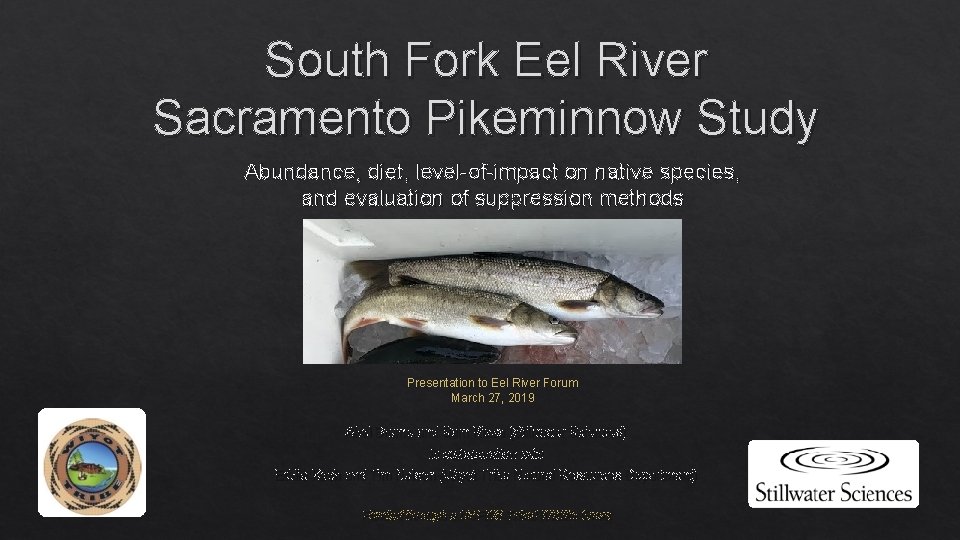
South Fork Eel River Sacramento Pikeminnow Study Abundance, diet, level-of-impact on native species, and evaluation of suppression methods Presentation to Eel River Forum March 27, 2019 Abel Brumo and Sam Rizza (Stillwater Sciences) in collaboration with Eddie Koch and Tim Nelson (Wiyot Tribe Natural Resources Department) Funded through a USFWS Tribal Wildlife Grant
Goals of Presentation Bring Eel River stakeholders up-to-speed on objectives, scope, methods, and status of this ongoing project. Help foster potential collaboration and coordination between pikeminnow research, monitoring, and control efforts in the Eel River basin.
Project Objectives Improve understanding of pikeminnow population size, diet, and impacts on native fish species in the South Fork Eel River (focus on lamprey and steelhead, due to high degree of spatial and temporal overlap w/pikeminnow and permitting constraints on sampling period) Develop and evaluate approaches to effectively monitor and suppress the Sacramento pikeminnow population in the Eel River
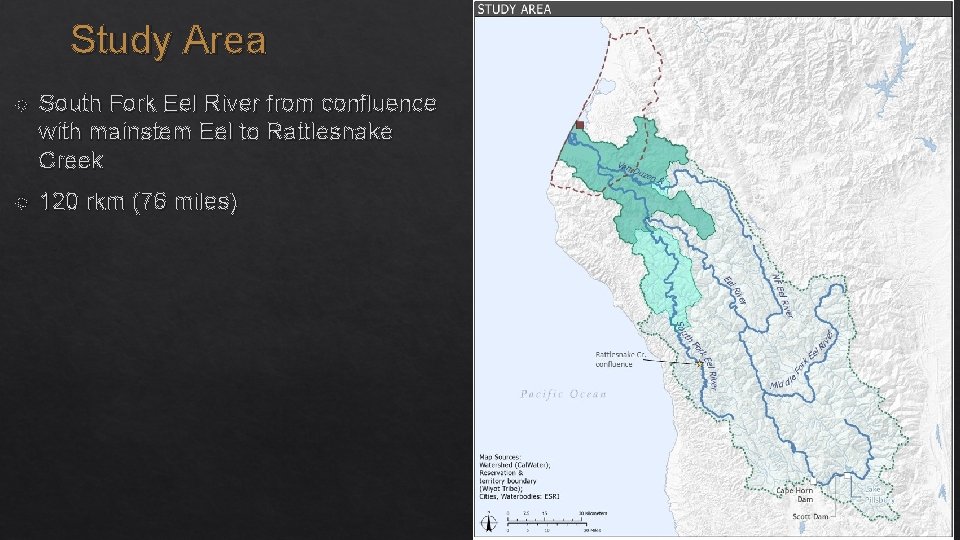
Study Area South Fork Eel River from confluence with mainstem Eel to Rattlesnake Creek 120 rkm (76 miles)
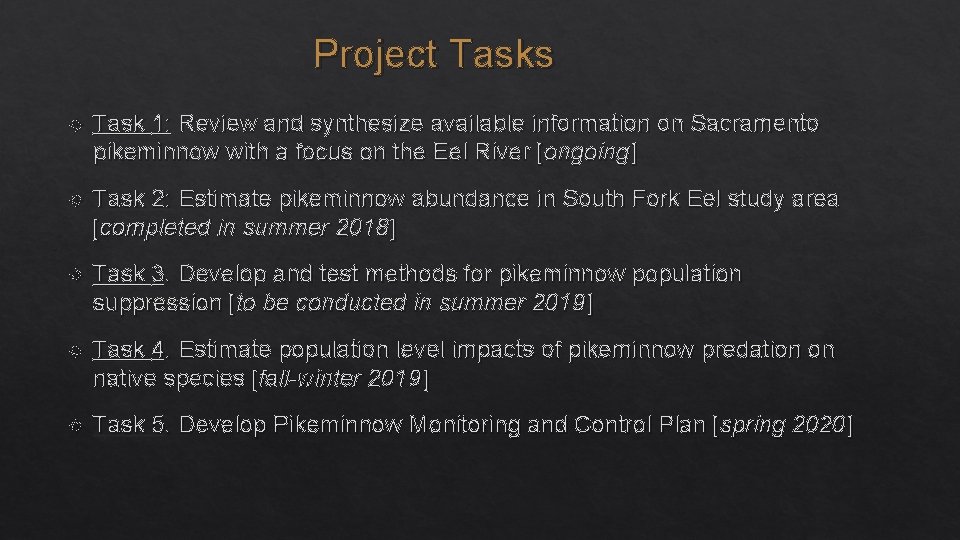
Project Tasks Task 1: Review and synthesize available information on Sacramento pikeminnow with a focus on the Eel River [ongoing] Task 2: Estimate pikeminnow abundance in South Fork Eel study area [completed in summer 2018] Task 3. Develop and test methods for pikeminnow population suppression [to be conducted in summer 2019] Task 4. Estimate population level impacts of pikeminnow predation on native species [fall-winter 2019] Task 5. Develop Pikeminnow Monitoring and Control Plan [spring 2020]
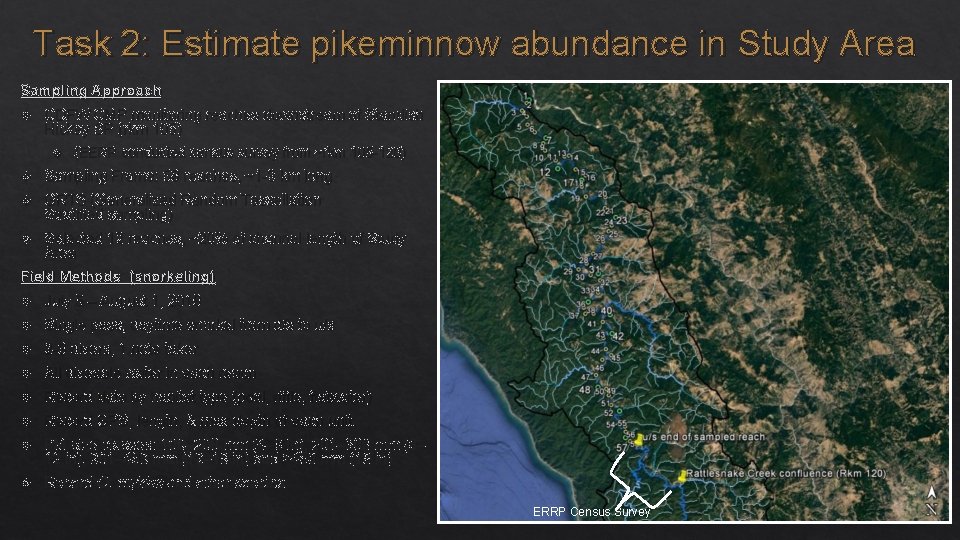
Task 2: Estimate pikeminnow abundance in Study Area Sampling Approach CDFW CMP monitoring reaches downstream of Standish Hickey SP (rkm 105) (EERP conducted census survey from ~rkm 105 -120) Sampling Frame: 58 reaches, ~1 -3 km long GRTS (Generalized Random Tessellation Stratified sampling) Selected 12 reaches, ~20% of channel length of Study Area Field Methods (snorkeling) July 5 – August 1, 2018 Single pass, daytime snorkel from d/s to u/s 2 -3 divers, 1 note taker All diveable water in each reach Record data by habitat type (pool, riffle, flatwater) Record GPS, length, & max depth of each unit. PM size classes: 100– 200 mm (4– 8 in), 201– 300 mm (8– 12 in), 301– 450 mm (12– 18 in) and >450 mm (18 in) Record O. mykiss and other species ERRP Census Survey
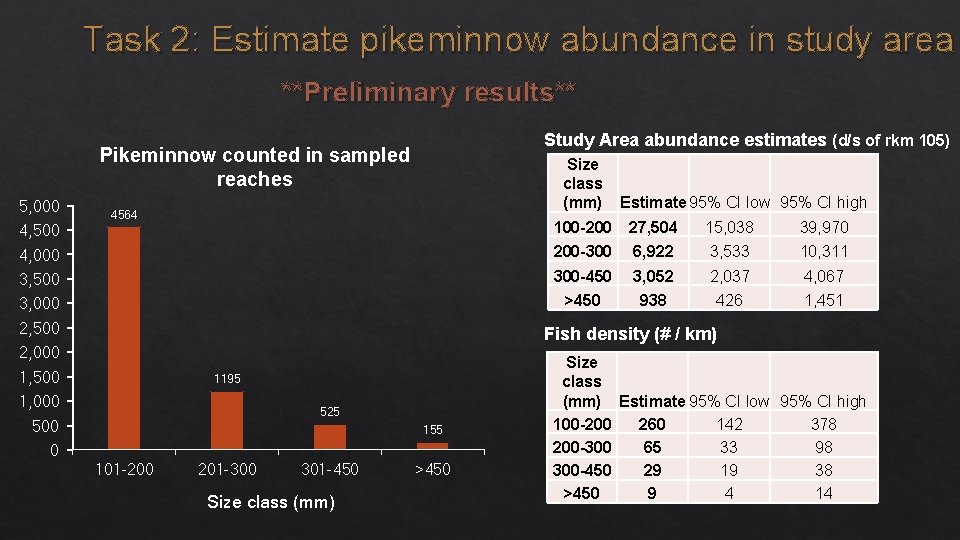
Task 2: Estimate pikeminnow abundance in study area **Preliminary results** Study Area abundance estimates (d/s of rkm 105) Pikeminnow counted in sampled reaches 5, 000 Size class (mm) 4564 Estimate 95% CI low 95% CI high 4, 500 100 -200 27, 504 15, 038 39, 970 4, 000 200 -300 6, 922 3, 533 10, 311 3, 500 300 -450 3, 052 2, 037 4, 067 3, 000 >450 938 426 1, 451 2, 500 Fish density (# / km) 2, 000 1, 500 1195 1, 000 525 500 155 0 101 -200 201 -300 301 -450 Size class (mm) >450 Size class (mm) Estimate 95% CI low 95% CI high 100 -200 260 142 378 200 -300 65 33 98 300 -450 29 19 38 >450 9 4 14
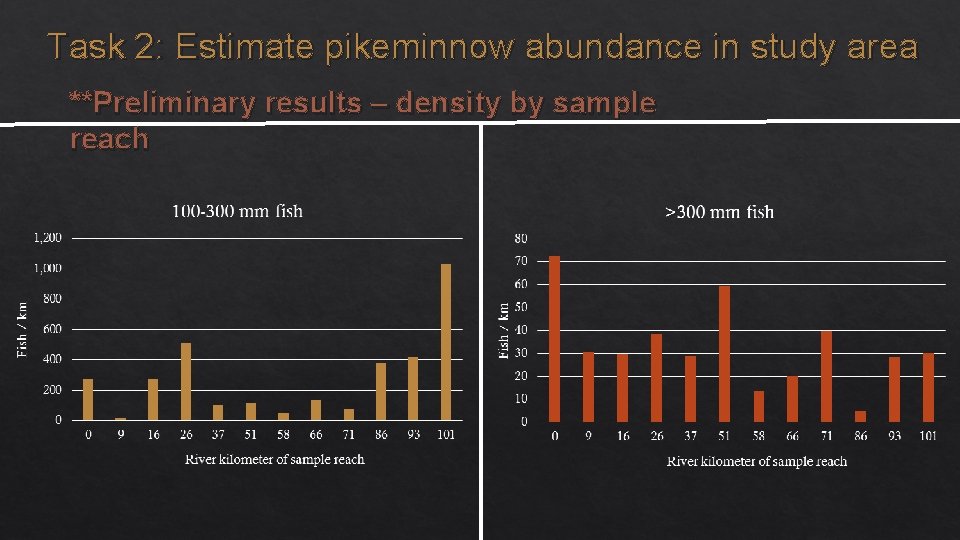
Task 2: Estimate pikeminnow abundance in study area **Preliminary results – density by sample reach
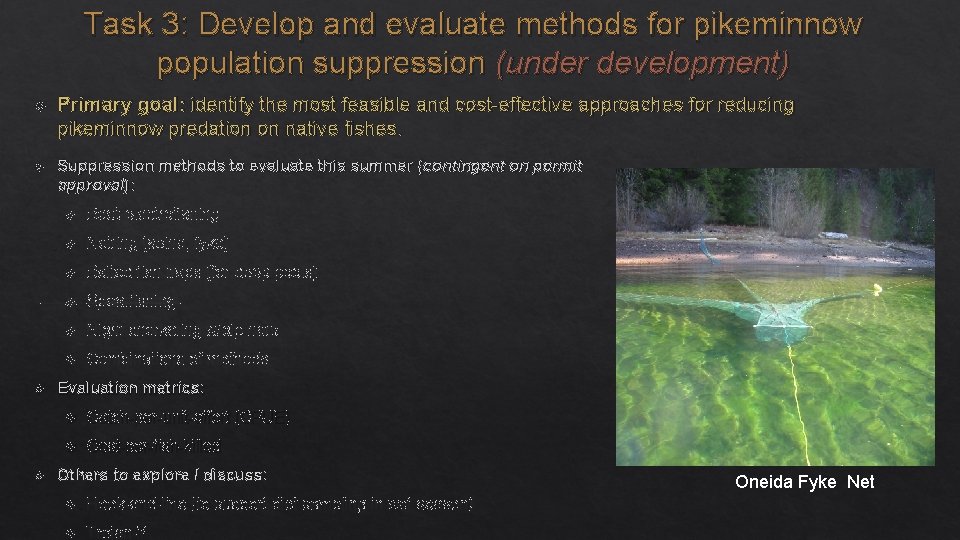
Task 3: Develop and evaluate methods for pikeminnow population suppression (under development) Primary goal: identify the most feasible and cost-effective approaches for reducing pikeminnow predation on native fishes. Suppression methods to evaluate this summer (contingent on permit approval): Boat-electrofishing Netting (seine, fyke) Baited fish traps (for deep pools) Spearfishing Night snorkeling w/dip nets Combinations of methods Evaluation metrics: Catch-per-unit-effort (CPUE) Cost-per-fish-killed Others to explore / discuss: Hook-and-line (to support diet sampling in wet season) Trojan-Y Oneida Fyke Net
Task 3: Develop and evaluate methods for pikeminnow population suppression (contd…) Field methods Conduct suppression trials at habitat unit scale. Count, measure & weigh, & euthanize all pikeminnow Subsample gut contents by size class and reach (for direct diet analysis) Collect muscle tissue for isotopic diet analysis (need funding) Scales and otoliths for age analysis (need funding) Boat e-fishing only in reach where salmonids not present in summer (lower ~70 rkm) Snorkel each unit to verify O. mykiss absence and count pikeminnow Multi-pass depletion e-fishing estimates to estimate snorkel observation efficiency Use hook-and-line and night hand-netting to capture pikeminnow: In reaches where listed O. mykiss are present in summer to minimize impacts. Fall – spring diet samples when other methods are unlikely to be permitted due to presence of salmonids.
Task 4. Estimate population-level impacts of pikeminnow predation on native species Methods: Population size data from snorkel surveys. Diet data: Summer data from suppression trials. Fall, Winter, Spring data from angling. Direct estimates of consumption rate: Use diet data to estimate pikeminnow seasonal consumption rates (fish eaten / day) by size class. Total numbers of prey consumed in each season = seasonal consumption rate * population size (for each PM size class) Bioenergetics model (to be developed): Use Fish Bioenergetics 4. 0 to estimate number of each prey species consumed based on population size and growth rate. Model will allow evaluation of different diet, water temperature, and population control scenarios etc … (If possible, integrate diet information from isotopic analyses and age & growth information from scale & otlilith analyses)
Task 5: Pikeminnow Monitoring and Control Plan (to complete in spring 2020) Plan will include the following elements: Summary of results from each task. Evaluation of the likely population-level impacts of pikeminnow predation on focal species. Assessment of level-of-control (# of pikeminnow killed by size class) and cost required to have meaningful impacts in terms of increased production of lamprey and steelhead. Specific recommendations for pikeminnow monitoring and population control in the South Fork Eel, including best approaches, locations, timing, life-stages, and considerations for adaptive management. Discussion of applicability of monitoring and suppression methods to other parts of the Eel River watershed (e. g. , reaches of the Upper Eel affected by the Potter Valley Project).
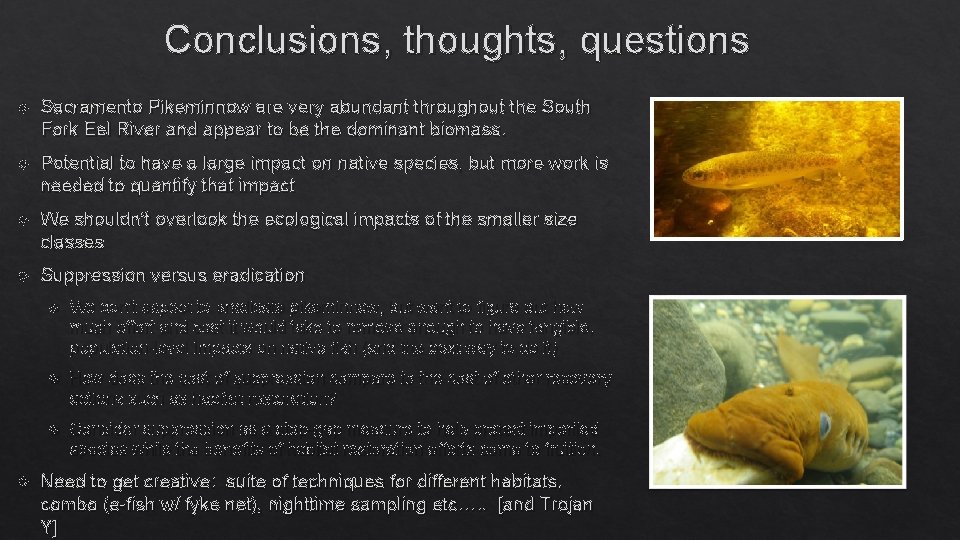
Conclusions, thoughts, questions Sacramento Pikeminnow are very abundant throughout the South Fork Eel River and appear to be the dominant biomass. Potential to have a large impact on native species, but more work is needed to quantify that impact We shouldn’t overlook the ecological impacts of the smaller size classes Suppression versus eradication We don’t expect to eradicate pikeminnow, but want to figure out how much effort and cost it would take to remove enough to have tangible, population-level impacts on native fish (and the best way to do it) How does the cost of suppression compare to the cost of other recovery actions such as habitat restoration? Consider suppression as a stop-gap measure to help protect imperiled species while the benefits of habitat restoration efforts come to fruition. Need to get creative: suite of techniques for different habitats, combo (e-fish w/ fyke net), nighttime sampling etc…. . [and Trojan Y]
Acknowledgements Funding: USFWS Tribal Wildlife Grant Field data collection Cori Flannery (WNRD) Jason Jackson (HSU) Sam Rizza (Stillwater Sciences) Chris Loomis (HSU) Ø Interested in helping with suppression trials this summer? Ø Ideas for funding isotopic diet and aging analyses? Technical and project support and input Bret Harvey (RSL) Rod Nakamoto (RSL) Allan Renger (CDFW) Seth Ricker (CDFW) Scott Monday (CDFW) Pat Higgins (ERRP) Darren Ward (HSU Contact: Abel Brumo abel@stillwatersci. com Eddie Koch eddie@wiyot. us
Advantages of isotopic analysis Gut content examination only provides a point-in-time depiction of an individual fish’s diet, which may not be representative of diet over a longer time period. Prey items from gut contents are often hard to identify due to varying levels of digestion, and when a species exhibits strong diel feeding patterns (i. e. , night feeding), it is likely that much of the gut contents have been digested by the time of capture. For example, at 18 °C Northern Pikeminnow can completely digest a juvenile salmon in as few as 10 hours (Petersen et al. 2003) and prey items are likely unidentifiable even sooner. Lamprey ammocoetes would presumably be digested even faster due to small size and lack of hard parts Measuring the ratios of the stable isotopes 13 C and 15 N in tissue samples will allow description of the relative contribution of major prey items (e. g. , lamprey ammocoetes, juvenile salmonids, other fishes, macroinvertebrates etc. . ) over a longer time period than gut content examination (weeks or months instead of hours), By providing more accurate estimates of diet composition, isotopic analysis will improve the accuracy of bioenergetics modelling aimed at assessing the magnitude of pikeminnow predation on native fishes and strengthen overall conclusions about pikeminnow impacts in the Eel River.
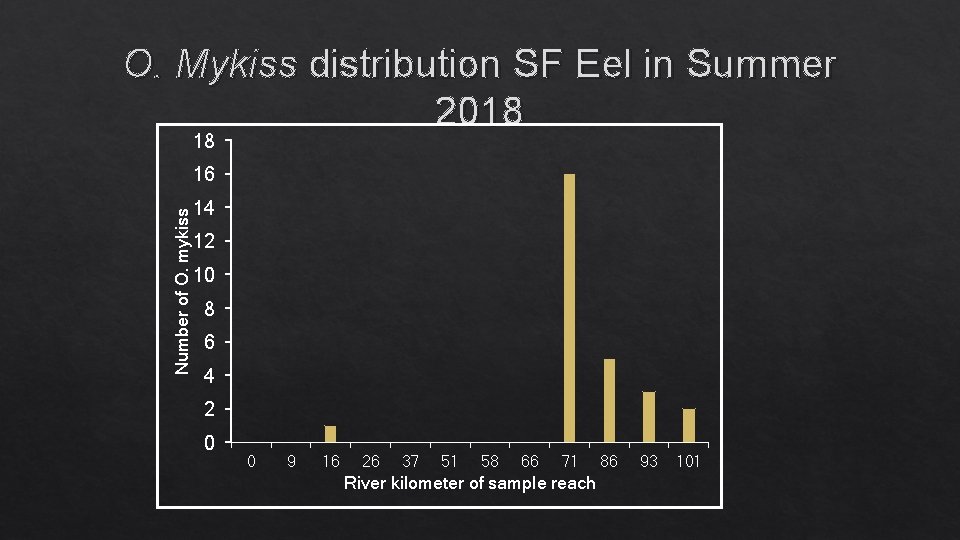
O. Mykiss distribution SF Eel in Summer 2018 18 Number of O. mykiss 16 14 12 10 8 6 4 2 0 0 9 16 26 37 51 58 66 71 River kilometer of sample reach 86 93 101
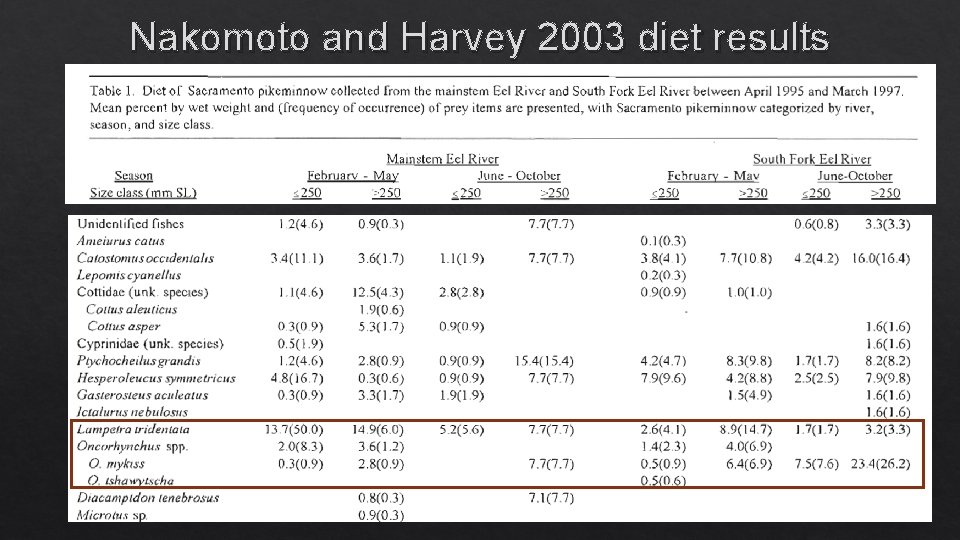
Nakomoto and Harvey 2003 diet results
- Slides: 17