
South Florida Natural Resources Center Everglades National Park
- Slides: 15
South Florida Natural Resources Center Everglades National Park Service U. S. Department of the Interior The Critical Ecosystem Studies Initiative Annual Meeting of the South Florida Caribbean Cooperative Ecosystem Studies Unit (SFC CESU) Biscayne National Park October 21, 2016
The Foundation: Science Subgroup of the Task Force, 1996 “The overall objective of the Science Subgroup is to develop an interagency, interdisciplinary science program that will guide restoration actions by determining relationships between ecosystem function and hydrologic regime…”
DOI Contribution = the CESI Program Purposes and objectives: • • • understand how the natural system originally functioned identify the ways in which it is now impaired define viable options for ecosystem restoration. Formal Peer review by National Academy of Sciences in 2003 • • • the fundamental purposes and objectives of the CESI research program should remain intact the commitment to ecosystem research in addition to model development and environmental assessments, needs to be continued. CESI should create a more open process to engage a broader range of scientists in Everglades research and monitoring (Broad Agency Announcement)
Guiding Information • Task Force Science Subgroup: Information Needs, 1996 • Strategic Science Plan for Florida Bay, 1998, 2004 • National Research Council Review of CESI, 2003 • Department of the Interior Science Plan, first written in 2005 with annual updates as needed • Feedback/information exchange among DOI staff scientists
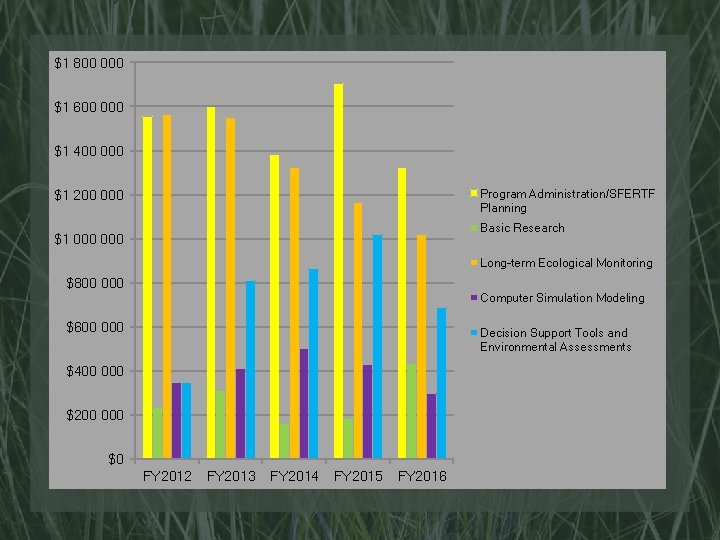
$1 800 000 $1 600 000 $1 400 000 Program Administration/SFERTF Planning $1 200 000 Basic Research $1 000 Long-term Ecological Monitoring $800 000 Computer Simulation Modeling $600 000 Decision Support Tools and Environmental Assessments $400 000 $200 000 $0 FY 2012 FY 2013 FY 2014 FY 2015 FY 2016
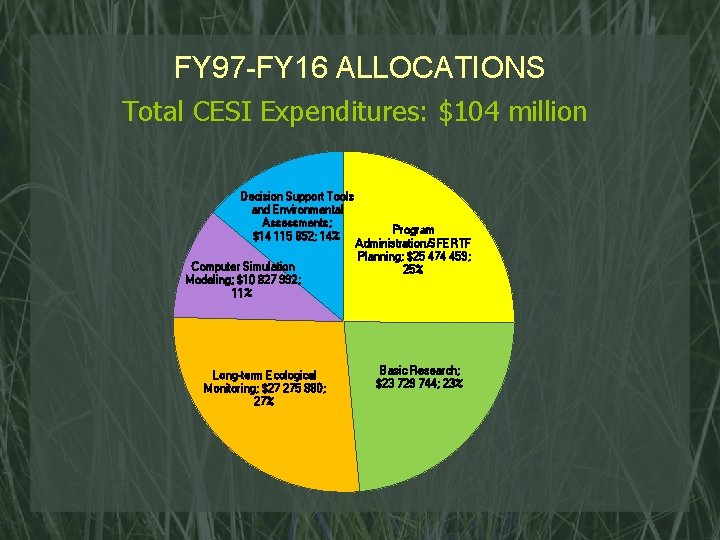
FY 97 -FY 16 ALLOCATIONS Total CESI Expenditures: $104 million Decision Support Tools and Environmental Assessments; $14 115 852; 14% Computer Simulation Modeling; $10 827 992; 11% Long-term Ecological Monitoring; $27 275 880; 27% Program Administration/SFERTF Planning; $25 474 459; 25% Basic Research; $23 729 744; 23%
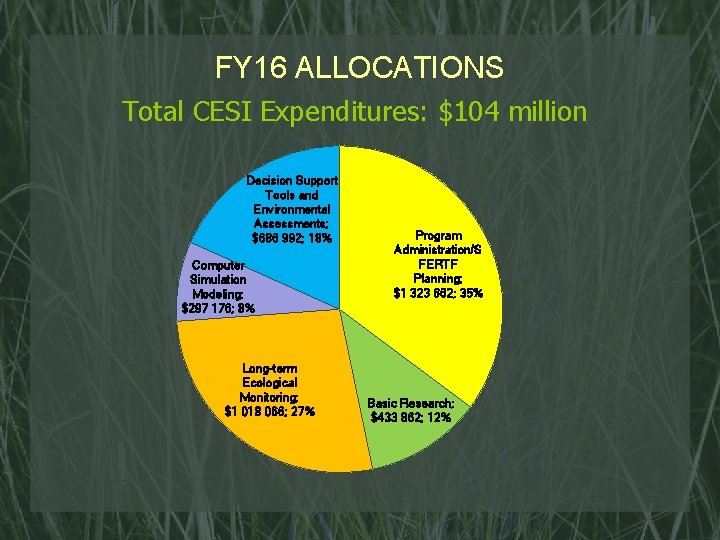
FY 16 ALLOCATIONS Total CESI Expenditures: $104 million Decision Support Tools and Environmental Assessments; $686 992; 18% Computer Simulation Modeling; $297 176; 8% Long-term Ecological Monitoring; $1 018 066; 27% Program Administration/S FERTF Planning; $1 323 662; 35% Basic Research; $433 862; 12%
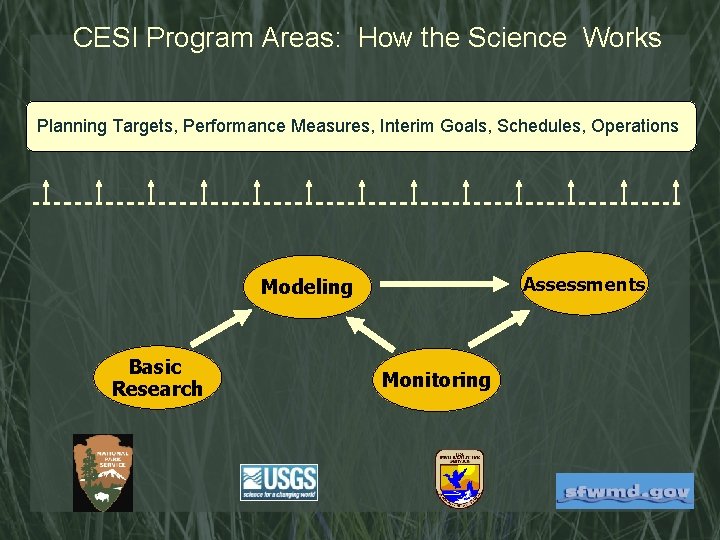
CESI Program Areas: How the Science Works Planning Targets, Performance Measures, Interim Goals, Schedules, Operations Assessments Modeling Basic Research Monitoring
Basic Research • Bathymetry Mapping of Lostmans and Shark Rivers using an Acoustic Swath Sonar System • An Integrated Plan for Invasive Reptile Research and Management in Everglades National Park, Big Cypress National Preserve, and Biscayne National Park • Increasing CSSS Habitat Suitability: Fire Management Field Test • Linkages of Water Quality, Submerged Aquatic Vegetation and Wintering Waterfowl in EVER • Ecosystem dynamics in the White Zone: history, drivers, and restoration implications • Mechanisms and Conditions Responsible for Elevated TP Levels in Surface Water discharges to Shark River Slough with Everglades National Park • Seagrass Die-off and Recovery in Florida Bay: Research in Process and Restoration • Identifying and Quantifying the Prey of Nesting White Ibis in Everglades National Park
Long-Term Monitoring • Re-sampling of Vegetation Survey Sites within Cape Sable Seaside Sparrow Habitat • Recovery of the Endangered Cape Sable Seaside Sparrow in Everglades National Park: Demographic Monitoring, Population Surveys, Habitat Assessment, and Setting Priorities • Feasibility of determining flow-weighted mean TP concentrations from the L-29 Canal through the 1 -mile bridge along the Tamiami Trail • Monitor Surface Water and Groundwater Conditions in the Lower • C-111 Wetlands, Everglades National Park • Analyzing the Impact of Changing Hydrologic Conditions along the Boundary of Everglades National Park • Vegetation Monitoring within the Habitat of Cape Sable Seaside Sparrow in Southern Everglades
Computer Simulation Modeling • FATHOM Hydrologic Model Development and Application for Linked Florida Bay - Everglades Restoration Analysis • Software Design and Development to Support Ecological Numeric Modeling • Restoration Modeling: Wading Bird Model Synthesis and Refinement • Modeling Evapotranspiration (ET) in Everglades National Park using Eddy Covariance Data and Satellite-based Information • Statistical Advice and Technical Support for Collecting and Analyzing Ecological Data • Devising a Predictive Florida Bay Seagrass Model to Assess Current Water Management Operations and Future Comprehensive Everglades Restoration Plan Scenarios • Wader Distribution Evaluation Modeling (WADEM) as a Greater Everglades Restoration Performance Measure • Simulating the Fate and Transport of Phosphorus using the Mike Modeling System • Modeling Spatial Habitat Quality for the Cape Sable Seaside Sparrow • Multispecies Spatial Optimization for Landscape Planning and Operational Forecasting
• Prepare an Environmental Assessment for the Cape Sable Canal Dams Phase II Assessment (EA) (aka Cape Sable Environmental Assessment for New Canal Plugs) • Florida Bay Mud-bank Vulnerability Assessment • Decision making, planning, management, and research support for invasive species in EVER • Continuation of UM-RSMAS Everglades Bio. Corps Internships • Optimizing Containment Efforts for Argentine Black and White Tegus in South Florida Conference (Workshop) • Vegetation Study within the Current and Adjoining Potential Habitat of Cape Sable Seaside Sparrow in the Southern Everglades • Everglades National Park Lidar Acquistion • Effects of the 30 -yr Crocodile Sanctuary Closure and Opening of Joe Bay on Fish Communities: Spatial and Temporal Comparisons Using Fisheriesindependent Moniotiring Seine Data • Effects of Crocodile Sanctuary Closure and Opening of Joe Bay on Fishes and Recreational Fisheries • Man and the Biosphere Designation - advising and compliance
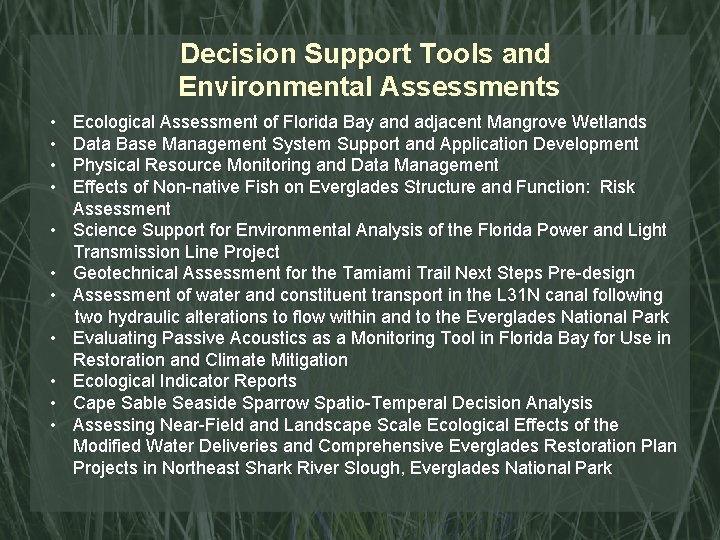
Decision Support Tools and Environmental Assessments • • • Ecological Assessment of Florida Bay and adjacent Mangrove Wetlands Data Base Management System Support and Application Development Physical Resource Monitoring and Data Management Effects of Non-native Fish on Everglades Structure and Function: Risk Assessment Science Support for Environmental Analysis of the Florida Power and Light Transmission Line Project Geotechnical Assessment for the Tamiami Trail Next Steps Pre-design Assessment of water and constituent transport in the L 31 N canal following two hydraulic alterations to flow within and to the Everglades National Park Evaluating Passive Acoustics as a Monitoring Tool in Florida Bay for Use in Restoration and Climate Mitigation Ecological Indicator Reports Cape Sable Seaside Sparrow Spatio-Temperal Decision Analysis Assessing Near-Field and Landscape Scale Ecological Effects of the Modified Water Deliveries and Comprehensive Everglades Restoration Plan Projects in Northeast Shark River Slough, Everglades National Park
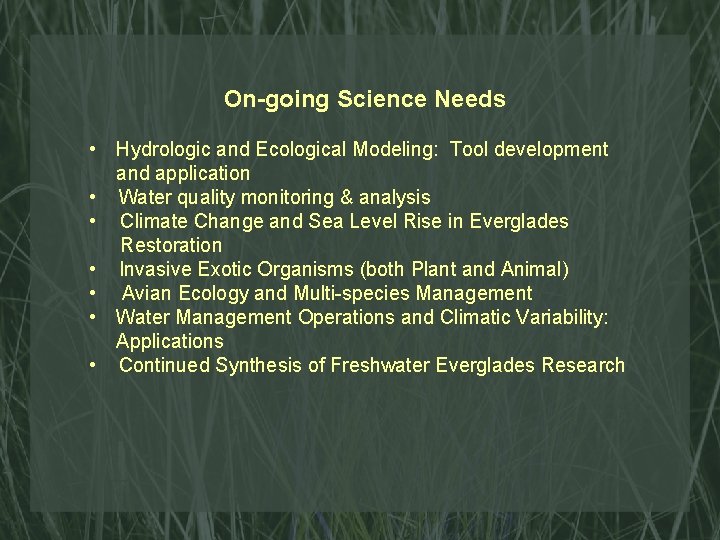
On-going Science Needs • Hydrologic and Ecological Modeling: Tool development and application • Water quality monitoring & analysis • Climate Change and Sea Level Rise in Everglades Restoration • Invasive Exotic Organisms (both Plant and Animal) • Avian Ecology and Multi-species Management • Water Management Operations and Climatic Variability: Applications • Continued Synthesis of Freshwater Everglades Research
South Florida Natural Resources Center Questions? Everglades National Park Service U. S. Department of the Interior