
South East CME Task and Finish Group Mike

- Slides: 18
South East CME Task and Finish Group Mike Stoneman Deputy Director of Children, Families and Education Service 7 th June 2019 www. portsmouth. gov. uk
Background • Children Missing Education - definition used in its broadest sense including school absence, exclusions, reduced timetables, elective home education and CME • Group has met twice with contributions from: Portsmouth; West Berkshire; Oxfordshire; Surrey; and Hampshire – explored a range of issues and shared different approaches • Approaches vary according to size of LA and school landscape • LA’s capacity and resources to monitor, challenge and support schools are becoming ever increasingly stretched (and undermined by academisation? ) • Impact of reducing school budgets, the ‘ask’ of schools to be more inclusive without appropriate funding and resources and the drive to deliver good results is having a negative impact • In some areas there is a lack of guidance from the Df. E and / or lack of clarity 2 www. portsmouth. gov. uk
Elective Home Education: context • Rise in the numbers of children being educated at home nationally and regionally • Research points to a small proportion of schools who are responsible for large proportion of children who become EHE – backed by evidence in the SE • Children’s Commissioner report Skipping School: Invisible Education Feb 2019 • Government Call for Evidence in 2018 • Df. E Guidance April 2019 (for local authorities and parents) • Ofsted Inspection Framework 2019 3 www. portsmouth. gov. uk
Elective Home Education The ACDS EHE Survey 2018 found that across 106 responding LAs, the number of EHE pupils has increased in each of the past five years, by an average of approximately 20% each year: Source: ACDS Elective Home Education Survey 2018 4 www. portsmouth. gov. uk
Elective Home Education: issues • • • 5 Defining ‘suitable education’ Identifying children who are EHE Off-rolling Unregistered settings Safeguarding risks www. portsmouth. gov. uk
Elective Home Education: LA approaches • Variable support from LAs for home educators – from being fairly supportive to fairly hostile • 14 -16 college placements for children who are EHE • 3 way meetings where parent is intent on home schooling i. e. school, parent/carer, local authority • Open and transparent sharing of data about numbers of pupils leaving each school when de-registrations took place, alongside exclusions and attendance data • In-year applications • Flexi schooling • EHE protocols agreed with schools • LA advice and guidance to schools and parents 6 www. portsmouth. gov. uk
Reduced Timetables or Reintegration Timetables: issues • A backdoor to exclusions • For whose benefit? The school or the pupil? • No national data available but some LAs in the SE are reporting a rise in their use • No statutory basis upon which to establish a RTT • Parental rights? • Safeguarding risks 7 www. portsmouth. gov. uk
Reduced Timetables: LA approaches • Reasons should be exceptional and limited to: reintegration; medical reasons; part of an in-school package of support • Should be short term • Requires parental consent (and for LAC/SEN: consent of the LA) • Early Help Assessments should be considered • LAs should be notified, RTTs logged and monitored, plans saved • Accurate recording on the attendance register • Any RTT exceeding 6 weeks with no clear plan should be challenged by the LA 8 www. portsmouth. gov. uk
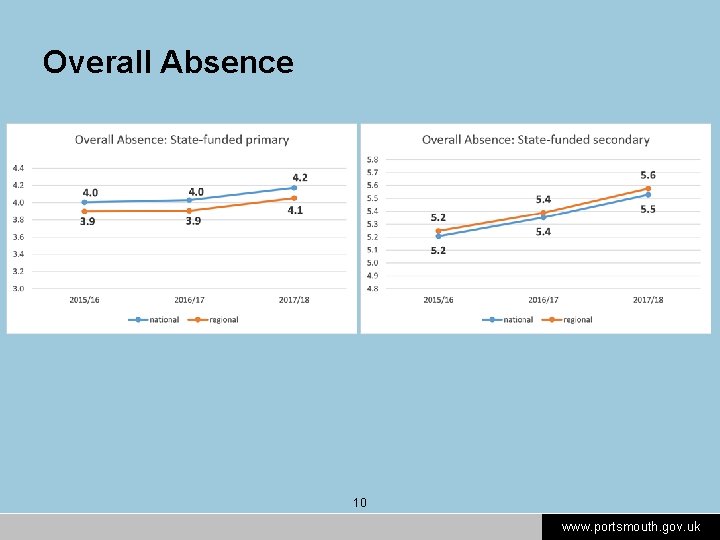
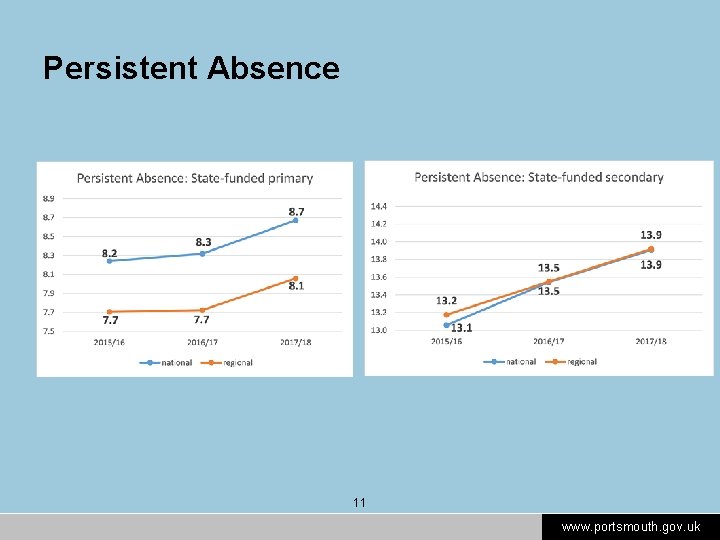
School absence, persistent absence, chronic absence: issues • Overall absence and persistent absence is rising both nationally and regionally • Capacity of schools attendance teams (Education Welfare Officers) and what they offer varies. Many teams have been depleted due to loss of funding and move to traded services 9 www. portsmouth. gov. uk
Overall Absence 10 www. portsmouth. gov. uk
Persistent Absence 11 www. portsmouth. gov. uk
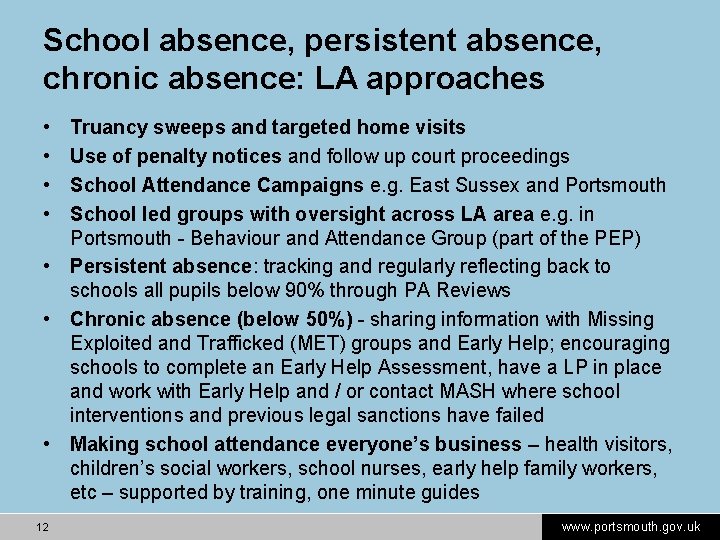
School absence, persistent absence, chronic absence: LA approaches • • Truancy sweeps and targeted home visits Use of penalty notices and follow up court proceedings School Attendance Campaigns e. g. East Sussex and Portsmouth School led groups with oversight across LA area e. g. in Portsmouth - Behaviour and Attendance Group (part of the PEP) • Persistent absence: tracking and regularly reflecting back to schools all pupils below 90% through PA Reviews • Chronic absence (below 50%) - sharing information with Missing Exploited and Trafficked (MET) groups and Early Help; encouraging schools to complete an Early Help Assessment, have a LP in place and work with Early Help and / or contact MASH where school interventions and previous legal sanctions have failed • Making school attendance everyone’s business – health visitors, children’s social workers, school nurses, early help family workers, etc – supported by training, one minute guides 12 www. portsmouth. gov. uk
13 www. portsmouth. gov. uk
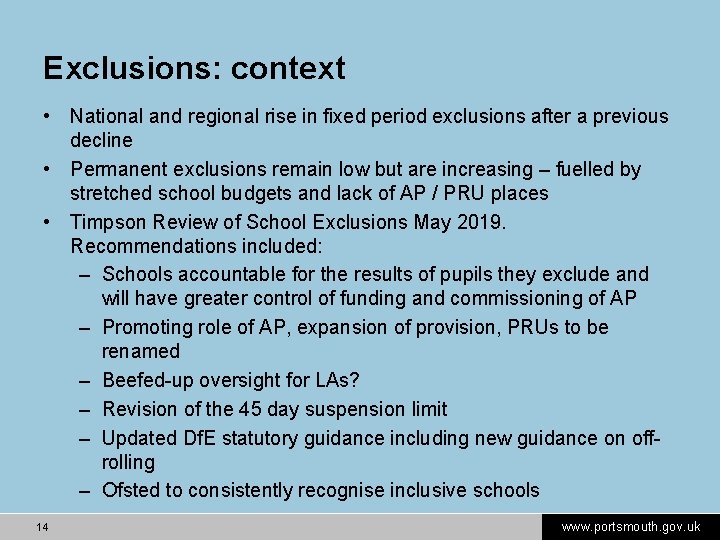
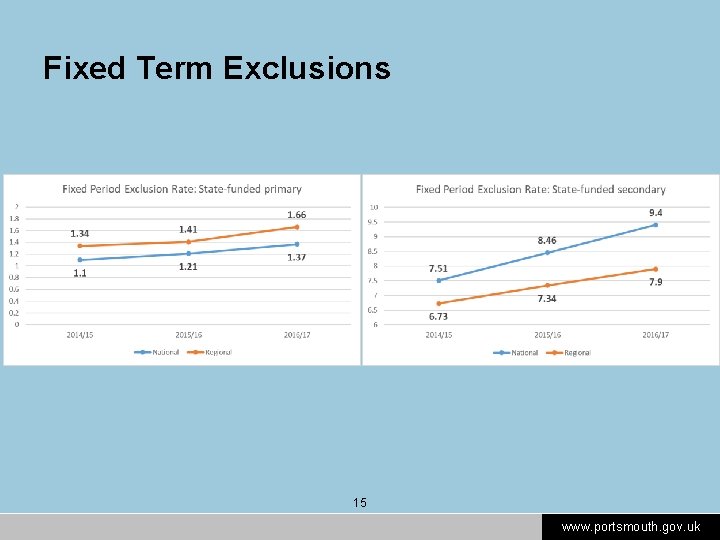
Exclusions: context • National and regional rise in fixed period exclusions after a previous decline • Permanent exclusions remain low but are increasing – fuelled by stretched school budgets and lack of AP / PRU places • Timpson Review of School Exclusions May 2019. Recommendations included: – Schools accountable for the results of pupils they exclude and will have greater control of funding and commissioning of AP – Promoting role of AP, expansion of provision, PRUs to be renamed – Beefed-up oversight for LAs? – Revision of the 45 day suspension limit – Updated Df. E statutory guidance including new guidance on offrolling – Ofsted to consistently recognise inclusive schools 14 www. portsmouth. gov. uk
Fixed Term Exclusions 15 www. portsmouth. gov. uk
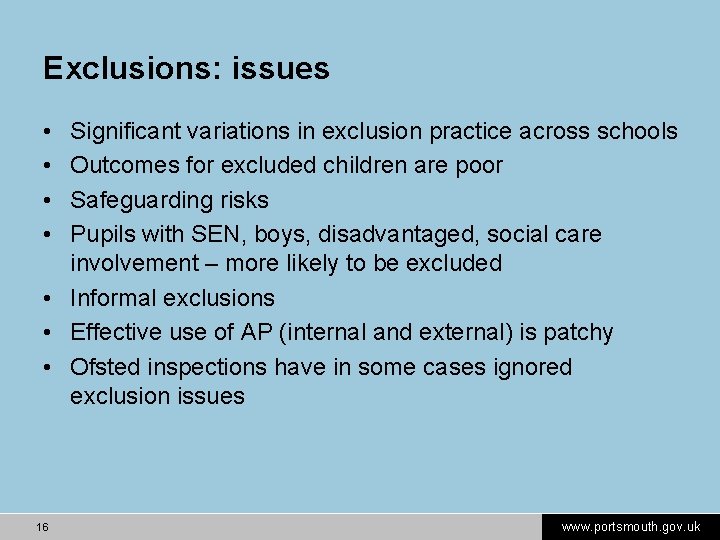
Exclusions: issues • • Significant variations in exclusion practice across schools Outcomes for excluded children are poor Safeguarding risks Pupils with SEN, boys, disadvantaged, social care involvement – more likely to be excluded • Informal exclusions • Effective use of AP (internal and external) is patchy • Ofsted inspections have in some cases ignored exclusion issues 16 www. portsmouth. gov. uk
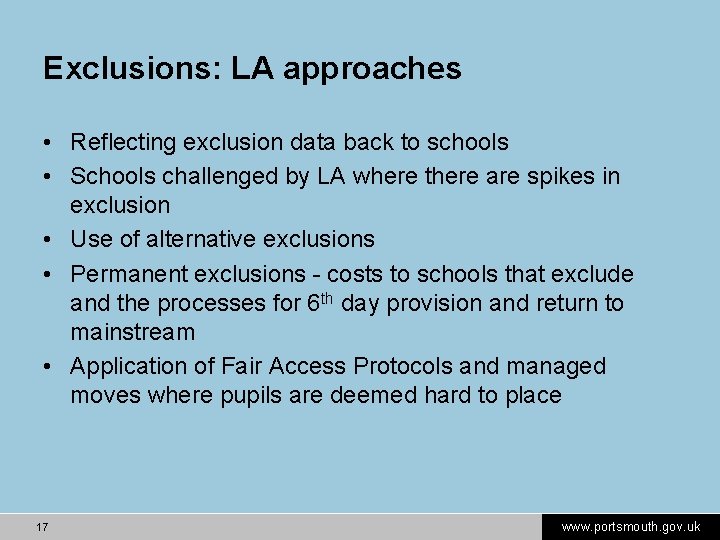
Exclusions: LA approaches • Reflecting exclusion data back to schools • Schools challenged by LA where there are spikes in exclusion • Use of alternative exclusions • Permanent exclusions - costs to schools that exclude and the processes for 6 th day provision and return to mainstream • Application of Fair Access Protocols and managed moves where pupils are deemed hard to place 17 www. portsmouth. gov. uk
Next steps / recommendations • Establish a regional network to continue this work and share good practice • Provide a regional voice to lobby and influence e. g. implementation of Timpson’s recommendations; further calls to strengthen LA’s oversight of EHE, etc • Create shared directory – LA guidance documents, protocols, etc 18 www. portsmouth. gov. uk