
South Dublin Local Regional Drug Task Forces Presentation
South Dublin Local & Regional Drug Task Force’s Presentation to South Dublin Joint Policing Committee ‘Information is that which reduces Uncertainty’ 15 th May 2009 South Dublin Local and Regional Drug Task Force's

Background to Local/Regional Drug Task Force’s Local & Regional Drug Task Force’s stem from the National Drug Strategy 2001 -2008 South Dublin Local and Regional Drug Task Force's

National Drug Strategy Overview National Drugs Strategy 2001 -2008 “To significantly reduce the harm caused to individuals and society by the misuse of drugs through a concerted focus on supply reduction, prevention, treatment & research” Supply Reduction Prevention Treatment South Dublin Local and Regional Drug Task Force's Research

NATIONAL DRUGS STRATEGY 2001 – 2008 Structures Cabinet Committee on Social Inclusion DRUGS STRATEGY UNIT, D/CR&GA Interdepartmental Group on Drugs (IDG) National Drugs Strategy Team 14 Local Drug Task Forces 10 Regional Drug Task Forces Over 340 Projects in operation 165 Projects in operation South Dublin Local and Regional Drug Task Force's
National Drugs Strategy 20092016 2008 Consultation Process New Substance Use Strategy expected inclusive of Alcohol South Dublin Local and Regional Drug Task Force's
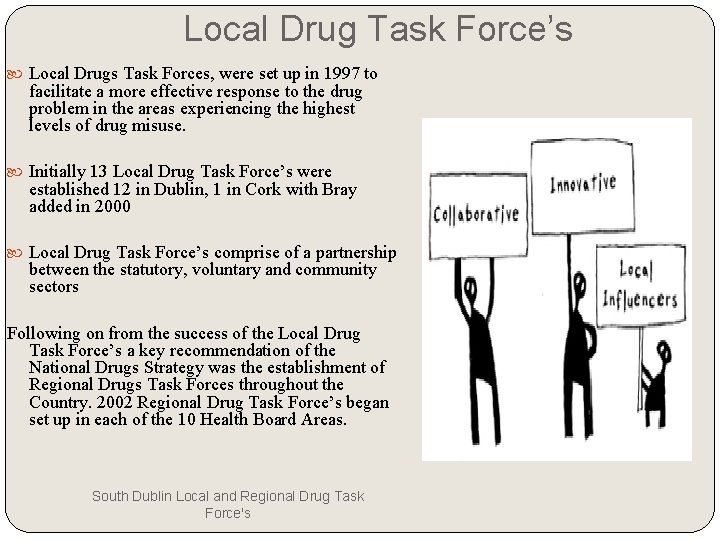
Local Drug Task Force’s Local Drugs Task Forces, were set up in 1997 to facilitate a more effective response to the drug problem in the areas experiencing the highest levels of drug misuse. Initially 13 Local Drug Task Force’s were established 12 in Dublin, 1 in Cork with Bray added in 2000 Local Drug Task Force’s comprise of a partnership between the statutory, voluntary and community sectors Following on from the success of the Local Drug Task Force’s a key recommendation of the National Drugs Strategy was the establishment of Regional Drugs Task Forces throughout the Country. 2002 Regional Drug Task Force’s began set up in each of the 10 Health Board Areas. South Dublin Local and Regional Drug Task Force's

Local and Regional Drug Task Force’s operating within South Dublin Local and Regional Drug Task Force's

Task Force Boundary Map Clondalkin Tallaght South Dublin Local and Regional Drug Task Force's D 12
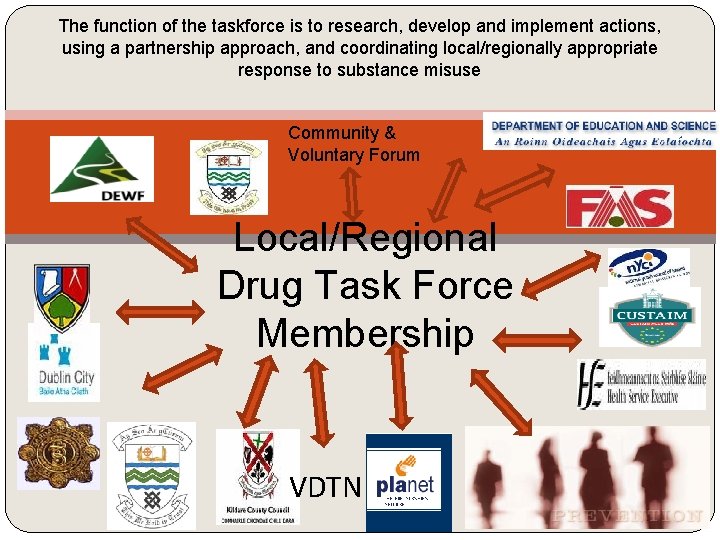
The function of the taskforce is to research, develop and implement actions, using a partnership approach, and coordinating local/regionally appropriate response to substance misuse Community & Voluntary Forum Local/Regional Drug Task Force Membership VDTN

Clondalkin Drugs Task Force Presentation to SDCC Joint Policing Committee Co-ordinator: Sandra Mullen
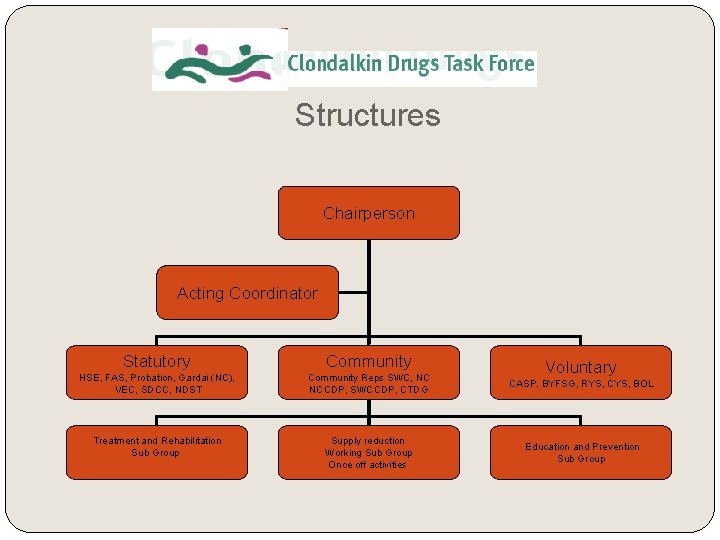
Structures Chairperson Acting Coordinator Statutory Community HSE, FAS, Probation, Gardai (NC), VEC, SDCC, NDST Community Reps SWC, NC NCCDP, SWCCDP, CTDG CASP, BYFSG, RYS, CYS, BOL Treatment and Rehabilitation Sub Group Supply reduction Working Sub Group Once off activities Education and Prevention Sub Group Voluntary
Prevalence and Demographics Approx 1, 591 opiate users in Clondalkin Profile of problematic drug users (esp. opiates): male, Irish, single, unemployed, early school leaver, aged 15 – 24 years Recreational cocaine users: all age groups and social strata Begin opiate use at 20 years, do not seek treatment until late 20’s early 30’s South Dublin Local and Regional Drug Task Force's

Polydrug use patterns Poly drug use is the norm Heroin + cannabis/cocaine/benzos/alcohol/crack (descending order of popularity) Recreational cocaine +Cannabis/Alcohol Injecting Cocaine by injecting heroine users (no of times inject in one session (avg = 2, rang 1 -10 times) Group setting = Health implications 50% injected mixture of heroine & cocaine South Dublin Local and Regional Drug Task Force's
Contemporary Clondalkin drug scene More problematic every year Dealing seen as lucrative, attractive career Dealing obvious in all public spaces All types of drugs mostly dealt on streets Drugs more available than 5 years ago Droughts: prices rise, quality decreases, addiction to other drugs Children ( 8 - 10 years) delivering drugs Consumption of drugs more invisible (except cocaine-night time social venues) Most drugs consumed in others company Less injecting equipment in area: sin bins 1 st encounter – cannabis-14 yrs with friend 1 st injected heroine 20 years Most have history of drug use in family South Dublin Local and Regional Drug Task Force's
Strategic Review 2008 - 2013 Research into the Nature and Extent of Drug Misuse in Clondalkin 2007 Drug related violence has increased significantly particular gangland crime Increase in gun crime associated with drug deaths as well as hostility between drug dealing gangs Concerns of the wider community appear to be focussed on crime element of drug use and visibility of drug dealing. Fear of using public amenities parks shops walkways. Increase in physical assault on drug users Normalisation of drug misuse and associated crime particularly amoung young people ( 8 – 12 yrs)
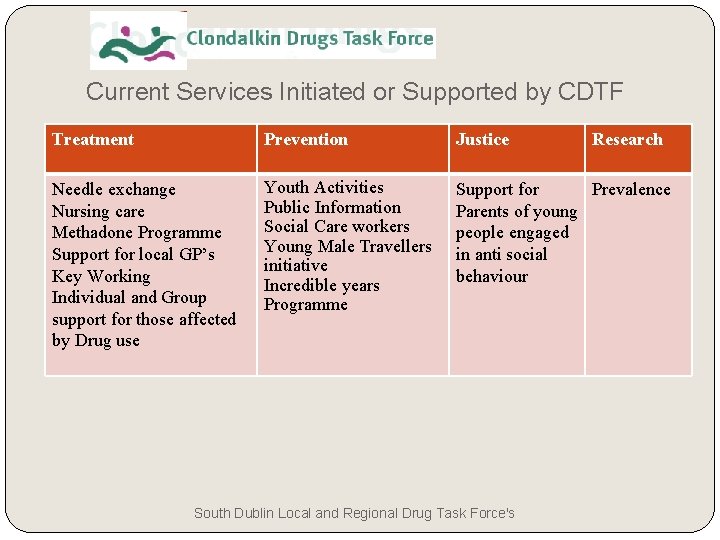
Current Services Initiated or Supported by CDTF Treatment Prevention Justice Needle exchange Nursing care Methadone Programme Support for local GP’s Key Working Individual and Group support for those affected by Drug use Youth Activities Public Information Social Care workers Young Male Travellers initiative Incredible years Programme Support for Prevalence Parents of young people engaged in anti social behaviour South Dublin Local and Regional Drug Task Force's Research
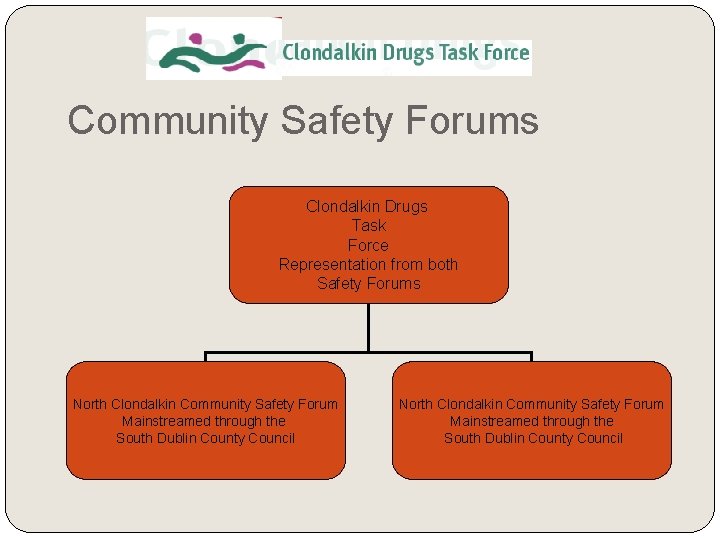
Community Safety Forums Clondalkin Drugs Task Force Representation from both Safety Forums North Clondalkin Community Safety Forum Mainstreamed through the South Dublin County Council
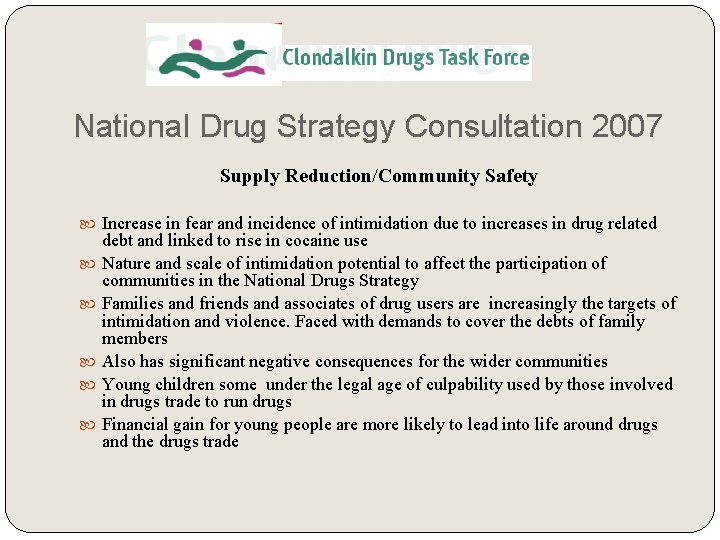
National Drug Strategy Consultation 2007 Supply Reduction/Community Safety Increase in fear and incidence of intimidation due to increases in drug related debt and linked to rise in cocaine use Nature and scale of intimidation potential to affect the participation of communities in the National Drugs Strategy Families and friends and associates of drug users are increasingly the targets of intimidation and violence. Faced with demands to cover the debts of family members Also has significant negative consequences for the wider communities Young children some under the legal age of culpability used by those involved in drugs trade to run drugs Financial gain for young people are more likely to lead into life around drugs and the drugs trade
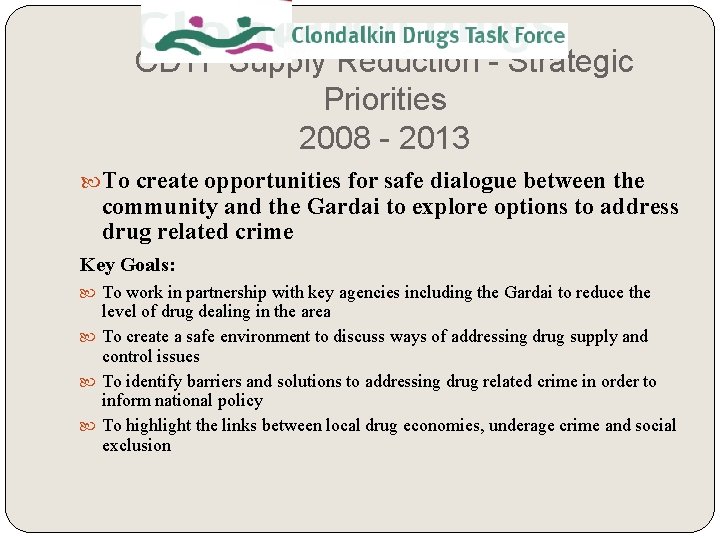
CDTF Supply Reduction - Strategic Priorities 2008 - 2013 To create opportunities for safe dialogue between the community and the Gardai to explore options to address drug related crime Key Goals: To work in partnership with key agencies including the Gardai to reduce the level of drug dealing in the area To create a safe environment to discuss ways of addressing drug supply and control issues To identify barriers and solutions to addressing drug related crime in order to inform national policy To highlight the links between local drug economies, underage crime and social exclusion
Clondalkin Drugs Task Force Indicative actions 2008 - 2013 Create safe space for ongoing dialogue with Gardai at Senior level to explore appropriate responses at local and national level Explore Models of good practice internationally Develop pilot initiative for young people ( 12 – 18 yrs) involved in drug related crime Garda Family Liaison officer in each local area
Acting Co-ordinator: Grace Hill South Dublin Local and Regional Drug Task Force's
Demographics Dublin 24 area and Whitechurch Population of 80, 000 46% aged under 25 years 1 in 2 people aged over 15 completed their education at lower secondary level Significant increase in numbers of households Significant increase in numbers of 3 rd country nationals Extent of Drug Misuse Steady increase in numbers presenting for treatment: 2004– 6 70% opiate users; 12% alcohol users; 11% cocaine users Poly drug use high 2005: 983 people in receipt of methadone treatment People presenting for treatment more likely to be unemployed; left school at or before Junior Cert South Dublin Local and Regional Drug Task Force's
ent Treatm es challeng w e n , s : s e rotocols d Progr p o d o e G e r g. 1 fa t; um use o ovision to each clien es; m i t p O r p urc 2. sed reso -ordinate Co y-ba ommunit c f o ers; e s u tion. Best key work d n a plementa w o im fl d n n o a ti a ion Inform d quality n i. e. posit a , e e u c i g t lo c a dia pr Further t to best ession r en s to prog ommitm y c a n w i a h t t a n i p en 3. Ma strength – s y a w 4. Path REHABI LITATIO Identify N Barriers & Progres sion, Fle Gaps xibility & Focus Case Ma nageme nt Appro Profess a ional De velopme ch Options nt for Serv ice User s Supply & Redu ction Raise A warene 2) ss Annual Commu Educatio nity n I n / Prevent formatio 1. Outreac ion n h workers Event 3) 2. Improve Increas awarenes e confid s-raising f ence in 3. Build on T a llaght G or parents schools / ardai communit 4) 4. Efficient I ncrease y links. implemen number tation of s based ed C of o c mmunit hoolucation y G 5. DEWF q uards in Tallagh uality of s t tandards guidelines 5) & SPHE Dial to s top Dru 6. Researc 6) gs Cam h – high r I d e paign n t is i fy Targe k young p 7. Maintain e t o Education “Hot Sp 7) p Designa ots” Support in le Tallaght ted Gar Fo e w Force's da for Ta South Dublin Local and Regional Drugrc. Task sk ork 1)
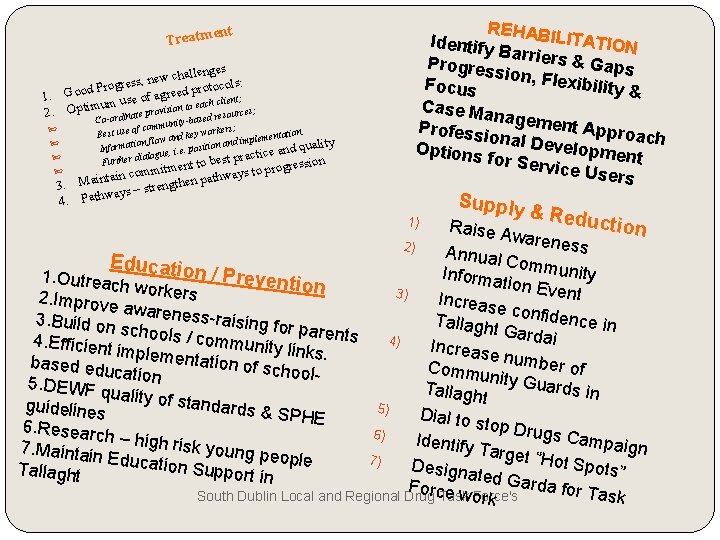
Supply & Reduction 1) 2) 3) 4) 5) 6) 7) Raise Awareness Annual Community Information Event Increase confidence in Tallaght Gardai Increase number of Community Guards in Tallaght Dial to stop Drugs Campaign Identify Target “Hot Spots” Designated Garda for Task Force work South Dublin Local and Regional Drug Task Force's
Tallaght Dial to Stop Drug Dealing Campaign
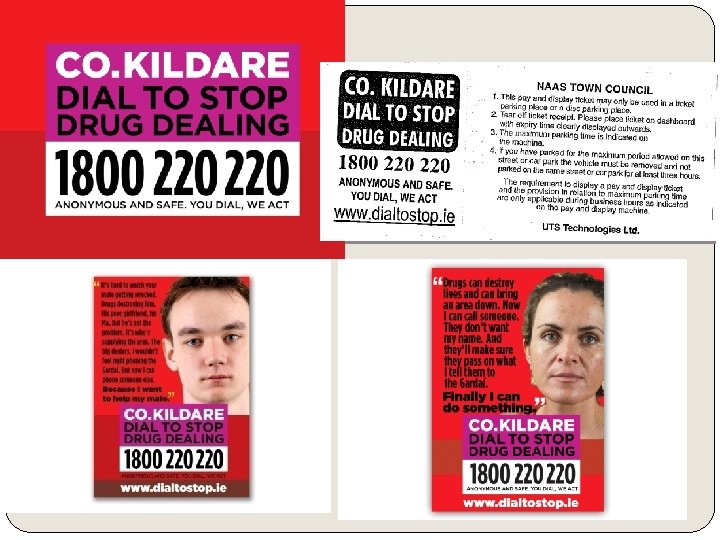
The Dial–to-Stop Drug Dealing Campaign was designed to encourage people to provide, through a confidential telephone line any information, which they may have on drug dealing.
Campaign Elements Target market: entire community, niche marketing for specific groups Literacy: critical issue Media: multi-media, poster, leaflet, radio, schools, fridge magnet… Production: high quality and meaningful, simple and evocative Message: clear, direct, focused, action based, confidentiality assurances Branding: strong, relevant, meaningful: ‘dial to stop drug dealing’ Face: relevant local
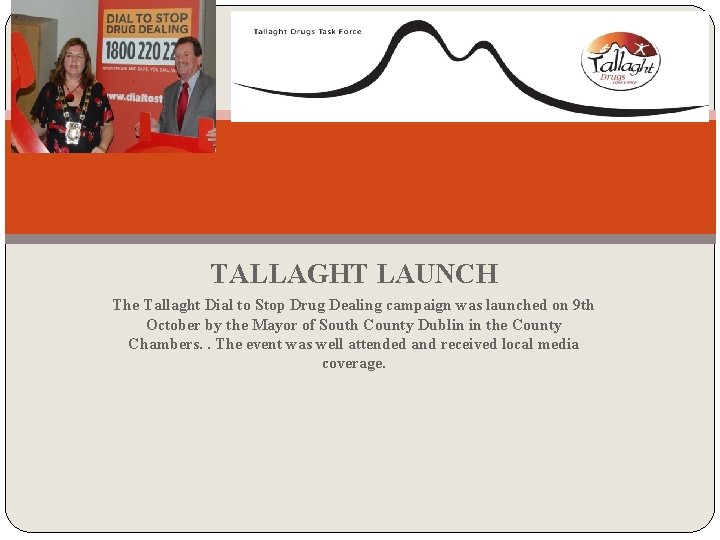
TALLAGHT LAUNCH The Tallaght Dial to Stop Drug Dealing campaign was launched on 9 th October by the Mayor of South County Dublin in the County Chambers. . The event was well attended and received local media coverage.
. NATIONAL CAMPAIGN The Tallaght campaign was part of phase 1 of the national campaign, run across 5 Local & Regional Drugs Task Force areas (Tallaght, Blanchardstown, Dublin North East, North Inner City and South Western RDTF) with funding being provided by the Department of Community, Rural and Gaeltacht Affairs (€ 100, 000) and the Department of Justice, Equality and Law Reform (€ 50, 000).
RESULTS! Overall the number has received over 1900 calls which has generated over 500 information reports to the Gardai. An excess of 42 reports were made directly to the Tallaght Garda station during the course of the campaign. DIAL to STOP - Call Reports Received Sep-08 Oct-08 Nov-08 Dec-08 Jan-09 Feb-09 Mar-09 Apr-09 23 10 5 6 10 7 3 3 Total 64
3. 1. 3. Should the Public be Encouraged to help Gardaí Q. Do you think the public should be encouraged to help the Gardaí with the drugs problem in this area? Base: sample who answered ‘yes definitely’ Growth in all areas except B. Remarkable in DNE & T.

2. 5. 2. Level of Intimidation of Local People Q. Has the level of intimidation of local people by drug dealers increased, decreased or stayed the same over the past two years? Base: sample who answered ‘increased’ Again, T and SW show significant upward shift in perception in past 2 months.

3. 2. 1. Satisfaction with Gardaí Q. How satisfied are you with the way in which the Gardaí are handling the drugs problem in this area? Base: total sample combining all 4 areas Restrained satisfaction with the Gardaí. One fifth are unsure.
Dublin 12 Local Drug Task Force An Overview Aoife Fitzgerald Co-ordinator
Current Snap Shot of D 12 Population 55, 699 (2006 census) D 12 becoming more deprived despite the Celtic tiger - 12 ED’s experiencing worsening deprivation. Unemployment in ‘ 06 nearly twice national average in Crumlin/Drimnagh. Education rates very low in parts of Crumlin, Drimnagh and Walkinstown Greenhills. Only 9% of people in Kimmage A have completed 3 rd level education compared to national average of 30% In 2009 3095 on Job seekers allowance. 2037 of these are in the last 6 months. 1, 383 single parent family payments. 614 are to parents with more than one child
Nature and extent of Drug Misuse in D 12 419 people from Dublin 12 were accessing methadone treatment. (HSE&CTL April-June 2008), The vast majority of clients were receiving methadone through clinics and their GPs. Following years of declining client numbers, there was a substantial increase of 66 new clients between 2006/2007.
Trends In Drug Use In D 12 Increase of 43 people presenting for opiate treatment from 2006 -2007. Increase of 221% presenting for cocaine treatment in 2007 (NDTRS). Cocaine is now the second highest drug dependency presented for treatment. The numbers presenting for alcohol treatment accounted for 15% of all clients. Poly Drug Use- In 2007 65% reported that they use more than one drug with 23% using three drugs. Increase of 27% of those injecting between 2006 and 2007. Increase of 21% in those that reported sharing equipment between 2006 and 2007
Availability of Drugs in D 12 Drugs are easily available in Dublin 12 The price of drugs has dropped considerably in recent years including Crack Cocaine and methamphetamine Public places identified for drug dealing including: Crumlin Shopping Centre, Pubs, Schools and beside the grand canal and luas stops in Drimnagh In 2008 there were 378 arrests for possession of drugs and /or intent to supply in Dublin 12 compared to 273 in 2007 Ø 28 of those arrested were under the age of 17 Ø 87 were aged between 17 and 21 Ø 158 were over the age of 21 Significant rise in seizures of drugs in D 12 in 2008 with an overall street value of € 6, 211, 003 compared to € 1, 077, 743 in 2006.
Availability of Drugs in D 12 In 2008 there were 378 arrests for possession of drugs and /or intent to supply in Dublin 12 compared to 273 in 2007 28 of those arrested were under the age of 17 87 were aged between 17 and 21 158 were over the age of 21 There was a significant rise in seizures of drugs in D 12 in 2008 with an overall street value of € 6, 211, 003 compared to € 1, 077, 743 in 2006.
Strategic Priorities Supply Control Overall Strategic Aim To ensure that drug supply and the impact of drug dealing is reduced in Dublin 12. Strategic Objectives Work with others to ensure that National Policy Frameworks and iniativesto reduce drug dealing are implemented in D 12 such as the Joint Policing Committees and the Dial to Stop Drug Dealing programme. Continue to be involved in and develop the Community Safety Partnership Develop structures to link the outcomes of the CSP to the Dublin South City and South Dublin Joint Policing Committees. Continue to work with the Gardai to respond to drugs and associated crime in Dublin 12. Encourage and promote sense of safety and well being in Dublin 12.

D 12 Community Safety Partnership Established late 2006 Membership Community An Garda Siochana Dublin City Council South Dublin County Council Public Rep Dublin 12 LDTF Funding- € 12, 000 per annum
D 12 Community Safety Partnership Aim: “To create a partnership structure and approach involving all relevant agencies and local community to promote a safer environment in Dublin 12”
D 12 Community Partnership Objectives: Partnership approach involving all relevant stakeholders Improve Communications between Agencies and Community Identify local concerns in relation to community safety Prepare for future local developments in policing in light of the Garda Siochana Act 2005 Identify response to drug and alcohol issues using interagency and community development approach
D 12 Community Safety Partnership Workplan: Community consultation April 2008 helped inform the current workplan: Ø Promote neighbourhood watch Ø Second Club 4 U to be established Ø Crime Prevention through Environmental Design Ø Youth representation Ø Senior Citizen Representation Ø Dial to Stop Drug Dealing campaign Ø Promote positive image of Dublin 12 Ø Engage with senior citizens Ø Identification of Public Order Hotspots §

Achievements to Date: Ø Two community consultation workshops Ø Involvement in Drug Awareness campaigns in 08 and 09 Ø Crime prevention evening for the elderly Ø Launch of dial to stop drug dealing campaign Ø Launch of “Positively Dublin 12” campaign Ø Ongoing attention to safety in D 12
Steven Joyce- Development Worker South Dublin Local and Regional Drug Task Force's
The Regional Drug Task Force (RDTF) The success of the Local Drugs Task Forces prompted the Government to extend the Task Force model to other parts of the country The role of the RDTFs is to research, develop and implement a co-ordinated response to drug misuse through a partnership approach. South Dublin Local and Regional Drug Task Force's

SWRDTF Lucan-Newcastle-Rathcoole. Saggart-Ballinascorney. Rathmines-Ternure- Rathfarnhan - Knocklyon South Dublin Local and Regional Drug Task Force's
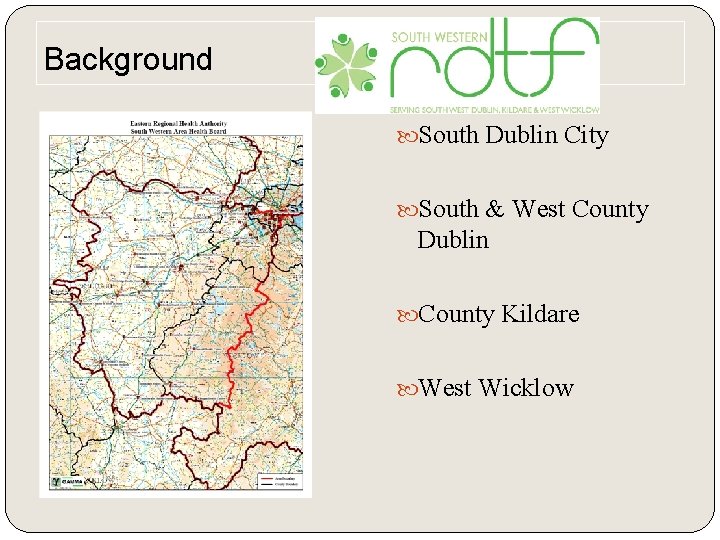
Background South Dublin City South & West County Dublin County Kildare West Wicklow
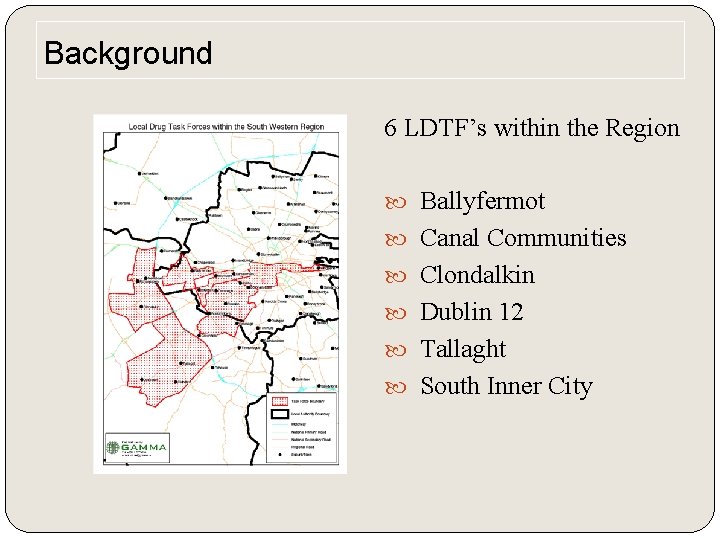
Background 6 LDTF’s within the Region Ballyfermot Canal Communities Clondalkin Dublin 12 Tallaght South Inner City
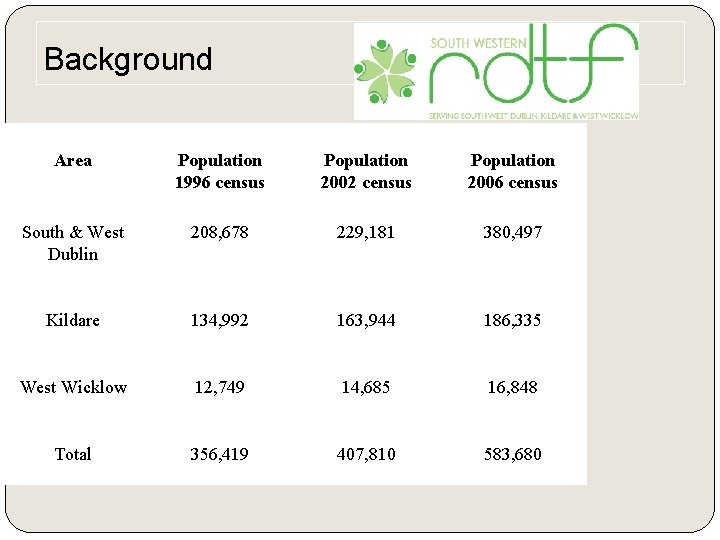
Background Area Population 1996 census Population 2002 census Population 2006 census South & West Dublin 208, 678 229, 181 380, 497 Kildare 134, 992 163, 944 186, 335 West Wicklow 12, 749 14, 685 16, 848 Total 356, 419 407, 810 583, 680
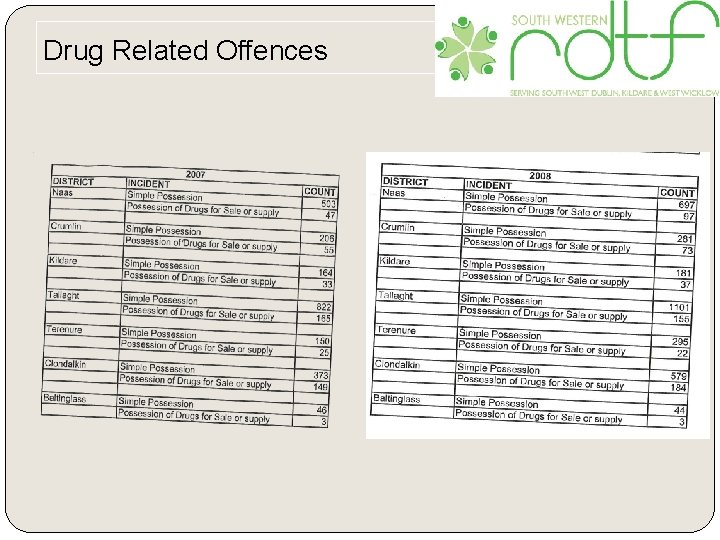
Drug Related Offences
Focus of the RDTF Prevention & Education Sub-group Treatment & Rehabilitation Sub-group Supply & Justice Sub-group Work groups convened as necessary Urban, sub-urban and rural geography to consider South Dublin Local and Regional Drug Task Force's
Supply & Justice Sub-group Members – Supply & Justice Sub-group • Representatives from • Community Sector • An Garda Síochána • Revenue’s Customs Service • A full picture of Drug Misuse can only be achieved by including persons presenting for treatment in conjunction with Garda and Customs Seizures. • Difficulty associated with overlapping areas of responsibility; HSE, An Garda Síochána, County Boundaries etc.
Actions JLO Counseling Supports Fund Aims - To identify patterns of drug use within the Region - To assess the nature and extent of Drug Misuse in the region - To exchange information to stem the sale and supply of drugs within the region. Facilitate sharing of information between drug squads across the region Develop protocols for justice related projects and drug information/awareness prevention Host seminar on Community Policing Kildare Dial to Stop Drug Dealing South Dublin Local and Regional Drug Task Force's
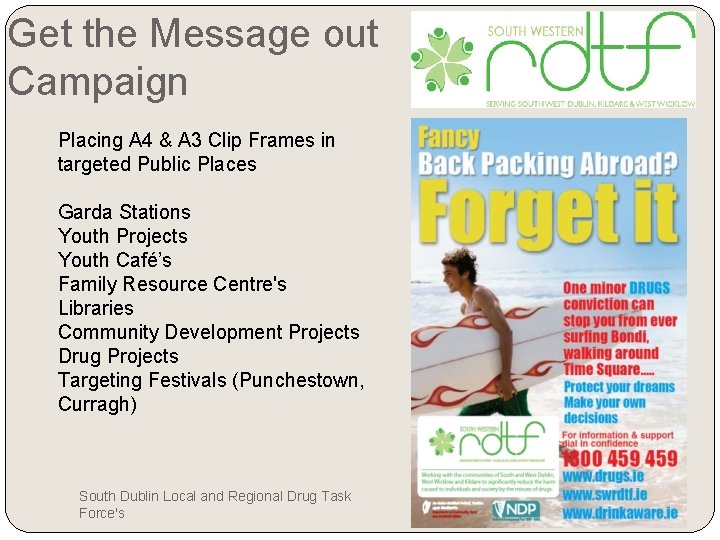
Get the Message out Campaign Placing A 4 & A 3 Clip Frames in targeted Public Places Garda Stations Youth Projects Youth Café’s Family Resource Centre's Libraries Community Development Projects Drug Projects Targeting Festivals (Punchestown, Curragh) South Dublin Local and Regional Drug Task Force's
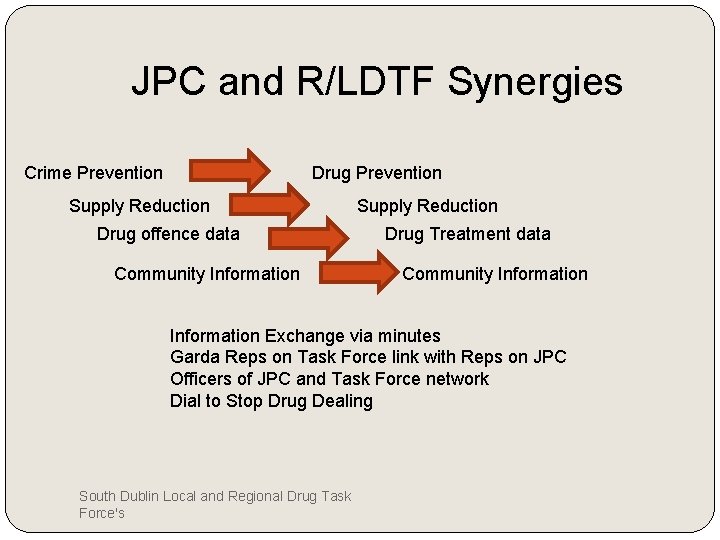
JPC and R/LDTF Synergies Crime Prevention Drug Prevention Supply Reduction Drug offence data Community Information Supply Reduction Drug Treatment data Community Information Exchange via minutes Garda Reps on Task Force link with Reps on JPC Officers of JPC and Task Force network Dial to Stop Drug Dealing South Dublin Local and Regional Drug Task Force's
The Following Extracts from JPC Guidelines Highlight the need for synergies between Task Force’s and JPC Functions “The joint policing committee’s function is to serve as a forum for consultations, discussions and recommendations on matters affecting the policing of the local authority’s administrative area, and in particular to – (a) keep under review (i) the levels and patterns of crime, disorder and anti-social behaviour in that area (including the patterns and levels of misuse of alcohol and drugs), (This is included in the Terms of Reference for Task Forces) and (ii) the factors underlying and contributing to the levels of crime, disorder and antisocial behaviour in the area, (Similar to the Prevention Strategies of the Task Force’s) South Dublin Local and Regional Drug Task Force's
In accordance with action 11 of the National Drugs Strategy 2001 – 2008, Guidelines for the operation of local policing fora in Local Drugs Task Force areas, tailored to address particular issues faced by those areas, will be issued separately prior to their establishment. Guidelines for the operation of local policing fora in other areas will issue subsequently when JPCs are well established and prior to their establishment (Concerns Regarding NON- Local Drug Task Force Areas) Possible issues a JPC could focus on are: illegal drugs; CCTV; public order; anti-social behaviour; underage drinking; drinking in public places; consideration of drink licensing applications; vandalism; safer neighbourhoods; estate management (including tenancy enforcement and 22 public lighting); youth diversion; traffic management; planning of major events attracting large crowds, eg. fleadhanna; casual trading; litter; community-based crime prevention initiatives. Consideration of issues should be data and research based – South Dublin Local and Regional Drug Task Force's
- Slides: 60