
South Carolina The Beautiful Palmetto State Chapter 9

South Carolina: The Beautiful Palmetto State Chapter 9: The Civil War STUDY PRESENTATION © 2013 Clairmont Press
Section 1: The Coming of War Section 2: The Early Fighting Section 3: South Carolina during the War Section 4: The War Roars to a Conclusion
Section 1: The Coming of War Ø Essential Question: How did conflicting beliefs lead to the Civil War? 3
Section 1: The Coming of War Ø What terms do I need to know? • border states • Confederate States of America 4
The Election of 1860 Ø 1860 – The National Democratic Party held a convention in Charleston; a candidate could not be produced, so the convention met later in Baltimore and split into: (1) Northern Democrats – nominated Stephen A. Douglas (2) Southern Democrats – nominated John C. Breckinridge Ø The Republican Party nominated a moderate on the issue of slavery, Abraham Lincoln. Ø The Constitutional Union Party, which arose in border states, nominated someone they believed would hold the Union together, John Bell. Ø Lincoln won all the Northern states, and he had electoral votes to give him presidential victory. 5
Secession Ø 1860 – A convention was called by South Carolina leaders to consider secession. • a unanimous vote in favor of secession, 169 -0 Ø The “Declaration of the Causes of Secession” indicated that the election of President Abraham Lincoln was the main reason for South Carolina’s declaring independence from the United States. 6
Forming the Confederate States of America Ø 1861 – • Six other states followed South Carolina out of the Union: Florida, Georgia, Alabama, Mississippi, Louisiana, Texas. They became the Confederate States of America. Ø A Confederate Constitution was created, which was similar to United States Constitution, but it placed greater emphasis on states’ rights. Ø Jefferson Davis was elected president and Alexander H. Stephens was elected vice-president. Ø The compromise failed, and political struggle moved toward fighting when Lincoln became President. 7
The Fighting Starts Ø As the states seceded, they took control of most federal property and forts within their borders. Ø Star of the West, a supply ship, was fired upon by Carolinians in January, 1861; following was a bombardment of Fort Sumter, in Charleston harbor. Ø April 12, 1861 – The Civil War began. Ø Some Carolinians worried about what they started, but they felt that their cause was just. Ø For several months, eager volunteers from South Carolina and other Southern States joined the Confederate Army. 8
The Border States Ø Lincoln’s response to the Fort Sumter attack was to call for 75, 000 volunteers to put down rebellion. Ø 4 border states (Virginia, Tennessee, Arkansas, North Carolina) joined the Confederacy after Lincoln’s response to put down rebellion. Ø Troops were sent by Lincoln into the other 4 border states (Maryland, Delaware, Kentucky, Missouri); they remained in the Union. Ø The Confederacy consisted of 11 states and a new capital at Richmond, Virginia. 9
Section 2: The Early Fighting Ø Essential Question: How did events of the early 1860 s affect the war? 10
Section 2: The Early Fighting Ø What terms do I need to know? • • total war blockade freedmen casualties conscripted ironclad emancipation Emancipation Proclamation 11
Introduction & The Early War in South Carolina Ø The Confederacy won several early battles, but they underestimated the political will and overall determination of Northern leaders. Ø first modern total war Ø November, 1861 – Federal troops captured Beaufort and several Sea Islands. • planters moved out; slaves left behind declared “contraband of war” – therefore, free • “Port Royal Experiment” – former slaves worked abandoned plantations • schools for freedmen built and run by Northerners • Over 5, 000 black soldiers from South Carolina served in the Union Army. • Robert Smalls was noted for his courage in the Civil War and was the first Black Captain of a United States Vessel. 12
The Broader War Ø Military strategy of Confederacy: • (1) Use army to defend South against Union efforts to prevent secession • (2) Had advantage of home turf • (3) Shorter supply lines, psychological benefit – defending home Ø Military strategy of Union: • (1) Capture Confederate capital (Richmond, VA) • (2) Cut Confederacy in two by taking Mississippi River Valley, thus isolating Texas, Arkansas, Louisiana • (3) Blockade coastline preventing supplies from pouring into South Ø Some battles involved more soldiers and causalities than many American battles in history. 13
South Carolina’s Fighting Men Ø Men in South Carolina volunteered eagerly at first for military duty. Ø Many valiant Carolinians fought in the war. Ø Wade Hampton III as most illustrious hero Ø Other prominent Carolinians in the fight included: • Matthew C. Butler • Ellison Capers • Confederate Army Brigadier General, States Rights Gist 14
The Union Advantage Ø Advantages of the North: • much larger population to support war effort and from which to draw troops • industrial development of the North • North had 70% of nation’s railroads (better supplied with guns, equipment, boots, clothing) • Union Navy’s blockade of Southern States stopped most trade Ø The Confederate Army was short of critical supplies and tried to transfer some vessels to ironclads in an effort to challenge blockade ships. 15
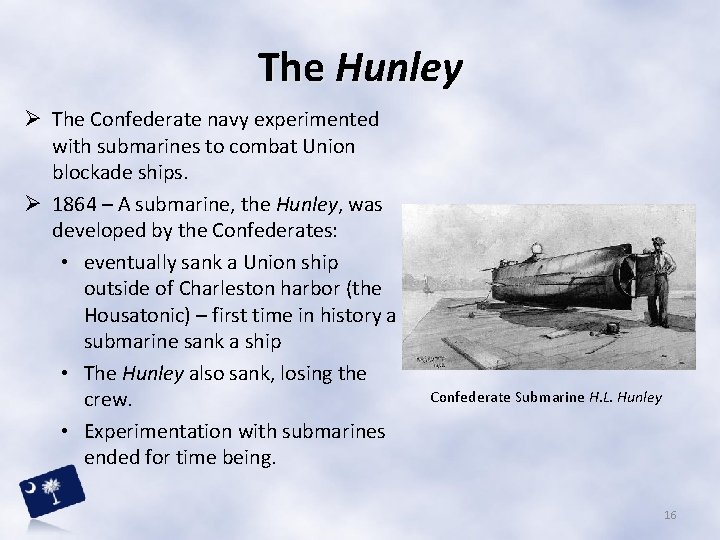
The Hunley Ø The Confederate navy experimented with submarines to combat Union blockade ships. Ø 1864 – A submarine, the Hunley, was developed by the Confederates: • eventually sank a Union ship outside of Charleston harbor (the Housatonic) – first time in history a submarine sank a ship • The Hunley also sank, losing the crew. • Experimentation with submarines ended for time being. Confederate Submarine H. L. Hunley 16
No Foreign Assistance Ø Confederate leaders counted on assistance from Europe, but two developments defeated that hope: • (1) European manufacturers found new sources of cotton in Egypt and India. • (2) Lincoln used the issue of emancipation to keep Britain, France, and others from helping the South; Europeans were strongly opposed to slavery. 17
The Emancipation Proclamation Ø September, 1862 – Emancipation Proclamation announced by Abraham Lincoln: • To take effect in 1863 (unless Southern states gave up rebellion against United States) • Seen, by Lincoln, as a necessary step to win the war • Slavery not entirely destroyed (only to states still in rebellion against United States on January 1, 1863) • Huge numbers of slaves flocked to Union armies as Union troops advanced into Confederate territory. 18
Section 3: South Carolina during the War Ø Essential Question: How did fighting affect the lives of South Carolinians? 19
Section 3: South Carolina during the War Ø What terms do I need to know? • hoarding • speculation • inflation 20
Introduction & South Carolina Government in the Confederacy Ø Challenging situations faced South Carolina. Ø Governor and Legislature unsupported by public opinion in South Carolina Ø Measures of State government to prepare for war: • Initiated a draft; required slave owners to provide some slaves to assist • Placed restrictions on making/selling alcoholic beverages • Bought military equipment from foreign countries • Encouraged businesses to produce iron products/ammunition for military use Ø Most actions taken were needed for the war effort, but they restricted individual freedom and angered citizens. 21
The Homefront in South Carolina Ø The condition of a homefront often contributes to the outcome of a war. Ø Situation of homefronts worsened during War: • most able-bodied white men (18 -45 years old) served in army - many never returned, many came back injured Ø Maintenance of the homefront by women, older men, and children: • Plowed fields, tended animals, produced food from garden • Sometimes worked without adequate animal power • Children took early responsibility for their family’s survival. 22
The Role of Women on the Homefront Ø Women were long-suffering, overworked heroines of homefront: • Ran farms, served as nurses, teachers, factory workers, etc. • Organized dances, raffles, bake sales, etc. , to raise money for war effort and to raise community spirit • Kept soldiers supplied with clothes; prepared food boxes • Set up hospitals for wounded/dying soldiers 23
Rich versus Poor Ø Small farmers and working poor in towns experienced suffering during war: • Shortage of food – often a problem • The rich could afford high prices (could have necessities and often, luxuries). • Unfairness of military draft noticed by the poor (one male was exempt from service for every 20 slaves the family owned; richer man could legally hire another man to take his place in the army) 24
Scarcity on the Homefront Ø Shortages and high prices often caused by hoarding and speculation: • Considered unpatriotic (ignored desperate needs of many people) • Weakened support for war (Confederate government failed to control) Ø most damaging shortages - salt, leather Ø other items difficult to obtain - ammunition for hunting, medicine, meat, flour, candles, soap, sugar, coffee 25
Money and Inflation Ø The Confederate government printed lots of money, but they bought less as war continued. Too much money was in circulation. Ø South Carolina had little confidence in the Confederate government in Richmond. Ø Prices rose more rapidly than wages (known as inflation). Ø Money bought less. Ø Many left the army as homefront conditions worsened. 26
Slavery during the War Ø Most slaves lived on plantations and farms and were therefore affected in similar ways as whites. Ø Accounts of slave owners reveal that: • Slaves became less reliable, trustworthy, and unruly • Some helped escaping prisoners, directing them to Union-held territory • Many remained loyal to their owners Ø Slave disobedience and rebellion was a major worry. 27
Section 4: The War Roars to a Conclusion Ø Essential Question: What were the effects of the war’s conclusion on South Carolina? 28
Section 4: The War Roars to a Conclusion Ø What terms do I need to know? • siege • forage 29
The Battlefronts Ø July 1 -3, 1863 – General Lee engaged major Union forces at Gettysburg, Pennsylvania. • one of greatest battles of Civil War • involved about 160, 000 men Ø Union General Ulysses S. Grant captured Vicksburg, Mississippi, after conducting a siege that lasted 47 days. Ø By July 4, 1863, the Confederacy was cut in two. Ø General William Tecumseh Sherman’s army cut a long, broad strip across Georgia 60 miles wide - burning Atlanta, capturing Savannah, destroying property and economic production. This shortened the Civil War. 30
Sherman Storms through South Carolina Ø February 1, 1865 – Sherman’s march from Savannah to the middle of South Carolina: • Strategy was to disable South Carolina • Army lived off land through forage of countryside. • Roads, bridges, railroads badly damaged Ø Concept of total war now fully realized: • Great suffering placed on people of South Carolina • Feelings of resentment left, lasting for generations 31
Damage to Towns and Plantations Ø Sherman’s army left a thirty-mile wide path of destruction across the heart of South Carolina. Ø Twenty other small towns and numerous plantations along the army’s route experienced fires and looting. Ø Heartbreaking episode: burning much of Columbia Ø Purpose of march: to kill will and ability of people supporting the war against the Union; very few actually died in the march. The burning of Columbia, South Carolina, February 17, 1865 32
The Fall of Charleston Ø February 17, 1865 – Columbia surrendered to Sherman, and Charleston fell: • Charleston left in shambles, many main buildings destroyed, desolation, vacant homes, widowed women Ø Surrender date: • Joyful day of Emancipation for slave population • Charleston surrendered to commanding officer of 21 st United States Colored Regiment 33
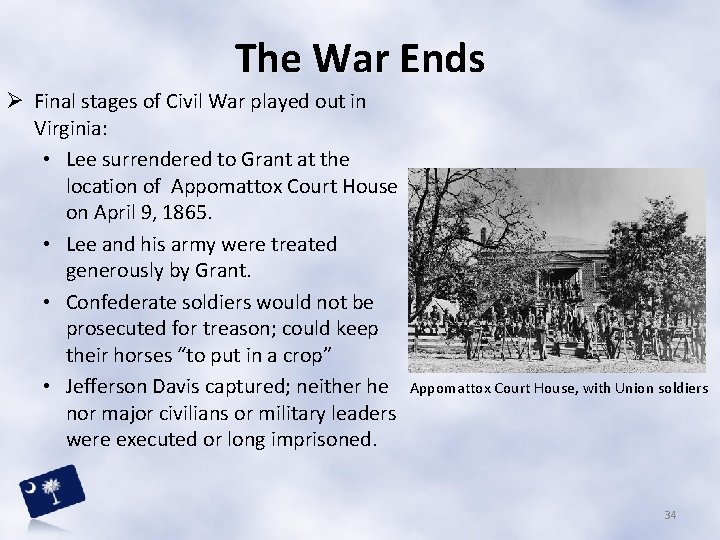
The War Ends Ø Final stages of Civil War played out in Virginia: • Lee surrendered to Grant at the location of Appomattox Court House on April 9, 1865. • Lee and his army were treated generously by Grant. • Confederate soldiers would not be prosecuted for treason; could keep their horses “to put in a crop” • Jefferson Davis captured; neither he nor major civilians or military leaders were executed or long imprisoned. Appomattox Court House, with Union soldiers 34
The Impact of the War on the Nation Ø Impact of war on whole nation was horrible: • About 3, 000 American men fought (both sides included) • Over 1/5 of these died either from battle wounds or diseases; those who died had been among the healthiest and most active men in the nation. Ø The Civil War Era (most dramatic and destructive episode in story of America and South Carolina) was pivotal: • Contributed to emergence of industry as dominant over agriculture • Signaled federal government would be dominant partner in national affairs • Freed over 1/10 of American population from slavery 35
The Impact of the War on South Carolina Ø Within four years, the state dropped from being one of richest to one of poorest - from a position of national leadership to position of relative insignificance in national affairs. Ø South Carolina suffered more destruction than any state: • About 1/3 of 60, 000 men in Confederate Army died; many returned home crippled for life • Property loss astounding • Emancipation shattered dominant labor system in State • New worker/employee relationships between whites and blacks had to be developed Ø South Carolina was in a period of adjustment, a pivotal moment in her history. 36

Image Credits Slide 1: Clemson 3564 on Wikimedia Commons; Slide 2: Public Domain Wikimedia Commons; Slide 16: Public Domain Wikimedia Commons; Slide 32: Public Domain Wikimedia Commons; Slide 34: Public Domain Wikimedia Commons Return to Main Menu 37
- Slides: 37