
South Carolina Stroke RACE Rapid Arterial o Cclusion
- Slides: 21
South Carolina Stroke RACE Rapid Arterial o. Cclusion Evaluation STROKE BY THE NUMBERS History created by SCD DHEC Bureau of EMS
EMS & Strokes �Historical Context EMS is the first medical contact in over 50% of all stroke victims in U. S. Unless the patient had altered LOC, strokes were treated as non-emergent events and transported routine to ER Prehospital care seen only as supportive and permanent disability was seen as inevitable, much like cardiac arrest in the 70’s Typically Cincinnati Stroke Scale used to confirm stoke event MEND and NIHSS taught in school but rarely used in field System
Stroke Care in South Carolina �South Carolina now has the third best “door to balloon” time for STEMI care in the United States. 1 �No reason why stroke care should not follow suit �Currently there are 21 designated stroke centers in South Carolina: HFAP – 1, DNV – 2 TJC – 18 �Most EMS services have adopted State Stroke Protocol: “The Reperfusion Checklist should be completed for any suspected stroke patient. With a duration of symptoms of less than 8 hours, hours scene times should be limited to 10 minutes, early destination notification / activation should be provided and transport times should be minimized based on the EMS System Stroke Plan. ” How we work (1) SCHA, 2013
How we have to do business at BEMS �POLICIES / PROCEDURES - EMT manuals, protocols, formulary �REGULATION 61 -7, 61 -96, 61 -116 �STATUTE 44 -61 series – Articles – 1, 3, 5, 6, etc
What the Law says…. � (5) It is also in the best interest of the people of South Carolina to modify the state's emergency medical response system to ensure that potential stroke patients are quickly identified and transported to and treated in facilities that have the capability for providing timely and effective treatment for stroke patients. � (B) The department, in consultation with the Stroke System of Care Advisory Council, shall adopt and distribute a nationally recognized, standardized stroke-triage assessment tool. The department must post the stroke-triage assessment tool on its website and provide a copy, which may be an electronic copy, of the stroke-triage assessment tool to each licensed emergency medical services provider before January 31, 2012. Each licensed emergency medical services provider must establish a stroke assessment and triage system that incorporates the department approved stroke-triage assessment tool. time
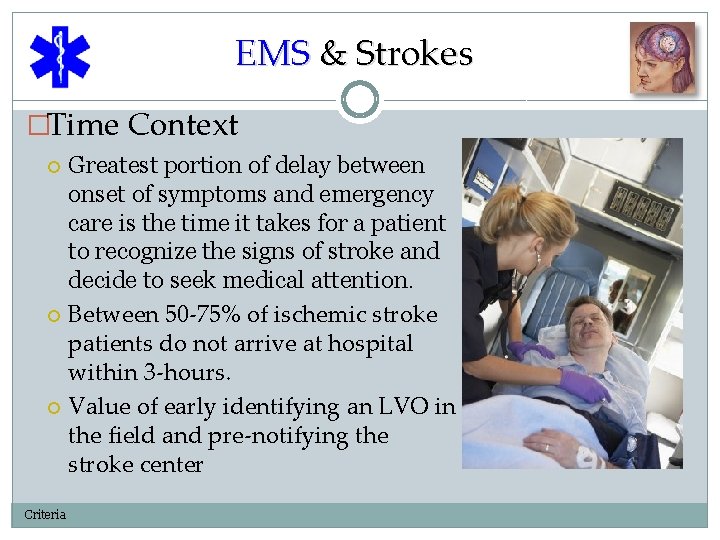
EMS & Strokes �Time Context Greatest portion of delay between onset of symptoms and emergency care is the time it takes for a patient to recognize the signs of stroke and decide to seek medical attention. Between 50 -75% of ischemic stroke patients do not arrive at hospital within 3 -hours. Value of early identifying an LVO in the field and pre-notifying the stroke center Criteria
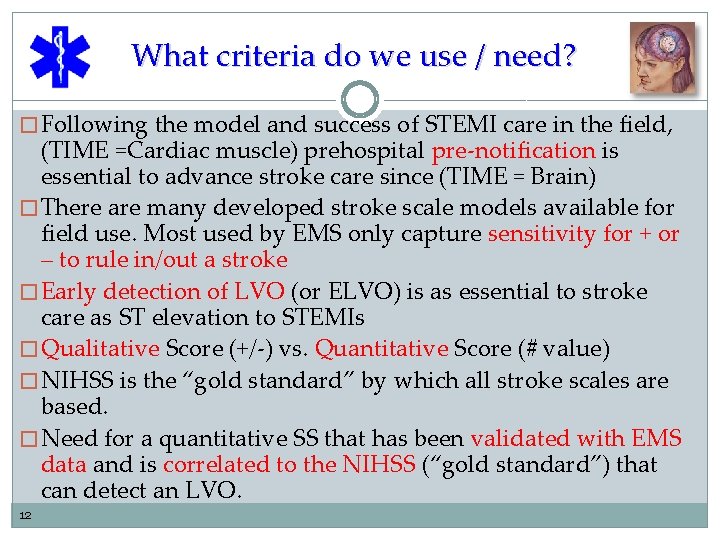
What criteria do we use / need? � Following the model and success of STEMI care in the field, (TIME =Cardiac muscle) prehospital pre-notification is essential to advance stroke care since (TIME = Brain) � There are many developed stroke scale models available for field use. Most used by EMS only capture sensitivity for + or – to rule in/out a stroke � Early detection of LVO (or ELVO) is as essential to stroke care as ST elevation to STEMIs � Qualitative Score (+/-) vs. Quantitative Score (# value) � NIHSS is the “gold standard” by which all stroke scales are based. � Need for a quantitative SS that has been validated with EMS data and is correlated to the NIHSS (“gold standard”) that can detect an LVO. 12
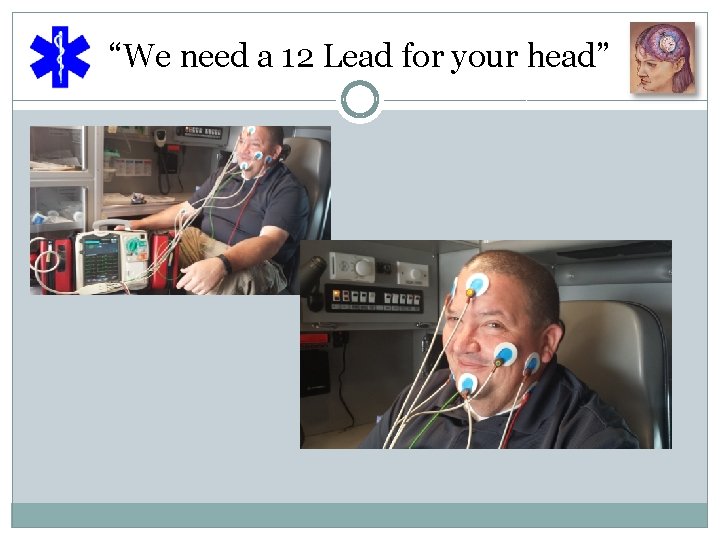
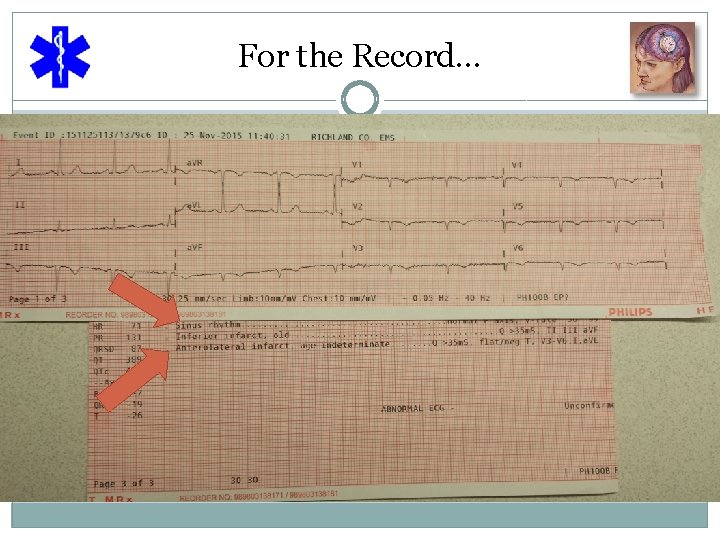
“We need a 12 Lead for your head”
For the Record…
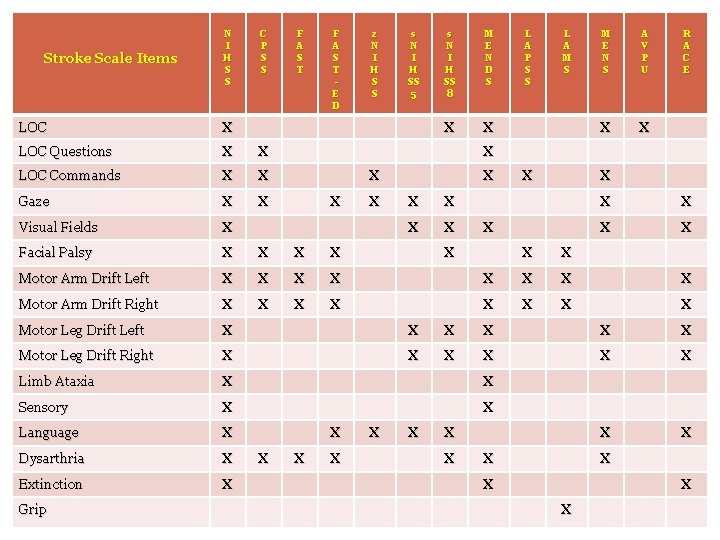
Stroke Scale Items N I H S S C P S S F A S T E D z N I H S S s N I H SS 5 s N I H SS 8 M E N D S X X L A P S S Stroke by the Numbers L A M S M E N S A V P U X X R A C E LOC X LOC Questions X X LOC Commands X X Gaze X X Visual Fields X Facial Palsy X X Motor Arm Drift Left X X Motor Arm Drift Right X X Motor Leg Drift Left X X X Motor Leg Drift Right X X X Limb Ataxia X X Sensory X X Language X X X Dysarthria X Extinction X Grip X X X X X X X X X X
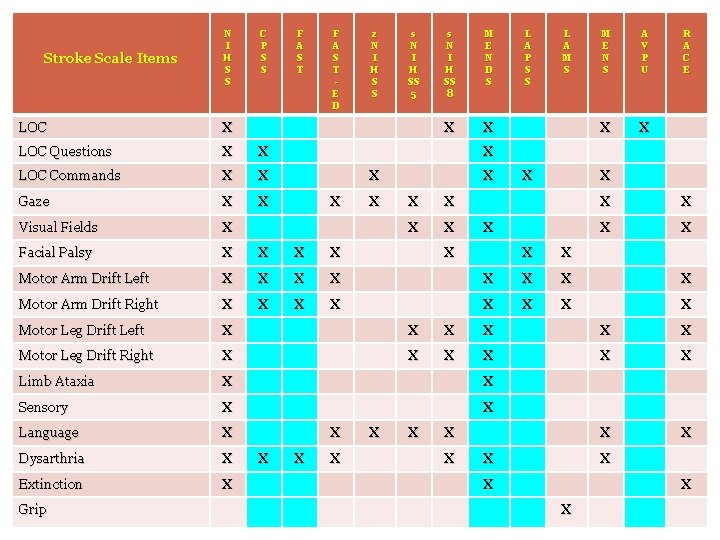
Stroke Scale Items N I H S S C P S S F A S T E D z N I H S S s N I H SS 5 s N I H SS 8 M E N D S X X L A P S S Stroke by the Numbers L A M S M E N S A V P U X X R A C E LOC X LOC Questions X X LOC Commands X X Gaze X X Visual Fields X Facial Palsy X X Motor Arm Drift Left X X Motor Arm Drift Right X X Motor Leg Drift Left X X X Motor Leg Drift Right X X X Limb Ataxia X X Sensory X X Language X X X Dysarthria X Extinction X Grip X X X X X X X X X X
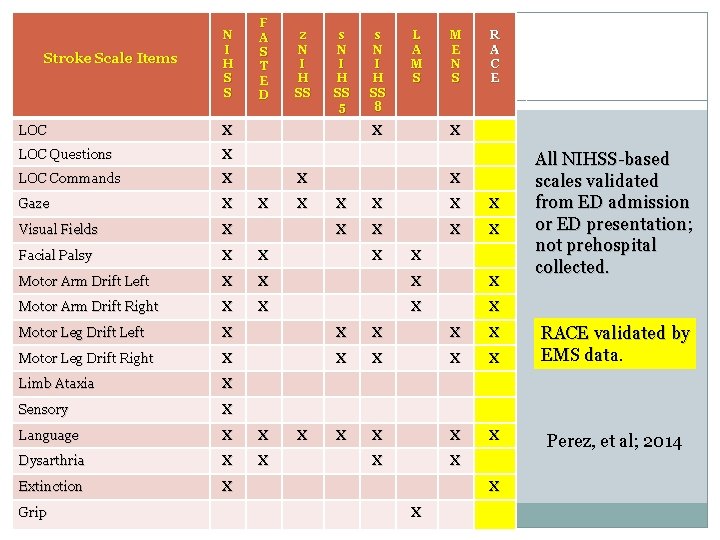
N I H S S F A S T E D z N I H SS s N I H SS 5 s N I H SS 8 L A M S Stroke by the Numbers Stroke Scale Items R A C E LOC X LOC Questions X LOC Commands X Gaze X Visual Fields X Facial Palsy X X Motor Arm Drift Left X X Motor Arm Drift Right X X Motor Leg Drift Left X X X Motor Leg Drift Right X X X Limb Ataxia X Sensory X Language X X X Dysarthria X X Extinction X Grip X M E N S X X X X X All NIHSS-based scales validated from ED admission or ED presentation; not prehospital collected. RACE validated by EMS data. Perez, et al; 2014
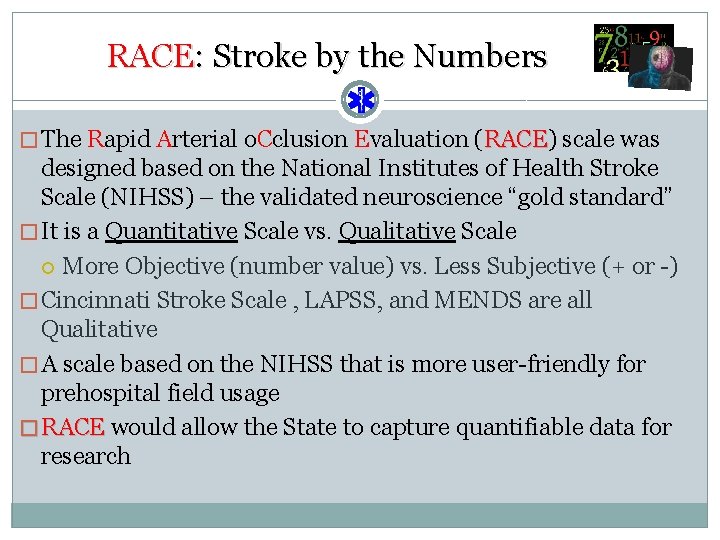
RACE: Stroke by the Numbers � The Rapid Arterial o. Cclusion Evaluation (RACE) RACE scale was designed based on the National Institutes of Health Stroke Scale (NIHSS) – the validated neuroscience “gold standard” � It is a Quantitative Scale vs. Qualitative Scale More Objective (number value) vs. Less Subjective (+ or -) � Cincinnati Stroke Scale , LAPSS, and MENDS are all Qualitative � A scale based on the NIHSS that is more user-friendly for prehospital field usage � RACE would allow the State to capture quantifiable data for research
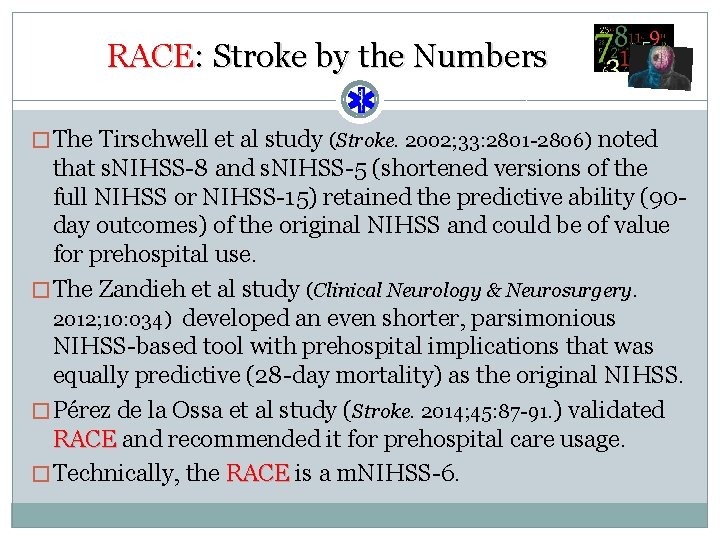
RACE: Stroke by the Numbers � The Tirschwell et al study (Stroke. 2002; 33: 2801 -2806) noted that s. NIHSS-8 and s. NIHSS-5 (shortened versions of the full NIHSS or NIHSS-15) retained the predictive ability (90 day outcomes) of the original NIHSS and could be of value for prehospital use. � The Zandieh et al study (Clinical Neurology & Neurosurgery. 2012; 10: 034) developed an even shorter, parsimonious NIHSS-based tool with prehospital implications that was equally predictive (28 -day mortality) as the original NIHSS. � Pérez de la Ossa et al study (Stroke. 2014; 45: 87 -91. ) validated RACE and recommended it for prehospital care usage. � Technically, the RACE is a m. NIHSS-6.
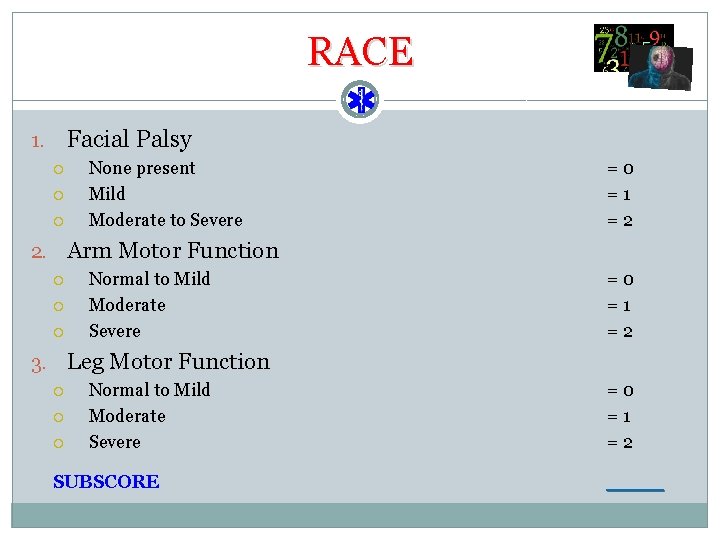
RACE Facial Palsy 1. None present Mild Moderate to Severe =0 =1 =2 2. Arm Motor Function Normal to Mild Moderate Severe =0 =1 =2 3. Leg Motor Function Normal to Mild Moderate Severe SUBSCORE =0 =1 =2 ____
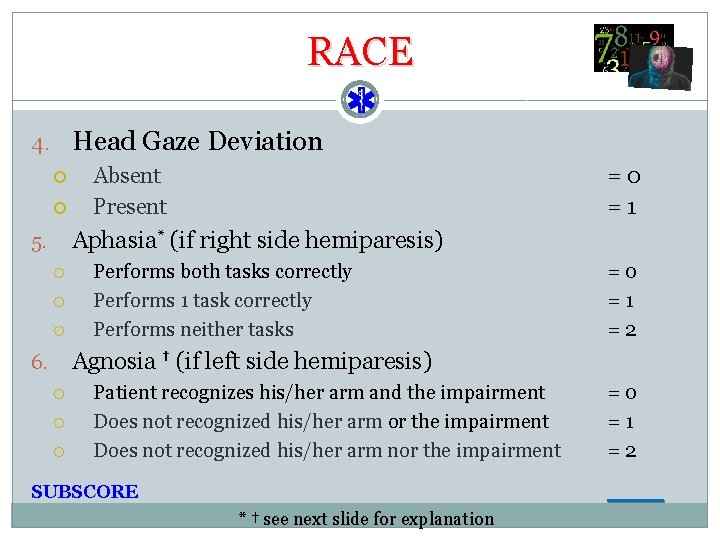
RACE 4. Head Gaze Deviation Absent Present =0 =1 Aphasia* (if right side hemiparesis) 5. Performs both tasks correctly Performs 1 task correctly Performs neither tasks =0 =1 =2 Agnosia † (if left side hemiparesis) 6. Patient recognizes his/her arm and the impairment Does not recognized his/her arm or the impairment Does not recognized his/her arm nor the impairment =0 =1 =2 ____ SUBSCORE * † see next slide for explanation
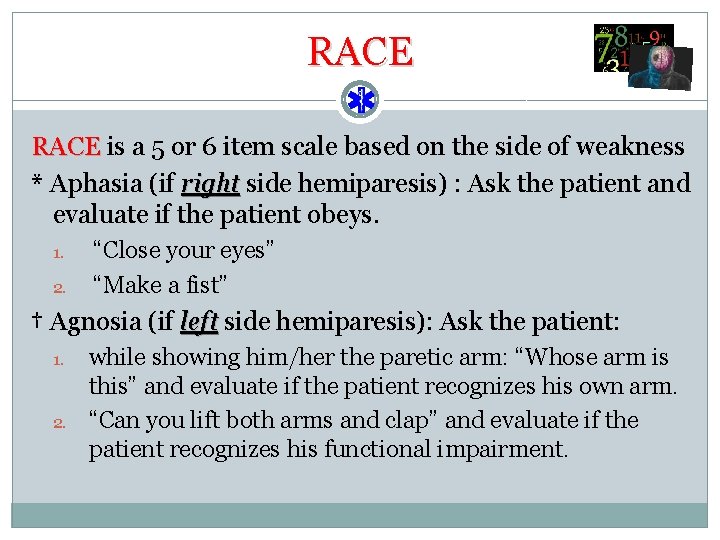
RACE is a 5 or 6 item scale based on the side of weakness * Aphasia (if right side hemiparesis) : Ask the patient and evaluate if the patient obeys. 1. 2. “Close your eyes” “Make a fist” † Agnosia (if left side hemiparesis): Ask the patient: 1. 2. while showing him/her the paretic arm: “Whose arm is this” and evaluate if the patient recognizes his own arm. “Can you lift both arms and clap” and evaluate if the patient recognizes his functional impairment.
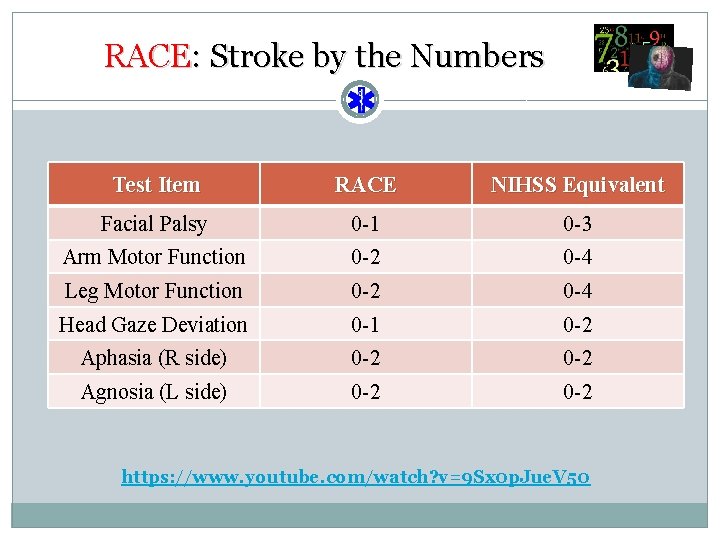
RACE: Stroke by the Numbers Test Item RACE NIHSS Equivalent Facial Palsy 0 -1 0 -3 Arm Motor Function 0 -2 0 -4 Leg Motor Function 0 -2 0 -4 Head Gaze Deviation 0 -1 0 -2 Aphasia (R side) 0 -2 Agnosia (L side) 0 -2 https: //www. youtube. com/watch? v=9 Sx 0 p. Jue. V 50
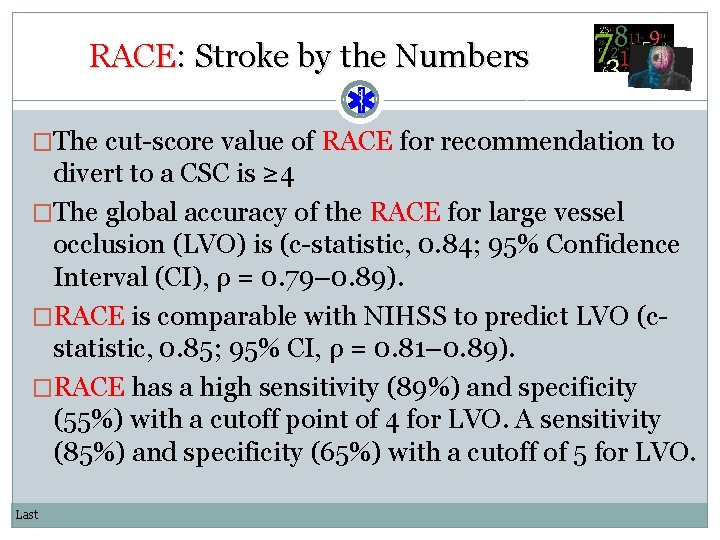
RACE: Stroke by the Numbers �The cut-score value of RACE for recommendation to divert to a CSC is ≥ 4 �The global accuracy of the RACE for large vessel occlusion (LVO) is (c-statistic, 0. 84; 95% Confidence Interval (CI), ρ = 0. 79– 0. 89). �RACE is comparable with NIHSS to predict LVO (cstatistic, 0. 85; 95% CI, ρ = 0. 81– 0. 89). �RACE has a high sensitivity (89%) and specificity (55%) with a cutoff point of 4 for LVO. A sensitivity (85%) and specificity (65%) with a cutoff of 5 for LVO. Last
RACE: Stroke by the Numbers Questions?
Stay in Tune with EMS ! �SCEMSPORTAL. ORG �@SCEMS 1 �WRONSKRA@DHEC. SC. GOV �HAVE A GOOD EMAIL IN CIS !!!!