
South Carolina Human Affairs Commission SC Human Affairs



























- Slides: 69
South Carolina Human Affairs Commission
SC Human Affairs Commission Please take notice that anything proffered during the course of this training is for demonstration and educational purposes only. Nothing said or done or the information on the slides is intended to be legal advice. Additionally, any case law cited speaks for itself, is limited in its application and interpretation to its jurisdiction, may be subject to change at any time by respective appellate courts, and should not be relied upon without consultation and approval by an agency attorney. Likewise, any questions regarding specific factual scenarios or practices or procedures specific to the agency should be directed to the general counsel for the agency.
Declaration of Independence “We hold these truths to be self-evident, that all men are created equal, that they are endowed by their Creator with certain unalienable Rights, that among these are Life, Liberty and the Pursuit of Happiness…”
Signing of the 1964 Civil Rights Act
1972 SC Human Affairs Commission
SC Laws Enforced by the Human Affairs Commission • South Carolina Human Affairs Law • South Carolina Fair Housing Law • South Carolina Equal Enjoyment and Privileges to Public Accommodations • Federal Laws Prohibiting Discrimination
Federal Equal Employment Laws Enforced by the SC Human Affairs Commission • Title VII of the 1964 Civil Rights Act – Bans discrimination in employment because of race, color, religion, sex, or national origin • Age Discrimination in Employment Act (ADEA) – Makes unlawful employment discrimination because of age against anyone 40 years of age and older • Pregnancy Discrimination Act – Amends Title VII and states that employment discrimination is prohibited when based on pregnancy, childbirth, and related medical conditions. • The Americans with Disabilities Act, as amended (ADA) – Prohibits employment discrimination against qualified individuals with disabilities in the private sector, and in state and local governments.
The Intake/Investigation Process
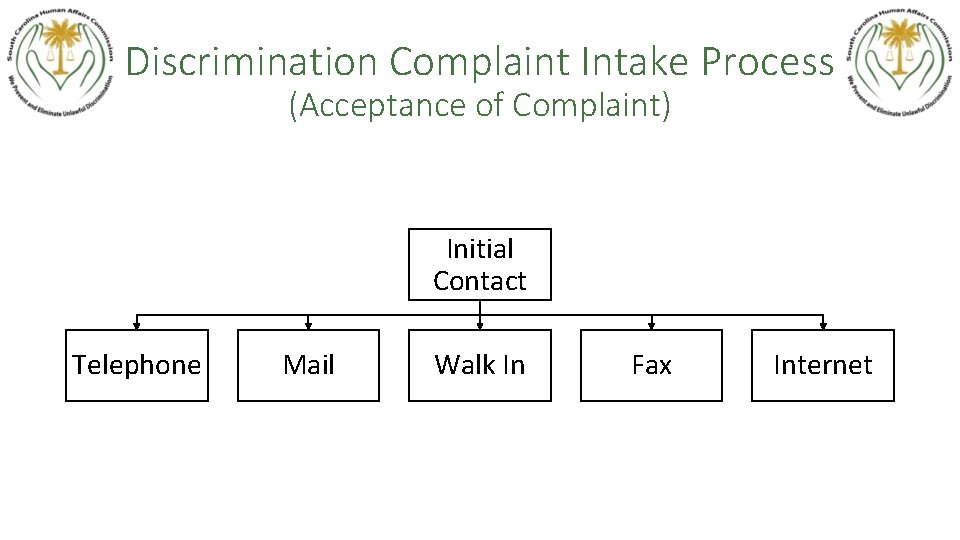
Discrimination Complaint Intake Process (Acceptance of Complaint) Initial Contact Telephone Mail Walk In Fax Internet
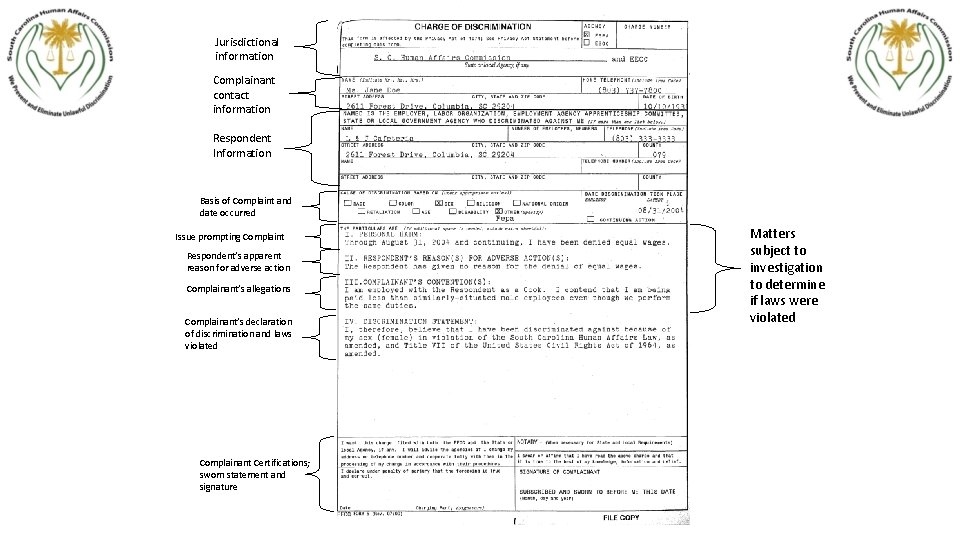
Jurisdictional information Complainant contact information Respondent Information Basis of Complaint and date occurred Issue prompting Complaint Respondent’s apparent reason for adverse action Complainant’s allegations Complainant’s declaration of discrimination and laws violated Complainant Certifications; sworn statement and signature Matters subject to investigation to determine if laws were violated
SCHAC and EEOC Tips to Keep in Mind South Carolina is divided between EEOC Districts: • Atlanta District Office – Allendale, Bamberg, Barnwell, Beaufort, Berkeley, Charleston, Colleton, Dorchester, Georgetown, Hampton, Jasper, and Williamsburg • Charlotte District Office – the other 34 counties
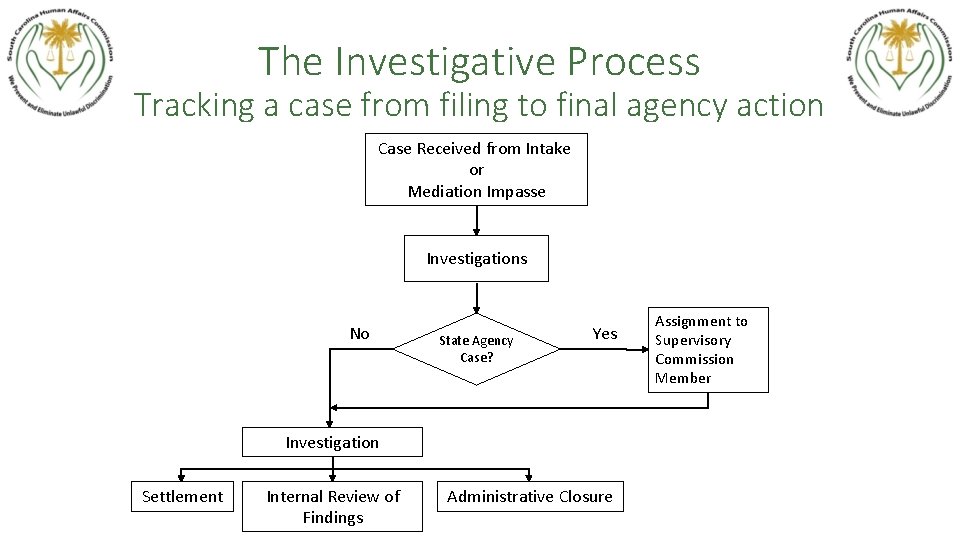
The Investigative Process Tracking a case from filing to final agency action Case Received from Intake or Mediation Impasse Investigations No State Agency Case? Yes Investigation Settlement Internal Review of Findings Administrative Closure Assignment to Supervisory Commission Member
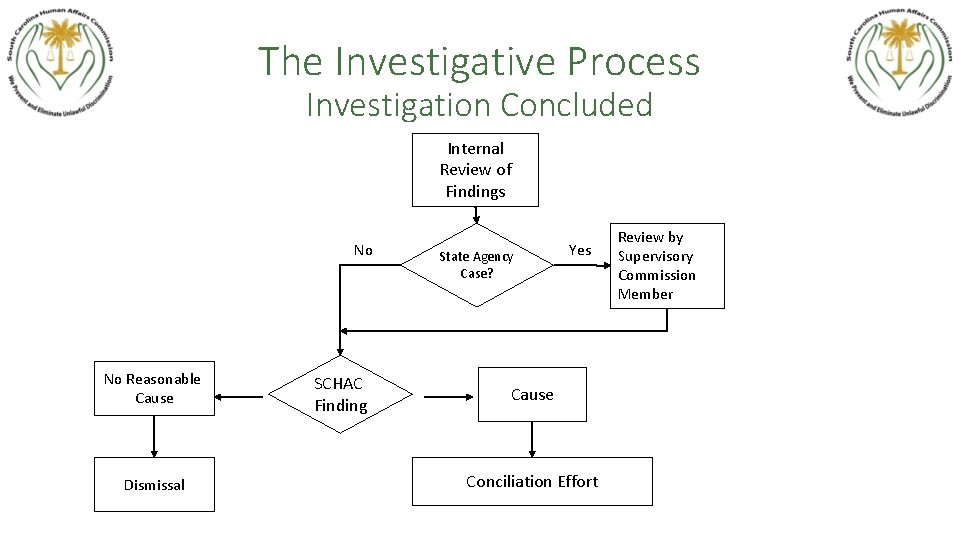
The Investigative Process Investigation Concluded Internal Review of Findings No No Reasonable Cause Dismissal SCHAC Finding State Agency Case? Yes Cause Conciliation Effort Review by Supervisory Commission Member
Mediation/ADR
Benefits to Mediation • A Notice of Right to Sue is not issued • The case does not go to court • Saves time • Saves money • Resolves a complaint so that all parties are content • Discussion can result in solving other problems and issues
Employment Discrimination: Unfair vs. Unlawful
State Human Affairs Law Prohibits Employment Discrimination Based on: • Race • Color • Religion • National Origin • Sex • Pregnancy Accommodations Act • Age • Disability
Harassment
Elements of Harassment • Submission to conduct is made explicitly or implicitly a condition of an individual’s employment • Submission or rejection of the conduct is used as the basis for making employment decisions that affect the individual. • Such conduct has the purpose or the effect of unreasonably interfering with an individual’s work performance, or creating an intimidating, hostile, or offensive working environment.
Preventing Harassment in the Work Place • Harassment can occur based on all 7 protected bases • Be aware of the Culture in the work place and how you set the tone for that culture • Social Media, Office Parties, Conferences in and out-of-State • Third party harassment – customers, venders, etc.
Age-Based Discrimination
Sex-Based Discrimination
Sexual Attraction vs. Sexual Harassment SEXUAL ATTRACTION • Positive • Admiring • Does not diminish • Expression of sexuality • Ceases when unwanted or unwelcome SEXUAL HARASSMENT • Negative • Degrading • Absent respect for integrity of another • Escalates • Abuse of Power
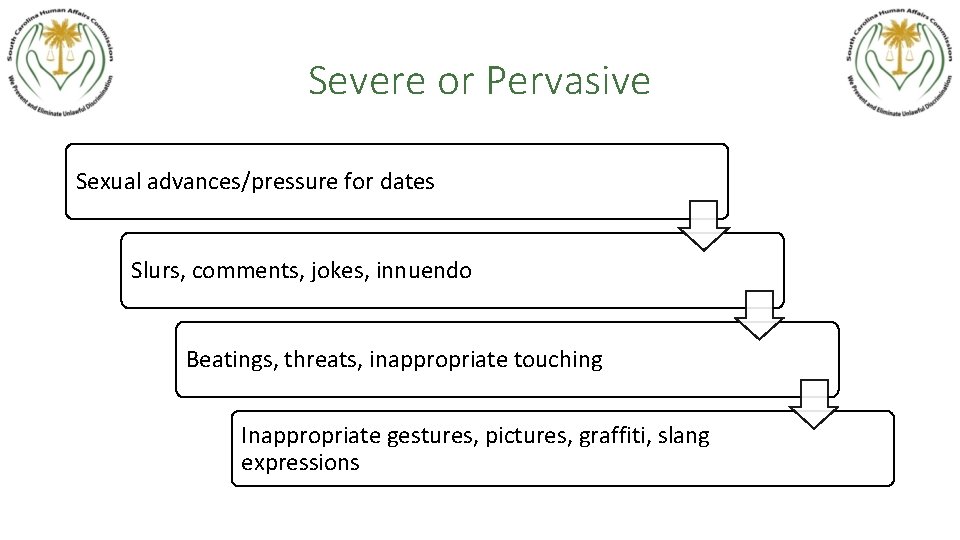
Severe or Pervasive Sexual advances/pressure for dates Slurs, comments, jokes, innuendo Beatings, threats, inappropriate touching Inappropriate gestures, pictures, graffiti, slang expressions
Sexual Harassment Jokes…Innuendos…Banter INTENT: Friendly, Amiable, Humorous vs EFFECT: Insulted, Embarrassed, Demeaned
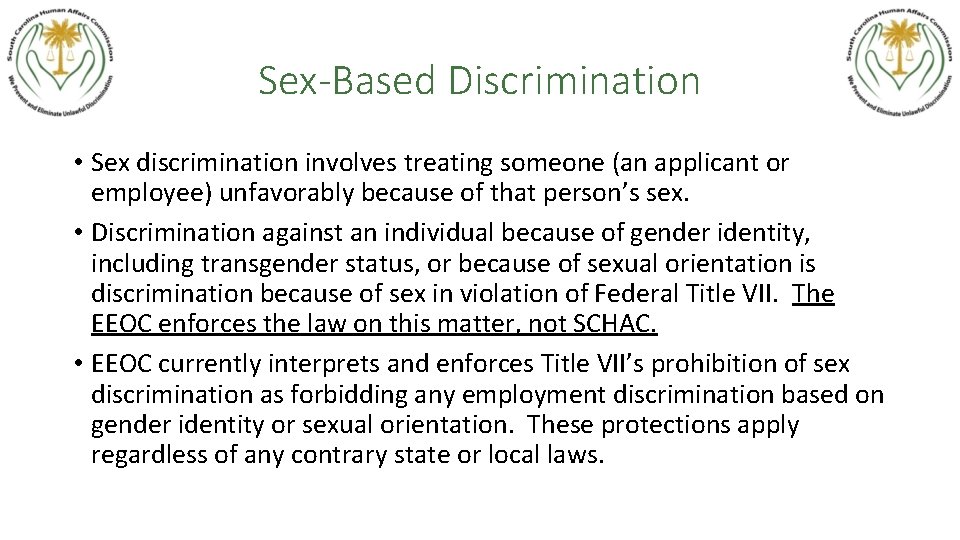
Danita S. v. U. S. Dep’t of Transp. • A male air traffic controller, C 1, made sexual comments about Complainant in a web-based game many controllers played. • Complainant notified management and provided screenshots and a transcript of the messages. • Complainant was given two days of administrative leave and referred to the EAP. Her request to be reassigned off the control floor or to another facility was denied. Her manager insisted she “battle through it” and commented to another employee “boys will be boys. ” • Agency found Complainant was subjected to national origin and sex harassment, noting that the graphic nature of the comments made them humiliating and the fact they were made in a chat room in which other coworkers participated made a single incident severe, but held it wasn’t liable because it investigated and reprimanded C 1. • EEOC held Agency failed to take appropriate corrective action because it failed to remove C 1 from the control room floor during the investigation, which resulted in Complainant requesting leave and/or reassignment.
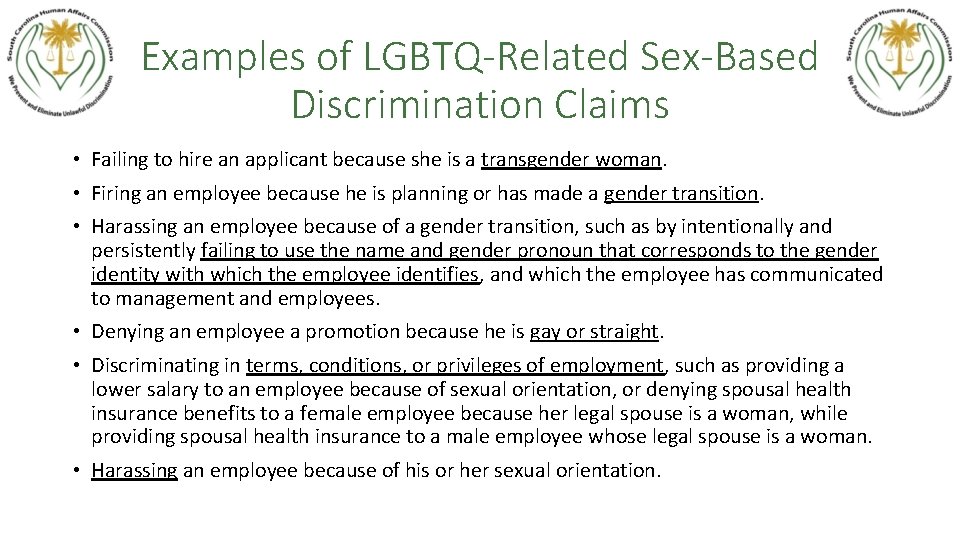
Sex-Based Discrimination • Sex discrimination involves treating someone (an applicant or employee) unfavorably because of that person’s sex. • Discrimination against an individual because of gender identity, including transgender status, or because of sexual orientation is discrimination because of sex in violation of Federal Title VII. The EEOC enforces the law on this matter, not SCHAC. • EEOC currently interprets and enforces Title VII’s prohibition of sex discrimination as forbidding any employment discrimination based on gender identity or sexual orientation. These protections apply regardless of any contrary state or local laws.
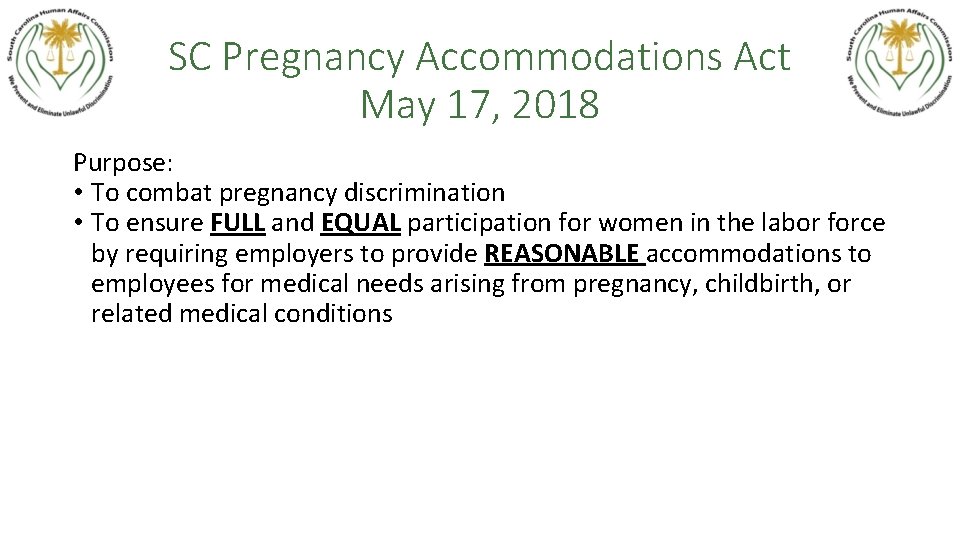
Examples of LGBTQ-Related Sex-Based Discrimination Claims • Failing to hire an applicant because she is a transgender woman. • Firing an employee because he is planning or has made a gender transition. • Harassing an employee because of a gender transition, such as by intentionally and persistently failing to use the name and gender pronoun that corresponds to the gender identity with which the employee identifies, and which the employee has communicated to management and employees. • Denying an employee a promotion because he is gay or straight. • Discriminating in terms, conditions, or privileges of employment, such as providing a lower salary to an employee because of sexual orientation, or denying spousal health insurance benefits to a female employee because her legal spouse is a woman, while providing spousal health insurance to a male employee whose legal spouse is a woman. • Harassing an employee because of his or her sexual orientation.
SC Pregnancy Accommodations Act
SC Pregnancy Accommodations Act May 17, 2018 Purpose: • To combat pregnancy discrimination • To ensure FULL and EQUAL participation for women in the labor force by requiring employers to provide REASONABLE accommodations to employees for medical needs arising from pregnancy, childbirth, or related medical conditions
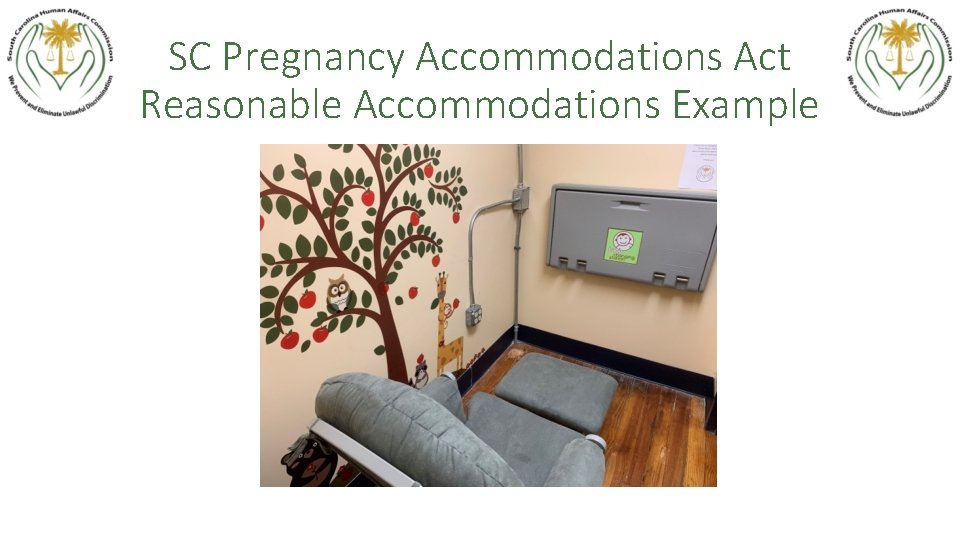
SC Pregnancy Accommodations Act Reasonable Accommodations Reasonable accommodation must be provided for: • Pregnancy related medical conditions, including lactation Reasonable accommodations may include: • Making existing facilities used by employees readily accessible to and usable by individuals with disabilities and individuals with medical needs arising from pregnancy, childbirth, or related medical conditions • Private place other than bathroom stall An accommodation is only reasonable if it is absent showing of undue hardship
SC Pregnancy Accommodations Act Reasonable Accommodations Example
Americans with Disabilities (ADA)
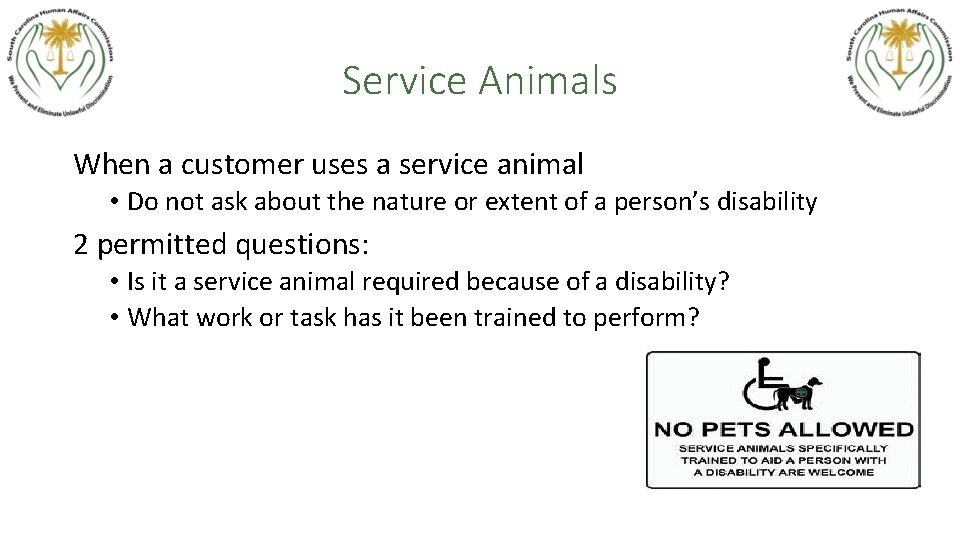
Service Animals When a customer uses a service animal • Do not ask about the nature or extent of a person’s disability 2 permitted questions: • Is it a service animal required because of a disability? • What work or task has it been trained to perform?
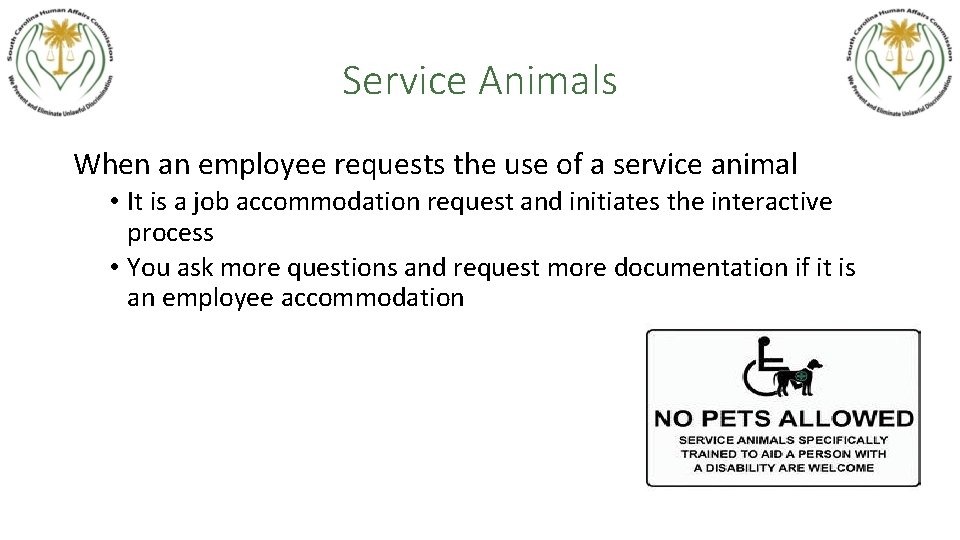
Service Animals When an employee requests the use of a service animal • It is a job accommodation request and initiates the interactive process • You ask more questions and request more documentation if it is an employee accommodation
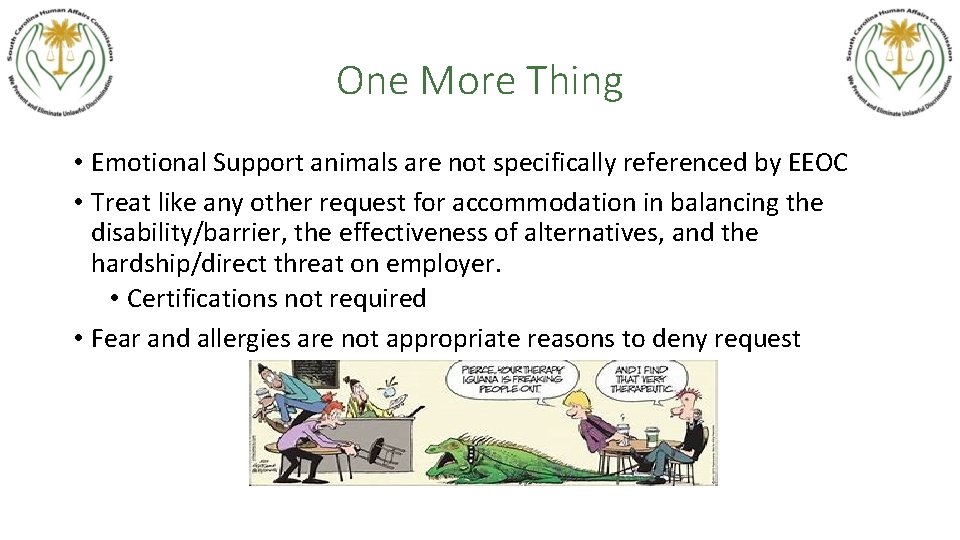
One More Thing • Emotional Support animals are not specifically referenced by EEOC • Treat like any other request for accommodation in balancing the disability/barrier, the effectiveness of alternatives, and the hardship/direct threat on employer. • Certifications not required • Fear and allergies are not appropriate reasons to deny request
Essential Functions What is the reason the job exists? • Job Descriptions are essential. • Does the job require specialized skills? • Amount of time spent on a function • Would the nature of the job change without function?
Reasonable Accommodation Any change or adjustment to a job or work environment that permits a qualified applicant or complainant with a disability to: • Participate in the job application process, • Perform the essential functions of a job, or • Enjoy benefits and privileges of employment equal to those enjoyed by employees without disabilities Accommodations may involve modifying policies or procedures to enable employees with disabilities to enjoy equal benefits and privileges of employment
Interactive Process by which complainant notifies employer of disability and need for accommodations and employer’s efforts to eliminate the workplace barrier. The “interactive process” is premised on two assumptions: • The individual knows the most about his or her restrictions; and • The employer knows the most about what might be done in the workplace to accommodate those restrictions. • An employer must provide an accommodation, up to and including leave and/or transfer unless they can show that ANY accommodation would be an “undue hardship” or direct threat to the health/safety of the individual and/or others that cannot be eliminated or reduced.
Interactive Process • Employee’s responsibility to ask for accommodation • Employers must work with employee to provide an effective accommodation • Employer must act quickly in providing accommodation • Failure to do so may be a violation in itself • Employer must provide accommodations even when employee refuses to mitigate the disability through use of assistive device or medication • Where disability is known, the employer may ask if an accommodation is needed.
Additional Employer: • Not required to purchase personal use items that are for on and off duty purposes • Not required to provide exact accommodation • May request limited medical documentation • May send for medical evaluation at company choice where accommodations/requirements are unclear • Not entitled to call doctors and see medical records or require employee to sign HIPAA release for all medical records • FMLA DOCS ARE VERY IMPORTANT
Leave • Leave available until employer can show undue hardship • May ask employee to transfer to vacant position if it is something the employee can do until they are able to resume the prior position • Unlike FMLA, an employee who takes leave must be returned to the position originally vacated • If the employee is never able to return to the position, then he must be offered any vacant position.
Reassignment • Reassignment is a last resort option • Could be considered a form of Retaliation • Available only if • No effective accommodation available • All reasonable accommodations would be undue hardship • Employee’s expense • Even if employer has policy that no one may work from home, if the accommodation would be effective, it must modify the policy.
York County, South Carolina The Justice Department announced on June 10, 2019, that it reached a settlement agreement with York County, South Carolina under the Americans with Disabilities Act (ADA). The agreement resolves the Department’s lawsuit alleging that the county discriminated against an applicant on the basis of his disability, dwarfism, when he sought to apply for a Purchasing Manager position. The complaint alleges that York County required applicants for the Purchasing Manager position to possess a driver’s license even though having a driver’s license is not essential to performing the job functions of the position. By requiring a driver’s license, the county unfairly screened out the applicant, who because of his disability does not possess a driver’s license, but who was otherwise qualified for the position.
Alejandro v. ST Micro Elecs. , Inc. , 178 F. Supp. 3 d 850 (N. D. Cal. 2016) • Plaintiff, a sales engineer, alleged he was subjected to disability discrimination when he was denied accommodation and terminated. • In July 2013, Plaintiff told his manager that he had bipolar disorder and generalized anxiety disorder, which sometimes made him unable to work. Manager said Plaintiff or someone else should notify the manager when Plaintiff’s disability caused him to miss work. • On March 19, 2014, manager asked him to call, e-mail, or text before 9: 00 a. m. about illnessrelated absences. Plaintiff agreed. • Plaintiff was absent March 31 –April 3, 2014. He claims he had an “inability to communicate” and an inability to work. • Manager texted Plaintiff March 31 and April 1. Plaintiff replied April 1 “I’m in a nasty hole. ” Manager responded that they needed to meet in person April 2. Plaintiff didn’t respond. • April 3, manager told Plaintiff he was terminated for job abandonment. • After learning of his termination, Plaintiff submitted a doctor’s note requesting leave March 28 – April 9 due to severe anxiety.
Undue Hardship • Consider the nature and costs of the accommodation • Consider the size, type, and financial resources of the facility
Resources
Race, Color, and National Origin
Race and Color Discrimination • Involves treating someone unfavorably because he/she is of a certain race or because of personal characteristics associated with race (such as hair texture, skin color, or certain facial features). • Color discrimination involves treating someone unfavorably because of skin color complexion. • Race/color discrimination also can involve treating someone unfavorably because the person is married to (or associated with) a person of a certain race or color. • Discrimination can occur when the victim and the person who inflicted the discrimination are the same race or color.
National Origin Discrimination • Treating someone less favorably because he or she comes from a particular place, because of his or her ethnicity or accent, or because it is believed that he or she has a particular ethnic background. • Also means treating someone less favorably at work because of marriage or other association with someone of a particular nationality. • Can sometimes involve denying access to vital information in a language they can understand
Religious Discrimination
Religious Accommodation If an employee asserts a need for religious accommodation, the employer should do the following: • Inquire as to the nature of the employee’s beliefs. • Consider the sincerity with which the employee holds these beliefs • Consider the nature of the conflict between the employee’s religious believes and their job obligation • Consider possible accommodations • Consider the burdens on business of accommodation • Offer a reasonable accommodation unless to do so would cause undue hardship
Lawful Interviewing Practices
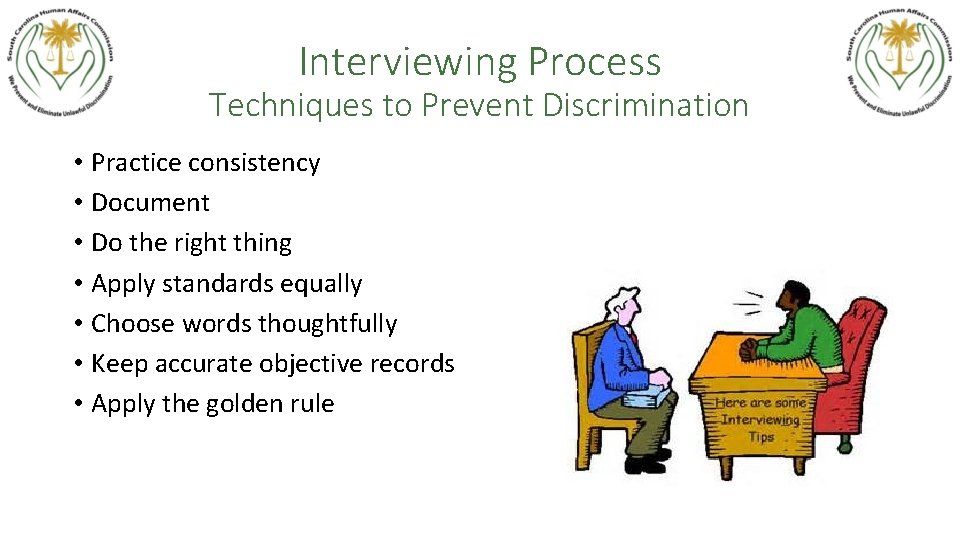
Interviewing Process Interviews should focus on an applicant’s talents, skills, and abilities that relate to the performance of the essential duties of the job. The following should not be discussed during an interview: • Disabilities, • Religion, • National Origin, • Etc.
Interviewing Process An employer may ask all applicants this question: • Can you perform the essential duties of the job, with or without accommodation?
Interviewing Process Techniques to Prevent Discrimination • Practice consistency • Document • Do the right thing • Apply standards equally • Choose words thoughtfully • Keep accurate objective records • Apply the golden rule
Prevention • Know your agencies policies • Know the internal complaint process • Do your part to prevent harassment • Be respectful • Be fair
Retaliation
Do Not Retaliate!
Diversity
How to Appreciate Diversity AVOID • Stereotypes – An exaggerated belief or fixed idea about a person or group • Stereotypes are: Natural, but often destructive because they are unfair, do not allow for individuality, and interfere with communication. • Prejudice – A preconceived ideal or negative attitude, formed before the facts are known, and sustained by overgeneralizations • A belief is a fact thought to be true without any knowledge or proof, we just believe that something is true.
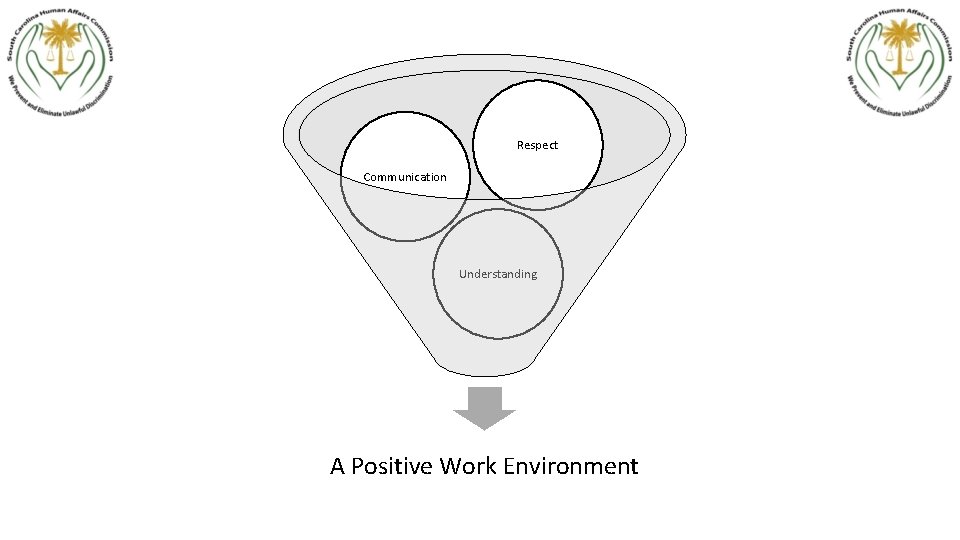
How to Appreciate Diversity RESPECT • Treat people the way they want to be treated. Respect individuals as a whole person and be aware of their feelings.
The Path of Intercultural Learning Develop a culture of respect within your organization through: • Awareness • Understanding • Acceptance • Appreciation • Multi-cultural
Respect Communication Understanding A Positive Work Environment
“How are we going to develop trust and relationships with each other if we continue to stay in our separate corners? We can’t. …if we’re going to be true to the charge of moving South Carolina and our nation forward, the actions have to move through each of us. If we want to bring opportunity to every American, we will have to work together. That requires commitment, openmindedness, and a willingness to think differently by all of us. ” - Former Governor Nikki Haley
Remember • Always follow Agency Policies • Always contact your HR Office or OGC if you have a question about EEO Laws
Q&A Any Questions?
“All men are created equal…With certain rights…Life, Liberty, and the Pursuit of Happiness… Do your part to prevent and eliminate discrimination Thank you! Presented by: Dan Koon Deputy Commissioner danny@schac. sc. gov 803 -737 -7832 TTY 711 Stephani Frese Director of Technical Services sfrese@schac. sc. gov 803 -737 -7805 TTY 711