
SOUTH AFRICA APARTHEID HISTORY 12SMITHMBSS BACKGROUND notes optional
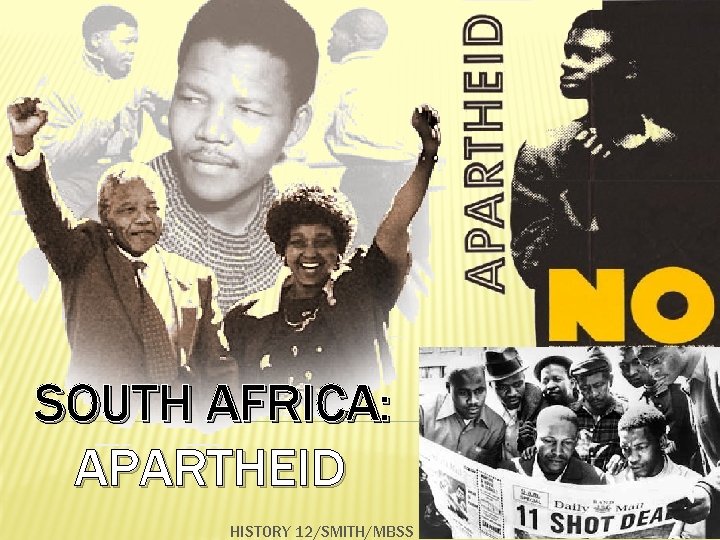
SOUTH AFRICA: APARTHEID HISTORY 12/SMITH/MBSS
BACKGROUND (notes optional) ~1650 ~1800 ~1830 Original European settlers were Dutch Colonized by the British Decedents of original Dutch (Boers/ Afrikaners) establish their own republics. 1867/84 Diamonds/Gold discovered: British interest grows, and the need to subdue both indigenous and Boer elements. 1 st Boer War: 1880 -1881 Boers resist the British nd
EARLY 20 TH CENTURY (notes optional) 1910 1913 1931 Union of South Africa was created Native Lands Act- limits black ownership of land Statute of Westminster- virtual independence/ member of the British Commonwealth ~1930’s Power shared between the Afrikaners National Party & the South African Party 1948 National Party wins a majority, solidifies power and white rule by institutionalizing racial
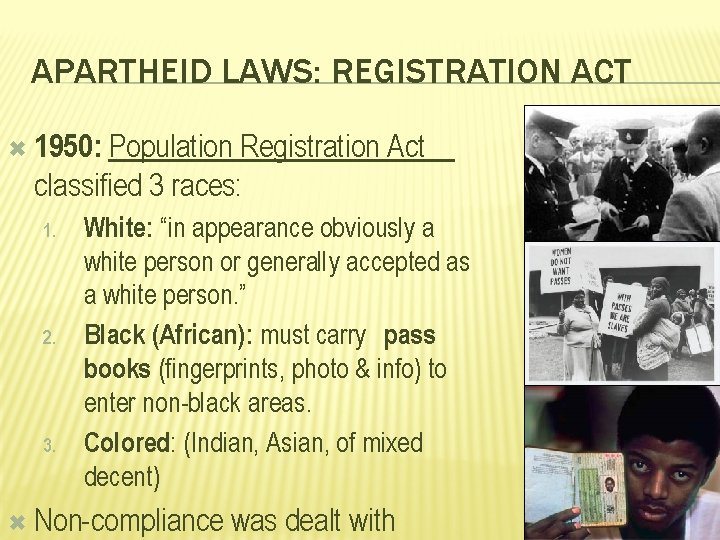
APARTHEID LAWS: REGISTRATION ACT 1950: Population Registration Act classified 3 races: 1. 2. 3. White: “in appearance obviously a white person or generally accepted as a white person. ” Black (African): must carry pass books (fingerprints, photo & info) to enter non-black areas. Colored: (Indian, Asian, of mixed decent) Non-compliance was dealt with

APARTHEID LAWS: HOMELANDS 1951 Bantu Authorities Act set up African reserves, known as “homelands”. (states to which each African was assigned). All political (voting) rights restricted to one’s homeland. They were citizens of the homeland, losing South African citizenship & representation in the S. A. Parliament. Blacks in the homelands needed passports to enter South Africa: aliens in their own country.
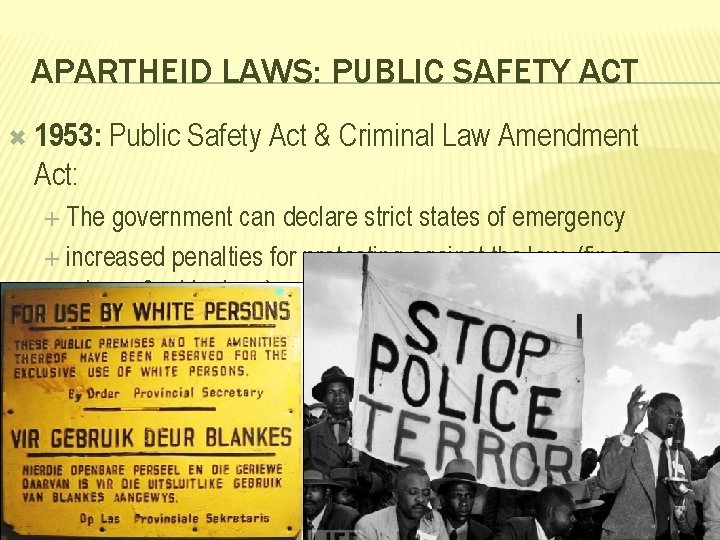
APARTHEID LAWS: PUBLIC SAFETY ACT 1953: Public Safety Act & Criminal Law Amendment Act: The government can declare strict states of emergency increased penalties for protesting against the law, (fines, prison, & whippings).
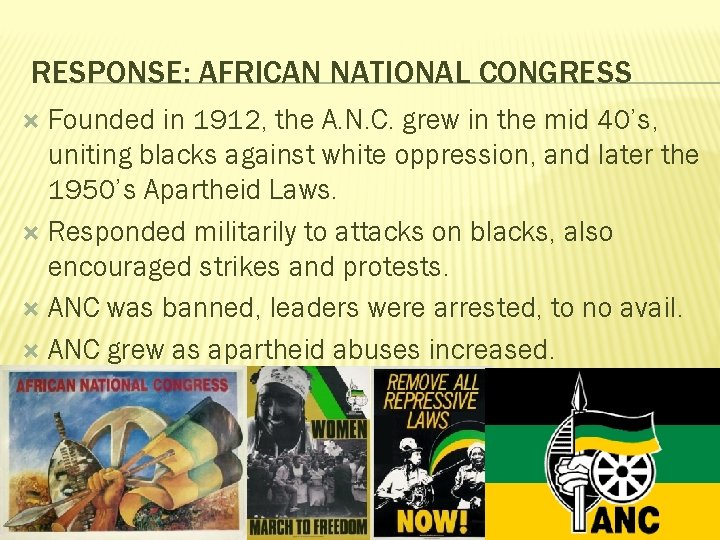
RESPONSE: AFRICAN NATIONAL CONGRESS Founded in 1912, the A. N. C. grew in the mid 40’s, uniting blacks against white oppression, and later the 1950’s Apartheid Laws. Responded militarily to attacks on blacks, also encouraged strikes and protests. ANC was banned, leaders were arrested, to no avail. ANC grew as apartheid abuses increased.
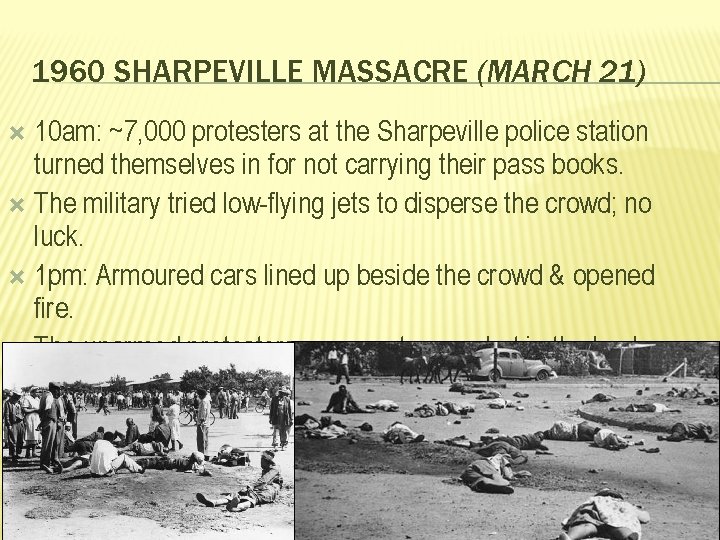
1960 SHARPEVILLE MASSACRE (MARCH 21) 10 am: ~7, 000 protesters at the Sharpeville police station turned themselves in for not carrying their pass books. The military tried low-flying jets to disperse the crowd; no luck. 1 pm: Armoured cars lined up beside the crowd & opened fire. The unarmed protesters ran, most were shot in the back. 69 died & 187 were wounded.
1960 SHARPEVILLE MASSACRE: FALLOUT March 30: State of emergency declared, 18, 000+ arrested, (could be held without charges for up to 6 months). Thousands died in custody, often after torture. Convicted were sentenced to death, life in prison, or banished. States of emergency continued intermittently until 1989. The end of ANC’s program of peaceful strikes & protests ANC went underground; increased military training & sabotage. International protests; UN resolution condemned the shootings.
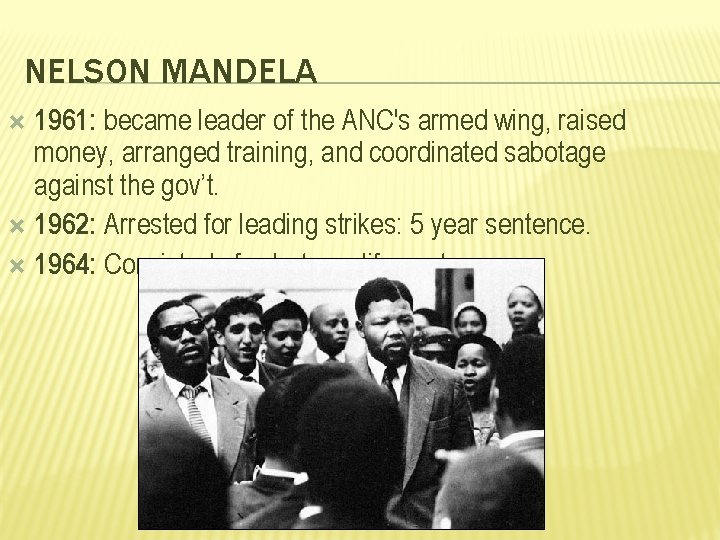
NELSON MANDELA 1961: became leader of the ANC's armed wing, raised money, arranged training, and coordinated sabotage against the gov’t. 1962: Arrested for leading strikes: 5 year sentence. 1964: Convicted of sabotage: life sentence.
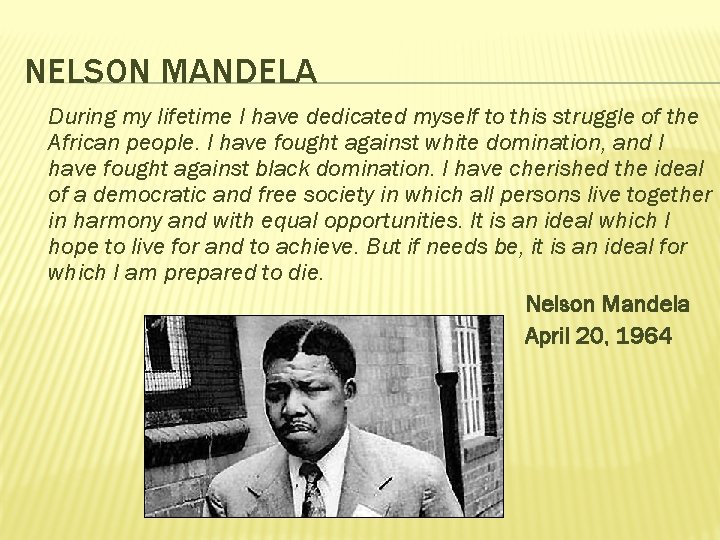
NELSON MANDELA During my lifetime I have dedicated myself to this struggle of the African people. I have fought against white domination, and I have fought against black domination. I have cherished the ideal of a democratic and free society in which all persons live together in harmony and with equal opportunities. It is an ideal which I hope to live for and to achieve. But if needs be, it is an ideal for which I am prepared to die. Nelson Mandela April 20, 1964
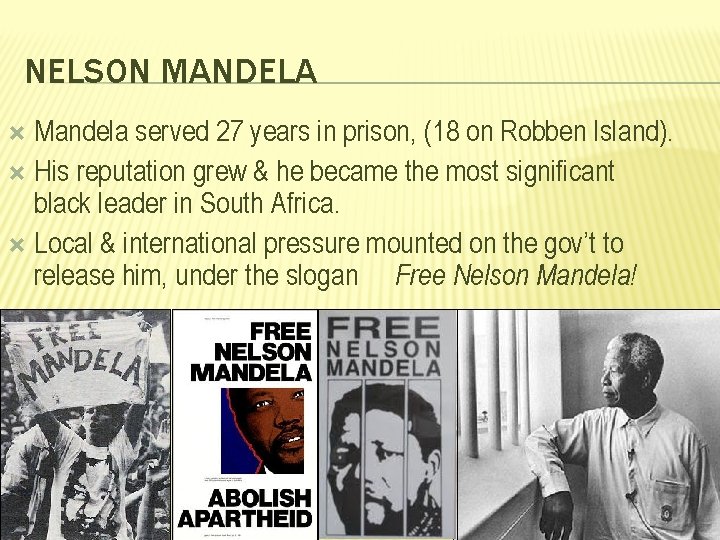
NELSON MANDELA Mandela served 27 years in prison, (18 on Robben Island). His reputation grew & he became the most significant black leader in South Africa. Local & international pressure mounted on the gov’t to release him, under the slogan Free Nelson Mandela!
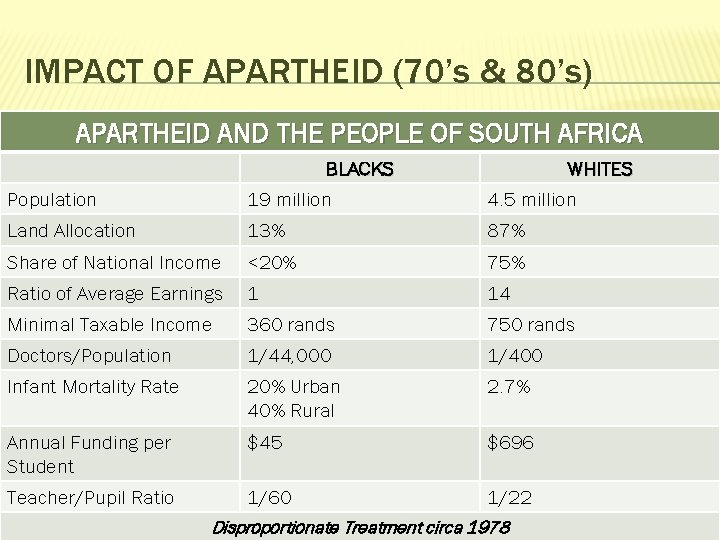
IMPACT OF APARTHEID (70’s & 80’s) APARTHEID AND THE PEOPLE OF SOUTH AFRICA BLACKS WHITES Population 19 million 4. 5 million Land Allocation 13% 87% Share of National Income <20% 75% Ratio of Average Earnings 1 14 Minimal Taxable Income 360 rands 750 rands Doctors/Population 1/44, 000 1/400 Infant Mortality Rate 20% Urban 40% Rural 2. 7% Annual Funding per Student $45 $696 Teacher/Pupil Ratio 1/60 1/22 Disproportionate Treatment circa 1978
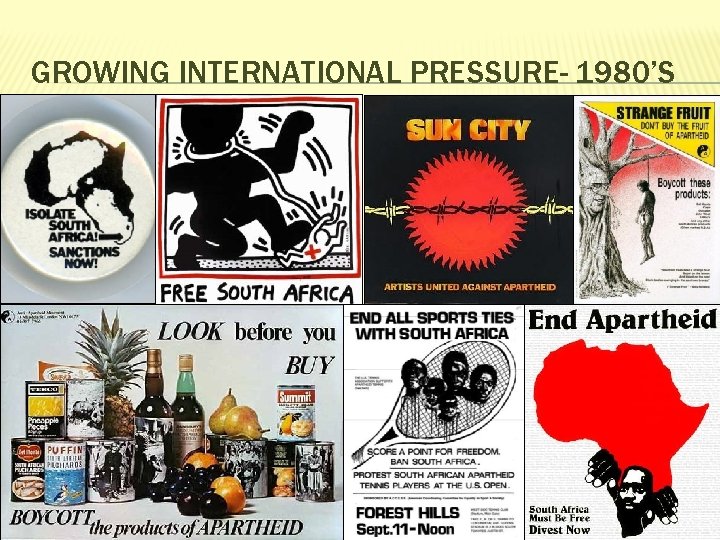
GROWING INTERNATIONAL PRESSURE- 1980’S
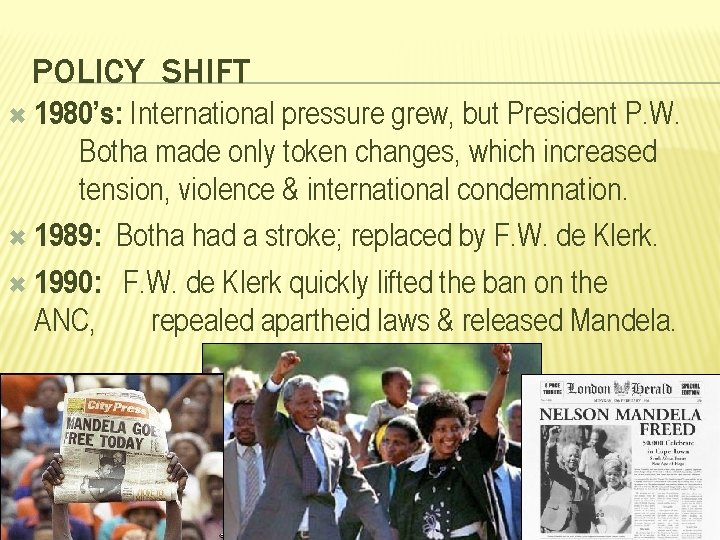
POLICY SHIFT 1980’s: International pressure grew, but President P. W. Botha made only token changes, which increased tension, violence & international condemnation. 1989: Botha had a stroke; replaced by F. W. de Klerk. 1990: F. W. de Klerk quickly lifted the ban on the ANC, repealed apartheid laws & released Mandela.
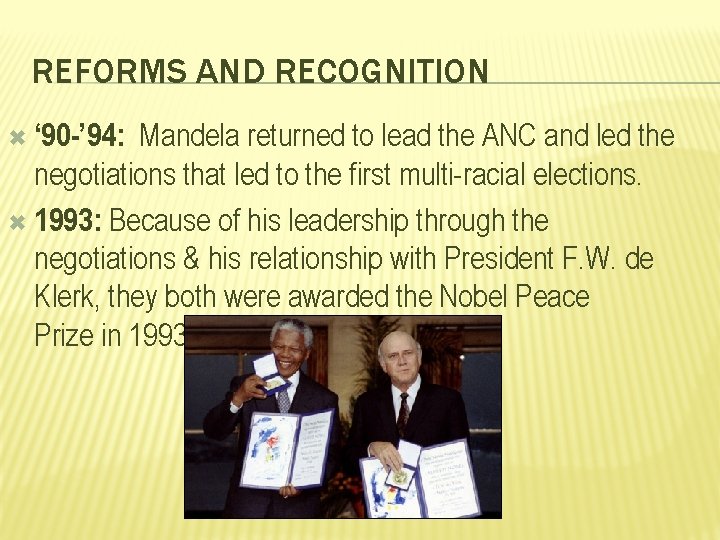
REFORMS AND RECOGNITION ‘ 90 -’ 94: Mandela returned to lead the ANC and led the negotiations that led to the first multi-racial elections. 1993: Because of his leadership through the negotiations & his relationship with President F. W. de Klerk, they both were awarded the Nobel Peace Prize in 1993.
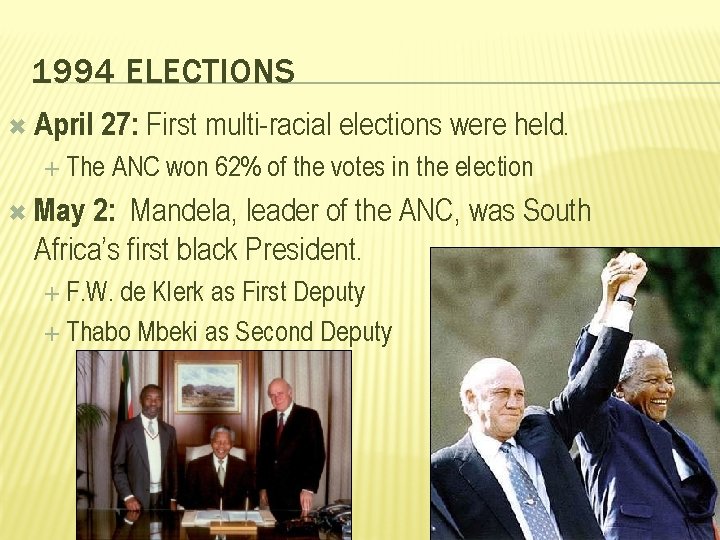
1994 ELECTIONS April 27: First multi-racial elections were held. The ANC won 62% of the votes in the election May 2: Mandela, leader of the ANC, was South Africa’s first black President. F. W. de Klerk as First Deputy Thabo Mbeki as Second Deputy
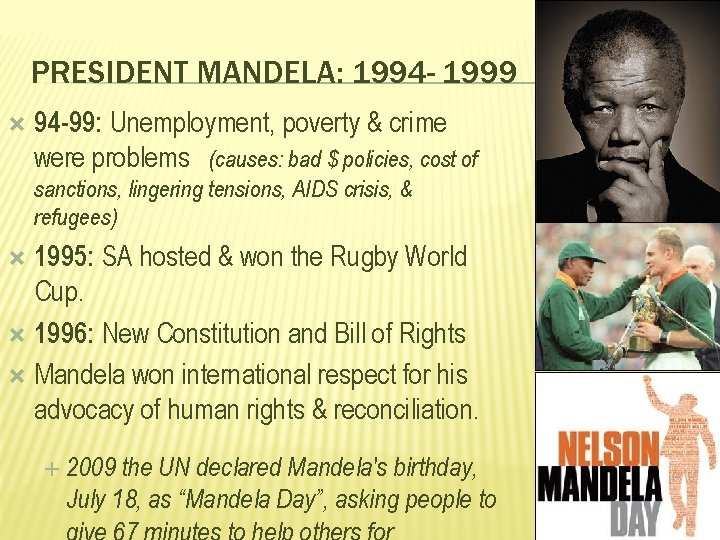
PRESIDENT MANDELA: 1994 - 1999 94 -99: Unemployment, poverty & crime were problems (causes: bad $ policies, cost of sanctions, lingering tensions, AIDS crisis, & refugees) 1995: SA hosted & won the Rugby World Cup. 1996: New Constitution and Bill of Rights Mandela won international respect for his advocacy of human rights & reconciliation. 2009 the UN declared Mandela's birthday, July 18, as “Mandela Day”, asking people to
- Slides: 18