
SOURCES OF SOCIAL POLICY DIRECTIVE PRINCIPLES OF STATES
- Slides: 24
SOURCES OF SOCIAL POLICY
DIRECTIVE PRINCIPLES OF STATES POLICY (DPSP) Enumerated in Part-IV of the Constitution Article 36 -51 Borrowed the idea from Irish Constitution of 1937 These are “Novel features” of the Indian Constitution Soul of the constitution
“Conscience of the constitution” Denotes the ideals that state should keep in mind while formulating the policies and enacting laws Constitutionals instructions and recommendations to state in legislative, executive and administrative matters
DPSP constitutes a very comprehensive economic, social and political programmes for modern democratic state They aim at realising the high ideals of justice, liberty, equality and fraternity They embody the concept of ‘welfare state’ Seek to establish economic and social democracy
They are non-justiciable in nature However, they help the courts to examine and determine the constitutional validity of a law
CLASSIFICATION OF DPSP Socialistic Gandhian Principles Liberal-Intellectual Principles
SOCIALISTIC PRINCIPLES These principles reflects the ideology of socialism They lay down the framework of democratic socialistic state, aim at providing social and economic justice, and the path towards welfare state
To promote the welfare of the people by securing social order permeated by justice-minimize inequalities in income, status, facilities and opportunities (Art. 38) To secure the right to adequate means of livelihood for all citizen (Art. 39) To promote equal justice and to provide free legal aid to the poor (Art. 39 A)
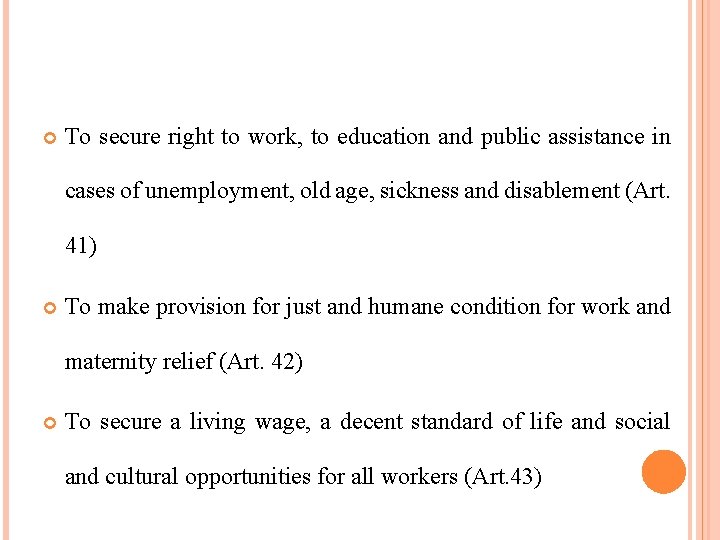
To secure right to work, to education and public assistance in cases of unemployment, old age, sickness and disablement (Art. 41) To make provision for just and humane condition for work and maternity relief (Art. 42) To secure a living wage, a decent standard of life and social and cultural opportunities for all workers (Art. 43)
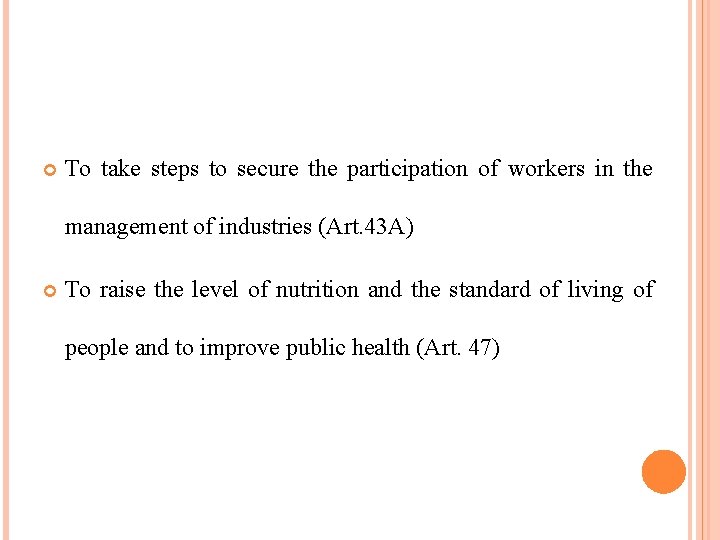
To take steps to secure the participation of workers in the management of industries (Art. 43 A) To raise the level of nutrition and the standard of living of people and to improve public health (Art. 47)
GANDHIAN PRINCIPLES Based on Gandhian ideology Represent the programme of reconstruction enunciated by Gandhi
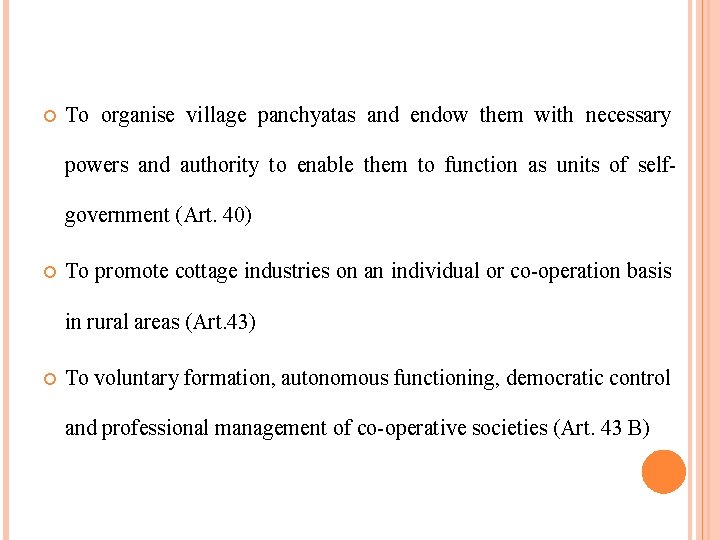
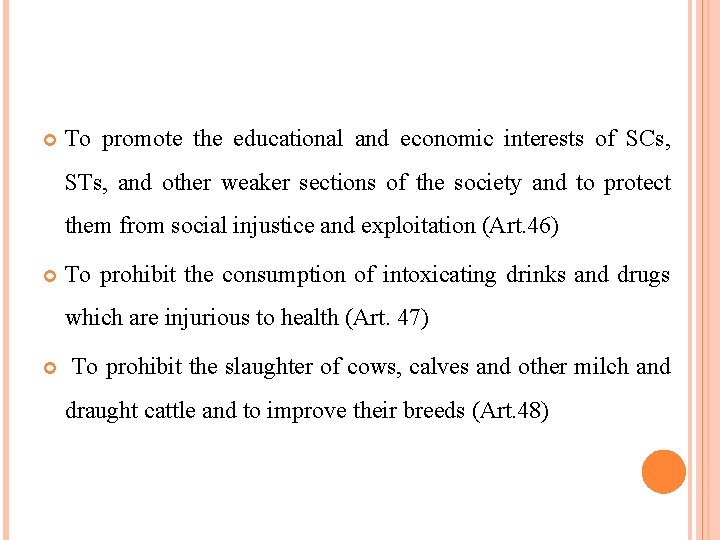
To organise village panchyatas and endow them with necessary powers and authority to enable them to function as units of selfgovernment (Art. 40) To promote cottage industries on an individual or co-operation basis in rural areas (Art. 43) To voluntary formation, autonomous functioning, democratic control and professional management of co-operative societies (Art. 43 B)
To promote the educational and economic interests of SCs, STs, and other weaker sections of the society and to protect them from social injustice and exploitation (Art. 46) To prohibit the consumption of intoxicating drinks and drugs which are injurious to health (Art. 47) To prohibit the slaughter of cows, calves and other milch and draught cattle and to improve their breeds (Art. 48)
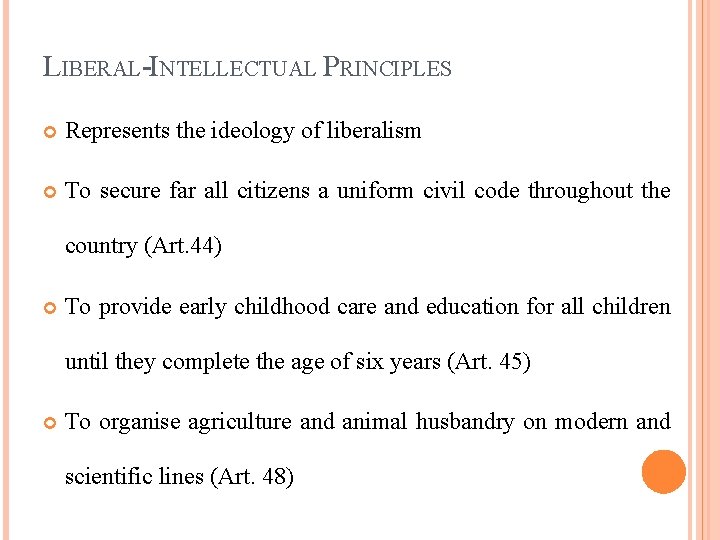
LIBERAL-INTELLECTUAL PRINCIPLES Represents the ideology of liberalism To secure far all citizens a uniform civil code throughout the country (Art. 44) To provide early childhood care and education for all children until they complete the age of six years (Art. 45) To organise agriculture and animal husbandry on modern and scientific lines (Art. 48)
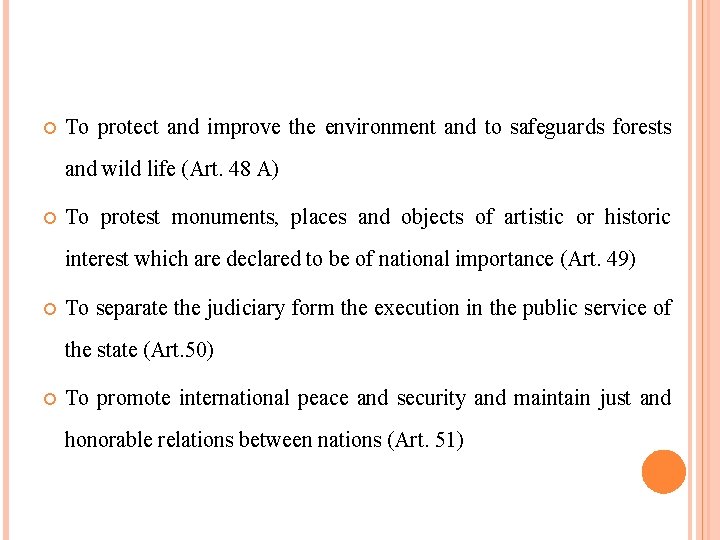
To protect and improve the environment and to safeguards forests and wild life (Art. 48 A) To protest monuments, places and objects of artistic or historic interest which are declared to be of national importance (Art. 49) To separate the judiciary form the execution in the public service of the state (Art. 50) To promote international peace and security and maintain just and honorable relations between nations (Art. 51)
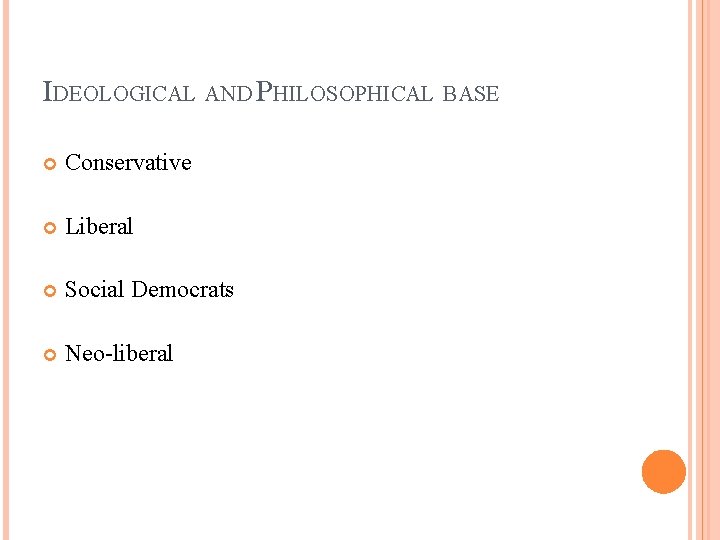
IDEOLOGICAL AND PHILOSOPHICAL BASE Conservative Liberal Social Democrats Neo-liberal
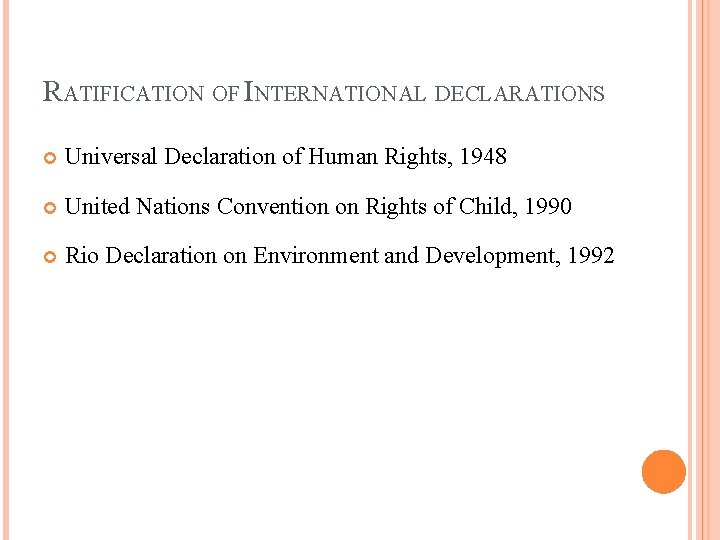
RATIFICATION OF INTERNATIONAL DECLARATIONS Universal Declaration of Human Rights, 1948 United Nations Convention on Rights of Child, 1990 Rio Declaration on Environment and Development, 1992
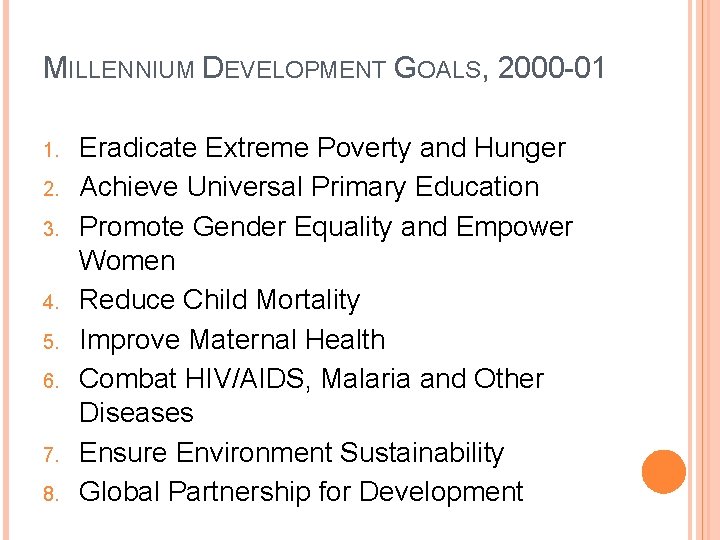
MILLENNIUM DEVELOPMENT GOALS, 2000 -01 1. 2. 3. 4. 5. 6. 7. 8. Eradicate Extreme Poverty and Hunger Achieve Universal Primary Education Promote Gender Equality and Empower Women Reduce Child Mortality Improve Maternal Health Combat HIV/AIDS, Malaria and Other Diseases Ensure Environment Sustainability Global Partnership for Development
GENESIS OF THE POLICY Conflicts about “Choice of society” Contemporary societies are characterised by a plurality of opinions
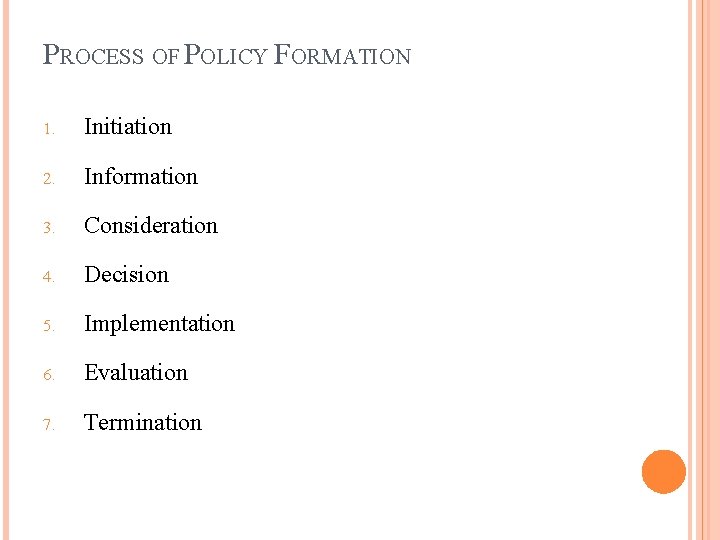
PROCESS OF POLICY FORMATION 1. Initiation 2. Information 3. Consideration 4. Decision 5. Implementation 6. Evaluation 7. Termination
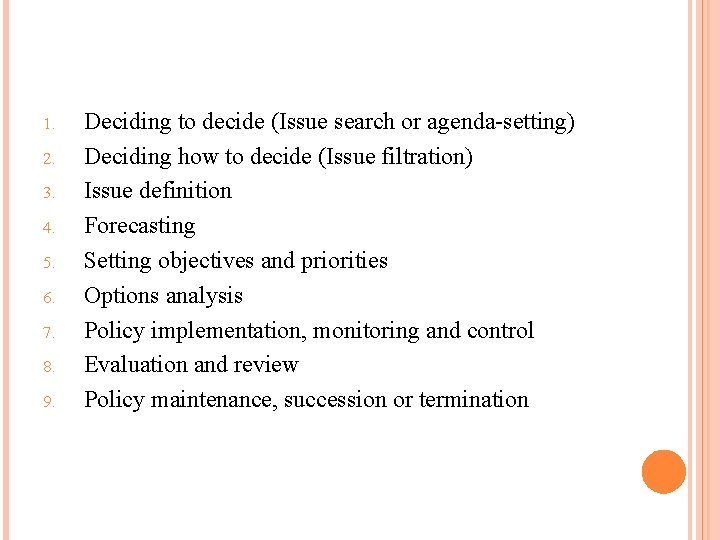
1. 2. 3. 4. 5. 6. 7. 8. 9. Deciding to decide (Issue search or agenda-setting) Deciding how to decide (Issue filtration) Issue definition Forecasting Setting objectives and priorities Options analysis Policy implementation, monitoring and control Evaluation and review Policy maintenance, succession or termination
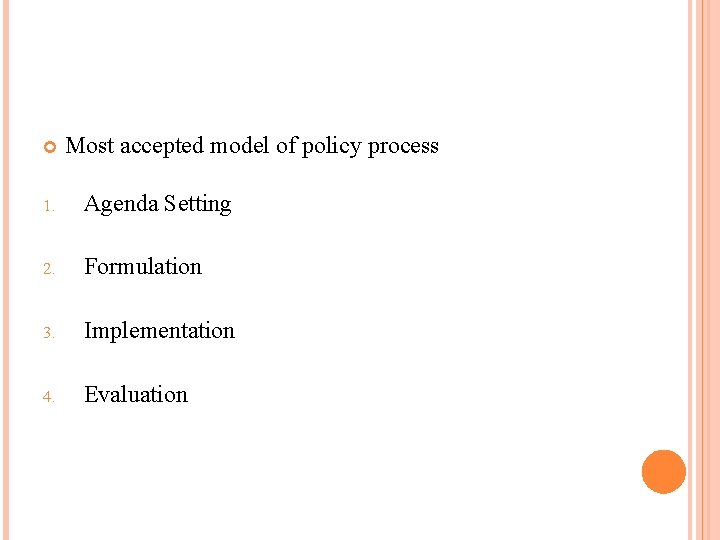
Most accepted model of policy process 1. Agenda Setting 2. Formulation 3. Implementation 4. Evaluation
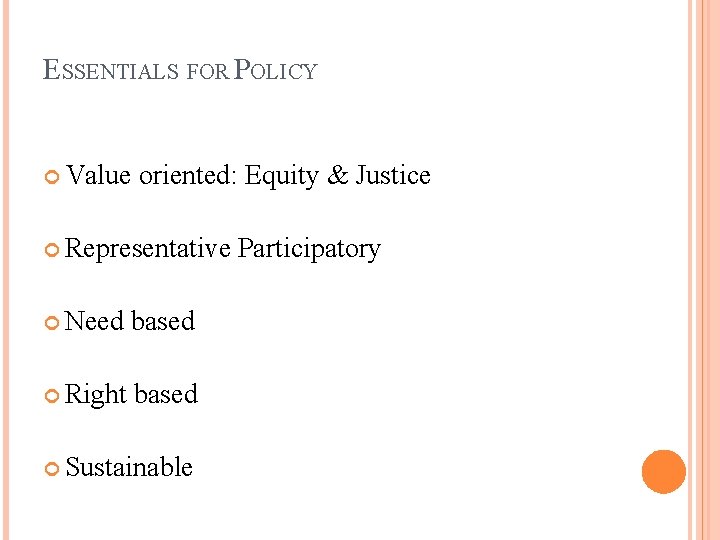
ESSENTIALS FOR POLICY Value oriented: Equity & Justice Representative Need based Right based Sustainable Participatory
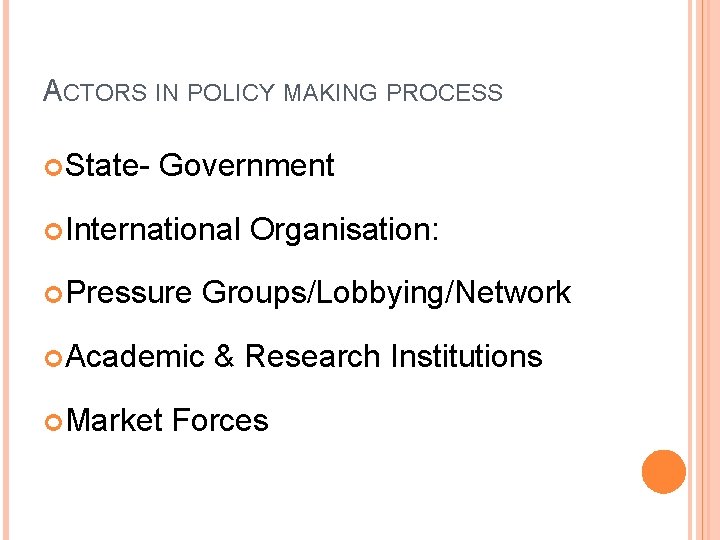
ACTORS IN POLICY MAKING PROCESS State- Government International Pressure Groups/Lobbying/Network Academic Market Organisation: & Research Institutions Forces