
Sources of Radiation Nuclear Fuel Cycle Fuel Fabrication
Sources of Radiation Nuclear Fuel Cycle – Fuel Fabrication IAEA Day 4 – Lecture 7 1
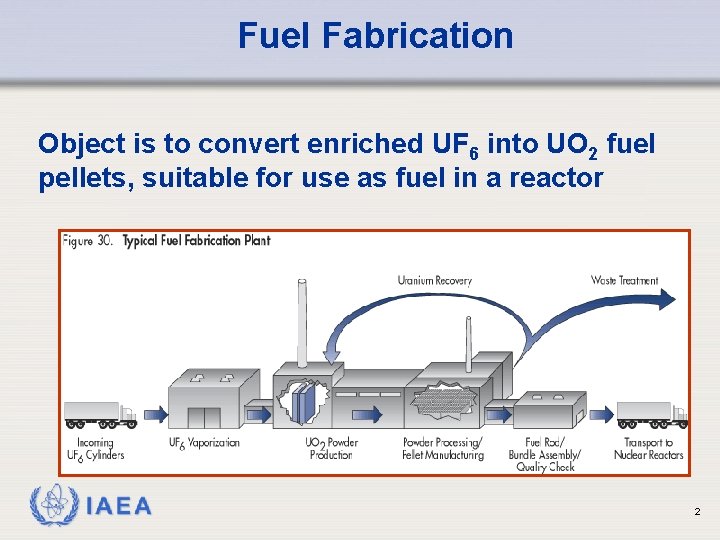
Fuel Fabrication Object is to convert enriched UF 6 into UO 2 fuel pellets, suitable for use as fuel in a reactor IAEA 2
Basic Chemical Approaches Ø “Wet” process chemistry Ø Ø hydrolyze UF 6 in solution precipitate with ammonia compounds calcine/reduce to UO 2 ADU = ammonium diuranate Ø “Dry” process chemistry Ø hydrolyze UF 6 with steam Ø convert to UO 2 with steam/H 2 Ø IDR = Integrated Dry Route (BNFL term) IAEA 3
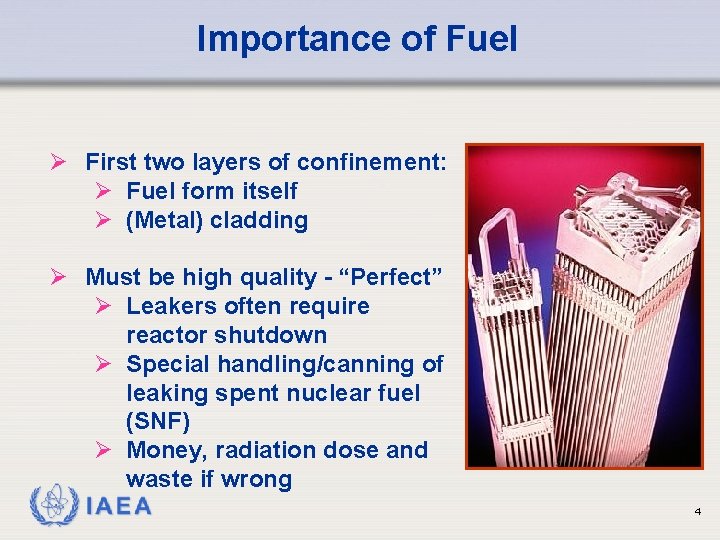
Importance of Fuel Ø First two layers of confinement: Ø Fuel form itself Ø (Metal) cladding Ø Must be high quality - “Perfect” Ø Leakers often require reactor shutdown Ø Special handling/canning of leaking spent nuclear fuel (SNF) Ø Money, radiation dose and waste if wrong IAEA 4
Importance of Fuel Ø Fuel around for “decades” Ø Ø Ø usually 3 cycles (about 5 years) in reactor minimum of 5 years in wet SNF storage minimum of 20 years in dry SNF storage some power reactor fuel 35+ years old Repository - 100+ years Ø Fuel is the “tail that wags the dog” IAEA 5
Fuel Considerations Ø Enriched UF 6 not suitable for fuel Ø Requires chemical conversion to more stable and robust form Ø Requires mechanical activities, cladding, and assembly Ø Fuel requires high density to achieve adequate nucleonics and properties IAEA 6
Chemical Forms of Uranium Fuel Ø UO 2 (a compromise) is used in most power reactors as cylindrical pellets Ø Pebble bed would use coated UO 2 and would probably be a UO 2/UC mix IAEA 7
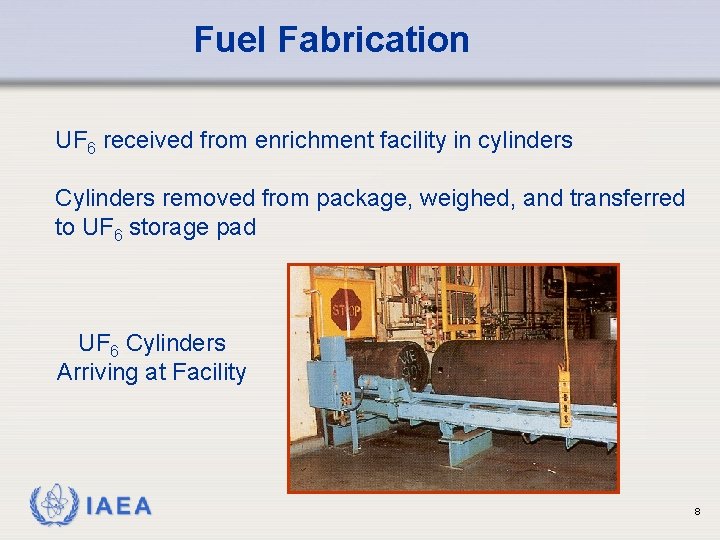
Fuel Fabrication UF 6 received from enrichment facility in cylinders Cylinders removed from package, weighed, and transferred to UF 6 storage pad UF 6 Cylinders Arriving at Facility IAEA 8
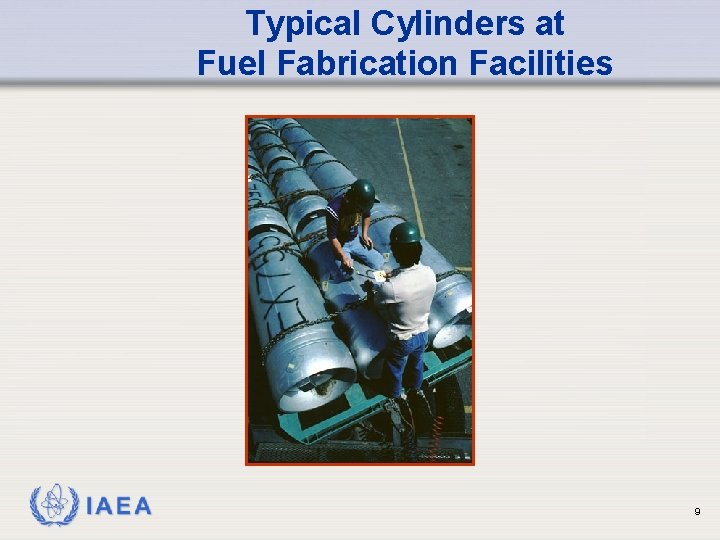
Typical Cylinders at Fuel Fabrication Facilities IAEA 9
Greatest Environmental Hazards in Fuel Fabrication Ø Whether wet or dry … Ø chemical conversion of UF 6 into UO 2 Ø chemical operations in scrap/recovery IAEA 10
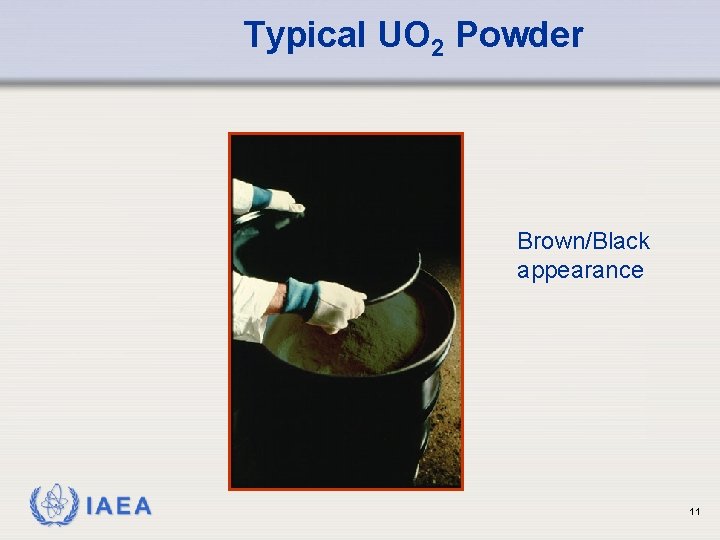
Typical UO 2 Powder Brown/Black appearance IAEA 11
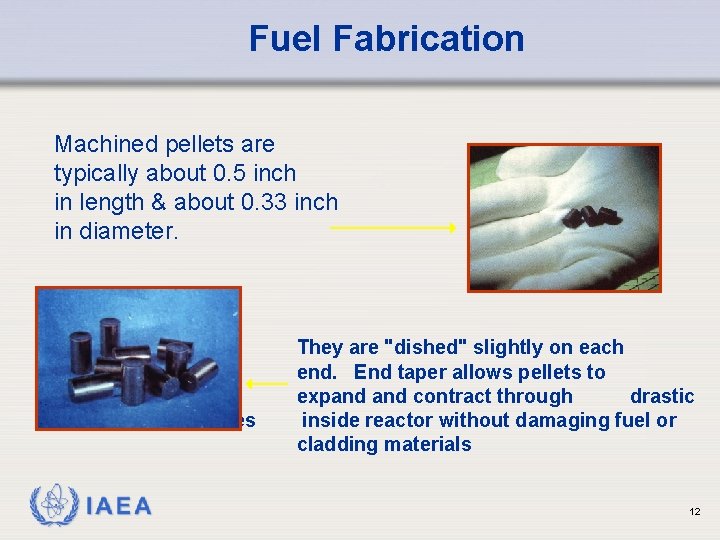
Fuel Fabrication Machined pellets are typically about 0. 5 inch in length & about 0. 33 inch in diameter. temperature changes IAEA They are "dished" slightly on each end. End taper allows pellets to expand contract through drastic inside reactor without damaging fuel or cladding materials 12
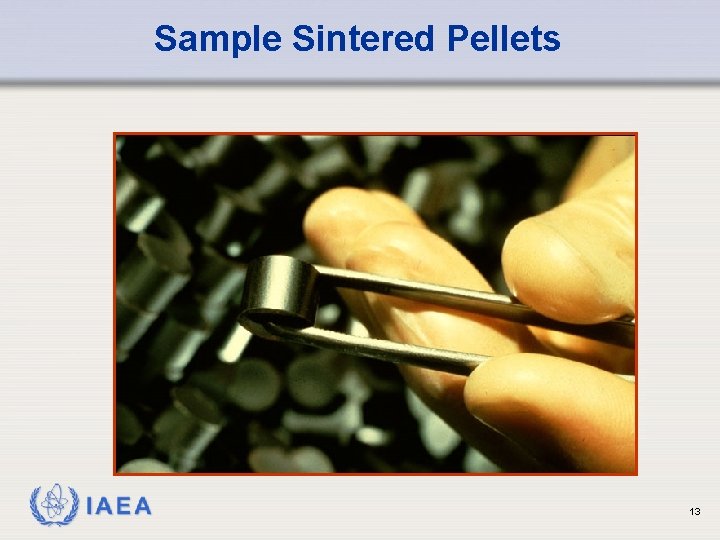
Sample Sintered Pellets IAEA 13
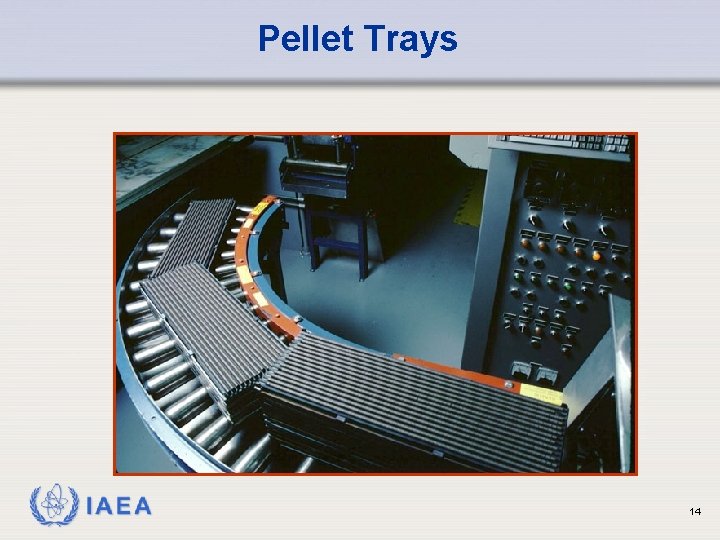
Pellet Trays IAEA 14
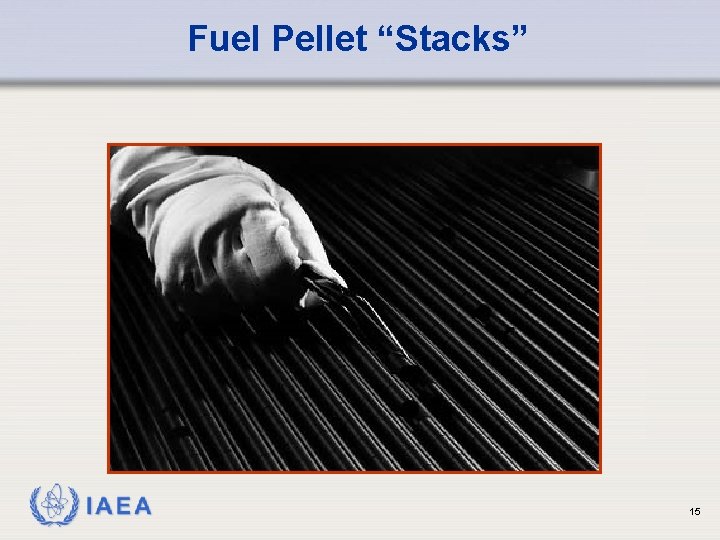
Fuel Pellet “Stacks” IAEA 15
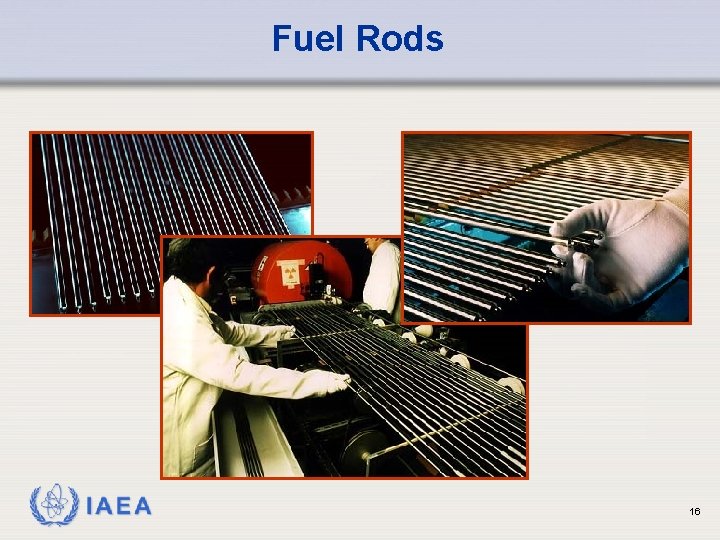
Fuel Rods IAEA 16
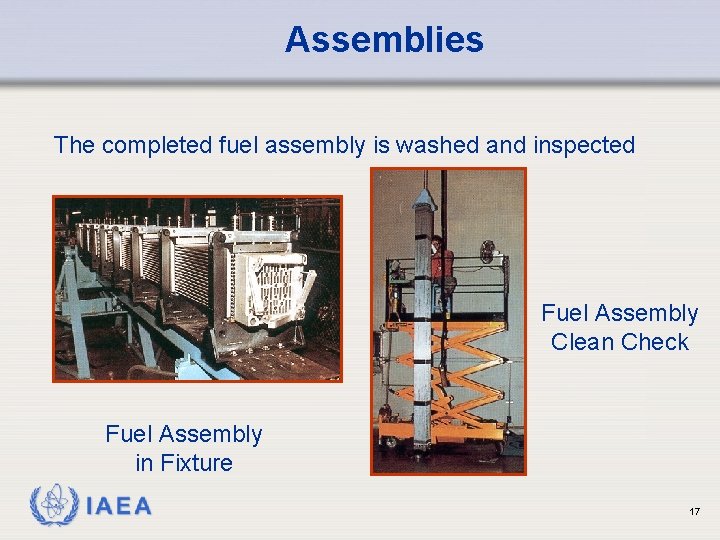
Assemblies The completed fuel assembly is washed and inspected Fuel Assembly Clean Check Fuel Assembly in Fixture IAEA 17
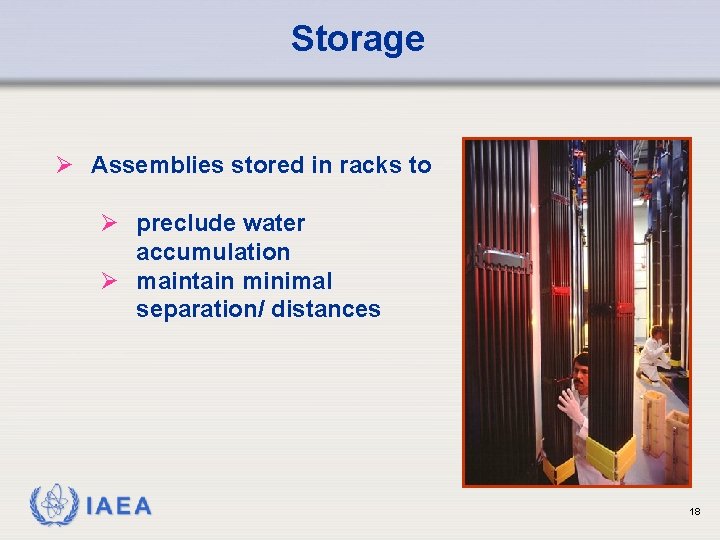
Storage Ø Assemblies stored in racks to Ø preclude water accumulation Ø maintain minimal separation/ distances IAEA 18
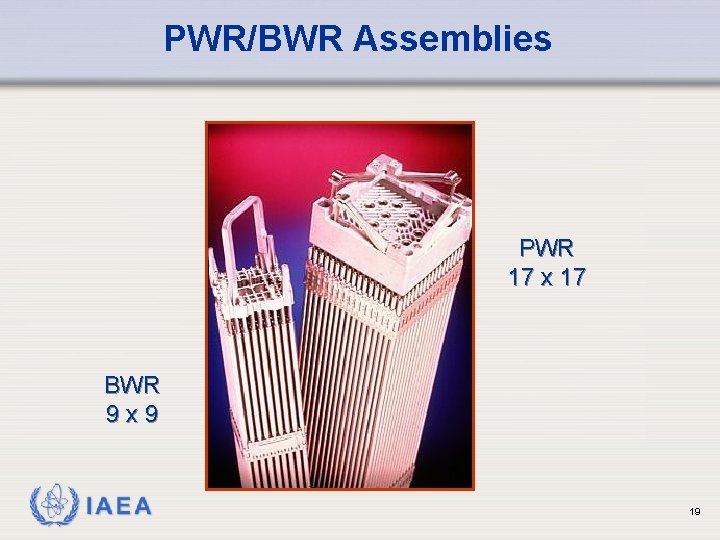
PWR/BWR Assemblies PWR 17 x 17 BWR 9 x 9 IAEA 19
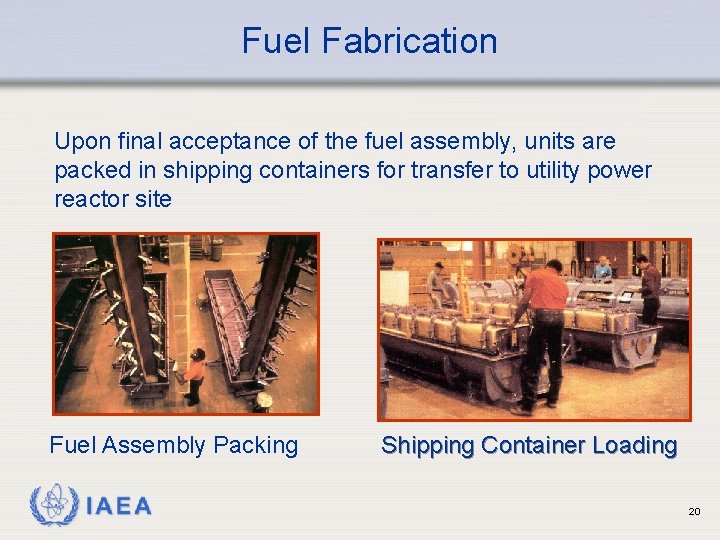
Fuel Fabrication Upon final acceptance of the fuel assembly, units are packed in shipping containers for transfer to utility power reactor site Fuel Assembly Packing IAEA Shipping Container Loading 20
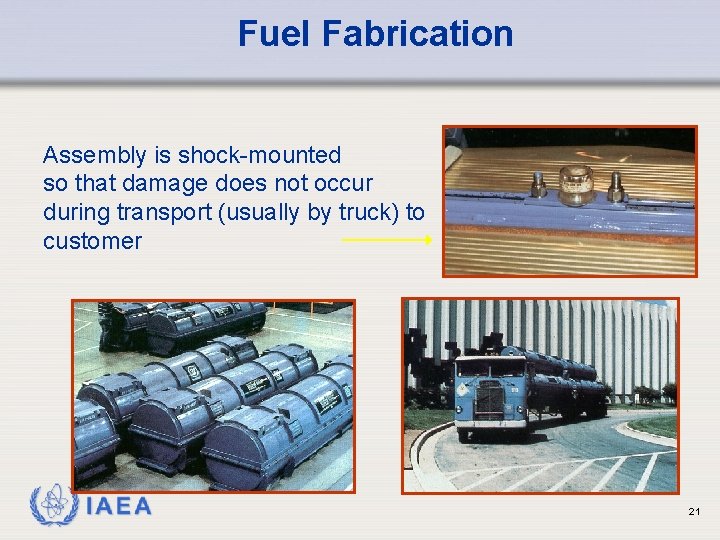
Fuel Fabrication Assembly is shock-mounted so that damage does not occur during transport (usually by truck) to customer IAEA 21
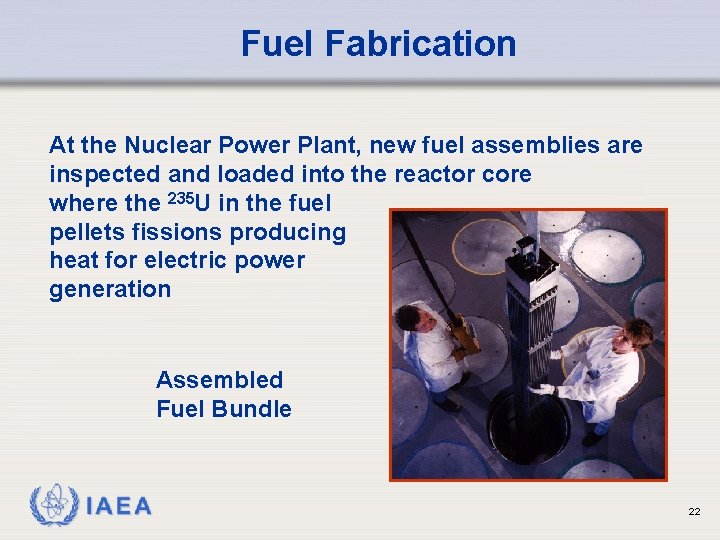
Fuel Fabrication At the Nuclear Power Plant, new fuel assemblies are inspected and loaded into the reactor core where the 235 U in the fuel pellets fissions producing heat for electric power generation Assembled Fuel Bundle IAEA 22
Fuel Fabrication Hazards • UF 6 release • Criticality • Chemicals used in process IAEA 23
Reference Ø International Atomic Energy Agency, Postgraduate Educational Course in Radiation Protection and the Safety of Radiation Sources (PGEC), Training Course Series 18, IAEA, Vienna (2002) IAEA 24
- Slides: 24